Sample Category Title
Forex Technical Analysis: EUR/USD, USD/JPY, GBP/USD
EUR/USD
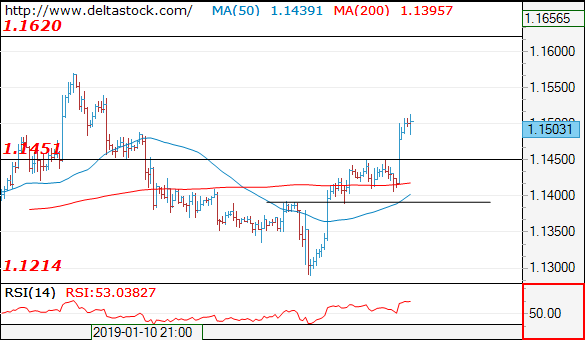
Current level - 1.1503
The dovish Fed tone caused a break through 1.1450 hurdle and the intraday bias is positive above that area. Initial major resistance lies at 1.1570 and crucial on the downside is 1.1405 low.
| Resistance | Support | ||
| intraday | intraweek | intraday | intraweek |
| 1.1570 | 1.1630 | 1.1450 | 1.1214 |
| 1.1630 | 1.1820 | 1.1390 | 1.1100 |
USD/JPY
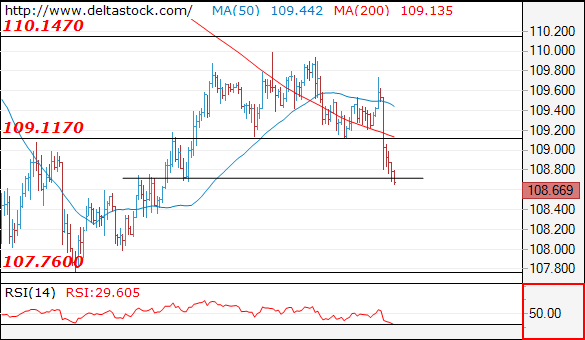
Current level - 108.66
The pair broke through 109.10 support and the outlook is bearish, for a continuation towards 107.70 zone. Initial resistance lies at 109.10.
| Resistance | Support | ||
| intraday | intraweek | intraday | intraweek |
| 109.10 | 111.45 | 108.70 | 106.70 |
| 110.20 | 112.20 | 107.70 | 104.60 |
GBP/USD
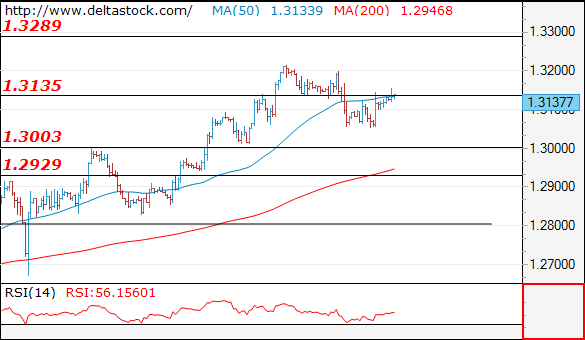
Current level - 1.3137
Despite the neutral intraday bias, I favor a slide towards 1.3000 area. Crucial on the upside is 1.3200 hurdle.
| Resistance | Support | ||
| intraday | intraweek | intraday | intraweek |
| 1.3135 | 1.3290 | 1.3000 | 1.3000 |
| 1.3290 | 1.3480 | 1.2930 | 1.2800 |
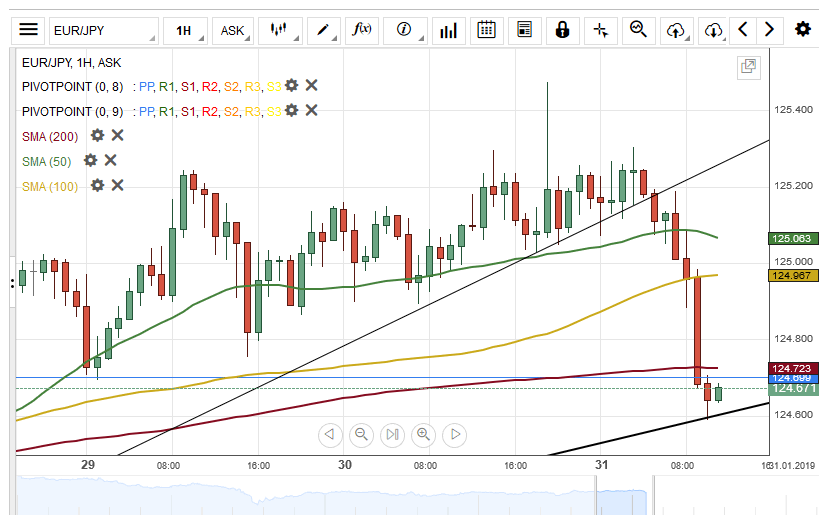
EUR/JPY Breaches Channel Pattern
The Eurozone single currency appreciated against the Japanese Yen on Wednesday. The exchange rate breached January swing high of 125.31 at the end of yesterday's trading session.
However, today's session began with bearish sentiment, and by the middle of the day, the currency pair has breached both the lower boundary of an ascending channel and the 50– and 100-hour SMAs.
The decline of the pair is likely to continue within this session. The downside target for bearish traders will be near a support cluster at 124.74.
Although, technical indicators suggest otherwise. It flashes bullish signals on the 4H time frame.
AUD/USD Moving Towards Monthly R1
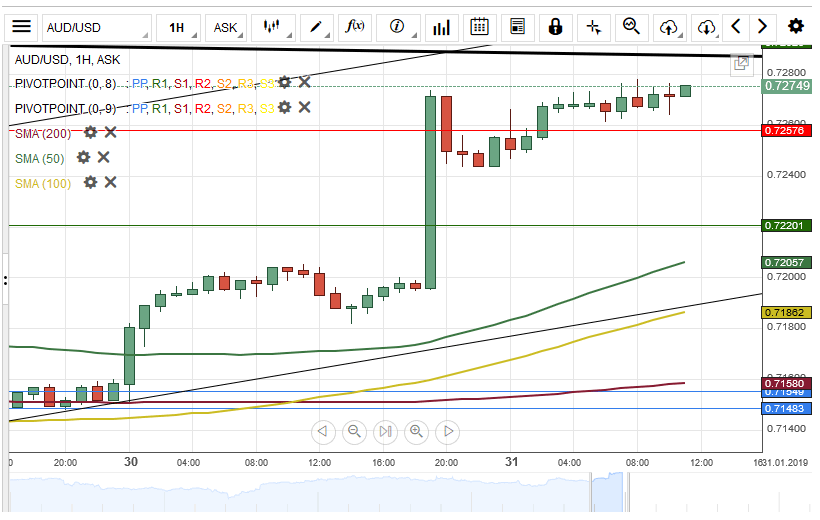
Bullish sentiment dominated the Australian Dollar versus the US Dollar on Wednesday. The currency pair gained about 1.72% of its values during Wednesday's trading session.
The bullish momentum could continue within this session. The upside target for the currency exchange rate will be near the upper boundary of a junior ascending channel pattern at 0.7292.
The AUD/USD exchange rate could make a pullback south from the monthly resistance level at 0.7292 during the following trading session.
In the meantime, technical indicators flash bullish signals on the 4(H) time frame.
USD/CAD Decline Likely To Continue
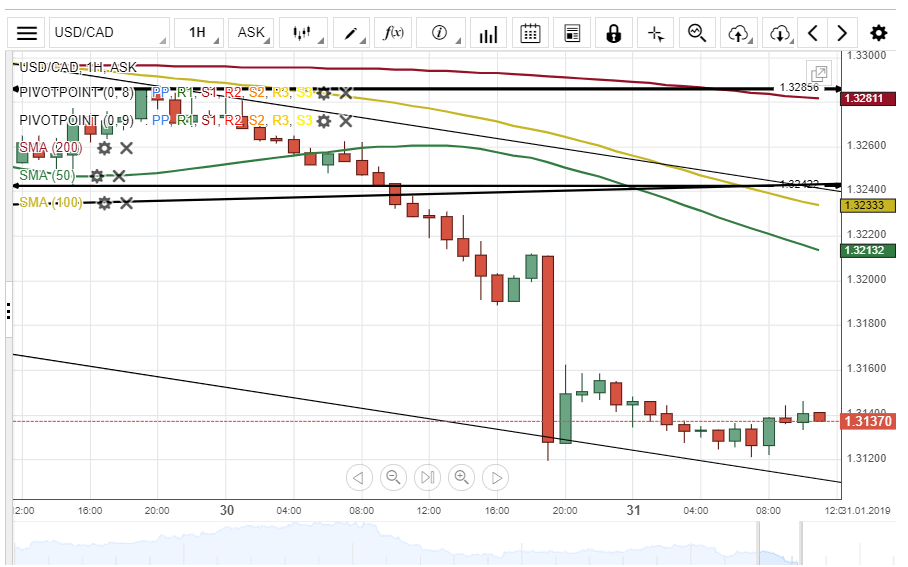
Bearish sentiment dominated the US Dollar on Wednesday. The Greenback depreciated about 162 base points against the Canadian Dollar during Wednesday's trading session.
The exchange rate is currently trading near the bottom border of a descending channel pattern at 1.3125 and could be set for a breakout.
If this breakout occurs, the currency exchange rate will decline towards a psychological support level at 1.3000.
However, if the descending channel pattern holds, bullish traders could aim for a re-test of the 50-hour simple moving average at 1.3220.
NZD/USD Bulls Market
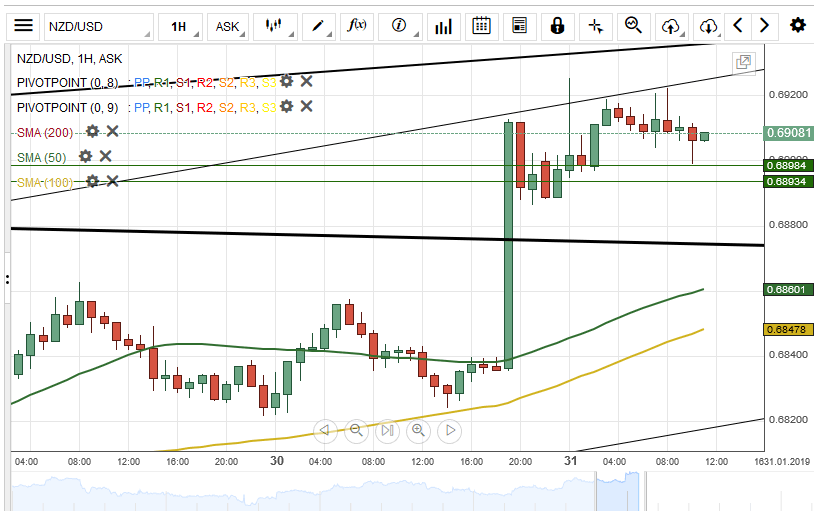
Upside risks prevailed in the market on Wednesday, thus sending the New Zealand Dollar to appreciated about 86 base points against the US Dollar.
The currency pair was trading near the upper boundary of an ascending channel pattern at 0.6920 during the second half of Thursday's trading session and could be set for a breakout.
Bullish traders are likely to push the currency exchange rate towards the weekly R2 at 0.6944 today.
However, it is expected that the pair makes a brief decline towards the 50-hour simple moving average at 0.6858 during the following hours.
Risk Rally Fades Ahead Of More Earnings
Earnings and Fed give markets a bump
Stock markets received a combined earnings and Fed boost on Wednesday but that has already faded ahead of the open this morning, with futures only slightly in the green.
At a time when investors are fretting about the prospects for global growth, there's going to be extra scrutiny on earnings season for any sign that companies are either experiencing or anticipating a slowdown. The start of the reporting season has gone relatively well, which is offering support to the recovery following a horrendous fourth quarter. The Dow is back above 25,000 which is psychologically very encouraging but we're still more than 7% - almost 2,000 points – from the highs so there's still some way to go.
The investor mind-set has very much changed since the Dow and other achieved those record highs but what investors have in their favour now, that they didn't before, is a more supportive and "patient" central bank and the prospect of improved trade prospects between the US and China. These are important tailwinds at a time when the challenges for companies and the economy are stacking up.
The Fed is a very important factor in keeping investors onside. The central bank has quite clearly become more dovish over the last couple of months and on Wednesday vowed to remain patient on interest rate hikes and flexible with the balance sheet. This may have supported stocks but the yield curve has become increasingly inverted as a result. Investors became very concerned about the inversion in the yield curve in early December due to the recession risk that is typically associated with it.
Powell comments weigh on USD and propel gold higher
The dollar also softened considerably as a result of Powell's comments, propelling the euro back above 1.15 in the process. EURUSD has been relatively range bound for the last few months, between 1.13 and 1.15, with both currencies seemingly engaged in a battle to be the weakest. Neither central bank is now expected to be particularly active this year but it seems support for the greenback is dwindling faster.
The weaker dollar is once again providing a bullish case for gold, which is putting pressure on $1,320. This comes only days after it broke through $1,300 following numerous efforts to do so since the start of the year. If $1,320 also falls, then $1,340 becomes the next notable level of resistance, one that may also prove temporary if traders continue to bail on the greenback.
Oil testing major resistance
A weaker dollar and risk rally on Wednesday was supportive for oil, with WTI and Brent making steady gains to test major resistance. A break through $55 in WTI and $65 in Brent would be a very bullish signal for these and could be the catalyst for more significant upside, with oil having stabilised over the last few weeks following the post-Christmas bounce.
WTI Oil Outlook: Fed, China, Venezuela Add To Positive Signals For Bullish Continuation
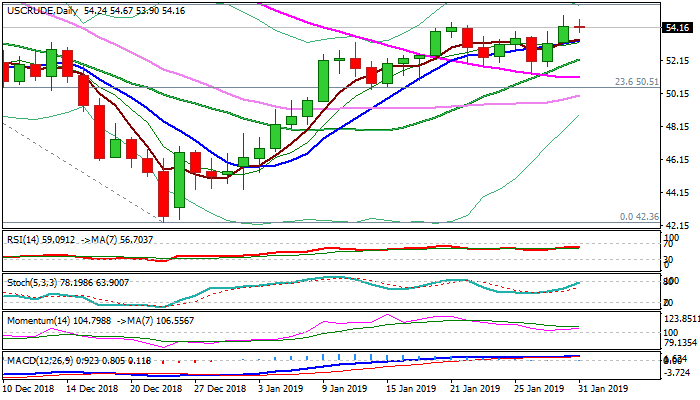
WTI oil consolidates under new nine-week high at $54.91, posted on Wednesday, after oil extended gains on weaker dollar after dovish Fed. Eventual break above recent congestion to ($54.54) was initial signal that consolidative phase is over and bulls look for extension of recovery rally from $42.36 (24 Dec low, the lowest in 2018). Several factors support scenario, soft tone from Fed that could keep the greenback under pressure, better than expected data from China, which revive hopes for steady demand, political turmoil in Venezuela that threats supply disruption and lower than expected rise of US crude inventories. Bulls need close above cracked former high at $54.48 (21 Jan) and extension through pivot at $55.55 (Fibo 38.2% of $76.88/$42.36) to generate stronger signal for continuation. Broken ascending 10SMA ($53.38) offers solid support which should ideally contain and keep bullish bias intact. Ascending 20SMA marks pivotal support at $52.21, violation of which would soften near-term tone and sideline bulls.
Res: 54.67, 54.91, 55.55, 56.00
Sup: 53.90, 53.38, 52.65, 52.21
Weaker Dollar Ahead, Optimism On US-China Talks Boost Yuan
Given yesterday's decision of the US Federal Reserve not to raise interest rates, US dollar weakness for 2019 is on track. The Fed decelerated monetary policy and its tightening path, and it gave a very strong signal that interest rate cycle is finished. Fed Chairman Jay Powell shifted course, becoming dovish on policy rates and flexible on balance sheet reduction. Given the resilience of the US economy, the Fed has surrendered to market volatility. The Fed only slightly downgraded its growth outlook, stating that the economy is expanding at a “solid” pace versus “strong.” What is it with central banks and market volatility? Markets matter, and they directly influence central banks, even the detached Fed.
Risky assets rallied across the board, while the greenback fell. A March interest hike is completely off the table, and one in June is unlikely. A September hike is expected by only the thinnest of probabilities, then nothing in 2020. This sets a final target of 2.50-2.75% for this tightening cycle. We expected the Fed's balance sheet to normalize around $2.0-2.5 trillion, which implies excessive reserves of approximately $2 trillion. Managed reduction of the balance sheet should help cool US inflation while not affecting risk appetite.
Optimism on US-China talks boost yuan
USD/CNY dropped 2.20% since the beginning of the year on US-China trade optimism, USD softness and China's manufacturing rebound. However, the USD/CNY could rapidly turn north, as a trade deal with the US, China's by far largest trade partner, would significantly reduce its trade surplus. USD/CNY is currently trading at 6.71, approaching 6.70 short-term.
A Chinese delegation led by Vice Premier Liu He and US trade representative Robert Lighthizer are looking for a trade resolution in a record period. Time is running short, as there are only 28 days to go before the implementation of customs tariffs, while issues of market access, intellectual property and China-owned companies' subsidies remain unsolved. Markets' hopes are rising with the recent arrival of People's Bank of China Governor Yi Gang, who oversees financial institutions, which implies that talks are becoming more concrete on China's financial market liberalization. A recent approval made by Chinese authorities to grant access to US company Standard & Poor's rating agency to assess China's bond market, the first authorized foreign credit agency to operate in the country, is a leap forward. Trade talks are focusing on China's structural reforms and a timeline, a “soft resolution”, rather than a quick solution.
Eurozone GDP grew 0.2% qoq in Q4, Italy contracted -0.2% qoq
Eurozone (EA19) GDP growth came in at to 0.2% qoq in Q4, matched expectations. it's also the same rate as in Q3. That's also the lowest rate in four years since Q2 of 2014. Annual rate slowed to 1.2% yoy, down from Q3's 1.6% yoy. The year-on-year rate is a five year low.
European Union (EU28) GDP growth came in at 0.3% qoq. Annual rate slowed to 1.5% yoy, down from 1.8% yoy.
Also released, Italy GDP contracted -0.2% qoq in Q4, worse than expectation of -0.1% qoq. Italian was in technical recession with two consecutive quarters of contraction.
AUD/USD Outlook: Bulls Look For Test Of 200SMA
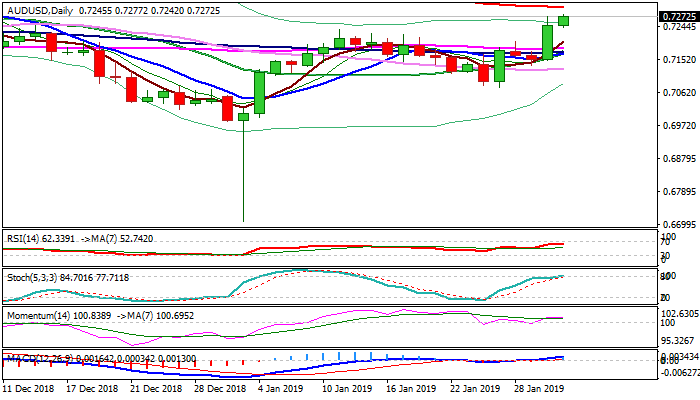
The Aussie hit new eight-week high on Thursday, in extension of previous day's 1.3% rally, sparked dovish Fed that pushed the US dollar lower across the board. Better than expected China's PMI data today (Jan Manufacturing PMI 49.5 vs 49.3 f/c / Non-Manufacturing Jan 54.7 vs 53.9 f/c) added to positive tone. Bullish daily techs underpin for final push towards strong barrier at 0.7296 (200SMA), where bulls may run out of steam as slow stochastic is breaking into overbought territory. Broken Fibo barrier at 0.7231 (76.4% of 0.7393/0.6706) marks initial support which guards more significant daily cloud top (0.7205) where extended corrective dips should find ground to keep bulls in play.
Res: 0.7277, 0.7296, 0.7355, 0.7393
Sup: 0.7242, 0.7231, 0.7205, 0.7176