

Sample Category Title
Markets Hit Like Button
January was a month to celebrate
Facebook and General Electric are not names that bought a smile to investors faces in 2018. Both heavyweights found themselves unfriended and blocked last year but that all changed last night. Both recorded sparkling results and 10.0% plus rallies which saw them back in from the cold with so many new followers, they could have been accorded “influencer” status. It helped lift the S&P in the overnight session and making January a month to celebrate for investors.
The U.S.-China trade talks made “substantial progress” according to U.S Trade Rep. Lighthizer. No deal as yet but President Trump will travel to China to meet President Xi in February. For the markets, which are clearly in “risk-on” mood, it was a case of no news is good news.
Stocks markets, EM and bonds continue to bask in the warm Fed. afterglow as do precious metals on a lower US dollar.
All eyes now turn to the US Non-farm payrolls number this evening with the street predicting 165,000 jobs added. The fact that the Non-farms has not been mentioned at all among commentators this week until overnight says to me that we have negotiated most of the event risk for now and the Non-farms effect on the market will be short-term.
In Asia today the data calendar is very light. What will be closely watched is the India Budget, especially significant ahead of mid-year elections. I won’t even begin to try and disseminate its nuances, as with all things India, that is better left to the experts. Suffice to say surprises within have the potential to cause volatility in India and spill over into regional EM to some degree.
FX
EM and G10 currencies continued to consolidate gains against the US dollar overnight in an otherwise sideways session. With the Lunar New Year starting Monday in Asia, I would expect the region to ease into the week’s end, rather than go out with a bang.
Stocks
We would expect Asian bourses to be in the green today now that most of the event risk of the week has passed and following the US indices strong overnight showing.
Gold
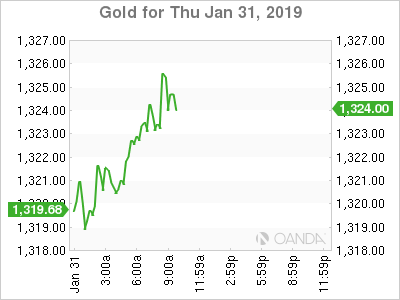
It is consolidating its gains overnight with stiff technical resistance in the 1350.00 to 1355.00 region. With most of Asia out next week for Lunar New Year, dips in gold should be well supported as local investors do some risk hedging.
Oil
WTI continues testing the 54.00 resistance with price action constructive. The freezing weather and Venezuela disruptions perhaps driving it. Brent, however, is mid-range between 60.00 and 63.00 and looks like staying there implying its WTI cousin’s bullish tone may be temporary.
Eco Data 2/1/19
[php_everywhere instance="1"]
BTCUSD Seems Neutral to Negative; Ichimoku Confirms Bearish View
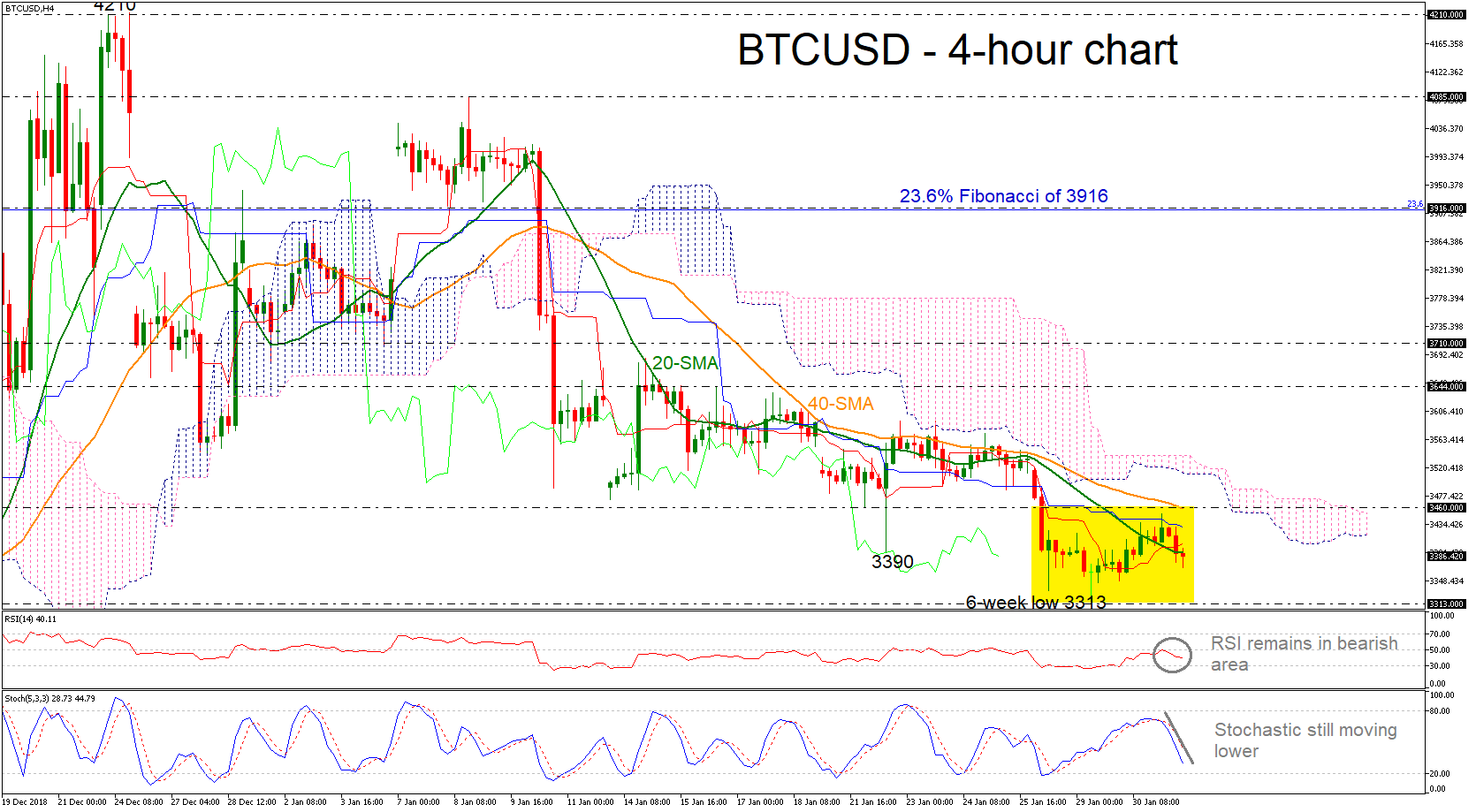
BTCUSD holds slightly below the 20-and 40- simple moving averages (SMAs) in the 4-hour chart as well as below the Tenkan- and Kijun- sen lines, suggesting further negative pressures. The RSI indicator is flattening in the negative zone, while the stochastic oscillator is approaching the oversold zone with strong momentum.
Should the price stretch south, immediate support is coming from the six-week low of 3390 barrier, taken from the bottom on Tuesday. A step lower could bring the bearish sentiment back into play, hitting the 3116.50 hurdle, taken from the bottom on December 14. More losses could send price to post another lower low confirming the strong bearish sentiment.
Should the price extend higher, it could find resistance at the 3460 level, which currently coincides with the 40-SMA. Also, an advance above this region would increase speculation that a bullish move is in progress towards the 3644 hurdle and further up, the 3710 area would be the next level for investors to focus on, registered on January 16.
To sum up, the very short-term bias remains neutral especially as BTCUSD lies between the 3313 and 3460 levels over the last three days.
Sunset Market Commentary
Markets:
Global core bonds cautiously continue the upward trend of yesterday after the Fed’s U-turn. German Bunds initially followed US Treasuries in a rally higher after the Fed cleared interest-rate hikes probably at least until the Summer while also leaving the option for a slowdown of the balance run-off open. The German Bund opened little higher but investors awaited an avalanche of EU economic data. Germany kicked off with the fastest growth slowdown in retail sales in 11 years in December, while French consumer inflation decreased for a third month in a row. Italy officially entered a technical recession as growth in the 4th quarter printed negative for a second consecutive quarter. Disappointing EMU data and EU equities that gave up early gains and continued to move lower, usually support German Bunds. However, the Bund only moved higher in the run-up to US openings to pair its intraday losses. The German yield curve moves lower with changes varying between -0.1 bp (2-yr) to -2.6 bps (10-yr).US Treasuries initially took a breather today after jumping higher on the Fed’s dovish pivot. Mixed Q4 earnings and weaker than expected jobless claims/Chicago PMI had little impact. UST’s moved higher as US investors joined discussions. The US yield curve edged lower with changes up to -2.5 bps (10-yr). Peripheral spreads vs German 10-yr yield remain more or less stable with Italy underperforming (+3 bps).
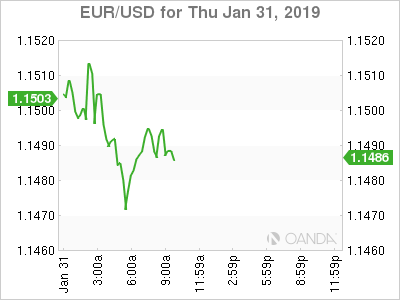
The post-Fed USD sell-off slowed today. EUR/USD tried to regain/stay north of the 1.15 big figure this morning, but the move wasn’t convincing at all. European investors were not impressed by the potential positive effects of the new ‘Fed-put option’. European equities showed a lackluster performance and finally slipped back into negative territory. Poor EMU eco data also capped further EUR/USD gains. The dollar probably won’t get any additional interest rate support from the Fed anytime soon. However, the prospect for the relative monetary policy cycle to move in favour of the single currency isn’t obvious neither. US eco data (including jobless claims and Chicago PMI) also disappointed, but with little impact on the dollar. EUR/USD hovers in a tight range close to/slightly below 1.15. USD/JPY (108.55 area) is drifting further south as risk sentiment deteriorated through the day and as US and European yields declined slightly further.
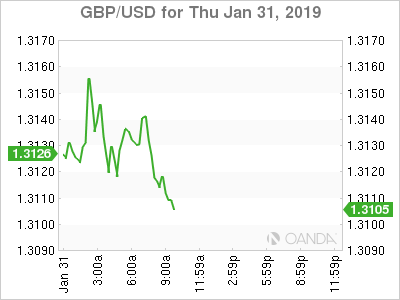
EUR/GBP is holding near this week’s top. Sterling was hammered on Tuesday as UK MP’s instructed PM May to return to Brussels to try to renegotiate the Brexit arrangement regarding the Irish border backstop. This opened a new period of uncertainty on how the separation between the UK and the EU will be solved. This uncertainty will likely continue up until February 14, when a next Brexit vote is scheduled in the House of Commons. A Brexit deal or a delay is still possible, but political visibility remains low. Investors show little appetite to place additional bets on an orderly outcome of the process. Sterling stays in the defensive. EUR/GBP is trading in the 0.8750 area. Cable yesterday rebounded from the mid 1.30 area to the 1.31+ area, but this is USD weakness in the wake of Fed communication.
News Headlines:
More preliminary EMU GDP data confirmed the bloc’s waning economic momentum stretching into 2018Q4. While Spanish growth printed strongly (0.7% QoQ, 2.4% YoY), Italy posted slightly weaker data than expected (-0.2% QoQ, 0.1% YoY), thereby officially entering a recession. Euro zone GDP growth was limited to 0.2% QoQ (1.2% YoY).
One month after launching a cartel probe of euro-bond trading, the EU officially raised antitrust objections over a suspected “collusive scheme that aimed at distorting competition”. Government bond traders of the 8 yet unidentified banks under scrutiny are said to have “exchanged sensitive information and coordinated on strategies”. The transactions under investigation date back to 2007-2012.
Stock Gains Ease Up as Dollar Steadies Following Yesterday’s Dovish Fed
Global equities seesawed overnight as momentum from the dovish Fed meeting faded, another round earnings focused on global growth concerns, and expectations are low to see a significant progress with trade talks today. President Trump will meet with Vice Premier Liu He, the most important meeting since the December 1st meeting with President Xi, which saw the announcement of the 90-day trade truce. Risk appetite’s next move will likely be dictated by corporate earnings today and whether we see confirmation that talks will continue between China and US.
USD
The Fed’s dovish message was loud and clear to dollar traders. The Fed removed the reference for further gradual rate increases and placed the word patient in their policy statement. The greenback could see further weakness as key technical levels are teetering on another breakout. The dovishness is likely to remain firmly in place until we start to see cross currents ease. Rate hike expectations for the remainder of the year have completely disappeared, with the market pricing in a greater chance of a cut as the next move.
AUD
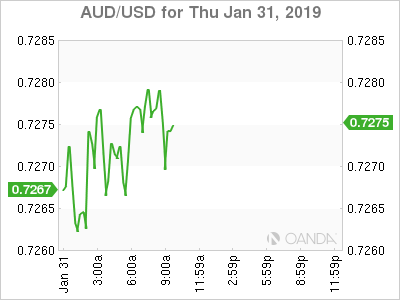
Chinese Vice Premier Liu He, the top economic advisor for President Xi will meet with President Trump this afternoon, with low expectations of seeing any major progress expected on key issues regarding intellectual property theft, forced technology transfers, and market access. Early this morning, President Trump tweeted “No final deal will be made until my friend President Xi, and I, meet in the near future to discuss and agree on some of the long standing and more difficult points.”
GBP
The EU resumes the game of chicken with UK, as they offer no signs of giving any concessions over the next few weeks. PM May is still planning on going to Brussels to make her case, but the EU appears set on not offering her anything until after the UK has another vote on February 14th. The EU is tentatively saying that they will meet with at the next scheduled summit which is on March 21-22, only a week before Brexit day. While the risk of a no-deal hard Brexit has gone up, cable appears unfazed for now.
INDIA
While many emerging market currencies have rallied in January, the rupee is the worst performer in Asia as fiscal concerns will be tested when Indian Prime Minister Narendra Modi announces his budget. This is a make or break moment for Modi ahead of the national vote in May. With inflation already near 18-month lows, pressure may grow for the RBI to lower rates.
OIL
It seems all the headlines of late our positive for crude prices. Oil is stronger after the Fed’s dovish pivot crushed the dollar, helping commodity prices, OPEC + production cuts are kicking in, sanctions against Venezuelan’s state-owned oil company PDVSA were announced, and Saudi Arabia has cut exports to the US, dropping them to the lowest since October 2017. The recent rally for West Texas Intermediate crude continues to respect the $55 level, and if we don’t see that breached soon, we could see a big round of profit taking.
Earnings
Today will be the busiest day of this earnings season. GE delivered mixed results that were accompanied with news they reached a settlement of $1.5 billion with the Department of Justice on their old subprime mortgage business. Looking at the tech sector, shares of Facebook soared on better than expected earnings, while Microsoft shares dropped as concerns grow for the cloud business. Intel also fell after a 6-month search process for a new CEO, ended with them naming interim CEO Bob Swan as the permanent solution.
Gold
Gold’s momentum got another boost yesterday from the Fed’s dovish pivot on rates. The precious metal is poised for its fourth consecutive monthly gain as the fundamentals remain strong for it to climb higher. Gold has rallied in January on nervousness that trade talks between the US and China may not yield significant progress before March 1st deadline, slower global growth concerns, and expectations that the Fed’s next move will be a cut. While the recent rally is ripe for some profit taking, the yellow metal might not find significant resistance until the $1,370 area.
Canada’s Economy Softens in November as Oil Sector Woes Worsen
Canadian economic activity contracted by 0.1% month-on-month in November. In all, 13 of 20 major industries expanded on the month, but this growth was overwhelmed by declines in wholesale trade, manufacturing, and construction.
Services industries as a whole were flat on the month, as advances in administration (+0.9%), arts and entertainment (+0.9%), and accommodation and food services (+0.6%) were offset by declines in wholesale trade (-1.1%), finance and insurance (-0.7%), transportation (-0.5%), and retail trade (-0.3%).
Weaker bond and equity market activity contributed to the decline in financial services sector. Meanwhile, a 4.5% decline in output of postal and courier services related to the Canada Post strike resulted in the second consecutive monthly decline in transportation services. Weakness in the retail trade sector was due to lower motor vehicle sales and building materials suppliers (six consecutive months of decline), trouncing any boost from Black Friday/Cyber Monday electronics sales. Statistics Canada also noted that retail trade data in this release excluded activity of cannabis retailers.
After rising 0.3% in October, goods producing industries fell back into contraction (-0.3%) in November, the third in the past four months. Leading the way lower was a 0.5% drop in manufacturing activity, as petroleum and coal products manufacturing (-2.2%) contributed most to the decline. This was due to a combination of refinery maintenance, turnaround work, and lower production. In addition to refinery woes, mining, oil and gas extraction contracted 0.1% in the month. Mining excluding oil and gas extraction expanded 2.3%, partially offsetting October's decline. However, oil and gas extraction declined 1.6%, reflecting a drop in both commodities. Statistics Canada noted that a storm off Canada's East Coast affected offshore drilling activities for conventional oil and gas. Non-conventional oil extraction contracted 0.9% in the month.
Key Implications
As expected, oil sector woes weighed on the monthly GDP print, as November saw worsening discounts on Canadian oil blends and voluntary production curtailments. Looking ahead, we anticipate further weakness in the oil sector to continue to weigh on overall growth as mandatory production cuts take effect in January. Indeed, declines in the oil patch are expected to subtract a full percentage point drag on 19Q1 growth. That said, yesterday's announcement by the Alberta government to boost oil production in the province by an additional 75k barrels in February could reduce the overall drag from the sector on GDP. This is expected to boost overall production to 3.63 million barrels per day in February.
With today's data, we are now tracking Q4 growth at just 1.0% (q/q saar), below the Bank of Canada's October forecast of 1.3%.
The temporary slump in the oil sector, combined with elevated global economic uncertainty warrants patience on behalf of the Bank of Canada. There is little urgency to hike, especially given an expectation that inflation will remain well contained near target. We look to Senior Deputy Governor Carolyn Wilkins speech later today for hints on how patient the Bank is prepared to be.
EUR/USD Mid-Day Outlook
Daily Pivots: (S1) 1.1424; (P) 1.1463; (R1) 1.1519; More.....
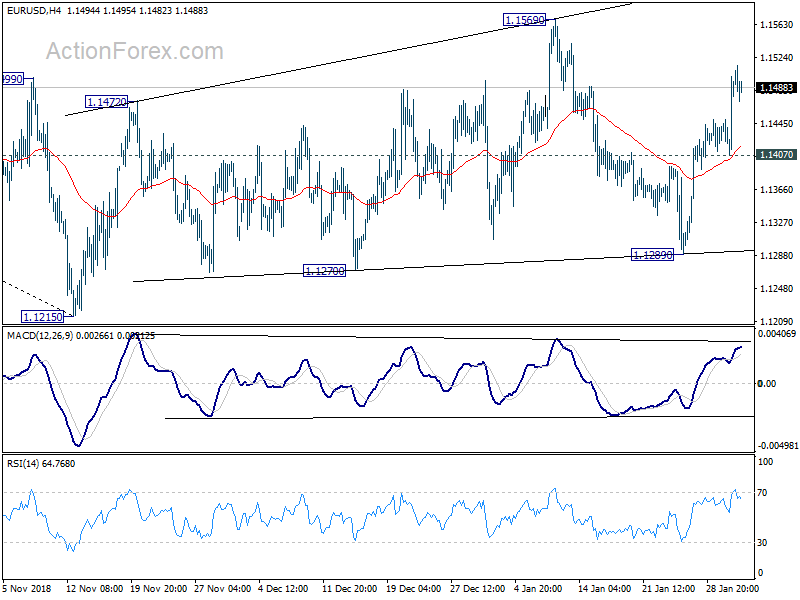
Intraday bias in EUR/USD remains on the upside for the moment. Current rise from 1.1289 is seen as another rising leg in the correction pattern from 1.1215. Further rally would be see to 1.1569 resistance and above. On the downside, break of 1.1407 minor support will turn bias back to the downside for 1.1289 support instead.
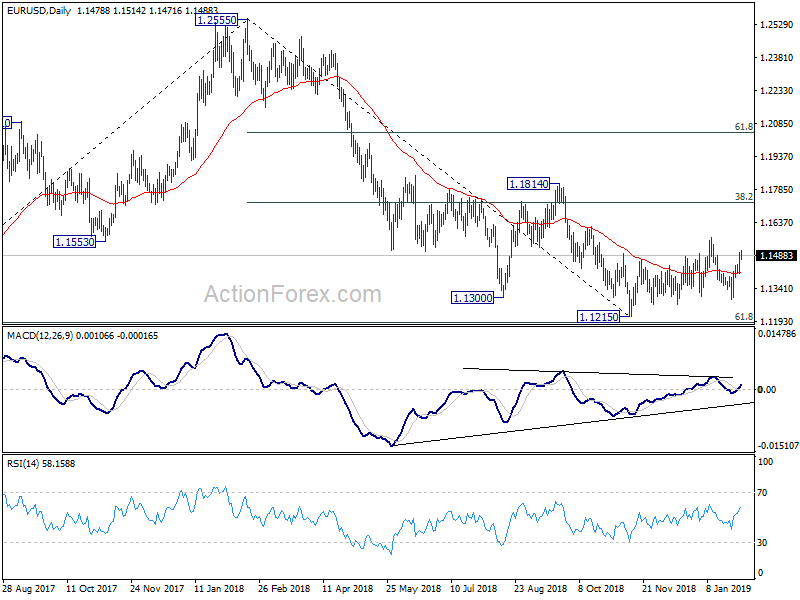
In the bigger picture, as long as 1.1814 resistance holds, down trend down trend from 1.2555 medium term top is still in progress and should target 61.8% retracement of 1.0339 (2017 low) to 1.2555 at 1.1186 next. Sustained break there will pave the way to retest 1.0339. However, break of 1.1814 will confirm completion of such down trend and turn medium term outlook bullish.
GBP/USD Mid-Day Outlook
Daily Pivots: (S1) 1.3063; (P) 1.3104; (R1) 1.3157; More....
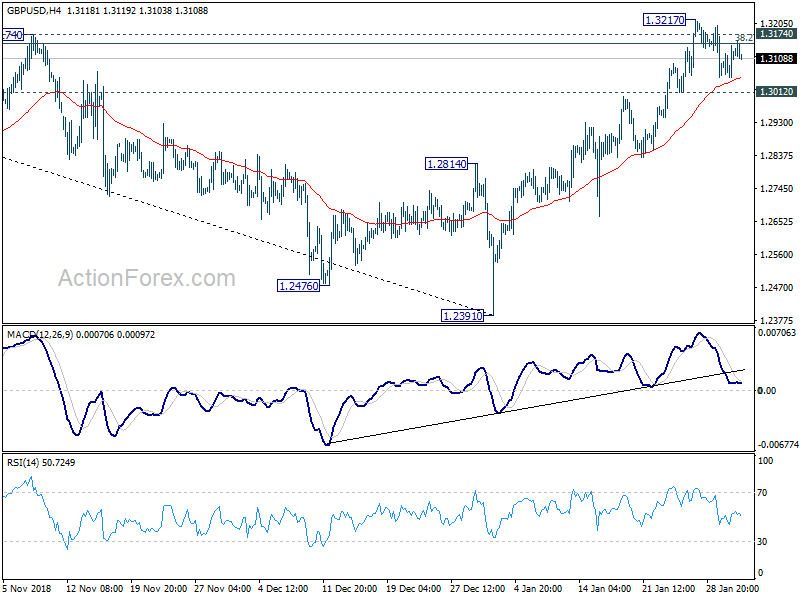
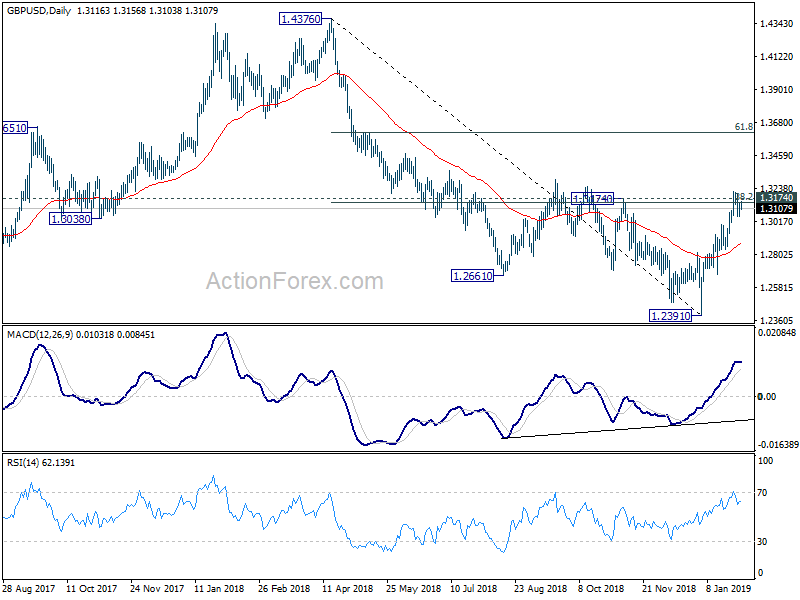
Intraday bias in GBP/USD stays neutral and outlook is unchanged. On the downside, break of 1.3012 minor support will suggest rejection by 1.3174 key resistance, and turn bias to the downside for 1.2814 support. On the upside, sustained break of 1.3174 key resistance will argue that whole decline from 1.4376 has completed at 1.2391. In such case, further rise should then be seen to 61.8% retracement of 1.4376 to 1.2391 at 1.3618.
In the bigger picture, rise from 1.1946 (2016 low) to 1.4376 (2018 high) is seen as a corrective move. Similarly, fall from 1.4376 to 1.2391 also displace a corrective structure. Current development suggests that rise from 1.2391 is the third leg of the corrective pattern from 1.1946 and could extend beyond 1.4376 high. Firm break of 61.8% retracement of 1.4376 to 1.2391 at 1.3618 will affirm this case. On the downside, break of 55 day EMA (now at 1.2865) will turn focus back to 1.2391 low instead.
USD/CHF Mid-Day Outlook
Daily Pivots: (S1) 0.9917; (P) 0.9956; (R1) 0.9981; More....
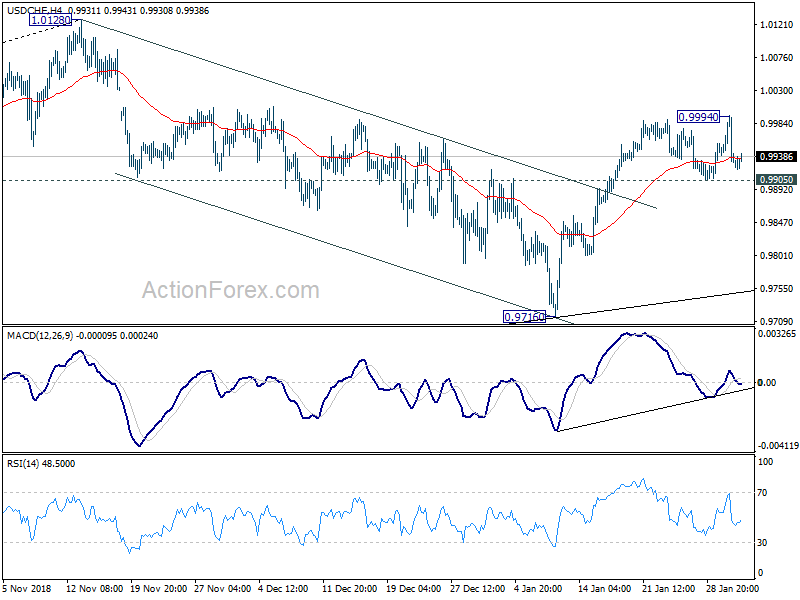
Intraday bias in USD/CHF remains neutral at this point. Further rise is expected as long as 0.9905 support holds. We're holding on to the view that corrective pull back from 1.0128 has completed at 0.9716 already. On the upside, break of 0.9994 will resume the rise from 0.9716 to retest 1.0128 high. However, break of 0.9905 will dampen this view and turn bias to the downside.
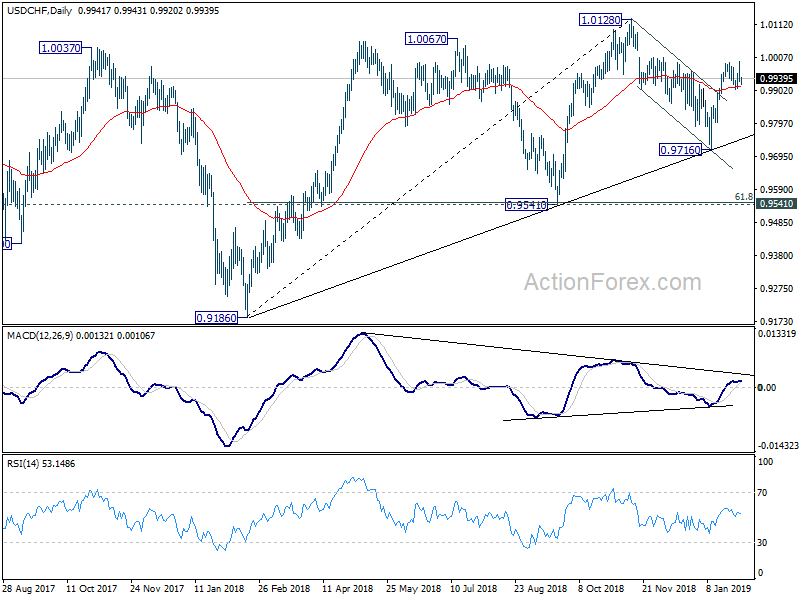
In the bigger picture, USD/CHF drew strong support from medium term trend line and rebounded. That suggests rise from 0.9186 is still in progress. Break of 0.9963 will affirm this bullish case. Further break of 1.0128 will confirm up trend resumption and target 1.0342 key resistance. Nevertheless, break of 0.9716 will dampen this bullish view and at least bring deeper fall to 0.9541 key support.
Canadian GDP Edged Lower in November
Highlights:
- Canadian GDP was on consensus, falling 0.1% in November. That is the second decline in three months, leaving year-over-year growth at 1.7%.
- Goods production was down 0.3% thanks to declines in manufacturing and oil and gas extraction.
- Services activity was flat as declines in wholesale, retail, and transportation were offset by gains in many other services sectors.
- Production and sale of cannabis will be incorporated in December’s GDP release.
- Today’s release was in line with our expectations, leaving our Q4/18 GDP monitoring unchanged at 1.1% annualized. That would be the slowest pace since Q2/16.
Our Take:
Today’s GDP release was pretty much as expected, coming in on consensus with a 0.1% decline. Even the details were fairly predictable—manufacturing, wholesale and retail trade slowed (as flagged in earlier reports) and transportation and warehousing activity was down for a second consecutive month as the Canada Post strike continued through nearly all of November. And oil and gas extraction fell due to weather-related disruptions on the East Coast (there were also reports that oil companies began curtailing production amid steep discounts on Western Canadian oil). We think much of this slowing will prove transitory, but over varying timeframes. Weakness in the transport sector will have reversed in December as labour disruptions ended. A slowdown in the energy sector will last a bit longer. Drilling activity was down in December and larger mandated production cuts will have weighed on oil output in January. The Alberta government just announced that production cuts will start to ease back in February and March, which should relieve some of the downward pressure on activity. But that won’t be enough to salvage first quarter growth. Today’s release is in line with our call for Q4/18 GDP growth in the 1% (annualized) range, and Q1/19 isn’t likely to be much better. The Bank of Canada has anticipated this, expecting gains of 1.3% and 0.8% in Q4 and Q1—meaning today’s release won’t surprise Governing Council, either.