Sample Category Title
USDJPY Hits 2-Week Low, Remains Neutral In Long Term
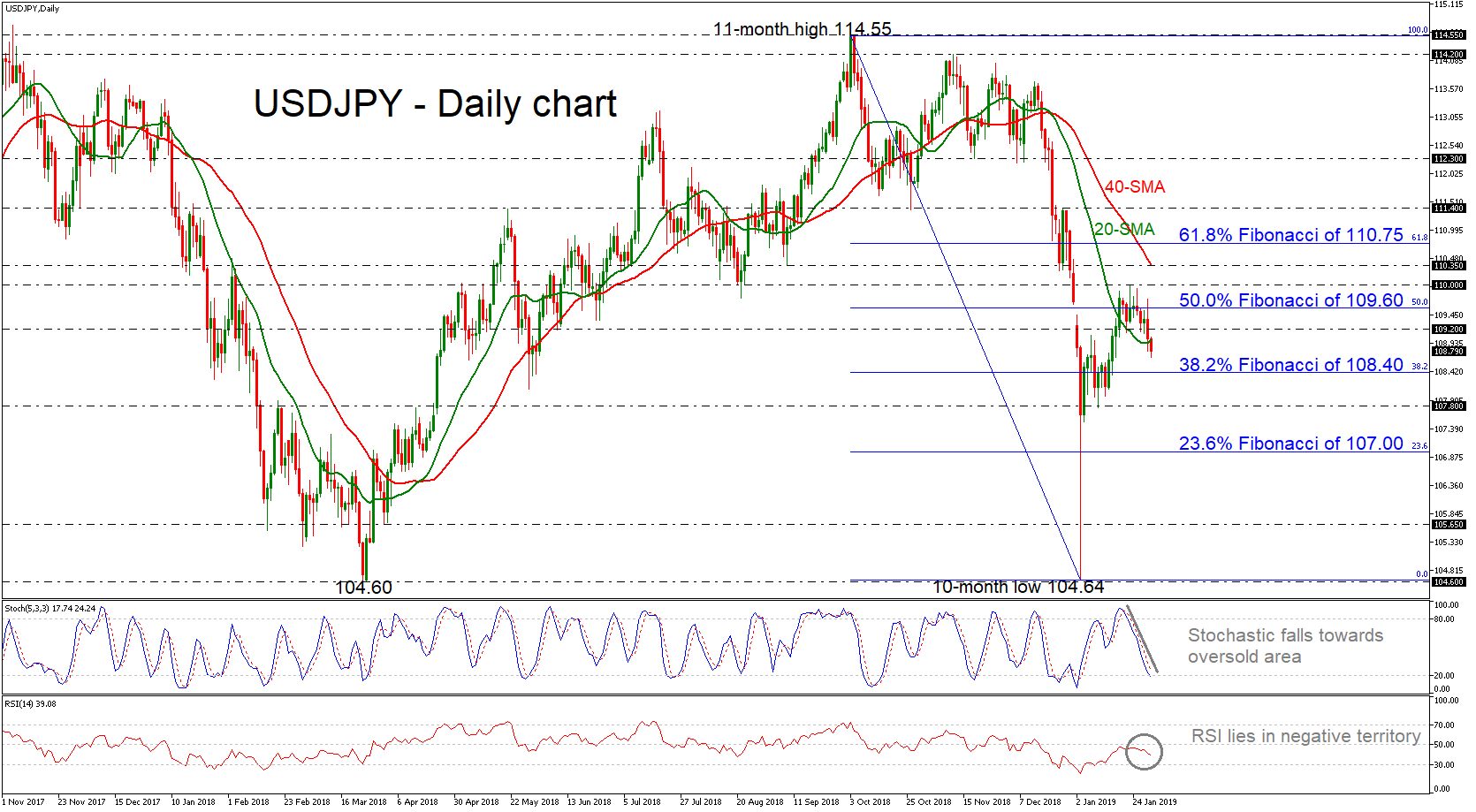
USDJPY has been underperforming since yesterday, breaking back below the 50.0% Fibonacci retracement level of the downleg from 114.55 to 104.64, around 109.60 and the 20-simple moving average (SMA) in the daily chart. The price recorded a fresh two-week low of 108.68.
Momentum indicators are pointing to a negative bias in the short term with the RSI just below 50 and the stochastic oscillator approaching the oversold area. However, the 20-SMA is pointing slightly up despite the latest bearish pullback, while the 40-SMA continues to head south.
In the negative scenario, where the price continues to extend below today’s low, a new bottom could be formed around the 108.40 support, which is the 38.2% Fibonacci mark. If the market manages to plunge below that area, traders could look for next stop at the 107.80 obstacle before steeper bearish actions take the price down to the 23.6% Fibonacci, which stands near the psychological level of 107.00.
A reversal to the upside could stall at the 109.20 resistance and slightly higher at the 50.0% Fibonacci of 109.60. Further up, the price could find resistance near the 110.00 – 110.35 area, which encapsulates the 40-SMA. Any violation of this point could potentially trigger more buying interest in the market, probably leading the price up to 61.8% Fibonacci of 110.75.
When looking at the bigger picture the pair lacks a clear trend and has been consolidating over the last two years with upper boundary the 114.55 resistance and lower boundary the 104.60 support.
Fed Shifts Into Patient Wait-And-See Modus
- Fed leaves policy rate unchanged at 2.25%-2.50%; BUT…
- … makes a dovish U-turn. Patience is the new code.
- The need for further gradual rate hikes is no longer mentioned
- The balance sheet will remain bigger than expected until now
- The new ‘Powell put’ propels risky assets
The Fed as expected left its left the target range for Fed fund rate unchanged at 2.25%-2.50%. However, they made some key changes to their policy statement. In a separate statement regarding the monetary policy implementation and monetary policy normalisation, the Fed indicated that it could alter the current run-off of its balance sheet. At the press conference, Fed chairman Powell in several ways said that the Fed can remain patient on any further changes to monetary policy.
The Fed didn’t change that much in int’s monetary policy statement regarding its assessment on the economy or on inflation. They repeated that the labour market has continued to strengthen and that economic activity has been raising at a ‘solid’ (instead of strong) pace. The Fed’s assessment on inflation was also little changed. On a 12- month basis, inflation remains near 2%, but the US central bank acknowledged that market-based measures of inflation compensation have moved lower in recent months. Important: the Fed omitted the sentence from the December policy statement that it judges that some further gradual increases in the policy rate will be consistent with reaching its target. The Fed also removed the assessment that risk to the economic outlook are roughly balanced, acknowledging doubt about the (near term) future. The Fed paragraph did repeat thath future changes in the target range will depend on a wide range of incoming information.
In a separate statement regarding monetary policy implementation and balance sheet normalisation, the Fed indicated to continue to implement monetary policy in a regime of ample supply in which the Federal funds rate (and other administered interest rates) will remain the key policy instruments. At the same time, the Fed signals that it would be prepared to adjust the details of completing balance sheet normalisation in the light of recent financial and economic developments. In this respect, the committee would be prepared altering the composition and the size of the balance sheet if future economic conditions would warrant to do so.
Key takeaways
The Fed clearly turned much softer on its policy intentions going forward even as its assessment on the economy hasn’t profoundly changed. Powell said that the US economy is still in a good place, but that some crosscurrents and conflicting signals have interfered. Brexit, the US government shutdown and the US-China trade tensions are among those crosscurrents.
The Fed doesn’t explictely say that the monetary tightening cycle has come to end. Strong incoming data might still decide otherwise. However, the statement at least suggests that there is also a chance that the monetary cycle is up for a long pause, allowing the Fed to monitor economic and other developments. It this framework it is even not excluded that the next move might be a rate cut.
The Fed didn’t give real specific hints on the timing of a possible slowdown in the roll-off of the balance sheet or on its size once the normalisation process will be finished. However, Powell clearly hinted that ‘tapering’ of the balance sheet roll-off might comes sooner than was expected until now and that the size of the balance sheet will be probably reamin substantially higher than expected at the start of the run-off
Bridging the gap with markets
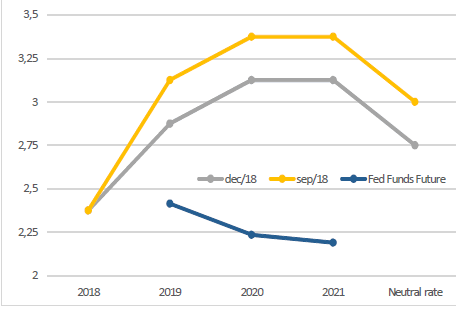
There remained quite a big discrepancy after the December policy meeting between the Fed guidance (as mirrored by the Fed dots and the communication after the policy decision) and market pricing. Yesterday’s ‘wait-and-see’ and patience, doesn’t give an explicit direction on the next Fed move. However, it is reasonable to conclude that the Fed has made a big step in the direction of recent market pricing. Market now see a big chance of the Fed leaving rates unchanged untill the end of the year, with a slightly higher probability of a rate cut rather than a rate hike toward the end of 2019. Yesterday’s comments suggest the Fed is sidelined at least until and probably beyond the Summer.
Market moves on the Fed policy statement and on Powell’s comments were very substantial. The yield curve bull steepened with the 2-yr (2.51%, -6.5 bps) and the 5-yr (2.48%, -6,2 bps) outperforming. The 10-yr yield declined 3.3bps. The 30-yr yield shed less than 1 bp. The moves in the major USD cross rates were significant, but not excessive. The trade-weighted dollar declined slightly more than 0.5% and closed the session in the 0.9540 area. EUR/USD tested the 1.15 area but closed at 1.1480. USD/JPY dropped to the 109 area, compared to an intraday peak in the 109.75 area. The prospect of a more accommodative Fed policy (a new ‘Powell put’?!) propelled US equity markets, with the major US indices rising 1.55% (S&P) to 2.20 % (Nasdaq)
USD/CAD Daily Outlook
Daily Pivots: (S1) 1.3086; (P) 1.3185; (R1) 1.3253; More...
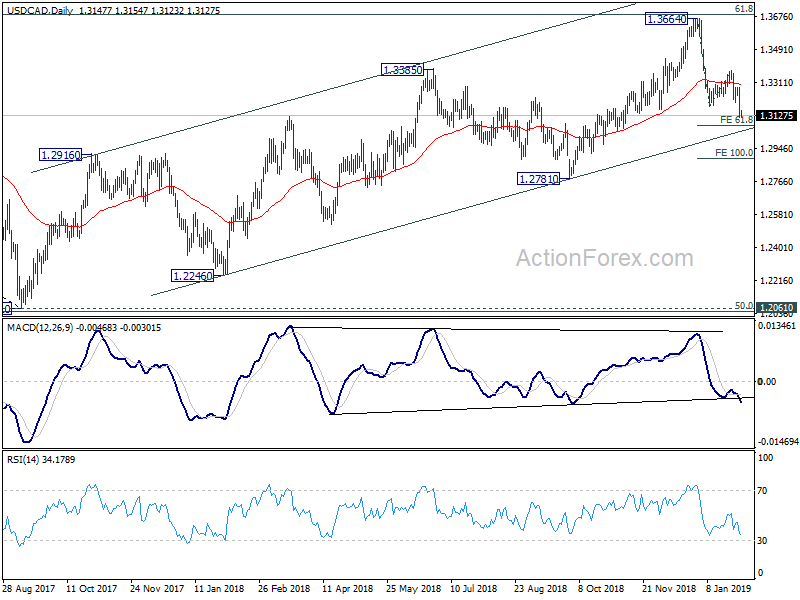
USD/CAD's fall from 1.3664 resumed by taking out 1.3180 and reaches as low as 1.3118 so far. Intraday bias is back on the downside for 61.8% projection of 1.3664 to 1.3180 from 1.3375 at 1.3076 next. Break will target 100% projection at 1.2891. On the upside, break of 1.3203 minor resistance will turn intraday bias neutral and bring consolidation. But further decline is expected as long as 1.3375 resistance holds.
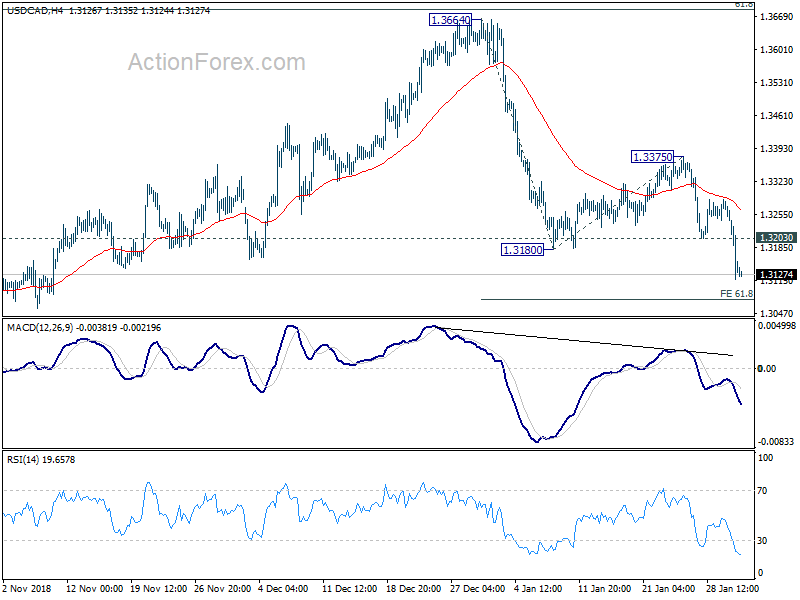
In the bigger picture, structure of the medium term rise from 1.2061 (2017 low) is not clearly impulsive so far. Hence, we'd stay cautious on strong resistance from 61.8% retracement of 1.4689 (2016 high) to 1.2061 at 1.3685 and 1.3793 resistance to limit upside, and bring medium term topping. But in any case, medium term outlook will stay bullish as long as channel support (now at 1.3036) holds. Sustained break of 1.3793 will pave the way to retest 1.4689 (2015 high)..
US/China Trade Talks Due To Conclude Today
General Trend:
- Samsung guided 2019 CAPEX lower y/y, expects annual earnings in 2019 to decline
- Asian currencies rally on Fed decision
- Little news seen as US/China trade talks due to conclude today
- US companies expected to report earnings on Thursday include Altria, Amazon, Celgene, Charter Communications, ConocoPhillips, Deckers, DuPont, GE, International Paper, Mastercard, Sherwin Williams, Sprint, The Blackstone Group, UPS, Valero Energy (including afterhours)
Headlines/Economic Data
Japan
- Nikkei 225 opened +1.3%
- (JP) JAPAN DEC PRELIM INDUSTRIAL PRODUCTION M/M: -0.1% V -0.5%E; Y/Y: -1.9% V -2.3%E
- (JP) Japan Investors Weekly Net Buying of Foreign Bonds: -¥102.6B v +¥822.9B prior; Foreign Buying of Japan Stocks: +¥166.6B v -¥66.7B prior
- (JP) Bank of Japan (BOJ) Summary of Opinions for Jan 22-23 meeting: Economy is expanding moderately, not feeling impact of US/China trade war yet; important to continue with monetary easing
- (JP) Bank of Japan (BOJ) Amamiya: Reiterates important to continue with easing; need to contain negative effects to continue easing
- (JP) Japan MoF sells ¥2.1T v ¥2.1T indicated in 0.10% (0.10% prior) 2-yr JGBs, avg yield: -0.167% v -0.127% prior, bid to cover 6.08x v 5.36x prior
Korea
- Kospi opened +0.7%
- (KR) Senior diplomatic talks between US and North Korea said to have gotten nowhere on denuclearization - press
- (KR) SOUTH KOREA DEC INDUSTRIAL PRODUCTION M/M: -1.4% V -0.2%E; Y/Y: 1.6% V 1.5%E
- (KR) South Korea Dec Construction Output y/y: -9.5% v -10.6% prior
- 005930.KR Reports final Q4 (KRW) Net 8.3T v 10.3Te; Op 10.8T v 10.8T prelim; Rev 59.3T v 59.0T prelim
- (KR) Bank of Korea (BOK) Gov Lee: Fed's prudence will help to stabilize markets – Yonhap
- 017670.KR Reports Q4 (KRW) Net 484.9B v 804Be; Op 225.3B v 290Be; Rev 4.35T v 4.4Te; Guides FY19 Rev KRW18.0T v 17.5T y/y
China/Hong Kong
- Hang Seng opened +0.7%, Shanghai Composite +0.2%
- (CN) CHINA JAN OFFICIAL (NBS) MANUFACTURING PMI: 49.5 V 49.3E; Non-Manufacturing PMI: 54.7 v 53.8e; Composite PMI: 53.2 v 52.6 prior
- (CN) China Dec Swift Global Payments CNY: 2.1% v 2.1% prior
- (CN) China PBoC Open Market Operation (OMO): Injects CNY50B in 14-day reverse repos v CNY50B in 14-day prior; Net: CNY50B injects v CNY50B injection prior
- (CN) China PBoC sets Yuan Reference Rate: 6.7025 v 6.7343 prior (strongest fix since July 2018)
- (CN) China 2018 gold demand 1,151t, +5.7% y/y; gold production 401t, -5.9% y/y
- (CN) China PBOC: Reiterates to further open up bond market
Australia/New Zealand
- ASX 200 opened +0.2%
- ORG.AU Reports Q2 production 63.1 PJ v 83.5 y/y v 64.3 q/q; Sales 64.2 PJ v 63.7 q/q
- FMG.AU Reports Q2 Iron Ore Shipments 42.5Mt v 42.6Me; production 49.2Mt v 47.5M y/y; Affirms FY19 production
- (NZ) S&P raises New Zealand Sovereign Rating outlook to positive from stable; Affirms AA rating
- (AU) Australia Dec Private Sector Credit m/m: 0.2% v 0.3%e; y/y: 4.3% v 4.4%e
- (AU) AUSTRALIA Q4 EXPORT PRICE INDEX Q/Q: 4.4% V 2.7%E; IMPORT PRICE INDEX Q/Q: 0.5% V 0.3%E
- (AU) Australia sells A$500M v A$500M indicated in April 2019 notes, avg yield 2.0115% v 1.9603% prior , bid to cover: 3.78x v 3.65x prior
Other Asia
- 2317.TW Responds to media: remains committed to promoting long term investment in the US and Wisconsin, global market has changed, will review current situation, adjust in accordance to clients' needs
North America
- (US) FOMC LEAVES TARGET RANGE UNCHANGED BETWEEN 2.25-2.50%; REMOVES REFERENCE TO GRADUAL RATE INCREASES
- (US) US White House said to prepare emergency wall plan - US Press
Europe
- (UK) PM May may offer cash injections in order to win support from Labour – Times
- (DE) Germany Finance Ministry Jan Report: 2018 tax Rev €713.8B, +5.8% y/y
- (UK) Jan Lloyds Business Barometer: 19 v 17 prior
- (UK) Jan GfK consumer Confidence: -14 v -15e
- (UK) CBI Small Business Survey: Export sentiment falling at fastest pace since financial crisis; overseas political and economic worries highest since survey started in 1988
Levels as of 12:50ET
- Hang Seng +1%; Shanghai Composite +0.4%; Kospi +0.3%; Nikkei225 +1%; ASX 200 -0.4%
- Equity Futures: S&P500 +0.1%; Nasdaq100 +0.4%, Dax +0.2%; FTSE100 +0.1%
- EUR 1.1475-1.1508; JPY 108.74-109.08 . ; AUD 0.7235-0.7273 ;NZD 0.6885-0.6924
- Commodity Futures: Gold +0.7% at $1,319/oz; Crude Oil +0.7% at $54.59/brl; Copper +0.1% at $2.776/lb
AUD/USD Daily Outlook
Daily Pivots: (S1) 0.7170; (P) 0.7221; (R1) 0.7300; More...
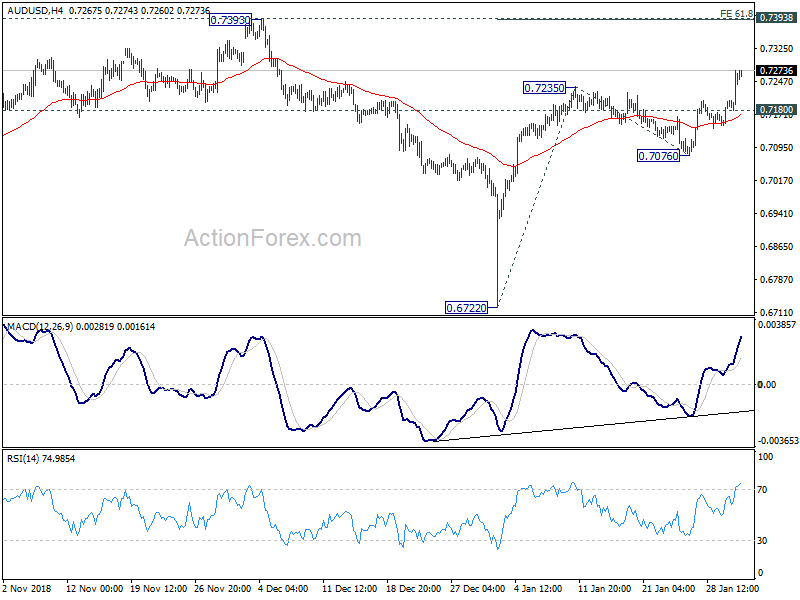
AUD/USD's rise rebound 0.6722 resumed by taking out 0.7235 and hits as high as 0.7273 so far. Intraday bias is back on the upside for 0.7393 cluster resistance (61.8% projection of 0.6722 to 0.7235 from 0.7076 at 0.7393). We'd expect strong resistance from there to limit upside to complete the rebound. On the downside, break of 0.7180 minor support will turn bias back to the downside for 0.7076 support. However, sustained break of 0.7393 will indicate near term reversal and target 100% projection at 0.7589 next).
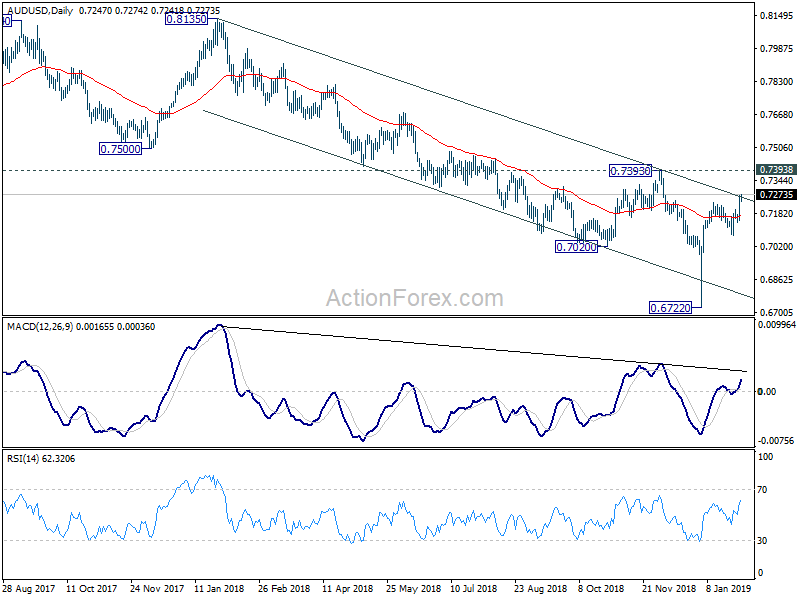
In the bigger picture, the failure to sustain below 0.6826 (2016 low) suggests that the long term down trend is not ready to resume yet. But prior rejection by 55 week EMA indicates underlying medium term bearishness in the pair. Outlook will also bearish as long as 0.7393 resistance holds. On the downside, sustained break of 0.6826 will target 0.6008 (2008 low).
Patient Fed
Market movers today
The US-China high-level trade talks continue today. Look out for any statements from the two sides tonight when the negotiations conclude. We believe we will see some progress in areas like intellectual property rights and technology transfer, where China has already laid out new legislation that it aims to pass at the annual People's National Congress in March. Enforcement will be one of the tricky issues in the talks.
In the euro area, Q4 GDP is expected to show an unchanged meagre growth rate of 0.2% q/q. If so, it will be the weakest performance over two quarters since 2013. Although temporary effects from German car sector bottlenecks explain some of the growth drag, the overall economic environment, with a Chinese slowdown, Brexit and fragile risk sentiment in financial markets, also weigh on growth prospects. In light of the latest months' disappointing industrial production data and falling sentiment indicators, we do not believe the euro area economy picked up speed in the past quarter.
In the US, we will get initial jobless claims, which fell to a new cycle low last week. The US Employment Cost Index for Q4 is likely to add to the picture of rising wage costs. Chicago PMI is set to correct lower as it is still at a much higher level than other regional surveys and ISM manufacturing.
Selected market news
As widely expected, the Fed did not raise its target range, which remains at 2.25-2.50%. The FOMC now states that it can afford to be 'patient' in raising rates, waiting to see better global data, a robust improvement in risk sentiment and higher inflation. Based on our positive macro outlook for the US and the global economy (and hence markets), we still expect the Fed to hike this year, but it is no longer a given that the first one would come as early as June, which is our current base case. We still think the Fed will end its hiking cycle this year. The Fed also seems ready to end the balance sheet run-off sooner rather than later.
US Bond yields declined and the US government yield curve bull steepened as the Federal Reserve sounded a dovish tone to the market, while the USD weakened against G7 counterparts and US equity futures advanced. Asian stocks are in the green this morning, after official Chinese NBS PMI manufacturing numbers for January showed signs of stabilisation in Chinese activity, despite remaining in contraction territory at 49.5.
Ireland's Central Bank Governor Philip Lane has become the only nominee to replace Peter Praet as ECB Chief Economist in June. Lane is considered a centrist who would be likely to continue the gradualist course of President Draghi. The next steps in the appointment procedure involve an EU Parliament hearing and a final confirmation by EU leaders.
Yesterday PM Theresa May's plan to convince the EU to renegotiate the withdrawal agreement already got a first damper, when Jean-Claude Juncker warned that the chances of a disorderly Brexit have increased, telling European leaders they should 'prepare for the worst' (see Brexit Monitor: May has two and half weeks to renegotiate the backstop , 29 January 2019).
Elliott Wave View Expects Exxon Mobil To Rally
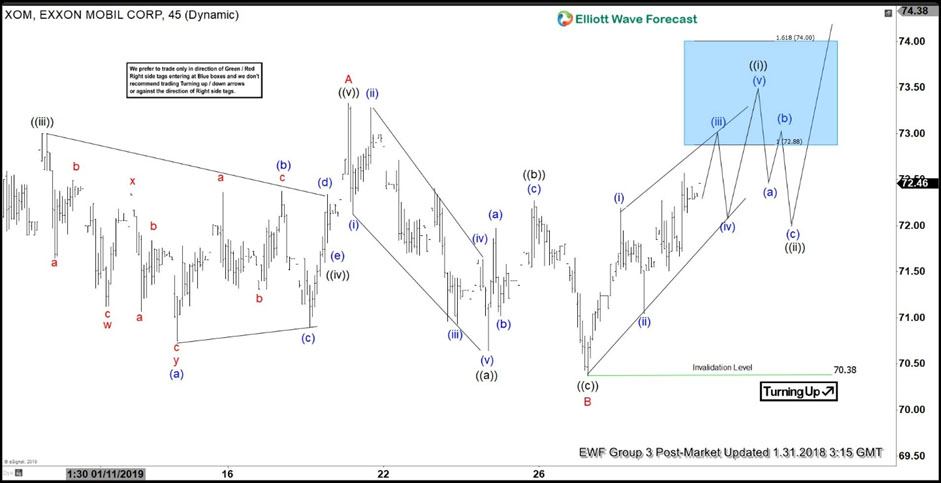
Elliott Wave view in Exxon Mobil (ticker: XOM) suggests that the rally from December 26, 2018 low ($64.65) is unfolding as Elliott Wave zigzag. The first leg of the zigzag ended at $73.33 on January 18, 2019 high as wave A. A zigzag is a 5-3-5 structure and wave A should unfold in 5 waves in impulse or diagonal. We can see in the chart below that wave ((iii)) of A ended at $73, wave ((iv)) of A ended at $71.95, and wave ((v)) of A ended at $73.33.
The stock then pullback in wave B with the internal as a zigzag Elliott Wave structure as well. Down from $73.33, wave ((a)) ended at $70.64, wave ((b)) ended at $72.27, and wave ((c)) ended at $70.37. Wave C rally has started and the stock is expected to break above wave A at $73 and could see as high as $79 when wave A = C. To gain confirmation for this view, the stock still needs to break above $73. Otherwise, technically we still can’t rule out a double correction in wave B. Near term, while pullback stays above $73.33, expect Exxon Mobil to extend higher.
Exxon Mobil 1 Hour Elliott Wave Chart
EUR/USD Daily Outlook
Daily Pivots: (S1) 1.1424; (P) 1.1463; (R1) 1.1519; More.....
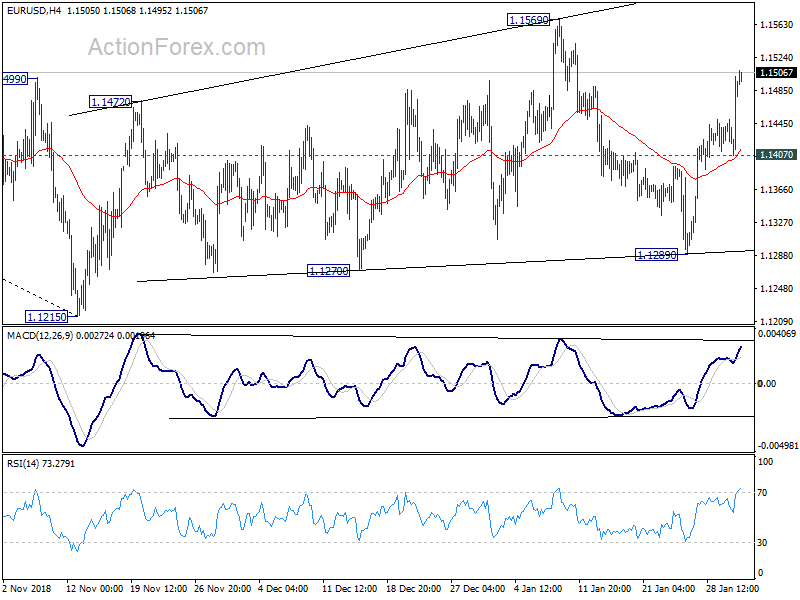
EUR/USD's rise from 1.1289 resumed after brief retreat and reaches as high as 1.1508 so far. Intraday bias is back on the upside. Such rise is seen as another rising leg in the correction pattern from 1.1215. Further rally would be see to 1.1569 resistance and above. On the downside, break of 1.1407 minor support will turn bias back to the downside for 1.1289 support instead.
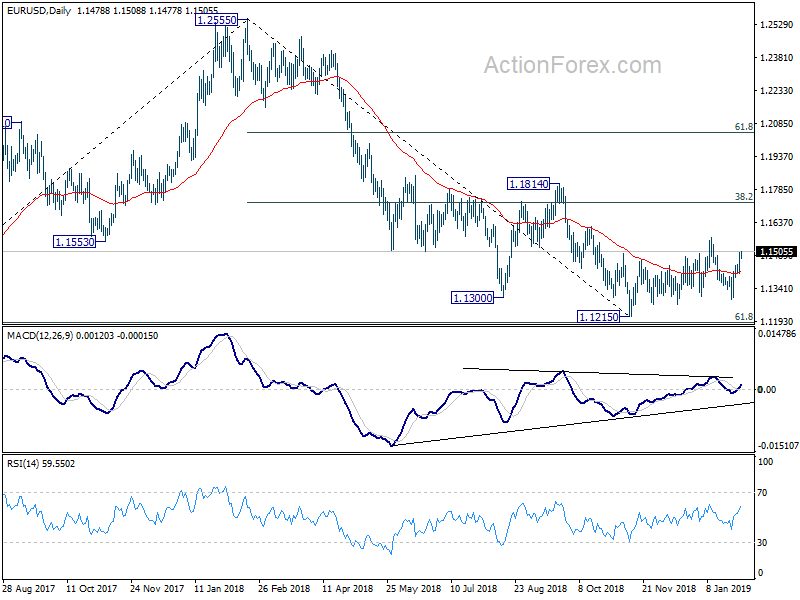
In the bigger picture, as long as 1.1814 resistance holds, down trend down trend from 1.2555 medium term top is still in progress and should target 61.8% retracement of 1.0339 (2017 low) to 1.2555 at 1.1186 next. Sustained break there will pave the way to retest 1.0339. However, break of 1.1814 will confirm completion of such down trend and turn medium term outlook bullish.
GBP/USD Daily Outlook
Daily Pivots: (S1) 1.3063; (P) 1.3104; (R1) 1.3157; More....
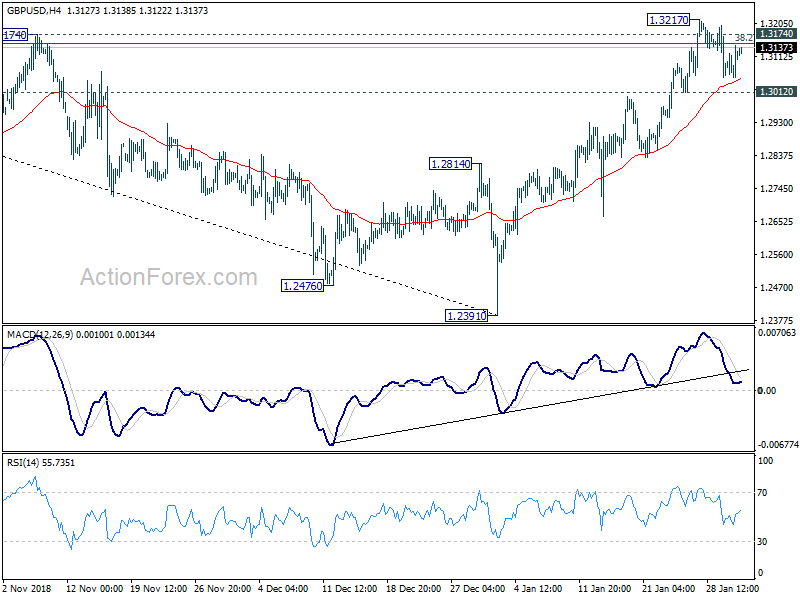
Intraday bias in GBP/USD remains neutral at this point. On the downside, break of 1.3012 minor support will suggest rejection by 1.3174 key resistance, and turn bias to the downside for 1.2814 support. On the upside, sustained break of 1.3174 key resistance will argue that whole decline from 1.4376 has completed at 1.2391. In such case, further rise should then be seen to 61.8% retracement of 1.4376 to 1.2391 at 1.3618.
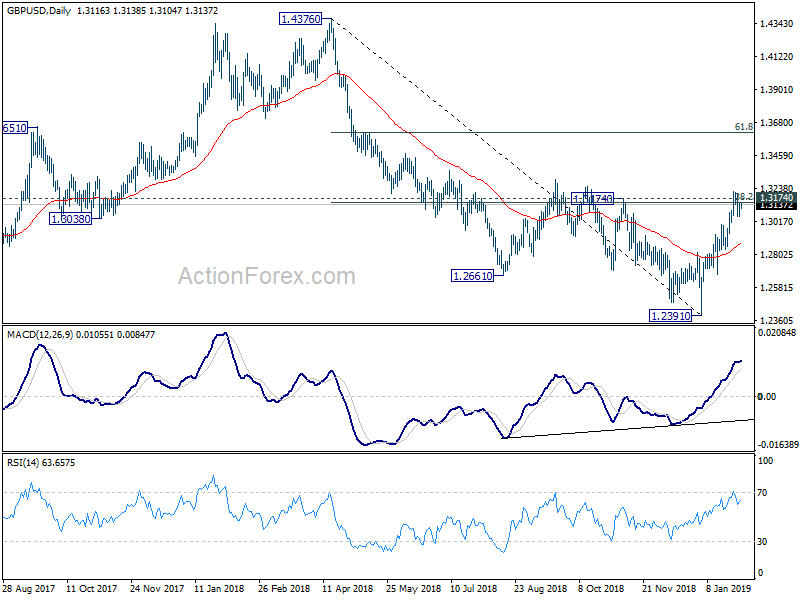
In the bigger picture, rise from 1.1946 (2016 low) to 1.4376 (2018 high) is seen as a corrective move. Similarly, fall from 1.4376 to 1.2391 also displace a corrective structure. Current development suggests that rise from 1.2391 is the third leg of the corrective pattern from 1.1946 and could extend beyond 1.4376 high. Firm break of 61.8% retracement of 1.4376 to 1.2391 at 1.3618 will affirm this case. On the downside, break of 55 day EMA (now at 1.2865) will turn focus back to 1.2391 low instead.
Euro Extends Its Gains In The Asian Session
For the 24 hours to 23:00 GMT, the EUR rose 0.43% against the USD and closed at 1.1484.
Data indicated that the Euro-zone's final consumer confidence index climbed to a level of -7.9 in January, in line with market expectations and confirming the preliminary print. In the prior month, the index had recorded a revised reading of -8.3.
On the other hand, the region's economic sentiment indicator dropped to a two-year low level of 106.2 in January, compared to a revised level of 107.4 in the previous month. Market participants had envisaged the economic sentiment indicator to fall to a level of 106.8. Moreover, the business climate indicator declined to a level of 0.69 in January, compared to market anticipations for a slide to a level of 0.77. The business climate indicator had registered a revised level of 0.86 in the prior month.
Separately, in Germany, the preliminary consumer price inflation slowed to a 11-month low level of 1.4% on an annual basis in January, less than market expectations for an advance of 1.6%. The CPI had registered a rise of 1.7% in the prior month. Furthermore, the nation's Gfk consumer confidence index unexpectedly jumped to a level of 10.8 in February, defying market expectations for a drop to a level of 10.3. In the prior month, the index had recorded a revised reading of 10.5.
The US dollar declined against a basket of currencies, after the US Federal Reserve (Fed) paused its rate hike policy.
The Fed, in its latest monetary policy meeting, kept its benchmark interest rate unchanged at 2.50%. The central bank signalled that it would remain “patient” on future interest rate hikes. Further, the Fed revealed that it expects the economy to expand and enhance jobs growth. However, the central bank expressed concerns over growing uncertainty about the outlook.
In the US data showed that, the US private sector employment advanced by 213.0K in January, compared to market expectations for a gain of 181.0K. The private sector employment had registered a revised increase of 263.0K in the prior month.
On the flipside, the nation's pending home sales declined 9.8% on an annual basis in December, dropping to its lowest level since 2014 and following a fall of 7.7% in the preceding year. Additionally, the MBA mortgage applications dropped 3.0% on a weekly basis in the week ended 25 January 2019, compared to a decline of 2.7% in the previous week.
In the Asian session, at GMT0400, the pair is trading at 1.1502, with the EUR trading 0.16% higher against the USD from yesterday's close.
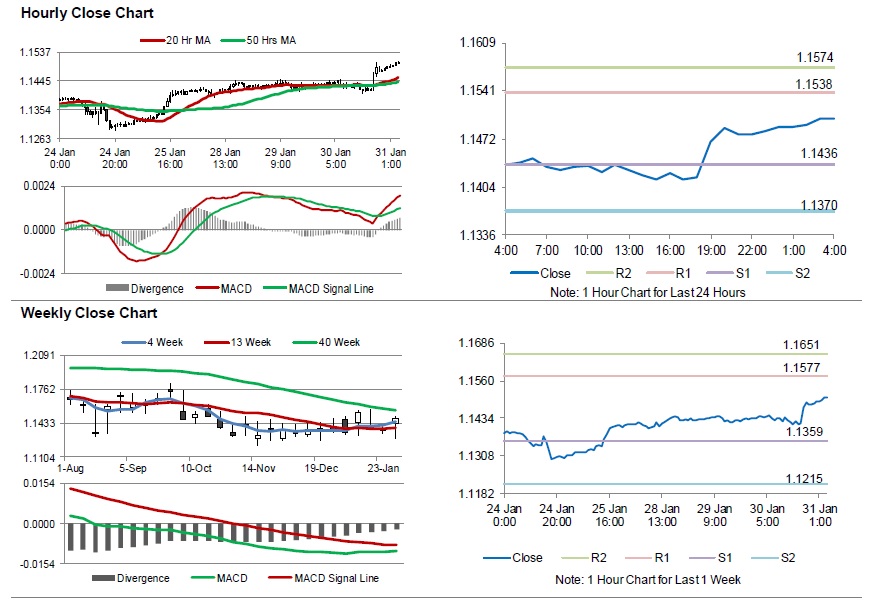
The pair is expected to find support at 1.1436, and a fall through could take it to the next support level of 1.1370. The pair is expected to find its first resistance at 1.1538, and a rise through could take it to the next resistance level of 1.1574.
Looking ahead, traders would await the Euro-zone's 4Q gross domestic product and unemployment rate for December along with Germany's unemployment rate for January and retail sales for December, set to release in a few hours. Later in the day, the US personal income and personal spending, both for December followed by the Chicago purchasing managers' index for January, will garner significant amount of investors' attention.
The currency pair is trading above its 20 Hr and 50 Hr moving averages.