Sample Category Title
Dollar Tumbles Broadly after Dovish FOMC, More Downside Ahead
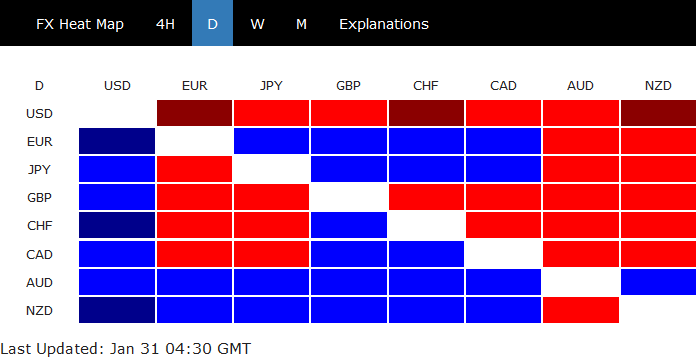
Dollar was sold off broadly overnight after Fed's dovish FOMC statement. And it remains the weakest one for today. US equities also surged sharply and risk appetite was carried through to Asian session. Riding on this, commodity currencies are generally higher, as led by Australian Dollar. However Yen also remains resilient for now, as helped by deep decline in USD/JPY. Meanwhile, Sterling is the second weakest following Dollar on Brexit uncertainty. Swiss Franc is the third weakest.
Technically, EUR/USD resumed the rebound from 1.1289 and breached 1.15 handle. It's targeting 1.1569 resistance and above. USD/JPY's break of 109.14 suggests completion of recent rebound from 104.69 and 107.77 support is next downside target. AUD/USD's break of 0.7235 indicate resumption of rebound from 0.6722, for 0.7393 resistance. USD/CAD also resumed the fall from 1.3664 by taking out 1.3180 support. Dollar will look into tomorrow's NFP as savior, or some positive news from US-China trade talks.
In other markets, Nikkei closed up 1.06% at 20773.49. Hong Kong HSI is currently up 0.92%. China Shanghai SSE is up 0.17%. Singapore Strati Times is up 0.42%. Japan 10-year JGB yield is down -0.0018 at 0.002. Overnight, DOW rose 1.77% or 434.9pts to 25014.86, reclaimed 25k handle. S&P 500 rose 1.55% to 2681.05. NASDAQ rose 2.20% to 7183.08. 10-year yield dropped -0.017 to 2.695, back below 2.7.
Fed stood pat, dropped tightening bias, stressed patience
Fed left federal funds rate unchanged at 2.25-2.50% as widely expected. The overall announce was rather dovish. In short, Fed dropped the tightening bias language of ""some further gradual increases" in interest rate. Instead, Fed said it would be "patient as it determines what future adjustments". On balance sheet reduction plan, Fed is "prepared to adjust any of the details for completing balance sheet normalization in light of economic and financial developments". But no detail was revealed yet. On economic assessment Fed stay activity has been "rising at a solid rate" rather than being "strong". Also, "market- based measures of inflation compensation have moved lower in recent months".
More on FOMC:
- FOMC Review – Fed Calls for Patience on Further Rate Hike
- FOMC Review: All We Need Is Just A Little Patience
- Fed Balance Sheet Shrinking Inches Closer Towards Ending
- FOMC Adopts A 'Patient' Stance
- Fed Holds Off on Raising Rates Citing Need to Support Economic Activity as Risks No Longer Roughly Balanced
- FOMC Statement Enshrines "Patient" Approach to Future Policy Moves
- FOMC Recap: No More Hiking Bias?
- (FED) Federal Reserve Issues FOMC Statement
82% chance of Fed on hold through 2019, more yield curve inversion
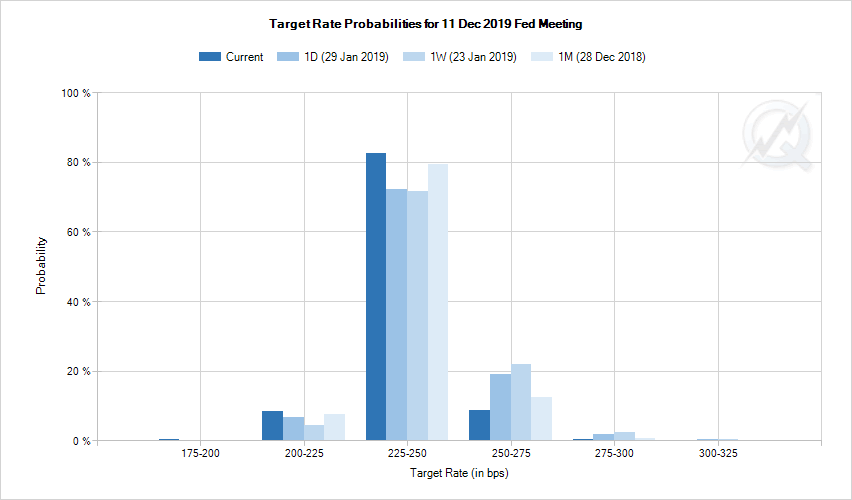
Markets firmed up their pricing that fed will stand pat throughout 2019 after yesterday's FOMC statement that adopted the "patience" language. Fed funds futures are pricing in 82.5% chance of federal funds rate staying at current 2.25-2.50% after December meeting. It compares to prior day's 72.0%. Nevertheless, it's not that higher than 79.3% a month ago.
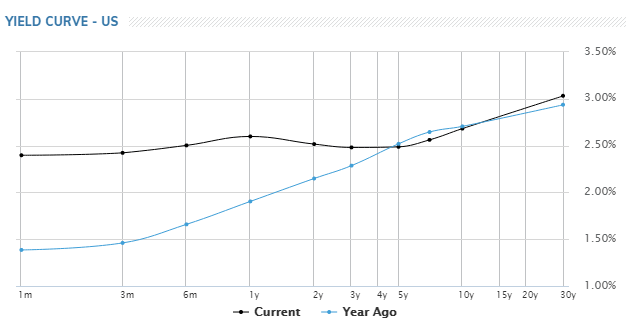
Treasury yields responded with 30-year yield rose 0.012 to 3.053. 10-year-year yield dropped -0.017 to 2.695. 5-year yield suffered steep decline and dropped -0.044 to 2.503. 1-year yield dropped -0.008 to 2.606. Yield curve from 1-year to 5-year has indeed inverted more after FOMC.
BoJ opinions: Swift decisive actions needed should downside risks materialize
BoJ released summary of opinions of January 22/23 monetary policy meeting today. It's noted there that "hard data suggest that the trend in Japan's economy has been firm". However, "some market participants hold excessively pessimistic views." And, risks to overseas economies have been "increasingly tilted to the downside" and there are concerns that some "may materialize".
BoJ also noted that recent fall in stocks prices "to a certain extent indicates the anticipation of a global decline in the real economic growth rate." And, "this is clear from developments in exports and imports, rather than GDP, which is declining marginally."
The central bank also reiterated the stance to maintain current monetary easing. And more importantly, if downside risks materialize, BoJ "should be prepared to make policy responses". It's added that "Since achieving the price stability target has been delayed, it is not desirable to adopt a stance of not taking actions until a serious crisis occurs. Rather, a stance of taking swift, flexible, and decisive actions, including additional easing, in response to changes in the situation is desirable."
China PMI manufacturing broke downtrend, but stayed contractionary
China PMI manufacturing rose 0.1 to 49.5 in January, up from 49.4 and beat expectation of 49.3. It's, nonetheless, the second month of contractionary reading. It's noted in the release that the continuous decline since August last year was finally broken, showing signs of stabilization. Slight increase in export orders also suggested that sharp decline export growth since November was slowing down.
However, decline in new orders and backlog orders reflected downward pressure on demand. Overall, "the current economy has signs of stabilization, but the foundation still needs to be consolidated. Also from China PMI non-manufacturing rose to 54.7, up from 53.8, and beat expectation of 53.9.
Also release in Asia session, Japan industrial production dropped -0.1% mom in December versus expectation of -0.5% mom. Housing starts rose 2.1% yoy in December, matched expectation. Australia import prices rose 0.5% qoq in Q4, above expectations of 0.3% qoq. UK Gfk consumer confidence was unchanged at -14 in January.
Looking ahead
Eurozone GDP will be the main focus in European session. Germany unemployment will also be featured. Later in the day, Canada GDP, IPPI and RMPI will be featured. US will release employment cost index, jobless claims, new home sales and Chicago PMI.
USD/JPY Daily Outlook
Daily Pivots: (S1) 108.66; (P) 109.20; (R1) 109.60; More...
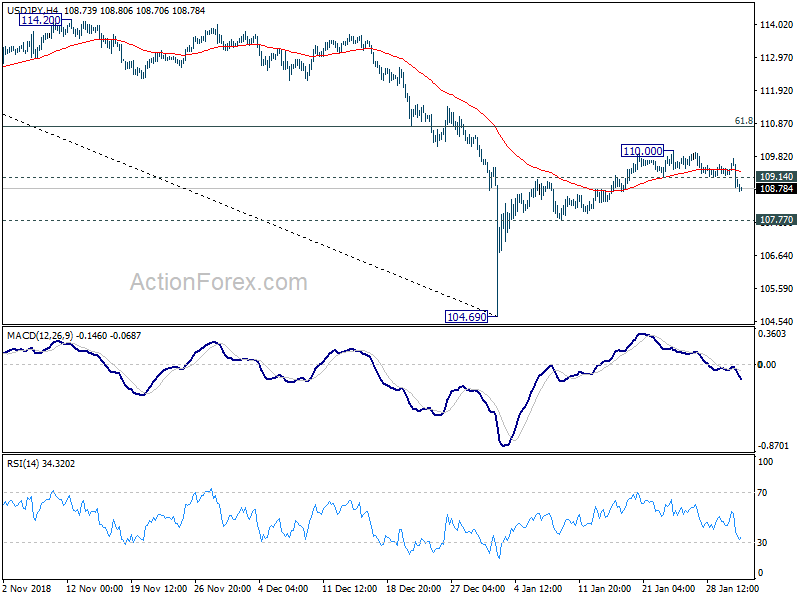
USD/JPY's break of 109.14 minor support suggests that whole rebound from 104.69 has completed at 110.00 already. Intraday bias is turned back to the downside for 107.77 support first. Decisive break there should confirm this bearish case and target retesting 104.69 low. On the upside, break of 110.00 will extend the rebound. But we'd expect strong resistance from 61.8% retracement of 114.54 to 104.69 at 110.77 to limit upside.
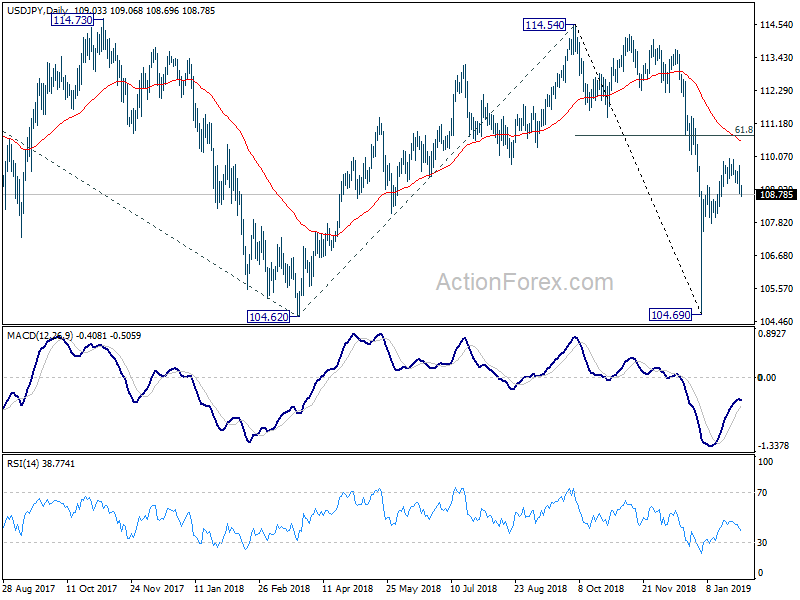
In the bigger picture, while the rebound from 104.69 is strong, there is no change in the view that it's a corrective move. That is, fall from 114.54, as part of the decline from 118.65 (2016 high), is not completed yet. Break of 104.62 will target 100% projection of 118.65 to 104.62 from 114.54 at 100.51, which is close to 100 psychological level. Nevertheless, sustained trading above 55 day EMA (now at 110.82) will dampen this bearish view and turn focus back to 114.54 resistance instead.
Economic Indicators Update
| GMT | Ccy | Events | Actual | Forecast | Previous | Revised |
|---|---|---|---|---|---|---|
| 23:50 | JPY | BOJ Summary of Opinions Jan | ||||
| 23:50 | JPY | Industrial Production M/M Dec P | -0.10% | -0.50% | -1.00% | |
| 0:01 | GBP | GfK Consumer Confidence Jan | -14 | -14 | -14 | |
| 0:30 | AUD | Import Price Index Q/Q Q4 | 0.50% | 0.30% | 1.90% | |
| 1:00 | CNY | Manufacturing PMI Jan | 49.5 | 49.3 | 49.4 | |
| 1:00 | CNY | Non-manufacturing PMI Jan | 54.7 | 53.9 | 53.8 | |
| 5:00 | JPY | Housing Starts Y/Y Dec | 2.10% | 2.10% | -0.60% | |
| 8:55 | EUR | German Unemployment Change Jan | -10K | -14k | ||
| 8:55 | EUR | German Unemployment Claims Rate Jan | 5.00% | 5.00% | ||
| 10:00 | EUR | Eurozone Unemployment Rate Dec | 7.90% | 7.90% | ||
| 10:00 | EUR | Eurozone GDP Q/Q Q4 | 0.20% | 0.20% | ||
| 10:00 | EUR | Italian GDP Q/Q Q4 P | -0.10% | -0.10% | ||
| 12:30 | USD | Challenger Job Cuts Y/Y Jan | 35.30% | |||
| 13:30 | CAD | GDP M/M Nov | 0.30% | |||
| 13:30 | CAD | Industrial Product Price M/M Dec | -0.80% | |||
| 13:30 | CAD | Raw Materials Price Index M/M Dec | -11.70% | |||
| 13:30 | USD | Personal Income Dec | 0.50% | 0.20% | ||
| 13:30 | USD | Personal Spending Dec | 0.30% | 0.40% | ||
| 13:30 | USD | PCE Deflator M/M Dec | 0.10% | |||
| 13:30 | USD | PCE Deflator Y/Y Dec | 1.80% | |||
| 13:30 | USD | PCE Core M/M Dec | 0.10% | |||
| 13:30 | USD | PCE Core Y/Y Dec | 1.90% | |||
| 13:30 | USD | Employment Cost Index Q4 | 0.80% | 0.80% | ||
| 13:30 | USD | Initial Jobless Claims (JAN 26) | 210K | 199K | ||
| 14:45 | USD | Chicago PMI Jan | 61 | 65.4 | ||
| 15:30 | USD | Natural Gas Storage | -163B |
RBA Forecasts to Be Consistent With On Hold Policy
The first RBA meeting of 2019 takes place on Tuesday and will be followed by a speech from Governor Lowe on Wednesday and Statement on Monetary Policy on Friday. We believe the RBA will lower their growth forecast in response to recent data but maintain an outlook consistent with rates remaining on hold.
After the usual summer recess the Reserve Bank will conduct its Board meeting on February 5, followed by a speech from Governor Lowe on February 6 and the February Statement on Monetary Policy which will print on February 8.
Of course there will be no rate change following the Board meeting but there will be considerable interest in the Governor’s Statement and the subsequent communications.
Recall that the minutes of board meetings have usually contained words along the lines of “members continued to agree that the next move in the cash rate was more likely to be an increase rather than a decrease.” Alternatively the November Statement on Monetary Policy noted “further reducing unemployment and ensuring inflation is consistent with the target. If that progress is made higher interest rates are likely to be appropriate at some point.”
But those sentiments were expressed when markets had been anticipating rate hikes. At the beginning of 2018 when Westpac was predicting the cash rate would remain on hold in both 2018 and 2019, markets had priced-in a full 25bps rate hike by end 2018. Today, markets are assessing that the next move in the cash rate will be down by 25 basis points with a probability of 60% (15bps) by year’s end.
In defence of the economists, only 11 of the 20 forecasters (Bloomberg Survey, January 12, 2018) predicted a hike or hikes in 2018 but this group did include the other three major banks, AMP, and most major investment banks. There is no survey evidence to check how many of the “no-change nine” supported the Westpac view that rates would remain on hold through 2019 as well. Since that survey in January last year Westpac has extended its “on hold view” through 2020. Turning to today, there is also, at this stage, little support from the economists for the “market view” which is pricing rates to be cut by end 2019.
The key as to whether the Reserve Bank will placate markets and adopt a pure neutral bias by eliminating the “next move up” in its commentary will hinge on how it reassesses its forecasts which will be released with the February Statement on Monetary Policy (SOMP) on February 8.
Recall that, based on its forecasts in the November SOMP, the conclusion that the cash rate would eventually rise was reasonable.
Growth was forecast at 3.5% in 2018; 3.25% in 2019; and 3% in 2020. Trend growth is assessed by the RBA as 2.75% (1 ppt for productivity growth and 1.75 ppts for labour force growth).
Three consecutive years of comfortably above trend growth could be expected to erode significant excess capacity and boost employment growth so that inflation would lift into the 2-3% target range and the unemployment rate would approach the NAIRU. Accordingly, the Bank forecast core inflation to lift to 2.25% in 2019 and 2020 and the unemployment rate to fall to 4.75% by end 2020.
The December quarter inflation report printed underlying inflation at 0.4% and headline inflation at 0.5%. These numbers were around market expectations although there was a “whisper” number in markets of somewhat lower. Importantly, the print for underlying inflation for 2018 was 1.7% – in line with the Reserve Bank’s forecast from its November SOMP.
The November inflation forecasts for 2019 and 2020 are 2.25% – a marked lift from the 2018 actual of 1.7% but it is likely the Bank will persist with this confident signal in its February forecasts. Even if it decides to lower the 2019 forecast to 2.0% in recognition of a lower growth forecast for 2019 the number would still be in the target zone (2–3%) and the gradual progress would be emphasised by maintaining the forecast for 2020 at 2.25%.
Their views on the labour market have been cautious. The unemployment rate has already reached 5% while the Wage Price Index growth rate has lifted in recent quarters to 2.3%. Scrutiny of a chart which, for the first time, was provided in the November SOMP points to a cautious forecast of WPI annual growth reaching 2½ per cent by end 2020.
However, the September quarter GDP report has disrupted the RBA’s comfortable position on the growth outlook. With growth only printing 0.3% in that quarter it would be necessary for the December quarter to print 1.2% to achieve the November forecast of 3.5%. The 2018 growth forecast is likely to be lowered from 3.5% to 3.0%. But what will this mean for the 2019 and 2020 forecasts?
We know that the Bank has assessed a minimal wealth effect on consumption and the Q3 growth report is unlikely to have changed that view. Even further negative evidence on house prices in Sydney and Melbourne is unlikely to change the qualitative assessment that the wealth effect was minimal while house prices were booming and therefore will be minimal in reverse. RBA Director Harper recently played down any evidence of a wealth effect in an interview with Dow Jones late last week.
Westpac differs in that regard pointing to a fall in the savings rates in NSW and Victoria over the year to September 2018 of 1.7 ppt’s in NSW and 1.9 ppt’s in Victoria. We expect some reversal of that effect in 2019 and 2020 pushing growth in consumer spending down from our previous forecast of 2.6% in each year to 2.4%. Our simulation work suggests that the impact on consumption of this negative wealth effect may be significantly larger. We expect the Bank will maintain its current view that consumption growth will run at 3% in both 2019 and 2020.
We also differ on the likely downtrend in residential construction in 2019 and 2020, “Dwelling investment has remained high and... should remain at a high level for the next year or so” (Nov SOMP). Based on the recent falls across the board in dwelling approvals (detached and multi) we look for a 8% fall in new dwelling construction in 2019 and 5% decline in 2020.
Westpac’s growth forecasts are 2.6% in 2019 and 2.6% in 2020. Those forecasts are only slightly below trend and consistent with steady rates in 2019 and 2020.
We expect the RBA will forecast growth of 3% in 2019 and 3% in 2020. That higher growth will reflect a limited slowdown in housing construction and no meaningful wealth effect. Those growth forecasts are still above trend and likely to ensure the view that the next move in rates will be up.
Indeed, in his comments to Dow Jones, Director Harper repeated the expectation that the next move in rates will be up. While he emphasised these were his own views it is important to point out that Dr Harper has a distinguished past in the Research Department of the Bank. Some of the Bank’s senior executives would have been colleagues. His comments carry much more weight than the personal observations of an outside director.
Of course we need to be mindful that the comments preceded the shock from the monthly NAB Business Survey that showed a collapse in business conditions (business confidence held around previous levels). Risks around business surveys that are taken in January must be recognised. Indeed that particular survey has shown some volatile movements around the Christmas period. It is doubtful that the Bank would change its longstanding rhetoric on the basis of a January Business Survey.
If, however, we thought the RBA was likely to lower its growth forecasts in 2019 and 2020 to 2.5% or less then we would certainly expect it to adopt an easing bias.
Other factors which may impact market thinking are the higher recent levels of BBSW and associated out of cycle hikes by some banks. The RBA will probably view those developments as likely to exacerbate housing price weakness but due to an insignificant wealth effect, will be unlikely to materially change their forecasts.
Accordingly, despite lowering its growth forecasts for 2018 and 2019, we expect the Bank will retain its current stance that the next move in rates will be up.
BoJ opinions: Swift decisive actions needed should downside risks materialize
BoJ released summary of opinions of January 22/23 monetary policy meeting today. It's noted there that "hard data suggest that the trend in Japan's economy has been firm". However, "some market participants hold excessively pessimistic views." And, risks to overseas economies have been "increasingly tilted to the downside" and there are concerns that some "may materialize".
BoJ also noted that recent fall in stocks prices "to a certain extent indicates the anticipation of a global decline in the real economic growth rate." And, "this is clear from developments in exports and imports, rather than GDP, which is declining marginally."
The central bank also reiterated the stance to maintain current monetary easing. And more importantly, if downside risks materialize, BoJ "should be prepared to make policy responses". It's added that "Since achieving the price stability target has been delayed, it is not desirable to adopt a stance of not taking actions until a serious crisis occurs. Rather, a stance of taking swift, flexible, and decisive actions, including additional easing, in response to changes in the situation is desirable."
China PMI manufacturing broke downtrend, but stayed contractionary
China PMI manufacturing rose 0.1 to 49.5 in January, up from 49.4 and beat expectation of 49.3. It's, nonetheless, the second month of contractionary reading. It's noted in the release that the continuous decline since August last year was finally broken, showing signs of stabilization. Slight increase in export orders also suggested that sharp decline export growth since November was slowing down.
However, decline in new orders and backlog orders reflected downward pressure on demand. Overall, "the current economy has signs of stabilization, but the foundation still needs to be consolidated. Also from China PMI non-manufacturing rose to 54.7, up from 53.8, and beat expectation of 53.9. Full release in simplified Chinese.
Also release in Asia session, Japan industrial production dropped -0.1% mom in December versus expectation of -0.5% mom. Housing starts rose 2.1% yoy in December, matched expectation. Australia import prices rose 0.5% qoq in Q4, above expectations of 0.3% qoq. UK Gfk consumer confidence was unchanged at -14 in January.
Asian update: Dollar weakest on dovish Fed, DOW reclaimed 25k overnight
Dollar tumbled broadly overnight, while stocks surged, after dovish FOMC statement. The greenback remains the weakest on in Asian session today, followed by Sterling and then Swiss Franc. On the other hand, strong risk appetite lifts Australian and New Zealand Dollar. Technically, AUD/UD broke 0.7235 resistance yesterday to resume rebound from 0.6722 for 0.7393 key resistance. USD/CAD also broke 1.3180 support to resume fall from 1.3664. EUR/USD resumed rise from 1.1289 towards 1.1569 resistance. USD/JPY also broke 109.14 minor support which argues that rebound from 104.69 has completed at 110.00 already.
In short, Fed dropped the tightening bias language of ""some further gradual increases" in interest rate. Instead, Fed said it would be "patient as it determines what future adjustments". On balance sheet reduction plan, Fed is "prepared to adjust any of the details for completing balance sheet normalization in light of economic and financial developments". But no detail was revealed yet. On economic assessment Fed stay activity has been "rising at a solid rate" rather than being "strong". Also, "market- based measures of inflation compensation have moved lower in recent months".
More on FOMC:
- FOMC Review – Fed Calls for Patience on Further Rate Hike
- FOMC Review: All We Need Is Just A Little Patience
- Fed Balance Sheet Shrinking Inches Closer Towards Ending
- FOMC Adopts A 'Patient' Stance
- Fed Holds Off on Raising Rates Citing Need to Support Economic Activity as Risks No Longer Roughly Balanced
- FOMC Statement Enshrines "Patient" Approach to Future Policy Moves
- FOMC Recap: No More Hiking Bias?
- (FED) Federal Reserve Issues FOMC Statement
In Asia:
- Nikkei is up 1.24%.
- Hong Kong HSI is up 1.21%.
- China Shanghai SSE is up 0.63%.
- Singapore Strait Times is up 0.38%.
- Japan 10-year JGB yield is down -0.0022 at 0.001.
Overnight:
- DOW rose 1.77% or 434.9pts to 25014.86, reclaimed 25k handle.
- S&P 500 rose 1.55% to 2681.05.
- NASDAQ rose 2.20% to 7183.08.
- 10-year yield dropped -0.017 to 2.695, back below 2.7.
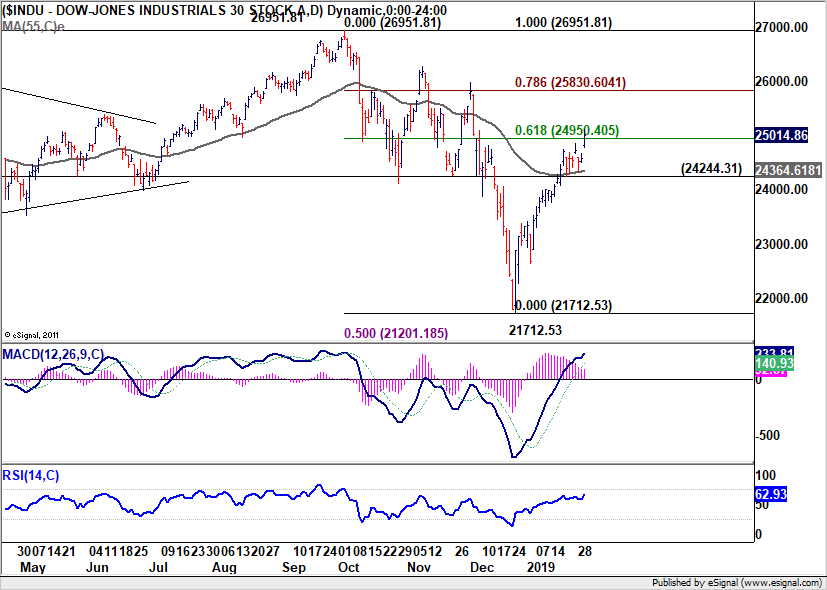
DOW's rally from 21712.53 resumed and broke 61.8% retracement of 26951.81 to 21712.53 at 24950.40. It's on track to 78.6% retracement at 25830.60 and above.
US Crude Oil Inventory Increased Less than the Market had Expected
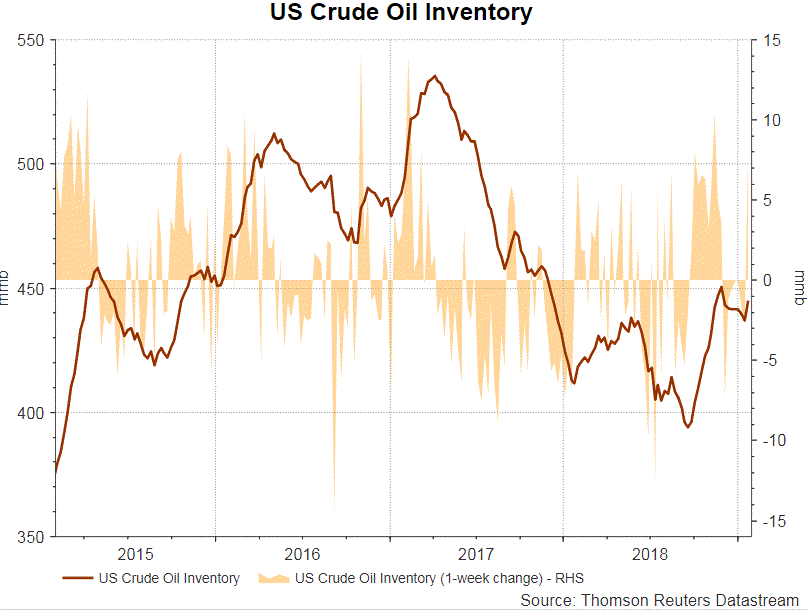
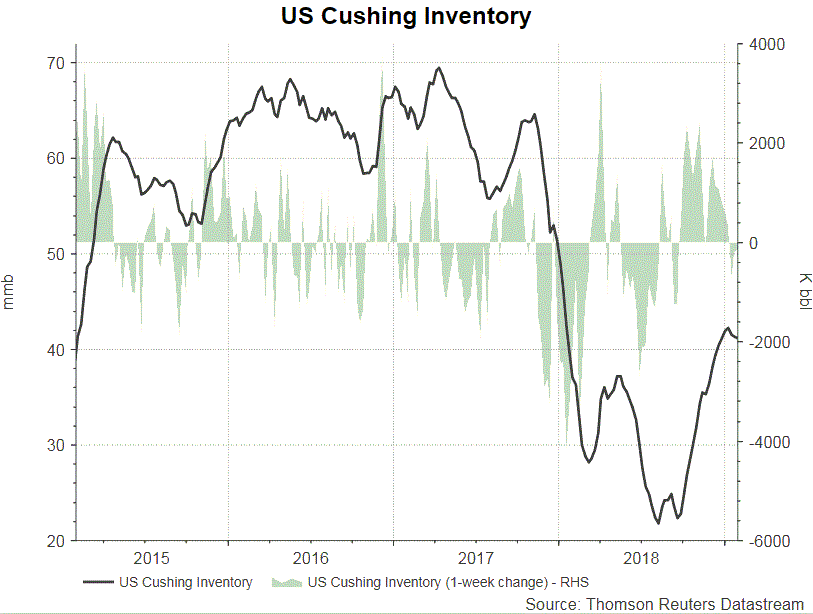
The report from the US Energy Information Administration (EIA) shows that total crude oil and petroleum products (ex. SPR) stocks declined -4.77 mmb to 1262.34 mmb in the week ended January 25. Crude oil inventory added +0.92 mmb to 445.94 mmb (consensus: +3.16 mmb). Inventories increased in 3 out of 5 PADDs. Meanwhile, Cushing stock dropped -0.15 mmb to 41.18 mmb. Utilization rate slipped dropped -2.8% to 90.1% and crude production steadied at 11.9M bpd for the week. Crude oil imports plunged to 7.08M bpd from 8.19M bpd in the prior week.
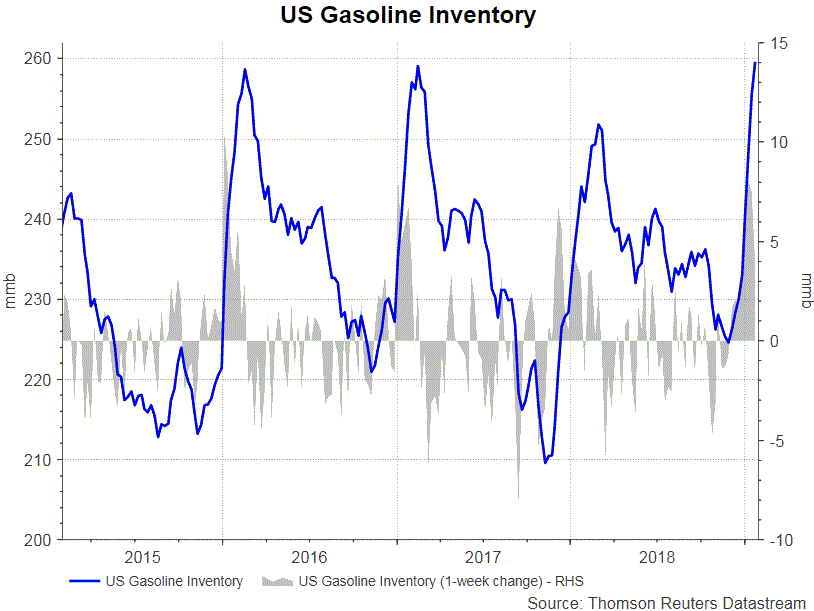
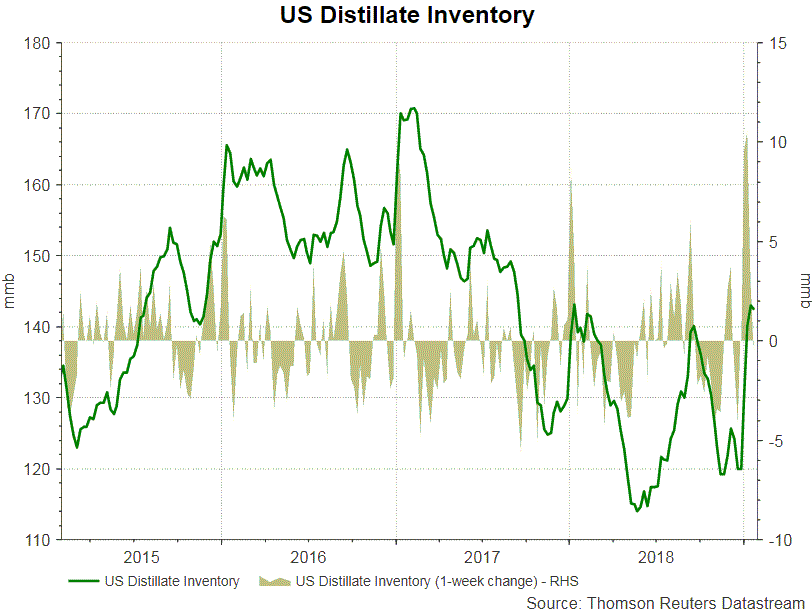
 Concerning refined oil product inventories, gasoline inventory fell -2.24 mmb to 257.38 mmb although demand jumped +7.85% to 9.56M bpd. The market had anticipated a -1.92 mmb decrease in stockpile. Production rose +3.12% to 9.9 bpd while imports jumped+48.81% to 0.52M bpd during the week. Distillate inventory dropped -1.12 mmb to 141.27 mmb. Demand plunged -11.7 to 4.12M bpd. The market had anticipated a --1.43 mmb drop gain in inventory. Production fell -3.55% to 5.02M bpd while imports slumped -62% to 0.14M bpd during the week.
Released after market close on Wednesday, the industry- sponsored API estimated that crude oil inventory gained +2.1 mmb during the week. For refined oil products, gasoline stockpile gained +2.2 mmb while distillate added +0.2 mmb.
82% chance of Fed on hold through 2019, more yield curve inversion
Markets firmed up their pricing that fed will stand pat throughout 2019 after yesterday's FOMC statement that adopted the "patience" language. Fed funds futures are pricing in 82.5% chance of federal funds rate staying at current 2.25-2.50% after December meeting. It compares to prior day's 72.0%. Nevertheless, it's not that higher than 79.3% a month ago.
Treasury yields responded with 30-year yield rose 0.012 to 3.053. 10-year-year yield dropped -0.017 to 2.695. 5-year yield suffered steep decline and dropped -0.044 to 2.503. 1-year yield dropped -0.008 to 2.606. Yield curve from 1-year to 5-year has indeed inverted more after FOMC.
FOMC Review: All We Need Is Just A Little Patience
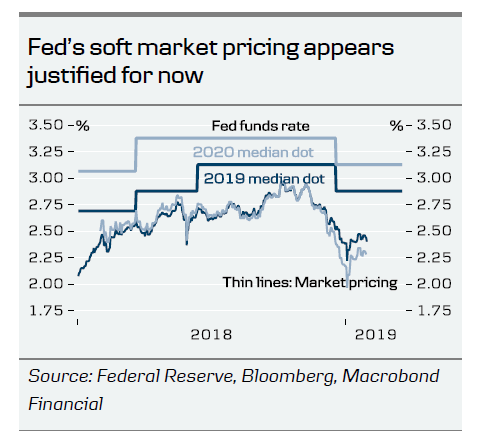
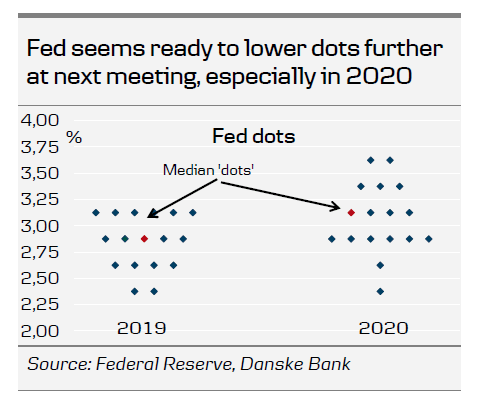
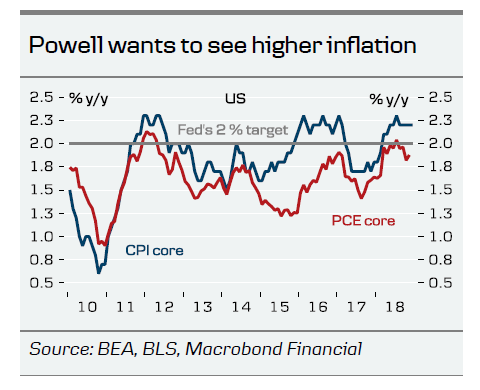
As widely expected, at the meeting the Fed did not raise its target range, which remains at 2.25-2.50%. More interesting was the statement filled with changes, which reflects what we heard in speeches ahead of the meeting. The Fed no longer says that it 'judges some further gradual increases' are needed, and the sentence on the balance of risk was also removed. Instead, the Fed now says it can afford to be 'patient' for now (a word that has appeared in many speeches ahead of the meeting) 'in light of global economic and financial developments and muted inflation pressure'. Fed Chair Powell said during his Q&A that higher inflation was 'big part' of what he needed to see before moving again. As noted in the FOMC minutes from the December meeting, the Fed now also recognises that market-based inflation expectations have fallen. All of the above is dovish but not a big surprise given the dovish signals in recent speeches.
Despite what we thought just a couple of months ago, the Fed does not seem to be on autopilot this year. Based on our positive macro outlook for the US and the global economy (and hence markets), we still expect the Fed to hike this year but it is no longer a given that the first one comes as early as June, which is our current base case. This is particularly true if Powell sticks to his ‘higher inflation is needed’, as we are less optimistic on the inflation outlook than the Fed is. In this light, we think current Fed market pricing seems fair for now although it is much more dovish than our base case. Markets also need to see the same things as the Fed before pricing in further hikes. We still think the Fed will end its hiking cycle this year.
The Fed also seems ready to end the balance sheet run-off sooner rather than later. The Fed released a statement saying 'the Committee is prepared to adjust any of the details for completing balance sheet normalisation in light of economic and financial developments'. While for a long time the Fed argued that the balance sheet reduction should be as boring as watching paint dry, we have highlighted several times that the Fed may be too optimistic on how much it can reduce the supply of reserves (see for example, Research US: Fed’s regulatory hurdle for starting QT, 13 March 2017, and FX Strategy: Rise in Fed funds could put early end to QT, 26 October 2018). Powell said that the Fed is now evaluating the balance sheet run-off and that the plans would be finalised 'at coming meetings'. This supports the view that Quantitative Tightening will end this year, perhaps by tapering the reduction pace soon. An announcement could come as early as the March meeting, or otherwise in May. We will have to look at the coming speeches to determine the exact timing, we believe.
The market welcomed the dovish signals, sending both EUR/USD and S&P500 higher. The message cements the sense of a ‘Fed on hold’, which is key to the FX market as this means the USD carry momentum is fading, notwithstanding a few more hikes down the road. The USD is vulnerable to such a shift as positioning likely remains stretched on USD longs. However, in order to see a sustained move higher from the recent range around 1.15, we believe the euro-zone cyclical outlook has to improve and this is not likely until late H1.
Fed Balance Sheet Shrinking Inches Closer Towards Ending
One Question Answered, While Others Remain
For months, a debate has been brewing behind the scenes about the future of monetary policy implementation in the United States. The unprecedented quantitative easing measures undertaken in the wake of the financial crisis led to a significant expansion of the Federal Reserve’s balance sheet and to changes in the way Fed mechanically controls short-term interest rates. Until this week, the Fed’s officially stated goal was to hold “no more securities than necessary to implement monetary policy efficiently and effectively.” This left open the door to two potential monetary policy regimes: the old “corridor” system of setting the fed funds rate via open market operations, or the new “floor” system of utilizing administered interest rates to lift short-term interest rates in a financial system awash with excess reserves.
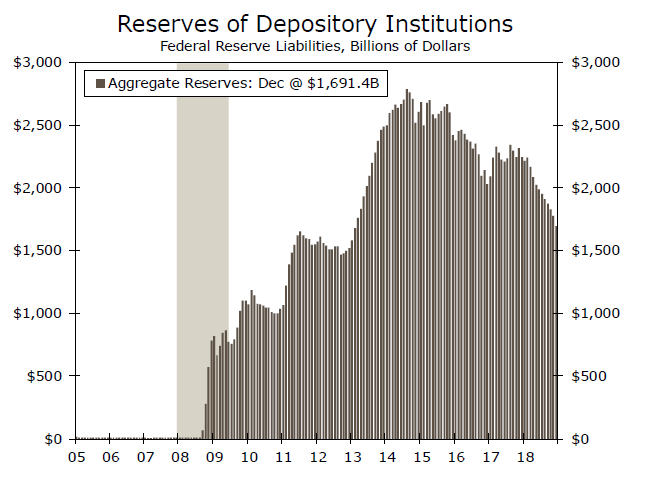
The economic and financial market implications of these two separate scenarios are quite significant. Under a corridor system, excess reserves must be sufficiently small for open market operations to have an impact on the fed funds rate. To accommodate this system, the Fed’s balance sheet would need to decline significantly to a level where excess reserves are close to zero, as was the case before the crisis (top chart). Because the Fed’s balance sheet is just that, a balance sheet, its asset holdings (mostly Treasuries and mortgage-backed securities) would also have to decline precipitously for years to come.
Under a floor system, the Fed can keep its balance sheet much larger, using direct, central bank administered rates to drive changes in money market rates more broadly. In a separate policy statement, the Fed affirmed its intention to maintain this system, stating that “the Committee intends to continue to implement monetary policy in a regime in which the level of the federal funds rate and other short-term interest rates is exercised primarily through the setting of the Federal Reserve’s administered rates, and in which active management of the supply of reserves is not required.”
While this answers one open question, several more remain. When and how will the Fed deem the level of reserves adequate? What will be the composition of the balance sheet going forward? Will the Fed turn to a new target rate given the changes and challenges in the fed funds market?
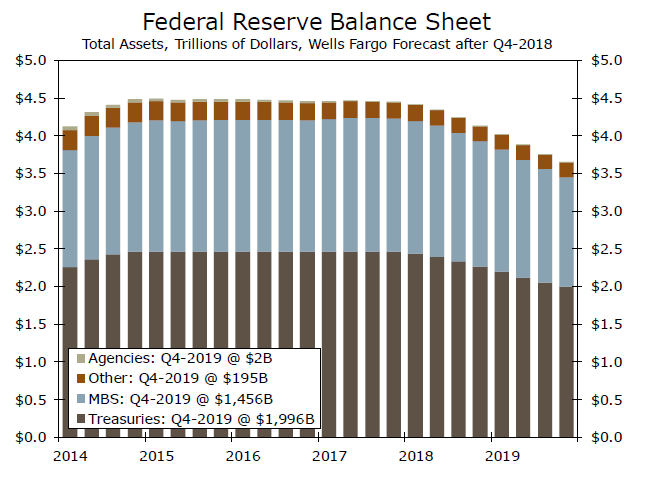
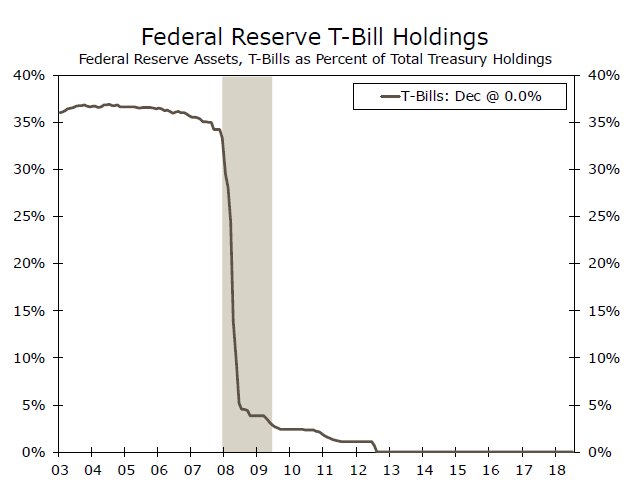
As we laid out last year, we continue to expect the balance sheet unwind to end sometime in late 2019/early 2020 at a total size of about $3.5 trillion (middle chart). After that, the balance sheet would begin to organically grow again in line with currency in circulation and other standard Federal Reserve liabilities. It would not surprise us to see the Fed’s MBS holdings decline even as the total balance sheet grows again, with MBS replaced by more Treasuries, particularly T-bills (bottom chart). For further reading on these topics, see our two part series on the Fed’s balance sheet normalization (Part I and Part II) and our report on ongoing changes in the fed funds market
FOMC Adopts A ‘Patient’ Stance
Fed Remains on Hold to the Surprise of Nobody
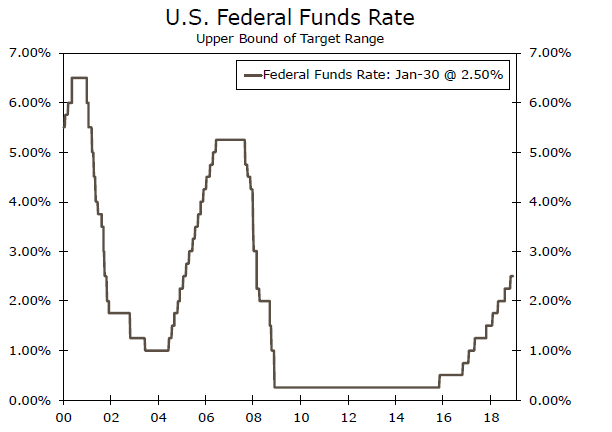
As widely expected, the Federal Open Market Committee (FOMC) decided today to keep its target range for the fed funds rate unchanged at 2.25% to 2.50% (top chart). There were no dissents among the 10 voting members of the committee. The decision to keep rates on hold had been widely expected by the market because most FOMC members had been indicating in recent public comments that the committee likely will be on hold for the foreseeable future as it watches incoming economic data.
Fed Can Be 'Patient'
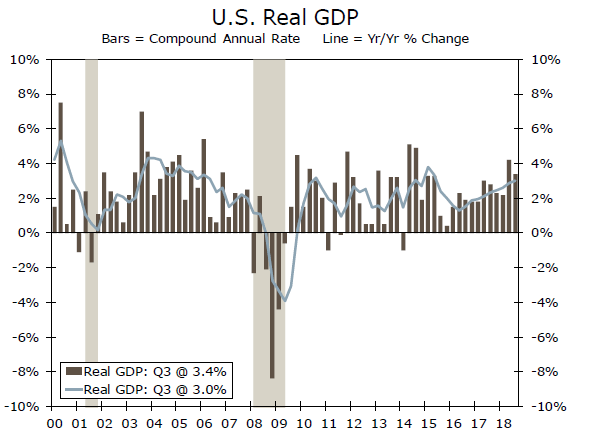
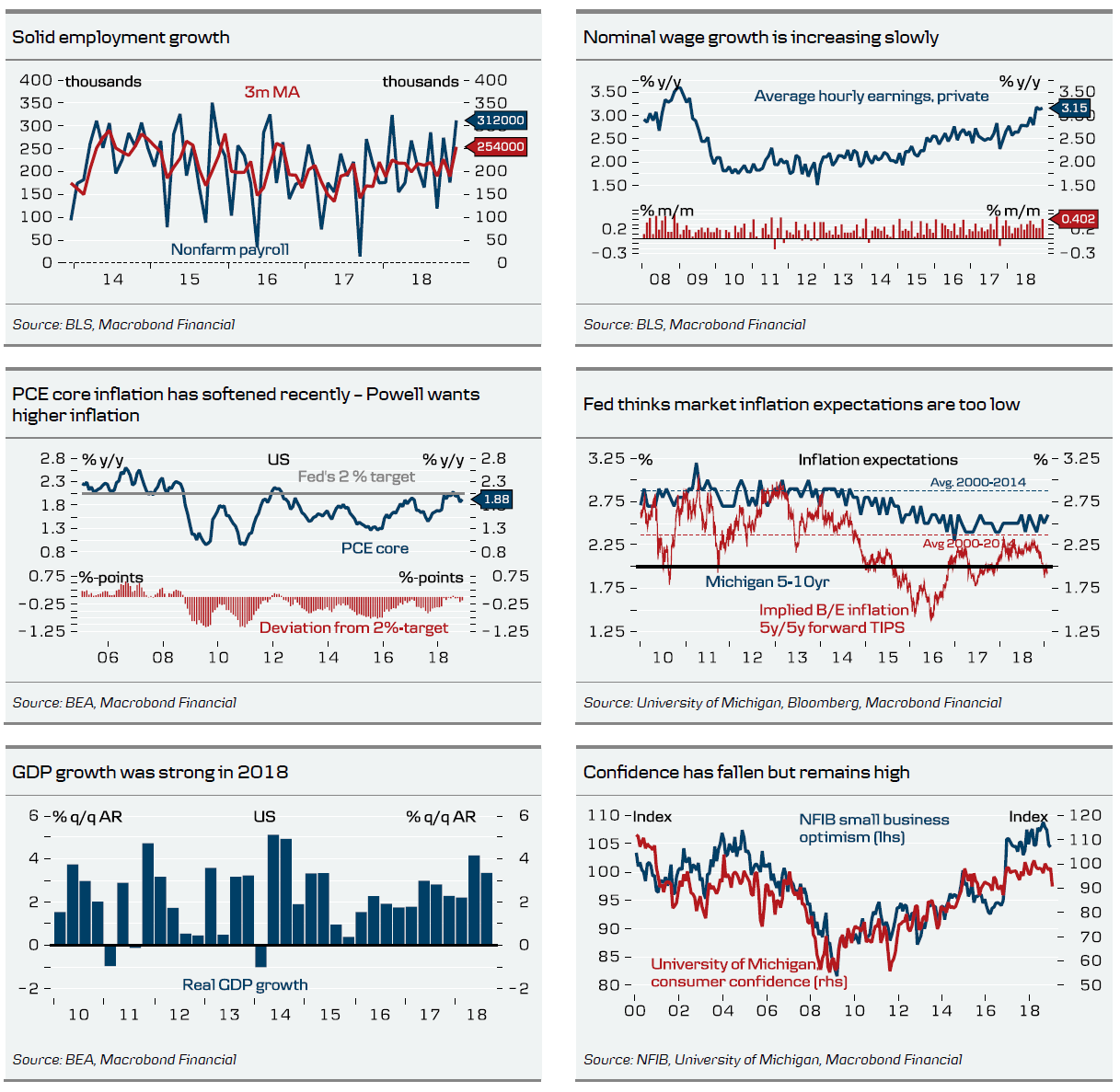
Of more interest was the statement that the FOMC released today, which we interpret as generally dovish. For starters, the committee downgraded its assessment of the economy. In December, the FOMC said that 'economic activity has been rising at a strong (emphasis ours) rate.' It now characterizes the pace of growth as solid. Indeed, GDP growth slowed in the third quarter (middle chart), and we estimate that growth slowed further in the fourth quarter and forecast that growth will downshift further in the first quarter of 2019.
Additionally, the committee removed its forward guidance. Following previous meetings, the FOMC had judged that 'some further gradual increases in the target range for the federal funds rate' would be needed to ensure that the economic expansion remained sustainable without inflation overshooting the Fed’s two percent objective. Although the committee maintains that continued economic expansion is still 'the most likely outcome,' the FOMC removed the reference to further rate hikes. Furthermore, the committee said that it can be 'patient' (emphasis ours) as it determines what future adjustments to the target range for the federal funds rate may be appropriate.
Next Rate Move: Up or Down?
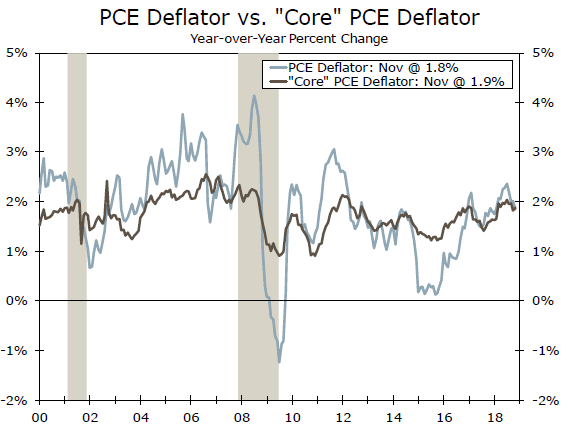
In short, the Fed is on hold for the foreseeable future. Indeed, the FOMC can afford to be patient because PCE inflation (the Fed’s preferred measure of consumer price inflation) is running at its target of 2% (bottom chart). So what is the next move for the fed funds rate? Will the Fed eventually hike rates again, or will it reverse course and cut rates? Or will it be on hold for an indefinite period of time?
In our view, another rate hike is the most likely outcome. We forecast that real GDP will grow at an annualized rate between 2.0% and 2.5% in coming quarters. If that forecast is reasonably close to being correct, then the unemployment rate, which is already near a 50-year low, likely will continue to trend lower, putting some upward pressure on wage inflation. We judge that the FOMC will opt to tap on the brakes again (i.e., raise rates by 25 bps) this summer and again at the end of the year. We then look for the Fed to remain on hold through much of 2020.