Sample Category Title
USD/CHF Mid-Day Outlook
Daily Pivots: (S1) 0.9917; (P) 0.9938; (R1) 0.9968; More....
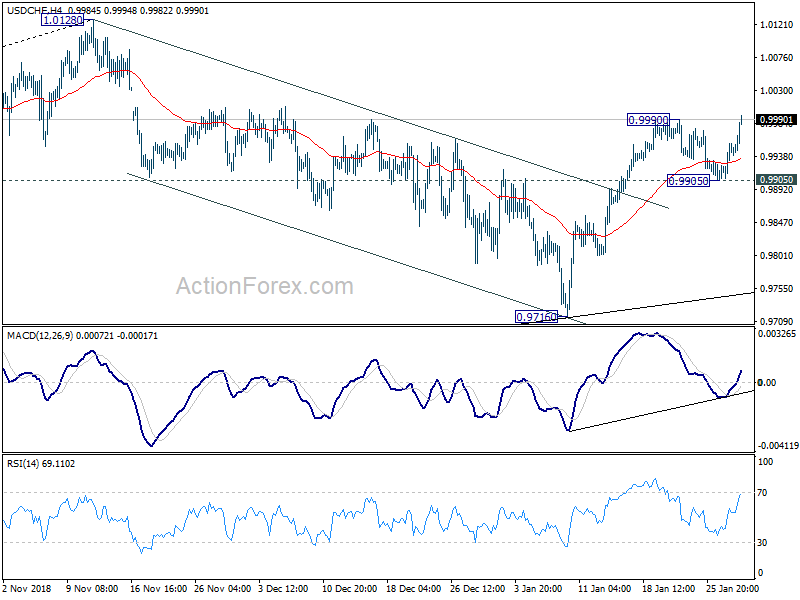
USD/CHF's strong rally and break of 0.9990 resistance suggests resumption of rise from 0.9716. Intraday bias is back on the upside. As noted before, corrective pull back from 1.0128 has completed at 0.9716 already. Rise from 0.9716 should target 1.0128 resistance next. On the downside, break of 0.9905 support is now needed to indicate completion of the rebound. Otherwise, outlook will remain bullish in case of retreat.
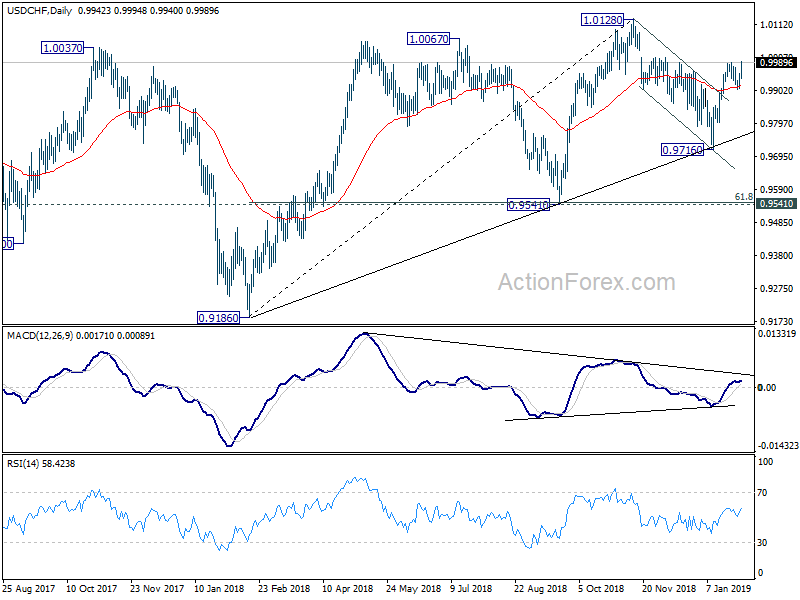
In the bigger picture, USD/CHF drew strong support from medium term trend line and rebounded. That suggests rise from 0.9186 is still in progress. Break of 0.9963 will affirm this bullish case. Further break of 1.0128 will confirm up trend resumption and target 1.0342 key resistance. Nevertheless, break of 0.9716 will dampen this bullish view and at least bring deeper fall to 0.9541 key support.
Dollar Surges after Strong ADP Job Data, FOMC Next
Dollar jumps notably in early US session against Swiss Franc and Yen following stronger than expected ADP job report. But strength in the greenback is not broad based. Traders are cautiously await FOMC statement and press conference, to see how cautious Fed would sound. There is prospect of a stronger comeback in Dollar should Fed doesn't sound dovish at all. In addition, any news from meeting of Chinese Vice Premier Liu He and US Trade Representative Robert Lighthizer will also be closely watched.
Staying in the currency markets, Australian Dollar remains the strongest one for today following stronger than expected CPI reading. Canadian Dollar follows closely with help from rebound in oil price. Sterling is mildly higher today as Brexit uncertainties continue. The Pound is the weakest for the week following yesterday's Brexit development. While UK Prime Minister Theresa May is seeking re-negotiation on Irish backstop, EU shows no sign of backing down from the stance of not reopening negotiation.
Technically, USD/CHF's break of 0.9990 resistance suggests resumption of rally from 0.9716. The pair should now head towards 1.0128 key resistance. USD/JPY will likely take on 110.00 resistance too. For now, AUD/USD is held below 0.7235 resistance, and thus, it's staying in near term consolidation. Similarly, USD/CAD is held above 1.3180 support and is staying in consolidation too.
In European markets, FTSE is up 1.67%. DAX is down -0.29%. CAC is up 0.75%. German 10-year yield is down -0.0123 at 0.191, back below 0.2 handle. Earlier in Asia, Nikkei closed down -0.52%. Hong Kong HSI rose 0.40%. China Shanghai SSE dropped -0.72%. Singapore Strait Times dropped -0.42%. Japan 10-year JGB yield dropped -0.0014 to 0.003.
US ADP employment grew 213k, job market weathered government shutdown well
US ADP report shows 213k job growth in private sector in January, well above expectation of 170K. Prior month's figure was revised down slightly from 271k to 263k.
Ahu Yildirmaz, vice president and co-head of the ADP Research Institute said in the release "the labor market has continued its pattern of strong growth with little sign of a slowdown in sight". And, there was "significant growth in nearly all industries, with manufacturing adding the most jobs in more than four years".
Mark Zandi, chief economist of Moody's Analytics, said, "The job market weathered the government shutdown well. Despite the severe disruptions, businesses continued to add aggressively to their payrolls. As long as businesses hire strongly the economic expansion will continue on."
FOMC forward guidance and balance sheet reduction plan watched
Fed is widely expected to keep federal funds rate unchanged at 2.25-2.50%. Since December, following extreme market volatility and cautious turn in Fedspeaks, pricing of Fed's rate path changed drastically. Fed funds futures are now only pricing in around 20% chance of a 25bps hike by the December meeting. Dollar then started weakening broadly. The greenback suffered another round selloff last week after a WSJ report suggesting that the Fed members are considering to end the balance sheet reduction plan earlier than previously expected.
The first focus today will be on forward guidance in the statement. Back in December, FOMC noted that "the Committee judges that some further gradual increases in the target range for the federal funds rate will be consistent with sustained expansion of economic activity, strong labor market conditions, and inflation near the Committee's symmetric 2 percent objective over the medium term."
But since then, Fed officials sung a chorus, saying that Fed can afford some patience before another rate move. And Fed chair Jerome Powell even indicated that Fed is flexible to move in either direction if necessary. Any change in the forward guidance that hints at a pause could give Dollar more pressure.
And secondly, Powell will need to indicate if there is any change in Fed's balance sheet reduction plan.
Irish Conveny urges UK May to hold her previous words on Irish backstop
Irish Foreign Minister Simon Conveny said today that the so called alternative arrangements for Irish backstop that UK is now seeking are options around time limits, exit clauses and technology. But he dismissed such options as "we have been through all of these things."
He added "we have tested them and we have found that they do not stand up to scrutiny, and now we have a British prime minister advocating again for the same things that were tested."
Conveny then complained that "What we are being asked to do here is to compromise on a solution that works and to replace it with wishful thinking. That's what's being asked of the Irish government and we won't do it."
In addition, he emphasized UK Prime Minister Theresa May has "outlined repeatedly that the backstop is not only desirable but necessary to reassure people in Northern Ireland so surely the responsible thing for the Irish government to do is to hold the British government to its word."
German CPI slowed to 1.4%, Gfk consumer confidence dropped to 10.8
German CPI dropped -0.8% mom in January, matched expectation. But annual rate slowed sharply to 1.4% yoy, down from 1.7% yoy, and missed expectation of 1.6% yoy. Today's German CPI miss should weigh on expectation for Eurozone CPI reading to be released later in the week, it's expected to slow to 1.4% yoy.
Germany Gfk consumer confidence rose 0.4 to 10.8 in February, above expectation of 10.3. Gfk noted that rising income prospects and an increasing propensity to buy mean that the consumer climate is improving once more. This is further reinforced by a decrease in propensity to save in January.
France GDP rose 0.3%, matched expectations
French GDP rose 0.3% qoq in Q4 2018, same pace as prior quarter and matched expectation. Looking at the details, household consumption expenditures decelerated (0.0% after +0.4%), likewise total gross fixed capital formation slowed down (GFCF: +0.2% after +1.0%). Overall, final domestic demand excluding inventory changes decelerated: it contributed 0.1 points to GDP growth, after 0.5 points in the previous quarter.
Imports bounced back in Q4 (+1.6% after −0.7%) and exports accelerated significantly (+2.4% after +0.2%). All in all, foreign trade balance contributed positively to GDP growth again: +0.2 points, after +0.3 points in Q3. Conversely, changes in inventories contributed negatively to GDP growth (−0.1 points after −0.5 points).
Also released in from Eurozone, Eurozone business climate dropped to 0.69 in January, economic confidence dropped to 106.2, industrial confidence dropped to 0.5, services confidence dropped to 11.0, consumer confidence was finalized at -7.9.
Swiss KOF dropped to 95.0, negative developments in manufacturing and services
Swiss KOF Economic Barometer dropped for he fourth time in a row to 95.0 in January, below expectation of 98.1. It's now 5pts below its long term average.
KOF noted that "The downward tendency that emerged at the end of last year continues. The economic outlook for Switzerland continues to dampen at the beginning of 2019". And, "this renewed decline is especially attributable to negative developments within the manufacturing industry and the service industry. In addition, export prospects cloud over."
Australia CPI slowed to 1.8%, but beat expectations
Australian CPI rose 0.5% qoq in Q4 versus expectation of 0.4% qoq. Annual rate slowed to 1.8% yoy, down from 1.9% yoy, but beat expectation of 1.7% yoy. RBA trimmed mean CPI rose 0.4% qoq, 1.8% yoy, matched expectations. RBA weighed media CPI rose 0.4% qoq, 1.7% yoy, basically matched expectations.
ABS Chief Economist, Bruce Hockman said: "Annual growth in the CPI remains below 2 per cent in the December quarter 2018, with annual growth in tradables inflation of just 0.6 per cent, while non-tradables inflation rose 2.4 per cent. Over the past four years, annual growth in the CPI has only risen above 2 per cent in two of the past 16 quarters."
Also release in Asian session, Japan retail sales rose 1.3% yoy in December, above expectation of 0.9% yoy. Consumer confidence dropped to 41.9 in January, down from 42.7, beat expectation of 42.5.
USD/CHF Mid-Day Outlook
Daily Pivots: (S1) 0.9917; (P) 0.9938; (R1) 0.9968; More....
USD/CHF's strong rally and break of 0.9990 resistance suggests resumption of rise from 0.9716. Intraday bias is back on the upside. As noted before, corrective pull back from 1.0128 has completed at 0.9716 already. Rise from 0.9716 should target 1.0128 resistance next. On the downside, break of 0.9905 support is now needed to indicate completion of the rebound. Otherwise, outlook will remain bullish in case of retreat.
In the bigger picture, USD/CHF drew strong support from medium term trend line and rebounded. That suggests rise from 0.9186 is still in progress. Break of 0.9963 will affirm this bullish case. Further break of 1.0128 will confirm up trend resumption and target 1.0342 key resistance. Nevertheless, break of 0.9716 will dampen this bullish view and at least bring deeper fall to 0.9541 key support.
Economic Indicators Update
| GMT | Ccy | Events | Actual | Forecast | Previous | Revised |
|---|---|---|---|---|---|---|
| 23:50 | JPY | Retail Trade Y/Y Dec | 1.30% | 0.90% | 1.40% | |
| 00:01 | GBP | BRC Shop Price Index Y/Y Jan | 0.40% | 0.30% | ||
| 00:30 | AUD | CPI Q/Q Q4 | 0.50% | 0.40% | 0.40% | |
| 00:30 | AUD | CPI Y/Y Q4 | 1.80% | 1.70% | 1.90% | |
| 00:30 | AUD | CPI RBA Trimmed Mean Q/Q Q4 | 0.40% | 0.40% | 0.40% | |
| 00:30 | AUD | CPI RBA Trimmed Mean Y/Y Q4 | 1.80% | 1.80% | 1.80% | |
| 00:30 | AUD | CPI RBA Weighted Median Q/Q Q4 | 0.40% | 0.50% | 0.30% | |
| 00:30 | AUD | CPI RBA Weighted Median Y/Y Q4 | 1.70% | 1.70% | 1.70% | 1.80% |
| 05:00 | JPY | Consumer Confidence Index Jan | 41.9 | 42.5 | 42.7 | |
| 06:30 | EUR | French GDP Q/Q Q4 | 0.30% | 0.30% | 0.30% | |
| 07:00 | EUR | German GfK Consumer Confidence Feb | 10.8 | 10.3 | 10.4 | |
| 08:00 | CHF | KOF Leading Indicator Jan | 95 | 98.1 | 96.3 | 96.4 |
| 09:30 | GBP | Mortgage Approvals Dec | 64K | 63K | 64K | |
| 09:30 | GBP | Money Supply M4 M/M Dec | 0.40% | 0.20% | 0.00% | 0.10% |
| 10:00 | EUR | Eurozone Business Climate Indicator Jan | 0.69 | 0.73 | 0.82 | 0.86 |
| 10:00 | EUR | Eurozone Economic Confidence Jan | 106.2 | 106.7 | 107.3 | 107.4 |
| 10:00 | EUR | Eurozone Industrial Confidence Jan | 0.5 | 0.6 | 1.1 | 2.3 |
| 10:00 | EUR | Eurozone Services Confidence Jan | 11 | 11.2 | 12 | 12.2 |
| 10:00 | EUR | Eurozone Consumer Confidence Jan F | -7.9 | -7.9 | -7.9 | -8.3 |
| 13:00 | EUR | German CPI M/M Jan P | -0.80% | -0.80% | 0.10% | |
| 13:00 | EUR | German CPI Y/Y Jan P | 1.40% | 1.60% | 1.70% | |
| 13:15 | USD | ADP Employment Change Jan | 213K | 170K | 271K | 263K |
| 15:00 | USD | Pending Home Sales M/M Dec | 1.10% | -0.70% | ||
| 15:30 | USD | Crude Oil Inventories | 3.0M | 8.0M | ||
| 19:00 | USD | FOMC Rate Decision (Upper Bound) | 2.50% | 2.50% | ||
| 19:00 | USD | FOMC Rate Decision (Lower Bound) | 2.25% | 2.25% |
Into US session: AUD and CAD strongest, but upside capped below near term resistance
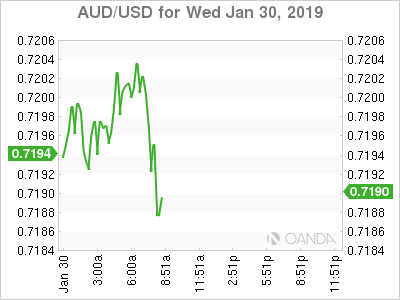
Entering into US session, Australian Dollar remains the strongest one for today following stronger than expected CPI reading. Canadian Dollar follows closely with help from rebound in oil price. However, AUD/USD is still held below 0.7235 resistance. USD/CAD is kept above 1.3180 support. Thus, both pairs are still bounded in near term consolidations.
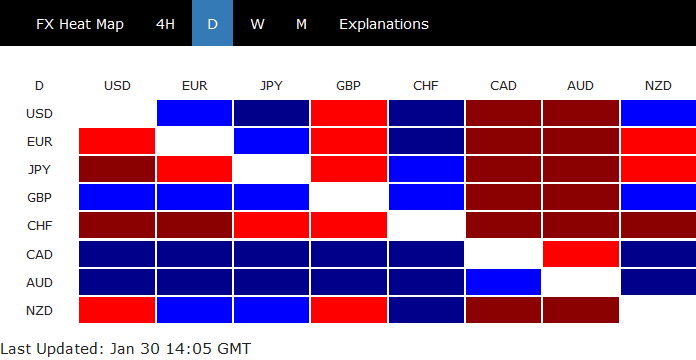
Instead, Dollar catches bids against both Yen and Swiss Franc after stronger than expected ADP job data. USD/CHF is already pressing 0.9990 resistance, with help from strong rally in EUR/CHF. USD/JPY is also heading back to 110.00. We might see upside breakout in these two pairs later in the session. But the greenback's fate will depend on FOMC statement and press conference, as well as any news on US-China trade negotiations.
Meanwhile, Sterling is mildly higher today as Brexit uncertainties continue. The Pound is the weakest for the week following yesterday's Brexit development. While UK Prime Minister Theresa May is seeking re-negotiation on Irish backstop, EU shows no sign of backing down from the stance of not reopening negotiation.
In European markets:
- FTSE is up 1.67%.
- DAX is down -0.29%.
- CAC is up 0.75%.
- German 10-year yield is down -0.0123 at 0.191, back below 0.2 handle.
Earlier in Asia:
- Nikkei closed down -0.52%.
- Hong Kong HSI rose 0.40%.
- China Shanghai SSE dropped -0.72%.
- Singapore Strait Times dropped -0.42%.
- Japan 10-year JGB yield dropped -0.0014 to 0.003.
Dollar Frozen ahead FOMC Decision and Start of High Level US-China Trade Talks
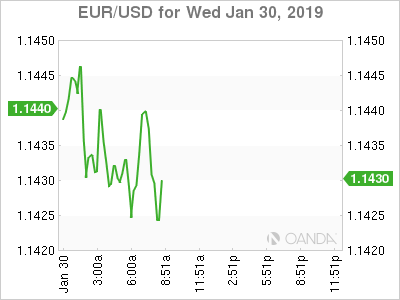
The US dollar appears frozen as parts of the Midwest brace for Antartic-like weather. The greenback may fall today if the Fed does sticks to the script of remaining patient and flexible.
The Fed is expected to deliver a dovish message and signal that they will be patient in raising rates. The Fed will begin their new communication strategy of having a press conference after all FOMC decisions this year. The Fed’s balance sheet reduction has been blamed for some of the selloff we saw since mid-December. The Fed initially planned to shrink the balance sheet by $2 trillion dollars, and investors will look for clues if they signal that it will end much sooner. Most economist expect the balance sheet runoff to continue for the rest of the year. The Chairman may provide a little more clarity on the balance sheet, but don’t expect specific levels.
The US-China 90-day trade truce is coming to an end on March 1st and today’s start of the two-day meeting with high level officials will tackle key core US demands on intellectual property rights and forced technology transfers. China has already delivered proposals on narrowing the trade gap buy purchasing goods, but we may see talks fail to reach any significant agreement on the core issues. Talks could very well fall apart this week as both sides attempt to outline key stances for negotiation purposes, but the door would be open for another round of talks.
Canadian Dollar Gains Ground as Investors Expect Dovish Fed Statement
USD/CAD has posted losses in the Wednesday session. Currently, the pair is trading at 1.3225, down 0.34% on the day. On the release front, there are no Canadian releases. In the U.S., the highlight is the Federal Reserve rate statement. With the Fed expected to remain on the sidelines, investors will be focusing on the rate statement, which is expected to be dovish in tone. The ADP nonfarm employment change fell to 213 thousand, but managed to beat the forecast of 180 thousand. On Thursday, the U.S. publishes Employment Cost Index and unemployment claims. Canada releases monthly GDP, which is expected to decline by 0.1%.
Will we see a breakthrough in the nasty U.S-China trade spat? The two largest economies in the world have imposed tariffs on each other’s products and triggered a global trade war. Investors are hopeful that a second round of talks between Chinese and U.S. officials, which start on Wednesday, will narrow the gaps between the sides. The trade war has taken a toll on the Canadian economy, which is heavily reliant on exports. U.S. Treasury Secretary Steven Mnuchin said he expects significant progress in the talks, but warned that the sides would have to tackle “complicated issues”. Tensions between China and the U.S. have escalated in recent weeks, with the U.S. Justice Department filing criminal charges against Huawei, a Chinese technology company. The U.S. is also trying to extradite a senior Huawei executive from Canada, which has caused a serious diplomatic crisis between Canada and China.
The Federal Reserve was aggressive in 2018, raising rates by a quarter-point on four occasions. With a nasty trade war dampening global economic growth, it is clear that the Fed will ease up on monetary policy this year. But, by how much? There are a various answers, depending on who you ask. The markets are not expecting any increases this year, while the Federal Reserve continues to stick with a forecast of two hikes. The Congressional Budget Office has also weighed in, saying that it expects further rate increases this year. Investors will be combing through the rate statement, looking for clues as to the timing of the next rate hike.
US ADP employment grew 213k, job market weathered government shutdown well
US ADP report shows 213k job growth in private sector in January, well above expectation of 170K. Prior month's figure was revised down slightly from 271k to 263k.
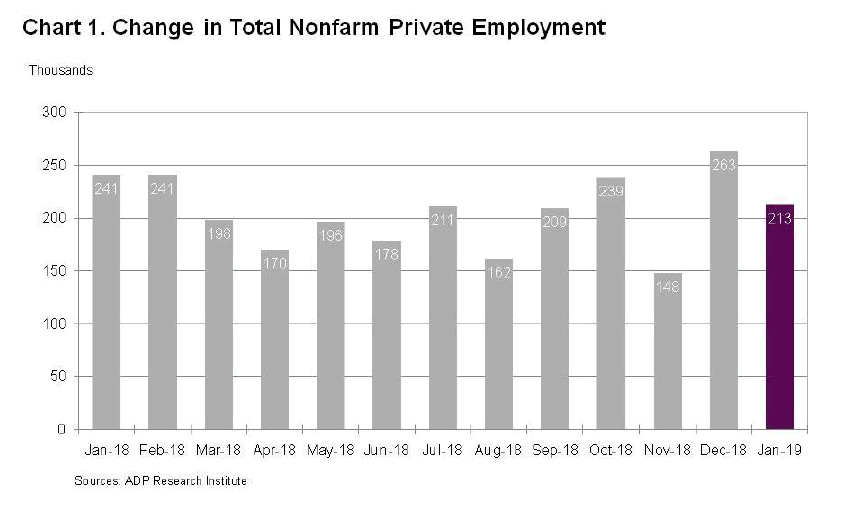
"The labor market has continued its pattern of strong growth with little sign of a slowdown in sight," said Ahu Yildirmaz, vice president and co-head of the ADP Research Institute. "We saw significant growth in nearly all industries, with manufacturing adding the most jobs in more than four years. Midsized businesses continue to lead job creation, however the share of jobs was spread a bit more evenly across all company sizes this month."
Mark Zandi, chief economist of Moody's Analytics, said, "The job market weathered the government shutdown well. Despite the severe disruptions, businesses continued to add aggressively to their payrolls. As long as businesses hire strongly the economic expansion will continue on."
Germany CPI slowed sharply to 1.4% in Jan, Euro shrugs
German CPI dropped -0.8% mom in January, matched expectation. But annual rate slowed sharply to 1.4% yoy, down from 1.7% yoy, and missed expectation of 1.6% yoy. Today's German CPI miss should weigh on expectation for Eurozone CPI reading to be released later in the week, it's expected to slow to 1.4% yoy.
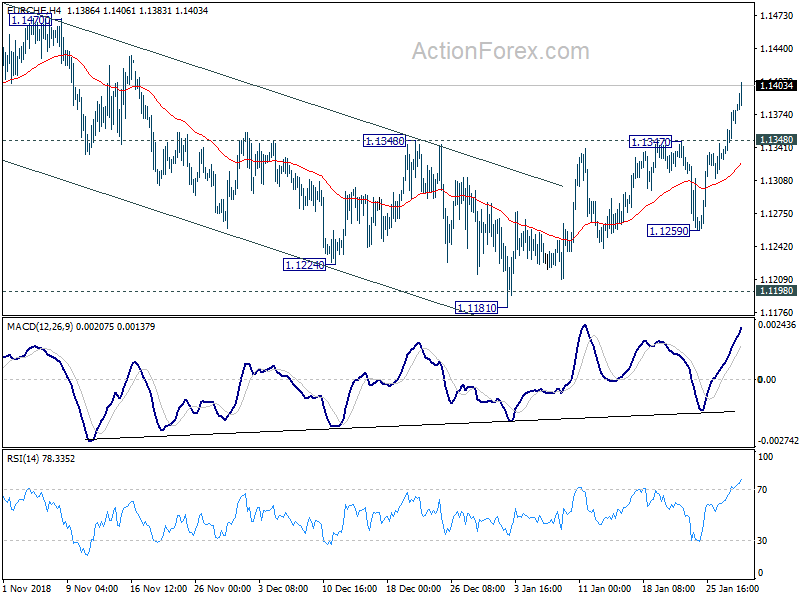
Euro shrugs off the data, nevertheless. In particular, EUR/CHF's rally is accelerating after taking out 1.1347 resistance yesterday.
Irish Conveny urges UK May to hold her previous words on Irish backstop
Irish Foreign Minister Simon Conveny said today that the so called alternative arrangements for Irish backstop that UK is now seeking are options around time limits, exit clauses and technology. But he dismissed such options as "we have been through all of these things."
He added "we have tested them and we have found that they do not stand up to scrutiny, and now we have a British prime minister advocating again for the same things that were tested."
Conveny then complained that "What we are being asked to do here is to compromise on a solution that works and to replace it with wishful thinking. That's what's being asked of the Irish government and we won't do it."
In addition, he emphasized UK Prime Minister Theresa May has "outlined repeatedly that the backstop is not only desirable but necessary to reassure people in Northern Ireland so surely the responsible thing for the Irish government to do is to hold the British government to its word."
EURJPY Creates Positively Aligned Channel in Near Term
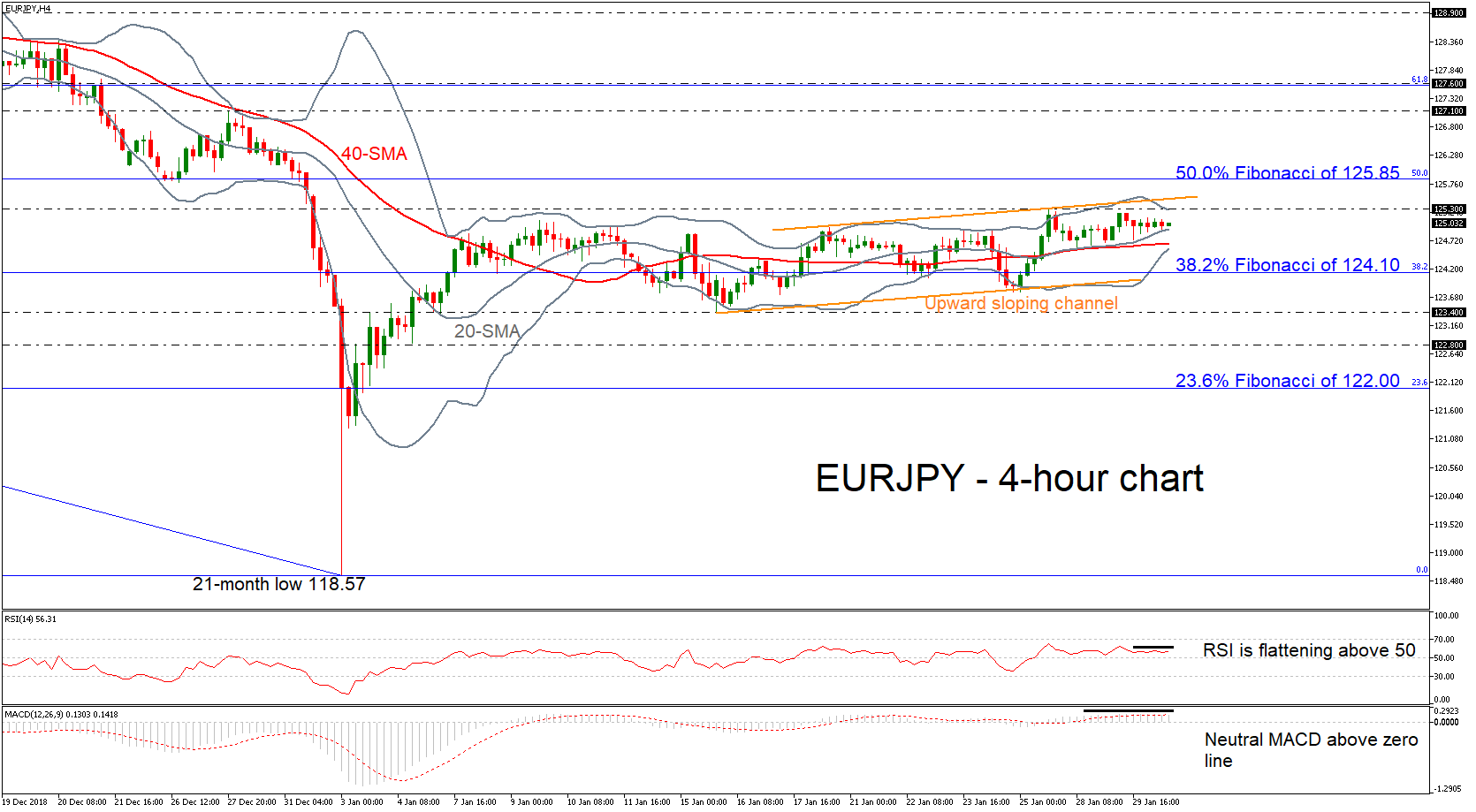
EURJPY has struggled within an upward sloping channel over the last couple of weeks finding strong resistance obstacle around the upper Bollinger band. According to the technical indicators, in the 4-hour chart, the RSI and the MACD are slightly losing momentum above the neutral threshold of 50 and the zero line respectively. It is worth mentioning, that the Bollinger bands are squeezing the price action, suggesting a possible strong break outside of the channel in either direction.
If the market pushes the pair higher above the upper Bollinger band, prices could challenge the 50.0% Fibonacci retracement level of the downleg from 133.10 to 118.57 around 125.85. More advances would likely open the door for the 127.10 resistance, taken from the highs on December 27.
On the flipside, if the market manages to turn to the downside again and slips back below the 20- and 40-simple moving averages (SMAs), the pair could touch the lower Bollinger band around 124.45. In case of an extension below these lines, the 38.2% Fibonacci of 124.40 could be in focus. Another step lower may reach the ascending trend line of the channel around 124.00.
In the longer timeframe, the price remains in a strong bearish structure following the pullback on 133.10 and only an advance above the 61.8% Fibonacci near 127.60 could confirm bullish correction mode.
Pound Rattled by Brexit Vote; FOMC in Focus
The Pound suffered sharp losses yesterday after an unforgettable night of votes in the British House of Commons revived fears of a ‘no-deal’ Brexit scenario.
Sterling was an easy target for bearish investors after MPs voted against the Cooper amendment that would have provided a safety net against a ‘no deal’ outcome. Although the passing of the Brady amendment came as a win for Theresa May, this proposal was immediately rejected by the European Union. With less than two months until the official Brexit divorce date and Brussels warning that the backstop is “not open for renegotiation”, the odds of an extension to Article 50 are rising. While this scenario has the potential to support the Pound as investors completely discount fears of a ‘no deal’ Brexit, the continued uncertainty will most likely cloud the currency’s medium- to longer-term outlook.
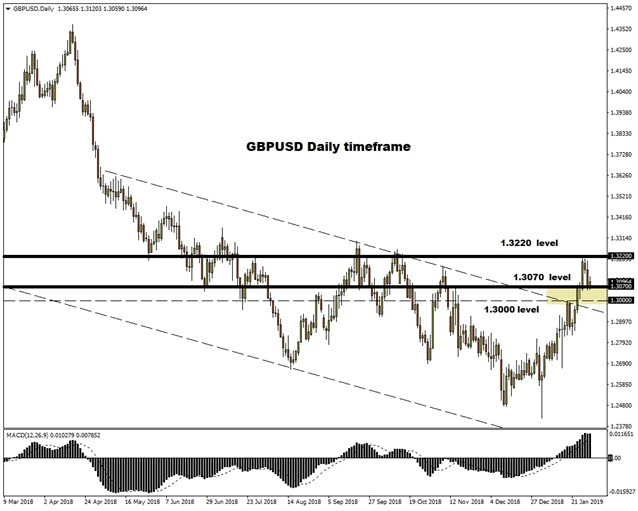
Taking a look at the technical picture, the GBPUSD is nursing its wounds today with prices trading marginally below 1.3100 as of writing. Although the trajectory points to further upside, Brexit developments have the ability to overshadow the technicals. Bulls have the ability to push prices back towards 1.3220 as long as 1.3000 proves to be reliable support. Alternatively, a breakdown and daily close under the psychological 1.3000 level is likely to invite a decline towards 1.2940.
Dollar waits on FOMC meeting
Across the Atlantic, much attention will be directed towards the FOMC meetingthis evening which is expected to conclude with monetary policy being left unchanged.
Investors will be paying extra attention towards the language in the policy statement to see whether the Fed signals a pause in rate hikes. With the US government shutdowndelayingthe release of important economic data and uncertainty over trade talks weighing on sentiment, it may be tricky assessing how the US economy has performed. Although the Dollar continues to benefit from safe-haven flows, buying sentiment is seen taking a hit if the Fed sounds more dovish than expected.
Focusing on the technical picture, the Dollar Index is under pressure on the daily charts. Sustained weakness below 96.00 is likely to encourage a decline back towards 95.50 and 95.28, respectively.
Commodity spotlight – Gold
It has been an incredibly positive trading week for Gold thus far thanks to market caution and investors clearly avoiding riskier assets in favour of safe-haven investments.
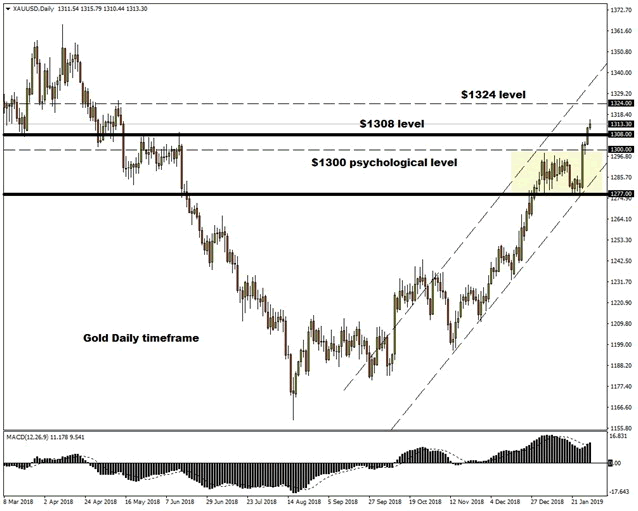
For as long as US-China trade tensions, concerns over slowing global growth and Brexit drama continue to weigh on risk appetite, Gold is seen shining throughout the trading week. The zero-yielding metal is poised to receive a welcome boost if the Federal Reserve adopts a dovish tone. With the fundamentals driving Gold marrying the technical, we see vast upside potential. The daily close above $1,308 is seen opening a path towards $1,316 and $1,324, respectively.