

Sample Category Title
FOMC Statement Enshrines “Patient” Approach to Future Policy Moves
Highlights:
- As expected, the target range for the fed funds rate was held steady at 2.25-2.50% in a unanimous decision. The current rate is at the lower end of the range of estimates of the longer-run neutral policy rate.
- Their tightening bias was replaced with language that emphasizes a “patient” approach to future policy adjustments—consistent with recent messaging from a number of committee members.
- The statement no longer characterized risks to the economic outlook as “roughly balanced,” but a sustained expansion remains the Fed’s base case.
- In a separate statement on monetary policy implementation, the committee said they’re prepared to adjust the details for completing balance sheet normalization in light of “economic and financial developments.” That should help assuage some investors’ fears that balance sheet normalization is on autopilot. Powell also confirmed that the FOMC will continue with their current rate-setting framework indefinitely, meaning an “ample supply of reserves” will be needed.
Our Take:
The FOMC left rates unchanged today and made some dovish changes to their policy statement that left it more in line with recent messaging from a number of committee members. Most notably, reference to “some further gradual” rate hikes was dropped. Instead, the Fed will be “patient” in determining whether further policy adjustments are warranted. That shift was motivated by global economic and financial market developments and muted inflation pressures. Chairman Powell elaborated on some of those “cross currents” in his press conference, noting further signs of slowing global growth (particularly in Europe and China), persistent uncertainty over trade policy, some sustained tightening in financial conditions (despite recent improvement), and a government shutdown that will impact Q1 growth (and hasn’t been fully resolved at this point). He also indicated that inflation trends and financial stability risks don’t point to a pressing need for tighter monetary policy. Summing things up, Powell noted the case for raising rates has weakened. The overall message was even more dovish than markets expected, sending Treasury yields lower (particularly at the front end) and boosting equities.
While “cross currents” suggest risk of a less favourable outlook, the Fed still sees sustained economic expansion, strong labour markets, and near-2% inflation as “the most likely outcomes.” We agree with that assessment, and our central expectation is that the Fed will raise rates twice this year with the next hike coming in June. But with the committee no longer holding an explicit tightening bias, the bar for a near-term move has been raised. Unless some of the risks clouding the economic outlook are resolved in short order, or inflation starts to pick up more significantly, we might not see any moves from the Fed until later this year.
Market Morning Briefing: Euro Has Risen Sharply In Line With Our Expectation
STOCKS
The Dow (yesterday) and Asians (today) have recovered a bit due to the FOMC fillip, but not yet become clearly bullish. Nor are they clearly bearish now. Maybe we have to live with indecision for a few days.
Solid rise in the Dow (25014.86, +434.90, +1.77%) yesterday after Powell said he will be "patient" with rate hikes. The Dow has closed just above 25000, the crucial resistance we were looking at. If the rally sustains today, then it may prove our earlier bearishness towards 24000 to be incorrect.
Surprisingly, the DAX (11181.66, -37.17, -0.33%) did not move up yesterday, despite us being ready to consider a rally and the Dow rallying well. It is still jammed in a "could go either way" place on the 3-day Candles, with equal chances of a dip to 10900 as of a further rally to 11500.
Contrary to our near-term bearishness, the Nikkei (20714) is trading higher today after dipping to 10557 yesterday. Unable to figure out direction now it seems. Resistance available in the 20800-21000 region; Support in the 20500-400 region. Maybe we just need to stand back and see how the price behaves around these over the next few days.
The Shanghai (2584) could be rallying from the 2550 Support (low of 2559 was seen on Wednesday), but needs to rise past 2600-2660 to acquire bullishness.
Also, the Sensex (35591.25, -1.25, 0.00%) and Nifty (10651.80, -0.40, 0.00%) did not see follow-through sales yesterday, despite breaking below Supports the day before. Maybe they will move up a bit along with the other markets today? As with the others, will need to see if the rally sustains or not.
COMMODITIES
Precious metals have risen and looks bullish for the near term. Copper is bullish while above 2.75. Crude may also see some rise in the next few sessions.
Sharp rise seen in Gold (1323.40) and Silver (16.04). The FED signaled an end to the interest rate hike cycle. The FED, post yesterday's meeting seemed to reverse the communication made in the Dec'18 meet where 2 more rate hikes were expected in 2019. The dovish comments might have triggered a rise in the previous metals. While the rise continues, Gold could see a rise towards 1330-1350 on the upside while Silver could test 16.55 before starting to come off from there.
Crude prices are trading higher. Crude rose after the EIA weekly report showed a less than expected rise in the US stockpiles. This is mainly because of decrease in imports especially from Saudi Arabia. Crude inventories rose 919000 barrels against an expectation of 3.2 mln barrels for the week ended 25th Jan.
Brent (62.05) and WTI (54.59) have risen. Although Brent has broken above the trend resistance near 62, we would turn bullish for the near term only on a break above 65 (near term horizontal resistance). On WTI, while the break above 54.50 holds, it could enable a rise towards 58 in the near term. On the daily line chart, WTI has 13-day Ma and 21-Ma as supports near 52 and if that holds well, it could be an indication of a bullish signal. We need to watch for a break above 65 on Brent while WTI may head towards 56-58 levels.
Copper (2.7755) has risen sharply breaking above 2.75.This if sustains, is a crucial bullish signal for the medium term towards 3. For now, while above 2.75, we may look for a rise towards 2.80-85. Immediate view is bullish while above 2.75.
FOREX
The FED kept interest rates unchanged. Dovish comments post the meet has lead to a fall in the Dollar Index. Most currencies are trading strong against the Dollar but we need to see if this is temporary or the current move sustains for the medium term.
Dollar Index (95.25) has come off as expected and could test 95 on the downside. 95.0-94.75 is a decent support on the 3-day and weekly charts and is likely to hold in the medium term. Over today and tomorrow Dollar Index could trade weak.
Euro (1.1503) has risen sharply in line with our expectation. A rise towards 1.16-1.1650 could be on the cards if the current upward momentum stays intact. Daily candle show trend resistance at 1.16 while 1.15 is also a decent resistance. A break above 1.1650 is needed to look at fresh bullishness for the Euro. For now we expect 1.15-1.1650 resistance zone to hold.
Dollar Yen (108.81) is heading towards 108 as expected and a test of 108 in the next couple of sessions could negate a rise back to levels above 110 in the near term. A test of 108 is possible followed by a bounce thereafter.
Pound (1.3135) is likely to trade sideways in the 1.32-1.30 region for the next few sessions.
Aussie (0.7267) has moved up sharply on strength in the commodities especially Copper. Immediate trend resistance is seen near 0.73 which if breaks on the upside could turn bullish for the medium term towards 0.74 and higher. Watch price movement near 0.73.
USD-CNY (6.7044) could test 6.65 on the downside before pausing within the current downmove. Immediate support is seen at 6.65.
Dollar Rupee (71.12) came off after opening near 71.36 yesterday. While upside resistance zone of 71.40/60 holds, we could possibly see a test of 71.0-70.9 levels again. At the same time rise in Brent could keep Dollar-Rupee higher. Overall the broad 70.90-71.40/60 region is likely to hold in the near term.
INTEREST RATES
The FOMC said it will be patient about raising rates. Music to the ears of the bond market. Yields fell across the Curve. Good dip in the US 2Yr (2.51%, down from 2.58%) and 5Yr (2.49%, down from 2.56%), both down a good 7bp.
The US 10yr (2.68%, down from 2.73%) and 30Yr (3.03%, down from 3.05%) also fell, but by 5bp and 2bp respectively, much less than the 7bp dip on the 2yr. As a result, the 10-2 Spread (0.17%) and the 30-2 Spread (0.52%) have actually moved up from 0.15% and 0.47% earlier, steepening the Curve in the process. Same with the 10-5 and 30-5 Spreads as well. This might be good news for the Equity markets.
As mentioned yesterday, we see chances of further dip in yields towards 2.50% (2Yr); 2.45% (5Yr); 2.60% (10Yr) and 2.85% (30yr).
The German-US 2Yr Spread (-3.07%) and German-US 10Yr Spread (-2.49%) have both shot up over the last two days, from 3.19% and -2.56% respectively, giving a boost to the Euro (1.1503).
Let us see whether the Fed's new found dovishness will find an echo with the RBI on 7th Feb. Before that the Budget (only a Vote on Account) is to be presented tomorrow. The 10Yr GOI (7.5515%) is holding above 7.50/48% but below 7.59% and could probably range in the 7.60-7.50% region for a few more days.
FOMC Review – Fed Calls for Patience on Further Rate Hike
The Fed addressed the issues we are concerned with, in quite a dovish tone, at the January meeting. As widely anticipated, the Fed funds rate stayed unchanged at 2.25-2.5%. The members removed the forward guidance of gradual interest rate increases. They called for patience on further normalization, as inflation pressured has eased and uncertainties in the global economic and financial developments have intensified. Despite growing worries over the global developments, the Fed remained upbeat about the US economy. This suggests that the next move in the monetary policy should still be a hike. The Fed added that they are prepared to adjust the details of the balance sheet normalization in response to the change in economic developments. The market views that as implication that the balance sheet reduction plan could end earlier than previous anticipated, and/ or the size of reduction would be trimmed. Indeed, the Fed has not revealed how much it has intended to shrink the balance sheet. As the reduction plan has been in progress more than a year, it is prudent to assess the situation and communicate with the market its intended size of the balance sheet.
Slight Downgrade on Economic Assessment
As we have anticipated, the Fed slightly downgraded its economic assessment. At the accompanying statement, it noted that “economic activity has been rising at a solid rate”, compared to previous description of “strong”. However, the Fed reiterated the view of “sustained expansion of economic activity, strong labor market conditions, and inflation near the Committee’s symmetric 2% objective”. On inflation, the latest statement added that “market- based measures of inflation compensation have moved lower in recent months”. Yet, it retained previous view that indicators of “longer- term inflation expectations are little changed”.
Calling for Patience in Future Rate Adjustment
The close-watched forward guidance has been removed. In the past, the Fed used to indicate that there would be “some further gradual increases in” the Fed funds rate and suggest that “risks to the economic outlook are roughly balanced”. This time, the Fed noted that it would be “patient as it determines what future adjustments” to the policy rate, due to “global economic and financial developments and muted inflation pressures”. Meanwhile, it removed the risk bias, implying that the members themselves do not have conviction on the risks to the economic outlook.
Balance Sheet Normalization
The Fed released the “Statement Regarding Monetary Policy Implementation and Balance Sheet Normalization”, together with the policy statement. The key message is that the Committee is “prepared to adjust any of the details for completing balance sheet normalization in light of economic and financial developments”. Also, the Committee would be “prepared to use its full range of tools, including altering the size and composition of its balance sheet, if future economic conditions were to warrant a more accommodative monetary policy than can be achieved solely by reducing the federal funds rate”. At the press conference, Chair Jerome Powell suggested that the members would “in coming meetings” discuss the balance sheet plan. The market views that as implication that the balance sheet reduction plan could end earlier than previous anticipated, and/ or the size of reduction would be trimmed. We are rather neutral on this matter. Indeed, the Fed has not revealed how much it has intended to shrink the balance sheet despite the fact that the reduction plan has been in progress more than a year. It is prudent to assess the situation and communicate with the market its intended size of the balance sheet.
EUR/GBP Could Continue To Rebound In Near Term
Key Highlights
- The Euro formed a solid support near 0.8620 and recovered against the British Pound.
- There was a break above a crucial bearish trend line with resistance at 0.8660 on the 4-hours chart of EUR/GBP.
- The Euro Zone Economic Confidence Index in Jan 2019 declined from 107.4 to 106.2.
- Today, the Euro Zone GDP figure for Q4 2018 (Prelim) will be released, which could grow 0.2% (QoQ).
EURGBP Technical Analysis
This past week, the Euro declined sharply from the 0.8800 resistance zone against the British Pound. The EUR/GBP pair even broke the 0.8700 support before buyers appeared above the 0.8600 support.
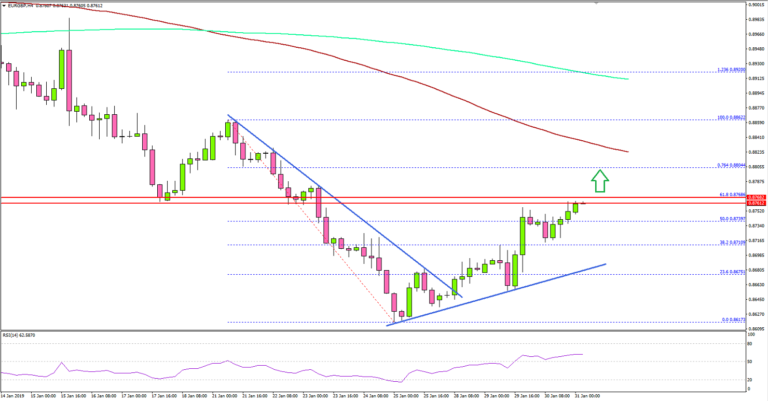
Looking at the 4-hours chart, the pair traded as low as 0.8617 and later formed a solid support near 0.8620. As a result, the pair started a decent recovery and moved above the 0.8650 resistance.
The pair broke the 38.2% Fib retracement level of the recent drop from the 0.8862 high to 0.8617 low. Moreover, there was a break above a crucial bearish trend line with resistance at 0.8660. It opened the doors for more gains and the pair traded above the 0.8700 resistance.
However, the pair struggled to hold gains above the 0.8750 level and the 50% Fib retracement level of the recent drop from the 0.8862 high to 0.8617 low. Therefore, there could be a couple of swing moves, but the pair is likely to remain supported near 0.8680.
On the upside, buyers need to surpass the 0.8770-80 resistance area in a convincing manner. If they continue to struggle, there could be a bearish reaction below the 0.8680 and 0.8650 support levels.
Fundamentally, the Euro Zone Economic Confidence Index for Jan 2019 was released by the European Commission. The market was looking for a drop in the index from the last reading of 107.3 to 106.8.
The actual result was lower than the forecast as the Euro Zone Economic Confidence Index declined to 106.2. On the positive side, the last reading was revised up from 107.3 to 107.4. More importantly, the Business climate indicator declined from the last revised reading of 0.86 to 0.69.
Overall, both EUR/USD and EUR/GBP were under pressure after the release, but they both are trading above key support levels.
Economic Releases to Watch Today
- German Retail Sales for Dec 2018 (MoM) – Forecast -0.6%, versus +1.4% previous.
- German Retail Sales for Dec 2018 (YoY) – Forecast 0.6%, versus 1.1% previous.
- Germany’s Unemployment Change for Jan 2019 – Forecast -10K, versus -14K previous.
- Germany’s Unemployment Rate for Jan 2019 – Forecast 5.0%, versus 5.0% previous.
- Euro Zone GDP Q4 2018 (QoQ) (Prelim) – Forecast 0.2%, versus 0.2% previous.
- Euro Zone GDP Q4 2018 (YoY) (Prelim) – Forecast 1.2%, versus 1.6% previous.
- US Initial Jobless Claims – Forecast 199K, versus 215K previous.
Daily Markets Broadcast
Wall Street gains on patient Fed
The US FOMC kept rates unchanged at yesterday's meeting, as expected, and removed the reference to gradual rate increases in the accompanying statement. Day two of the US-China trade negotiations gets under way. China's January manufacturing PMI beats estimates.
US30USD Daily Chart
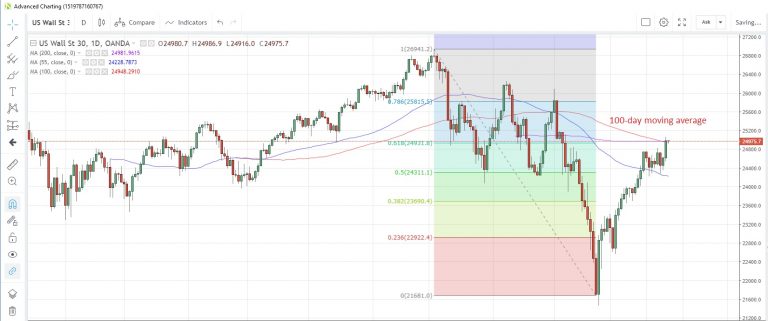
The US30 index advanced yesterday as Fed Chairman Powell said the case for raising rates had been weakened somewhat.
The index traded above the 100-day moving average at 24,959 yesterday for the first time since December 4
The Fed also said it is prepared to adjust balance sheet normalization in light of economic and financial developments, implying they stood ready to scale back the tapering of its quantitative tightening activities.
DE30EUR Daily Chart
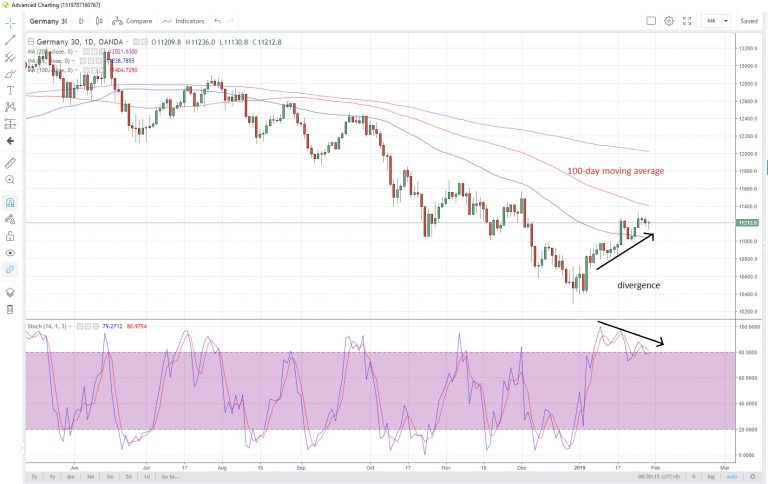
The Germany30 index closed little changed yesterday as European sentiment indicators produced mixed results with a weaker bias
Possible bearish divergence unfolding on the daily stochastics indicator, which suggests the 100-day moving average at 11,404 will hold for now
Euro-zone Q4 GDP growth is scheduled to be released today. It's expected to dip to +1.2% y/y from +1.6%. A deeper slowdown could be negative for the index.
CN50USD Daily Chart
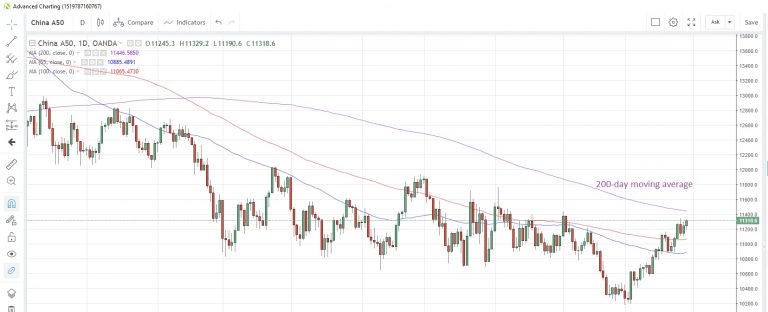
Chinese shares advanced for a second day yesterday as the US-China trade negotiations got under way in Washington
The China50 index is edging toward the 200-day moving average at 11,447, which has capped prices since April 13 last year
China's January manufacturing PMI came in at 49.5, topping estimates of a 49.3 reading. The non-manufacturing index rose to 54.7 from 53.8 in December.
Gold Rally Takes Pause Ahead Of Fed Rate Statement
Gold is unchanged in the Wednesday session. In North American trade, the spot price for one ounce of gold is $1311.64, up 0.01% on the day. On the release front, investors are awaiting the conclusion of the Federal Reserve monthly meeting. With the Fed expected to remain on the sidelines, investors will be focusing on the rate statement, which is expected to be dovish in tone. The ADP nonfarm employment change fell to 213 thousand, but still beat the estimate of 180 thousand. On Thursday, the U.S. publishes Employment Cost Index and unemployment claims.
Gold is sensitive to interest rate moves, so traders should treat the Federal Reserve rate statement as a market-mover. The Fed was aggressive in 2018, raising rates by a quarter-point on four occasions. With a nasty trade war dampening global economic growth, it is clear that the Fed will ease up on monetary policy this year. But, by how much? There are a various answers, depending on who you ask. The markets are not expecting any increases this year, while the Federal Reserve continues to stick with a forecast of two hikes. The Congressional Budget Office has also weighed in, saying that it expects further rate increases this year. Investors will be combing through the rate statement, looking for clues as to the timing of the next rate hike.
Will the gold rally continue? The metal has sparkled, jumping 7.5% in Q4 adding another 2.2% in January. The metal is at 8-month highs, benefitting from geopolitical hotspots such as the U.S-China trade war, Brexit, and a more dovish Federal Reserve. Investors remain cautious, and safe-haven gold has been an attractive alternative to the recent turmoil in the equity markets.
Eco Data 1/31/19
[php_everywhere instance="1"]
Fed drops tightening bias, stress patience, dollar dives
Fed left federal funds rate unchanged at 2.25-2.50% as widely expected. The most important change in the statement is that Fed dropped the language that "some further gradual increases in the target range for the federal funds rate will be consistent..."
Instead, Fed now said "the Committee will be patient as it determines what future adjustments to the target range for the federal funds rate may be appropriate".
That's a rather drastic change and dollar drops broadly after the release.
Full statement below.
Federal Reserve Issues FOMC Statement
Information received since the Federal Open Market Committee met in December indicates that the labor market has continued to strengthen and that economic activity has been rising at a solid rate. Job gains have been strong, on average, in recent months, and the unemployment rate has remained low. Household spending has continued to grow strongly, while growth of business fixed investment has moderated from its rapid pace earlier last year. On a 12-month basis, both overall inflation and inflation for items other than food and energy remain near 2 percent. Although market-based measures of inflation compensation have moved lower in recent months, survey-based measures of longer-term inflation expectations are little changed.
Consistent with its statutory mandate, the Committee seeks to foster maximum employment and price stability. In support of these goals, the Committee decided to maintain the target range for the federal funds rate at 2-1/4 to 2-1/2 percent. The Committee continues to view sustained expansion of economic activity, strong labor market conditions, and inflation near the Committee's symmetric 2 percent objective as the most likely outcomes. In light of global economic and financial developments and muted inflation pressures, the Committee will be patient as it determines what future adjustments to the target range for the federal funds rate may be appropriate to support these outcomes.
In determining the timing and size of future adjustments to the target range for the federal funds rate, the Committee will assess realized and expected economic conditions relative to its maximum employment objective and its symmetric 2 percent inflation objective. This assessment will take into account a wide range of information, including measures of labor market conditions, indicators of inflation pressures and inflation expectations, and readings on financial and international developments.
Voting for the FOMC monetary policy action were: Jerome H. Powell, Chairman; John C. Williams, Vice Chairman; Michelle W. Bowman; Lael Brainard; James Bullard; Richard H. Clarida; Charles L. Evans; Esther L. George; Randal K. Quarles; and Eric S. Rosengren.
(FED) Federal Reserve Issues FOMC Statement
Information received since the Federal Open Market Committee met in December indicates that the labor market has continued to strengthen and that economic activity has been rising at a solid rate. Job gains have been strong, on average, in recent months, and the unemployment rate has remained low. Household spending has continued to grow strongly, while growth of business fixed investment has moderated from its rapid pace earlier last year. On a 12-month basis, both overall inflation and inflation for items other than food and energy remain near 2 percent. Although market-based measures of inflation compensation have moved lower in recent months, survey-based measures of longer-term inflation expectations are little changed.
Consistent with its statutory mandate, the Committee seeks to foster maximum employment and price stability. In support of these goals, the Committee decided to maintain the target range for the federal funds rate at 2-1/4 to 2-1/2 percent. The Committee continues to view sustained expansion of economic activity, strong labor market conditions, and inflation near the Committee's symmetric 2 percent objective as the most likely outcomes. In light of global economic and financial developments and muted inflation pressures, the Committee will be patient as it determines what future adjustments to the target range for the federal funds rate may be appropriate to support these outcomes.
In determining the timing and size of future adjustments to the target range for the federal funds rate, the Committee will assess realized and expected economic conditions relative to its maximum employment objective and its symmetric 2 percent inflation objective. This assessment will take into account a wide range of information, including measures of labor market conditions, indicators of inflation pressures and inflation expectations, and readings on financial and international developments.
Voting for the FOMC monetary policy action were: Jerome H. Powell, Chairman; John C. Williams, Vice Chairman; Michelle W. Bowman; Lael Brainard; James Bullard; Richard H. Clarida; Charles L. Evans; Esther L. George; Randal K. Quarles; and Eric S. Rosengren.
EU Juncker: No Brexit renegotiation, Ireland’s border our border and joint priority
EU continued to pour cold water on UK's intention to reopen Brexit negotiation. European Commission President Jean-Claude Juncker told the European Parliament that "the Withdrawal Agreement remains the best and only deal possible." He added that "The debates and votes in the House of Commons yesterday will not change that. The Withdrawal Agreement will not be renegotiated."
Juncker also emphasized "Ireland's border is EU's border and is our joint priority," and "Yesterday's vote has further increased the risk of a disorderly Brexit." Though, he remained optimistic that "there can and will be agreement with UK."