Sample Category Title
Japanese Yen Ticks Higher, Retail Sales Ahead
USD/JPY continues to have a quiet week. In Monday’s North American session, the pair is trading at 109.50, up 0.14% on the day. There are only two releases on the schedule. In the U.S., CB Consumer Confidence is expected to drop to 125.0 points. Japanese retail sales slowed to 1.4% in November and the downward trend is expected to continue in December, with an estimate of 0.9%. On Wednesday, the Federal Reserve will publish its monthly rate statement. Japan releases the BoJ summary of opinions from the January policy meeting as well as preliminary industrial production.
After four rate hikes last year, the Fed is widely expected to ease on policy in 2019. But by how much? The answer varies, depending on who you ask. The markets are not expecting any increases, while the Federal Reserve continues to stick with a forecast of two hikes. The Congressional Budget Office (CBO) has also weighed in, saying that the expect further rate increases this year. The CBO made the forecast in its 10-year outlook update, but did not specify how many hikes. The CBO report projected growth of 2.3% for the U.S economy in 2019, matching the forecast of the Federal Reserve.
On Wednesday, the BoJ released the minutes from the BoJ meeting in December, with a message of “more of the same”. Policymakers stated that the bank would maintain its ultra-accommodative policy “for an extended period of time”. The BoJ also expressed concern about the Chinese slowdown and the negative impact it could have on the Japanese economy. Other members expressed concern over weak inflation, which remains well below the bank’s inflation target of around 2 percent. The U.S.-China trade war has weighed on Japan’s economy, and if the crisis continues, the economy could tip into recession. The key export sector is hurting, as exports fell in December to their lowest level in two years.
Canadian Dollar Unchanged, Investors Eye U.S.-China Talks
USD/CAD is showing little movement in the Tuesday session. Currently, the pair is trading at 1.3262, up 0.01% on the day. On the release front, there are no Canadian releases until Thursday. The U.S. releases CB Consumer Confidence, which is expected to drop to 125.0 points. On Wednesday, the Federal Reserve will publish its monthly rate statement.
The U.S.-China trade spat will be back in the headlines this week, as Chinese and U.S. officials will hold a second round of talks on Wednesday and Thursday. The trade tensions between the two largest economies in the world has taken a toll on the Canadian economy, which is heavily reliant on exports. On Monday, U.S. Treasury Secretary Steven Mnuchin said he expects significant progress in the talks, but warned that the sides would have to tackle “complicated issues”. Tensions between China and the U.S. have escalated in recent weeks, with the U.S. Justice Department filing criminal charges against Huawei, a Chinese technology company. The U.S. is also trying to extradite a senior Huawei executive from Canada, which has caused a serious diplomatic crisis between Canada and China.
How many times will the Fed raise rates in 2019? The answer varies, depending on who you ask. The markets are not expecting any increases, while the Federal Reserve continues to stick with a forecast of two hikes. The Congressional Budget Office (CBO) has also weighed in, saying that the expect further rate increases this year. The CBO made the forecast in its 10-year outlook update, but did not specify how many hikes. The CBO report projected growth of 2.3% for the U.S economy in 2019, matching the forecast of the Federal Reserve.
Into US session: Sterling recovers, but upside capped by Brexit confusions
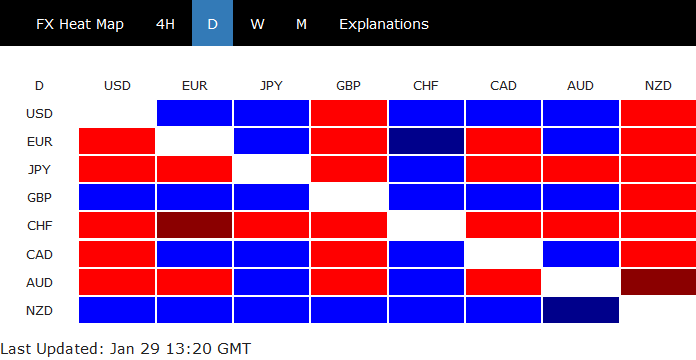
Entering US session, New Zealand Dollar remains the strongest one for today. Sterling regains some ground yet it's limited generally below yesterday's high. Traders are looking at Brexit debate and amendment voting in the Commons, with increasing confusions. New alternatives emerge including the Brady Amendments as the Malthouse Compromise. But after all, one of the keys lies in whether there would be a united consensus within the UK. And another key is whether the EU would agree to re-open negotiations.
As for today, Swiss Franc is the weakest one followed by Yen. European stocks rise broadly on return of risk appetite while DOW futures also point to higher open. Eyes will also be on US-China trade negotiations but so far there is little news.
In Europe, currently:
- FTSE is up 1.34%.
- DAX is up 0.20%.
- CAC is up 0.97%.
- German 10-year yield is down -0.001 at 0.207.
Earlier in Asia:
- Nikkei rose 0.08%.
- Hong Kong HSI dropped -0.16%.
- China Shanghai SSE dropped -0.10%.
- Singapore Strait Times dropped -0.37%.
- Japan 10-year JGB yield rose 0.005 to 0.005.
UK PM May to push EU to reopen Brexit negotiations
UK Prime Minister Theresa May has told her cabinet today that Brexit negotiation has to be reopened with the EU, to provide legal changes to the Irish backstop. Her spokesman said that "the prime minister said that in order to win the support of the House of Commons legal changes to the backstop will be required, that would mean reopening the Withdrawal Agreement". And he added that "a vote of the Brady amendment makes it clear that the current nature of the backstop is the key reason that the House cannot support the deal."
Also, May is expected to return to the Commons as soon as possible with a revised deal with the EU. If no deal could be reached by February 13, May will make a statement to the House that day, and table an amendable motion for debate the follow day.
As for today, a so called Malthouse Compromise emerged which has support from heavy weight Brexiteers, Remainers as well as Northern Ireland DUP. But EU was quick to dismiss it. EU's deputy chief negotiator, Sabine Weyand, had said technology to avoid a hard border does not exist.
Final Round Of Discussion On Trade War
US and China are going to start their final round of discussion, tensions are as high as they can be and the US corporates are suffering.
The US-China trade war is on and the clock is ticking The U.S.is about to increase the tariff rate on $200 billion worth of Chinese goods. The current tariff rate imposed by the Trump administration is 10 percent and on 1st March, this rate will go to 25 percent.
A new round of trade talk, perhaps the final one due to the limited time, is scheduled to take place on 30th January, and if there is no resolution in the following 28 days, the investors are likely to react like some Armageddon has hit the markets.
To avoid this, China filed a trade dispute with the Geneva-based arbiter, the World Trade Organisation, reporting the Trump administration for being in conflict with the current rules. The expectation is that an arbiter will be able to level the playfield between the two biggest superpowers in the world. However, expecting a resolution in the near future would be a mistake because there are already 23 disputes against the U.S. administration and investors are well aware of this backlog. Hence, hopes of an outcome coming out of the WTO are low. In fact, there is a strong possibility that Trump may turn his guns towards the WTO and accuse the organisation of stepping over its limit, which could aggravate the situation further.
The Trump administration is not concerned about the self-inflicting wounds, despite the fact that American corporations are already suffering heavily because of their tactics. For instance, look at Caterpillar’s latest earning results. The company’s stock slumped after missing earnings as China demand waned. Caterpillar’s earnings are considered an economic bellwether. Its earnings missed estimates by 15 percent, the most since the fourth quarter of 2009, and this makes investors uncomfortable about the ongoing cold war between the two countries.
The fact is that Caterpillar isn’t the only stock to take the heat. Warnings about softer demand are also coming from tech giants. Intel blamed softer demand n China for its lower than expected full-year forecast last week. Ford motors echoed a similar message when it posted its fourth-quarter loss in China. The International Monetary Fund has already announced its concerns about the global economic growth and lowered its growth forecast.
In this dark period, the U.S. shocked everyone yesterday by filing criminal charges against China’s largest technology company, Huawei. The charges are for bank fraud, IP theft, sanctions violations and wire fraud. Basically, anything that one can think of which can increase the tension between China and the U.S. In addition to this, the U.S. is also seeking the extradition of CFO Meng Wanzhou and all of this is taking place just ahead of the scheduled discussion between the two countries.
This situation has escalated the tension at a time when both countries are caught up in a trade war. China’s foreign minister has already asked Washington to stop hitting below the belt by harassing Huawei and other companies. Beijing has demanded Washington to revoke the CFO’s extradition with immediate effect and it doesn’t look like the Trump administration is likely to do that unless they get what they want out of the trade negotiations.
The next few weeks are going to be immensely important for the markets. It is highly likely that Apple will attribute the upcoming earning result to weak Chinese growth. If the U.S. and China do not resolve their situation, things are only going to get worse from here.
DAX Steady, Investors Eye US-China Talks, German CPI
The DAX index has posted gains in the Tuesday session. Currently, the index is at 11,236, up 0.24% on the day. In economic news, there are no major eurozone or German events for a second successive day. On Wednesday, Germany releases Preliminary CPI and the Federal Reserve will publish its monthly rate statement.
The U.S.-China trade spat will be back in the headlines this week, as Chinese and U.S. officials will hold a second round of talks on Wednesday and Thursday. The stakes are high, as the trade tensions between the two largest economies in the world has taken a toll on the global economy and rocked world equity markets. On Monday, U.S. Treasury Secretary Steven Mnuchin said he expects significant progress in the talks, but warned that the sides would have to tackle “complicated issues”. Tensions between China and the U.S. have escalated in recent weeks, with the U.S. Justice Department filing criminal charges against Huawei, a Chinese technology company. The U.S. is also trying to extradite a senior Huawei executive from Canada.
As the largest economy in the eurozone, Germany is a bellwether for the rest of the bloc. Recent German numbers have been weak, raising concerns about the strength of the eurozone economy. On Friday, German Ifo Business Climate dipped to 99.1, below the 100-level for the first time since 2010. Earlier in the week, a ZEW survey found that institutional investors remain deeply pessimistic about the German and eurozone economies. There was also grim news from the manufacturing front, as German manufacturing PMI slipped to 49.9, falling into contraction territory for the first time since 2013.
XAU/USD Outlook: Gold Advances On Safe-Haven Demand Ahead Of Key Macroeconomic Events
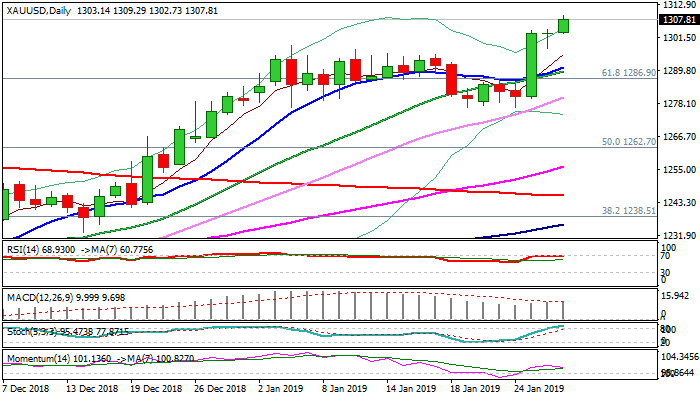
Spot gold extends advance to new nearly nine-month high at $1309 on Tuesday, after Monday's Doji candle signaled a pause after last Friday's 1.7% rally (the biggest one-day gains since 11 Oct 2018).
The yellow metal benefits as traders remain cautious ahead of key events: Brexit vote in the UK, Fed's policy decision, end of the latest US/China talks as well as release of earnings of big tech companies.
Bullish daily techs add to positive outlook, however, weaker momentum warns that bulls may struggle to extend further. Bulls eye targets at $1309 (14 Jun high) and $1311 (Fibo 161.8% projection of the rally from $1276), violation of which would expose pivotal barrier at $1316 (Fibo 76.4% of $1365/$1160).
Former high at $1298 (4 Jan) marks initial support, with more significant support provided parallel-running converged 10/20SMA's (1290/89) expected to contain deeper corrective actions.
Res: 1309, 1311, 1316, 1325
Sup: 1302, 1298, 1295, 1290
EUR/USD – Lack Of Fundamental Releases Leaves Euro Subdued
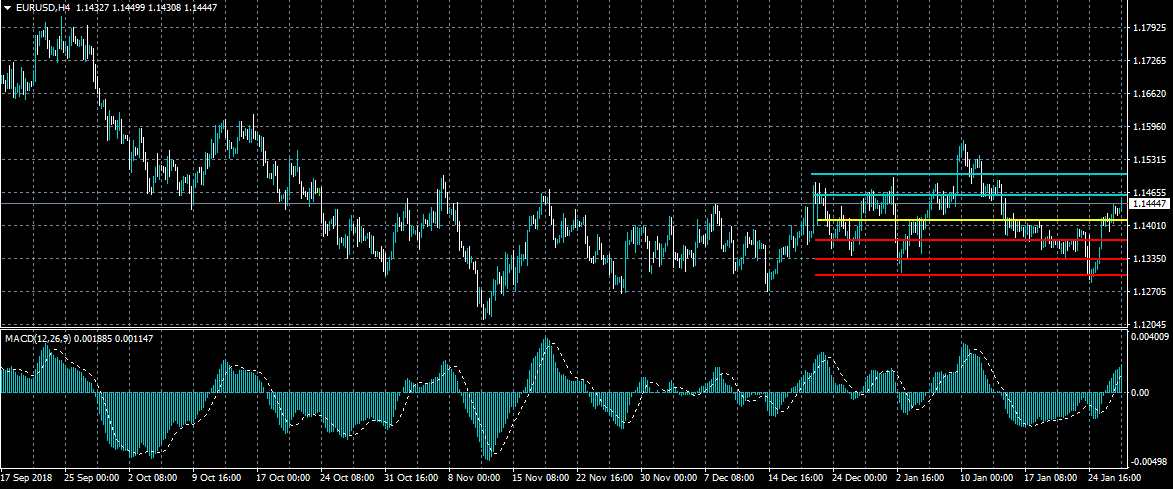
EUR/USD continues to gain ground this week. Currently, the pair is trading at 1.1432, up 0.03% on the day. On the release front, there are on eurozone or German releases. In the U.S. the key event is CB Consumer Confidence, which is expected to drop to 125.0 points.
As the largest economy in the eurozone, Germany is a bellwether for the rest of the bloc. Recent German numbers have been weak, raising concerns about the strength of the eurozone economy. On Friday, German Ifo Business Climate dipped to 99.1, below the 100-level for the first time since 2010. Earlier in the week, a ZEW survey found that institutional investors remain deeply pessimistic about the German and eurozone economies. There was also grim news from the manufacturing front, as German manufacturing PMI slipped to 49.9, falling into contraction territory for the first time since 2013.
On Monday, ECB President Mario Draghi painted a mixed picture in his testimony before a EU parliamentary committee. Draghi highlighted serious concerns affecting the eurozone. Draghi pointed to uncertainties over geopolitical factors and protectionism threats continued to weigh on the eurozone economy. On the bright side, Draghi noted that an improving labor market and stronger inflation were fueling expansion in the eurozone. At last week’s policy meeting, the ECB said that risks to growth have “moved to the downside”. This pessimistic comments were result of weaker eurozone releases in recent weeks. The economy has slowed, as weaker growth in China and trade tensions, such as Brexit, have dampened business and consumer confidence.
How many times will the Fed raise rates in 2019? The answer varies, depending on who you ask. The markets are not expecting any increases, while the Federal Reserve continues to stick with a forecast of two hikes. The Congressional Budget Office (CBO) has also weighed in, saying that the expect further rate increases this year. The CBO made the forecast in its 10-year outlook update, but did not specify how many hikes. The CBO report projected growth of 2.3% for the U.S economy in 2019, matching the forecast of the Federal Reserve.
Switzerland’s Record Exports
Despite a 2018 that included trade sanction escalations, a sharp drop in emerging currencies, fears of a global economic slowdown and a hawkish Fed, Swiss exports reached CHF 233.1 billion (+5.70%), a new record and the highest percentage gain since 2010. Switzerland not only maintained exports thanks to machines, electronic and watch products, it also imported more, reaching CHF 200 billion for the first time, coming to a trade surplus of CHF 31.3 billion. Swiss exports boomed in North America (+11.60%), Europe (+4.20%) and Asia (+4.40%). However, there was a sharp drop in UK demand of 23% to its lowest in 30 years, amid continued Brexit uncertainties. The Swiss watch industry appears in shape, with only two monthly drops in 2018 and yearly exports of CHF 21.2 billion, 6.30% higher than last year, although CHF 1.1 billion less than 2014's record high.
Still, the State Secretariat for Economic Affairs (SECO) recently revised its Swiss GDP growth forecast in 2019 from 2% to 1.50%. We expect Switzerland to maintain solid export numbers despite economic conditions.
Euro upside
Markets seems less concerned with EUR/GBP and GBP/USD as 1-month volatility remains low. The European Central Bank is cautious, expected to launch new liquidity facility. While it is not directly focused on Brexit risk, it does help backstop overall European risk. We should see lower Eurobonds, especially in Italy, and the EUR/USD is poised for bullish extension. ECB's admission of softer economic growth failed to damage the single currency. With negatives already priced into the Euro, expected improvement in economies and ECB support, a EUR/USD upside feels likely.
Brexit's next test
In the UK, the House of Commons votes today on a second version of the Brexit deal. By most accounts it will also be rejected. Brexit fatigue is setting in. The high probability trade is of a compromise, resulting in a softer Brexit. No Brexit agreement would raise the probability of a second referendum and of the UK staying in the European Union. Opinion polls of remain/leave have not materially shifted since the Brexit referendum: we are uncertain of this outcome. This level of granularity in the middle of the UK's greatest political knife fight feels disingenuous.
EURUSD Hits Fresh Weekly High
The euro has continued to rise against the US dollar during the European session, with the pair hitting a fresh weekly trading high as the greenback comes under renewed selling pressure. Buyers need to quickly break above the 1.1460 level to build on the recent bullish momentum. If bulls fail to surpass the 1.1460 level, an eventual decline back towards the 1.1360 level may occur.
The EURUSD pair is bullish while trading above the 1.1410 level, key technical resistance remains at the 1.1460 and 1.1500 levels.
If the EURUSD pair fails to break the 1.1460 level, sellers may test towards the 1.1410 and 1.1360 support levels.