

Sample Category Title
Eurozone to Trim Growth in Q4, Inflation to Step Down in December
Eurozone’s initial GDP growth estimates for the fourth quarter could put the euro in a vulnerable position when they come out on Thursday at 1000 GMT as forecasters see the economy drying up before the start of an uncertain year. A day after, flash CPI figures for the month of January could add further pressure to the market, making the need of an accommodative monetary policy more apparent.
Quarter-on-quarter, GDP growth in the euroland is said to have remained unchanged at 0.2% in the three months to December but relative to the same period last year, the annual rate is projected to come weaker by 0.4 percentage points at 1.2% – the lowest expansion rate registered since Q2 2015. The slowdown looks even more worrisome when compared to the relatively robust 2.7% growth achieved in the end of 2017, which back then was taken as a sign that the bloc could grow even faster in the coming months. The subsequent data however proved the opposite, with output growth going downhill instead.
The subdued core Consumer Price Index (CPI) may have been some sort of evidence that the economic expansion was not based on a solid foundation during 2018. Despite super-easy monetary policy and a tightening labor market, the indicator remained stubbornly well below the ECB’s 2.0% inflation target, with policymakers pointing to slow-rising wages for the target miss. On Friday, preliminary readings are expected to reveal that the measure stood flat at 1.1% y/y in December, while the headline CPI, affected by the fall in oil prices, is projected to ease to 1.4% y/y from 1.6% in the prior month, reaching the smallest rate of price increases since May.
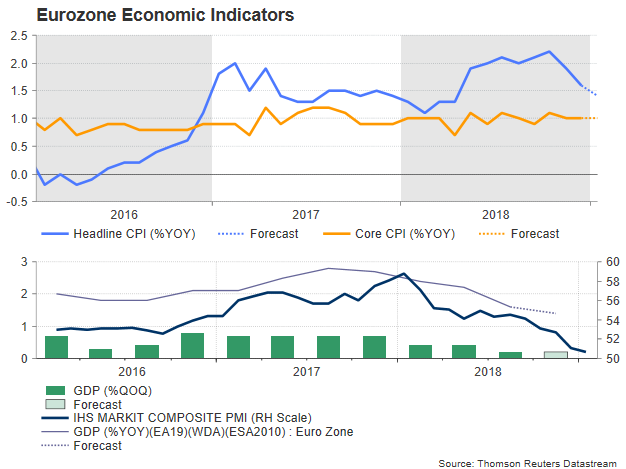
While a recession is not in the horizon, a larger-than-expected deterioration in GDP growth and CPI figures would signal that the outlook for the Eurozone economy is no longer neutral but has indeed shifted to the downside as the ECB chief Mario Draghi admitted at his press conference following the ECB policy meeting last week. Besides, with manufacturing and services PMIs slipping to four-year lows and consumer morale turning more negative in December, the bearish sentiment cannot be easily alleviated at a time when Brexit and the US-Sino trade war remain unresolved. Not to mention the additional risks stemming from the Italian fiscal stimulus and the indebted banking system. Economic developments in Germany, Europe’s economic powerhouse, seem to be a concern too after a GDP contraction in the third quarter and a slump in industrial production. Its external dependency on the diminishing Chinese economy is another reason why some caution is in the air. Nevertheless, Germany is still in good shape overall even if markets believe that it left 2018 with one black eye. Note that the German government dropped its growth forecast for 2019 to 1.0% from 1.8%.
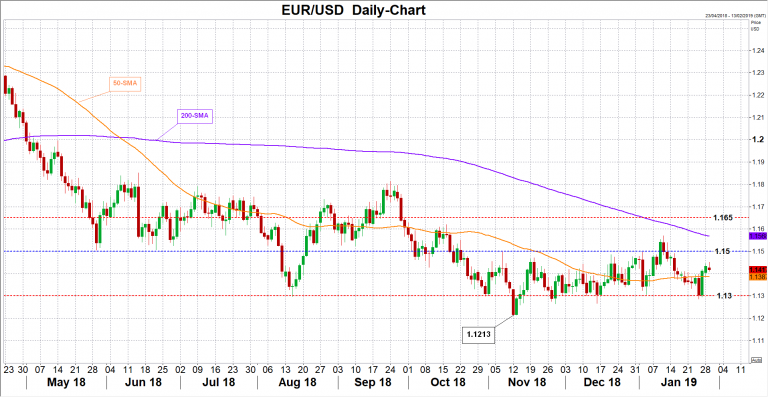
Meanwhile in FX markets, EURUSD drifted lower after Draghi acknowledged that the risk to the EU’s economic performance has shifted to the downside. Still, with the ECB chief holding prospects for a rate hike after summer 2019 alive, the price could not close below the 1.13 floor. Unfavourable GDP growth and/or CPI prints in coming days could resume bearish speculation that any rate rise may only come with a delay – and it is still an open question whether Draghi will deliver any rate hike before his term ends in October. In this case the price may head back down to 1.13. Breaking that key obstacle, attention would gather around the 1.1213 trough, while beneath that, the way could open towards the 1.11 psychological mark.
Alternatively, an upside surprise would increase optimism that some strength is still in storage to mitigate any potential negative developments inside and outside the bloc. In this case the price could retest resistance around 1.15 before meeting the 200-day simple moving average at 1.1560. If the bulls manage to break that line, the next stop could come near 1.1650.
It is also worth mentioning that discussion around growth and inflation will continue in March when the ECB is shceduled to release its new projections.
British Pound Subdued as Parliament Revisits Brexit Deal
GBP/USD has posted small gains in the Tuesday session. In North American trade, the pair is trading at 1.3177, up 0.14% on the day. In the U.S., CB Consumer Confidence dropped sharply to 120.5, missing the forecast of 125.2 points. In the U.K., parliament will vote on amendments to the Brexit withdrawal agreement. On Wednesday, the Federal Reserve will publish its monthly rate statement. The U.K. will release Net Lending to Individuals and GfK Consumer Confidence.
All eyes will be on the British parliament on Tuesday, which will vote on amendments to the Brexit withdrawal agreement. There is a great deal of uncertainty surrounding Brexit, but the confusion is unlikely to clear up after Tuesday’s parliamentary proceedings. Prime Minister May has said she will go back to Brussels to make some changes regarding the Irish border issue, but the EU has insisted that it will not reopen the withdrawal deal. On Tuesday, an EU official expressed dismay over the Brexit wrangling, saying that “London has negotiated with itself more than the EU”.
After four rate hikes last year, the Fed is widely expected to ease on policy in 2019. But by how much? The answer varies, depending on who you ask. The markets are not expecting any increases, while the Federal Reserve continues to stick with a forecast of two hikes. The Congressional Budget Office (CBO) has also weighed in, saying that the expect further rate increases this year. The CBO made the forecast in its 10-year outlook update, but did not specify how many hikes. The CBO report projected growth of 2.3% for the U.S economy in 2019, matching the forecast of the Federal Reserve.
US consumer confidence dropped to 120.1 on temporary shock
US Conference Board Consumer Confidence dropped to 120.2 in January, down from 128.1 and missed expectation of 125.0.
Conference board noted in the release that "Shock events such as government shutdowns (i.e. 2013) tend to have sharp, but temporary, impacts on consumer confidence. Thus, it appears that this month's decline is more the result of a temporary shock than a precursor to a significant slowdown in the coming months."
USD/TRY Outlook: Recovery from 200SMA Struggles to Extend and Keep Risk of Fresh Weakness in Play
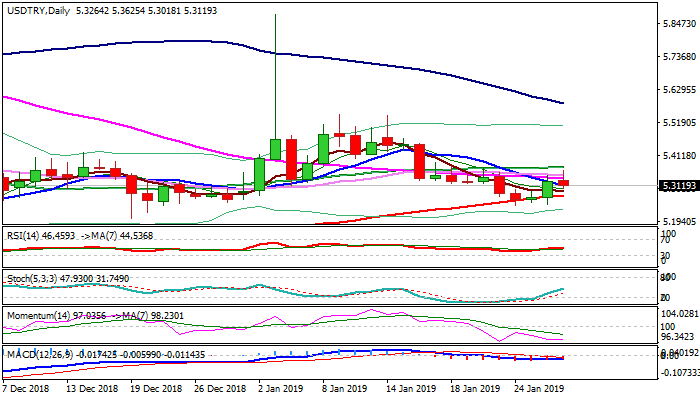
Monday's close above daily close base, following bounce after short-lived probes below 200SMA, was initial positive signal. Recovery extension cracked converged 55/30SMA's (5.3358 / 5.3459) but without clear break for now. Fears that lira could extend weakness after recent rally failed to clear 200SMA exist, but the pair needs to break above 20SMA (5.3704) to confirm reversal. On the other side, scenario of retesting 200SMA support (currently at 5.2796) remains on the table, with repeated daily close below 55SMA, expected to increase downside risk. Daily techs are in mixed mode and lack clearer direction signal for now, however, strengthening negative momentum warns of fresh weakness. Loss of lower pivot (200SMA) would risk extension towards another key support at 5.1323 (29 Nov low).
Res: 5.3388; 5.3459; 5.3589; 5.3704
Sup: 5.3000; 5.2796; 5.2461; 5.2012
Sunset Market Commentary
Markets
Global core bonds lost modest ground today. With an empty eco calendar during European trading hours, risk sentiment guided investors. Sentiment deteriorated overnight as the US announced it was officially pressing charges against Chinese tech giant Huawei. However, markets recovered in the run up to the European opening. EU equities opened cautiously higher and continued an upward trend through the day. The German Bund proved resilient and moved cautiously higher. The German yield curve moves were mixed as yield changes are varying between -0.7 bps (30-yr) to +0.9 bps (2-yr). US Treasuries behaved in a similar way and didn’t chose a clear direction. In the run-up to the US bell, US Treasuries edged higher. The US yield curve moved south with changes between -0.7 bps (30-yr) to ‑1.7 bps (10-yr). Bond traders’ focus was on supply too. Bond offerings from Belgium, Austria and Greece received large bids but had little impact on German Bunds. Belgium sold €5bn of the 30-yr bond, bringing the total amount raised this year to €11bn out of the total finance need of €28 bn in 2019.
Trading in the majors USD cross rates developed in wait-and-see modus today. Interest rates provided no clear guidance. The dollar traded in the defensive this morning in the wake of yesterday’s US equity sell-off. However, Asian and European equity markets reacted calm to the US equity volatility and to the headline risk regarding the US-China trade relations (Huawei). The dollar still lost slightly ground in Asia and early in Europe, but selling gradually eased. There was too little news to force a break beyond technically relevant levels especially as investors are looking forward to guidance from tomorrow’s Fed meeting. EUR/USD declined off the intraday highs and is changing hands in the 1.1430 area. USD/JPY is changing hands in the 109.40 area.
EUR/GBP and cable showed a rather erratic trading pattern as investors are looking forward to a series of key votes scheduled in the UK Parliament this evening, possibly changing course of the Brexit process. One possible outcome is that the government will be forced to ask the EU to delay Brexit to avoid a no-deal scenario. Another possible outcome might send PM May back to Brussels to renegotiate the Irish border backstop. Of late, the first scenario was seen as the most GBP-supportive. However, the exact consequences of different all scenarios still contain quite a high degree of uncertainty. This afternoon there were headlines on a Plan C of the conservative party (Malthouse compromise) that combines aspects of both amendments. Sterling lost some ground this morning, but rebounded this afternoon. EUR/GBP is changing hands in the 0.8665 area. Cable hovers in the high 1.31 area.
News Headlines
US house prices rose at the slowest pace since early 2015 in November (4.7% Y/Y), decelerating for an eight straight month according to the S&P CoreLogic Case-Shiller index. The data underscore the slowdown in the US housing market with ever-receding affordability of properties a big issue.
UK PM May is expected to endorse the “Malthouse compromise”. It’s a compromise agreement to bridge the divide in the UK Conservative party. Under this ‘Plan C’ proposal, PM May should go back to Brussels to try to renegotiate the Irish backstop. It would also include a 1 year extension of the transition period. If the attempt fails, the UK would honour its agreed financial contributions and its commitments on EU citizens’ rights, preparing for a “managed, no-deal brexit” after the extended transition period.
The Hungarian central bank kept its policy rates unchanged today (deposit rate: -0.15% and refi rate 0.9%). The governing council said the probability increased that core inflation will rise above the central bank’s 3% target. That will be the main factor determining the MNB’s policy path and not expectations about the timing of interest rate increases by the world’s leading central banks (which have shifted to an ever later date).
EUR/USD Mid-Day Outlook
Daily Pivots: (S1) 1.1395; (P) 1.1421; (R1) 1.1451; More.....
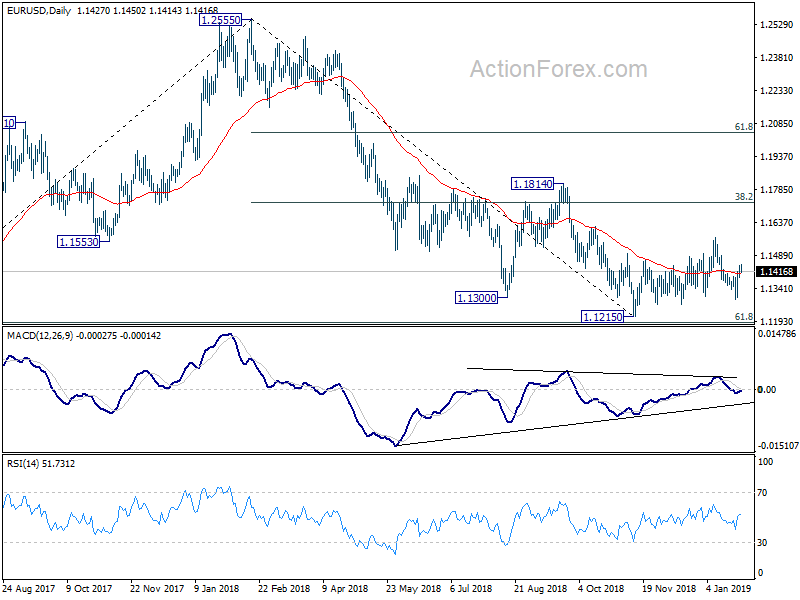
With 1.1390 minor support intact, further rise is mildly in favor in EUR/USD. Current development suggests that corrective pattern from 1.1215 is still extending, with rise from 1.1289 as another leg. Further rally would be seen to 1.1569 resistance and above. On the downside, below 113.90 minor support will turn bias back to the downside for 1.1289 support instead.
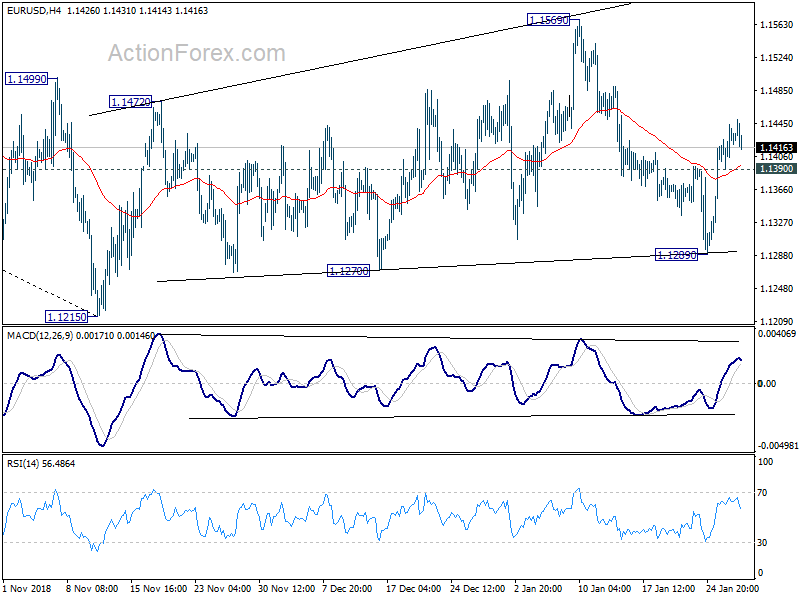
In the bigger picture, as long as 1.1814 resistance holds, down trend down trend from 1.2555 medium term top is still in progress and should target 61.8% retracement of 1.0339 (2017 low) to 1.2555 at 1.1186 next. Sustained break there will pave the way to retest 1.0339. However, break of 1.1814 will confirm completion of such down trend and turn medium term outlook bullish.
USD/CHF Mid-Day Outlook
Daily Pivots: (S1) 0.9901; (P) 0.9924; (R1) 0.9942; More....
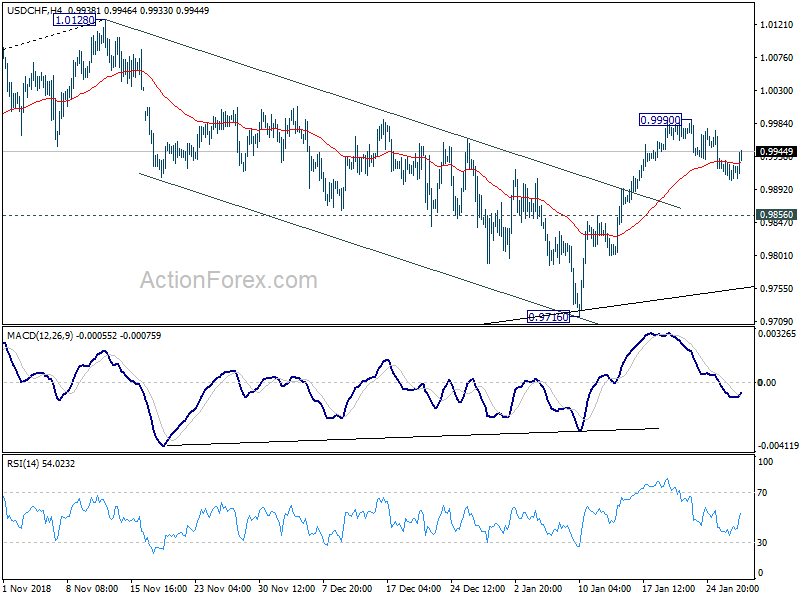
USD/CHF is staying in consolidation from 0.9990 and intraday bias remains neutral. In case of deeper fall, downside should be contained by 0.9856 resistance turn support to bring another rally. As note before, corrective pull back from 1.0128 has completed at 0.9716 already. Above 0.9990 will extend the rise from 0.9716 to retest 1.0128 high.
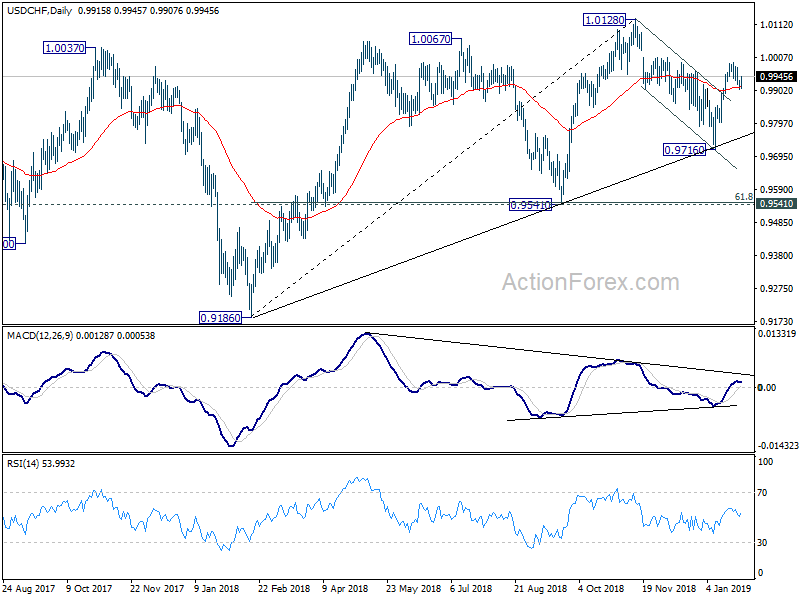
In the bigger picture, USD/CHF drew strong support from medium term trend line and rebounded. That suggests rise from 0.9186 is still in progress. Break of 0.9963 will affirm this bullish case. Further break of 1.0128 will confirm up trend resumption and target 1.0342 key resistance. Nevertheless, break of 0.9716 will dampen this bullish view and at least bring deeper fall to 0.9541 key support.
USD/JPY Mid-Day Outlook
Daily Pivots: (S1) 109.13; (P) 109.36; (R1) 109.55; More...
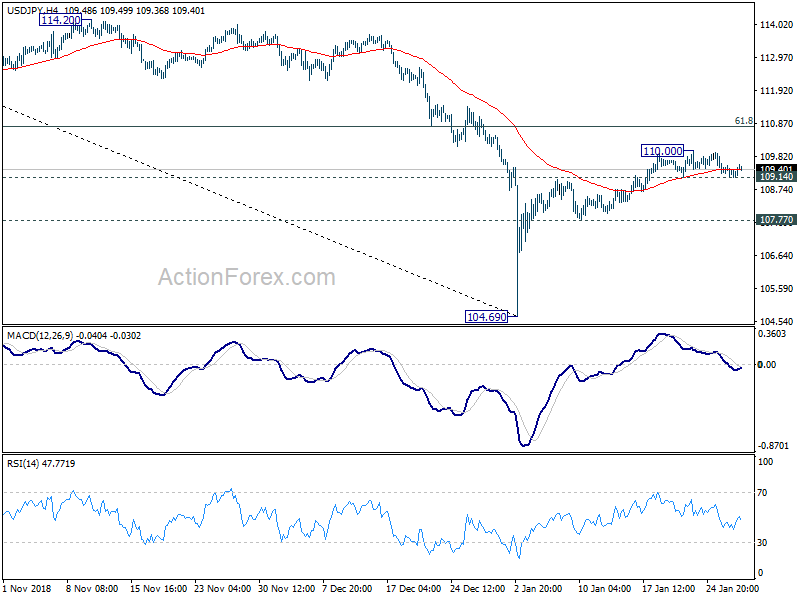
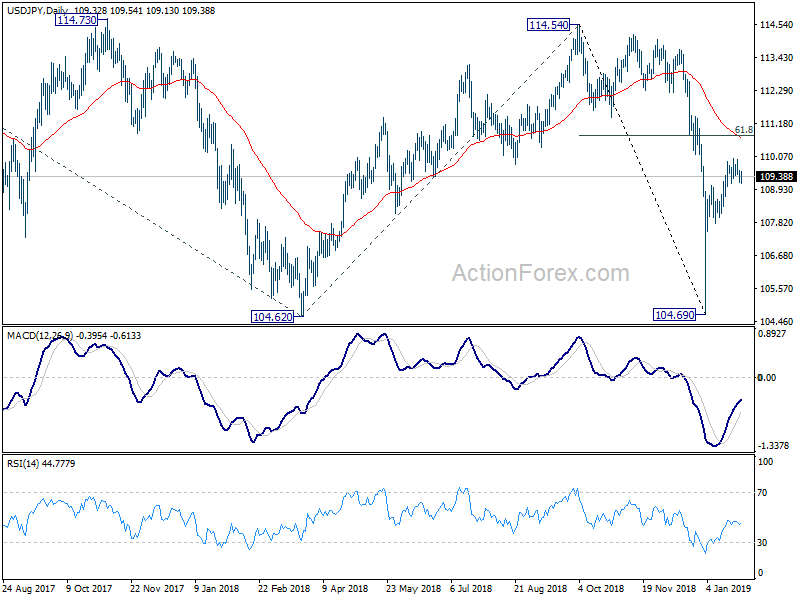
Intraday bias in USD/JPY remains neutral for the moment. On the upside, break of 110.00 will resume the rebound from 104.69. But we'd expect strong resistance from 61.8% retracement of 114.54 to 104.69 at 110.77 to limit upside. On the downside, break of 109.14 minor support will be the first sign of completion of the rebound. Intraday bias will then be turned back to the downside for 107.77 minor support first.
In the bigger picture, while the rebound from 104.69 is strong, there is no change in the view that it's a corrective move. That is, fall from 114.54, as part of the decline from 118.65 (2016 high), is not completed yet. Break of 104.62 will target 100% projection of 118.65 to 104.62 from 114.54 at 100.51, which is close to 100 psychological level. Nevertheless, sustained trading above 55 day EMA (now at 110.82) will dampen this bearish view and turn focus back to 114.54 resistance instead.
What Jerome Powell Will Say?
Every meeting is a live meeting, this is the message which Jerome Powell delivered the last time. Traders are going to make their moves depending on these important factors.
This is an important week for markets and there are several events that are going to keep investors on their toes. The most important event is the Federal Reserve meeting taking place on Wednesday.
Remember, the chairman of the Federal Reserve, Jerome Powell, has already given a clear message: every meeting is a live meeting. Hence, investors are going to listen to his statement very carefully. This is despite the fact that not many have priced in another interest rate hike during this meeting.
If you recall, the Fed increased the interest rates four times last year making the president of the United States, Donald Trump, really unhappy about this. The equity markets also indicated their discomfort and started to face a major turmoil towards the end of 2018. It was then, that the Fed decided to become less hawkish; the committee scaled back from their interest rate hike guidance for this year. Initially, the Fed was going to increase interest rates 3-4 times this year, but the reality hit them, and they decided that two interest rate hikes may be enough for this year,
The Fed's biggest task is to avoid any kind of severe financial instability. They cannot afford to undo all the hard work they have done over the last five years. However, at the same time, the Fed also needs to create room for themselves and buy back enough animation (tighten the monetary policy so that they can relax it again) . Hence reducing the size of the balance sheet and normalising the interest rates have been a significant priority for them. In order to avoid the bouts of financial volatility, just like the two of his predecessors, Jerome Powell needs to add more colour in his official statement and language. Markets need assurance that the Fed president is working for them not against them. If he doesn’t deliver on this, it creates panic and the Fed runs a risk of moving the timeline of another crisis closer than where it currently is.
On the economic data front, the element that stands stronger is the job market: the weekly jobless claims data is at 199K, in order words, it is near its 50-year low . This tells us that the job market is solid, and it continues to create more jobs. The solid job market is also supporting the wage growth and attracting workers who have been discouraged to participate in the labour force. In simple terms, jobs seekers are returning to the workforce.
This element of the job market made the Fed keep the economy on autopilot. This stance was deemed immensely hawkish by the market participants. The reality is that the global economy is not as strong as it was last year because of the lack of the central bank support in terms of their dovish monetary policy; most of them have started to tighten the liquidity taps and this has triggered suffocation for the global economic growth.
The upcoming meeting is going to be decisive for the market sentiment and the Fed needs to make sure that the terms they use are market friendly. Their recent policy guidance has led to a rebound in market confidence with the S&P 500 over 10% up from its December lows, confirming the argument that the Fed's monetary policy has a direct effect on the markets.
To sum it up, in this meeting, the Fed needs to strike a balance in their language. This is no easy task though. The economic data is forcing the Fed to keep the economy on autopilot while market participants expect from the Fed to avoid the same mistake that led to market turmoil in June and continued all the way to December.
Thus, to control all of this, the Fed needs to tailor the message in their statement and speech very carefully. It should acknowledge that the future interest rate hikes depend on the health of the economy. They also need to point out that the next version of Fed Dots and economic projection may be skewed to the downside. To balance this extremely dovish stance, the Fed needs to acknowledge that the global geopolitical risk has improved, and the curve has shifted to the downside. The message should be that they are open to take control of their destiny. Jerome Powell needs to make it clear that the Fed Committee has the full ability to alter the current pace of balance sheet reduction according to the needs of time.
Overall, the goal for the Federal Reserve should be to avoid any self-inflicting statements. They have tailwind on their side. It may not be as strong as in the previous years, but the force is still there.
Stocks to Open Higher as Markets Await Apple’s Results after the Close
Stocks appear poised to open slightly higher after yesterday’s tech led selloff. Results from 3M, the industrial and consumer products company delivered a slight beat to the top and bottom line, with a guidance cut that was not as bad as many feared. 3M’s revenue results paint the same story we have seen so far this earning season, with strong US sales and nothing to brag about from the Asia-Pacific region.
The positive open is limited with the Dow and S&P futures poised to open 0.1% higher, while the Nasdaq is up 0.2%. After the close we will see Apple’s earning report. Markets were warned at the beginning of the year of that the results will be poor. They delivered a guidance cut that showed iPhone upgrades eased on January 2nd and their earning results are widely expected to show their first holiday quarter sales decline since the iPhone was launched. The stock is down roughly a third and value investors may start finding valuations attractive after one last push lower. Analysts will closely watch to see if they are able to deliver optimism on call regarding the services revenue stream.