

Sample Category Title
Crude Oil: Oil Trading Higher, Ahead Of EIA’s Weekly Crude Oil Stockpiles Data
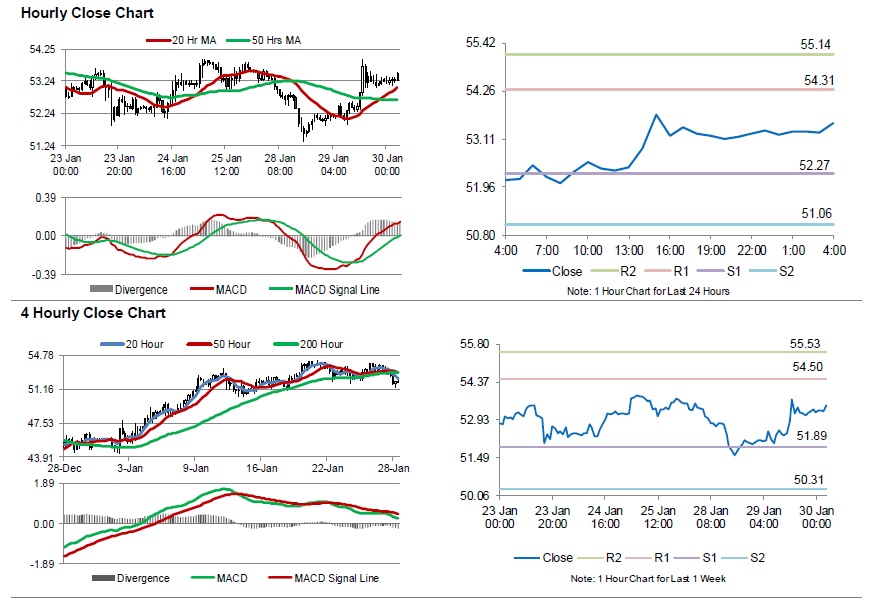
For the 24 hours to 23:00 GMT, Crude Oil rose 2.44% against the USD and closed at USD53.32 per barrel, amid possibilities of Venezuelan supply disruptions after the US sanctions.
Separately, the American Petroleum Institute (API) reported that US crude oil inventories rose 2.1 million barrels to 445.7 million barrels in the week ended 25 January.
In the Asian session, at GMT0400, the pair is trading at 53.48, with oil trading 0.30% higher against the USD from yesterday's close.
The pair is expected to find support at 52.27, and a fall through could take it to the next support level of 51.06. The pair is expected to find its first resistance at 54.31, and a rise through could take it to the next resistance level of 55.14.
Crude oil is trading above its 20 Hr and 50 Hr moving average.
EUR/GBP Daily Outlook
Daily Pivots: (S1) 0.8685; (P) 0.8722; (R1) 0.8788; More...
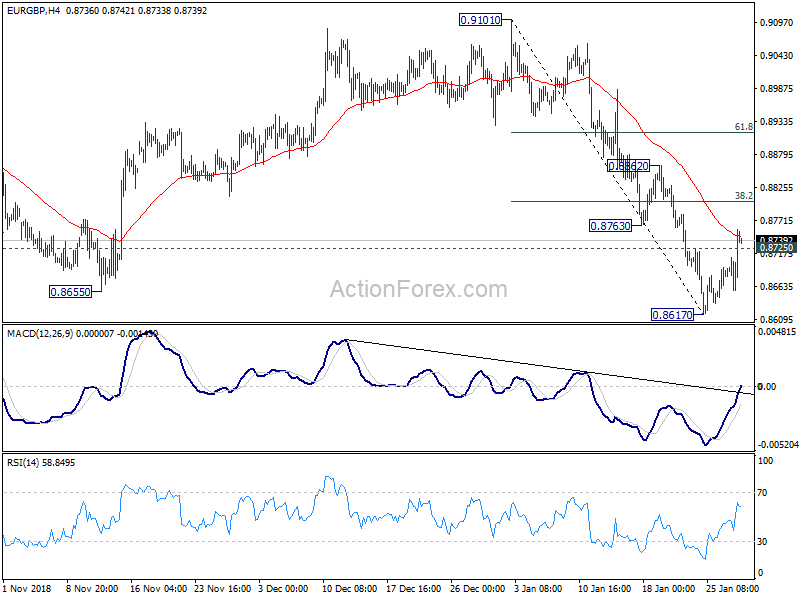
EUR/GBP's strong rebound and break of 0.8725 minor resistance suggests short term bottoming, after defending 0.8620 key support. Intraday bias is turned back to the upside for 38.2% retracement of 0.9101 to 0.8617 at 0.8802. Break will target 61.8% retracement at 0.8916. On the downside, decisive break of 0.8620 will resume larger decline from 0.9305 and target 100% projection of 0.9305 to 0.8620 from 0.9101 at 0.8416.
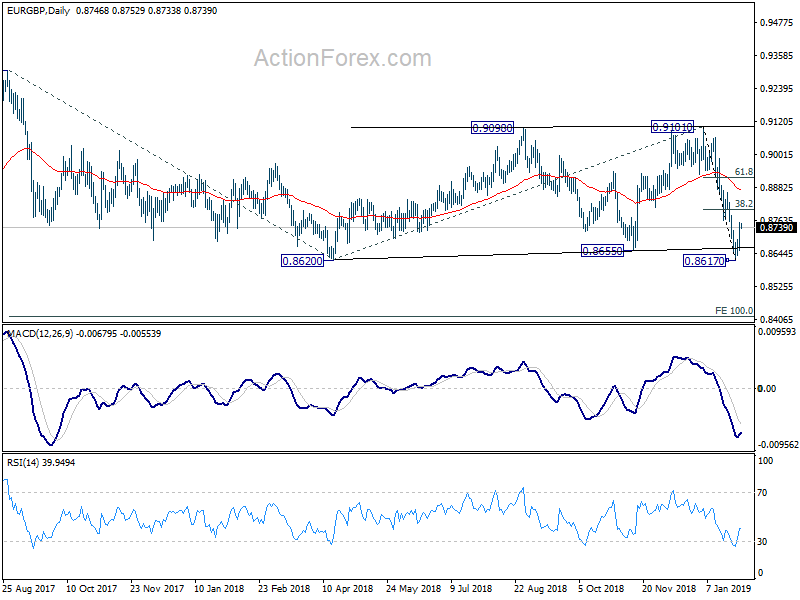
In the bigger picture, EUR/GBP is seen as staying in long term range pattern started at 0.9304 (2016 high). The medium term range is set between 0.8620 and 0.9101. Downside breakout of 0.8620 will pave the way back to 0.8312 support . Break of 0.9101 will bring retest of 0.9304/5 resistance.
Sterling Tumbles as UK Seeks Irish Backstop Renegotiation, Dollar Awaits FOMC and Trade Talks
Sterling tumbled broadly as the UK opened a new chapter in Brexit negotiation with yesterday's parliamentary amendment votes. In short, Prime Minister Theresa May needs to go back to EU to renegotiate the Irish backstop into alternative arrangements. But EU has repeated its stance on no renegotiation. For now it's uncertain whether there could be on standoff on the issue. But so far, losses in the Pound are relatively limited as it stabilized in Asian markets.
At this point, Australian Dollar is the strongest one for today, as lifted by stronger than expected consumer inflation reading. New Zealand Dollar follows as the second. Canadian Dollar is also firm as oil prices rebound due to US sanctions on Venezuela. Swiss Franc, Yen and Dollar are the weakest ones. The greenback will look into today's FOMC statement and press conference. Traders will also keep an eye on US-China trade talks, as high level meeting between Chinese Vice Premier Liu He and US Trade Representative Robert Lighthizer starts today in Washington.
Technically, EUR/GBP's rebound tentatively suggests that 0.8620 key support is defended. Break of 1.3012 in GBP/USD will further indicate near term topping in the Pound. With today's rebound, AUD/USD is now looking at 0.7235 resistance and break will confirm resumption of recent rebound from 0.6722 low.
In other markets, Nikkei is currently down -0.29%. Hong Kong HSI is up 0.24%. China Shanghai SSE is down -0.01%. Singapore Strait Times is down -0.18%. Japan 10-year JGB yield is up 0.0033 at 0.007. Overnight, DOW rose 0.21%. S&P 500 dropped -0.15%. NASDAQ dropped -0.81%. 10-year yield dropped -0.032 to 2.712.
Sterling drops as UK seeks to reopen Brexit negotiation
Sterling dropped broadly after the Parliament voted 317 to 301 for Conservative MP Graham Brady's Brexit deal amendment. Prime Minister Theresa is now required to go back to EU to renegotiate the deal to replace the Irish backstop with "alternative arrangements". At the same time, the Parliament rejected Labour MP Yvette Cooper's proposal to force Article 50 extension to avoid no-deal Brexit. Though, the symbolic amendments opposing no-deal Brexit was passed.
May's spokesman said that "tonight parliament has sent a clear message that there is a way forward to secure this deal if we are able to secure changes in relation to the backstop." And, "the EU's position remains that they want the United Kingdom to leave with a deal. They want the UK to leave with a deal because it's in their interests as well as those of the UK."
However, EU repeated its stance that there will be no renegotiation. And, it's uncertain what exactly alternative arrangements on the Irish border backstop are.
EU Tusk: Brexit withdrawal agreement is not open for renegotiation
On UK's decision to seek Brexit deal renegotiations, European Council President Donald Tusk said via his spokesman "The Withdrawal Agreement is and remains the best and only way to ensure an orderly withdrawal of the United Kingdom from the European Union". "The backstop is part of the Withdrawal Agreement, and the Withdrawal Agreement is not open for renegotiation."
Nevertheless, Tusk said "We welcome and share the UK parliament's ambition to avoid a no-deal scenario. We continue to urge the UK government to clarify its intentions with respect to its next steps as soon as possible." And, "If the UK's intentions for the future partnership were to evolve, the EU would be prepared to reconsider its offer and adjust the content and the level of ambition of the political declaration... Should there be a UK reasoned request for an extension, the EU27 would stand ready to consider it and decide by unanimity."
European Parliament Guy Verhofstadt echoed and said "we stand by Ireland,"and "there is no majority to re-open or dilute the Withdrawal Agreement in the European Parliament, including the backstop."
Australia CPI slowed to 1.8%, but beat expectations
Australian Dollar is lifted slightly by stronger than expected consumer inflation reading. Headline CPI rose 0.5% qoq in Q4 versus expectation of 0.4% qoq. Annual rate slowed to 1.8% yoy, down from 1.9% yoy, but beat expectation of 1.7% yoy. RBA trimmed mean CPI rose 0.4% qoq, 1.8% yoy, matched expectations. RBA weighed media CPI rose 0.4% qoq, 1.7% yoy, basically matched expectations.
ABS Chief Economist, Bruce Hockman said: "Annual growth in the CPI remains below 2 per cent in the December quarter 2018, with annual growth in tradables inflation of just 0.6 per cent, while non-tradables inflation rose 2.4 per cent. Over the past four years, annual growth in the CPI has only risen above 2 per cent in two of the past 16 quarters."
ABS also noted that the most significant price rises this quarter are tobacco (+9.4%), domestic holiday travel and accommodation (+6.2%), fruit (+5.0%) and new dwelling purchase by owner-occupiers (+0.4%). The most significant price falls this quarter are automotive fuel (-2.5%), audio visual and computing equipment (-3.3%), wine (-1.9%), and telecommunications equipment and services (-1.5%).
FOMC forward guidance and balance sheet reduction plan watched
The economic calendar is rather busy today. French GDP, Swiss KOF, Eurozone confidence indicators, Germany CPI and US ADP employment will also be watched. But the major focus will be on FOMC rate decision and press conference.
Fed is widely expected to keep federal funds rate unchanged at 2.25-2.50%. Since December, following extreme market volatility and cautious turn in Fedspeaks, pricing of Fed's rate path changed drastically. Fed funds futures are now only pricing in around 20% chance of a 25bps hike by the December meeting. Dollar then started weakening broadly. The greenback suffered another round selloff last week after a WSJ report suggesting that the Fed members are considering to end the balance sheet reduction plan earlier than previously expected.
The first focus today will be on forward guidance in the statement. Back in December, FOMC noted that "the Committee judges that some further gradual increases in the target range for the federal funds rate will be consistent with sustained expansion of economic activity, strong labor market conditions, and inflation near the Committee's symmetric 2 percent objective over the medium term."
But since then, Fed officials sung a chorus, saying that Fed can afford some patience before another rate move. And Fed chair Jerome Powell even indicated that Fed is flexible to move in either direction if necessary. Any change in the forward guidance that hints at a pause could give Dollar more pressure.
And secondly, Powell will need to indicate if there is any change in Fed's balance sheet reduction plan.
Here are some previews on FOMC:
- Fed Meeting: All Eyes on Powell's Balance Sheet Remarks
- What Jerome Powell Will Say?
- Will Fed Signal Slowdown in Balance Sheet Reduction?
EUR/GBP Daily Outlook
Daily Pivots: (S1) 0.8685; (P) 0.8722; (R1) 0.8788; More...
EUR/GBP's strong rebound and break of 0.8725 minor resistance suggests short term bottoming, after defending 0.8620 key support. Intraday bias is turned back to the upside for 38.2% retracement of 0.9101 to 0.8617 at 0.8802. Break will target 61.8% retracement at 0.8916. On the downside, decisive break of 0.8620 will resume larger decline from 0.9305 and target 100% projection of 0.9305 to 0.8620 from 0.9101 at 0.8416.
In the bigger picture, EUR/GBP is seen as staying in long term range pattern started at 0.9304 (2016 high). The medium term range is set between 0.8620 and 0.9101. Downside breakout of 0.8620 will pave the way back to 0.8312 support . Break of 0.9101 will bring retest of 0.9304/5 resistance.
Economic Indicators Update
| GMT | Ccy | Events | Actual | Forecast | Previous | Revised |
|---|---|---|---|---|---|---|
| 23:50 | JPY | Retail Trade Y/Y Dec | 1.30% | 0.90% | 1.40% | |
| 0:01 | GBP | BRC Shop Price Index Y/Y Jan | 0.40% | 0.30% | ||
| 0:30 | AUD | CPI Q/Q Q4 | 0.50% | 0.40% | 0.40% | |
| 0:30 | AUD | CPI Y/Y Q4 | 1.80% | 1.70% | 1.90% | |
| 0:30 | AUD | CPI RBA Trimmed Mean Q/Q Q4 | 0.40% | 0.40% | 0.40% | |
| 0:30 | AUD | CPI RBA Trimmed Mean Y/Y Q4 | 1.80% | 1.80% | 1.80% | |
| 0:30 | AUD | CPI RBA Weighted Median Q/Q Q4 | 0.40% | 0.50% | 0.30% | |
| 0:30 | AUD | CPI RBA Weighted Median Y/Y Q4 | 1.70% | 1.70% | 1.70% | 1.80% |
| 5:00 | JPY | Consumer Confidence Index Jan | 41.9 | 42.5 | 42.7 | |
| 6:30 | EUR | French GDP Q/Q Q4 | 0.30% | 0.30% | ||
| 7:00 | EUR | German GfK Consumer Confidence Feb | 10.3 | 10.4 | ||
| 8:00 | CHF | KOF Leading Indicator Jan | 98.1 | 96.3 | ||
| 9:30 | GBP | Mortgage Approvals Dec | 63K | 64K | ||
| 9:30 | GBP | Money Supply M4 M/M Dec | 0.20% | 0.00% | ||
| 10:00 | EUR | Eurozone Business Climate Indicator Jan | 0.73 | 0.82 | ||
| 10:00 | EUR | Eurozone Economic Confidence Jan | 106.7 | 107.3 | ||
| 10:00 | EUR | Eurozone Industrial Confidence Jan | 0.6 | 1.1 | ||
| 10:00 | EUR | Eurozone Services Confidence Jan | 11.2 | 12 | ||
| 10:00 | EUR | Eurozone Consumer Confidence Jan F | -7.9 | -7.9 | ||
| 13:00 | EUR | German CPI M/M Jan P | -0.80% | 0.10% | ||
| 13:00 | EUR | German CPI Y/Y Jan P | 1.60% | 1.70% | ||
| 13:15 | USD | ADP Employment Change Jan | 170K | 271K | ||
| 13:30 | USD | GDP Annualized Q/Q Q4 | 3.40% | |||
| 13:30 | USD | GDP Price Index Q4 | 1.80% | |||
| 15:00 | USD | Pending Home Sales M/M Dec | 1.10% | -0.70% | ||
| 15:30 | USD | Crude Oil Inventories | 8.0M | |||
| 19:00 | USD | FOMC Rate Decision (Upper Bound) | 2.50% | 2.50% | ||
| 19:00 | USD | FOMC Rate Decision (Lower Bound) | 2.25% | 2.25% |
EUR/USD Gains Traction, USD/JPY Facing Strong Resistance
EUR/USD started a nice upward move and traded above the 1.1400 resistance. USD/JPY is currently facing a strong resistance near the 109.40 level
Important Takeaways for EUR/USD and USD/JPY
- The Euro recovered nicely and moved above the 1.1360 and 1.1400 resistance levels.
- There is a key ascending channel in place with support at 1.1425 on the hourly chart of EUR/USD.
- USD/JPY is struggling to clear a major bearish trend line with resistance at 109.40 on the hourly chart.
- There is a risk of a downside break below the 109.15 and 109.00 support levels in the near term.
EUR/USD Technical Analysis
After a major drop, the Euro found support near the 1.1280 level against the US Dollar. The EUR/USD pair started a nice upward move and traded above the 1.1360 and 1.1400 resistance levels.
The upward move was solid as the pair even broke the 1.1430 resistance and settled above the 50 hourly simple moving average. A high was formed at 1.1449 on FXOpen and the pair later corrected lower.
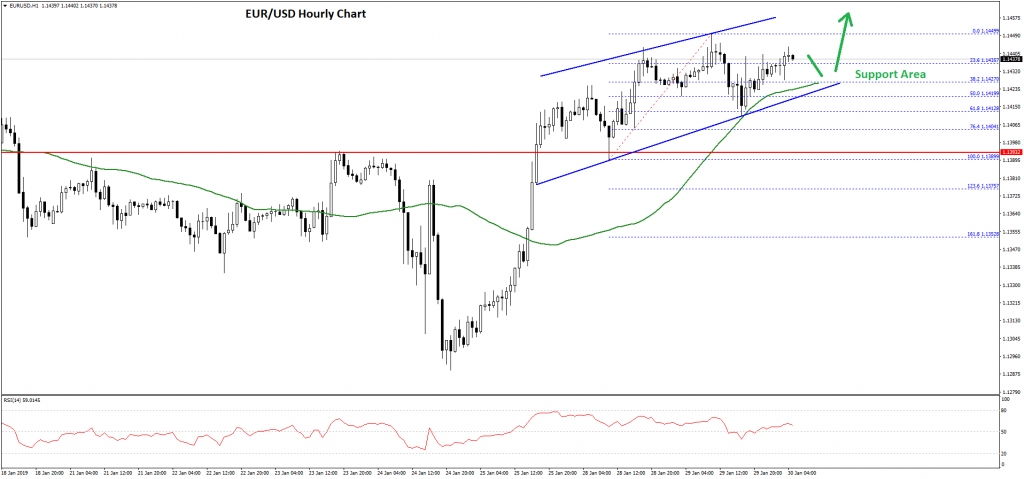
It declined below the 50% Fib retracement level of the recent wave from the 1.1389 low to 1.1449 high. However, the decline was protected by the 1.1410 level and the 50 hourly simple moving average.
Moreover, the 61.8% Fib retracement level of the recent wave from the 1.1389 low to 1.1449 high acted as a support. At the outset, it seems like there is a key ascending channel in place with support at 1.1425 on the hourly chart of EUR/USD.
If there is an upside break above 1.1445 and 1.1450, the pair is likely to accelerate gains above the 1.1480 resistance level. The next stop for buyers could be near the 1.1500 level. On the other hand, the 1.1425 level might act as a strong support.
If there is a drop below the 1.1425 and 1.1410 supports, the pair could drop towards the 1.1380 support level in the near term.
USD/JPY Technical Analysis
The US Dollar failed on more than two occasions to break the 110.00 resistance against the Japanese Yen. As a result, there was a sharp decline in the USD/JPY pair below the 109.60 and 109.50 support levels.
The pair even traded below the 109.40 support and the 50 hourly simple moving average. A low was formed near the 109.12 level before the pair started an upside correction.
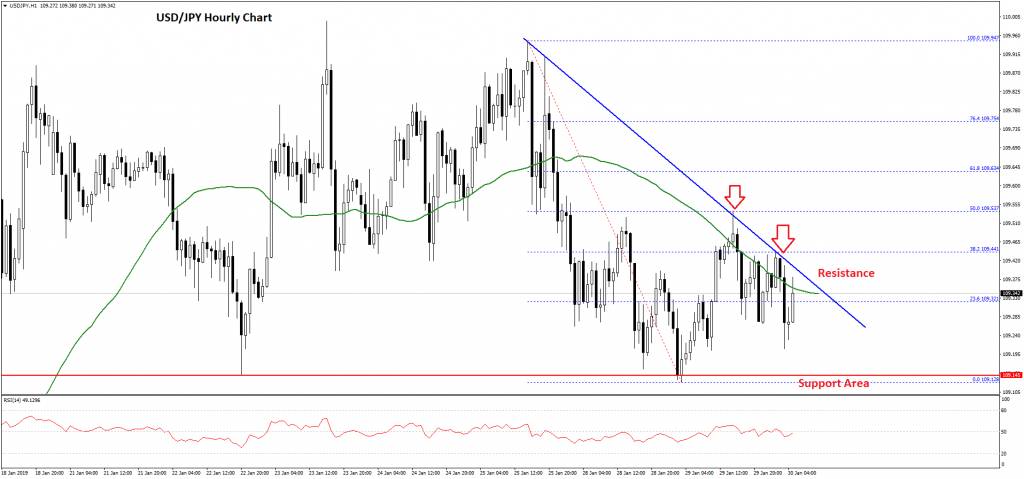
It recovered above the 23.6% Fib retracement level of the last decline from the 109.94 high to 109.12 low. However, the recovery was capped by the 109.50 resistance. Moreover, there is a major bearish trend line formed with resistance at 109.40 on the hourly chart.
The pair also failed to surpass the 50% Fib retracement level of the last decline from the 109.94 high to 109.12 low. It seems like the pair is facing a solid resistance near the 109.40 and 109.50 levels, above which it could resume its upward move towards the 110.00 resistance.
On the downside, an initial support is near the 109.20 level, below which there is a risk of more losses. The next stop for sellers could be near the 109.00 or 108.60 levels.
Brexit Monitor: May Has Two And Half Weeks To Renegotiate The Backstop
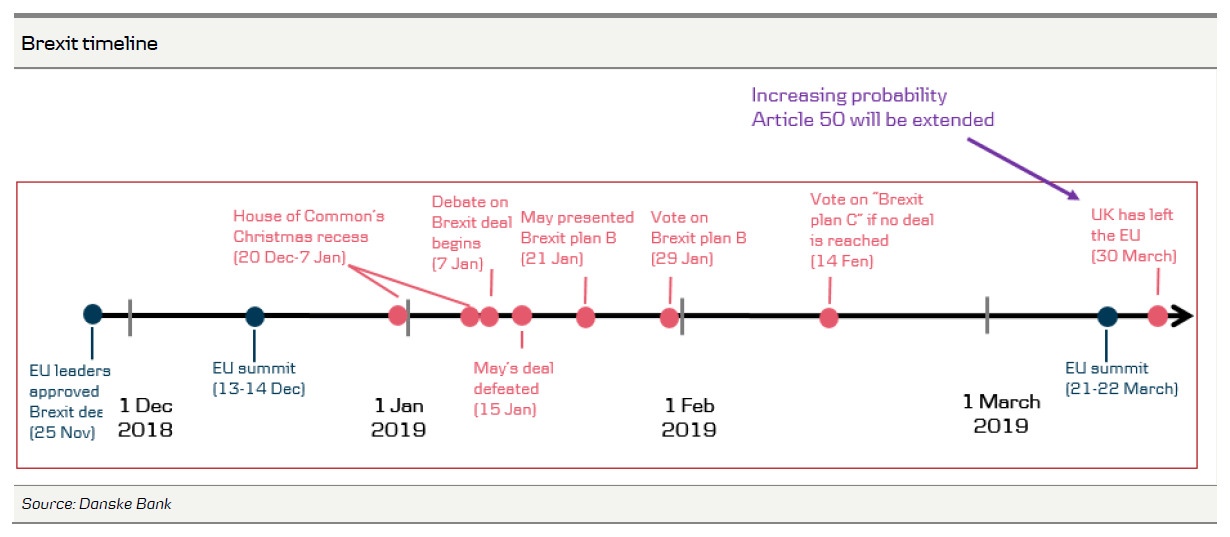
Against our expectation, the so-called Brady amendment passed by a small majority (317-301). The Brady amendment says the House of Commons can support May’s Brexit deal, but that the backstop has to be replaced with “alternative arrangements”.
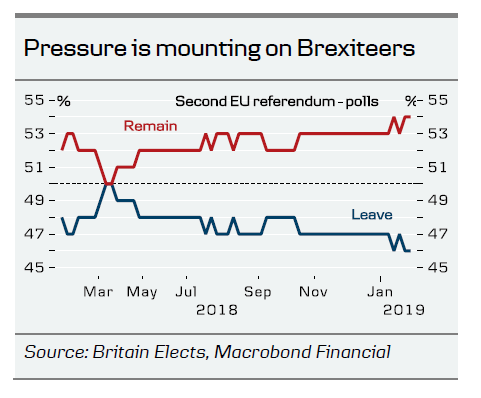
While it is positive for May that she has finally found her majority (probably due to the increasing pressure, as the 29 March deadline is drawing closer), the EU27 responded immediately by repeating it will not renegotiate the Withdrawal Agreement. As the pressure is also mounting on the EU27 given the shared responsibility of the Irish border and due to the possible economic consequences of a no deal Brexit, the EU may be more willing to listen now May can show what is needed for the deal to get over the finish line.
Also against our expectation, the so-called Cooper amendment failed (which would have given the House of Commons a vote on whether to ask the EU for an extension of Article 50 or not in case Prime Minister Theresa May had not won support for a deal by 26 February). During the day, the likelihood of it passing declined, partly because PM Theresa May promised the House of Commons would have another similar vote on 14 February if no deal has passed by then. While GBP depreciated on the loss, we do not think it matters much, as we still think there is a small majority in the Commons who will eventually step in to prevent a no deal Brexit. This is also what the passing of the so-called Spelman tells us (the Spelman amendment says Parliament does not want a no deal Brexit but without any enforcement). Still, it means May basically has two and half weeks to renegotiate the backstop with the EU.
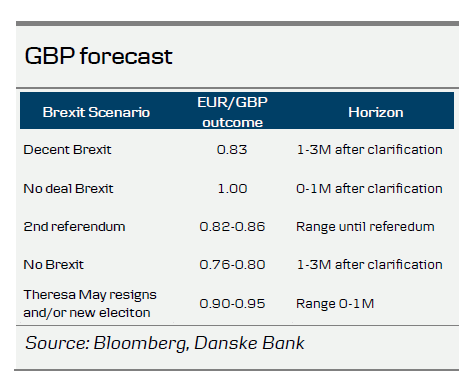
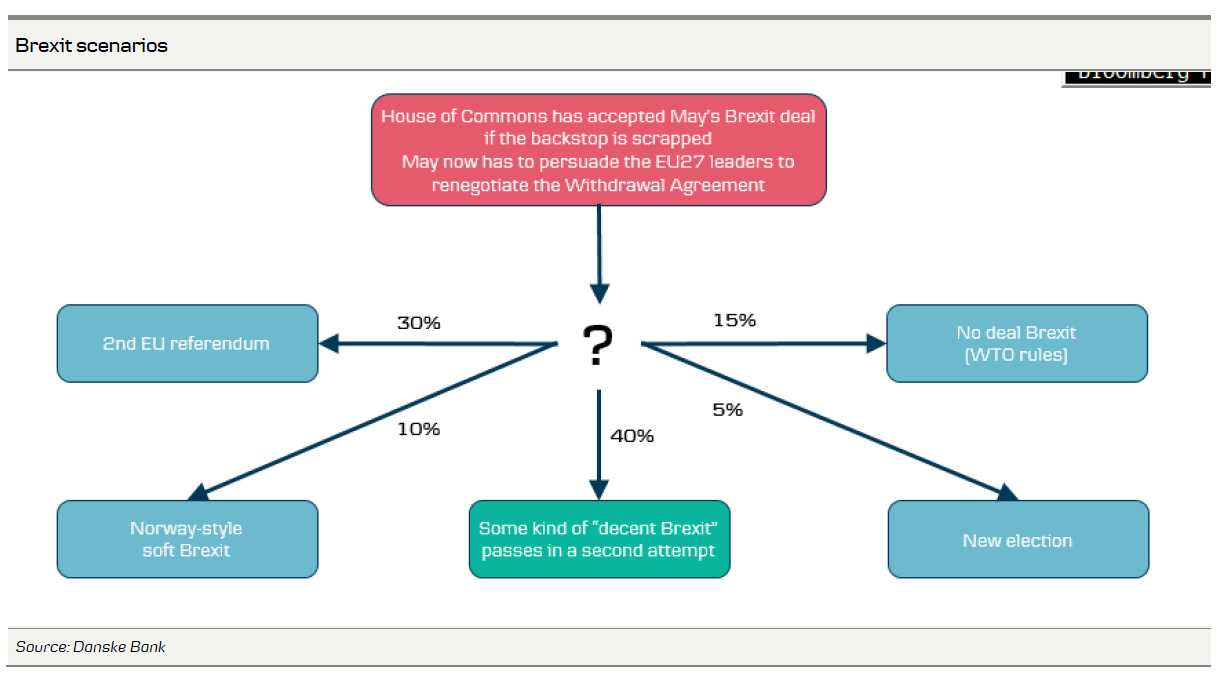
We think today’s results support our base case that PM May’s deal will pass eventually (40%), but uncertainty remains high and will probably stay high until the very end. We have argued for a long time that it is normal political negotiations that we have to get very close to the deadline before we will get a solution. If May does not get a deal, we think a second EU referendum is the second most likely outcome (30%). See also our game tree overleaf.
In our view, one possible way forward could be to extend Article 50 for a longer period and focus on the permanent future relationship. By doing that the two sides can reach an agreement, which would make the backstop redundant, without either side losing face.
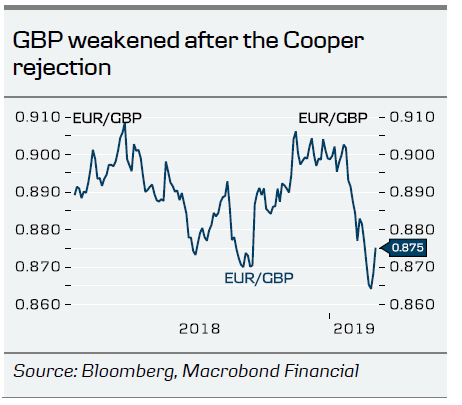
EUR/GBP broke above 0.8750 as parliament rejected the Cooper amendment. While the rejection was somewhat of a disappointment for the market, the sell-off in GBP seems fair in the light of past week’s rally as uncertainty remains intact. Overall, however, the risk of a no deal Brexit still appears to be lower compared to a month ago, which justifies a lower range for EUR/GBP, and we expect EUR/GBP to stay within the 0.86-0-89 range near term. We maintain the view that it will require further reduction in the ‘no deal’ Brexit risk for EUR/GBP to test and eventually break below 0.86. This could happen in the case of either 1) improved odds for Theresa May’s deal being passed in parliament, or 2) an extension of article 50 combined with renewed negotiations between UK and EU or 3) if a second referendum is called
Elliott Wave View: Gold Should Continue Higher
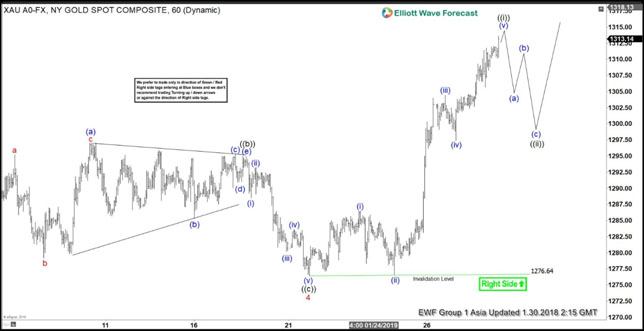
Elliott Wave view in Gold suggests the pullback to $1276.64 ended wave 4. Internal of wave 4 unfolded as a zigzag Elliott Wave structure. Wave ((a)) of 4 ended at $1276, wave ((b)) of 4 ended at $1295, and wave ((c)) of 4 ended at $1276.64. Rally from there looks impulsive and expected to end wave ((i)) soon as a 5 waves impulse Elliott Wave structure. Up from $1276.64, wave (i) ended at $1286.53, wave (ii) ended at $1276.59, wave (iii) ended at 1304.41, and wave (iv) ended at $1297.40.
Expect the yellow metal to end wave (v) soon and thus end wave ((i)) of larger degree. Afterwards, it should pullback in wave ((ii)) to correct the rally from January 21 low ($1276.64) before the rally resumes. The pullback should unfold in the sequence of 3, 7, or 11 swing. As far as pivot at $1276.64 low stays intact in the pullback, expect Gold to extend higher. As an alternate, the 5 waves move higher can end wave 5 of (3) instead of wave ((i)) of 5. In this alternate scenario, Gold should pullback in wave (4) to correct cycle from September 28, 2018 low ($1180.86) before the rally resumes.. Either way, expect pullback in the yellow metal to continue finding support for more upside.
Gold 1 Hour Elliott Wave Chart
AUD/USD Facing Significant Resistance Near 0.7200
Key Highlights
- The Aussie Dollar failed to surpass the 0.7200 barrier and declined recently against the US Dollar.
- There is a major bearish trend line in place with resistance at 0.7190 on the 4-hours chart of AUD/USD.
- Australia’s CPI in Q4 2018 increased 0.5% (QoQ), more than the 0.4% forecast.
- Today, the Fed Interest Rate Decision is scheduled (Forecast 2.5%, versus 2.5% previous).
AUDUSD Technical Analysis
This past week, the Aussie Dollar made a solid upward move from the 0.7100 support against the US Dollar. The AUD/USD pair broke the 0.7120 and 0.7150 resistance levels to move into a positive zone, but it struggled to clear the 0.7200 level.
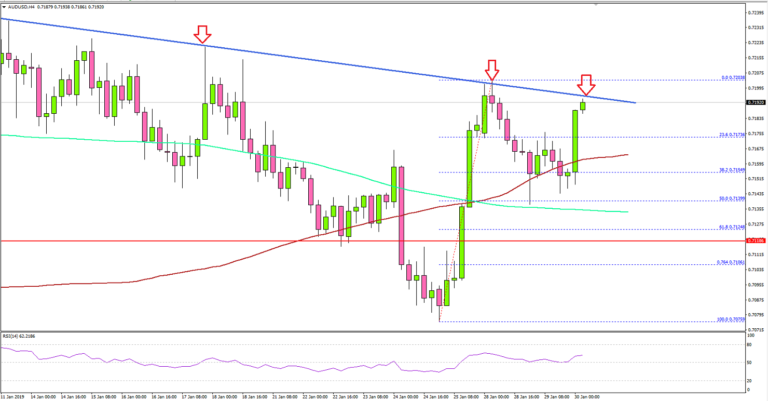
Looking at the 4-hours chart, the pair spiked above the 0.7200 level and formed a high at 0.7203. Later, it corrected lower and declined below the 38.2% Fib retracement level of the recent wave from the 0.7075 low to 0.7203 high.
However, the decline was protected by the 0.7140 level and the 50% Fib retracement level of the recent wave from the 0.7075 low to 0.7203 high. More importantly, the pair stayed above the 200 simple moving average (green, 4-hours).
On the upside, there is a strong hurdle formed near 0.7200 and a major bearish trend line with resistance at 0.7190 on the same chart. Therefore, a proper break above the 0.7200 resistance is must for an upside extension towards 0.7250. If not, there is a risk of a break towards the 0.7100 support.
Fundamentally, the Australian Consumer Price Index for Q4 2018 was recently released by the RBA and republished by the Australian Bureau of Statistics. The market was looking for an increase in the CPI by 0.4% in Q4 2018, compared with the previous quarter.
The actual result was better than the forecast as there was a 0.5% rise in the CPI. Looking at the yearly change, the Australian Consumer Price Index increased 1.8%, more than the 1.7% forecast, but less than the last 1.9%.
Overall, AUD/USD is facing an uphill task, but today’s Fed Interest Rate Decision might impact the market and major pairs like EUR/USD, GBP/USD, AUD/USD and USD/JPY.
Economic Releases to Watch Today
- German Consumer Price Index Jan 2019 (Prelim) (YoY) – Forecast +1.6%, versus +1.7% previous.
- German CPI Jan 2019 (Prelim) (MoM) – Forecast -0.8%, versus +0.1% previous.
- Euro Zone Services Sentiment Jan 2019 – Forecast 11.1, versus 12.0 previous.
- Euro Zone Industrial Confidence Jan 2019 – Forecast 0.5, versus 1.1 previous
- Euro Zone Economic Sentiment Indicator Jan 2019 – Forecast 106.8, versus 107.3 previous.
- US ADP Employment Change Jan 2019 – Forecast 175K, versus 271K previous.
- Fed Interest Rate Decision – Forecast 2.5%, versus 2.5% previous.
Australian Inflation – First Greater Than Expected Print In Two Years
An upside surprise but inflation remains well contained
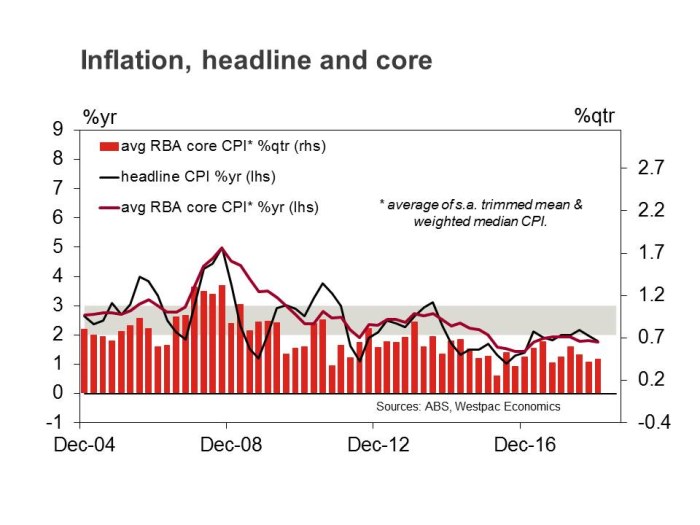
The December Quarter CPI printed 0.5%qtr, compared to the market median of 0.4% and Westpac’s forecast for 0.3%. At two decimal places, the rise in the CPI was 0.53%qtr, so a hard 0.5%. With base effects, the annual rate has eased back to 1.8%yr compared to 1.9%yr in Q3, 2.1%yr in Q2 and 1.9% in Q1. But with another sub 0.6% print, the six month annualised pace is down to 1.2%yr (using seasonally adjusted data – raw CPI six month annualised is 2.0%yr but this incorporates a seasonally stronger pace in H2). Inflation continues to bump along just at, or just under, the bottom of the RBA’s target band.
Following the December quarter 2017 CPI, we argued that searching for inflation in the Australian economy has been as fruitless as Vladimir and Estragon’s wait for Godot. While this report does suggest we have at least found a bottom in the disinflationary pulse, it is still too early to call an inflationary pulse is underway and there are some hints in the December 2018 report that the current scenario has much longer to run.
The average of the core measures, which are seasonally adjusted and exclude extreme moves, rose 0.4%qtr meeting market expectations. In the quarter, the trimmed mean gained 0.43% while the weighted median lifted 0.36%. The annual pace of the average of the core measures printed 1.8%yr which is the same as the September quarter print.
Incorporating revisions, the six month annualised growth in core inflation is 1.8%yr which is well below the bottom of the RBA target band and the slowest pace June 2016.
A small number of upside surprises but nothing that changes the fundamental picture
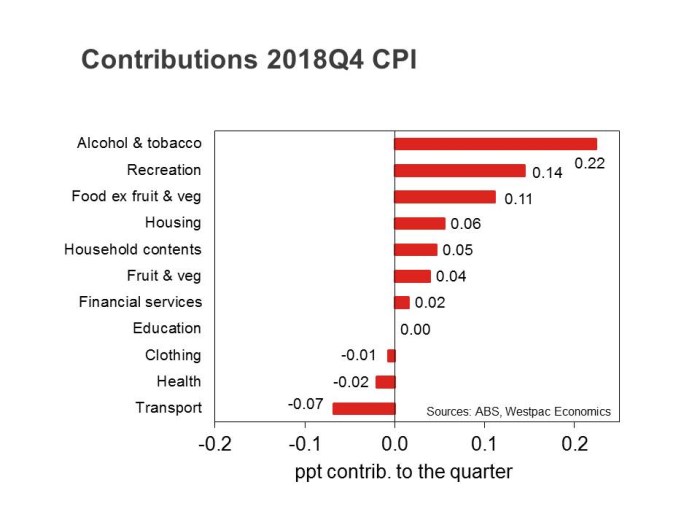
Some standouts in the quarter – on the positive side there was a stronger rise in alcohol & tobacco (3.2% vs 2.8% expected), a surprising rise in utilities (0.1% vs –0.3% expected), a smaller fall in auto fuel (–2.5 vs –4.2% expected), a surprising jump in household contents & services (0.5% vs –0.5% expected) and a stronger bump in holiday travel (2.6% vs 1.6% expected all due to strong domestic holiday prices). On the downside, food rose just 0.9% (1.2% expected) due to a smaller than expected rise in fresh fruit & vegetables, clothing & footwear fell –0.2% (a small rise was expected). Everything else came in close to expectations or just slightly stronger.
We think is worth noting the continued modest gains for housing expenditure. Housing costs overall rose as expected (0.2%) rents rose 0.2% (we thought they would be flat), dwelling prices rose just 0.4% (as we expected) while utilities rose 0.1% vs our –0.3% expected. The surprise in utilities was the jump in electricity prices that outweighed the normal seasonal fall in gas prices.
There remains a number of near term negative risks for both rents and dwelling purchase costs in NSW and Victoria. Given that rents and dwelling purchases are worth around 15% of the CPI on their own, this is significant for headline inflation, and even more so for core, where their weight is somewhat higher.
Tradables fell 0.3% in the December quarter. The tradable goods component fell –0.1% due to automotive fuel (-2.5%), audio, visual & comp equipment (-3.3%) and wine (-1.9%). The tradable services component fell 0.7% due to international holiday travel & accommodation (-0.8%).
Non-tradables component rose 0.9% in the December quarter. The non-tradable goods component rose 1.5%, due to the excise tax increase for tobacco (9.4%). The non-tradable services component rose 0.6%, due to domestic holiday travel & accommodation (6.2%).
Low inflation remains embedded in the economy
For the first time in two years inflation forecasters have underestimated the quarterly rise in the CPI. Does this signal a turnaround and the return of a more sustainable inflationary pulse? We don’t think so. While there are some isolated inflationary pressures; tobacco prices are clear standouts as well as embryonic indicators that the disinflationary pulse in retail, particularly in the household goods & services and domestic holidays & travel, may be ending. But, we are still seeing weakness in clothing and footwear while the moderation in housing costs (rents and dwelling purchases in particular) is a significant offset. We are, however, watching the surprising bump in electricity prices to see if this continues.
As housing has a significant group weighting in the CPI (15%) it has a meaningful impact on the estimates of both inflation and core inflation. As such, with core inflation below the bottom of the RBA’s target band we can find little to suggest any risk of a meaningful acceleration.
Market Morning Briefing: Euro Is Up Slightly
STOCKS
Most indices saw a small relief rally yesterday, but could be vulnerable to more profit-taking while below the important Resistances mentioned over the last few days.
Slight rally in the Dow (24579.96, +51.74, +0.21%) yesterday. But, as mentioned, while below 25000, it would be prudent to look for 24000 on the downside.
On the Dax ( 11218.83, +8.52, +0.076%), we mentioned yesterday that " Looking at the Weekly Candles, there are equal chances of a dip to 10900 as of a further rally to 11500." It dipped to 11159 yesterday, but did not push lower, holding above rising trendline coming up from 10400. So, could it be that the market is not as bearish as might have been thought?
The Nikkei (20555.13, -109.51, -0.53%) saw a small rally yesterday, but is vulnerable towards 20400 and lower in the medium term while below 21000. Near term looks bearish.
The Shanghai (2585.37, 8.88, -0.34%) saw a low of 2560 yesterday, close to our target of 2550, but then recovered most of the fall. Today, the index is again trading lower and could re-test 2550. Perhaps it will range sideways between 2550-2650 for some days now, with a bit of a bearish bias towards a test of 2535 as well.
Both Sensex (35592.50, -64.20, -0.18%) and Nifty (10652.20, -9.35, -0.088%) broke below their support levels at 35600 and 10670 respectively and can fall further towards 35000 and 10400 over the next couple of weeks.
COMMODITIES
Gold and Silver are trading higher. Copper has moved up but could face resistance above current levels. Crude is also trading higher but upside could be limited just now.
Gold (1318.30) has risen sharply above 1300 as expected. 1320 is an immediate resistance which if holds could push back the price to 1300 or lower. Failure to sustain below 1320 would open up 1340/50 on the upside.
Silver (15.88) is also trading higher and could test resistance near 16.0-16.5.
Copper (2.7220) has rebound to levels above 2.70, indicating possible bullish momentum for the near term. A rise to 2.75 is on the cards for the next couple of sessions from where a corrective dip is possible.
The API reported a crude built of 2.098 mln barrels for the week ended 25 the Jan, much lower than the analyst expectations of 7.97 mln barrels.
Crude prices are trading higher today, having risen slightly yesterday's dips.
Brent (61.23) and WTI (53.23) are trading higher but are tilted to the downside for the near term. Brent could fall in the near term towards 58 while below 62. WTI is holding well below horizontal resistance near 5450 on the weekly candles. While the price sustains below 54.50, WTI looks bearish towards 50.
FOREX
Currencies are mixed. Euro, Aussie, Yuan and Pound could see some strength against the US Dollar while Dollar Yen looks ranged. Overall some strength or stability is possible before a sharp movement sets in.
Dollar Index (95.76) is almost stable just now but looks bearish towards trend support at 95 on the 3-day and weekly candles. Thereafter a sharp rise from 95 could be expected in the longer run.
Euro (1.1438) is up slightly. Gradual up move in Euro could take it higher towards 1.150-1.155 levels in the near term.
Dollar Yen (109.33) is trading in narrow and small range just now unclear of the near term direction. While below 110, a fall towards 109-108 looks possible.
Pound (1.3094) has immediate support at 1.30 which if holds, could pull back Pound to 1.32/33 levels. Overall some ranged movement above 1.30 is possible in Pound for the near term.
Aussie (0.7193) has moved up on strength in commodities. But while the commodities may have upcoming resistances, the current strength in Aussie could be limited.
USD-CNY (6.7123) came off, breaking below our expected support at 6.72. The pair looks strongly bearish just now and could fall further towards 6.65. Near term looks bearish.
Dollar Rupee (71.12) closed below 71.25 after attempting an intra-day high of 71.21 yesterday. While 71.21 holds, we could see ranged movement within 70.90-71.25 region (revised lower limit from 70.80 to 70.90). A break above 71.25 would open up chances of re-testing higher resistance zone of 71.40/60.
INTEREST RATES
There is Resistance coming up near current levels on a number of the Yield Tenors as well as Yield Spreads. Together these suggest that Yields and Spreads can come down towards 2.50% (2Yr); 2.45% (5Yr); 2.60% (10Yr) and 2.85% (30yr). So, the dip that we were expecting (as mentioned in our 31-Dec-18 treasury report) can still take place, albeit with a little delay.
The 10Yr GOI (7.5262%) is looking bearish just now and could fall towards 7.50/48% before attempting a bounce from there.
Asian update: Sterling found footing after selloff, Aussie rises on CPI
Sterling suffered broad based selloff overnight as the UK parliament put Brexit back into uncertainty. But losses are so far limited as the Pound quickly stabilized. In short, the Parliament passed the proposal to ask Prime Minister Theresa May to go back to Brussels to renegotiate the Irish backstop into alternative arrangements. But EU has reinstated the stance that it won't reopen negotiations.
In the currency markets, Australian Dollar is the strongest one in Asian markets today, after slightly stronger than expected Q4 CPI reading. New Zealand Dollar follows as the second. Swiss Franc is currently the weakest one , followed by Dollar and then Yen. The economic calendar is rather busy today. French GDP, Swiss KOF, Eurozone confidence indicators, Germany CPI and US ADP employment will also be watched. But the major focus will be on FOMC rate decision and press conference.
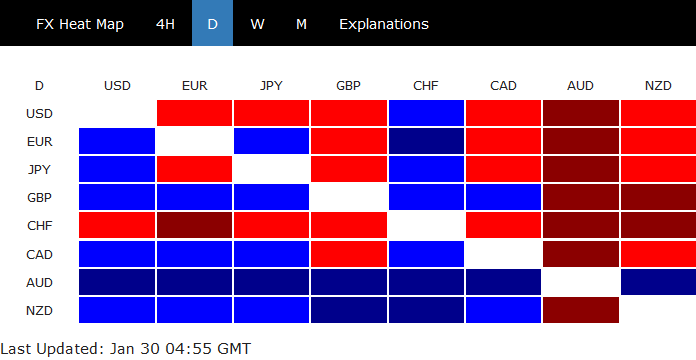
In Asia:
- Nikkei is currently down -0.26%.
- Hong Kong HSI is up 0.29%.
- China Shanghai SSE is up 0.09%.
- Singapore Strait Times is down -0.11%.
- Japan 10-year JGB yield is up 0.0003 at 0.004.
Overnight:
- DOW rose 0.21%.
- S&P 500 dropped -0.15%.
- NASDAQ dropped -0.81%.
- 10-year yield dropped -0.032 to 2.712.