

Sample Category Title
Aussie Gains As Inflation Shows Mild Acceleration
CPI hits year's high in Q4
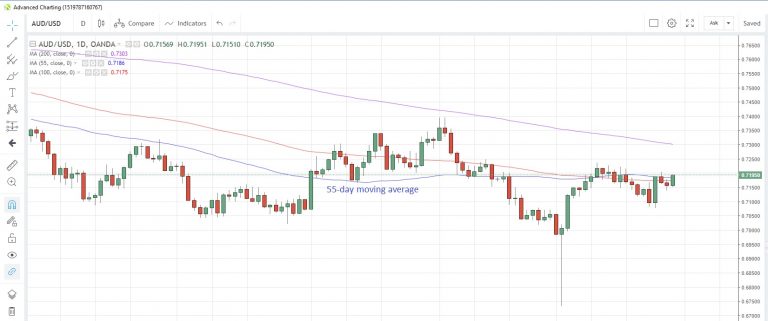
AUD/USD firmed to an intra-day high of 0.7197 after quarterly inflation data showed a slight acceleration. The RBA's favoured trimmed mean CPI came in as expected at +0.4% q/q and +1.8% y/y, but the quarterly headline number hit +0.5% q/q, the highest for 2018 and more than the +0.4% economists had forecast. That was the catalyst for the Aussie gains and AUD/USD could close above the 55-day moving average at 0.7186 for the first time in two weeks.
RBA meeting could get interesting
The data per se is unlikely to shift the central bank's monetary policy stance. If anything, yesterday's dismal NAB business surveys could have more of an impact. The business conditions index slumped to 2 in December, the lowest reading since February 2015, from 11 in November. Firms' profitability index has collapsed from 14 to zero in just two months, while forward orders have turned negative. Not exactly a bullish outlook.
The RBA meets next Tuesday, February 5, having kept interest rates at a record low of 1.50% for the past 26 meetings going back to September 2016. Yesterday, RBA board member Ian Harper said the next move in rates was likely to be higher, but I'd have to guess the speech was written before the data was known. We could see a more dovish tone from the RBA next week, which would exert downward pressure on the Aussie.
Light at the end of the tariff tunnel?
The US and China begin a scheduled two-day meeting to discuss trade issues. The January 4-7 meeting ended with some positive feedback/vibes but since then an escalation in the Huawei situation, has placed a cloud over the proceedings. Nevertheless, US Treasury Secretary Mnuchin sounded positive in an interview early yesterday, saying if China presents enough trade concessions, then there is a chance the US administration may lift all tariffs. Now that would be good news for risk appetite. On the opposite side of the spectrum, the March 1 deadline is looming where, if no deal is struck, the US will increase its tariffs on $200 billion worth of Chinese goods to 25% from the current 10%.
Euro-zone sentiment to show further weakness
Euro-zone sentiment indicators are expected to continue with a weaker bias in January, latest polls suggest. Economic sentiment is seen dropping to 106.8 from 107.3, the business climate index to 0.75 from 0.82 and industrial confidence to 0.5 from 1.1, further confirming Draghi recent comments about downside risks to the economy.
FOMC on tap
The Federal Reserve holds its first policy meeting of the year today, and is widely expected to keep rates unchanged and continue its recent theme of patience when it comes to more rate hikes. Chairman Powell will hold a press conference after the meeting, a new initiative starting this month.
We could see more reaction if there is discussion about the Fed adjusting its holdings of Treasury securities, possibly bringing the winding down of purchases to an end earlier than expected, as had been suggested in a Wall Street Journal story late last week.
Daily Markets Broadcast
Wall Street ends mixed on Apple optimism
Wall Street indices were mixed yesterday, lifted by an in-line earnings outlook from Apple, though the NAS100 index under-performed as tech stocks were pressured. UK Parliament rejected PM May’s Brexit deal and sent her back to Brussels to renegotiate. US and China begin the next round of trade negotiations.
US30USD Daily Chart
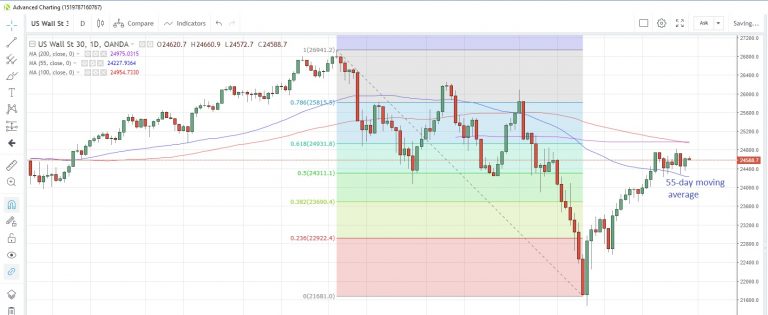
The US30 index rallied on Tuesday as steady results from Apple after a turbulent Q4 suggested stability
The index remains above the 55-day moving average at 24,227. The convergence of the 100- and 200-day moving averages at 24,954 and 24,975, respectively, act as resistance
US FOMC meets later today and is widely expected to keep rates unchanged. Investors will be monitoring the statement for comments about trimming its balance sheet.
DE30EUR Daily Chart
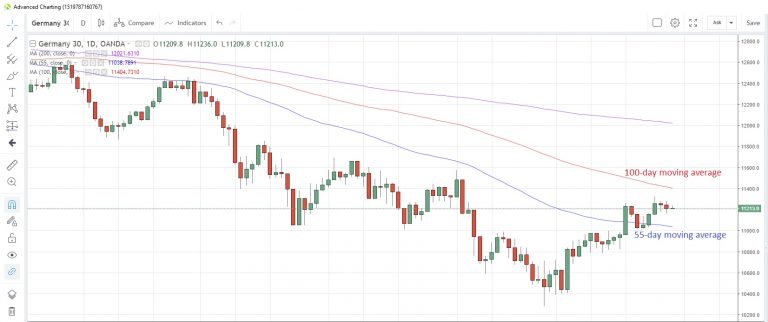
The Germany30 index fell for a second straight day yesterday as the UK Brexit deal weighed on sentiment
The index is trading between the 55-day moving average support at 11,038 and 100-day moving average resistance at 11,404
Euro-zone sentiment indicators for January are likely to show a further deterioration, the latest polls suggest. The economic sentiment indicator is seen sliding to 106.8 from 107.3.
WTICOUSD Daily Chart
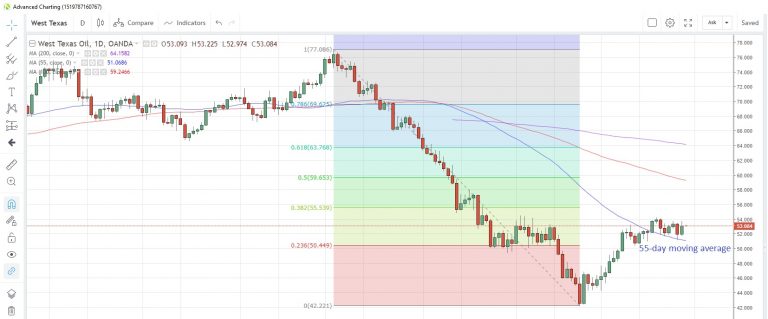
WTI advanced yesterday as the US imposed a de facto ban on Venezuelan oil
Oil prices continue to hold above the 55-day moving average at $51.07. Prices have closed above this average for almost two weeks
Oil gained despite another increase in inventories, according to the weekly API data. In the week to January 25, stockpiles grew by 2.1 million barrels, the second weekly addition in a row.
Brexit Quagmire Continues As Fed To Hit The Brakes
The US dollar is higher across the board versus major pairs on Tuesday. The biggest event was the Brexit vote in the UK parliament. A very mixed bag as a no-deal exit was almost guaranteed, but how to achieve an actual deal is looking murky. The amendments that were approved in narrow victories are against a hard Irish border and a parliamentary vote that blocks a no-deal exit. Voted down was an amendment seeking to extend the article 50 timeline to the end of the year. The EU has already said that the backstop and the deal will note renegotiated, but ready to consider a Brexit delay.
The first Federal Open Market Committee (FOMC) meeting of the year starts on Tuesday and wraps up on Wednesday, January 30 at 2pm EST. Chair Jerome Powell will host a press conference at 2:30 pm EST which will be the highlight as he is expected to give far more details on how what the next move is for the Fed.
Pound Falls After PM May Sent to Renegotiate Brexit Agreement
The pound lost 1.02 percent in the last two days. The outcome of the Brexit vote in parliament once again sends Prime Minister Theresa May to Brussels to seek a new agreement. The European Union was quick to issue a statement after the vote that the agreement already on the table is final, but is willing to extend the deadline.
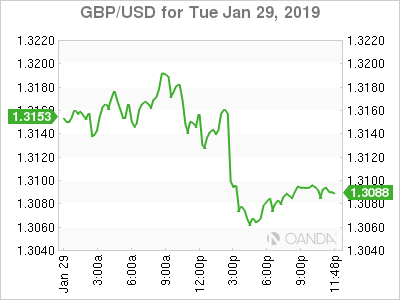
While the no-deal exit was rejected, the amendments that would have locked down plans to avoid a hard exit were voted down. The divorce between the United Kingdom and the European Union remains a messy affair with lots of talk and negotiation but very little to show for it. The fast approaching deadline and the major issues still to be ironed out will cause the currency market to have increased volatility.
Dollar Awaits Fed Chair Words More than Statement
The EUR/USD rose 0.04 percent on Tuesday. The single currency is slightly higher against the USD after the Brexit vote boosted the euro, but uncertainty remains on how it will all play out with a a new round of unwanted negotiations almost immediately rejected by the EU. The U.S. Federal Reserve will publish its FOMC statement on Wednesday with the market focusing on Chair Powell and his press conference.
This is the first press conference of the year, and the first in the new era of transparency. Powell will now face questions from the financial press after every meeting, instead of the four from his predecessors. This will be a test if Jay Powell continues his straight shooting answers as the Fed is ready to pump the brakes or if he conforms to a more obtuse communication style favoured by policy makers.
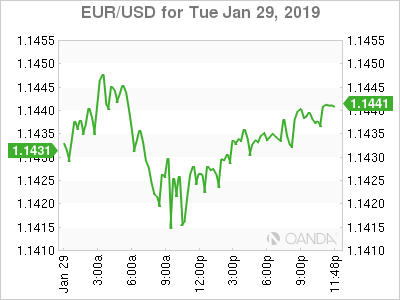
The CME FedWatch tool shows the market is forecasting a 100 percent probability that the Fed funds rate remains unchanged at 225–250 basis points range. The currency rose last year as geopolitical factors and the support of the central bank’s efforts to normalize interest rates.
The Fed had tightened monetary policy by raising rates, but also by unwinding the massive balance sheet it had accumulated as part of its quantitative easing program. Friday’s report in the WSJ about a possible end or long-term pause to the balance sheet reduction was a positive for the stock market, but a negative to the US dollar.
EURGBP Faces Price Recovery Extension Towards 0.8724 Zone
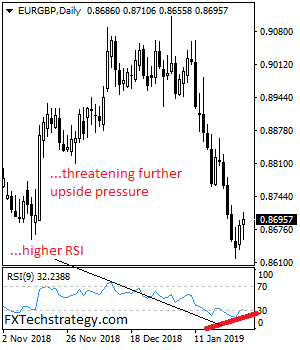
EURGBP faces price recovery extension towards 0.8724 zone. On the downside, support stands at the 0.8650 level where a violation will turn focus to the 0.8600 level. A break below here will aim at the 0.8550 level. Conversely, resistance lies at the 0.8850 level. A violation if seen will turn risk towards the 0.8900 level. Further up, resistance comes in at 0.8950 level followed by the 0.9000 level. Its daily RSI is bullish and pointing higher suggesting further upside pressure. All in all, EURGBP remains biased to the upside on further corrective upside pressure.
FOMC forward guidance and balance sheet reduction plan watched
The economic calendar is rather busy today. French GDP, Swiss KOF, Eurozone confidence indicators, Germany CPI and US ADP employment will also be watched. But the major focus will be on FOMC rate decision and press conference.
Fed is widely expected to keep federal funds rate unchanged at 2.25-2.50%. Since December, following extreme market volatility and cautious turn in Fedspeaks, pricing of Fed's rate path changed drastically. Fed funds futures are now only pricing in around 20% chance of a 25bps hike by the December meeting. Dollar then started weakening broadly. The greenback suffered another round selloff last week after a WSJ report suggesting that the Fed members are considering to end the balance sheet reduction plan earlier than previously expected.
The first focus today will be on forward guidance in the statement. Back in December, FOMC noted that "the Committee judges that some further gradual increases in the target range for the federal funds rate will be consistent with sustained expansion of economic activity, strong labor market conditions, and inflation near the Committee's symmetric 2 percent objective over the medium term."
But since then, Fed officials sung a chorus, saying that Fed can afford some patience before another rate move. And Fed chair Jerome Powell even indicated that Fed is flexible to move in either direction if necessary. Any change in the forward guidance that hints at a pause could give Dollar more pressure.
And secondly, Powell will need to indicate if there is any change in Fed's balance sheet reduction plan.
Here are some previews on FOMC:
Australia CPI slowed to 1.8%, but beat expectations
Australian Dollar is lifted slightly by stronger than expected consumer inflation reading. Headline CPI rose 0.5% qoq in Q4 versus expectation of 0.4% qoq. Annual rate slowed to 1.8% yoy, down from 1.9% yoy, but beat expectation of 1.7% yoy. RBA trimmed mean CPI rose 0.4% qoq, 1.8% yoy, matched expectations. RBA weighed media CPI rose 0.4% qoq, 1.7% yoy, basically matched expectations.
ABS Chief Economist, Bruce Hockman said: "Annual growth in the CPI remains below 2 per cent in the December quarter 2018, with annual growth in tradables inflation of just 0.6 per cent, while non-tradables inflation rose 2.4 per cent. Over the past four years, annual growth in the CPI has only risen above 2 per cent in two of the past 16 quarters."
ABS also noted that
- The most significant price rises this quarter are tobacco (+9.4%), domestic holiday travel and accommodation (+6.2%), fruit (+5.0%) and new dwelling purchase by owner-occupiers (+0.4%).
- The most significant price falls this quarter are automotive fuel (-2.5%), audio visual and computing equipment (-3.3%), wine (-1.9%), and telecommunications equipment and services (-1.5%).
EU Tusk: Brexit withdrawal agreement is not open for renegotiation
On UK's decision to seek Brexit deal renegotiations, European Council President Donald Tusk said via his spokesman "The Withdrawal Agreement is and remains the best and only way to ensure an orderly withdrawal of the United Kingdom from the European Union". "The backstop is part of the Withdrawal Agreement, and the Withdrawal Agreement is not open for renegotiation."
Nevertheless, Tusk said "We welcome and share the UK parliament's ambition to avoid a no-deal scenario. We continue to urge the UK government to clarify its intentions with respect to its next steps as soon as possible." And, "If the UK's intentions for the future partnership were to evolve, the EU would be prepared to reconsider its offer and adjust the content and the level of ambition of the political declaration... Should there be a UK reasoned request for an extension, the EU27 would stand ready to consider it and decide by unanimity."
European Parliament Guy Verhofstadt echoed and said "we stand by Ireland,"and "there is no majority to re-open or dilute the Withdrawal Agreement in the European Parliament, including the backstop."
Sterling drops as UK seeks to reopen Brexit negotiation
Sterling dropped broadly after the Parliament voted 317 to 301 for Conservative MP Graham Brady's Brexit deal amendment. Prime Minister Theresa is now required to go back to EU to renegotiate the deal to replace the Irish backstop with "alternative arrangements". At the same time, the Parliament rejected Labour MP Yvette Cooper's proposal to force Article 50 extension to avoid no-deal Brexit. Though, the symbolic amendments opposing no-deal Brexit was passed.
May's spokesman said that "tonight parliament has sent a clear message that there is a way forward to secure this deal if we are able to secure changes in relation to the backstop." And, "the EU's position remains that they want the United Kingdom to leave with a deal. They want the UK to leave with a deal because it's in their interests as well as those of the UK."
However, EU repeated its stance that there will be no renegotiation. And, it's uncertain what exactly alternative arrangements on the Irish border backstop are.
Eco Data 1/30/19
[php_everywhere instance="1"]
Fed Meeting: All Eyes on Powell’s Balance Sheet Remarks
The Fed is widely expected to keep policy unchanged when it announces its decision on Wednesday, at 1900 GMT. Even though there won’t be any updated forecasts this time, Chair Powell will hold a press conference after the event, and any market reaction will likely come from his remarks. In light of rate hikes being “on pause” for now, markets will focus on whether the Fed’s balance sheet reduction may also be halted before long. Any such signals could drag the dollar lower and propel stocks higher.
The Fed has become more sensitive to market concerns lately, with even the most hawkish of policymakers voicing support for a more “patient” approach moving forward. Several officials made it clear that any further rate increases are on hold for now while they assess the impact of various risks, ranging from a weakening US housing market to a global economic slowdown to the trade dispute to recession fears. That doesn’t necessarily mean the tightening cycle is over, but rather that hikes will only resume once – and if – these risks subside. In turn, markets are pricing in a mere 20% probability for just a single quarter-point rate increase by year-end.
Turning to this meeting, attention will fall mainly on Chair Powell’s press conference, which will now be held after every meeting. Since hikes are “on pause”, investors will dissect his comments for any hints on the other burning topic: the balance sheet reduction. To explain, the Fed’s balance sheet – or portfolio – grew massively during the Quantitative Easing (QE) era, as the central bank bought assets to stimulate the economy. Now, the Fed is doing the opposite. It is shrinking this portfolio, which in essence amounts to tightening policy as it drains liquidity, and thus has similar effects to raising rates.
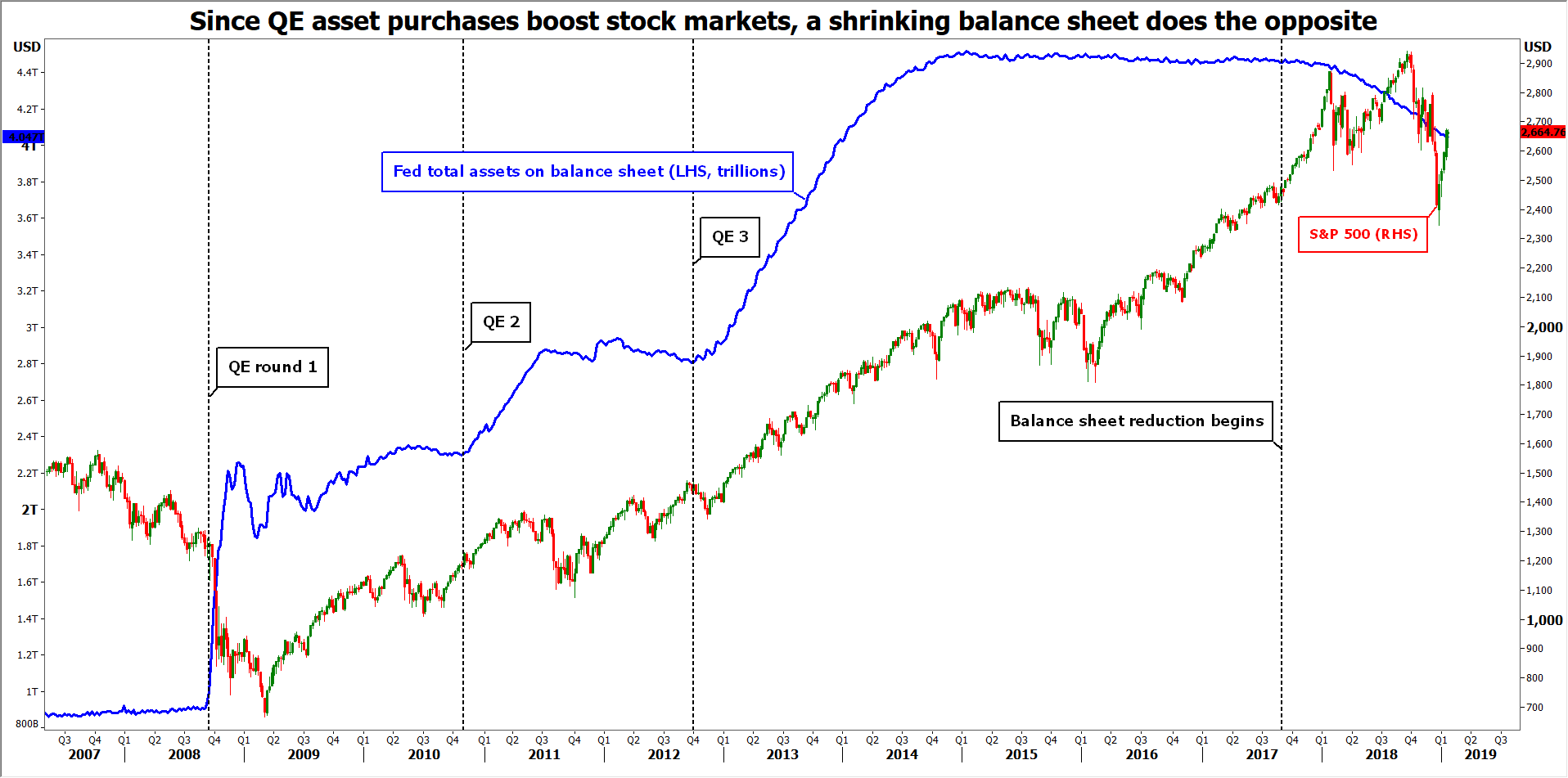
Recent media reports suggest policymakers are thinking about halting this portfolio reduction earlier than previously expected. If so, that would be the equivalent of easing monetary conditions, something that makes the dollar less attractive but increases the appeal of risky assets like stocks. While chief Powell is unlikely to go as far as actually announce a pause in the portfolio unwinding, he could very well hint that this would be a viable option if the economy slows down further, which may in itself be enough to trigger some of the aforementioned market reactions.
The other key determinant will be Powell’s broader tone on the economy, and to what extent he keeps further rate increases on the table. His job won’t be easy, as he will need to balance the fact that the US economy so far remains solid and may still require further hikes, with the possibility of a rate cut should investors’ fears of a recession prove correct. All while not appearing overly concerned himself, as any sense of nervousness from the Fed could incite even greater volatility in financial markets, which the central bank surely wants to avoid.
Outside of the Fed, there’s a lot more on the agenda this week for the dollar. Wednesday will also mark the start of another round of pivotal negotiations between the US and China; remember that the dollar has acted as a safe-haven on trade issues, so any signs of progress could harm the US currency. Separately, Friday will bring the release of the all-important US employment report and the ISM manufacturing PMI, both for January. Other key economic data out of the US scheduled for this week – including GDP figures – have been delayed without a specific day for their release yet, owing to the recent government shutdown.
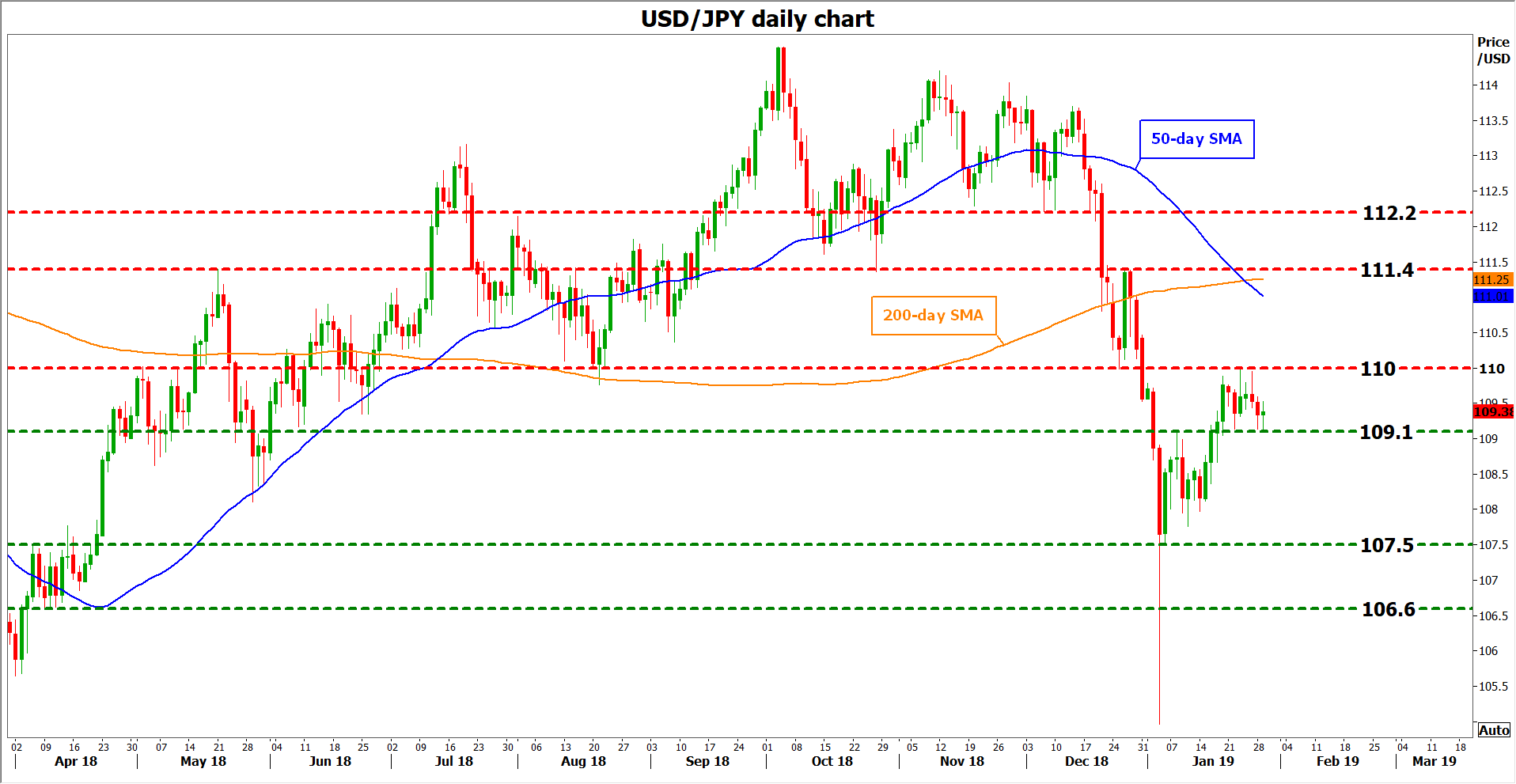
Technically, looking at dollar/yen, immediate support to declines may be found near 109.10, the low of January 22, with a downside break opening the way for a test of the 107.50 zone, defined by the January 4 trough.
On the flipside, initial resistance to advances may come around the 110.00 handle. If the bulls pierce above that, the next obstacle may be the 110.40 region; notice that both the 50-day and 200-day moving averages are nearby as well.