

Sample Category Title
Silver: White Metal Trading Higher In The Asian Session
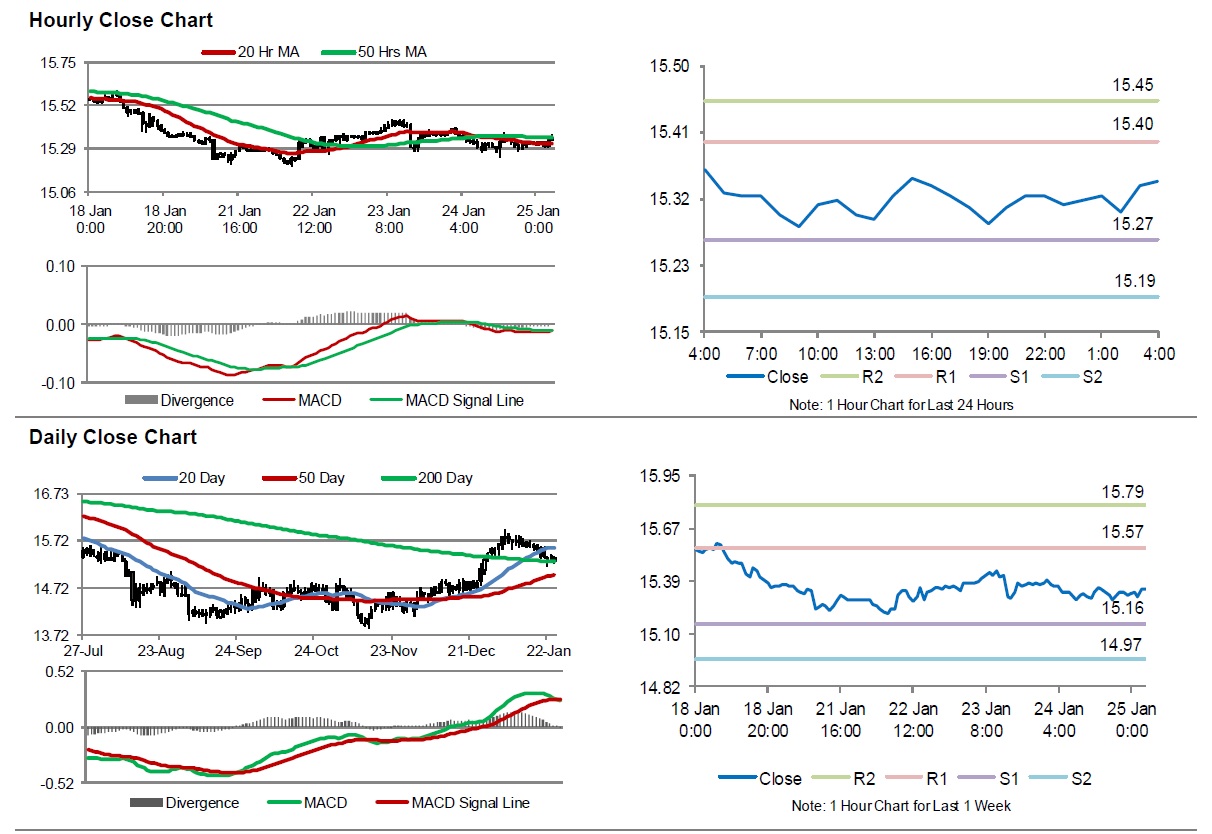
For the 24 hours to 23:00 GMT, Silver declined 0.33% against the USD and closed at USD15.32 per ounce, tracking losses in gold prices.
In the Asian session, at GMT0400, the pair is trading at 15.345, with silver trading 0.20% higher against the USD from yesterday’s close.
The pair is expected to find support at 15.27, and a fall through could take it to the next support level of 15.19. The pair is expected to find its first resistance at 15.40, and a rise through could take it to the next resistance level of 15.45.
The white metal is showing convergence with its 20 Hr and 50 Hr moving averages.
Crude Oil: Oil Trading Higher Ahead Of Baker Hughes Weekly Rig Count Data
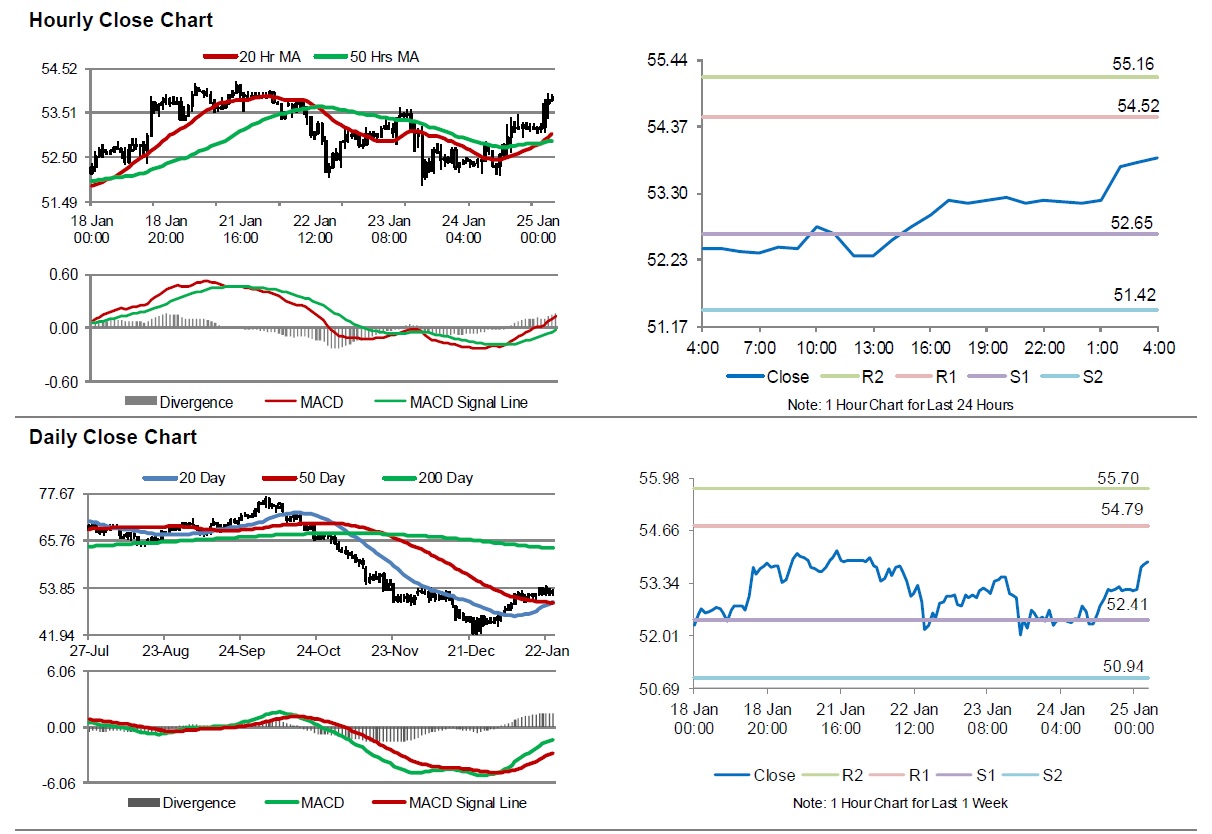
For the 24 hours to 23:00 GMT, Crude Oil rose 1.31% against the USD and closed at USD53.17 per barrel, amid potential US sanctions on Venezuela crude exports. Meanwhile, the Energy Information Administration reported that domestic crude supplies climbed by 8.0 million barrels in the week ended 18 January 2019.
In the Asian session, at GMT0400, the pair is trading at 53.87, with oil trading 1.32% higher against the USD from yesterday’s close, as political turmoil in Venezuela might disrupt crude oil exports.
The pair is expected to find support at 52.65, and a fall through could take it to the next support level of 51.42. The pair is expected to find its first resistance at 54.52, and a rise through could take it to the next resistance level of 55.16.
Crude oil is trading above its 20 Hr and 50 Hr moving averages.
Into European session: Yen weakest as Asian stocks surge, Sterling strong on Brexit rumor
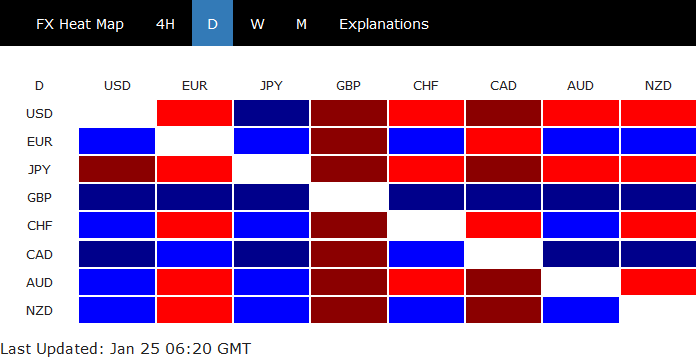
Entering European session, Yen is trading as the weakest one today, following strong risk appetite in Asia. Tech stocks led the way higher while investors shrug off conflicting comments from the US regarding trade negotiation with China. On the one hand, Commerce Secretary Wilbur Ross said the two countries are "miles and miles" away on a trade deal. But White House economic adviser Larry Kudlow said Trump is optimistic. Dollar follows as the second weakest and then Australian.
Sterling is boosted by news that Northern Ireland's DUP has privately agreed to conditional support to Prime Minister Theresa May's Brexit deal. But we'd doubt if the rumored condition of time limit on Irish backstop would get agreement from Brexit hardliners and the EU. Canadian Dollar, second strongest for today, follows oil price higher, as US threatens to sanction Venezuela. Euro is mixed after some knee-jerk actions follow ECB meeting yesterday.
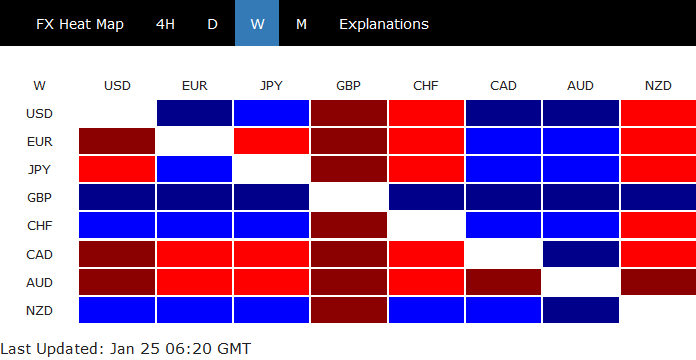
For the week, Sterling is also the strongest one, followed by, New Zealand Dollar and then Swiss Franc. Australian Dollar is the weakest followed by Canadian and then Euro.
In other markets:
- Nikkei closed up 0.97%.
- Hong Kong HSI is up 1.48%.
- China Shanghai SSE is up 0.79%.
- Singapore Strait Times is up 0.57%.
- Japan 10-year JGB yield is down -0.0082 at 0.002.
Overnight:
- DOW dropped -0.09%.
- S&P 500 rose 0.14%.
- Tech stocks shone as NASDAQ rose 0.68%.
- 10-year yield dropped -0.043 to 2.712. 2.7 is now a level to defend.
ECB Stands Still But Draghi Continues To ‘Nudge’ Markets
- No major surprises from Mr Draghi; ECB in 'assessment' mode
- Differing views within ECB on scale of EMU slowdown
- Retaining maximum flexibility while not signaling prospect of policy shift
- Draghi keeps wriggle room on future TLTRO's
Yesterday's policy meeting of the ECB's governing council didn't deliver any major surprises but it did hint at some differences of opinion that could have implications for when and, potentially, even which direction ECB policy next changes.
ECB in assessment mode
At present, the ECB is trying to evaluate an evolving economic situation and, as Mr Draghi emphasised repeatedly, the governing council did not discuss policy options. The ECB is now firmly in ‘watching and waiting' mode rather than contemplating or preparing any near term alterations to the current policy stance.
An acknowledgement of downside risks to the outlook for the Euro area economy implies that any material tightening of ECB policy entailing an initial rate rise is still a distant prospect.
Indeed, Mr Draghi's acknowledgement of differences of opinion among ECB policymakers in relation to how severe and persistent the recent weakening in growth may be might even hint that some on the ECB governing council may be considering whether some further easing of policy might be warranted before long although Mr Draghi's highlighting of this divergence doesn't seem to have prompted any immediate market reaction.
Mr Draghi emphasised that the ECB is focussed on an analysis of recent slower growth and as these deliberations hadn't produced definitive answers to the questions of ‘where we are, why we are here and how long will the slowdown last', the ECB hadn't considered the policy implications of the weaker trajectory of the EMU of late.
Muted immediate reaction
More importantly, markets also believe that recent slower growth doesn't point to any early alteration to the policy path consistently signalled since June 2018 in which ECB policy rates are expected ‘to remain at their present levels at least through the summer of 2019, and in any case for as long as necessary to ensure the continued sustained convergence of inflation to levels that are below, but close to, 2% over the medium term.'
A small change in thinking
At its previous policy meeting in December, the ECB had noted that the balance of risks to the outlook for activity was ‘moving to the downside owing to the persistence of uncertainties related to geopolitical factors, the threat of protectionism, vulnerabilities in emerging markets and financial market volatility.
In light of a sequence of disappointing activity indicators of late, Mr Draghi ventured that risks had now ‘moved to the downside', citing the same list of factors as in December. That this is a small and sequential nature of this adjustment is further hinted at in the explanation that ‘incoming information has continued to be weaker than expected..'
Significantly but not surprisingly, the opening press statement repeats earlier confidence that a range of factors encompassing ‘supportive financing conditions, favourable labour market dynamics and rising wage growth continue to underpin the euro area expansion and gradually rising inflation pressures'.
In turn, this is seen prompting the eventual return of inflation to target (and keeping ECB policy on its current path). Asked why price pressures had not materialised to this point, Mr Draghi suggested that rising wage pressures were squeezing profits at present. So, an uptick in inflation is expected to be simply ‘a matter of time'.
Mr Draghi spent much of the press conference discussing the various factors forces driving ‘the increase in general uncertainty' that is now weighing on the pace of growth in the Euro area economy. He indicated that ‘the key aspect to assess is the persistence of the general uncertainty'.
Unusual emphasis on differing opinions
While Mr Draghi said that there was unanimity within the ECB governing council that the likelihood of recession was low, he did note that there were two viewpoints in relation to the likely persistence of uncertainty and related weakness in growth . One view was that the weakness would likely ‘wash out' as policymakers addressed concerns such as those in relation to trade and the slowdown in China.
The other view emphasised that the ‘downside movement‘ in all indicators of Euro area activity had lasted several quarters and as risks were unlikely to disappear, this was now affecting confidence. Mr Draghi concluded that the Governing council would ‘give itself more time' and the benefit of new projections to assess economic prospects.
We draw attention to Mr Draghi's elaboration of these conflicting viewpoints because it is unusual for the ECB to set out in any detail the rationale behind differing views around the table of its governing council (although it is the norm in minutes of policy meetings of the US Federal Reserve). We think there could be several reasons for Mr Draghi's ‘openness' in this regard.
It could be the case that the Euro area is at a pivot point at present in which one of two very different paths lies ahead. The first would see temporary constraints on growth fade leading to a return of solid momentum as 2019 progresses. With the assistance of a tightening labour market, this would see inflation pressures progressively build. In these circumstances, the ECB might be in a position to begin to tighten policy, possibly as early as the end of this year.
An alternative path for the Euro area economy would see trade and sectoral disruptions persist and weigh more heavily on sentiment thereby weakening consumer spending and investment. In extremis, such circumstances could even call for a further policy easing and while Mr Draghi said that he didn't want to speculate about what contingencies would call for specific instruments, he added that ‘we have all our tool box still available' .
Nudging markets
By setting out differences in views within the governing council as to the economic outlook, Mr Draghi first of all discourages the view that the ECB are on an ‘automatic pilot' course towards tighter policy later this year. Arguably, a sense that the Federal Reserve was on such a pre-set course was an important element in recent market turmoil and led to an awkward restatement of policy intentions by senior Fed officials in recent weeks.
The subtle outline of differing governing council views also puts the ECB in a position where it can readily tilt its policy guidance in March or subsequently depending on the health or otherwise of economic indicators in the interim and explain such a development as the natural evolution of earlier thinking into a consensus view.
Probably of greatest significance, by nuancing comments about governing council views, the ECB can move market expectations and thereby ease (as is presently the case) or tighten financial conditions without having to formally precommit through an explicit change in policy guidance.
In this context, Mr Draghi highlighted that the markets' understanding that the nature of the ECB's policy guidance was ‘date but also state contingent' had already produced market movements that reflected an understanding of the ECB's reaction function.
So, it could be suggested that by nudging the markets in this way, Mr Draghi is implementing a form of verbal easing. In this regard, he later added that some of the ECB's instruments had already played an accommodative role in recent months whereas the activation of others would depend on the evolution of growth.
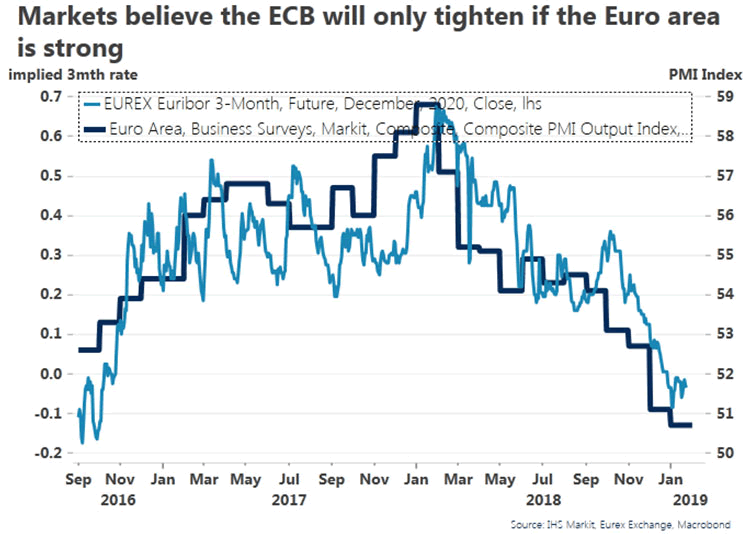
The markets sense of the ECB's reaction function is hinted at in the graph that shows the relation between the composite purchasing managers survey for the Euro area and futures markets expectations of the three month money rate in December. The graph implies markets are firmly of the view that the path and pace of future ECB policy rate changes will be significantly dictated by the health (or otherwise) of the Euro area economy.
More TLTRO's likely but not just yet
Mr Draghi was asked several questions as to whether the ECB would consider a further round of Targetted Long Term Refinancing Operations (TLTRO's). He initially responded that the policy meeting focussed on assessment rather than policies although he added that 'quite clearly the assessment would have policy implications but we haven't discussed them'. He later indicated TLTRO's would have to have a policy role and wouldn't be implemented simply as a sectoral subsidy (the first tranche of TLTRO'S which expire in mid-2020 will have diminishing usefulness for commercial bank's liquidity ratios from the middle of this year).
As Mr Draghi noted that previous TLTRO tranches had reduced fragmentation between Euro area countries and thereby assisted the transmission of monetary policy, it should be possible to make some broadly supportive arguments for another tranche of TLTRO's but this may be announced later than expected and could eventually be linked to other policy changes (as TLTRO's should reduce the variability of impacts across countries of such changes).
A source of ongoing easing?
Finally, in response to yet another question on the ECB's scope to respond to weaker economic conditions, Mr Draghi suggested that the ECB's holdings were significant at 25% of the stock of eligible Government debt.
As Mr Draghi indicated that the aggregate stock of Eurozone long term bonds had fallen consistently since 2014 and was expected to fall further in coming years, it could be argued that the increasing share of the outstanding stock of government bonds held by the ECB represents an ongoing source of policy accommodation.
Mr Draghi suggested that the evidence of lower yields and flatter curves since last June when the ECB announced its intention to cease monthly net asset purchases was significant evidence of such support.
Trump requesting down payment for border wall, and preparing declaration of national emergency
Both Trump's and Democrat's proposal to end the historical shutdown in the US were blocked in the Senate yesterday. White House spokeswoman Sarah Huckabee Sanders said afterwards that "the three-week CR would only work if there is a large down payment on the wall." That is, Trump is offering to reopen the government temporarily for three weeks, with certain down-payment for the USD 5.7B border wall.
Senate Minority Leader Chuck Schumer said after meting Senate Majority Leader Mitch McConnell that "Senate Democrats have made clear to Leader McConnell and Republicans that they will not support funding for the wall, prorated or otherwise." House Speaker Nancy Pelosi also criticized that Trump demand for down payment is "not a reasonable agreement". The House Democrats plan to offer a proposal today on border security, without the wall.
Separately, CNN reported that Trump is preparing a draft to declare national emergency And more than USD 7B in potential funds is already identified for the border wall. According to CNN, in the draft, it's said "the massive amount of aliens who unlawfully enter the United States each day is a direct threat to the safety and security of our nation and constitutes a national emergency." And, "Now, therefore, I, Donald J. Trump, by the authority vested in me by the Constitution and the laws of the United States of America, including the National Emergencies Act (50 U.S.C 1601, et seq.), hereby declare that a national emergency exists at the southern border of the United States."
Sterling jumps on rumor that DUP offer conditional support to May’s Brexit deal
Sterling surges broadly again on hope that UK Prime Minister Theresa May inches closer to getting enough support for an amended Brexit deal. The Sun reported that North Ireland's DUP is having delicate deliberations with May. And it's privately agreed that DUP will support the Brexit plan if there is a time-limit of the Irish backstop. That came on DUP's concern that pro-Remain Tories and Labour are pushing for a significantly softer Brexit.
However, it should first be noted that such a time-limit is likely not enough to win over Brexit hardliners. ERG chair Jacob Rees-Mogg is clear in his demand for complete removal. More importantly, EU's Chief Brexit negotiator Michel Barnier has blunted rejected the idea of time limit already. He said yesterday that "we have to maintain the credibility of this reassurance … it cannot be time-limited… It's not just about Ireland."
US Oil Inventory Increased Across the Board as Fear on Global Slowdown Intensified
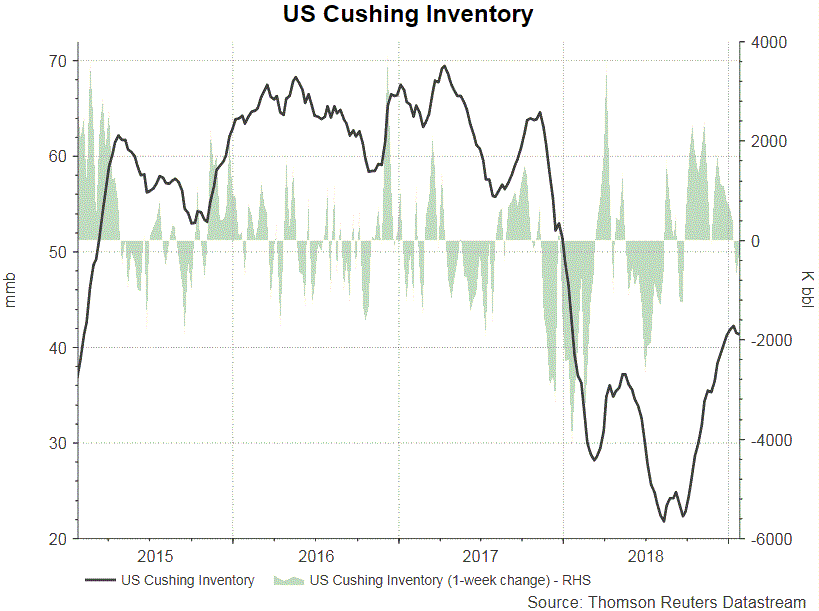
The report from the US Energy Information Administration (EIA) shows that total crude oil and petroleum products (ex. SPR) stocks gained +6.7 mmb to 1267.11 mmb in the week ended January 18. Crude oil inventory soared +7.97 mmb to 445.03 mmb (consensus: -0.04 mmb). Inventories increased in ALL 5 PADDs. Meanwhile, Cushing stock dropped -0.19 mmb to 41.33 mmb. Utilization rate slipped dropped -1.5% to 94.6% and crude production steadied at 11.9M bpd for the week. Crude oil imports rose to 8.19 M bpd, highest since August 2018.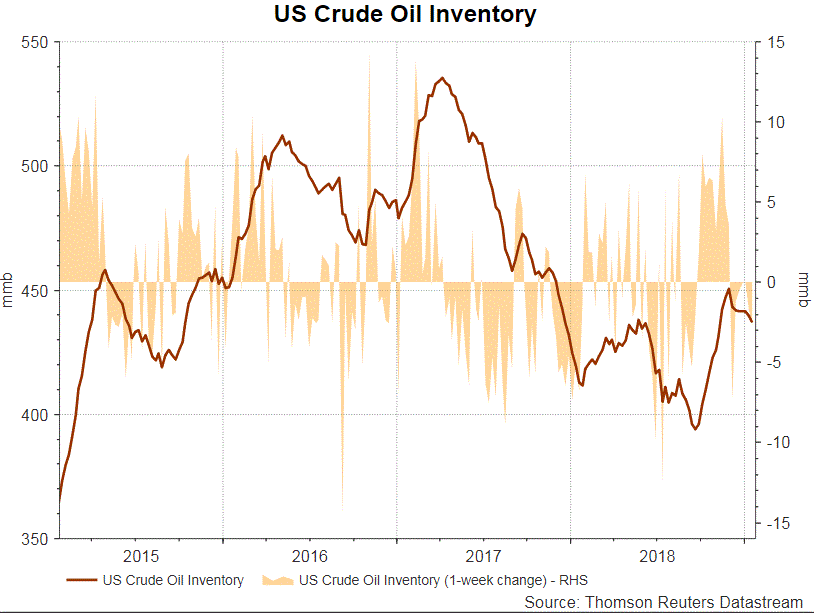
Concerning refined oil product inventories, gasoline inventory rose +4.05 mmb to 259.62 mmb although demand gained +3.54% to 8.87M bpd. The market had anticipated a +2.66 mmb increase in stockpile. Production added +0.21% to 9.6 bpd while imports jumped+48.81% to 0.56M bpd during the week. Distillate inventory slid -0.62 mmb to 142.39 mmb. Demand rose +4.92% to 4.67M bpd. The market had anticipated a -0.23 mmb drop gain in inventory. Production slipped -3.84% to 5.2M bpd while imports dropped -6.08% to 0.36M bpd during the week.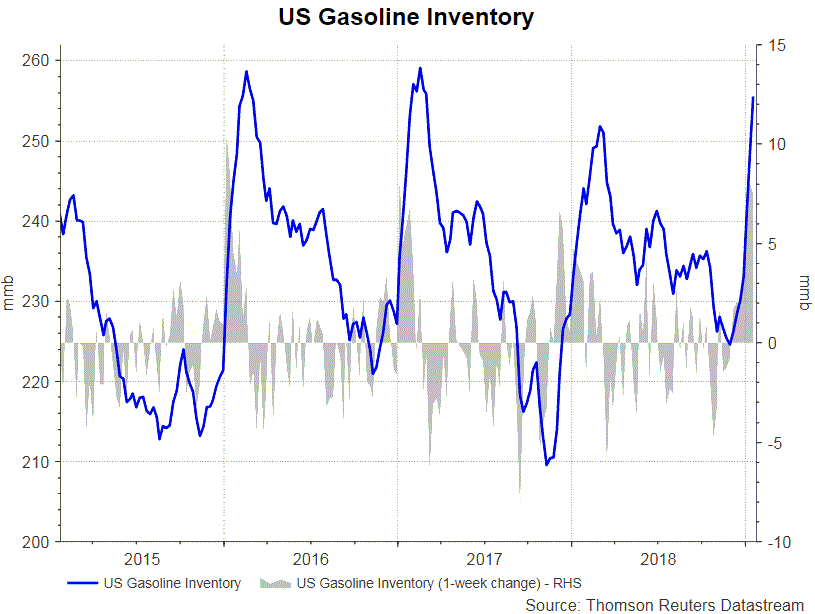
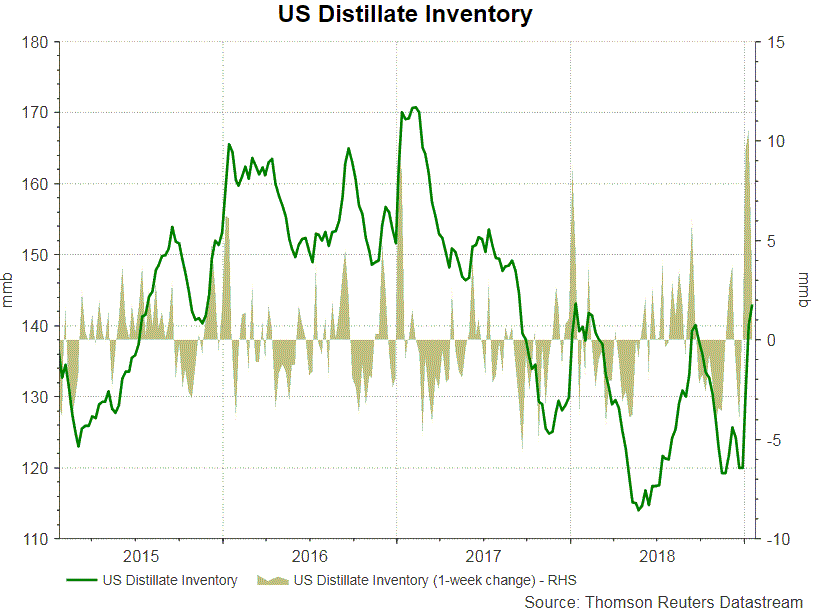
Released after market close on Wednesday, the industry- sponsored API estimated that crude oil inventory jumped +6.65 mmb during the week. For refined oil products, gasoline stockpile gained +3.64 mmb while distillate added +2.57 mmb.
Market Morning Briefing: Dollar Yen Is Slightly Higher
STOCKS
All Equity markets, except India, are testing important medium-term Resistances. India is testing near-term Supports.
The Dow (24553.24, -22.38, -0.09%) traded a mite lower than Wednesday. We see very little impetus to break past Resistance at 25000 given the rising growth concerns in Europe and China.
Dax (11,130.15, +58.64, +0.53%) has moved up, coming close to testing the Resistance at 11300 on the 3-day line chart. Again, given the growth concerns, we are expecting this to hold. But in case it breaks, there can be a further rise to 11400-600. Let us see how this goes.
Shanghai (2606) is trading strong today, testing the 2600-60 Resistance region mentioned yesterday. Whether this holds or breaks will set the trend for the next few weeks. If it holds, as we currently expect, we can see a dip back towards 2550-2500.
Nikkei (20784) is up strongly today as the Yen (109.76) is weakening again. Still, we continue to see important Resistance at 21000 for now.
In line with expectation both Sensex (36195.10, +86.63, +0.24%) and Nifty (10849.80, +18.30, +0.17%) have risen slightly. We have called for a corrective decline towards 34000 and 10500 in the long-term, but there is also Support available near 35600 and 10800-700 in the near term.
COMMODITIES
Precious metals and Copper look bearish for the near term apart from the possible fall in Crude prices. Overall commodities are set to enter a near term bearish phase.
Brent (61.79) and WTI (53.79) are holding well below the resistances near 62.50-64 and 54-56 respectively. Near term could be stable to bearish towards 60-58 and 50 respectively.
US crude inventories were up by 8mln barrels according to the EIA report. This year, the EIA expects U.S. production to grow by 1.7 million bpd, with the rise slowing down further in 2020 to 1.2 million bpd.
US said it could impose sanctions on Venezuela oil exports. Further drop in exports could squeeze global supply. This could be one factor that could be positive for the Crude prices in the near term and pull them up.
Gold (1281.90) and Silver (15.37) are stable just now. While Euro looks bearish in the near term, a corresponding stronger US Dollar would indicate some bearishness for the precious metals in the near term (Refer FOREX section below). Gold below 1280 could target 1270/60 levels while Silver could be headed towards 15.
Copper (2.6590) is almost stable today. Given the close directional correlation with Aussie and Shanghai, Copper is likely to come off from current levels. Shanghai has resistance at 2600-2660 zone and Aussie looks bearish towards 0.70-0.69 while below 0.7150. These could be negative cues for Copper for the next few sessions. (Refer Stocks section above and FOREX section below) Immediate view is bearish with a possible fall towards 2.55.
FOREX
Currencies look bearish. Watch important support on Euro at 1.13 while Pound could face resistance above current levels and eventually come off. Aussie looks bearish. Rupee and Yuan could see some strength against the US Dollar.
Euro (1.1316) declined sharply from trying to attempt a rise towards 1.14 yesterday after the ECB policy statement yesterday. Although the rates were kept unchanged, there is concern on the overall economic growth of Europe. Technically we have support at 1.13 which if breaks would turn bearish for the Euro for the medium term taking it down towards 1.12 or lower. This would be in line with our long term view as published in our Euro Jan’19 report (see below link to buy the report)
https://kshitij.com/eurusd-forecast-payment-details/jan-19
Although the movement below 1.1350 in Euro has gone contrary to your expectation of a bounce back towards 1.14-1.15, we need confirmation of a break below 1.13 to turn bearish for the near term. The German-US 10Yr (-2.54%) is looking bearish too towards -2.60% indicating a fall in Euro could be more likely. (Refer Interest Rates Section below)
Dollar Index (96.42) has moved up and could target 97-98 again on the upside as seen on the weekly candles.
Dollar Yen (109.71) is slightly higher and could test 110.0-110.5 on the upside while Nikkei has some scope towards 20900-21000. Thereafter, the Yen could see some strength back towards 109. Immediate view is bullish for 3-4 sessions followed by a decline.
Pound (1.3116) has risen above the 1.31 resistance mentioned yesterday and could now test 1.3150-1.32 before coming off from there. A rise on the upside if continues could open up chances of testing 1.36 in the longer run. See the weekly line charts.
Aussie (0.7099) has come off as expected and could head towards 0.70-0.69 in the near term. View looks bearish while below 0.7150.
USD-CNY (6.7709) is looking bearish just nowand could come off towards 7.76-7.74 before again bouncing back towards 7.80.
Dollar Rupee (71.08) has clearly broken below 71.10 indicating Rupee strength in the near term. We could see a test of 70.90/80 while below 71.10. Immediate view is bearish for Dollar-Rupee.
INTEREST RATES
The ECB kept interest rates unchanged yesterday and said principal maturity proceeds from earlier asset purchases will continue to be reinvested for a long time after it starts raising rater. It was also bearish on growth.
The German Yields (5Yr -0.32%, 10Yr +0.18% and 30Yr +0.77%) all seem to be headed lower, with potential to fall another 5-7bp at least, maybe even 10bp. Only the 2Yr (-0.60%) continues to have Support at -0.60%. A slow dip towards -0.62% might be possible.
The German-US 2Yr Spread (-3.17%) could dip towards -3.19% if that happens, especially while it remains below -3.15%. The German-US 10Yr Spread (-2.54%) could also gravitate lower towards -2.60%. This would keep downward pressure on the Euro.
Let us see if the 10Yr GOI (7.5577%) turns lower in the near term itself or remains ranged between 7.55-65%, as mentioned yesterday.
USD/JPY Remains Supported On Dips Near 109.20
Key Highlights
- The US Dollar traded towards the 110.00 level recently and later corrected lower against the Japanese Yen.
- There is a crucial bullish trend line formed with support at 109.30 on the 4-hours chart of USD/JPY.
- The US Initial Jobless Claims for the week ending Jan 19, 2019 declined from 212K to 199K.
- The German IFO Business Climate Index for Jan 2019 will be released today, which could decline from 101.0 to 100.6.
USDJPY Technical Analysis
The US Dollar started a steady upward move from the 108.00 support against the Japanese Yen. The USD/JPY pair traded above the 109.00 and 109.50 resistance levels before facing sellers near 111.00.
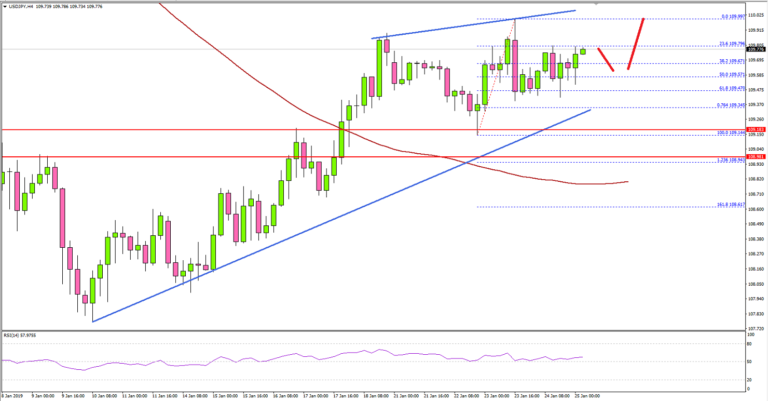
Looking at the 4-hours chart, the pair recently climbed higher from the 109.14 low and traded as high as 109.99. Later, the pair corrected lower and traded below the 109.60 support plus the 50% Fib retracement level of the last wave from the 109.14 low to 109.99 high.
However, the decline was protected by the 109.40-109.50 support and the 61.8% Fib retracement level of the last wave from the 109.14 low to 109.99 high. More importantly, there is a crucial bullish trend line formed with support at 109.30.
Therefore, if the pair declines further, it is likely to find a strong buying interest above the 109.20 pivot level. Alternatively, if there is a downside break below 109.20 and 109.00, the pair could decline towards the 108.80 level and the 100 simple moving average (red, 4-hours).
On the upside, the main resistance is near the 110.00 level, above which the pair is likely to gain strength for more gains towards the 111.20 and 111.40 levels.
Fundamentally, the US Initial Jobless Claims figure for the week ending Jan 19, 2019 was released. The market was looking for a rise in claims from the last reading of 213K to 220K.
The actual result was way better than the forecast as there was a drop in jobless claims to 199K (the lowest level for initial claims since November 15, 1969). Moreover, the last reading was revised down from 213K to 212K. The report stated that:
The 4-week moving average was 215,000, a decrease of 5,500 from the previous week’s revised average. The previous week’s average was revised down by 250 from 220,750 to 220,500.
Overall, the US Dollar might correct a few pips, but it remains well supported for more gains above 111.00 versus the Japanese Yen. More importantly, EUR/USD faced an increased selling pressure and declined below 1.1360, while GBP/USD stayed above the 1.2950 support.
Economic Releases to Watch Today
- German IFO Business Climate Index for Jan 2019 – Forecast 109.6, versus 109.8 previous.
- German IFO Current Assessment Index Jan 2019 – Forecast 117.9, versus 118.4 previous.
- German IFO Expectations Index for Jan 2019 – Forecast 104, versus 104 previous.
Daily Markets Broadcast
Wall Street pressured as shutdown continues
The Senate blocked two rival proposals to end the US government shutdown yesterday, so things stay as they were. US officials said the US and China are “miles apart” from a trade deal, though some progress is being made on the easy, minor issues. Ireland’s DUP is said to privately support May’s Brexit Plan B, which could boost sentiment.
US30USD Daily Chart
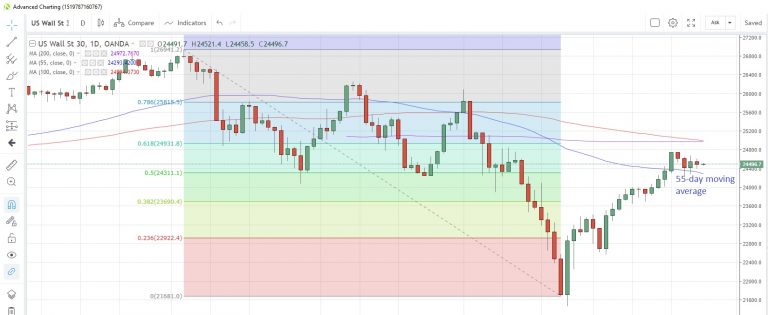
The US30 index finished in the red yesterday after a day of volatile swings
The index has held above the 55-day moving average at 24,293 for the past six days
US Secretary of Commerce Wilbur Ross says experiencing a global slowdown. US and China are miles apart and progress would depend on China making further reforms.
DE30EUR Daily Chart
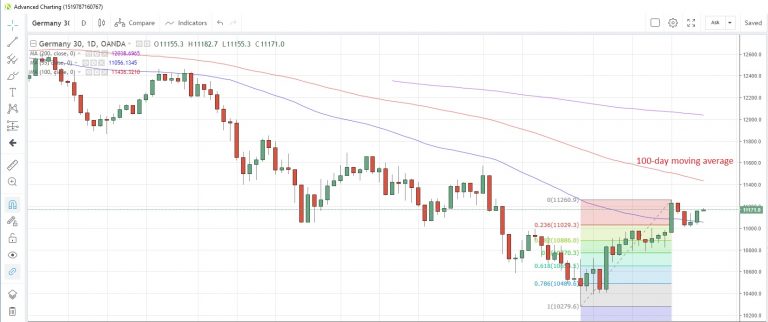
The Germany30 index looks set for the third consecutive daily gain amid hopes for progress in the Brexit situation
Fibonacci support at 11,029, which is 23.6% retracement of the December-January rally, has held this week. The 100-day moving average is at 11,436
ECB kept rates unchanged yesterday, as expected, and said economic outlook has moved to the downside. Germany’s Ministry of Economic Affairs cuts 2019 growth forecast to 1.0% from 1.8% due to global slowdown, Brexit.
UK100GBP Daily Chart
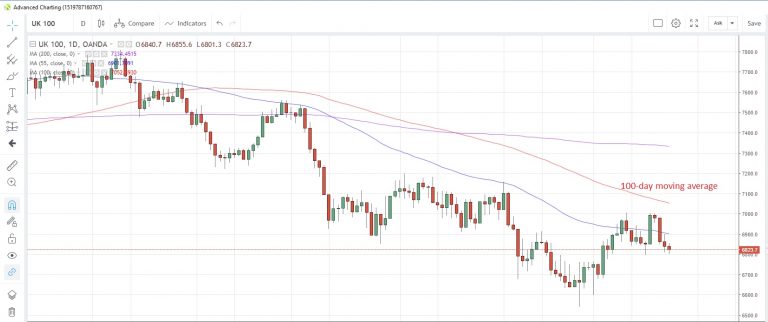
The UK100 index fell for the fourth straight day yesterday, but could stage a recovery today after news emerged that Ireland’s DUP could support May’s Plan B Brexit deal
The index has traded below the 100-day moving average for almost five months. It is at 7,052 today
on UK rates, BOE’s Haldane said yesterday “if the economy continues to tick along, as we expect, then we might expect some further limited and gradual rises.” However, the Bank would remain flexible to the economy’s performance.