Sample Category Title
ECB President Mario Draghi press conference live stream
https://www.youtube.com/watch?v=tCkqUtn7jbs
Draghi's introductory statement.
Ladies and gentlemen, the Vice-President and I are very pleased to welcome you to our press conference. We will now report on the outcome of today's meeting of the Governing Council, which was also attended by the Commission Vice-President, Mr Dombrovskis.
Based on our regular economic and monetary analyses, we decided to keep the key ECB interest rates unchanged. We continue to expect them to remain at their present levels at least through the summer of 2019, and in any case for as long as necessary to ensure the continued sustained convergence of inflation to levels that are below, but close to, 2% over the medium term.
Regarding non-standard monetary policy measures, we intend to continue reinvesting, in full, the principal payments from maturing securities purchased under the asset purchase programme for an extended period of time past the date when we start raising the key ECB interest rates, and in any case for as long as necessary to maintain favourable liquidity conditions and an ample degree of monetary accommodation.
The incoming information has continued to be weaker than expected on account of softer external demand and some country and sector-specific factors. The persistence of uncertainties in particular relating to geopolitical factors and the threat of protectionism is weighing on economic sentiment. At the same time, supportive financing conditions, favourable labour market dynamics and rising wage growth continue to underpin the euro area expansion and gradually rising inflation pressures. This supports our confidence in the continued sustained convergence of inflation to levels that are below, but close to, 2% over the medium term. Significant monetary policy stimulus remains essential to support the further build-up of domestic price pressures and headline inflation developments over the medium term. This will be provided by our forward guidance on the key ECB interest rates, reinforced by the reinvestments of the sizeable stock of acquired assets. In any event, the Governing Council stands ready to adjust all of its instruments, as appropriate, to ensure that inflation continues to move towards the Governing Council's inflation aim in a sustained manner.
Let me now explain our assessment in greater detail, starting with the economic analysis. Euro area real GDP increased by 0.2%, quarter on quarter, in the third quarter of 2018, following growth of 0.4% in the previous two quarters. Incoming data have continued to be weaker than expected as a result of a slowdown in external demand compounded by some country and sector-specific factors. While the impact of some of these factors is expected to fade, the near-term growth momentum is likely to be weaker than previously anticipated. Looking ahead, the euro area expansion will continue to be supported by favourable financing conditions, further employment gains and rising wages, lower energy prices, and the ongoing – albeit somewhat slower – expansion in global activity.
The risks surrounding the euro area growth outlook have moved to the downside on account of the persistence of uncertainties related to geopolitical factors and the threat of protectionism, vulnerabilities in emerging markets and financial market volatility.
Euro area annual HICP inflation declined to 1.6% in December 2018, from 1.9% in November, reflecting mainly lower energy price inflation. On the basis of current futures prices for oil, headline inflation is likely to decline further over the coming months. Measures of underlying inflation remain generally muted, but labour cost pressures are continuing to strengthen and broaden amid high levels of capacity utilisation and tightening labour markets. Looking ahead, underlying inflation is expected to increase over the medium term, supported by our monetary policy measures, the ongoing economic expansion and rising wage growth.
Turning to the monetary analysis, broad money (M3) growth moderated to 3.7% in November 2018, after 3.9% in October. M3 growth continues to be backed by bank credit creation. The narrow monetary aggregate M1 remained the main contributor to broad money growth.
The annual growth rate of loans to non-financial corporations stood at 4.0% in November 2018, after 3.9% in October, while the annual growth rate of loans to households remained broadly unchanged at 3.3%. The euro area bank lending survey for the fourth quarter of 2018 suggests that overall bank lending conditions remained favourable, following an extended period of net easing, and demand for bank credit continued to rise, thereby underpinning loan growth.
The pass-through of the monetary policy measures put in place since June 2014 continues to significantly support borrowing conditions for firms and households, access to financing – in particular for small and medium-sized enterprises – and credit flows across the euro area.
To sum up, a cross-check of the outcome of the economic analysis with the signals coming from the monetary analysis confirmed that an ample degree of monetary accommodation is still necessary for the continued sustained convergence of inflation to levels that are below, but close to, 2% over the medium term.
In order to reap the full benefits from our monetary policy measures, other policy areas must contribute more decisively to raising the longer-term growth potential and reducing vulnerabilities. The implementation of structural reforms in euro area countries needs to be substantially stepped up to increase resilience, reduce structural unemployment and boost euro area productivity and growth potential. Regarding fiscal policies, the Governing Council reiterates the need for rebuilding fiscal buffers. This is particularly important in countries where government debt is high and for which full adherence to the Stability and Growth Pact is critical for safeguarding sound fiscal positions. Likewise, the transparent and consistent implementation of the EU's fiscal and economic governance framework over time and across countries remains essential to bolster the resilience of the euro area economy. Improving the functioning of Economic and Monetary Union remains a priority. The Governing Council welcomes the ongoing work and urges further specific and decisive steps to complete the banking union and the capital markets union.
We are now at your disposal for questions.
As the Brexit Deadlock Lingers, What’s Behind the Pound’s Rally?
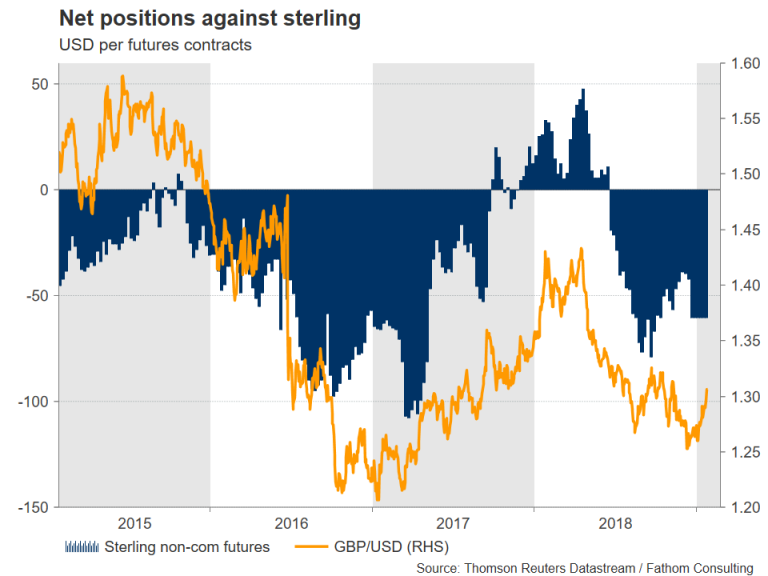
After Theresa May’s Brexit deal suffered the biggest Parliamentary defeat in history for a sitting government, few would have thought the pound’s response to the latest setback for the prime minister would have been to head higher. However, as British MPs grow increasingly determined to take control of the Brexit process, investors are becoming convinced that there is no majority will in Parliament to allow the country to leave the European Union without a deal.
The pound hit a new 11-week high on Thursday, coming close to hitting the $1.31 level, as the latest developments in Westminster led traders to speculate that a no-deal scenario could soon be taken off the table. The extent of opposition to the PM’s plan, which first became evident in December and forced May to delay the vote on her deal, has resulted in various amendments being put forward by MPs to limit the government’s power in the event it fails to come up with a proposal that would win parliamentary support.
The most notable amendments were to the Finance Bill, which restricts the government’s ability to respond to a no-deal Brexit with respect to spending and taxation, and the Grieve amendment that required May to present her Plan B in just three working days when her deal was rejected last week. The amendment was aimed at preventing any attempt by May to scare MPs into accepting her tweaked plan by scheduling the vote closer to the exit date of March 29.
However, the most significant amendment could be the one that’s currently being mooted and one that is gaining traction among senior Labour party members. Labour MP Yvette Cooper is proposing that Parliament should be given time to debate a bill on delaying Article 50 if May’s Plan B is rejected when it’s put to a vote on January 29. The bill would first provide for the government to come up with a revised Withdrawal Agreement until February 26, which, if voted down again, would grant MPs the power to demand a nine-month extension to Article 50.
If Labour decides to back the amendment, the pound could extend its recent gains as it could put lawmakers – and not the government – in the driving seat should May’s final offer get defeated. With the amendment also likely to gain the support of some ‘remainer’ Conservatives, it stands a good chance of being passed. Furthermore, as there’s still a few days of debate to go before the January 29 vote, additional amendments that would take the decision making away from the government’s hands and allow MPs to determine the next steps are possible.
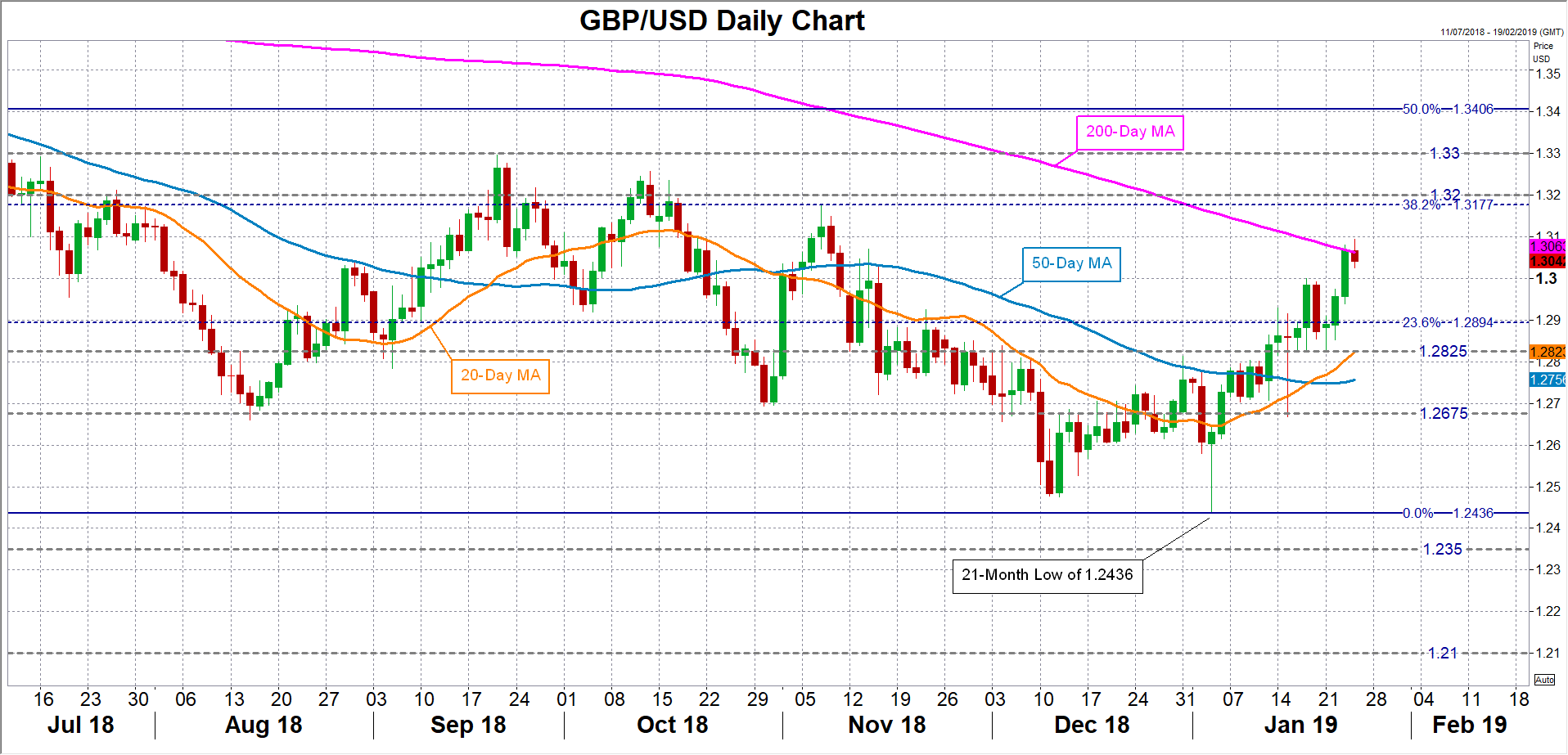
As a result, technical indicators for sterling have turned strongly bullish with cable crossing above its 20- and 50-day moving averages (MA) to touch its 200-day MA. A clear break above the 200-day MA, currently in the $1.3065 region, could drive the pound towards the $1.32 level, taking it above the 38.2% Fibonacci retracement of the downtrend from 1.4376 to 1.2436. However, cable could struggle to run even higher, with a move towards the $1.33 handle likely proving more challenging unless there is decisive progress on the Brexit front.
While a successful attempt by lawmakers to get Article 50 extended would avert the immediate threat of a no-deal scenario, it wouldn’t resolve the Brexit dilemma and more months of uncertainty would ensue. The next step by MPs, if the exit date was delayed, could be to call for a second referendum. Such a move is favoured by investors as it would increase the odds of reversing Brexit. However, there’s unlikely to be a majority in Parliament for another referendum and a ‘softer’ Brexit such as the ‘Norway option’ are more probable outcomes if the government fails to fix the Irish backstop issue that has been plaguing May’s Withdrawal Agreement.
But as traders increasingly price out the risk of a no-deal Brexit, can we really be sure that the British Parliament will be able to block a disorderly exit? Brexiteer Conservative MPs may not like May’s plan but are more likely to support it if faced with the choice of a delay or no Brexit at all. The Democratic Unionist Party, who are propping up May’s minority government, could also vote in favour of a modified deal if it meant preventing a second referendum. However, with some Remainer Conservatives still possibly voting against the government unless a drastically improved deal was on offer, the task of ever getting a majority on how to proceed with Brexit could prove impossible.
If in the next few weeks Parliament remains as polarised as ever, sterling could see a sharp downward retracement as the reality of a no-deal Brexit starts to re-emerge. Cable could immediately tumble towards the recent support at $1.2825 if Cooper’s amendment doesn’t pass at next week’s vote. A steeper decline would bring the previously congested region of $1.2675 into focus. But if MPs fail to reach any consensus in the coming weeks, sterling could suffer a heavier sell-off, with a breach of the 21-month low of $1.2436 plumbed earlier in January becoming probable. A drop below that point could see cable revisit key supports from 2016 and 2017 at around $1.2350 and $1.21.
EURNZD on Slippery Slope; Bears Take Charge in Near Term
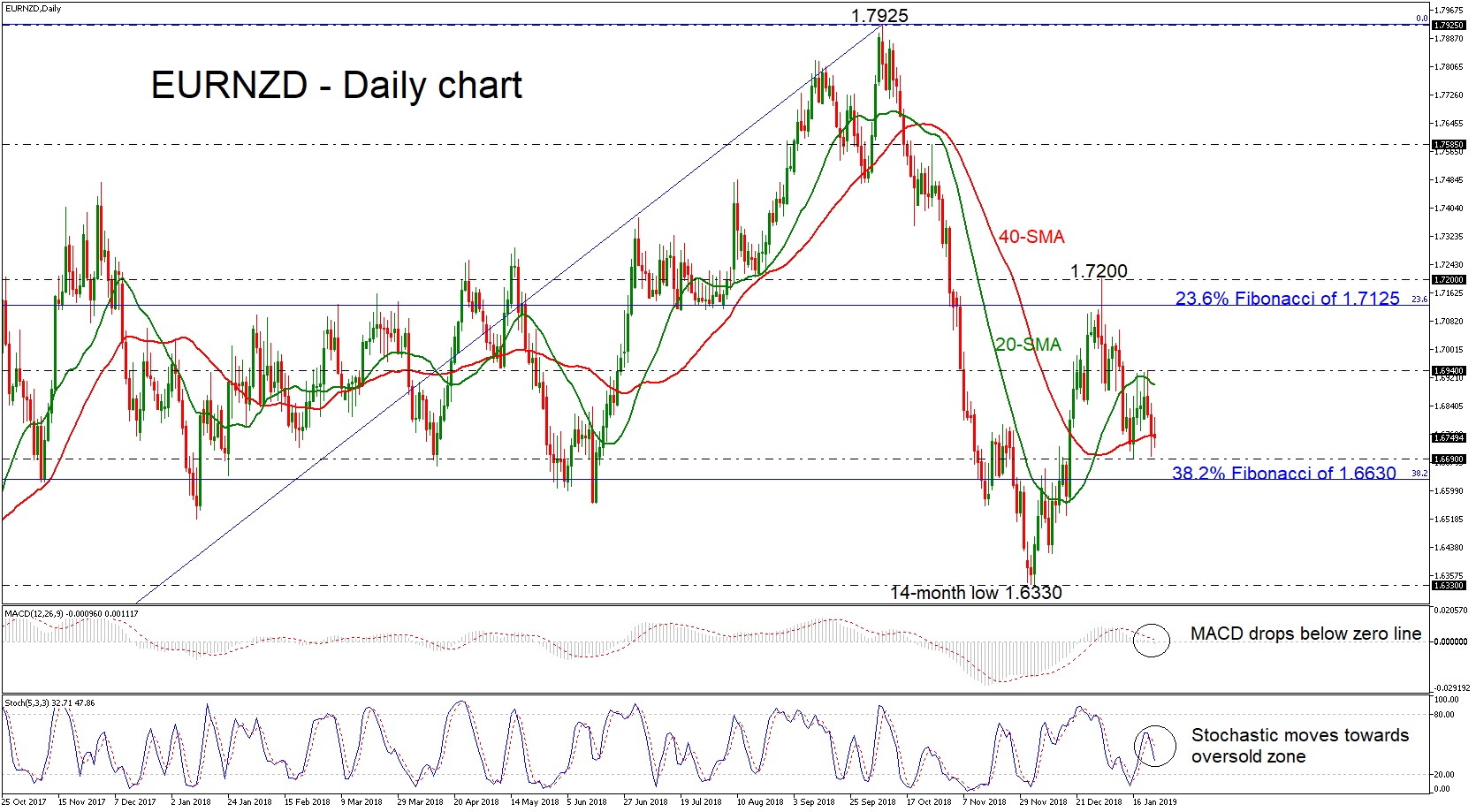
EURNZD has come close to breaking the 40-day simple moving average (SMA) today, moving towards the 1.6690 support level again. The MACD oscillator is consolidating below the zero and trigger lines keeping its momentum flat, while the %K line of the stochastic oscillator recorded a bearish crossover with the %D line, approaching the negative zone.
The next level for traders to have in mind is the 1.6690 support, before slipping towards the 38.2% Fibonacci retracement level of the upward movement from 1.4535 to 1.7925, around 1.6630. Lower still, the bears may aim for the 14-month trough of 1.6330, reached on December 5.
On the other side, a bounce off the 40-day SMA could drive prices higher towards the 20-day SMA currently at the 1.6900 handle. Slightly above this line could send prices until 1.6940. Further upside pressure may meet again the 23.6% Fibonacci of 1.7125.
To sum up, the market is expected to hold neutral in very short-term and bearish in the medium-term. A significant decline below December’s low could endorse the negative outlook in long term as well.
ECB keeps interest rate unchanged at 0%, maintains forward guidance
ECB kept main refinancing rate unchanged at 0.00% as widely expected. The forward guidance is also held unchanged. That is, "key ECB interest rates to remain at their present levels at least through the summer of 2019.
Full statement below.
Monetary Policy Decisions
At today's meeting the Governing Council of the European Central Bank (ECB) decided that the interest rate on the main refinancing operations and the interest rates on the marginal lending facility and the deposit facility will remain unchanged at 0.00%, 0.25% and -0.40% respectively. The Governing Council expects the key ECB interest rates to remain at their present levels at least through the summer of 2019, and in any case for as long as necessary to ensure the continued sustained convergence of inflation to levels that are below, but close to, 2% over the medium term.
Regarding non-standard monetary policy measures, the Governing Council intends to continue reinvesting, in full, the principal payments from maturing securities purchased under the asset purchase programme for an extended period of time past the date when it starts raising the key ECB interest rates, and in any case for as long as necessary to maintain favourable liquidity conditions and an ample degree of monetary accommodation.
The President of the ECB will comment on the considerations underlying these decisions at a press conference starting at 14:30 CET today.
(ECB) Monetary Policy Decisions
At today's meeting the Governing Council of the European Central Bank (ECB) decided that the interest rate on the main refinancing operations and the interest rates on the marginal lending facility and the deposit facility will remain unchanged at 0.00%, 0.25% and -0.40% respectively. The Governing Council expects the key ECB interest rates to remain at their present levels at least through the summer of 2019, and in any case for as long as necessary to ensure the continued sustained convergence of inflation to levels that are below, but close to, 2% over the medium term.
Regarding non-standard monetary policy measures, the Governing Council intends to continue reinvesting, in full, the principal payments from maturing securities purchased under the asset purchase programme for an extended period of time past the date when it starts raising the key ECB interest rates, and in any case for as long as necessary to maintain favourable liquidity conditions and an ample degree of monetary accommodation.
The President of the ECB will comment on the considerations underlying these decisions at a press conference starting at 14:30 CET today.
Forex Technical Analysis: EUR/USD, USD/JPY, GBP/USD
EUR/USD
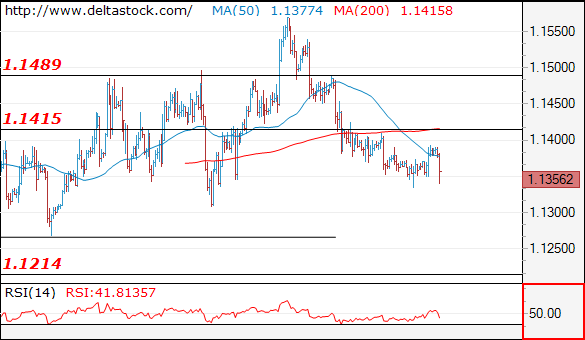
Current level - 1.1356
The reaction above 1.1330 is pretty weak, so my outlook remains bearish, for a slide towards 1.1214 low. Key hurdle lies at 1.1415.
| Resistance | Support | ||
| intraday | intraweek | intraday | intraweek |
| 1.1415 | 1.1630 | 1.1330 | 1.1214 |
| 1.1540 | 1.1820 | 1.1214 | 1.1100 |
USD/JPY
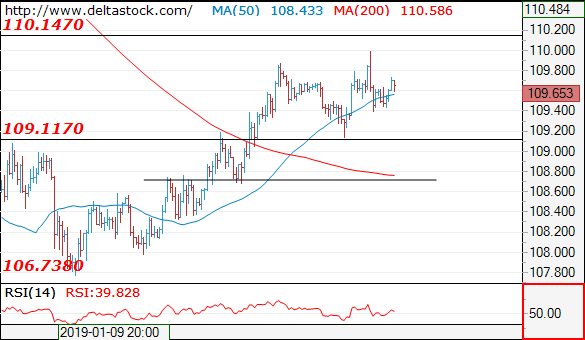
Current level - 109.65
Intraday, there is a risk of another downswing to 109.10 support area, but the overall outlook is already positive, for a rise towards 111.45 zone.
| Resistance | Support | ||
| intraday | intraweek | intraday | intraweek |
| 109.90 | 111.45 | 109.40 | 106.70 |
| 110.20 | 112.20 | 109.10 | 104.60 |
GBP/USD
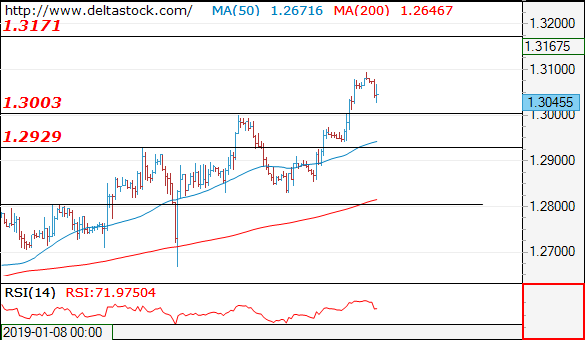
Current level - 1.3045
The direct climb above 1.3000 reached a temporary high at 1.3100 and the outlook is positive, for a continuation towards 1.3180. Initial support lies at 1.3000.
| Resistance | Support | ||
| intraday | intraweek | intraday | intraweek |
| 1.3100 | 1.3180 | 1.3000 | 1.2420 |
| 1.3180 | 1.3250 | 1.2800 | 1.2340 |
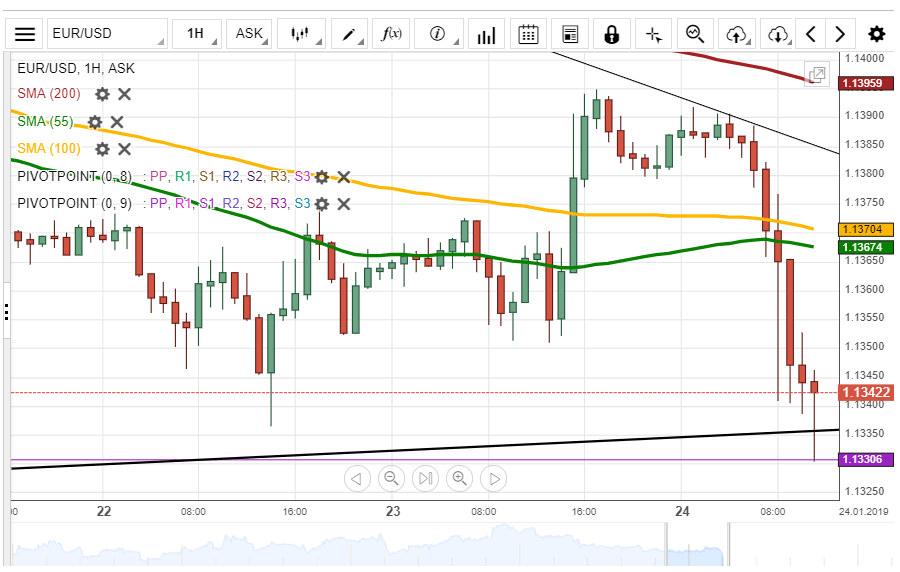
EUR/USD Passes SMAs To 1.1340
On Thursday morning, the currency exchange rate passed through the support levels of the 55-hour and the 100-hour simple moving averages to trade at the previously predicted 1.1340 level.
In regards to the near-term future, most likely, the European Single Currency will be retraced by the bottom boundary of the descending medium pattern line at 1.1320 to surge to the 1.1400 level.
However, the European Single Currency could depreciate against the US Dollar to the weekly S1 at 1.1315 during today's EU Main Refinancing Rate release at 13:45 GMT.
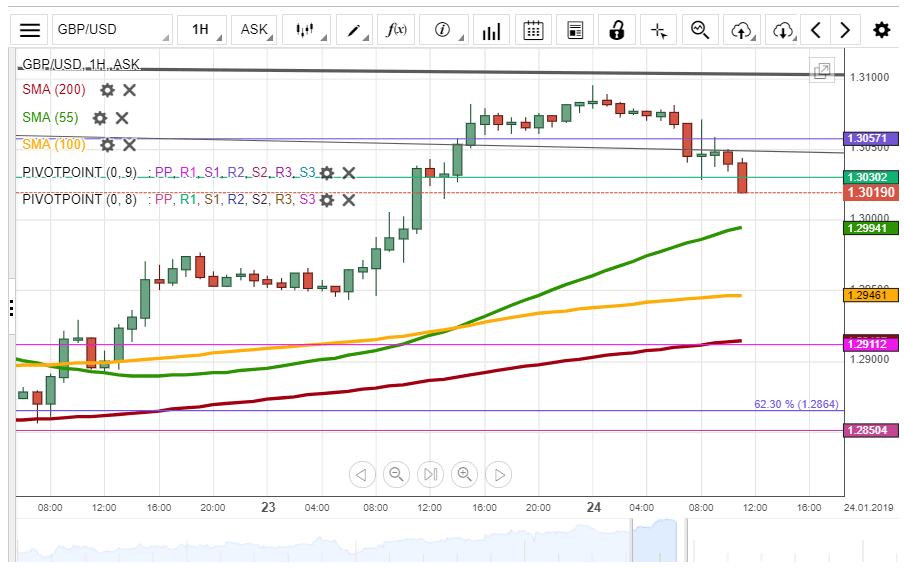
GBP/USD Expects Brexit News
During Wednesday's trading session, the previously drawn pattern was broken. Due to that fact, the chart was thoroughly reviewed to make a new pattern.
Brexit negotiation about Ireland border pushed the British Pound to appreciate against the US Dollar. There are expected two scenarios, if the United Kingdom and Ireland will agree not to build an outpost in Northern Ireland, most likely, the rate will break the upper boundary of the dominant pattern line at 1.3100 mark to trade towards the weekly R2 at 1.3181.
On the other hand, if the United Kingdom and Ireland will not agree on the deal, to the rate could go downwards to trade at the 1.2950 level.
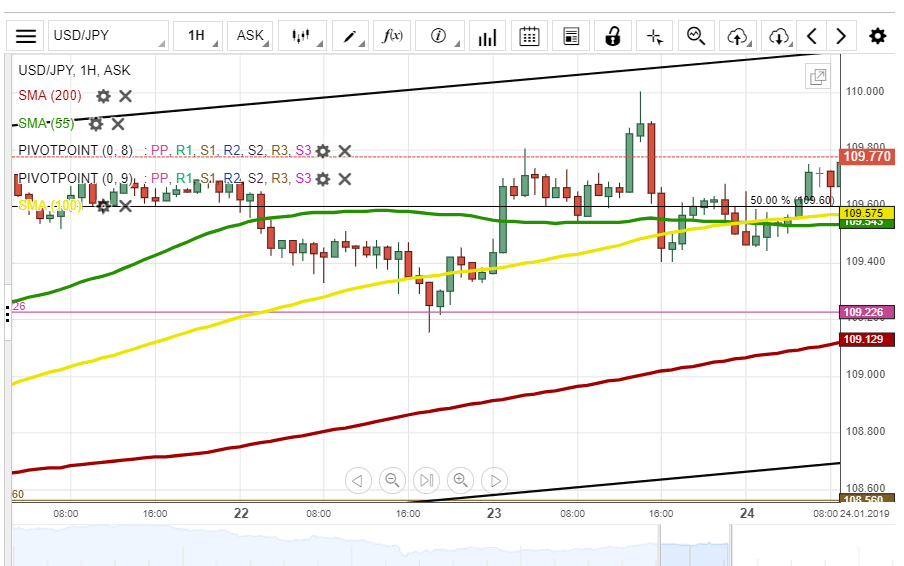
USD/JPY Surges To R1 At 110.46
During the previous trading session, the currency exchange rate broke the previously drawn pattern. Due to the fact, the chart was corrected!
In regards to the near-term future, most likely, the currency exchange rate will be trading towards the weekly R1 at 110.46 to end the trading session at the 110.00 level. Moreover, the 55-hour and the 100-hour simple moving averages will support the surge during the day.
On the other hand, the round level of 110.00 could retrace the currency exchange rate to move back to end the trading session at the 109.80 level.
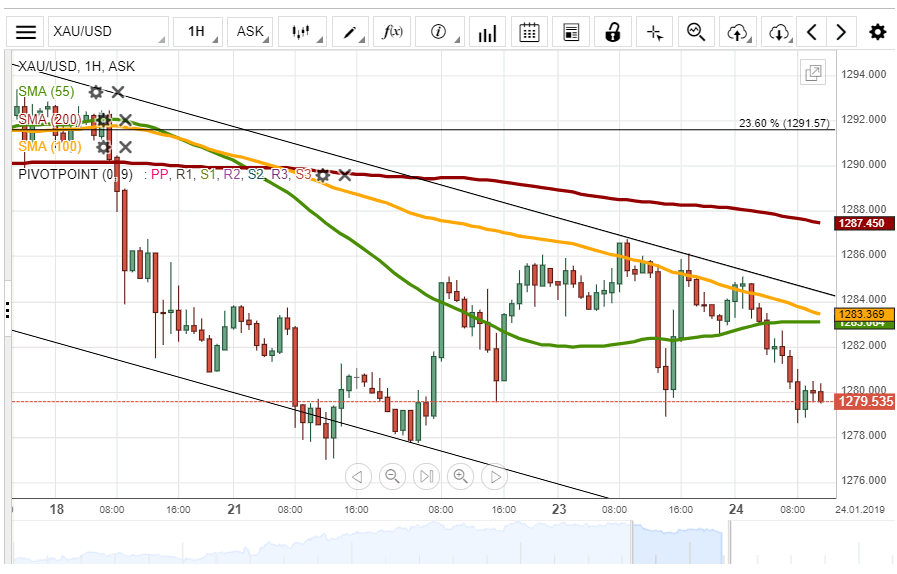
XAU/USD Retraces To PP At 1,262.88
On Thursday morning, the yellow metal was trading below the 55-hour and the 100-hour simple moving averages at the 1,280.06 mark.
In regards to the near term future, most likely, the 200-hour simple moving average will continue retracing the rate to the 1,274.00 level. It is expected, that the gold will reach the monthly pivot point at 1,262.88 in a couple of trading sessions.
On the other hand, any fundamental news could push the yellow metal to appreciate against the US Dollar to stay at the 1,280.00 level!