

Sample Category Title
Gold Shrugs As Jobless Claims Sink To 49-Year Low
After starting the week with losses, gold has been uneventful and the trend has continued on Thursday. In the North American trade, the spot price for one ounce of gold is $1282.80, unchanged on the day. In economic news, unemployment claims dropped to 199 thousand, beating the forecast.
Unemployment claims sparkled last week, falling from 213 thousand to 199 thousand. This was the first time that the indicator dropped below the 200-thousand level since 1969. The four-week average, which is less volatile, dropped by 5.5 thousand to 215,000. The strong figures indicate that the employment picture remains bright, despite the ongoing U.S. government shutdown, which has resulted in the layoff of some 800,000 government workers. With President Trump and the Democrats locked in a deadlock over funding for a wall with Mexico, the shutdown could have a negative impact on the U.S. economy and weigh on the U.S. dollar.
Gold ended 2018 with a bang, posting gains of 4.9 percent. However, the metal is unchanged in January, despite some pushes towards the symbolic $1300 level. Despite some geopolitical hotspots such as the Chinese slowdown, Brexit and the U.S-China trade war, risk appetite has generally remained steady. Investors have opted to remain on the sidelines rather than snap up safe-haven assets like gold. Earlier in the week, China posted its weakest GDP since 1990, and if China releases further soft data, risk apprehension could rise, which could boost gold prices.
Eco Data 1/25/19
[php_everywhere instance="1"]
ECB Turns Dovish amid Heightened Global Uncertainties
The ECB meeting evolved as we had expected: more dovish, downgraded assessment on economy, leaving unchanged the forward guidance on interest rates. the central bank has acknowledged that the uncertainties in the global economy have intensified and can persist for quite an extended time. No change was made in the monetary policy, leaving the main refi rate, the marginal lending rate and the deposit rate unchanged at 0.00%, 0.25% and -0.40% respectively.
Forward Guidance Unchanged
Dubbing what’s mentioned in the December statement, ECB indicated that it would “continue reinvesting, in full, the principal payments from maturing securities purchased under the asset purchase programme for an extended period of time past the date when we start raising the key ECB interest rates, and in any case for as long as necessary”. On interest rates, it also reiterated that there would no rate hike “at least through the summer 2019”. While giving no definite timing for the end of reinvestment, i.e., the beginning of balance sheet reduction, we anticipate it would continue at least through end-2020.
Economic Assessment
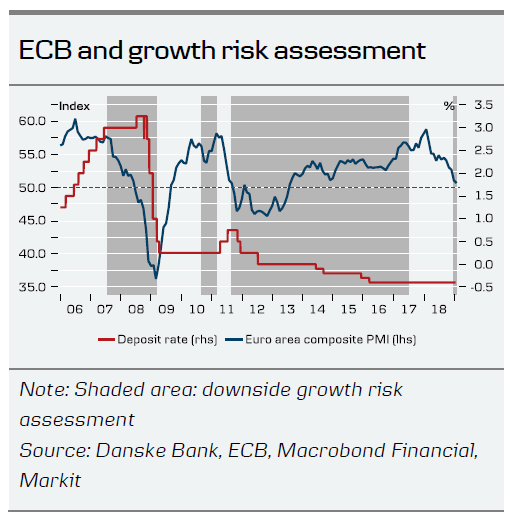
ECB noted that “the risks surrounding the Euro area growth outlook have moved to the downside”. This is the first time since April 2017 that the central bank admitted that risks are to the downside. Over the past 21 months, ECB had been describing risks as “broadly balanced”, while suggesting the balance is “moving to the downside”. The uncertainties ECB has identified are “geopolitical factors and the threat of protectionism, vulnerabilities in emerging markets and financial market volatility”. These have been unchanged from previous meetings.
No Announcement on New Liquidity Operations
While noting that TLTROs had been highly useful in the past, the ECB has not announced any related operations at the meeting. Yet, President Mario Draghi added that “several members mentioned the issue”. We retain the view that ECB wound launch a new round of TLTROs by 1Q19.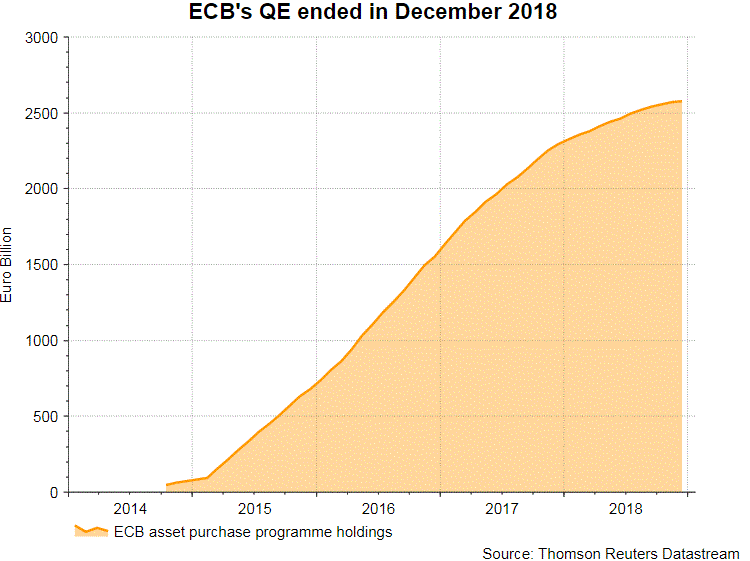
US Government Shutdown Impact on Canada
While the partial U.S. government shutdown has dominated the headlines and disrupted public services across the U.S., it isn’t ultimately expected to have a significant impact on broader trends in the U.S. economy, let alone Canada’s. But the protracted nature of the political im-passe contains red flags about the likelihood of a quick resolution to some debates that are of importance to Canada, including passage of the USMCA and the staying power of U.S. fiscal tailwinds. For that reason, it warrants a look.
Direct economic impact on the U.S. expected to be limited
Despite causing temporary financial hardship for U.S. federal workers, U.S. government shut-downs don’t tend to have a significant impact on the broader American economy. About 800k federal employees are currently going without pay but that is still just 0.5% of total U.S. em-ployment. And about half of those going without pay are still working and providing govern-ment services. Legislation has already been passed to ensure that all will be paid retroactively and many of the federal workers furloughed are able to apply for federal unemployment insur-ance benefits while off work. Contract employees have access to state unemployment insurance programs. That will limit the longer-run GDP/household income implications, although the longer the shutdown lasts, the larger the disruption to workers’ lives and spending pat-terns. There is already anecdotal evidence that this is happening.
Uncertainty surrounding fiscal policy can weigh on business confidence. However, government contracts with private businesses are typically not considered to be at risk from a shutdown, suggesting little impact on private business investment activity from the shutdown. The broader spillovers to other sectors are probably small. Our working assumption is that each week the shutdown lasts will lower the Q1 annualized GDP growth rate by about 0.1%. We lowered our own U.S. 2019 growth forecast by 0.1 ppts assuming the shutdown would last for about three weeks into January. Further adjustments may be necessary if the shutdown drags on.
Spillover effects in Canada are limited
The shutdown has resulted in the delay of some important U.S. economic data releases, and Sta-tistics Canada has warned that we may have to wait a little longer for the next round of monthly Canadian international trade data because its report relies on temporarily unavailable U.S. import data. There have also been reports of travel disruptions to and from the U.S. due to lower U.S. border and security staffing levels. But putting aside these inconveniences, a shutdown measured in weeks won’t be large enough to have direct significant spillover impacts on the broader Canadian economy.
Will House Democrats balk at USMCA?
For Canadians, a larger concern is what the political impasse in the U.S. says about the likeli-hood for quick resolution of what could be significantly more contentious debates down the road. That includes the passage (or not) of the USMCA deal that the Trump administration ne-gotiated to replace NAFTA. We continue to think there are elements of the new deal that Con-gressional Democrats will find difficult to vote against, including new labour standards cover-ing Mexico. It has always been possible that some Democrats will oppose the new deal to avoid handing President Trump a political “win.” But political gridlock that made it more diffi-cult for the Americans to pass the new deal would also make it more difficult to repeal the leg-islation that implemented NAFTA – so some form of free trade deal is still likely to remain in place.
U.S. fiscal tailwinds could shift to headwinds more quickly than expected
The biggest risk around the shutdown, even from Canada’s perspective, is that the U.S. fiscal tailwind could turn to a headwind more quickly than expected. Tax cuts and spending hikes en-acted last year ballooned the U.S. government budget deficit to 5% of GDP from 3 ½% in 2017. As problematic as that may be in the long run, the short-term result was stronger U.S. economic growth. U.S. GDP likely rose 3% last year. Some of that strength has spilled over into Canada as U.S. import demand grew. That fiscal tailwind was expected to fade once busi-nesses and households adjusted fully to the new tax system and government spending reverted to a slower growth rate. But the risk of persistent gridlock in Washington could mean it fades more quickly, with greater attention paid to growing fiscal imbalances and what could be a contentious debt-limit debate in the U.S. later this year.
Fed Rate Hikes: All in Good Time
In January’s Financial Markets Monthly we noted growing risks around our long-held call for the Fed to continue raising interest rates in March, with a brief pause in their tightening cycle looking increasingly likely. Ahead of next week’s FOMC meeting we are taking this opportunity to push back our forecast—we now see the Fed’s next move coming in June rather than March. We still expect two rate hikes this year, but with a second increase being put off until December. This more gradual pace reflects a patient ap-proach espoused by a number of Fed officials, as well as several downside risks to the outlook that are likely to keep investors on edge in the near-term.
With fed funds now at the lower end of its neutral range, monetary policy is becoming more data de-pendent and “patience” has become the Fed’s watchword:
December FOMC minutes: “Many participants expressed the view that, especially in an environment of muted inflation pressures, the Committee could afford to be patient about further policy firming.”
Chairman Powell: “We’re in a place where we can be patient and flexible and wait and see what does evolve, and I think for the meantime we’re waiting and watching.”
Vice Chairman Clarida: “With inflation muted, I believe that the Committee can afford to be patient as we see how the data evolve in 2019.”
Chicago Fed President Evans: “I feel we have good capacity to wait and carefully take stock of the in-coming data and other developments.”
Boston Fed President Rosengren: “I believe we can wait for greater clarity before adjusting policy.”
Market jitters and tightening financial conditions have been key in the Fed’s dovish shift. While volatility has largely subsided, equities and corporate bonds haven’t fully recovered from their end of year swoon. A number of issues continue to worry investors. The partial US government shutdown, now into its sec-ond month, shows no sign of being resolved and its impact on economic activity (while temporary) is growing by the day. Trade risks remain elevated—the tone on US-China talks has been positive, but the threat of a March 1 tariff hike can’t be dismissed. Escalating trade tensions and a slowdown in China were among the downside risks noted by the IMF when they lowered their global growth forecasts this week. The recent improvement in market sentiment is encouraging, but given these concerns, we doubt the Fed will want to test investors’ resilience by raising rates in Q1.
US Stocks rise on robust earnings and shrug off Commerce Sec Ross’s comments
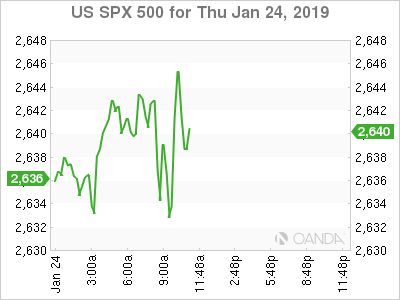
US stocks trade higher, albeit in a choppy manner in early trade after a brief selloff stemmed from an overreaction to Commerce Wilbur Ross comments on CNBC on trade talks. The move higher in equities was supported by a wrath of earnings painting differing stories among the 11 sectors. The US equity market initially sold off before the open after Commerce Secretary Ross’s comment that the US is “miles and miles away” from a China trade agreement. The markets however paid little attention to his optimism that he thinks there is a fair chance a deal will get done, just not this week. The rest of the comments which emphasized the need for progress on intellectual property theft and structural reform are in line with his prior comments over the past month. Sentiment is poor and the markets are overreacting to dire comments on trade talks. The dollar is also modestly stronger against its major trading partners.
Earning results this morning where strong from the airlines and not so bad for technology companies. Consumer discretionary stocks were flying higher after robust results from American Airlines, Southwest, and Jet Blue, although the uncertainty from the partial government could weigh on results in Q1. The pummeled technology sector is showing the strongest gains today as results and the outlook from STMicro are helping some believe that semis could be poised to see a bounce in the second half of the year. After the close we will see earnings from Western Digital, Intel and Starbucks, all showed signs of challenges last year and the bar is low for them to surprise.
ECB Review: Downside Growth Risks But Rate Hike Still on Track
- Today, the ECB did not take any new decisions at its governing council meeting.
- It changed its growth risk assessment to be on the downside, along our non-consensus call.
- The ECB did not take a decision on the liquidity situation. Despite this, we keep our call for another liquidity round announced in March and implemented in June.
Uncertainty prevails
In line with our non-consensus call, ECB changed the growth risk assessment – unanimously – to the downside in light of continued weaker incoming data and persistent global uncertainties. This has been long overdue in our view and with January PMIs released earlier today just showing another strong dip, a balanced risk assessment would clearly have challenged the ECB's claim of being data-dependent. Despite of this, the likelihood of a recession in the euro area was still seen as 'low' by the GC members due to favourable financial conditions, lower energy prices as well as the strong labour market developments supporting domestic demand. Mario Draghi hinted that the GC will reassess the implications from the slowdown for monetary policy at the March meeting. So far ECB's confidence for a wage-driven pick up a in core inflation remains clearly intact, although Draghi cautioned that the pass-through might take longer if the economic slowdown proves more persistent. This clearly points to a output-gap dependent modelling framework in the ECB.
Forward guidance – both date and state dependent
The ECB's decision was clear in both its date and state dependent aspect of the forward guidance. Markets are currently pricing the first rate hike by 20bp in 22 months (October 2021). Draghi stressed that when markets price a first rate hike in 2020 they are correct as they use the state dependent part of the forward guidance. As Draghi said, "markets understood the reaction function". Furthermore, Draghi repeated his reverse psychology argument (which he introduced in December) implying that no expectations for rate hikes in near the future supports the inflation and growth outlook.
That said, given the state dependent emphasis by Draghi, it is also important to stress that it also implies that if the economy picks up (as implied by the December staff projections), markets will have to reassess the pricing as rate hike is on the table. We therefore keep our ECB rate call for December by 20bp. We find the ECB pricing too dovish.
Liquidity operation
On liquidity operation, Draghi was not as clear as we had expected and struck an ambiguous tone. 'Several speakers' mentioned the TLTRO but ECB is still assessing the impact on the liquidity situation approaching the summer. Furthermore, Draghi was very conscious of linking a potential new liquidity operation as a monetary policy transmission tool. We do not think a new liquidity operation is as clear cut as market participants suggest (some 90% expect liquidity operation in March).
That said, with the NFSR approaching and a fragile banking sector in parts of the euro area, we stick to our call for a March announcement of LTRO, but with less probability than prior to the meeting. We assign a 75-80% probability of liquidity operation announcement in March.
EUR/USD: reluctant support from ECB
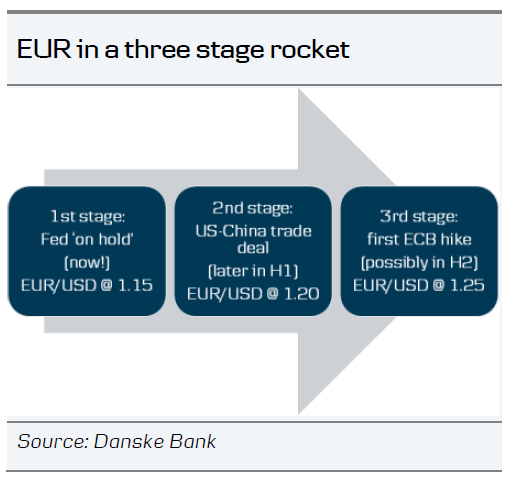
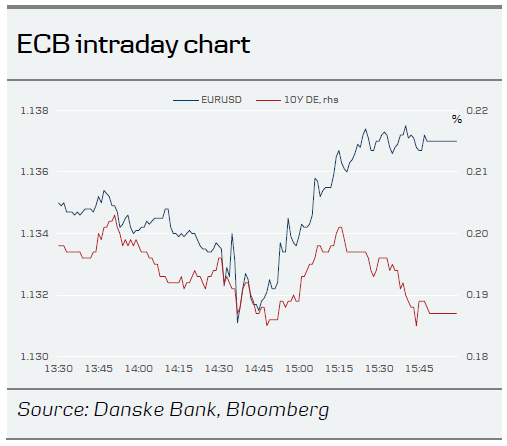
ECB's eagerness to get started was evident today in both Draghi's upbeat tone despite the downside risks assessment and in the EUR reaction. While EUR/USD initially traded lower during the press conference it still held above the 1.13 mark, even if we did at the same time have the statement from US commerce secretary, Ross, that US and China are far away from each other on trade deal – even if there is a 'fair' chance they may eventually reach one – which helped weigh on EUR/USD at first. In the end however, Draghi's still decently upbeat tone on inflation and his reluctance to commit to new liquidity operations, cemented that ECB remains on course for a hike in the 'not too distant' future. To us, EUR/USD still looks like a 1.15 range near term. Indeed, a higher range is now warranted than was the case just a few months by a move higher in EUR-USD real interest-rate spreads as the Fed has arguably largely withdrawn USD support by now. Do we have genuine EUR support from ECB? We still think the first hike is a tad too distant/fragile for FX markets to send EUR significantly higher, but as H1 progresses, we expect the next stage in a EUR/USD rebound to reached via a US-China trade deal. Associated CNY appreciation would further help keep the effective EUR from strengthening too much which would in turn pave the way for ECB. For true lift-off in EUR/USD towards the high 1.20s as warranted by valuation, we need to get closer to confirmation that the ECB intends to move on rates – and that will likely not happen until H2, but we are gradually moving in that direction (see chart).
A "dovish" twist sends bond yields lower
The comments from ECB's Draghi initially sent bond yield lower despite that we had already seen a decent rally in both core-EU and Periphery.
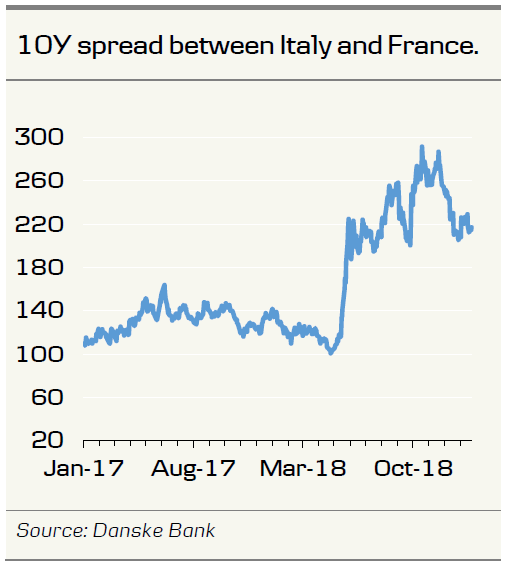
Given the tilt towards downside risks on the growth assessment, then the positive performance in the periphery should be sustained despite that a weaker growth outlook is not really helpful for e.g. the Italian economy. Hence, the 10Y spread between Italy and France is likely to break below the 220bp, which has been the lower bound since the start of the clash between Italy and EU last year.
We have expected that the Bunds should be range-trading between 0.25% to 0.75% during 2019 as we have seen since mid-2016. We still believe that range will hold for 2019 even though we have broken through the lower bound of the trading range. The comments from the ECB meeting today indicates it could take some time before we move back towards the middle of the trading range
Japanese Yen Steady ahead of Tokyo Core CPI
USD/JPY continues to have a quiet week. In the North American session, the pair is trading at 109.54, down 0.07% on the day. On the release front, U.S. unemployment claims dropped to 199 thousand, beating expectations. Japan releases Tokyo Core CPI, which is expected to post a gain of 0.9% for a second straight month.
The U.S. labor market continues to impress. Unemployment claims dropped sharply, from 213 thousand to 199 thousand. This was the first time that the indicator dropped below the 200-thousand level since 1969. The four-week average, which is less volatile, dropped by 5.5 thousand to 215,000. The strong figures indicate that the employment picture remains bright, despite the ongoing U.S. government shutdown, which has resulted in the layoff of some 800,000 government workers.
The BoJ wrapped up its monthly policy meeting, with BoJ Governor Kuroda sending out mixed messages. Kuroda warned of the risks of increased protectionism and softer global demand, but also said that he expected the economy to continue to grow at a modest pace. At the policy meeting, the bank maintained its huge stimulus program and also lowered its inflation forecast, a strong signal that the bank has no intention of reducing stimulus or raising rates anytime soon. The slowdown in China is undoubtedly raising alarm bells at the BoJ, but Governor Kuroda put on a brave face, saying that he hoped the U.S-China trade conflict would be resolved soon. However, If the U.S-China trade spat is not resolved soon, Japan could tip into recession. The export sector is hurting, as December exports fell to their lowest level in two years.
As for the yen, it posted gains of 3.4% in December, when risk appetite plunged and world stock markets fell sharply. The currency started January with gains, but these evaporated as risk appetite has improved. The lukewarm Japanese economy isn’t all that enticing for investors, but the safe-haven yen could once again become attractive if economic conditions worsen, such as a deterioration in the U.S-China trade war or softer data out of China.
US PMI composite rose to 54.5, solid start to 2019
US Markit PMI manufacturing rose to 54.9 in January, up from 53.8 and beat expectation of 53.5. PMI services dropped to 54.2, down from 54.4 and beat expectation of 54.1. PMI Composite recovered to 54.5, up from 54.4.
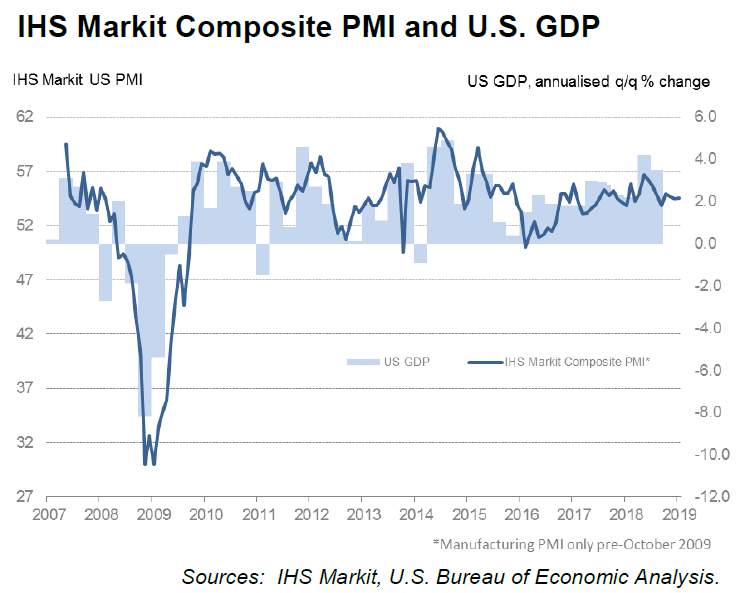
Commenting on the flash PMI data, Chris Williamson, Chief Business Economist at IHS Markit said:
"US businesses reported a solid start to 2019, with the rate of expansion running only slightly weaker than the average seen in the second half of last year.
"The resilience of the survey data suggest little impact from the government shutdown on the private sector, with very few companies reporting any material detrimental impact on their output or order books.
"Historical comparisons suggest January's survey data are indicative of the economy growing at an annualized rate close to 2.5%. However, as the survey does not include the government sector, the impact of the shutdown may not be fully captured.
"Manufacturers reported faster rates of increase for both output and order books during the month, accompanied by ongoing robust service sector growth. Both sectors continued to rely on domestic demand, however, with service sector exports falling for a second successive month and goods exports rising only moderately, acting as a drag on overall order books.
"The jobs data from the surveys were also somewhat disappointing, with the overall rate of job creation slipping to a 20-month low. However, even this weaker January survey employment index reading is consistent with private sector payroll growth of approximately 150,000.
"Encouragingly, business sentiment about the year ahead lifted higher, suggesting companies have started the year with increased optimism, boding well for robust business growth to be sustained in coming months."
Sunset Market Commentary
Markets
Global core bonds gained ground even as risk sentiment was fairly positive. Asian markets closed this morning with gains but European markets opened cautiously at first. China’s Ministry of Commerce confirmed the mid-level trade talks with the US. However, topic of the day remained the ECB policy decision and president Draghi’s Q&A afterwards. In the run up, disappointing EMU PMI’s supported the possibility for a softer ECB. It pushed German Bunds higher and gave US Treasuries direction as well. As widely expected, the ECB held policy rates unchanged and will continue to reinvest maturing QE debt. However, the ECB acknowledged that the risks ‘have moved’ to the downside (instead of ‘are moving’ at the December meeting). Draghi added that a country- or sectorial-specific case is not sufficient for a new TLTRO, but that it needs to be a ‘monetary policy case’. The German yield curve is moving down with changes varying between -0.2 bps (2-yr) to -3.2 bps (10-yr). US Treasuries received some additional tailwind as US Commerce Secretary Wilbur Ross said the US and China are “miles and miles” away from a trade agreement. The US yield curve shifted lower with changes in the range of -2.1 bps (2-yr) to -3.1 bps (5-yr). Italian BTP’s moved higher as well, leading the way for other peripheral bonds too. However, credit spreads over the German 10-yr yield remained rather stable.
The focus for EUR/USD trading was on the EMU side today as the EMU PMI’s unexpectedly declined further. The composite PMI (50.7) is nearing the 50 boom-or-bust level. The German manufacturing PMI and the French services PMI dropping below the 50 mark attracted market attention. European yields and the euro nosedived. EUR/USD dropped to the 1.1330/40 area in the run-up to the ECB policy decision. At the ECB press conference, Draghi admitted that the risks to the economic outlook have shifted to the downside (but mostly due to external factors and market volatility). EUR/USD tested the 1.1309 support area, but bottomed as Draghi said to be confident that inflation will evolve toward the 2.0% goal and as he sounded quite conditional on new TLTRO’s. US/German interest rate differentials are little changed given the EMU headlines. EUR/USD trades again in the mid 1.13 area. The equity rebound slowed during the ECB press conference and weighed on USD/JPY as well (currently near 109.55).
The recent impressive sterling rebound slowed today. Markets have apparently adjusted positions to bring them more in line with the (perceived?) lower probability of a no-deal Brexit. There was also little news on what the next concrete step in the Brexit process might be. Contrary to what was sometimes the case lately, there were no (constructive) UK eco data to reinforce the sterling short-squeeze. EUR/GBP briefly filled bid just below the 0.87 handle, but the sterling bid petered out. Another brief euro-dip during the ECB press conference was also reversed. The pair trades currently again in the 0.8715 area. The 0.8656/21 supports are coming closer, maybe also caused by some profit taking on EUR/GBP shorts. Cable also returned off intraday highs just below 1.31, but the pair is still holding well north of the 1.30 psychological barrier.
News Headlines
The Norwegian central bank left its policy rate unchanged at 0.75%. The bank mentioned weaker than projected global growth but with the economy nearing full capacity, a tightening labor market and inflation close to target, the bank remains on track for a second rate hike in March.
EMU PMI’s edged closer to the boom/bust-mark (50) in January. Eurozone manufacturing confidence declined to 50.5 from 51.4. Services PMI slipped to 50.8 (51.2 in December) while the composite hit 50.7 (51.1). The decline is widespread among the sub-indicators as new orders, exports, employment and output all fell multi-year lows. Respondents’ concerns focus on international trade tensions, Brexit, rising political stress and a weak auto sector.