Sample Category Title
USD/JPY Mid-Day Outlook
Daily Pivots: (S1) 109.31; (P) 109.65; (R1) 109.99; More...
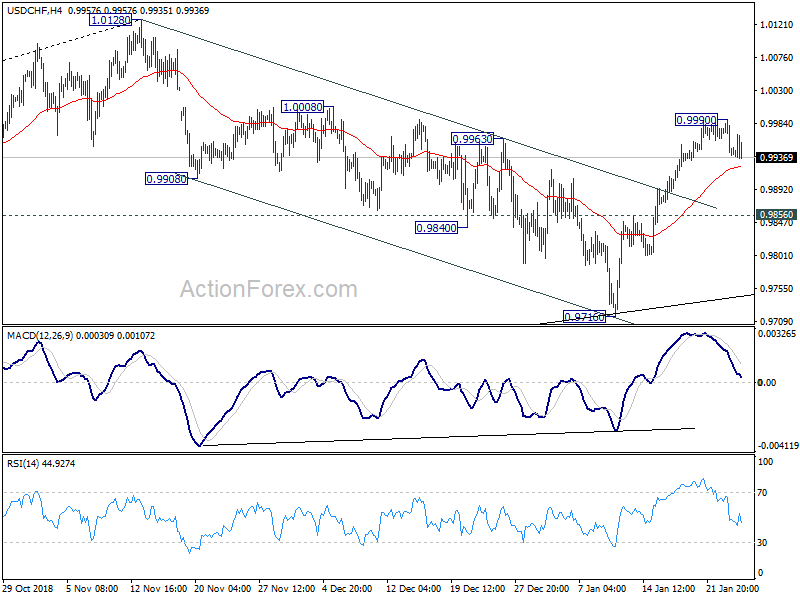
With 109.14 minor support intact, further rise is still mildly in favor in USD/JPY. Rebound from 104.69 could target 61.8% retracement of 114.54 to 104.69 at 110.77. We'd look for topping signal above there. On the downside, break of 109.14 minor support will be the first sign of completion of the rebound. Intraday bias will then be turned back to the downside.
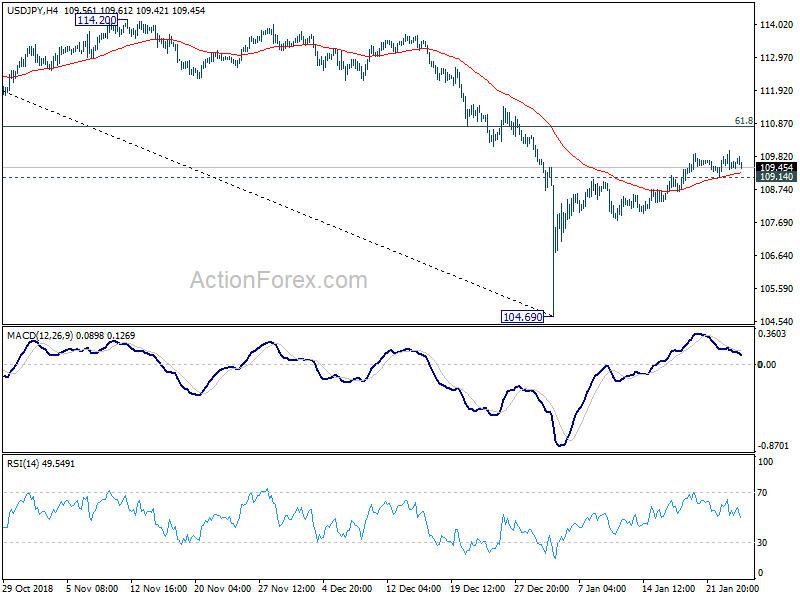
In the bigger picture, price actions from 125.85 (2015 high) are seen as a long term corrective pattern, no change in this view. Apparently, such corrective pattern is not completed yet. Fall from 114.54 is seen as part of the falling leg from 118.65 (2016 high). Break of 104.62 will target 100% projection of 118.65 to 104.62 from 114.54 at 100.51, which is close to 100 psychological level. But in that case, we'd expect strong support from 98.97 to contain downside to bring reversal. Also, this bearish case will remain the preferred one as long as 114.54 resistance holds.
USD/CHF Mid-Day Outlook
Daily Pivots: (S1) 0.9929; (P) 0.9959; (R1) 0.9980; More....
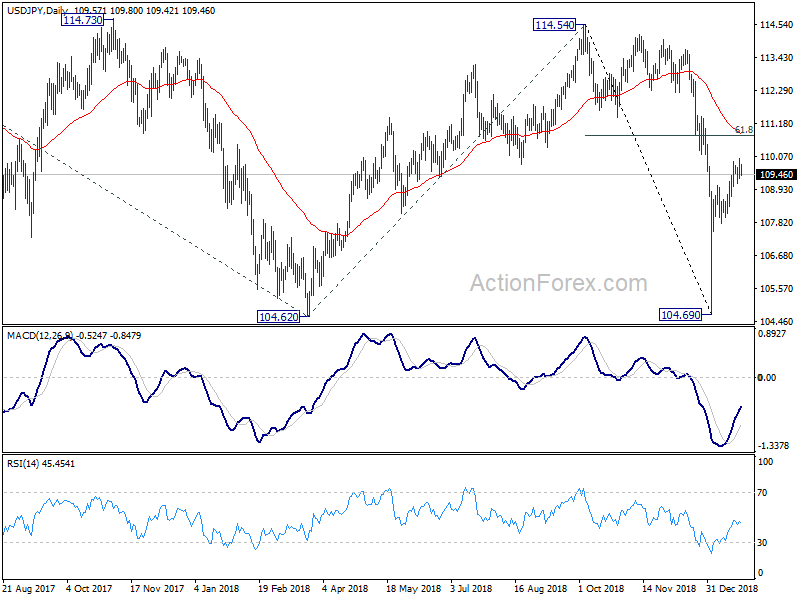
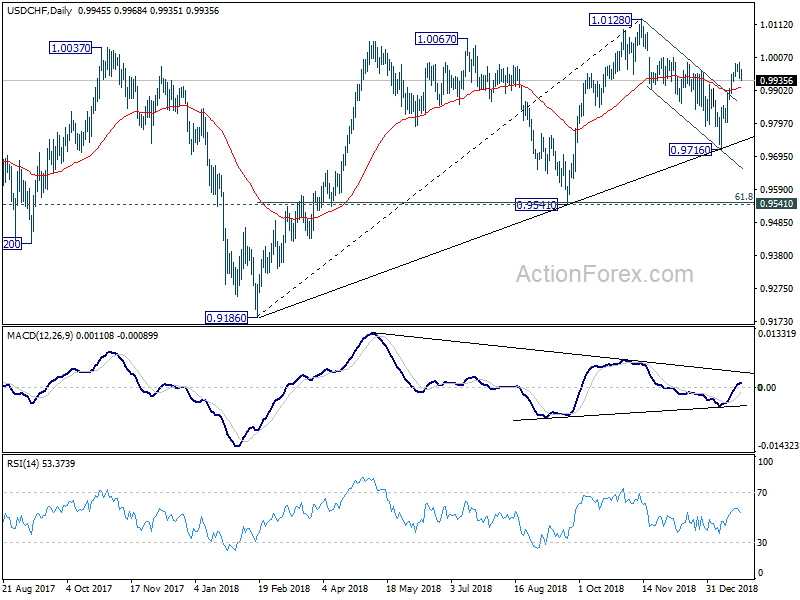
Intraday bias in USD/CHF remains neutral for consolidation below 0.9990 temporary top. Deeper retreat might be seen. But downside should be contained above 0.9856 support to bring another rise. As noted before, correction from 1.0128 should have completed at 0.9716 already. On the upside, above 0.9990 will target a test on 1.0128 high next.
In the bigger picture, current development suggests that rise from 0.9186 has possibly completed with three waves up to 1.0128 already. Decline from 1.0128 could either be correcting this move, or reversing the trend. As long as 0.9541 support holds, we'd slightly favor the former scenario, and expect another rise through 1.0128 at a later stage. However, sustained break of 0.9541 will confirm trend reversal and bring deeper fall back to 0.9186 low.
GBP/USD Mid-Day Outlook
Daily Pivots: (S1) 1.2981; (P) 1.3031; (R1) 1.3119; More....
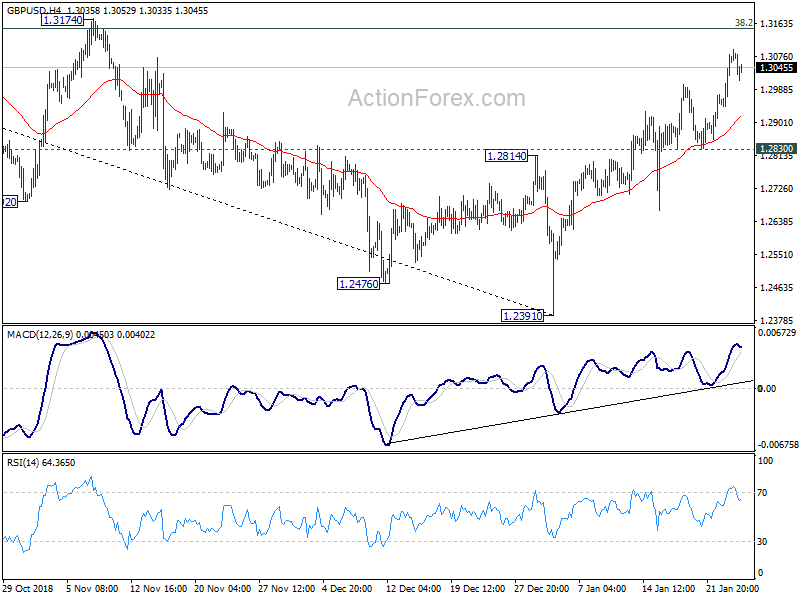
No change in GBP/USD's outlook. Intraday bias stays on the upside as rebound from 1.2391 is targeting 1.3174 resistance, which is close to 38.2% retracement of 1.4376 to 1.2391 at 1.3149. We'd expect strong resistance from there to limit upside, at least on first attempt. On the downside, break of 1.2830 support is needed to be the first sign of near term reversal. Otherwise, further rally is in favor in case of retreat.
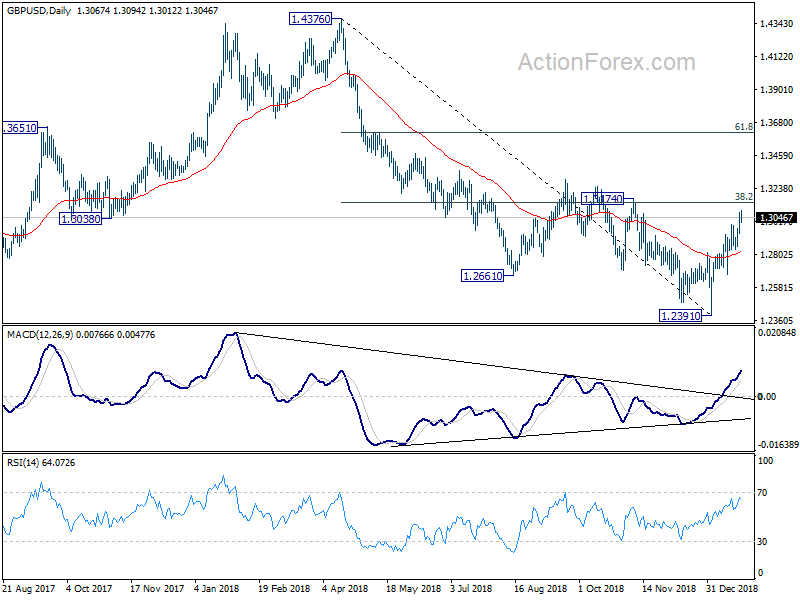
In the bigger picture, whole medium term rebound from 1.1946 (2016 low) should have completed at 1.4376 already, after rejection from 55 month EMA. The structure and momentum of the fall from 1.4376 argues that it's resuming long term down trend from 2.1161 (2007 high). And this will remain the preferred case as long as 1.3174 structural resistance holds. GBP/USD should target a test on 1.1946 first. Decisive break there will confirm our bearish view. However, sustained break of 1.3174 will invalidate this case and turn outlook bullish.
Elliott Wave Analysis: GBPUSD In a Five-wave Recovery
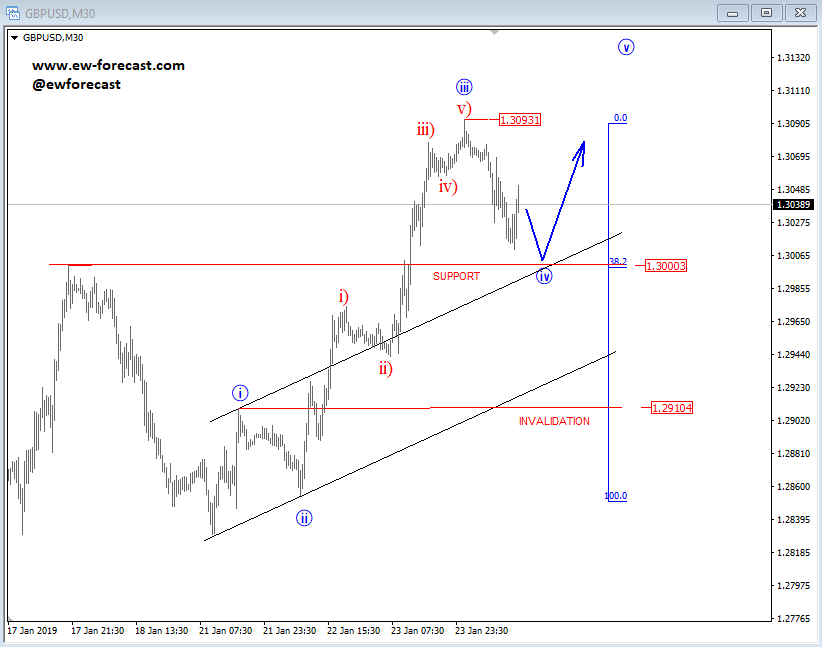
Cable is trading bullish in an impulsive manner and even more may come, if we consider the weak USD in the next couple of days/weeks. Currently, we are tracking wave »iv« correction, where ideal support would be at 1.3000 psychological level, but it could be even more complex, it may stay sideways or maybe it's already finished. However, we expect more upside on Cable, while price keeps trading above 1.2910 invalidation area.
GBPUSD, 1h
Canadian Dollar Steady, U.S. Jobless Claims Sparkles
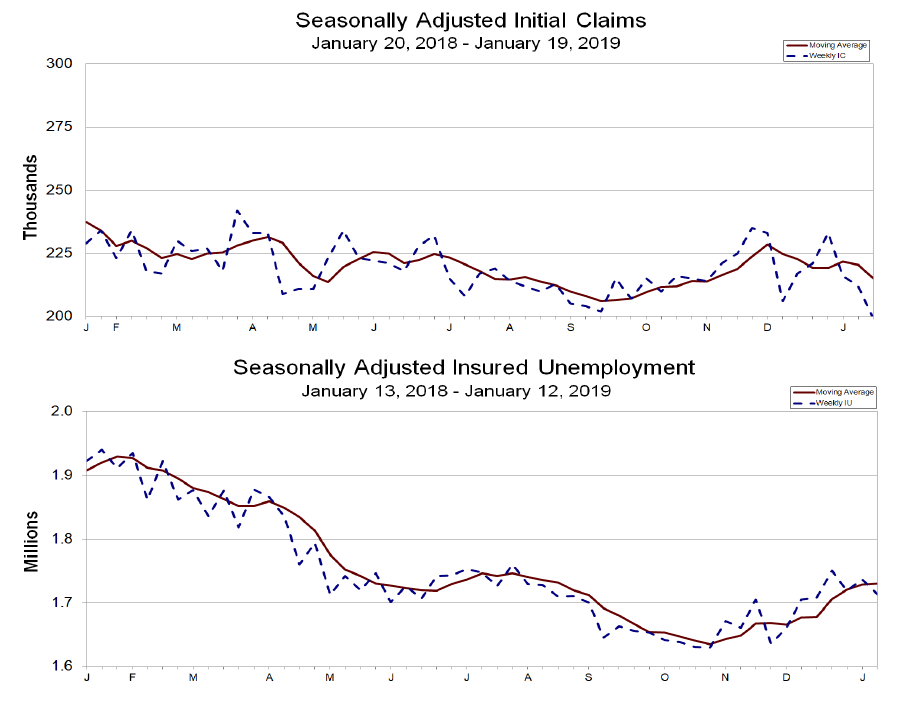
USD/CAD has ticked higher in the Thursday session. Currently, the pair is trading at 1.3347, up 0.03% on the day. On the release front, there are no Canadian events for the remainder of the week. In the U.S., today’s key event was unemployment claims, which dropped to 199 thousand, beating expectations.
There was good news from the U.S. labor market, as unemployment claims dropped sharply, from 213 thousand to 199 thousand. This was the first time that the indicator dropped below the 200-thousand level since 1969. The four-week average, which is less volatile, dropped by 5.5 thousand to 215,000. The strong figures indicate that the employment picture remains bright, despite the ongoing U.S. government shutdown, which has resulted in the layoff of some 800,000 government workers.
With the global trade war showing no signs of easing, it is no surprise that growth forecasts for 2019 are heading south. On Tuesday, the International Monetary Fund lowered its global and eurozone growth forecasts. In October, the IMF projected global growth of 3.7% percent, but this has been revised to 3.5 percent. IMF head Christine Lagarde said that the world’s economy continues to expand, but “it is facing significantly higher risks”.
As for Canada, the IMF downgrade was slight, from the October forecast of 2.0% to the current forecast of 1.9%. In December, the Bank of Canada also lowered its growth forecast, from 2.1% in October to 1.7%. The lower forecasts underscore the vulnerability of the Canadian economy to the U.S-China trade war and falling oil prices. The Canadian dollar has performed well in January, with gains of 2.1%, but there could be headwinds ahead for the Canadian dollar.
EUR/USD Mid-Day Outlook
Daily Pivots: (S1) 1.1356; (P) 1.1375; (R1) 1.1400; More.....
EUR/USD spikes lower to 1.1306 but quickly recovered. Intraday bias remains neutral first and some more consolidation could be seen. But still, further decline is expected as long as 1.1424 resistance holds. And, we're still slightly favoring that corrective rise from 1.1215 should have completed at 1.1569. On the downside, break of 1.1306 will resume the fall from 1.1569 to retest 1.1215 low. However, break of 1.1424 resistance will argue that the corrective pattern from 1.1215 is extending with another rise. And, intraday bias will be turned to the upside for 1.1569 and above.
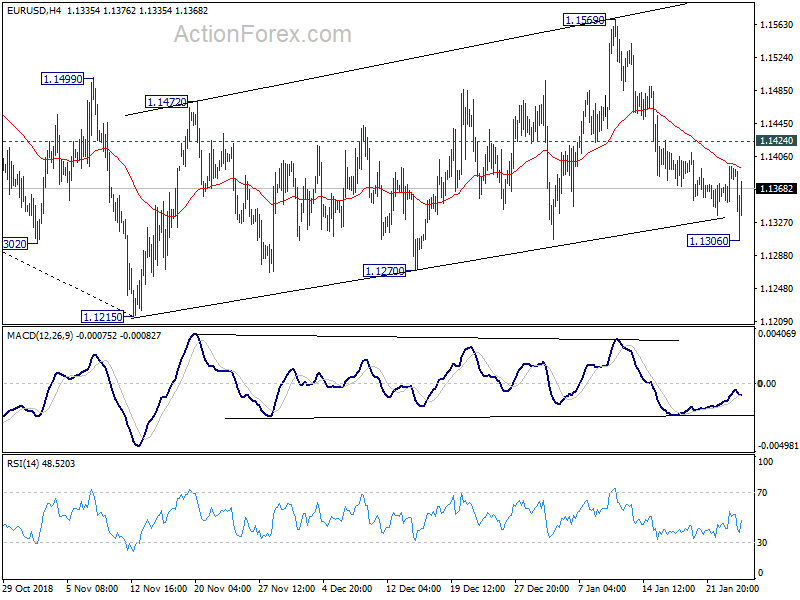
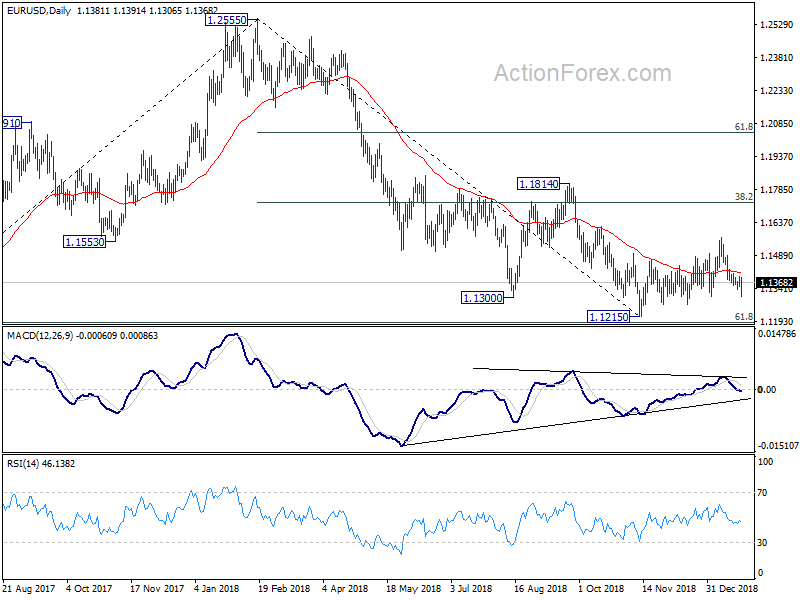
In the bigger picture, as long as 1.1814 resistance holds, down trend down trend from 1.2555 medium term top is still in progress and should target 61.8% retracement of 1.0339 (2017 low) to 1.2555 at 1.1186 next. Sustained break there will pave the way to retest 1.0339. However, break of 1.1814 will confirm completion of such down trend and turn medium term outlook bullish.
Euro Survives Downbeat ECB and Weak PMIs, Safe for Now
Euro has been under broad based pressure today after PMIs suggest more weakness in the economy ahead. The common currency then spikes further lower ECB President Mario Draghi sounds rather cautious and downbeat in the post meeting press conference. However, Euro quickly recovers as Draghi actually didn't bring out any "new" dovishness. The March meeting with new economic projection is the more crucial one, not today's.
Dollar, on the other hand, is firm as boosted by strong job data. But that is offset my US Commerce Secretary Wilbur Ross's comments that US and China are "miles and miles" from a trade deal. For now, Australian Dollar is the weakest one for the day, followed by Sterling, and then Euro. Swiss Franc is the strongest one, followed by Yen and then Dollar.
Technically, despite dipping to 1.1306, EUR/USD's quick recovery suggests that fall from 1.1569 is not ready to resume yet. More consolidations would be seen with risk of further recovery. USD/CHF is also in consolidation and might have slightly deeper pull back. Even though Yen is trading up against most, it's clearly held above below intraday resistance against others. Thus, today's strength in Yen is more of recovery rather than reversal.
In other markets, FTSE is currently down -0.37%. DAX is up 0.15%. CAC is up 0.39%. German 10-year yield is down -0.0336 at 0.194, back below 0.2 handle. Earlier in Asia, Nikkei dropped -0.09%. Hong Kong HSI rose 0.42%. China Shanghai SSE rose 0.41%. Singapore Strait Times rose 0.62%. Japan 10-year JGB yield rose 0.0058 to 0.011.
US initial jobless claims dropped to 199k, lowest since 1969
US initial jobless claims dropped -13k to 199k in the week ending January 19, below expectation of 215k. That's the lowest level since November 15, 1969. Four-week moving average of initial claims dropped -5.5k to 215k. Continuing claims dropped -24k to 1.713M in the week ending January 12. Four-week moving average of continuing claims rose 1.25k to 1.730M.
ECB stands pat, said risks moved the to the downside
ECB kept main refinancing rate unchanged at 0.00% as widely expected. The forward guidance is also held unchanged. That is, "key ECB interest rates to remain at their present levels at least through the summer of 2019.
In the post meeting press conference, Draghi noted that "The risks surrounding the euro area growth outlook have moved to the downside on account of the persistence of uncertainties related to the geopolitical factors and the threat of protectionism, vulnerabilities in emerging markets and financial market volatility." As he added that "The persistence of uncertainties, in particular relating to geopolitical factors and the threat of protectionism, is weighing on economic sentiment."
Later in the Q&A, Draghi said today's ECB meeting was devoted to an "assessment" on the slowdown. And about the questions of "Where are we? Why we're here? And how long will the slowdown last". The meeting was not about the implications on monetary policy. And ECB policymakers were "unanimous" on acknowledging weaker momentum" and "changing of the balance of risks for growth". The Governing Council will give itself more time to assess the risk factors, and there will be another discussion in March with new economic projections.
ECB press conference and statement.
Eurozone PMI composite dropped to 66-month low, both the manufacturing and service close to stagnation
Eurozone PMI manufacturing dropped to 50.5 in January, down from 51.4, missed expectation of 51.3. That's the lowest in 50 months. PMI services dropped to 50.8, down from 51.2, missed expectation of 51.5. That's the lowest in 65 months. PMI composite dropped to 50.7, down from 51.1. That's the lowest in 66 months.
Chris Williamson, Chief Business Economist at IHS Markit noted in the release that "The Eurozone economy slipped closer to stall speed in January, with companies reporting the first drop in demand for over four years. The disappointing survey data indicate that GDP is rising at a quarterly rate of just 0.1%."
He added "both the manufacturing and service sectors are close to stagnation". And, "companies are concerned about a wider economic slowdown gathering momentum, with rising political and economic uncertainty increasingly affecting risk appetite and demand.
Also, "the survey's output and price gauges have both now fallen into territory more associated with the ECB loosening rather than tightening policy, raising pressure on the central bank to acknowledge that downside risks to the outlook now predominate."
Germany PMI composite broke down trend, but manufacturing in contraction
Germany PMI manufacturing dropped to 49.9 in January, down from 51.5 and missed expectation of 51.5. That's the lowest in 50 months. PMI services rose to 53.1, up from 51.8 and beat expectation of 52.2. PMI composite rose to 52.1, up from 51.6.
Phil Smith, Principal Economist at IHS Markit said "growth performance signalled by the index was still one of the worst over the past four years." Also, "firms are also showing greater caution towards hiring with job creation at a 25-month low, though in a historic context these are still healthy employment figures."
And, "Manufacturing fell into contraction in January as the sector's order book situation continued to worsen, showing the steepest decline in incoming new work since 2012. Weakness in the auto industry was once again widely reported, as was a slowdown in demand from China.
France PMI composite dropped to 47.9, 50-month low, further weakness ahead
France PMI manufacturing recovered back to 51.2 in January, up from 49.7 and beat expectation of 50.0. However, PMI services dropped to 47.5, down from 49.0 and missed expectation of 50.5. That's also the lowest level in 59 months. PMI composite dropped to 47.9, down from 48.7, hitting a 50-month low.
Eliot Kerr, Economist at IHS Markit said, "the latest decline was the fastest for over four years, even quicker than the fall in protest-hit December." "Although firms reported higher confidence in January, other forward looking indicators such as new orders fell at the fastest pace for over four years. This suggests further weak performance for France in the coming months."
EU Parliament: No consent to Brexit agreement without Irish backstop
The European Parliament's Brexit group issued a statement today, reiterating that the Brexit agreement must include Irish backstop solution. The group noted that the "Withdrawal Agreement is fair and cannot be re-negotiated. This applies especially to the backstop since it is the guarantee that under no circumstances will there be a hardening of the border on the island of Ireland while at the same time safeguarding the integrity of the Single Market."
Also, "the EU remains clear, firm and united on this even if the negotiated backstop is not meant to be used. Therefore, the BSG insists that, without such an "all-weather" backstop-insurance, the European Parliament will not give its consent to the Withdrawal Agreement."
Additionally after rejection by UK Commons, the group urged "the UK Government must work together with all political parties in the House of Commons to overcome this deadlock. It expects the UK side to come back as quickly as possible with a positive and viable proposal on the way forward."
EU Chief Brexit negotiator Michel Barnier rejected the idea of time-limited backstop. He said "We have to maintain the credibility of this reassurance … it cannot be time-limited… It's not just about Ireland."
Japan PMI manufacturing dropped to 50, exports drop steepest in over 2.5 years
Japan PMI manufacturing dropped to 50.0 in December, down from 52.6. That also marked the end of the longest expansionary run for over a decade. In particular, exports decline at strongest pace in two-and-a-half years. And, production scaled back for first time since July 2016, while confidence lowest in over six years.
Joe Hayes, Economist at IHS Markit, noted "Preliminary PMI data for January bodes ill for Japan's manufacturing sector, indicating the end of a near two-and-a-half-year growth run as the index dropped to 50.0. The underlying picture will raise concern given renewed reductions were seen in new orders and output. Further signs that the downturn in the global trade cycle could yet worsen were also signalled, with new export orders falling at the sharpest rate since July 2016. The widely-anticipated rebound in Q4 should not distract from the bigger picture. Domestic economic weakness compounded with slowing global growth coincided with the lowest level of business confidence for over six years."
Australia job growth driven by part time jobs, participation rate fell
Australia job market grew 21.6k in December, above expectation of 18.1k. Full-time jobs, however, dropped -3k. Part-time jobs rose 24.6k. Unemployment rate dropped -0.1% to 5.0%, better than expectation of 5.0%. That equals the lowest level in more than 6 years, as touched back in September and October. However, participation rate dropped by -0.1% to 65.6%. While the set of data was solid, it isn't too encouraging and paints no sign of tightening in the Australian job market.
EUR/USD Mid-Day Outlook
Daily Pivots: (S1) 1.1356; (P) 1.1375; (R1) 1.1400; More.....
EUR/USD spikes lower to 1.1306 but quickly recovered. Intraday bias remains neutral first and some more consolidation could be seen. But still, further decline is expected as long as 1.1424 resistance holds. And, we're still slightly favoring that corrective rise from 1.1215 should have completed at 1.1569. On the downside, break of 1.1306 will resume the fall from 1.1569 to retest 1.1215 low. However, break of 1.1424 resistance will argue that the corrective pattern from 1.1215 is extending with another rise. And, intraday bias will be turned to the upside for 1.1569 and above..
In the bigger picture, as long as 1.1814 resistance holds, down trend down trend from 1.2555 medium term top is still in progress and should target 61.8% retracement of 1.0339 (2017 low) to 1.2555 at 1.1186 next. Sustained break there will pave the way to retest 1.0339. However, break of 1.1814 will confirm completion of such down trend and turn medium term outlook bullish.
Economic Indicators Update
| GMT | Ccy | Events | Actual | Forecast | Previous | Revised |
|---|---|---|---|---|---|---|
| 00:30 | AUD | Employment Change Dec | 21.6K | 18.1K | 37.0K | |
| 00:30 | AUD | Unemployment Rate Dec | 5.00% | 5.10% | 5.10% | |
| 00:30 | JPY | PMI Manufacturing Jan P | 50 | 52.6 | ||
| 08:15 | EUR | France Manufacturing PMI Jan P | 51.2 | 50 | 49.7 | |
| 08:15 | EUR | France Services PMI Jan P | 47.5 | 50.5 | 49 | |
| 08:30 | EUR | Germany Manufacturing PMI Jan P | 49.9 | 51.4 | 51.5 | |
| 08:30 | EUR | Germany Services PMI Jan P | 53.1 | 52.2 | 51.8 | |
| 09:00 | EUR | Eurozone Manufacturing PMI Jan P | 50.5 | 51.3 | 51.4 | |
| 09:00 | EUR | Eurozone Services PMI Jan P | 50.8 | 51.5 | 51.2 | |
| 12:45 | EUR | ECB Rate Decision | 0.00% | 0.00% | 0.00% | |
| 13:30 | EUR | ECB Press Conference | ||||
| 13:30 | USD | Initial Jobless Claims (JAN 19) | 199K | 215K | 213K | 212K |
| 14:45 | USD | US Manufacturing PMI Jan P | 53.5 | 53.8 | ||
| 14:45 | USD | US Services PMI Jan P | 54.1 | 54.4 | ||
| 15:00 | USD | Leading Index Dec | -0.10% | 0.20% | ||
| 15:30 | USD | Natural Gas Storage | -145B | -81B | ||
| 16:00 | USD | Crude Oil Inventories | -0.2M | -2.7M |
EUR/USD dips on Draghi’s press conference, but quickly recovers
Euro drops broadly after ECB President Mario Draghi sounds rather cautious and downbeat in the post meeting press conference. In particular, Draghi noted that "The risks surrounding the euro area growth outlook have moved to the downside on account of the persistence of uncertainties related to the geopolitical factors and the threat of protectionism, vulnerabilities in emerging markets and financial market volatility." As he added that "The persistence of uncertainties, in particular relating to geopolitical factors and the threat of protectionism, is weighing on economic sentiment."
Later in the Q&A, Draghi said today's ECB meeting was devoted to an "assessment" on the slowdown. And about the questions of "Where are we? Why we're here? And how long will the slowdown last". The meeting was not about the implications on monetary policy. And ECB policymakers were "unanimous" on acknowledging weaker momentum" and "changing of the balance of risks for growth". The Governing Council will give itself more time to assess the risk factors, and there will be another discussion in March with new economic projections.
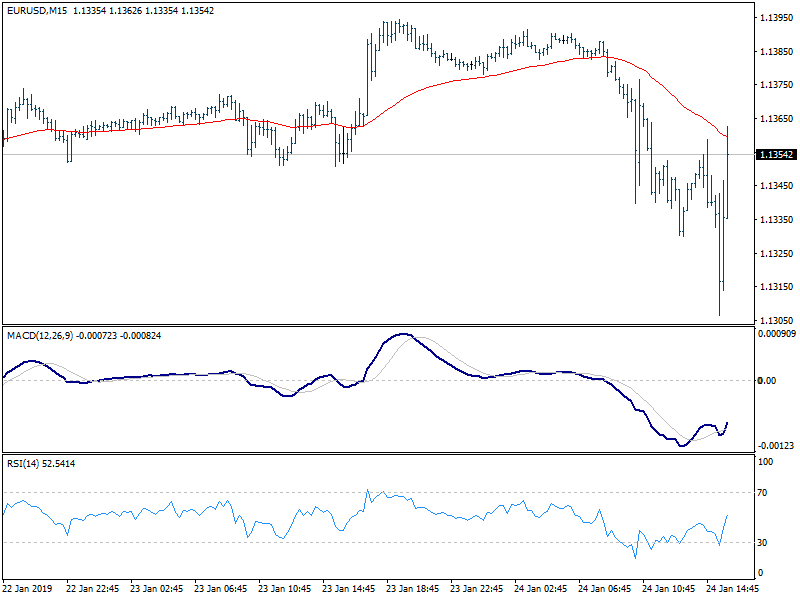
EUR/USD dips to as low as 1.1306 but is now back at 1.1352. While Draghi was cautious, he didn't bring out any "new" dovishness in the press conference.
(ECB) Introductory Statement to the Press Conference
(ECB) Introductory Statement to the Press Conference
Mario Draghi, President of the ECB,
Luis de Guindos, Vice-President of the ECB,
Frankfurt am Main, 24 January 2019
INTRODUCTORY STATEMENT
Ladies and gentlemen, the Vice-President and I are very pleased to welcome you to our press conference. We will now report on the outcome of today's meeting of the Governing Council, which was also attended by the Commission Vice-President, Mr Dombrovskis.
Based on our regular economic and monetary analyses, we decided to keep the key ECB interest rates unchanged. We continue to expect them to remain at their present levels at least through the summer of 2019, and in any case for as long as necessary to ensure the continued sustained convergence of inflation to levels that are below, but close to, 2% over the medium term.
Regarding non-standard monetary policy measures, we intend to continue reinvesting, in full, the principal payments from maturing securities purchased under the asset purchase programme for an extended period of time past the date when we start raising the key ECB interest rates, and in any case for as long as necessary to maintain favourable liquidity conditions and an ample degree of monetary accommodation.
The incoming information has continued to be weaker than expected on account of softer external demand and some country and sector-specific factors. The persistence of uncertainties in particular relating to geopolitical factors and the threat of protectionism is weighing on economic sentiment. At the same time, supportive financing conditions, favourable labour market dynamics and rising wage growth continue to underpin the euro area expansion and gradually rising inflation pressures. This supports our confidence in the continued sustained convergence of inflation to levels that are below, but close to, 2% over the medium term. Significant monetary policy stimulus remains essential to support the further build-up of domestic price pressures and headline inflation developments over the medium term. This will be provided by our forward guidance on the key ECB interest rates, reinforced by the reinvestments of the sizeable stock of acquired assets. In any event, the Governing Council stands ready to adjust all of its instruments, as appropriate, to ensure that inflation continues to move towards the Governing Council's inflation aim in a sustained manner.
Let me now explain our assessment in greater detail, starting with the economic analysis. Euro area real GDP increased by 0.2%, quarter on quarter, in the third quarter of 2018, following growth of 0.4% in the previous two quarters. Incoming data have continued to be weaker than expected as a result of a slowdown in external demand compounded by some country and sector-specific factors. While the impact of some of these factors is expected to fade, the near-term growth momentum is likely to be weaker than previously anticipated. Looking ahead, the euro area expansion will continue to be supported by favourable financing conditions, further employment gains and rising wages, lower energy prices, and the ongoing – albeit somewhat slower – expansion in global activity.
The risks surrounding the euro area growth outlook have moved to the downside on account of the persistence of uncertainties related to geopolitical factors and the threat of protectionism, vulnerabilities in emerging markets and financial market volatility.
Euro area annual HICP inflation declined to 1.6% in December 2018, from 1.9% in November, reflecting mainly lower energy price inflation. On the basis of current futures prices for oil, headline inflation is likely to decline further over the coming months. Measures of underlying inflation remain generally muted, but labour cost pressures are continuing to strengthen and broaden amid high levels of capacity utilisation and tightening labour markets. Looking ahead, underlying inflation is expected to increase over the medium term, supported by our monetary policy measures, the ongoing economic expansion and rising wage growth.
Turning to the monetary analysis, broad money (M3) growth moderated to 3.7% in November 2018, after 3.9% in October. M3 growth continues to be backed by bank credit creation. The narrow monetary aggregate M1 remained the main contributor to broad money growth.
The annual growth rate of loans to non-financial corporations stood at 4.0% in November 2018, after 3.9% in October, while the annual growth rate of loans to households remained broadly unchanged at 3.3%. The euro area bank lending survey for the fourth quarter of 2018 suggests that overall bank lending conditions remained favourable, following an extended period of net easing, and demand for bank credit continued to rise, thereby underpinning loan growth.
The pass-through of the monetary policy measures put in place since June 2014 continues to significantly support borrowing conditions for firms and households, access to financing – in particular for small and medium-sized enterprises – and credit flows across the euro area.
To sum up, a cross-check of the outcome of the economic analysis with the signals coming from the monetary analysis confirmed that an ample degree of monetary accommodation is still necessary for the continued sustained convergence of inflation to levels that are below, but close to, 2% over the medium term.
In order to reap the full benefits from our monetary policy measures, other policy areas must contribute more decisively to raising the longer-term growth potential and reducing vulnerabilities. The implementation of structural reforms in euro area countries needs to be substantially stepped up to increase resilience, reduce structural unemployment and boost euro area productivity and growth potential. Regarding fiscal policies, the Governing Council reiterates the need for rebuilding fiscal buffers. This is particularly important in countries where government debt is high and for which full adherence to the Stability and Growth Pact is critical for safeguarding sound fiscal positions. Likewise, the transparent and consistent implementation of the EU's fiscal and economic governance framework over time and across countries remains essential to bolster the resilience of the euro area economy. Improving the functioning of Economic and Monetary Union remains a priority. The Governing Council welcomes the ongoing work and urges further specific and decisive steps to complete the banking union and the capital markets union.
We are now at your disposal for questions.
US initial jobless claims dropped to 199k, lowest since 1969
US initial jobless claims dropped -13k to 199k in the week ending January 19, below expectation of 215k. That's the lowest level since November 15, 1969. Four-week moving average of initial claims dropped -5.5k to 215k.
Continuing claims dropped -24k to 1.713M in the week ending January 12. Four-week moving average of continuing claims rose 1.25k to 1.730M.