

Sample Category Title
UBS Stock To Remain Under Pressure After Disappointing Earnings Results
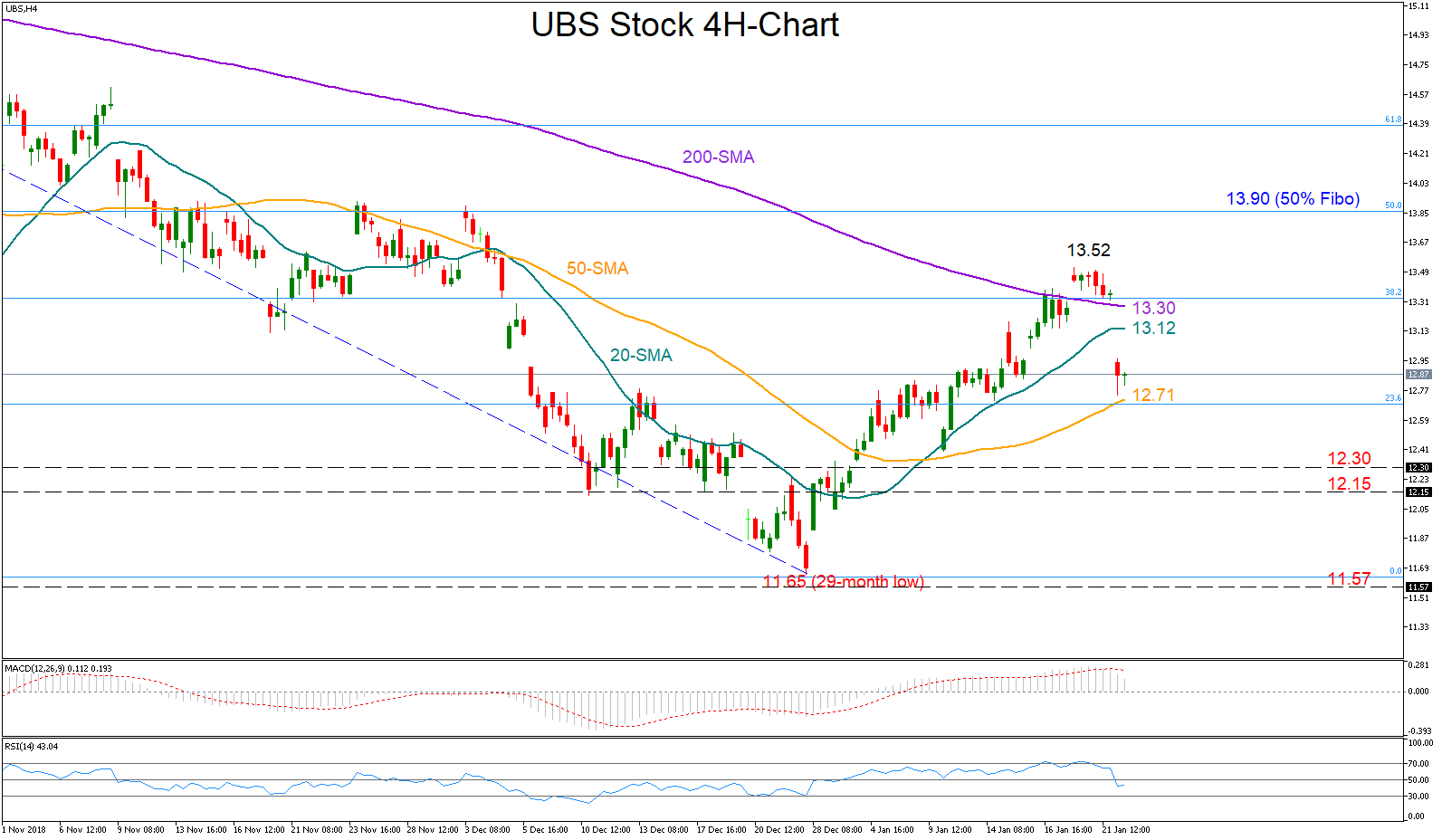
UBS Swiss Bank missed analysts’ earnings estimates on Tuesday, sending its stock price below the 200-period simple moving average (MA) on the four-hour chart and straight down to one-week lows. Technically the short-term bias looks neutral to negative according to momentum indicators; the RSI seems to be flattening below its 50-neutral threshold, while the MACD keeps weakening towards zero and below its red signal line.
A leg lower could touch the 50-period MA currently at 12.71 where any violation could set the stage for more selling, probably towards the 12.30-12.15 area. Moving lower, the bears will likely come in front of a taller wall within the 11.65 and 11.57 boundaries which remain unbreakable since 2012.
In the positive scenario, the stock price could find a barrier around the 20-period MA currently at 13.12 as the line seemed to be more restrictive earlier this month. Slightly higher, a jump above 13.30 and the 200-period MA would bring more buyers into the market, while a decisive close above the 13.52 peak and more importantly above 13.90 (50% Fibonacci of the long sell-off from 16.10 to 11.65) would confirm the sustainability of the recent rebound.
Forex Technical Analysis: EUR/USD, USD/JPY, GBP/USD
EUR/USD
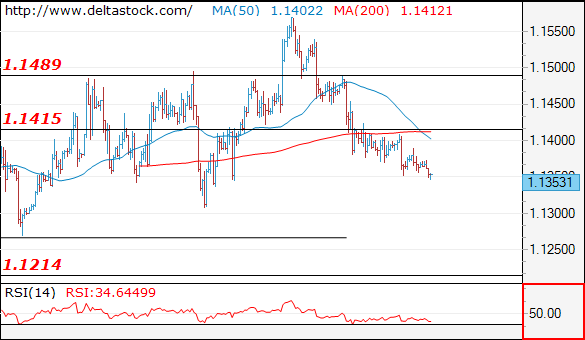
Current level - 1.1353
The overall bias remains bearish, for a break though 1.1310 support, towards 1.1214 low. Crucial on the upside is 1.1415.
| Resistance | Support | ||
| intraday | intraweek | intraday | intraweek |
| 1.1415 | 1.1630 | 1.1310 | 1.1214 |
| 1.1540 | 1.1820 | 1.1260 | 1.1100 |
USD/JPY
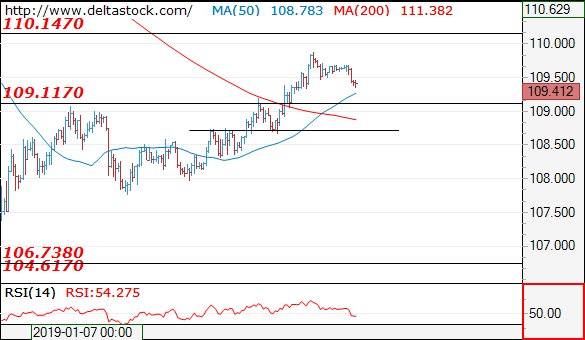
Current level - 109.60
The pattern below 109.80 is corrective, preceding another attempt at 110.20 resistance area. Key support lies at 109.10.
| Resistance | Support | ||
| intraday | intraweek | intraday | intraweek |
| 110.20 | 111.45 | 109.10 | 106.70 |
| 110.20 | 112.20 | 108.65 | 104.60 |
GBP/USD
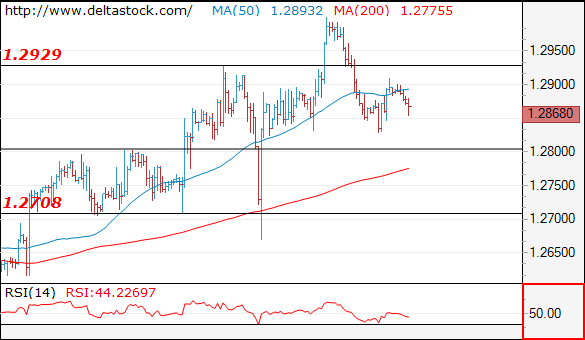
Current level - 1.2865
The resistance at 1.2930 should cap the upside, for a continuation downwards, to 1.2710 area.
| Resistance | Support | ||
| intraday | intraweek | intraday | intraweek |
| 1.2930 | 1.3050 | 1.2800 | 1.2420 |
| 1.3050 | 1.3250 | 1.2710 | 1.2340 |
German ZEW Survey Mixed, UK ILO Unemployment Back At Four Decade Lows
Notes/Observations
- PM May ‘plan B' for Brexit looks a lot like plan A; Key importance would be what amendments get tabled ahead of Tuesday's vote and whether or not they get a majority when voted on
- German Jan ZEW survey mixed; data suggested that markets experts had already considerably lowered growth expectations
- UK Nov ILO Unemployment Rate beats expectations and matches the lowest level since 1975 (4.0% v 4.1%e)
- IMF updates its World economic Outlook (WEO) and again cuts its 2019 Global GDP growth forecast from 3.7% to 3.5% (three-year low) citing no-deal Brexit and trade concerns - US Govt partial shutdown enters its 32nd day with no end in sight
Asia:
- South Korea Q4 Preliminary GDP Q/Q: 1.0% v 0.6%e; Y/Y: 3.1% v 2.7%e; Overall 2018 GDP Y/Y: 2.7% (slowest growth in 6 years)
- Canada Ambassador to US MacNaughton confirmed US to 'formally' seek extradition of CFO Meng
- Japan Fin Min Aso: Important that exchange rates were stable in Golden week holiday, do not expect any crisis situation
Europe:
- (UK) PM May to present ‘plan B' on Brexit which highlighted that the right way to rule out no-deal was to approve deal. Extending Article 50 wouldn't rule out no-deal Brexit; EU was very unlikely to extend Article 50 without a plan for a deal. A 2nd referendum would set difficult precedent and undermine faith in democracy. Confirmed next Tuesday's (January 29th) vote and added that ot would NOT a 2nd meaningful vote but the completion of this particular procedure. To give Parliament more say in future EU trade deal.
- "Dozens" of UK ministers said to be close to resigning over Brexit. Up to 40 members of the government to resign next week if Conservative MPs were banned from voting for a plan to stop a no-deal Brexit. work and pensions secretary Amber Rudd said to have demanded that all Tory MPs are allowed a free vote on plans that would clear the path for extending Article 50
- Italy Fin Min Tria stated that economic policies recommended by the IMF posed a risk to the global economy; defended deficit-spending. EU Commission said to cut Italy's growth forecast for 2019 to 0.6% or slightly below (Note: 2019 2019 GDP seen at 1.0%)
Americas:
- President Trump: China's latest economic numbers show need for trade. China should stop 'playing around' and do 'real deal' (Note: China Overall 2018 GDP growth of 6.6% was the slowest annual pace since 1990)
- United States nformed the Canadian government that it planned to proceed with a formal request to extradite Huawei chief financial officer Meng Wanzhou on allegations of banking fraud related to violations of US sanctions against Iran
Macro
- (UK) United Kingdom: Parliament will vote on a modified version of Prime Minister May's Withdrawal Agreement next Tuesday, January 29. May has pledged to try and win concessions from the EU on the Irish backstop but provided little detail while Irish and EU officials yesterday reaffirmed that there can be no renegotiation.
- (US) Global: Yesterday the IMF trimmed global growth amid trade war concerns, following downgrades in October, noting "the expansion is weakening and at a rate that is somewhat faster than expected." And risks for a more "significant downward corrections are rising." The Fund now projects 2019 GDP growth at 3.5% and 2020 at 3.6%, respectively, versus forecasts of 3.7% previously. The potential for a hard Brexit was the biggest threat, though trade frictions, tighter financial conditions, and slowing in China and the Eurozone. And in the U.S., a protracted government shutdown poses risks.
- (EU) ECB: The latest ECB bank lending survey reported pretty much unchanged credit standards for loans to firms as well as housing loans. Loan demand also held up, although banks are expecting a slowdown ahead. Notably though the ECB highlighted that banks' non-performing loan ratios had a tightening impact on their credit standards over the past six months. Banks clearly haven't used the period of relative calm to improve their NPL situations and the legacy from the last financial crisis continues to be a headache for many institutions at a time when growth is already slowing again.
SPEAKERS/FIXED INCOME/FX/COMMODITIES/ERRATUM
Equities
- Indices [Stoxx600 -0.12% at 355.92, FTSE -0.46% at 6,938.73, DAX -0.22% at 11,111.49, CAC-40 -0.30% at 4,853.01, IBEX-35 -0.14% at 9,041.00, FTSE MIB -0.51% at 19,538.50, SMI -0.28% at 8,994.20, S&P 500 Futures -0.60%]
- Market Focal Points/Key Themes: European Indices trade mostly lower this morning following a negative session in Asia and negative US futures. Macro developments remain in focus as the IMF cut its global growth forecasts, while macro commentary was in focus on the first day of the World Economic Forum in Davos. On the corporate front UBS set the negative tone after reporting earnings which missed forecasts, with IG Group, Zoo Digital, Connect Group, Close Brothers and Remy Cointreau among other names dropping after earnings and trading updates. BHP Group also falls after a fall in Iron ore production. Meanwhile Easyjet rises over 5% after in line earnings relieving some investor fears following Ryanair's profit warning on Friday. Elsewhere Hugo Boss rises after beating consensus, Dixons Carphone, Pets At Home, Midwich Group were among the other risers on earnings. Looking ahead notable earners include DOw components Johnson & Johnson and Travelers, as well as earnings from Haliburton, Stanley Black and Decker, Prologis and Steel Dynamics among others.
Equities
- Consumer discretionary: EasyJet [EZJ.UK] +2% (earnings), Dixons Carphone [DC.UK] +3.5% (trading update; Elliott reportedly could take a stake in company), Tomtom [TOM2.NL] -3% (divestment), Remy Cointreau [RCO.FR] -1.5% (earnings), Hugo Boss [BOSS.DE] +5% (earnings), Pets at Home [PETS.UK] +9% (earnings)
- Financials: UBS [UBSG.CH] -4% (earnings; CEO comments), IG Group [IGG.UK] -6% (earnings)
- Materials: K+S [SDF.DE] -3% (analyst action)
- Industrials: Getlink [GET.FR] +1% (earnings), SGS SA [SGSN.CH] +1% (earnings)
- Technology: Logitech International [LOGN.CH] +1% (earnings)
- Telecom: Orange [ORA.FR] n/c (reportedly faces fines), Elior [ELIOR.FR] +0.5%, Autogrill [AGL.IT] +1% (potential deal)
Speakers
- ECB Q4 Bank Lending Survey: Net demand increased in all loan categorizes in Q4 but expected some moderation in the coming quarter
- UK Brexit Sec Barclay: In both UK and EU interest to have a Brexit deal
- German ZEW Economists: Markets experts have already considerably lowered growth expectations. Negative factors like the rejection of the Brexit deal by the UK Parliament and weak growth from China had already been anticipated
- Belgium Foreign Min Reynders: Belgium was prepared for a no-deal Brexit but hopes it was possible to reach a deal
- Italy Deputy PM Salvini: France has no interest in stabilizing Libya (**Reminder on Jan 21st the French foreign minister was said to have summoned Italian ambassador after Deputy PM Di Maio's made an "unacceptable" comment on France's role in Africa
- OECD chief Gurria commented from Davos that Brexit was one fo the big elements of uncertainty
- China Foreign Ministry Spokeswoman Hua: Will respond in accordance with further action taken by US side if Huawei exec Meng is extradited
- China Securities Regulator (CSRC) Vice Chairman Fang Xinghai did not see China significantly cutting its US bond holdings
- IEA chief Birol: To pay special attention to US shale production in 2019
Currencies/Fixed Income
- Some risk aversion crept back into the markets that helped the USD stay near 3-week highs. Some jitters on the trade front surfaced after China noted it would respond in accordance with further action taken by US side if Huawei exec Meng was extradited. Also the IMF again cut its 2019 global growth forecast citing Brexit and trace concerns.
- GBP/USD was initially softer as dealers noted that PM May's plan B looked a lot like the failed plan A and did little to clarify the govt future Brexit plan. The pair continued to find support in the lower part of the 1.28 handle for the time being (tested 1.2830 on Monday and 1.2855 today). Better ILO employment data also aided the GBP currency sentiment with the pair above the 1.29 level ahead of the NY morning.
- EUR/USD was steady at 1.1363 and continued to remain locked within a 1.13-1.5 trading range. German Jan ZEW survey was mixed but suggested that markets experts had already considerably lowered growth expectations
- USD/JPY was lower by 0.2% on some safe-haven flows at 109.45 area. Focus on tomorrow BOJ rate decision but no changes were expected in its policy.
Economic Data
- (NL) Netherlands Jan Consumer Confidence Index : 1 v 9 prior
- (NL) Netherlands Nov Consumer Spending Y/Y: 2.0% v 1.7% prior
- (ZA) South Africa Nov Leading Indicator: 105.5 v 105.5e
- (MA) Malaysia Mid-Jan Foreign Reserves: $101.7B v $101.4B prior end-Dec
- (TW) Taiwan Dec Unemployment Rate: 3.7% v 3.7%e
- (HU) Hungary Nov Average Gross Wages Y/Y: 10.4% v10.2%e
- (HK) Hong Kong Dec CPI Composite Y/Y: 2.5% v 2.5%e
- (PL) Poland Dec Retail Sales M/M: 12.9% v 16.5%e; Y/Y: 4.7% v 8.1%e; Real Retail Sales Y/Y: 3.9% v 7.0%e
- (ES) Spain Nov Trade Balance: -€2.6B v -€3.8B prior
- (UK) Dec Jobless Claims Change: +20.8K v +24.8K prior; Claimant Count Rate: 2.8% v 2.8% prior
- (UK) Nov Average Weekly Earnings 3M/Y: 3.4% v 3.3%e; Weekly Earnings (ex Bonus) 3M/Y: 3.3% v 3.3%e
- (UK) Nov ILO Unemployment Rate: 4.0% v 4.1%e (matches low from 1975); Employment Change 3M/3M: +141K v +87Ke
- (UK) Nov Public Finances (PSNCR): £21.3B v £2.7B prior; Public Sector Net Borrowing: £2.1B v £1.1Be; Central Government NCR: £18.2B v £6.7B prior; PSNB ex Banking Groups: £3.0B v £1.9Be
- (DE) Germany Jan ZEW Current Situation Survey: 27.6 v 43.0e; Expectations Survey: -15.0 v -18.5e
- (EU) Euro Zone Jan ZEW Survey Expectations: -20.9 v -21.0 prior
Fixed Income Issuance
- (ES) Spain Debt Agency (Tesoro) opened its book to sell EUR-denominated Apr 2029 bond via syndicate; guidance seen +65bps to mid-swaps; order book over €50.0B - (ZA) South Africa sold total ZAR2.85B vs. ZAR2.85B indicated in 2023, 2035 and 2040 bonds
- (ES) Spain Debt Agency (Tesoro) sold total €1.46B vs. €1.0-2.0B indicated range in 3-month and 9-month bills
- (ID) Indonesia sold total IDR7.64T vs. IDR8.0T target in 6-month Islamic Bills, 2-year, 4-year, 7-year and 15-year Project-based Sukuk (PBS)
- (CH) Switzerland sold CHF74.1M in 3-month Bills; Avg Yield: -0.281% v -0.837% prior
Looking Ahead
- (NG) Nigeria Central Bank Interest Rate Decision: expected to leave Interest Rate unchanged at 14.00%
- 05:30 (UK) Weekly John Lewis LFL sates data
- 05:30 (EU) ECB allotment in 7-Day Main Refinancing Tender (MRO)
- 05:30 (HU) Hungary Debt Agency (AKK) to sell in 3-month Bills
- 05:30 (UK) DMO to sell £1.75B in Sept 2037 Gilts
- 06:00 (IE) Ireland Dec PPI M/M: No est v 3.9% prior; Y/Y: No est v -4.2% prior
- 06:30 (EU) ESM to sell €2.0B in 6-month bills
- 06:45 (US) Daily Libor Fixing
- 08:00 (UK) Baltic Dry Bulk Index
- 08:00 (RU) Russia announces weekly OFZ bond auction (held on Wed)
- 08:30 (CA) Canada Nov Wholesale Trade Sales M/M: -0.3%e v +1.0% prior; Manufacturing Sales M/M: -0.8%e v -0.1% prior
- 09:00 (MX) Mexico Dec Unemployment Rate (Seasonally Adj): 3.4%e v 3.3% prior; Unemployment Rate NSA (unadj): 3.2%e v 3.3% prior
- 09:00 (EU) Weekly ECB Forex Reserves: No est v €273.8B prior
- 10:00 (US) Dec Existing Home Sales: 5.24Me v 5.32M prior
- 10:00 (MX) Mexico weekly International Reserves
- 10:00 (CO) Colombia Nov Trade Balance: -$1.1Be v -$1.2B prior; Total Imports: $4.4Be v $5.2B prior
- 11:30 (US) Treasury to sell 3-Month and 6-Month Bills
- (IT) Italy Debt Agency (Tesoro) announcement for CTZ and BTPei auctions for Friday, Jan 25th
- 14:00 (AR) Argentina Dec Trade Balance: $1.2Be v $1.0B prior
- 14:00 (CO) Colombia Nov Economic Activity Index (Monthly GDP) Y/Y: 2.9%e v 2.3% prior
Profit Taking Seen In Light Trading
US paring gains after bank holiday weekend
The US returns from its long bank holiday weekend on Tuesday with stock market in profit taking mode, following four consecutive weeks of gains.
It would appear that investors took advantage of light bank holiday trade on Monday to lock in some profits following a very encouraging post-Christmas period. This is being reflected in US futures ahead of the open, with indices on Wall Street seen opening off around half a percent, similar to the declines we’ve seen across Europe at the start of the week.
This comes as talks between US and Chinese officials appear to be progressing well, with the 90 day deadline a little over a month away. Trump may have denied that the US is considering lifting tariffs – following reports that Steve Mnuchin has suggested doing so in order to draw more concessions from China – but it would appear that there is a desire from within parts of the administration to get a deal done.
Meanwhile, there has also been reports that China has offered to increase imports over a six year period in an effort to reduce the imbalance, as the country reported its slowest rate of growth in 28 years. As ever with these reports, it’s difficult to pick false stories from those with substance but I think there’s probably no smoke without fire here and both sides are keen to make work towards a solution quickly. Whether it’s the Chinese economy, US and Chinese markets or Trump’s 2020 re-election bid, there’s a lot to be gained from these going well for both sides.
Market shrugs off decent UK jobs report
The UK jobs report has somewhat fallen off most people’s radar this week, and understandably so considering the far more pressing issue of Brexit and its effect on the outlook for the economy. The jobs data itself was actually very good, with unemployment falling to 4% as more jobs were added than expected, while wages grew at 3.4%, which also exceeded market expectations.
Unfortunately, the state of the labour market right now pales to insignificance compared to how it will be once the UK leaves the EU, which is currently scheduled for 29th March, making the current negotiations far more impactful for sterling. The pound did push a little higher after the release to trade just above 1.29 against the dollar but the size of the move itself was small and just added to earlier gains.
Oil pares gains on growth downgrades
Oil is continuing to pare gains on Tuesday, with the latest pullback being attributed to the slower growth numbers from China and the IMFs revisions for global growth. While in skittish markets this may be enough to further exacerbate downward moves, this looks like nothing more than profit taking with these headlines another convenient reason to do so.
WTI and Brent bounced around 25% from their festive lows just under a month ago and a slow start to the week is prompting some profit taking. Oil is very much just a reflection of risk appetite at the moment and the fact that these declines are corresponding with similar moves in equity markets is not a coincidence. The test for WTI and Brent to the upside continues to be around $55 and $65, respectively.
WTI Crude Oil Futures Retreat From 1½-Month High, Pause Near 20-SMA
Oil futures retreated from a one-and-a-half-month high of 54.50 on Tuesday, touching the 20-simple moving average (SMA) in the 4-hour chart. The very short-term bias looks negative as the MACD keeps losing ground below its red signal line, while the RSI seems to be making its way down to retest its 50-neutral mark.
Should bearish dynamics dominate, the market might decline below the 53.25 key support and the near-term uptrend line to challenge the 40-SMA currently at 52.35. Below that, the area around 50.65, the 23.6% Fibonacci retracement level of the downleg from 76.90 to 42.50, could be another potential barrier in focus, while steeper declines may overcome that point to test 49.80.
On the flipside, if the price manages to rebound on 53.25, nearby resistance could come from the previous peak of 54.50. Further up, the market could rest around the 38.2% Fibonacci region of 55.64, while slightly above, the 55.85 hurdle could come next in focus.
To summarize, oil futures currently stand in a bullish correction within a four-month negative structure. The short-term outlook could shift to a more positive one if there was a successful close above 38.2% Fibonacci.

Gold Outlook: Reversal Pattern Is Forming On Daily Chart But 20SMA Limits Recovery
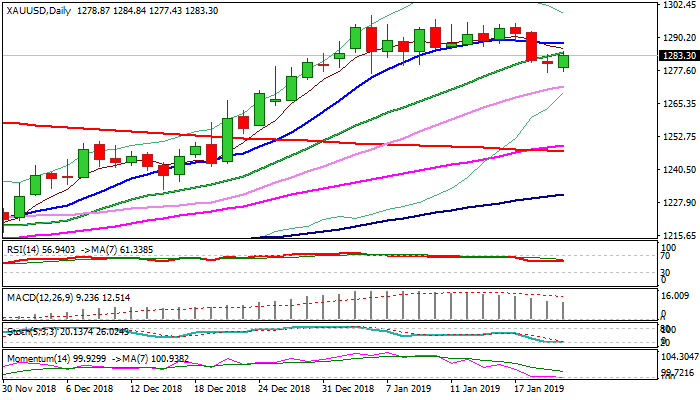
Spot gold regained traction and bounced from Asian low at $1277, as renewed risk-off mode on IMF downgrade of global growth forecast increased safe-haven demand. Fresh gains struggle to return above rising 20SMA ($1284), close above which is needed to complete Doji reversal pattern on daily chart and shift near-term focus towards $1287 (10SMA) and $1292 (Friday's high). Flat momentum and slow stochastic on daily chart obstruct recovery for now and the downside would remain vulnerable on today's repeated close below 20SMA. This would keep pivotal supports at $1276/73 (Monday's low / Fibo 38.2% of $1232/$1298 upleg) exposed, with stronger bearish signal to be expected on break here.
Res: 1284, 1287, 1292, 1295
Sup: 1281, 1276, 1273, 1265
Japan Interest Rates Won’t Change
The Bank of Japan (BoJ) will maintain its policy rate unchanged at -0.10% at tomorrow's monetary policy meeting. This comes on the heels of a recent cut in forecasted GDP growth for 2019 to 1.30%. BoJ is even more pessimistic, expecting growth below 1%. The Japanese economy faces growing risk of a recession: BoJ is expected to cut projections of inflation, and lower oil prices continue dragging overall prices downward. December's consumer price index expanded at a much slower pace of 0.30%, its lowest in 9 months on an annual basis, well off the target of 3%. Despite a decent rise in the government's 2019 budget to JPY 101.46 trillion (USD 900 billion), it seems that capital spending and private consumption, Japan's growth engine, are expected to stay flat in 2019 (2.70% and 1.20% respectively).
USD/JPY, currently trading at 109.47 (-0.26% year-to-date), is expected to rise following Wednesday's BoJ meeting.
German ZEW rose to -15, remarkable for no deterioration on risks
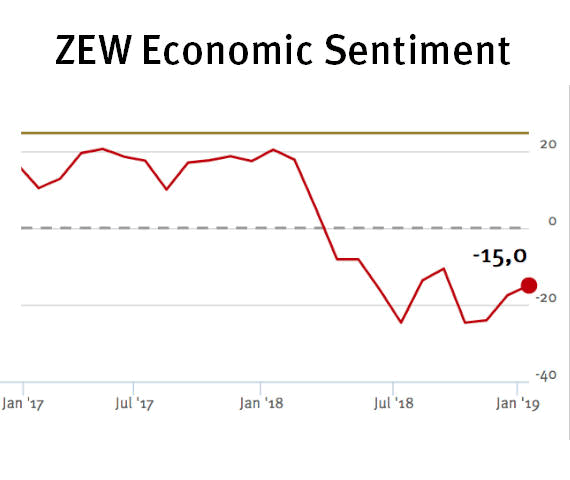
German ZEW economic sentiment improved to -15 in January, up from -17.5, and beat expectation of -18.5. ZEW current situation, however, dropped to 27.6, down from 45.3 and missed expectation of 43.3. ZEW noted that the indicator is still well below the long-term average of 22.4. And current economic situation once again decreased considerably.
ZEW President Achim Wambach said "It is remarkable that the ZEW Economic Sentiment for Germany has not deteriorated further given the large number of global economic risks. The financial market experts have already considerably lowered their expectations for economic growth in the past few months. New, potentially negative factors such as the rejection of the Brexit deal by the British House of Commons and the relatively weak growth in China in the last quarter of 2018 have thus already been anticipated,"
Eurozone ZEW economic sentiment, however, rose just marginally to -20.9, up from -21.0 and missed expectation of -20.1. Eurozone current situation also dropped -6.8 pts to 5.3.
Appetite For Market Risk Is Very Low
Tuesday January 22: Five things the markets are talking about
Appetite for risk in this holiday shorted week starts on the low side with Euro and Asia equities under pressure in their respective sessions, along with U.S futures, as an uncertain outlook for global trade and growth continues to inhibit investor appetite.
Data on the weekend showed that the world’s second largest economy, China, grew at its slowest pace (+6.6% y/y) in nearly three-decades in 2018, while yesterday, the IMF cut its forecasts for global economic growth this year to +3.5% from October’s +3.7% and from the +3.9% it had expected last July. They indicated that “global expansion has weakened,” dragged down by poor performance in Europe and some emerging markets. However, data stateside is beginning to be pressured by the Sino-U.S trade dispute and the ongoing partial U.S government shutdown.
The U.S dollar remains better bid for a sixth consecutive session as the go-to safe haven currency pair, while U.S Treasuries and Euro sovereign yields fall. Despite Brexit uncertainty outcomes, sterling, for the time being, remains contained after U.K PM Theresa May indicated yesterday that she will seek changes to the Irish border backstop to address parliament’s worries. She also added that “Brexit negotiations won’t be delayed and that there won’t be a second Brexit referendum.”
On Tap: U.S earning season remains in full swing, the Bank of Japan (BoJ) meet later this evening, which European Central Bank (ECB) monetary committee meet Thursday. Davos day 1 begins this morning.
1. Stocks dip on global growth worries
In Japan, the Nikkei edged lower overnight, retreating from a one-month high print Monday as investors took profits from recent gainers amid concerns about slowing economic growth. The index shed -0.47%, after Monday’s record print, while the broader Topix lost -0.6%.
Down-under, Aussie shares ended a five-day rally on weak financials and mining stocks. The S&P/ASX 200 index fell -0.5%. The benchmark rallied +0.2% on Monday. In S. Korea, the Kospi stock index closed weaker as data showed weakening exports had hit last year’s annual pace of growth to a six-year low, while global growth worries darkened investor outlook. At the close, the index ended down -0.32%.
In China, equities fell overnight as investors braced for a tough start to the New Year amid weak economic outlook domestically and abroad. At the close, the Shanghai Composite index fell -1.2%, while the blue-chip CSI300 index fell -1.3%. In Hong Kong, it was a similar story, at the close of trade, the Hang Seng index was down -0.7% and in line with a broad retreat across the region as profit-takers took control.
In Europe, regional bourses trade lower, following a negative session in Asia and negative U.S futures as macro developments remain in focus.
U.S stocks are set to open in the ‘red’ (-0.6%).
Indices: Stoxx600 -0.12% at 355.92, FTSE -0.46% at 6,938.73, DAX -0.22% at 11,111.49, CAC-40 -0.30% at 4,853.01, IBEX-35 -0.14% at 9,041.00, FTSE MIB -0.51% at 19,538.50, SMI -0.28% at 8,994.20, S&P 500 Futures -0.60%
2. Oil prices ease as China growth worries spread, gold lower
Ahead of the U.S open, oil prices are under pressure on signs that an economic slowdown in China, the world’s second-largest economy and oil consumer, is spreading, fuelling worries over future fuel demand.
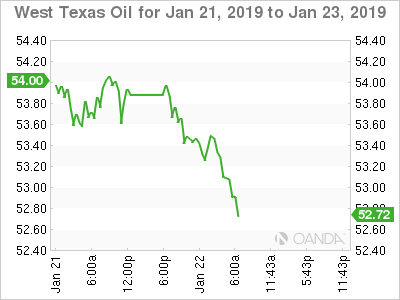
Brent oil futures are at +$62.26 per barrel, down -48c, or -0.8%, from Monday’s close, while U.S West Texas Intermediate (WTI) crude futures are at +$53.43 per barrel, down -0.7%, or -37c.
To date, China’s crude import numbers have so far resisted China’s economic slowdown, hitting a record above +10M bpd in Q4, 2018, but many now believe that the world’s second largest economy may be experiencing “peak energy growth,” with its demand set to reduce as the slowdown takes a deeper effect.
OPEC+ indicated last week that they had cut oil output sharply in December 2018 before a new accord to limit supply took effect on Jan. 1. This would suggest that the main producers have made a strong start to avoid creating a supply glut in 2019. In its monthly report, OPEC’s oil output fell by -751K bpd in December to +31.58M bpd, the biggest month-on-month drop in 24-months.
Note: The combination of production cuts by OPEC+, especially the Saudis, and tightening sanctions on Iranian oil exports is trying to bring the market close to equilibrium.
Also, a surge in U.S crude output is undermining most of OPEC’s efforts – U.S output has increased by more than +2M bpd in the last 12-months to +11.9M bpd.
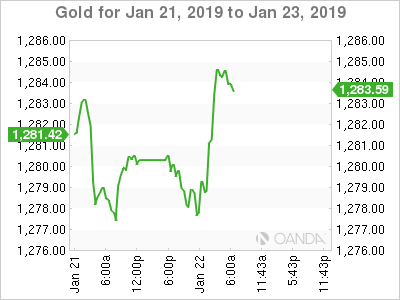
With the “big” dollar in demand, the precious yellow metal comes under pressure. Gold prices are hovering atop of their new three-week low touched yesterday, as a strong dollar limits gains. Spot gold is mostly unchanged at +$1,279.68 per ounce, after touching its lowest since Dec. 28 at +$1,276.31 on Monday. U.S. gold futures have fallen -0.3% to +$1,279.40 per ounce.
3. Sovereign yields trade on the soft side on growth worries
Eurozone government bond yields trade a tad lower as investors continue to remain cautious over Brexit developments, as well as expecting the ECB to mention growth concerns at Thursday’s meeting – a more “dovish” statement than currently priced in.
Data on the weekend showed that China’s economic growth slowed to a 30-year low in 2018, while yesterday, the IMF trimmed its’ 2019 and 2020 world growth forecasts – citing Italy as one of the main risks to growth because of its spending plans.
The 10-year German Bund yield trades at +0.183%, down about -2.5 bps.
Note: Eurozone futures pricing suggests that the market is pricing roughly a +40% chance that the ECB will raise its deposit rate +10 bps by the end of this year. It is now minus -0.40%.
Elsewhere, the yield on U.S 10-year Treasuries sank -4 bps to +2.75%, the largest tumble in more than a week. In the U.K, the 10-year Gilt yield dipped -2 bps points to +1.3%, the lowest in a week, while in Italy, 10-year BTP yield fell less than -1 bps to +2.756%.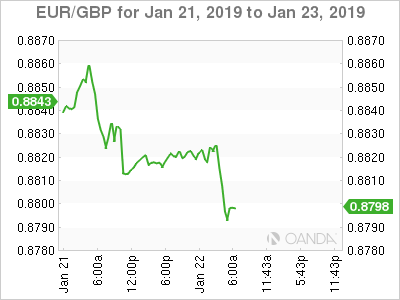
4. Risk aversion dominates proceedings
Some risk aversion has eased back into the market and is helping to support the ‘big’ dollar atop of its three-week high prints.
GBP/USD (£1.2914) was initially trading on the softer side as the market noted that PM May’s plan B looked a lot like the failed plan A and did little to clarify the governments future Brexit plan. The pair continued to find support in the lower part of the £1.2850, however, better employment data (see below) supported sterling’s positive sentiment with the pair trading above the psychological £1.29 level ahead of the U.S open.
EUR/USD (€1.1362) is steady and continues to remain confined within a €1.13-1.15 trading range. German Jan ZEW survey (-15 vs. -18.8) this morning was mixed, but suggested that market had already considerably lowered their growth expectations
USD/JPY (¥109.43) is a tad lower by -0.3% on some interesting safe-haven flow trading at ¥109.45-55 area. The markets focus now shifts to the Bank of Japan’s (BoJ) rate decision later this evening, but no changes are expected.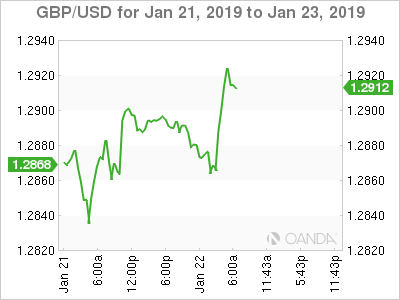
5. U.K employment keeps rising despite Brexit worries
Data this morning showed that the U.K economy continued to add jobs last year, despite the uncertainty facing businesses over the way the country will leave the E.U.
The ONS said today that the number of people in work in the three-months through November was up +141K, raising the employment rate to +75.8%, a record high.
More people were looking for work, and the number of unemployed rose by +8K vs. the previous three-month period, although the jobless rate stayed at +4.0%, its lowest level for four-decades.
With vacancies at a joint record high (+853K) employers raised wages by +3.4% y/y, and since pay rose faster than consumer prices, real wages were +1.2% higher, the largest increase in two-years.
Governor Carnet at the Bank of England (BoE) still expects a tightening labor market to push wages higher and keep inflation above its target over coming years, signaling that it intends to lift its key interest rate gradually and to a limited extent.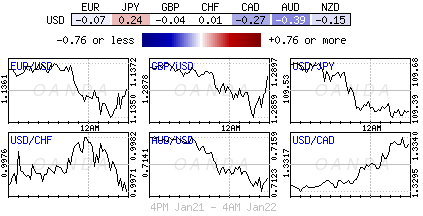
DAX Under Pressure As UBS Blues Drag Down Banking Sector
The DAX index has edged lower in the Tuesday session. Currently, the index is at 11,097, down 0.35% on the day. In economic news, Germany releases ZEW Consumer Sentiment remains weak, but improved to -15.5 points. This was better than the estimate of -18.8 points. Eurozone ZEW Economic Sentiment ticked higher to -20.9, shy of the forecast of -20.1 points. Germany releases ZEW Consumer Sentiment remains weak, but improved to -15.5 points. This was better than the estimate of -18.8 points. Eurozone ZEW Economic Sentiment ticked higher to -20.9, shy of the forecast of -20.1 points. On Wednesday, the eurozone releases consumer confidence. On Wednesday, the eurozone releases consumer confidence.
Is the DAX rally over? After posting three successive weeks of gains, the DAX is lower this week. On Tuesday, Swiss bank UBS dropped over 4 percent, after releasing weak fourth-quarter earnings. The UBS announcement dampened appetite for banking shares, and Deutsche Bank has declined 3.7 percent on the day. There was more bad news for investors, as the IMF revised downwards its global growth forecast. In October, the IMF projected growth of 3.7% percent, but this has been revised to 3.5 percent. IMF head Christine Lagarde said that the world’s economy continues to expand, but “it is facing significantly higher risks”.
Is the eurozone headed for a recession? Growth forecasts have been revised lower for the three largest economies in the bloc (Germany, France and Italy). The U.S-China trade war, which shows not signs of being resolved anytime soon, has taken a bite out of the eurozone export and manufacturing sectors have slowed. If the trade war worsens or the U.S. economy slows down in 2019, the eurozone could lapse into a recession. Given these weak economic conditions, the ECB, which finally terminated its massive stimulus program last month, is unlikely to raise interest rates before the fourth quarter of 2019. Just a few months ago, analysts were predicting a rate hike in the third quarter. Lower rates should be bullish for the equity markets, which will be more attractive to investors than the bond markets.