

Sample Category Title
USD/CHF Mid-Day Outlook
Daily Pivots: (S1) 0.9941; (P) 0.9965; (R1) 0.9996; More....
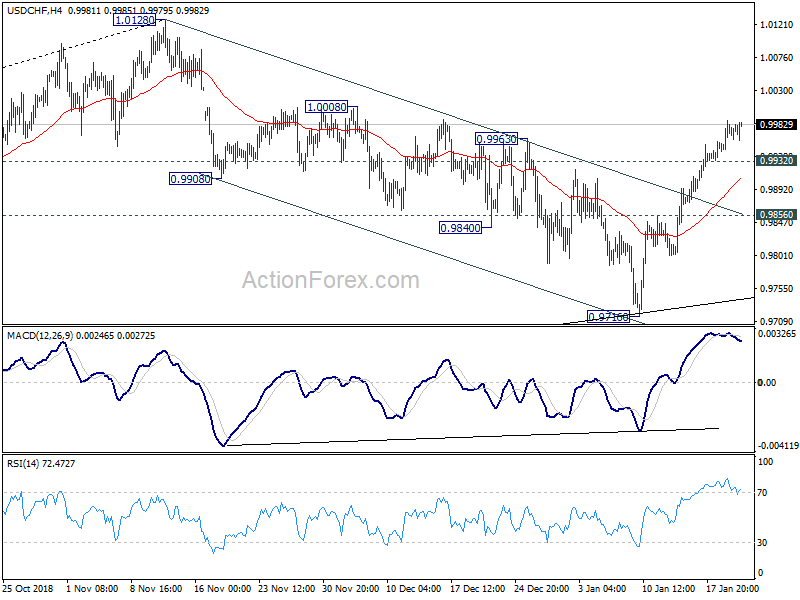
Intraday bias in USD/CHF remains on the upside with 0.9932 minor support intact. Current rise from 0.9716 should target a test on 1.0128 high next. On the downside, below 0.9932 minor support will turn intraday bias neutral again. But near term outlook will remain cautiously bullish as long as 0.9856 minor support holds.
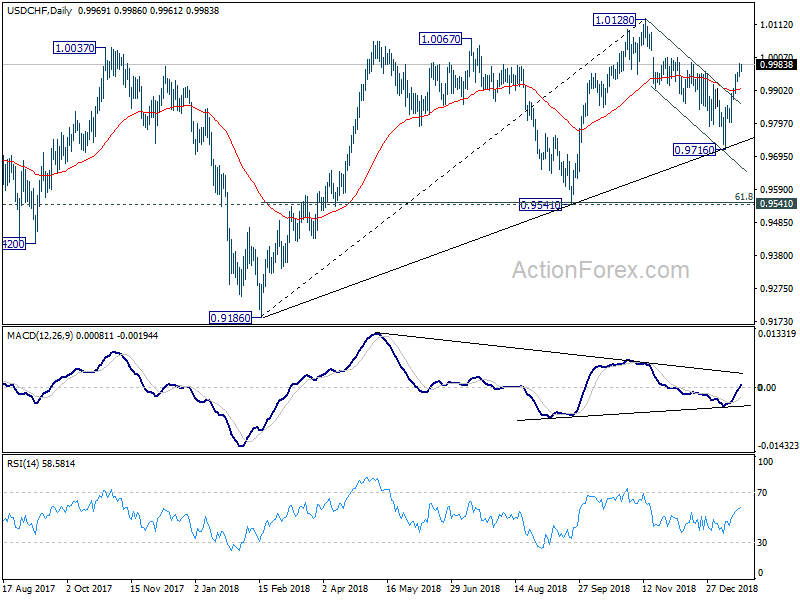
In the bigger picture, current development suggests that rise from 0.9186 has possibly completed with three waves up to 1.0128 already. Decline from 1.0128 could either be correcting this move, or reversing the trend. As long as 0.9541 support holds, we'd slightly favor the former scenario, and expect another rise through 1.0128 at a later stage. However, sustained break of 0.9541 will confirm trend reversal and bring deeper fall back to 0.9186 low.
GBP/USD Mid-Day Outlook
Daily Pivots: (S1) 1.2845; (P) 1.2879; (R1) 1.2927; More....
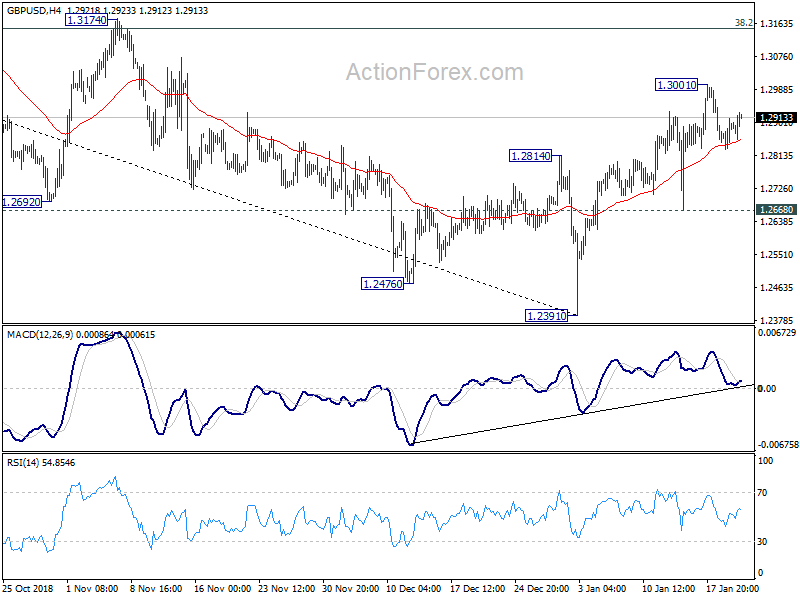
GBP/USD drew support form 4 hour 55 EMA and recovered. But upside is staying below 1.3001 temporary top. Intraday bias remains neutral first. Further rally is expected as long as 1.2668 minor support holds. On the upside, above 1.3001 will target 1.3174 resistance, which is close to 38.2% retracement of 1.4376 to 1.2391 at 1.3149. We'd expect strong resistance from there to limit upside, at least on first attempt. On the downside, break of 1.2668 support will argue that such rebound is completed and turn bias back to the downside for retesting 1.2391 low.
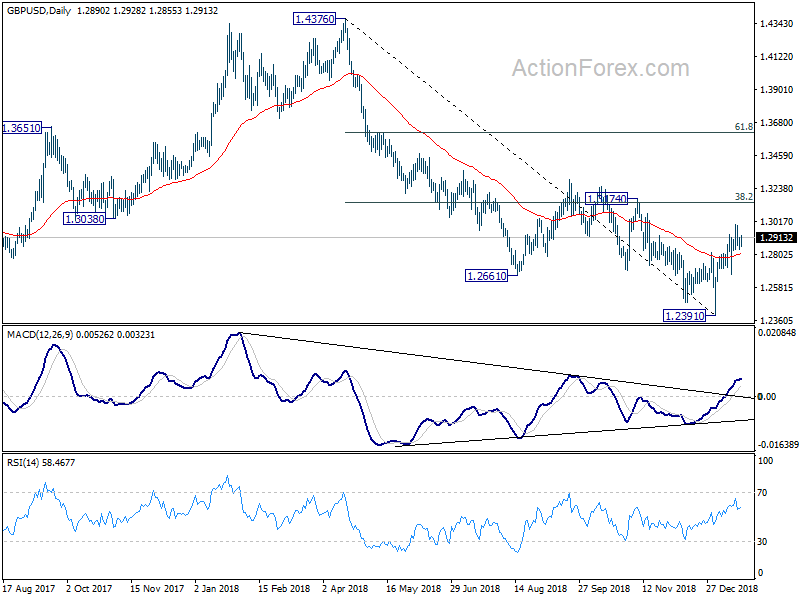
In the bigger picture, whole medium term rebound from 1.1946 (2016 low) should have completed at 1.4376 already, after rejection from 55 month EMA. The structure and momentum of the fall from 1.4376 argues that it's resuming long term down trend from 2.1161 (2007 high). And this will remain the preferred case as long as 1.3174 structural resistance holds. GBP/USD should target a test on 1.1946 first. Decisive break there will confirm our bearish view. However, sustained break of 1.3174 will invalidate this case and turn outlook bullish.
EURAUD Surpasses 200-SMA after Finding Support at 1.5770
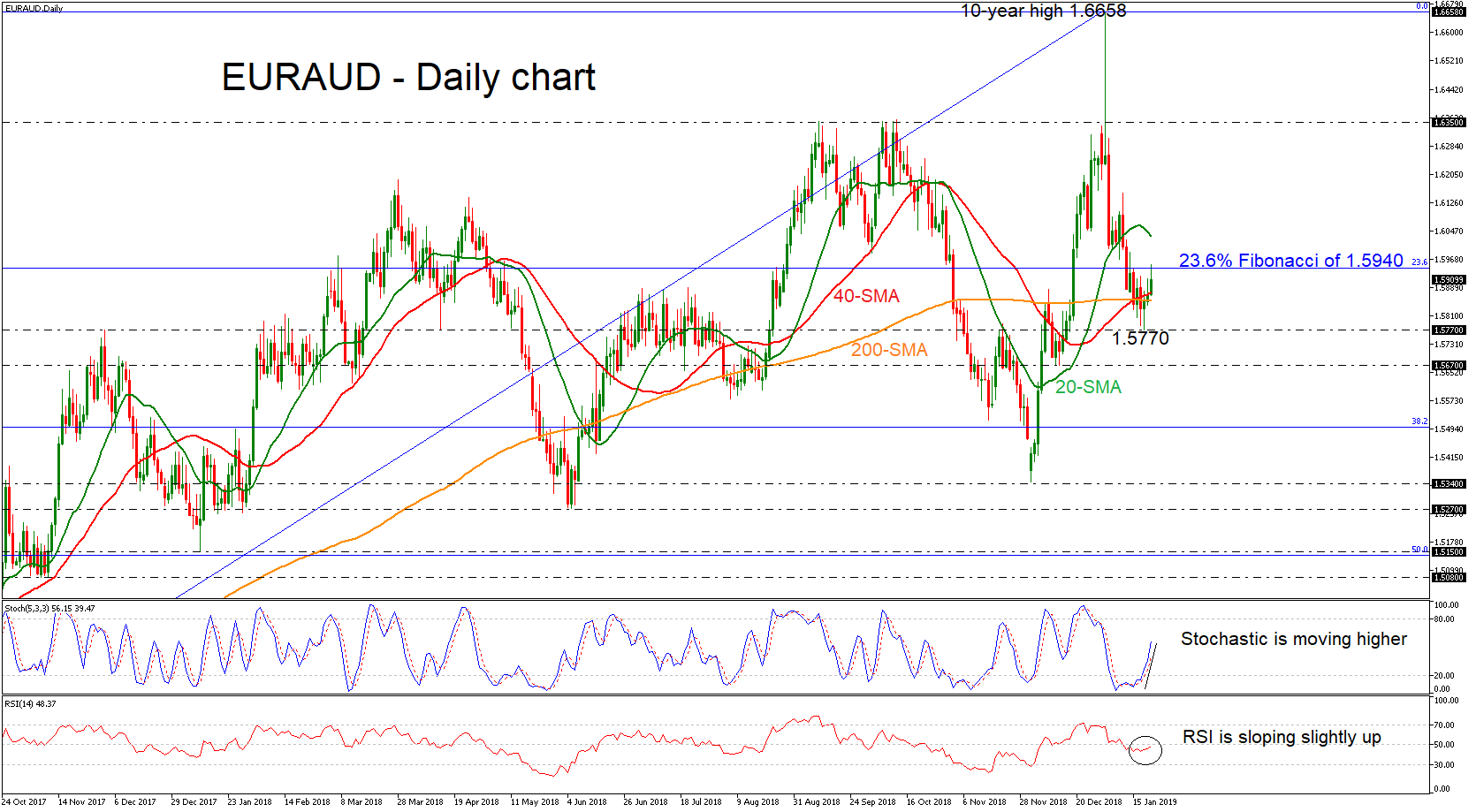
EURAUD retreated back to the 1.57 region after it found strong resistance on the almost 10-year high of 1.6658 but is currently challenging again the 23.6% Fibonacci level of the upward move from 1.3625 to 1.6658, which is around 1.5940. The bullish correction is confirmed by the technical indicators. The stochastic oscillator has steeply bounced back above its 20 oversold level, while the RSI indicator keeps sloping up to reach its 50 neutral mark.
If the price successfully surpasses the 23.6% Fibonacci mark, the focus could shift up to the 20-day simple moving average (SMA) currently at 1.6030. Moving higher, the bulls might find strong resistance at the 1.6350 barrier, taken from the highs on October 2018.
On the downside, immediate support could come from the 40- and 200-day SMAs currently near 1.5860. Below these lines, though the price could re-challenge the 1.5770 hurdle, before dropping even lower, to meet the 1.5670 barrier.
Concluding and looking at the long-term timeframe, EURAUD has been strongly positive creating higher highs and higher lows since February 2017.
EUR/USD Mid-Day Outlook
Daily Pivots: (S1) 1.1352; (P) 1.1371; (R1) 1.1386; More.....
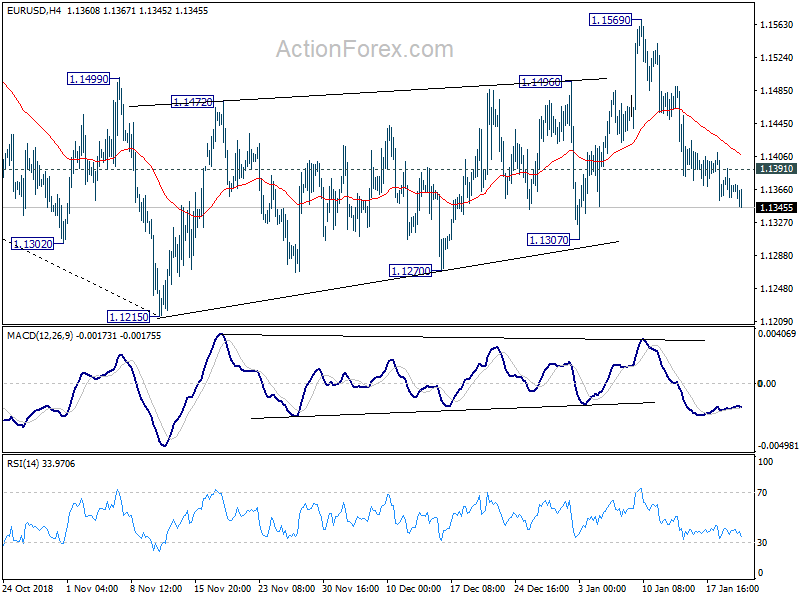
Intraday bias in EUR/USD remains on the downside as fall from 1.1569 is extending, towards 1.1307 support. The corrective rise from 1.1215 should have completed at 1.1569. Break of 1.1307 should resume larger down trend through 1.1215 low. On the upside, above 1.1391 minor resistance will turn intraday bias neutral again.
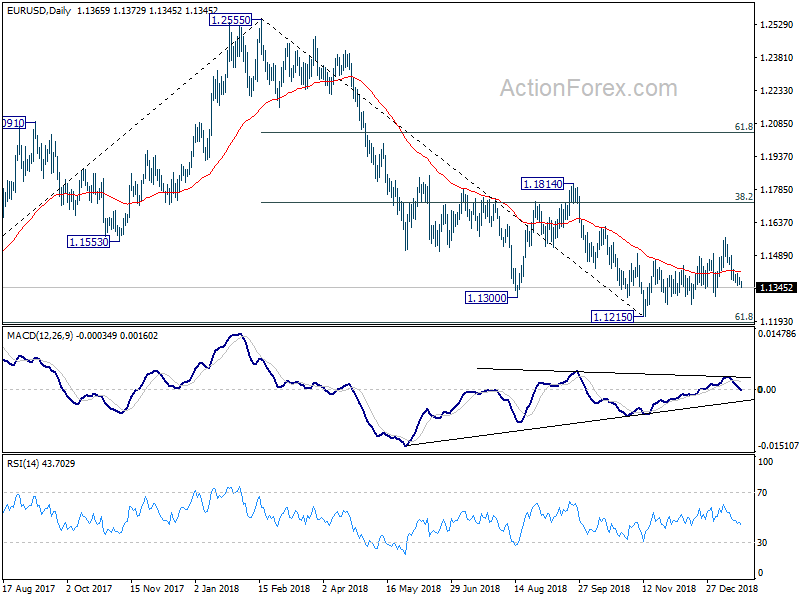
In the bigger picture, as long as 1.1814 resistance holds, down trend down trend from 1.2555 medium term top is still in progress and should target 61.8% retracement of 1.0339 (2017 low) to 1.2555 at 1.1186 next. Sustained break there will pave the way to retest 1.0339. However, break of 1.1814 will confirm completion of such down trend and turn medium term outlook bullish.
Yen Strengthens With Markets in Mild Risk Aversion, Australian Dollar Tumbles
Mild risk aversion is the main theme in the financial markets today. Selloff started in Asia, in particular in China, and spread to European session. Japan 10-year JGB yield also turned negative again. In the currency markets, Australian Dollar leads other commodity currencies lower in a typical day of risk aversion. Yen is the strongest one as usual. Sterling is boosted by solid job data, but gain is limited as Brexit stalemate continues. Dollar is the third strongest so far.
Technically, USD/CAD's earlier break of 1.3323 resistance suggests short term bottoming at 1.3180. Stronger rebound could be seen back to 1.3664 resistance. AUD/USD is pressing 0.7116 minor support now. Break will indicate completion of rebound from 0.6722 low and bring deeper fall back to this level. EUR/USD is also extending fall from 1.1569 towards 1.1307 support. One thing to note is that while Yen is strong, USD/JPY, EUR/JPY and GBP/JPY are all held well above near term support level. Thus, there is no confirmation of completion of recent rebound in yen crosses yet.
In other markets, at the time of writing, FTSE is down -0.58%, DAX is down -0.46%, CAC is down 0.45%. German 10-year yield is down -0.015 at 0.241. Earlier in Asia, Nikkei dropped -0.47%, Hong Kong HSI dropped -0.70%, China Shanghai SSE dropped -1.18%, Singapore Strait Times dropped -0.86%. Japan 10-year JGB yield dropped -0.006 to -0.001, turned negative.
Released from Canada, wholesale sales dropped -1.0% mom in November, manufacturing sales dropped -1.4% mom. US government shutdown is extending its record one.
German ZEW rose to -15, remarkable for no deterioration on risks
German ZEW economic sentiment improved to -15 in January, up from -17.5, and beat expectation of -18.5. ZEW current situation, however, dropped to 27.6, down from 45.3 and missed expectation of 43.3. ZEW noted that the indicator is still well below the long-term average of 22.4. And current economic situation once again decreased considerably.
ZEW President Achim Wambach said "It is remarkable that the ZEW Economic Sentiment for Germany has not deteriorated further given the large number of global economic risks. The financial market experts have already considerably lowered their expectations for economic growth in the past few months. New, potentially negative factors such as the rejection of the Brexit deal by the British House of Commons and the relatively weak growth in China in the last quarter of 2018 have thus already been anticipated,"
Eurozone ZEW economic sentiment, however, rose just marginally to -20.9, up from -21.0 and missed expectation of -20.1. Eurozone current situation also dropped -6.8 pts to 5.3.
UK unemployment rate dropped to 4.0%, lowest since 1975, Sterling jumps
Sterling rises mildly after better than expected job data. Unemployment rate dropped to 4.0% in November, down from 4.1% and beat expectation of 4.1%. That's also the lowest level since February 1975. Wage growth also shows sign of pick up. Average earnings including bonus accelerated to 3.4% 3moy, above expectation of 3.3% 3moy. Average earnings excluding bonus rose 3.3% 3moy, unchanged. Claimant count rose 20.8k in December, slightly above expectation of 20.0k.
UK Barclay: Interest of both EU and UK to have a Brexit deal
UK Brexit Minister Stephen Barclay told BBC today that the government is working on what to ask from the EU to get the deal approved in the parliament. He noted that "the EU don't want to be in a situation of having no deal – that would have a big impact not just on the Irish economy but other economies, the Dutch economy – so it's in both sides' interest to have a deal."
Separately, German Minister for European Affairs Michael Roth expressed disappointment on UK Prime Minister Theresa May's statement yesterday. He tweeted "Where is the plan B? Just asking for a friend…" German Justice Minister Katarina Barley also said she was "disappointed" and "that's not the way forward".
Polish suggestion of 5-year limit on Irish backstop is not EU position
Polish Foreign Minister Jacek Czaputowicz suggested limiting the Irish backstop arrangement to five years, to help get the Brexit deal through UK parliament. However, European Commission spokesman Margaritis Schinas said that is not EU's position.
Schinas told reports that "we have a unanimous, and I repeat unanimous, EU 27 position on the Withdrawal agreement and it's clear that the doorstep statement you're referring to was not part of the EU position."
China NDRC: Downward pressure on economy will be passed onto jobs
China National Development and Reform Commission spokeswoman Meng Wei warned that the job market faces "new changes" ahead and slowdown in the economy will pressure the job markets. She also noted that some factories in the export hub of Guangdong province have shut earlier than usual ahead of Lunar new year holiday.
Meng said "from the viewpoint of 'changes', the external environment is complex and austere." And, "Within the changes, there is something to worry about, and there is downward pressure on the economy. To a certain extent, the pressure will be passed onto jobs."
Her comments came after survey-based data showed unemployment rate rose 0.1% to 4.9% in December, release yesterday.
EUR/USD Mid-Day Outlook
Daily Pivots: (S1) 1.1352; (P) 1.1371; (R1) 1.1386; More.....
Intraday bias in EUR/USD remains on the downside as fall from 1.1569 is extending, towards 1.1307 support. The corrective rise from 1.1215 should have completed at 1.1569. Break of 1.1307 should resume larger down trend through 1.1215 low. On the upside, above 1.1391 minor resistance will turn intraday bias neutral again.
In the bigger picture, as long as 1.1814 resistance holds, down trend down trend from 1.2555 medium term top is still in progress and should target 61.8% retracement of 1.0339 (2017 low) to 1.2555 at 1.1186 next. Sustained break there will pave the way to retest 1.0339. However, break of 1.1814 will confirm completion of such down trend and turn medium term outlook bullish.
Economic Indicators Update
| GMT | Ccy | Events | Actual | Forecast | Previous | Revised |
|---|---|---|---|---|---|---|
| 09:30 | GBP | Jobless Claims Change Dec | 20.8K | 20.1K | 21.9K | 24.8K |
| 09:30 | GBP | Claimant Count Rate Dec | 2.80% | 2.80% | ||
| 09:30 | GBP | Average Weekly Earnings 3M Y/Y Nov | 3.40% | 3.30% | 3.30% | |
| 09:30 | GBP | Weekly Earnings ex Bonus 3M Y/Y Nov | 3.30% | 3.30% | 3.30% | |
| 09:30 | GBP | ILO Unemployment Rate 3Mths Nov | 4.00% | 4.10% | 4.10% | |
| 09:30 | GBP | Public Sector Net Borrowing (GBP) Dec | 2.1B | 1.1B | 6.3B | |
| 10:00 | EUR | German ZEW Economic Sentiment Jan | -15 | -18.5 | -17.5 | |
| 10:00 | EUR | German ZEW Current Situation Jan | 27.6 | 43.3 | 45.3 | |
| 10:00 | EUR | Eurozone ZEW Economic Sentiment Jan | -20.9 | -20.1 | -21 | |
| 13:30 | CAD | Wholesale Trade Sales M/M Nov | -1.00% | 0.20% | 1.00% | 0.70% |
| 13:30 | CAD | Manufacturing Sales M/M Nov | -1.40% | -0.50% | -0.10% | |
| 15:00 | USD | Existing Home Sales Dec | 5.27M | 5.32M |
AUD/USD: Weakens On Further Pullback Threats
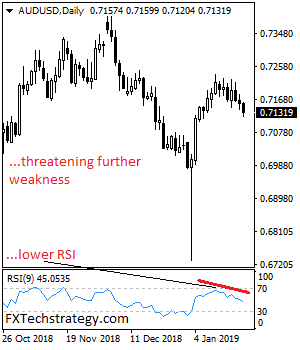
AUDUSD weakens on further pullback threats as it saw price extension during early trading on Tuesday. On the upside, resistance stands at the 1.7200 level. A cut through here will turn attention to the 0.7250 level and then the 0.7300 level. A violation will set the stage for a retarget of the 0.7350 level. Support resides at the 0.7100 level where a breach will aim at the 0.7050 level. Below here will set the stage for a run at the 0.7000 level with a cut through here targeting further downside pressure towards the 0.6950 level. On the whole, AUDUSD faces further downside threats.
Risk Sentiment Hit by IMF Pessimism; Gold Glitters
A wave of risk aversion swept across financial markets today with global equities retreating as pessimism over global growth sapped risk sentiment.
The International Monetary Fund’s recent gloomy global growth outlook left a bitter aftertaste while Brexit-related uncertainty and a prolonged US government shutdown drained investor confidence. With investors clearly keeping a safe distance from riskier assets amid the general gloom, Asian stocks closed in the red territory while European shares traded modestly lower. The declines witnessed across global stocks continue to highlight how fragile market sentiment remains. With geopolitical risk factors and global growth fears seen stimulating risk aversion, Wall Street is likely to open in a depressed fashion this afternoon.
UK jobs data offers temporary distraction from Brexit
The British Pound edged higher earlier today after encouraging jobs data offered investors a short-term distraction away from the Brexit chaos and political drama in Westminster.
With wage growth in the UK hitting a new 10-year high at 3.4% and employment growing more than expected in the three months to November, this certainly suggests that the labour markets remain resilient despite Brexit. However, this strong jobs data is destined to be overshadowed by Brexit developments.
In the latest episode to the Brexit saga, Theresa May has unveiled her ‘Plan B’ to Parliament. With MP’s describing ‘Plan A’ as ‘Plan B’ in disguise, nothing new has been brought to the table. Will the Prime Minister’s Brexit ‘Plan B’ be able to win the Commons over at the Parliamentary debate and vote on January 29th? This is a question on the mind of many investors. Whatever the outcome of the vote, it will play a role in how or if the UK departs from the European Union.
Commodity spotlight – Gold
Gold bounced back from multi-week lows on Tuesday as concerns over slowing global growth sent investors rushing to safe-haven assets.
Geopolitical risks in the form of Brexit drama, US-China trade developments, and a government shutdown in the United States boosted the metal’s allure with prices trading around $1,283 as of writing. Gold is likely to receive further support from growing speculation over the US Federal Reserve taking a pause on rate hikes this year.
In regards to the technical picture, Gold remains in a bullish channel on the daily charts. There have been consistently higher highs and higher lows with the MACD pointing to the upside. An intraday breakout above $1,286 is likely to open a path towards $1,295 and $1,300, respectively.
Into US session: AUD weakest, Yen strongest. China SSE drags global sentiments
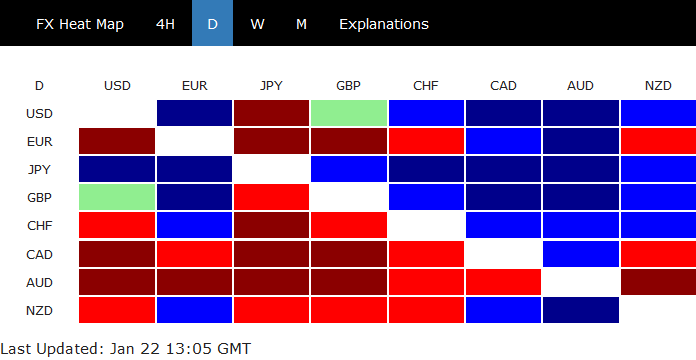
Entering into US session, Australian Dollar is trading as the weakest one today, followed by Canadian and then Euro. Yen is the strongest one, followed by Dollar an Sterling. Risk aversion seems to be back as led by Asian markets, in particular China and Hong Kong. DOW future is currently down -140 pts but we'll have to see if US stocks could regain strength.
Sterling is boosted by strong employment data, which saw acceleration in wage growth. Unemployment rate also dropped to lowest since 1975. But there is apparently no progress in Brexit negotiation, which is the ultimate driver in Sterling's trend. Euro got little support from mixed German ZEW economic sentiment, which saw improvement in the sentiment index but sharp deterioration in current condition index.
In Europe, currently:
- FTSE is down -0.44%.
- DAX is down -0.49%.
- CAC is down -0.51%.
- German 10-year yield is down -0.0137 at 0.242.
Earlier in Asia:
- Nikkei dropped -0.47%.
- Hong Kong HSI dropped -0.70%
- China Shanghai SSE dropped -1.18%
- Singapore Strait Times dropped -0.86%
- Japan 10-year JGB yield dropped -0.006 to -0.001, turned negative.
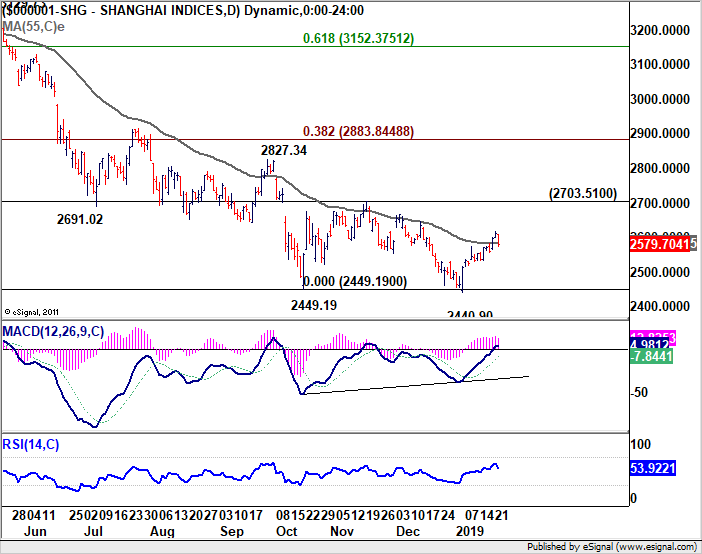
Today's sharp fall in SSE is the first since of notable weakness since rebound started on Jan 4. 2557.71 is now a support level to defend and break will be an early sign of reversal, which could drag global sentiments lower.
Polish suggestion of 5-year limit on Irish backstop is not EU position
Polish Foreign Minister Jacek Czaputowicz suggested limiting the Irish backstop arrangement to five years, to help get the Brexit deal through UK parliament. However, European Commission spokesman Margaritis Schinas said that is not EU's position.
Schinas told reports that "we have a unanimous, and I repeat unanimous, EU 27 position on the Withdrawal agreement and it's clear that the doorstep statement you're referring to was not part of the EU position."
Canadian Dollar Dips to 2-Week Low as Risk Appetite Softens
USD/CAD has edged higher in the Tuesday session. Currently, the pair is trading at 1.3328, up 0.24% on the day and at its highest level since January 7. On the release front, Canada publishes Manufacturing Sales, which has posted two declines in the past three months. The estimate for the November release is -0.8%. In the U.S., the sole indicator is Existing Homes, which is expected to drop to 5.27 million. On Wednesday, Canada releases retail sales reports.
There was pessimistic news from the well-respected International Monetary Fund on Monday. The IMF revised downwards its global growth forecast. In October, the IMF projected growth of 3.7% percent, but this has been revised to 3.5 percent. IMF head Christine Lagarde said that the world’s economy continues to expand, but “it is facing significantly higher risks”. Canadian growth was also revised lower, to 1.9% down from 2.0% in October. Earlier in January, the BoC lowered its growth forecast for the economy, from 2.1% in October down to 1.7%. With the Canadian economy vulnerable to global trade tensions and lower oil prices, the Canadian dollar could hit some headwinds in early 2019.
Investors were greeted with weak data on Monday, as China released GDP numbers. The world’s second largest economy continues to expand, but GDP has been softening, pointing to an economic slowdown. China reported that GDP had slowed to 6.6% in 2018, marking its lowest level since 1990. GDP for the fourth quarter dipped to 6.4%, compared to 6.5% in the previous quarter. The soft GDP release comes on the heels of soft trade and manufacturing data. A decline in China could send the Japanese economy into recession, as the export and manufacturing sectors are heavily dependent on Chinese demand.
The Trump administration has threatened further tariffs if a deal is not reached by March 1, but a second round of negotiations between the sides is scheduled for the end of the month in Washington. Chinese officials will be under pressure to show more flexibility in the talks, in order to stem the economic bleeding.