Sample Category Title
MARKET WRAP: Global Stocks React To Cloudy Outlook
Investors were not in the mood to take any risk
Stocks
- The S&P 500 Index fell 0.9 percent as of 15:30 London time as investors react to IMF report
- The Stoxx Europe 600 Index dropped 0.5 percent, despite strong ZEW economic reading.
- The U.K.’s FTSE 100 Index failed to react to positive average earning index and fell 0.9 percent.
- Germany’s DAX Index also fell 0.6 percent.
- The MSCI Emerging Market Index followed other and declined 0.5 percent, showing no appetite for risk.
Currencies
- The Dollar Spot Index jumped 0.1 percent, hitting the peak in almost three weeks.
- The Euro dropped 0.2 percent to $1.1343, hitting the weakest point in almost three weeks.
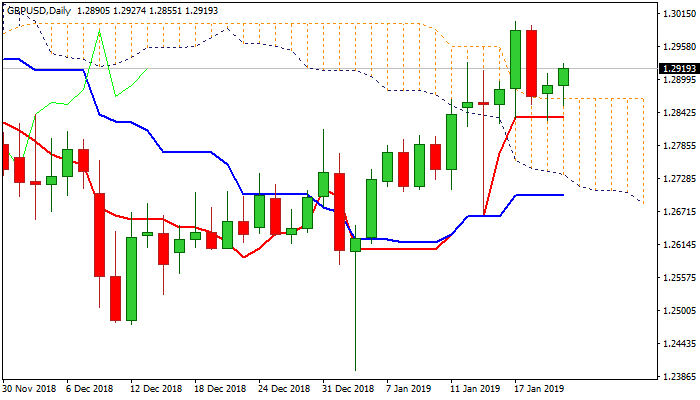
- The Pound pound soared 0.2 percent to $1.2914, eying the 1.30 mark.
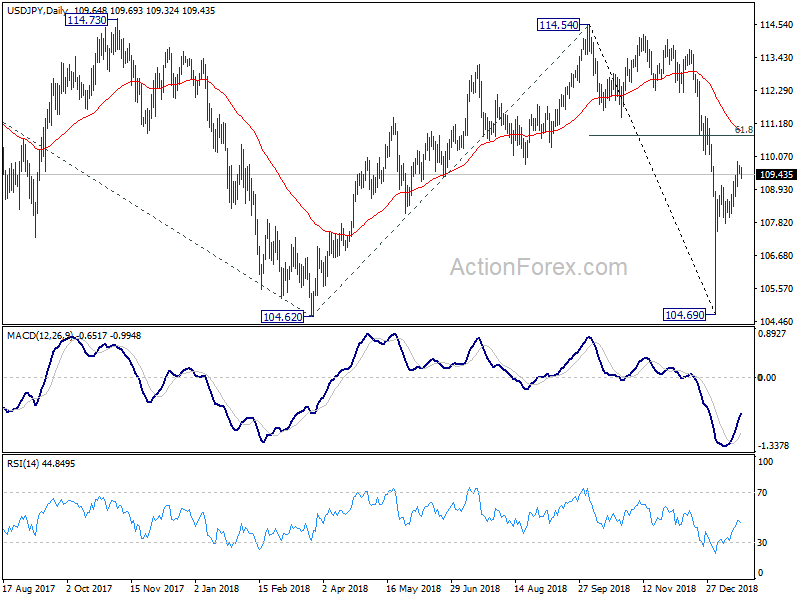
- The Japanese yen back in demand and jumped 0.2 percent to 109.44 per dollar.
Bonds
- The yield on 10-year Treasuries dropped by four basis points to 2.75 percent, the biggest drop in more than a week.
- Germany’s 10-year yield sank two basis points to 0.24 percent, the largest fall in a week.
- Britain’s 10-year yield came under pressure and dropped one basis point to 1.322 percent.
Commodities
- West Texas Intermediate crude reacted to demand and dropped 1.1 percent to $52.69 a barrel, the biggest drop in more than a week.
- Gold started to shine and rose 0.6 percent to $1,283 an ounce.
WTI Oil Outlook: Deeper Pullback Not Ruled Out after Repeated Rejection at Daily Cloud Base
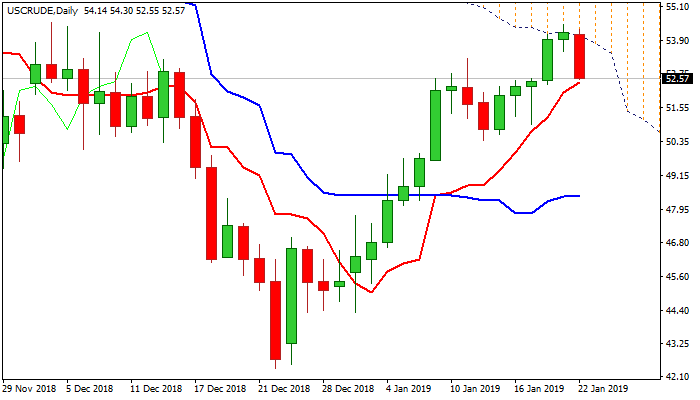
WTI oil holds in red on Tuesday and was down 2.4% since Asian opening, pressured by renewed pessimism over China's economic growth slowdown and consequent lower fuel demand. The oil price moved lower after strong technical resistance (base of thick daily cloud at $54.11) repeatedly capped recovery leg from $42.36 low, prompting investors to book profits. Technical outlook weakened as momentum turned south and created bear-cross with its 7-dSMA and slow stochastic is reversing from overbought territory. Both indicators signal reversal on formation of bearish divergence in previous two sessions. Fresh bears pressure rising 10SMA ($52.44) close below which would signal deeper pullback after bulls failed to break into daily cloud. Deeper dips could extend towards psychological $50 support but need to find ground above to keep larger bulls in play.
Res: 53.72; 54.11; 54.54; 55.55
Sup: 52.44; 52.01; 51.62; 50.97
Japanese Yen Edges Higher, BoJ Rate Statement Next
USD/JPY has edged lower on Tuesday. In the North American session, the pair is trading at 109.43, down 0.23% on the day. On the release front, Existing Home Sales was unexpectedly weak, dropping to 4.99 million and missing the estimate of 5.27 million. The indicator fell short of the 5.0-million threshold for the first time since November 2015. In Japan, BoJ Core Inflation edged lower to 0.4%, shy of the estimate of 0.5%. Later in the day, the Bank of Japan releases a rate statement.
No surprises are expected from the Bank of Japan, which winds up a policy meeting on Tuesday. Policymakers are expected to hold the course and continue the ultra-accommodative policy. The Japanese economy has been showing modest growth, and weak inflation means there is little pressure to raise interest rates. Still, policymakers have major headaches, including the global trade war and further signs that the Chinese economy is slowing down. Japan’s export and manufacturing sectors have weakened, and if the global economy takes a downturn, Japan could be hit with a recession. A negative side effect to prolonged low interest rates is that financial institutions have seen their profits fall, forcing some of them to make questionable loans in order to recoup lost profits. The BoJ has acknowledged the problem, but is unlikely to change course in the near future.
On Monday, the well-respected International Monetary Fund revised downwards its global growth forecast, but raised its forecast for Japan’s economy. With the U.S-China taking its toll on economies around the globe, the IMF’s prognosis should not come as a surprise. In October, the IMF projected growth of 3.7%, but this has now been revised to 3.5%. IMF head Christine Lagarde said that the world’s economy continues to expand, but “it is facing significantly higher risks”. As for Japan, the IMF raised its forecast for 2019 to 1.1%, up from 0.9% in October.
Canada: Petroleum and Coal Products Drive Manufacturing Sales Decline in November
Canadian manufacturing sales declined 1.4% in November, following the prior month's 0.1% drop (no revisions were made to the headline number). This came against expectations for a 1% decline. After accounting for price changes, the print was still disappointing, with volumes down 0.9%.
Durable good sales were up 0.5%, driven by transportation equipment sales, which saw a 1.3% increase on the back of a surge in the volatile railroad rolling stock (+28.6%) and aerospace products and parts (+7.7%) categories. Fabricated metal products also posed a decent 1.5% increase.
Non-durable goods, which fell 3.4%, were responsible for the decline in the headline number. This was driven primarily by a drop in petroleum and coal product sales (-13.8%). As expected, lower global oil prices were responsible for part of the this decline, but refinery maintenance and lower production also resulted in a lower volumes print (-8.4%). Only partially offsetting this decline in non-durable good shipments was an increase in food product sales (+1.5%).
Regionally, manufacturing sales were down in six provinces. Ontario (-1.1%), Alberta (-6.8%), Newfoundland & Labrador (-25.9%), and New Brunswick (-9%) led the overall decline. Quebec, Saskatchewan and Manitoba saw decent increases, up 0.9%, 3.3%, and 5.2%, respectively.
Inventories declined 0.6%, the first monthly decline in more than a year. The inventory-to-sales ratio ticked up to 1.47. Forward looking indicators were mostly negative, with new orders down 2.9% and unfilled orders up a modest 0.3%.
Key Implications
This was a disappointing, albeit expected decline, which was made worse by the volumes print. The one comforting bit of news is that after stripping out the impact of petroleum and coal products, manufacturing sales were up 0.2%. Nevertheless, the release confirms the moderating growth narrative, one that has been reinforced by other disappointing releases, including the recent international trade data and today's wholesale trade data.
Sub-par manufacturing performance is still expected in the near-term, as Alberta's production curtailment plan starts to reflect in manufacturing sales volumes.
It is important, however, to note that these are temporary shocks. As these shocks fade, manufacturing sales should receive support from strong economic performance south of the border, a weaker loonie, and expectations of increases in investment spending in the face of elevated capacity constraints.
Sunset Market Commentary
Markets
Global core bonds gained ground today with US Treasuries outperforming German Bunds. Risk sentiment deteriorated this week as the IMF has cut its 2019 global growth outlook and as the positivism around the US-Sino trade talks is fading. Core bonds opened higher on safe haven bids. The German ZEW Survey Expectations printed ‑15.0 in January, higher than expected and the UK printed decent labour data. European equities rebounded temporarily, causing bonds to (temporarily) pair some of their intraday gains. At the time of writing, the German yield curve bull flattens with changes ranging from -0.2 bps (2-yr) to -2.6 bps (30-yr). US investors joined dealings again after staying on the sidelines yesterday in remembrance of Martin Luther King day. Strong US Treasuries and lower US equity futures predicted a lower opening for US equities correctly. The US yield curve is moving south with changes varying between -3.2 bps (2-yr) to -4.5 bps (10-yr). Investors also eyed the Spanish syndication of a new 10-year bond. The Spanish treasury registered a record demand (€46bn). The selling amount is expected to be set close to €10bn and a final spread of 65 bps above midswap. The Spanish spread over the German 10-yr yield tightens cautiously (-2 bps), other peripheral spreads remain steady.
EUR/USD continued to hover around recent lows. This morning, EUR/USD declined slightly below the 1.1350 handle, but there was little follow-through price action even as European equities traded with a negative bias. ZEW German investor confidence (current situation) declined more than expected, but a bottoming in the expectations component might provide a glimmer of hope. A substantial decline in US yields after yesterday’s holiday maybe also prevented a real USD rally. In a global risk-off session EUR/USD (currently 1.1345 area) still struggles to prevent a further drop toward the 1.1309 support. USD/JPY is losing modest ground and is changing hands in the 109.40 area.
After taking a breather on Friday and yesterday, sterling again tried to extend its recent comeback. Investors still ponder the political chances of a longer delay of Brexit. Over the previous days, there was also growing speculation that at some point, the UK labour party might support a new referendum. At least for now, some parties in the market see the growing chances of this scenario as a GBP positive, too. Last but not least, even the UK data came out sterling supportive. Job growth (141k on a 3M/3M basis), the unemployment rate (decline to 4.0%) and wage growth (3.4% from 3.3%) all pointed to a healthy job market despite lasting uncertainty on Brexit. For now, the BoE’s hands are tightened as long as there is no clarity on Brexit. Even so, sterling reacted, albeit modestly, to the data. EUR/GBP is trading in the 0.8785 area. Cable regained the 1.29 level even as the dollar is also well bid.
News Headlines
The November job report revealed ongoing strength on the UK labor market. The unemployment rate dropped unexpectedly to an historic low of 4.0% while employment grew a 141 000 new jobs. Wages (ex-bonus) increased at a cycle high rate of 3.3%, further underpinning real wage growth.
The European Commission rebuffed Poland’s proposal to a 5 year limit of the Irish backstop arrangement after it kicked in from the end of 2020 if no all-round deal is in place. Poland’s foreign minister Czaputowicz said to his British and Irish colleagues on Monday they could consider such a limit.
The European Commission fined Mastercard €570 million for blocking cross-border competition. According to Vestager, EU Commissioner for Competition, the 2nd largest card scheme in the EEA abused its dominance to prevent merchants from “shopping around for better conditions [fees] offered by banks in other member states”.
Canada Manufacturing and Wholesale Sales Dropped in November
Highlights:
- Manufacturing sales fell 1.4% in nominal terms — and 0.9% excluding price impacts.
- Most of the manufacturing weakness came from lower petroleum & coal sales, both in nominal and volume terms.
- Separately reported wholesale sales declined 1.2% in volume terms. Along with the drop in manufacturing volumes, that sent our monitoring for November GDP growth down to –0.1%.
Our Take:
The manufacturing report wasn’t as bad as the big 1.4% nominal sales drop alone implied. Most of that decline came from a huge 13.8% drop in the petroleum & coal component — about half of which was accounted for by lower prices and the other half at least in part due to ’maintenance and turnaround work’ that will be reversed when production resumes. Excluding the petroleum component, sales were little changed in November — up 0.2% in nominal terms. Still, 13 of 21 industries posted declines. Excluding price impacts, overall manufacturing sales fell 0.9% month-over-month in November, and were up just 0.4% from a year ago. The separately-reported wholesale sales volumes also declined 1.2% in November and the Canada Post strike will temporarily weigh on activity in the month. And softness in the oil & gas sector is only likely to intensify going forward in the wake of lower prices and mandated Alberta oil production cuts in early 2019. Today’s data adds to the evidence that Canadian economic growth will look softer over the next couple of quarters. We are tracking a 0.1% decline in November GDP and just a 1.1% increase in Q4/18 as a whole.
Most of the factors that are expected to weigh on growth over the next several months are temporary. Global oil price benchmarks have edged higher in recent weeks, the discounts on Canadian oil prices have shrunk dramatically from November lows, and Alberta’s oil production cuts will ease once a backlog of inventories has cleared. Labour markets still look solid and, notwithstanding recent market volatility, the U.S. industrial sector is continuing to expand. That bodes well for Canadian manufacturing sales going forward. We still expect a ’data-dependent’ Bank of Canada will ultimately view more gradual rate hikes as appropriate this year — but very likely not until confirmation emerges that the expected slow patch over the next couple of quarters is temporary.
EU: No-deal Brexit pretty obviously means a hard Irish border
European Commission spokesman Margaritis Schinas warned today that a hard Irish border will inevitably be resulted from no-deal Brexit. He said in a press conference that "If you'd like ... to push me and speculate on what might happen in a no-deal scenario in Ireland, I think it's pretty obvious — you will have a hard border." But he also reiterated EU's commitment to the Good Friday Agreement and pledged to " take inevitably into account this fact".
Irish government spokesman said "We will not accept a hard border on this island and therefore we are not planning for one." Though, he added "Working out suitable customs and trade arrangements compatible with our EU membership will require detailed discussion with the Commission, while the UK will also need to live up to its responsibilities. We are under no illusions about how challenging that would be."
GBP/USD Outlook: Positive Tone after Upbeat Jobs Data Persists; Close above 100SMA to Re-expose Psychological 1.30 Barrier
Cable holds firm tone in early US trading and pressures European high (1.2927), posted after acceleration on upbeat earnings data. The pair was up around 80 pips after data, with subsequent short-lived correction on profit-taking. Better than expected UK jobs data improved the sentiment, but story about Brexit remains key driver for sterling. Renewed pressure from the opposition for vote on new Brexit referendum maintain positive tone, with focus on 29 Jan parliament's vote on next Brexit steps coming in focus. The pair holds firmly above daily cloud and looks for daily close above 100SMA (1.2892) which would generate bullish signal for further advance and renewed attempt at psychological 1.30 barrier (dented on 17 / 18 Jan attacks).
Res: 1.2827; 1.2953; 1.3000; 1.3088
Sup: 1.2909; 1.2892; 1.2863; 1.2830
SNB Maechler: Exchange rate is important to Swiss monetary conditions and prices
SNB Governing Board member Andrea Maechler said the central bank is maintaining negative interest rates. And it's ready to intervene in the forex markets.
She clarified that "our mandate is not to defend the Swiss franc, but price stability." However, she added that"we are a small, open country, which means the exchange rate is important for our monetary conditions and is linked to prices."
Also, "we have seen that if the franc is too strong, inflation goes negative".
USD/JPY Mid-Day Outlook
Daily Pivots: (S1) 109.50; (P) 109.63; (R1) 109.80; More...
Intraday bias in USD/JPY remains neutral for consolidation below 109.89 temporary top. Another rise could be seen with 107.77 minor support intact. On the upside, above 109.89 will target 61.8% retracement of 114.54 to 104.69 at 110.77. We'd look for topping signal above there. On the downside, break of 107.77 will indicate completion of the rebound from 104.69. Intraday bias will be turned back to the downside for retesting this low.
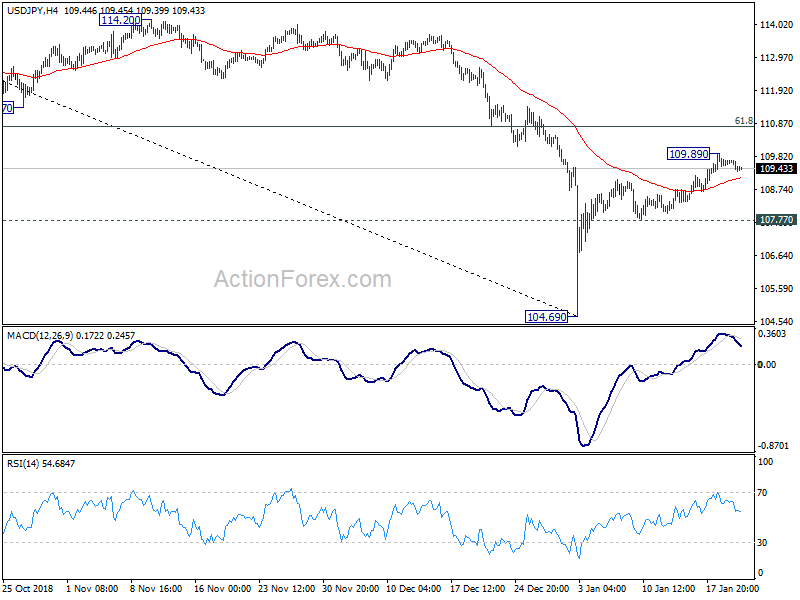
In the bigger picture, price actions from 125.85 (2015 high) are seen as a long term corrective pattern, no change in this view. Apparently, such corrective pattern is not completed yet. Fall from 114.54 is seen as part of the falling leg from 118.65 (2016 high). Break of 104.62 will target 100% projection of 118.65 to 104.62 from 114.54 at 100.51, which is close to 100 psychological level. But in that case, we'd expect strong support from 98.97 to contain downside to bring reversal. Also, this bearish case will remain the preferred one as long as 114.54 resistance holds.