Sample Category Title
USD/CAD Tests 200-Hour SMA At 1.3578
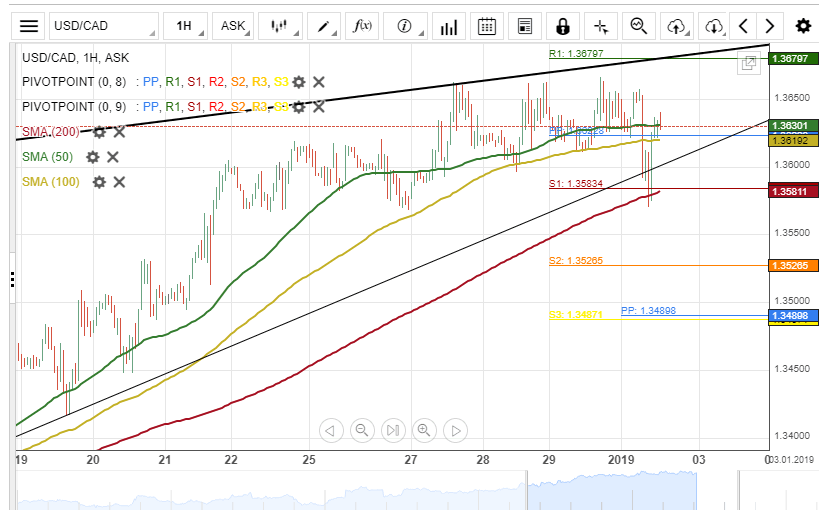
Bearish pressures have dominated the US Dollar against the Canadian Dollar since the beginning of December. As a result, the currency pair reached May 2017 swing high of 1.3663.
Today's session began with a strong bearish movement. By the middle of the European trading session, the exchange rate has breached the bottom border of an uptrend line at 1.3578.
In case bears manage to prevail during the following trading session, the currency exchange rate may aim at a support cluster formed by the combination of the weekly and the monthly PPs at 1.3489.
NZD/USD Falling Wedge Pattern
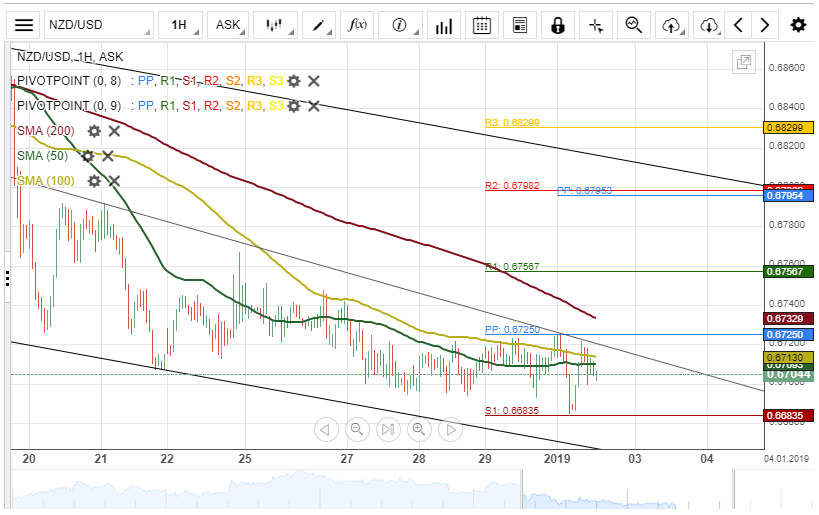
The New Zealand Dollar has been trading in a falling wedge pattern against the US Dollar since the middle of December. The currency pair was bounded between support and resistance area since the beginning of the holiday season.
Everything being equal, it is likely that the currency exchange rate edges lower within this session.
However, a support level formed by the monthly S1 at 0.6683 might prevent the NZD/USD currency pair from falling today.
EUR/USD Situation In 2019
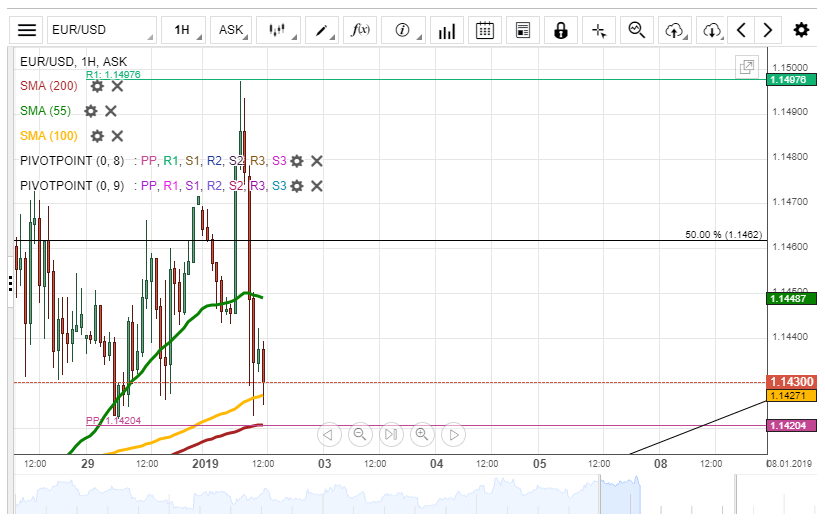
The EUR/USD first daily review reveals that the currency exchange rate was standing at a strong technical support cluster at 1.1420. The cluster was made up of the 100 and 200-hour simple moving averages and the weekly pivot point.
The rate is either going to clearly bounce off the mentioned support clusters and surge up to the 55-hour SMA at 1.1450 and afterwards the 1.1460 level where the 50.00% Fibonacci retracement level is located at.
On the other hand, the support cluster can be broken. In that case the rate will immediately test the technical support of the monthly pivot point at 1.1408 level.
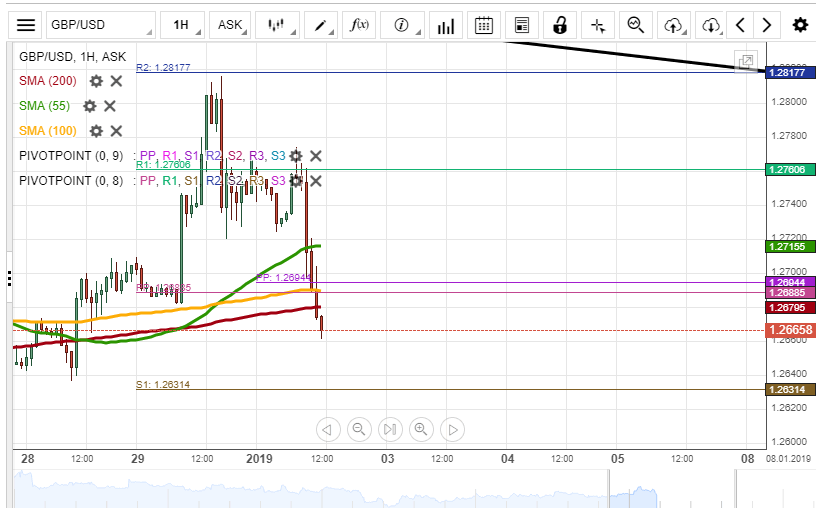
GBP/USD Might Drop To 1.2630
On Wednesday, the GBP/USD was piercing one support level after another near the 1.2690 mark. Namely, various SMAs and pivot points were being passed.
If the rate passes clearly below the 1.2680 level, it will be expected to fall as low as the 1.2630 level, as between these two technical levels there is no other support level.
However, with the start of a new year expect that the Brexit announcement will resume and start beating the GBP up and down with high volatility.
USD/JPY Remains In Pattern
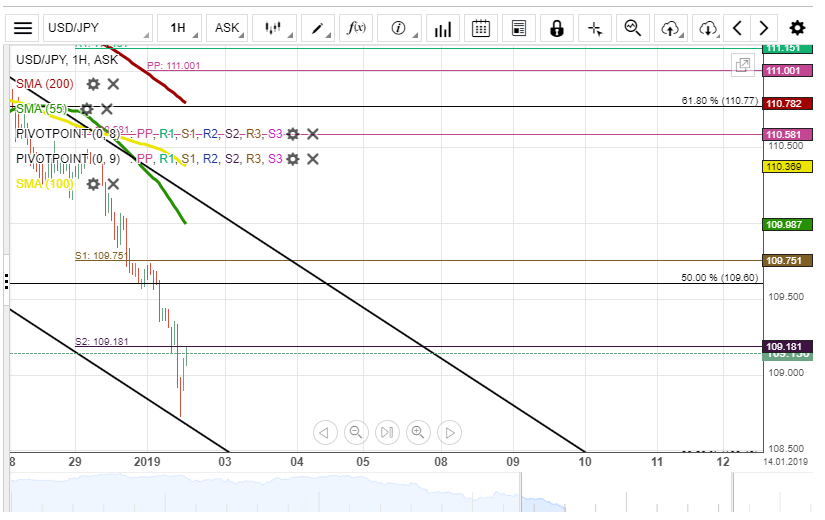
Dukascopy Analytics were surprised to find out that the previously drawn descending pattern, which was in focus of the daily reviews before Christmas, was still holding at the start of January.
In general, the pair had reached the lower trend line of the pattern and bounced off of it on Wednesday. Due to that reason it was expected that the rate should surge. First target for a surge would be the weekly S2 at the 109.18 level.
On the other hand, a decline could be resumed, as the pattern is steep enough for its lower trend line to be below the 108.50 level before the middle of Thursday's trading session.
Gold Breaks Patterns And Continues To Gain
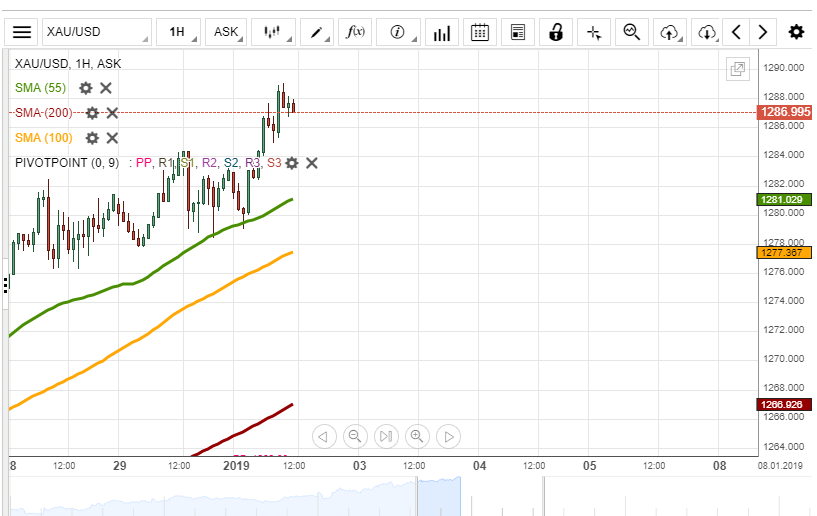
The yellow metal's price has surged above the 1,285.00 level by the middle of Wednesday's trading session. Moreover, the surge was expected to continue.
In general, it could be observed that the commodity price was pushed higher by the 55-hour simple moving average. The price surged and retraced back down to the SMA during the last couple of weeks.
Meanwhile, note that the rate will face the resistance of a 23.60% Fibonacci retracement level at the 1,291.57 mark.
EUR/JPY Bearish Sentiment Today
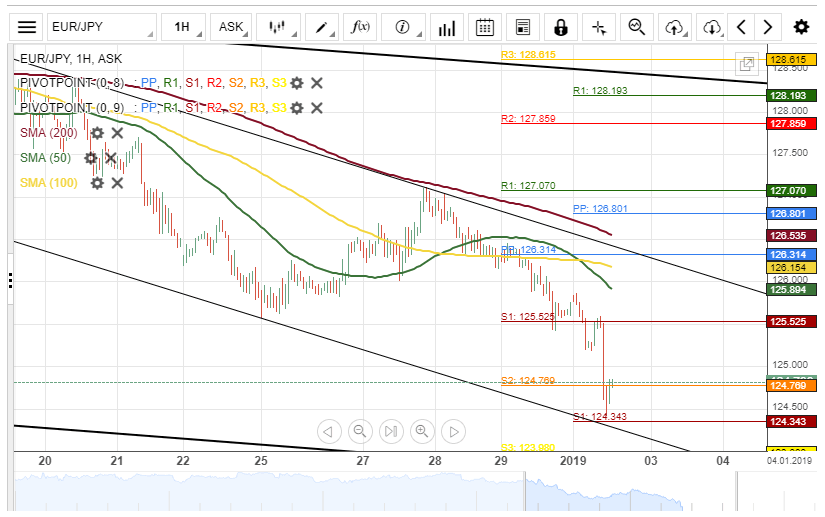
The last trading days of 2018 was dominated by the bearish sentiment. After testing the combined resistance level of the 200-hour simple moving average and the upper boundary of a descending channel pattern at 127.07, the common European currency began to depreciate against the Japanese Yen and shot down to the 124.34 area.
As shown on the chart, the first part of Wednesday's session was spent with a bearish momentum, the currency pair is currently trading near a support level formed by the weekly S1 and the bottom border of the descending channel pattern at 124.34.
If this decline continues, a breakout is likely to occur within this session.
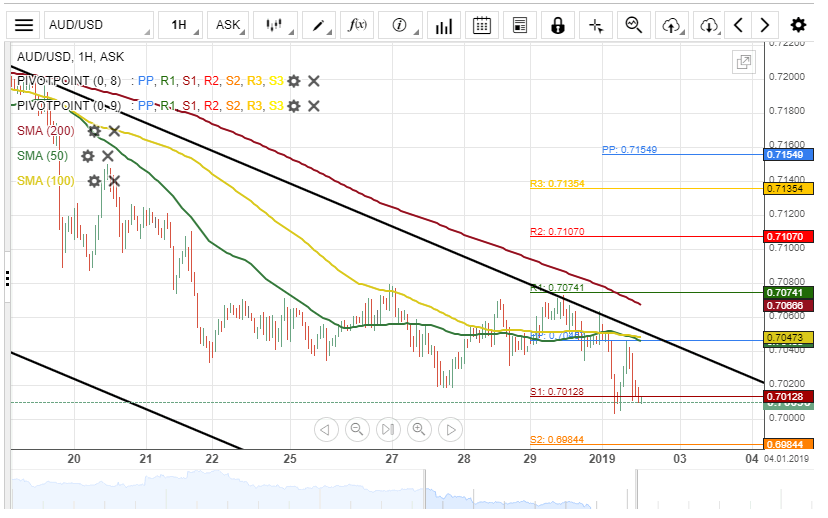
AUD/USD Meets Monthly S1 At 0.7012
The Australian Dollar continues its decline against the US Dollar in a descending channel pattern. This downward movement was not very distinct throughout the previous session, as traders were reluctant to enter into massive trades during the holidays season.
It seems that the bearish sentiment could allay today, as apparent by technical indicators. Given that the AUD/USD currency exchange rate is supported by the monthly pivot point at 0.7012 area, the Aussie is likely to remain above this zone within this session
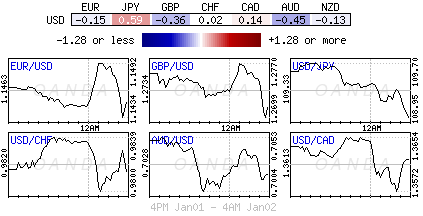
EUR/USD – Euro Dips As German And Eurozone Manufacturing PMIs Slip In December
EUR/USD has edged lower in the Wednesday session. Currently, the pair is trading at 1.1436, down 0.26%. On the release front, Germany and the Eurozone posted manufacturing PMIs, with readings of 51.5 and 51.4, respectively. Market forecasts were on the money, as both readings matched the forecast.
The global trade war has taken a bite out of European and German exports, and this in turn has put a damper on the manufacturing sectors. European and German manufacturing PMIs continued to fall in December, marking a fifth consecutive decline, as manufacturing growth has stagnated. If the negative trend continues, the euro will be under increasing pressure.
U.S. and Chinese teams will meet next week to tackle trade issues, and any progress in the talks would likely boost investor confidence. At the same time, the U.S. has said if the talks fail, it will impose heavy tariffs on Chinese products on March 1, so traders should be prepared for some volatility from EUR/USD in the weeks ahead. Earlier in the week, President Trump said that ‘big progress’ had been made with China, but with the sides yet to meet face-to-face, the markets are not putting much stock in Trump’s remarks.
After four rate hikes in 2018, the Federal Reserve will be drastically easing up on raising rates in 2019. Just a few months ago, there was heady talk of three or four rate hikes in 2019, but the Fed made an abrupt U-turn, saying the “neutral rate range” had been reached. Analysts expect one rate hike in 2019, as this year’s hikes and the global trade war have lessened the pace of expansion in the U.S. economy. According to the CME Group, the likelihood that the Fed will stay on the sidelines in January and March stands at 98% and 93%, respectively. This dovish stance from the Fed could weigh on the dollar in the coming months.
A New Year Starting Off With The Same Old Trading Habits
Investors enter 2019 remaining increasingly uncertain about where sovereign bond markets are heading given the confused interplay between interest rates, growth, and inflation that intensified in Q4, 2018.
The knock on effect from U.S interest rates will have a material impact on the ‘mighty’ U.S dollar and equity markets. Thus, it’s a necessity that the markets are focused firmly on the Fed.
Despite Fed officials continuing to express confidence in the U.S economy, the market remains worried that even though the Fed has scaled back its rate-raising plans for 2019, higher interest rates still pose a risk to expansion.
Note: The Fed last month had penciled in two hikes for 2019, rather than the three officials predicted in September. However, the market sees things differently, fixed income dealers have priced out any additional hikes this year with Fed fund futures implying no change and a -25 bps cut in 2020.
It’s not just the Fed actions that will have an impact on volatility, but it’s what they will also say in 2019. Investors need to keep an eye on the Fed’s own messaging.
Note: Fed Chair Powell will have the opportunity to once again lay out the Fed’s direction for 2019 as he joins former Fed Chairs Janet Yellen and Ben Bernanke for a joint discussion this Friday (Jan 5 10:15 am EDT).
Officials have signalled they intend to rely more on recent economic data in setting interest rates and coupled with Fed Chair Powell’s intention to hold news conferences after every FOMC policy meeting will only add to the volatility.
2019 has started on the back foot with global equities under pressure after disappointing Chinese data overnight has ruined investors hopes for an upbeat start to the New Year – safe havens including gold, Euro bonds and the yen have benefited in early trading.
On tap: The highlight of the week will be the two North American employment reports (Friday Jan 5 – CAD jobs and U.S non-farm payroll). Also Friday, the market will also be looking for some clarity from Fed Powell’s panel discussion titled “Federal Reserve chairs: Joint Interview.
1. Global equities suffer hangover
Disappointing data from the world’s second largest economy overnight is causing global equity markets to begin 2019 on the back foot. A private sector survey showed China manufacturing activity contracted for the first time in 19-months. The Caixin/Markit Manufacturing Purchasing Managers’ Index (PMI) for December fell to 49.7, from 50.2 m/m.
In Japan, equities were lower after the close this morning, as Pharma, Retail and Power sector losses took the lead lower. At the close, the Nikkei 225 fell -0.31%.
Down-under, Aussie stocks kicked off the New Year in the red, pressured by disappointing Chinese data – China is Australia’s largest trading partner and the AUD trades as a proxy for China economic growth. The S&P/ASX 200 index closed -1.6% lower – the benchmark ended -0.1% lower on Monday.
In China and Hong Kong, stocks slumped in their first trading session as investors digested the disappointing data, adding to concerns over trade and an economic slowdown. In China the blue-chip CSI300 index fell -1.4%, while the Shanghai Composite Index ended down -1.1%. In Hong Kong, at the close of trade, the Hang Seng index was down -2.77%, while the Hang Seng China Enterprises index fell -2.87%.
In Europe, regional bourses trade sharply lower across the board starting the year on a negative tone as weaker PMI data in Europe and China added to the negative sentiment.
U.S stocks are set to open in the red (-1.5%).
Indices: Stoxx 600 -0.44% at 334.20, FTSE -1.08% at 6,655.50, DAX -0.48% at 10,508.03, CAC-40 -1.90% at 4,640.96, IBEX-35 -1.55% at 8,407.85, FTSE MIB -1.57% at 18,035.50, SMI closed, S&P 500 Futures -1.49%
2. Oil kicks off New Year with losses on signs of economic slowdown
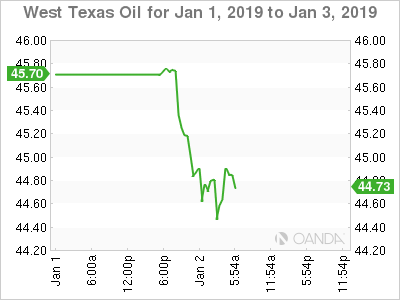
Oil markets start the New Year on the back foot, pulled down by surging U.S output and concerns about an economic slowdown in 2019 as factory activity in China, the world’s biggest oil importer, contracted.
Brent crude futures are at +$53.19 per barrel, down -61c, or -1.1%, from their final close of 2018. West Texas Intermediate (WTI) futures are at +$44.95 per barrel, down -47c, or -1%.
Note: Oil prices registered their first yearly decline in three-years in 2018 – Brent tumbled -20%, while WTI slumped -25%.
A number of factors are expected to provide heightened volatility in the commodity space in Q1, 2019. There is the markets uncertainty on Sino-U.S trade; there is Brexit, as well as political instability and conflict in the Middle East. There is U.S shale output numbers and there is OPEC’s and Russia’s supply discipline. All factors that are expected to have a meaningful impact on energy price in H1.
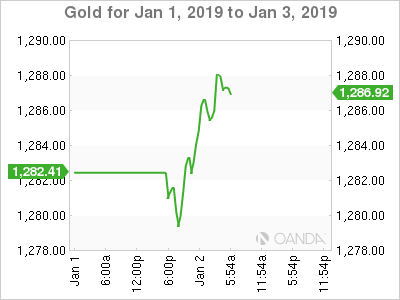
Gold prices scaled new heights earlier this morning, printing a six-month high, as the U.S dollar fell along with equities after disappointing data from China overnight flagged fears of a slowdown in global economic growth.
Spot gold was up +0.28% at +$1,285.71 an ounce, after hitting its highest since June 15, 2018 at +$1,287.31 earlier in the session. U.S gold futures have rallied +0.5% to +$1,287.80 per ounce.
3. Sovereign yields buckle
A disappointing Chinese PMI print overnight is keeping the demand for safety going, especially for German Bunds.
Overnight, German government Bund yields dropped to its lowest in 20-months as investors piled into one of the safest assets in the world on the back of widening stock market weakness and a gloomy global growth outlook.
The yield on Germany’s 10-year debt briefly dropped to +0.17%, it’s lowest since April 2017, before edging up to +0.183%, down -6 bps as we head towards the North American open. The German 2/10’s spread are at their tightest in over two-years at +79.90 bps.
On the horizon, supply will be an important factor for eurozone bond markets this month as countries start their annual funding programs.
Note: January is usually being the busiest month of the year.
Elsewhere, the yield on U.S 10’s has rallied less than +1 bps to +2.69%, the largest advance in a week. In the U.K, the 10-year Gilt yield fell -3 bps to +1.25%, the lowest in almost three-weeks, while the spread of Italy’s 10-year bonds over Germany’s rallied +4 bps to +2.53% to the biggest premium in a week.
4. Dollar under pressure from lower yields
The ‘mighty’ dollar has been dragged down by a steep fall in U.S Treasury yields over the last month as the market prices in the U.S Fed would not raise rates again in 2019, even though the Fed last month is still projecting at least two more hikes for this year.
Ahead of the U.S open, the dollar is somewhat mixed, edging up a tad on the EUR to €1.1445 and steady on a basket of currencies at 96.189 – DXY.
The safe-haven yen has extended its broad rally as the U.S dollar dropped to ¥109.37 in the overnight session, its lowest since June last year.
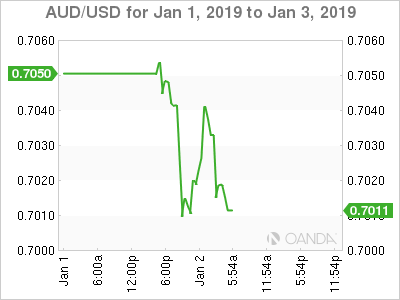
Elsewhere, the AUD, often used as a proxy for China sentiment, lost as much as -0.7% overnight, to print its lowest since February 2016 at A$0.7001.
5. U.K factories build up stockpiles before Brexit
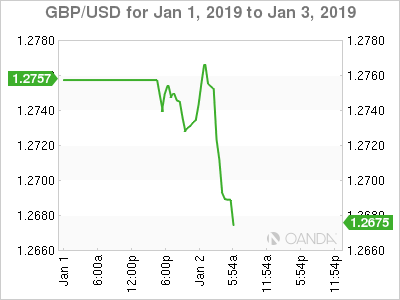
Data this morning showed that U.K factories last month ramped up their stockpiling as they prepared for possible border delays when Britain leaves the E.U in less than three months’ time.
The IHS Markit/CIPS Manufacturing Purchasing Managers’ Index (PMI) rose to 54.2 from an upwardly revised 53.6 in November, the highest reading in six-months and stronger than all forecasts.
Markit said “the improvement did not herald a big change in the outlook for Britain’s stuttering economy and was caused in large part by manufacturers stockpiling inputs and finished goods, both of which were near record highs.”
Note: In December, the Bank of England (BoE) cut its forecasts for quarterly growth to just +0.2% in Q4 of 2018 and Q1 of 2019. It has warned that a worst-case Brexit could push Britain into a deep recession.