Sample Category Title
Eurozone PMI manufacturing finalized at 51.4, manufacturing boom faded away to near stagnation
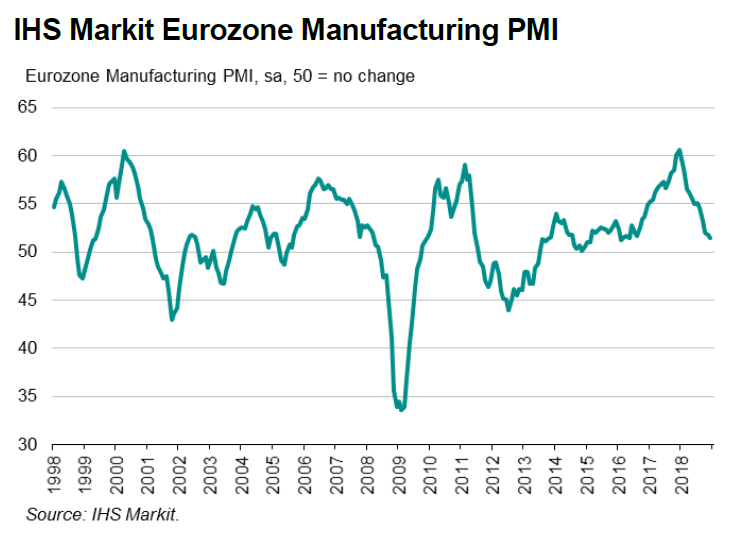
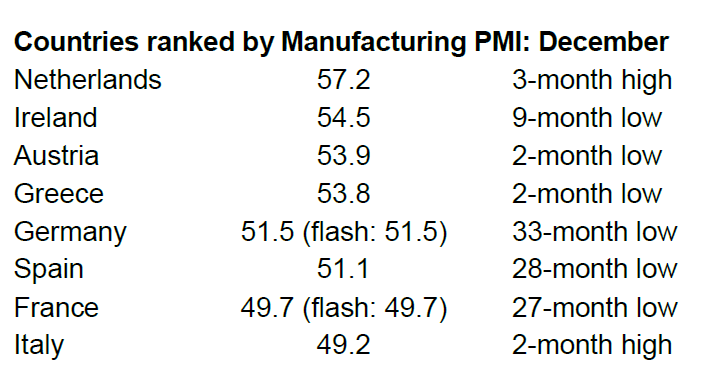
Eurozone PMI manufacturing was finalized at 51.4 in December, unrevised. It's down from November's 51.8 and hit the lowest since February 2016. Markit also noted that "fall in new work signalled for third month running" and "confidence about the future hits fresh six-year low". Among the countries, Germany hit 33-month low at 51.5. Spain hit 28-month low at 51.5. France hit 27-month low at 49.7, in contraction. Italy, despite recovering to 2-month high at 49.2, remained in contraction.
Commenting on the final Manufacturing PMI data, Chris Williamson, Chief Business Economist at IHS Markit said:
"A disappointing December rounds off a year in which a manufacturing boom faded away to near stagnation.
"The weakness of the recent survey data in fact raises the possibility that the goods producing sector could even act as a drag on the overall economy in the fourth quarter, representing a marked contrast to the growth surge seen this time last year. The last three months of 2018 saw manufacturers report the worst quarterly performance in terms of production since the second quarter of 2013.
"Worryingly, current production levels were achieved only by firms eating into backlogs of orders received in prior months and a dearth of new orders means capacity will be cut back in coming months unless demand revives. December saw a third consecutive monthly drop in new orders.
"More encouragingly, some of the recent weakness could prove temporary, being the result of protests in France and the auto sector struggling to adjust to new emissions regulations. However, the undercurrent of weak demand and growing risk aversion evident across the surveys suggests that any rebound could prove modest at best, with Brexit representing a particularly worrying unknown for the outlook."
USD/JPY Outlook: Yen Advances On Strong Safe-Haven Demand
The Japanese yen rallied against the US dollar in the first trading day in the New Year, extending strong advance from 111.40 (26 Dec lower top) into fourth straight day.
Cautious mode on concerns over global growth and signals that Fed would slow the pace of rate hikes in 2019, keep the greenback under pressure and give strong tailwinds to safe haven assets.
Lower global stocks in early Wednesday's trading and China's Manufacturing PMI falling below expectations and 50 threshold in Dec, add to yen's positive tone.
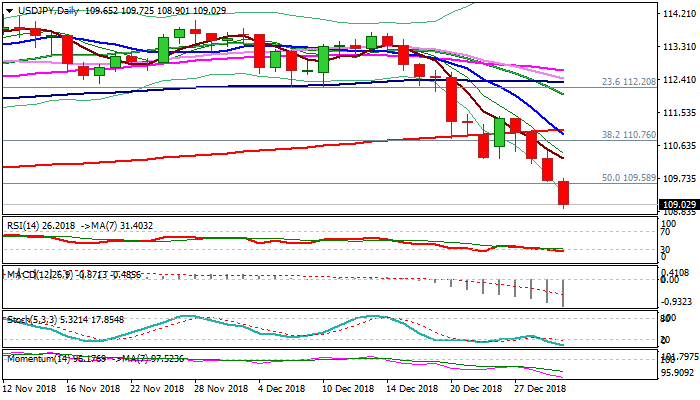
Friday's break and close below psychological 110 support was bearish signal for USDJPY pair's extension through 109.58 (50% of larger 104.63/114.54 ascend) and through narrowing weekly cloud (109.68/38) which twists next week and was magnetic.
Bears now eye next pivotal support at 108.41 (Fibo 61.8% of 104.63/114.54), violation of which could generate fresh bearish signal and add to dollar-negative environment.
Indicators on the daily chart are all heading south and strong bearish setup was reinforced by formation of 10/200SMA death-cross, with oversold conditions being so far ignored.
Violation of 108.41 Fibo support would expose 108.11 (29 May trough), with no further obstacles on the way towards 106.97 (Fibo 76.4%).
Corrective action could be anticipated in the coming sessions as daily techs are strongly oversold, but so far without any signal.
Solid barriers lay at 110.00/26 (psychological / 24 Dec former low / falling 5SMA) and expected to ideally cap upticks.
Res: 109.58, 110.00, 110.26, 110.76
Sup: 108.90, 108.41, 108.11, 106.97
European stocks in selloff, German 10 Yr yield hit lowest since Apr 2017, Yen accelerates higher
Following the selloff in Asian stock markets, major European indices open broadly lower and suffer heavy selling. Right now, FTSE is down -1.93%, DAX is down -1.45% and CAC is down -2.55%.
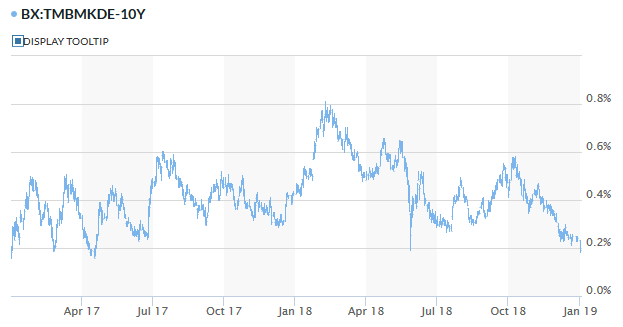
In particular, we'd like to point out that German 10 year bund yield tumbles sharply. It's current down -0.055 at 0.188. It actually hit as low as 0.181 in initial trading, breach the one day spike low at 0.186 back in May 2018. And it hit the lowest level since April 2017.
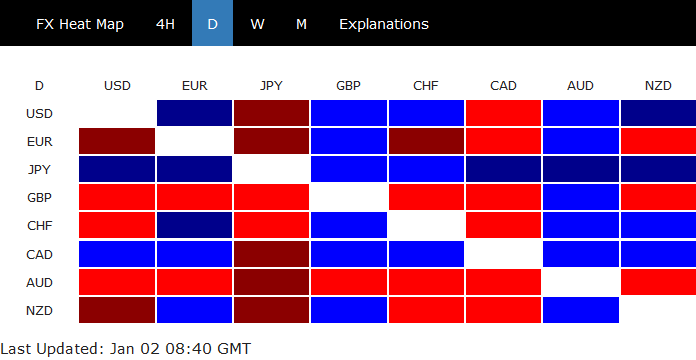
In the currency markets, Yen remains the strongest one and is accelerating for now. Canadian Dollar and Dollar are the next. Australian Dollar is the weakest followed by Sterling and then Euro.
USDJPY Tumbles To 7-Month Low, Looks Oversold
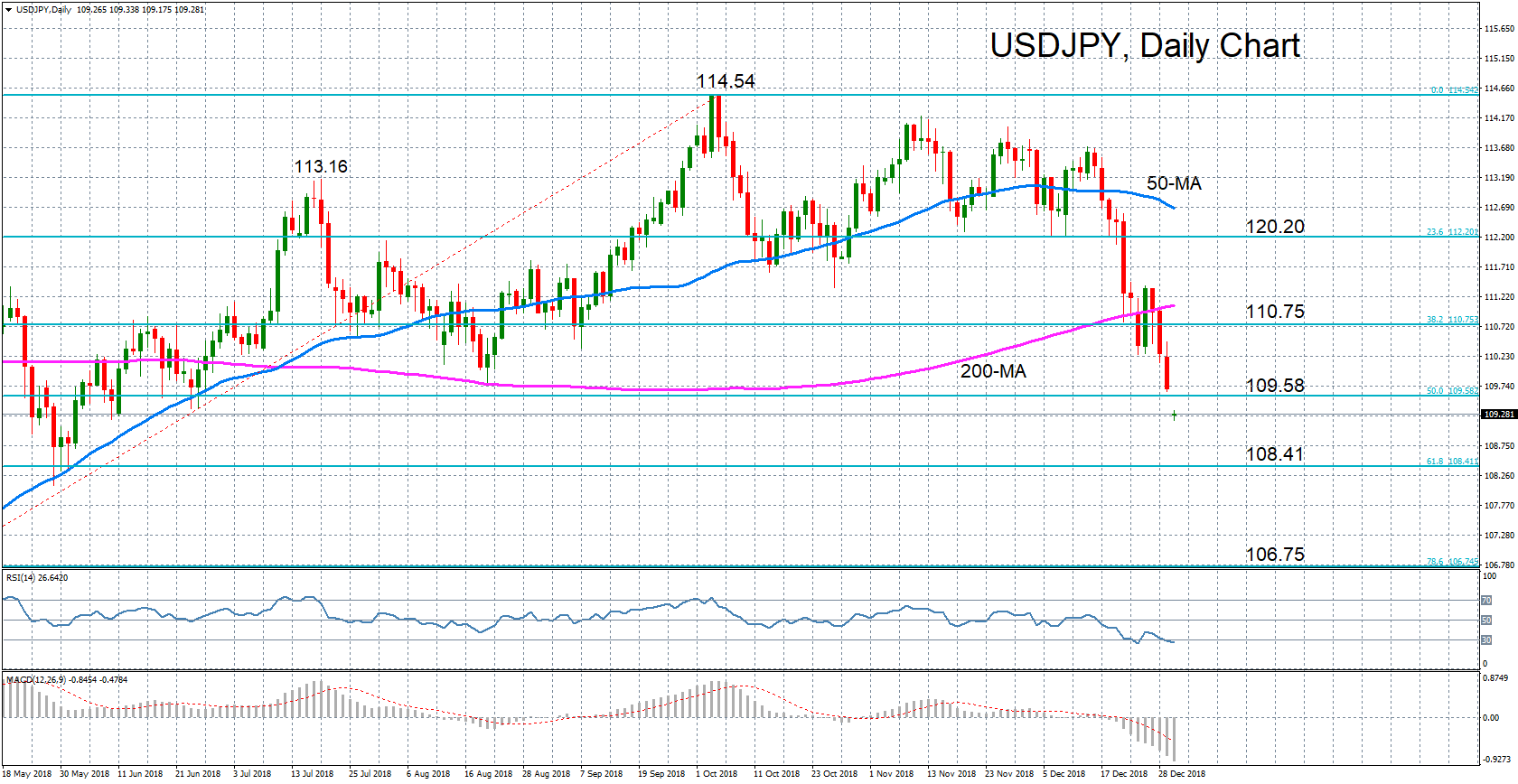
USDJPY opened with a gap lower on the first trading day of 2019 to fall to a 7-month low of 109.18. The pair is down by about 4.7% from the 11-month high of 114.54 set in October 2018 and has now slipped below both its 50- and 200-day moving averages, erasing its bullish structure in the medium term.
The momentum indicators point to further downside in the near term. The MACD continues to fall deeper into negative territory below its signal line. However, the RSI has just crossed into oversold territory below 30, suggesting an upside correction could be due soon.
Should prices continue to head lower, the next major support probably won’t arrive until the 61.8% Fibonacci retracement level of the upleg from 104.62 to 114.54, at 108.41. A breach of this support would signal a shift to a bearish outlook in the medium term and could accelerate the declines towards the 78.6% Fibonacci retracement at 106.75.
But if USDJPY manages to reverse higher, it is likely to face immediate resistance at the key 50% Fibonacci level at 109.58. A break above this level would strengthen the positive momentum and may drive the price until the 38.2% Fibonacci at 110.75. Further gains could see the 23.6% Fibonacci at 120.20 coming into view. However, the pair would need to aim even higher for the 50-day moving average (currently around 112.68) to eliminate the bearish bias.
No Signs Of Confidence In Equity Markets | Safe Haven Trade Is On
Global stock markets seem shaky on the first trading day of the year and still under the influence of the sell-off which we experienced in 2018. Investors are clearly concerned about the growth in 2019 and the lack of confidence is keeping them on the sidelines or they are feeling safer by parking their capital in risk-off assets.
The Chinese Caixin manufacturing number released today made investors more concerned about this as the number dipped below the critical point which differentiates the difference between contraction and expansion. The number came in at 49.7, any number below 50 shows that the economy is shrinking and any number above 50 shows growth. On the back of this number, investors followed one particular theme which spread from Hong Kong to Syndey- press the sell button only. Basically, for traders as long as the issues around the trade war between the US and China aren’t resolved, they cannot think of a situation which can promote growth.
Looking at the European markets and US futures, it appears investors aren’t showing any confidence despite the fact that Donald Trump has shown some indication that he may be finally willing to strike a deal to end the current government shutdown. President has invited the top congressional leaders from both parties to open the dialogue again.
It has been nearly two weeks (11 days to be precise) that we have seen a partial shutdown of the government entities over in the US. Donald Trump needs the government money to build the wall along the US and Mexico border and the politicians have simply refused to do so. The jury is still out if he can actually offer an olive branch to those who oppose his views on the wall however he has also made it clear that his opinion on the border security is still the same and he is not willing to stand off anytime soon.
S&P500 index which finished 2018 as the worst year since 2008, basically breaking the longest bull rally in the history, is poised to open lower today. The Index’s futures reversed all the gains and the only dominant trend is the downtrend.
As for the gold market, it has kicked off the year on a much positive note. The precious metal is the favourite choice among those investors who do not favour riskier assets. Gold prices are likely to break above the 1300 mark in the coming days and the year-end rally could really lead the price to cross the 1300 mark. Having said this, it is important to keep in mind that some daily technical indicators are flashing some warning signs after the massive rally we have seen in the gold price
Position trading: Hold EUR/JPY short, lower stop
Here's an update on our EUR/JPY short trade (sold at 127.80, stop at 127.70) as last updated here. EUR/JPY's decline resumed after recovery was limited at 127.09 and reached as low as 125.16 so far. Near term development stays bearish with the prior recovery limited by falling 4 hour 55 EMA.
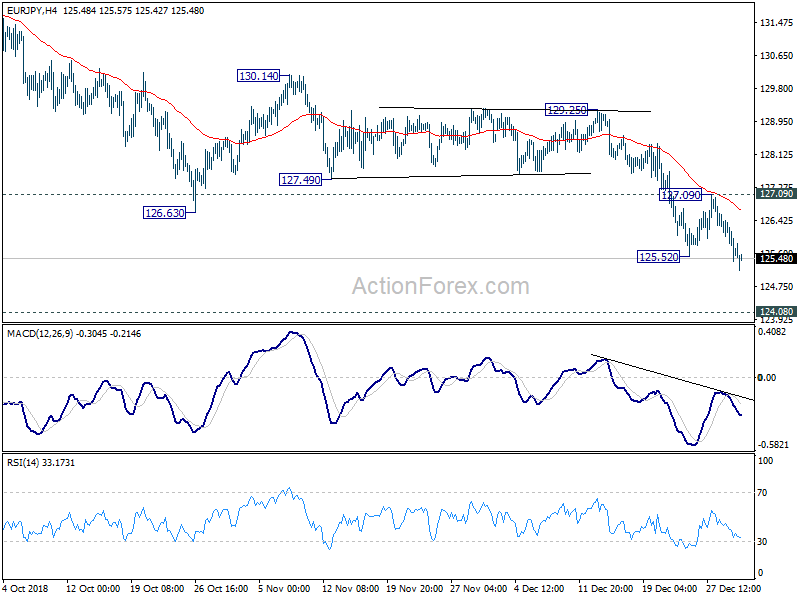
From the daily chart point of view, daily MACD stays negative and is trending down, indicating continuing downside momentum. So, overall, the bearishness remains in EUR/JPY and it should be targeting 124.08/89 key support zone.
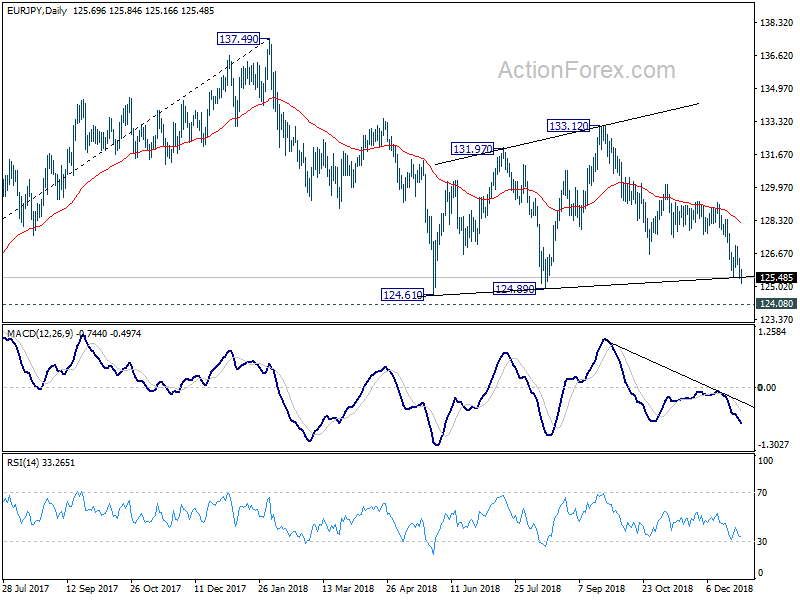
Ideally, we should see further downside accelerate through 124.08. That should confirm that fall from 137.49 is itself a medium term down trend rather than a correction. And in that case, the cross should target 61.8% retracement of 109.03 to 137.49 at 119.90 and possibly below.
However, loss of momentum ahead would probably keep 124.08 intact to bring rebound. The momentum of the current down move will be closely watched.
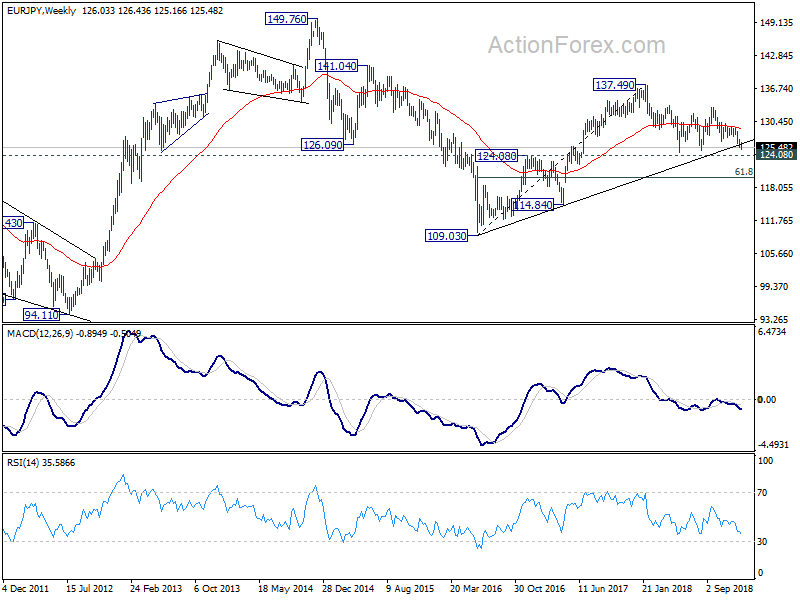
We'll hold short and lower the stop to 127.10, slightly above 127.09 resistance. Target is put at 120.00 first, slightly above 119.90 fibonacci level. But we'll see the reaction from 124.08 to decide whether to exit earlier.
EUR/USD Prepares For Bullish Wave C At 1.14 Support
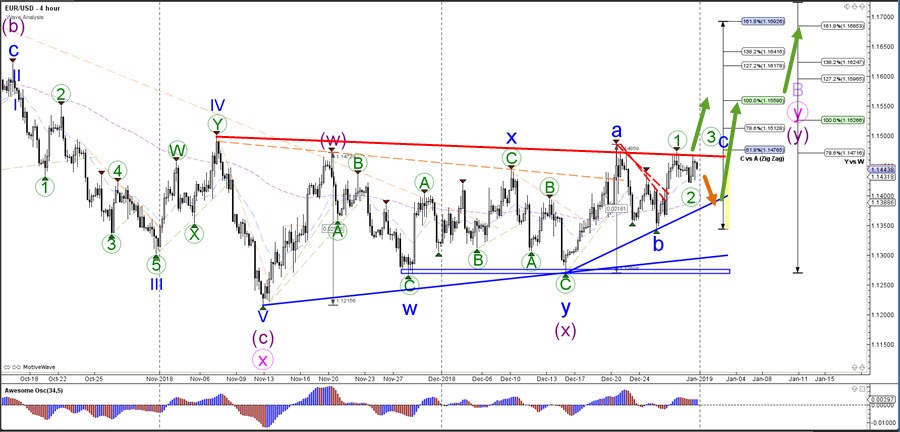
The EUR/USD seems to be building a wave 1-2 (green) pattern within wave C (blue). Price could confirm this expected wave pattern when price bounces at the support trend line (blue) or breaks above the next resistance trend line (red). A bullish breakout could see price move up towards the Fibonaccitargets whereas a break below the bottom of wave B (blue) invalidates the wave 2.
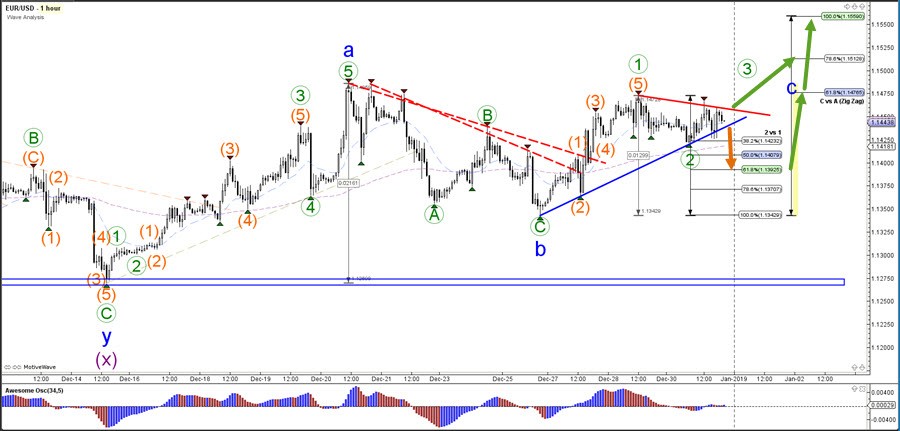
The EUR/USD seems to have completed 5 waves (orange) in wave 1 (green) and could be building an ABC correction in wave 2 (green). The Fibonacci levels of wave2 vs 1 could act as support and bouncing spots.
Is The Writing On The Wall?
Market movers today
From all of us at Danske Bank research, we wish you a happy and prosperous new year.
Today is rather slow in terms of economic releases while we wait for key economic indicators on Friday such as the US labour market report and the euro area inflation prints.
Focus today will be on the recent volatile equity developments as markets come to the new year with 'fresh eyes', amid the US government shutdown and a new issuance season from European governments. See also, Strategy: EGB supply and ECB reinvestment outlook for 2019 - gross issuance set to increase, but with limited issuance of ultra-long bonds.
Selected market news
After a brutal 2018 for equity markets, Asian stock markets begin the new year in the red with the publication of weak economic figures from China. US equity futures are trading in the red as well.
U.S. President Donald Trump is attempting to break the budget deadlock by inviting leaders from both parties to make a deal. The government has been in partial shutdown for 11 days as Trump remains adamant about securing funding for his wall, which was a key electoral pledge. The democrats will assume a majority in the House of Representatives and their leader, Nancy Pelosi, deems the wall "immoral".
Trump responded to North Korean leader Kim Jong Un. He tweeted "I also look forward to meeting with Chairman Kim," in response to threats uttered in a televised speech by the Chairman about North Korea taking "a new path" if economic sanctions are not eased.
Year-end speeches from global leaders, such as China's President Xi Jinping and Italian President Sergio Mattarella, highlighted key 2019 market themes, namely global economic slowdown and political risk.
China's President Xi Jinping stressed self-reliance in his new year's speech as the country faces economic slowdown and US trade belligerence. China's Caixin PMI was published this morning, yielding further confirmation of China's economic slowdown. The index fell more than analysts expected to 49.7 in December from 50.2 in November. The official manufacturing PMI published on Monday also broke through the critical 50 level, corroborating a slowdown.
Italy's President Sergio Mattarella used his speech to chastise Deputy Prime Ministers Matteo Salvini and Luigi Di Maio about driving through a budget piling on more debt on an already highly indebted country. He also voiced his hope for a "serene climate" as European elections approach.
Not So Happy New Year For Stock Markets
December woes carry into 2019
I think it's safe to say that after a turbulent and all-round woeful 2018, investors across the globe will be hoping 2019 brings with it more stability and a return to winning ways for stock markets.
That said, the year has already got off to a disappointing start, with risk aversion weighing heavily across asset classes as the trend that battered confidence in the final month of last year carries over into this. Naturally, it was a rather quiet end to the year with nothing really changing on the fundamental landscape but unfortunately during that time of reflection, investors found no reason to be less pessimistic.
We saw a small rebound – primarily in the US – in the final days of the year but that move looks to have exhausted itself quite quickly. Trump – who always has one eye on the stock market – tried to offer some words of optimism on talks with China, tweeting that “big progress is being made” towards a comprehensive deal but that seems to have been taken for nothing more than an attempt to offer encouraging words at a time when no progress is being made on re-opening government and markets are slumping.
Dollar slump and risk-off trading sends gold towards $1,300
It seems that one thing many traders are in agreement on heading into 2019 is that it's going to be a rough year for the dollar. A combination of factors are feeding into this view, with the changing position of the Fed being the most obvious. It has already dialled back its rate hike expectations for the coming year and it's widely believed that it will do so again in the coming months, which could weigh on the currency.
This continues to be supportive for Gold, along with the overall risk-off environment that we're currency experiencing right now. The inverse correlation with the dollar and safe haven status is very bullish for the yellow metal at the moment as its impressive fourth quarter – up more than 7.5% - looks set to continue with $1,300 not far away. This may provide temporary resistance but I'm not convinced it will hold for too long.
Oil remains vulnerable but downside may be limited
This risk-off environment is also piling on the misery for oil, with Brent and WTI both coming under pressure once again today. Both are around 40% off their highs of only three months ago and continue to look vulnerable, albeit to a lesser extent than they have in recent months.
Slower global growth is clearly a strong headwind for oil but I wonder whether the doom and gloom is a little overdone and with OPEC+ seemingly committed to bringing balance back into the market, the bottom may not be far away. Traders may simply be waiting for some evidence that more output cuts will have the desired effect in a world where the US is increasing its dominance thanks to a booming shale industry.
ETHUSD Buyers Began Control Of Price Action
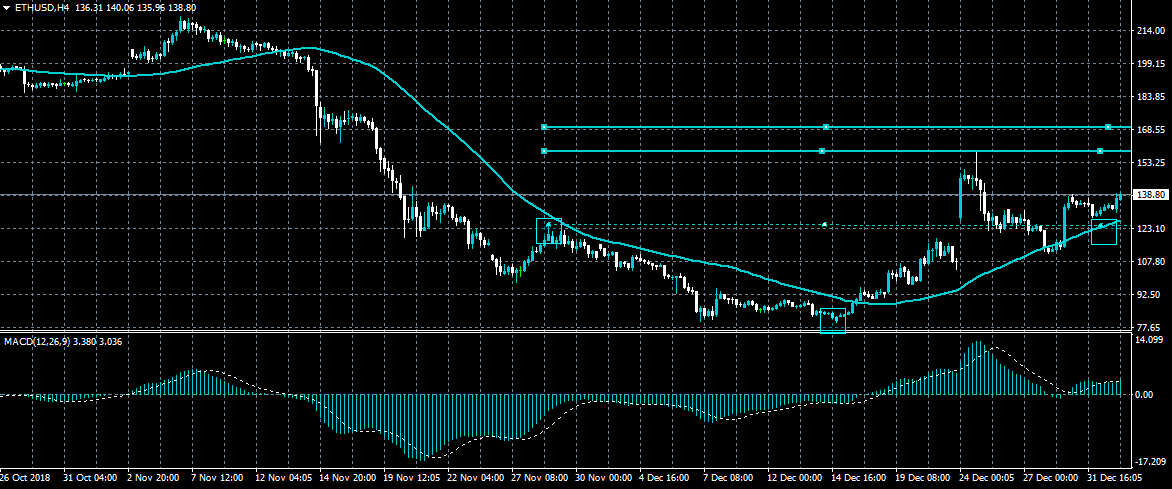
Buyers have regained control of price-action in early Wednesday trading after Ethereum’s recent decline found strong technical support from the $111.00 level. The ETHUSD pair is only intraday bullish while trading above the neckline of the inverted head and shoulders pattern, at $126.00. Bulls may test towards the former weekly high, at $158.00, and potentially the $170.00 level.
The ETHUSD pair is bullish while trading above the $126.00 level, key resistance is found at the $158.00 and $170.00 levels.
If ETHUSD pair trades below the $126.00 level, sellers may test towards the $111.00 and $100.00 support levels.