Sample Category Title
Eco Data 1/3/19
[php_everywhere instance="1"]
Poor Start for Dollar Bears and US Stocks
2019 is not off to a great start for dollar bears and US stocks. With liquidity starting to flow back into the markets, risk aversion especially hit the bond markets as yields continue to slide. The 10-year yield on US Treasury’s fell 1.8bps to 2.665% and German Bunds are off by 8.2bps at 0.153%. Early in Asia, the risk-off move was supported by further data that showed China is slowing. The Caixin China reading for December fell into contraction at 49.7, lower like the official gov’t reading (49.4) at the end of last year. With both the private sector release and the official PMI reading for the second largest economy falling to negative territory, expectations are growing for the PBOC to act sooner. The trend of lower yields and equities is the current theme of the market as trade concerns and slower growth fundamentals appear firmly in place.
After the US open, the US December Manufacturing PMI reading came in at 53.8, softer than the flash reading of 53.9. The headline reading was the lowest since September 2017, while the components also showed weakness. Employment declined from 55.3 to 52.7, the worst reading since June 2017 and new orders declined month over month.
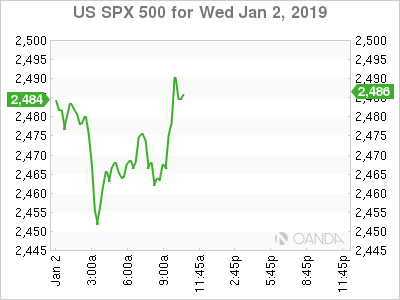
US Stocks are down over a full percent with the S&P 500 down 1.3% at 2,474 and the Dow down 1.1% 23,069. The dollar is also firmer against the high-beta currencies, up 0.9% with the euro, 1.0% to cable, and 0.9% with Aussie dollar.
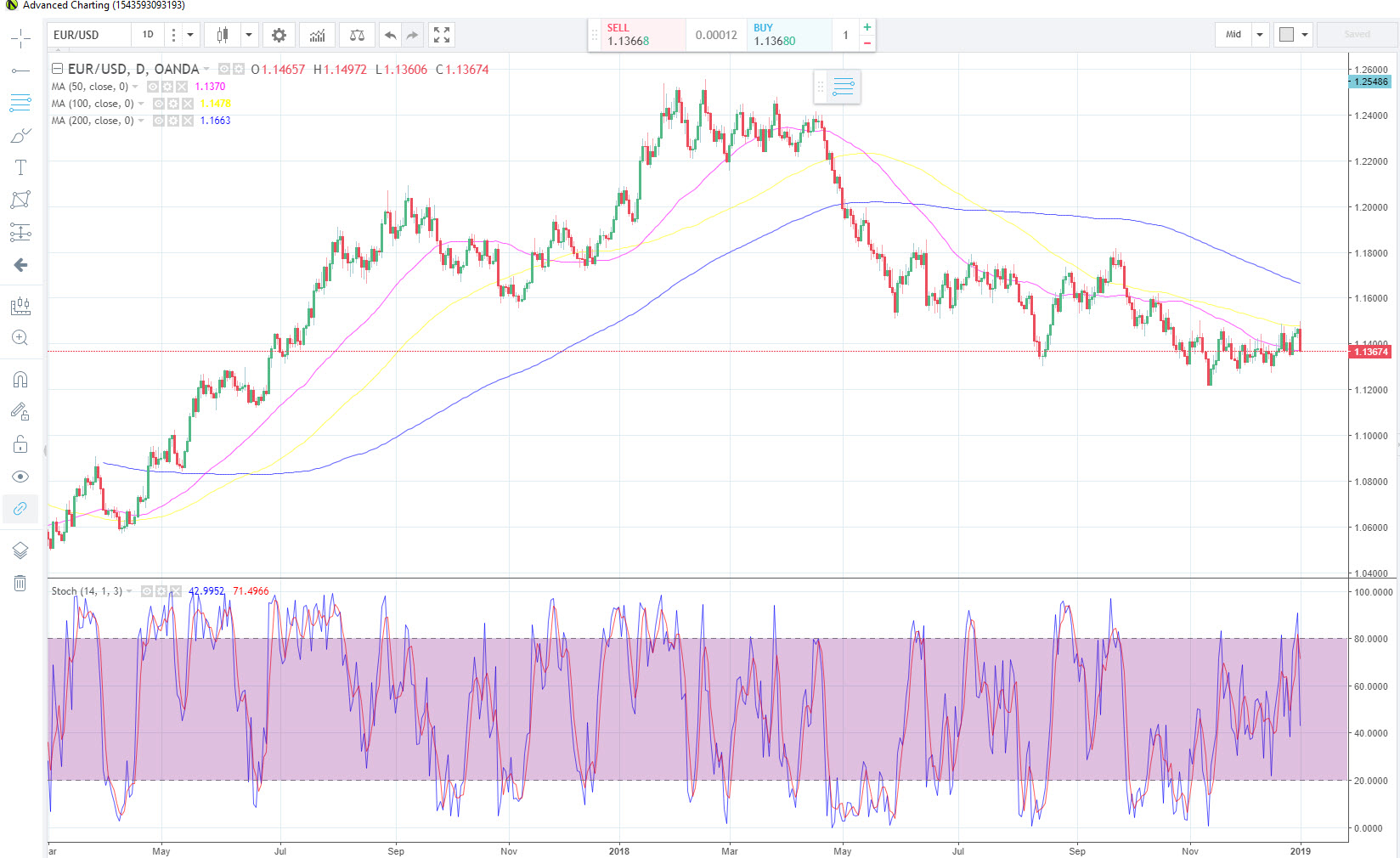
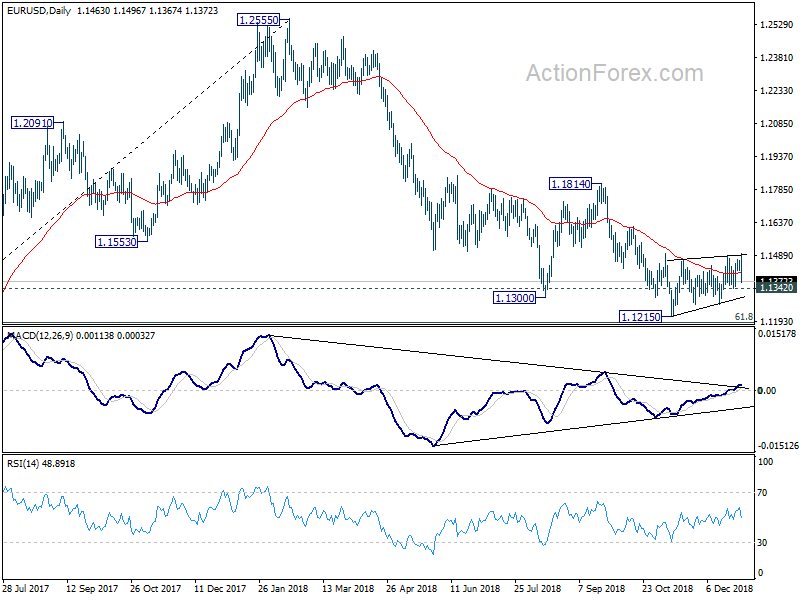
The EUR/USD daily chart shows price is testing the 50-day SMA at 1.1368. If we see 1.13 break, we could see price find support from the November 13th low of 1.1215. To the upside 1.15 remains key resistance.
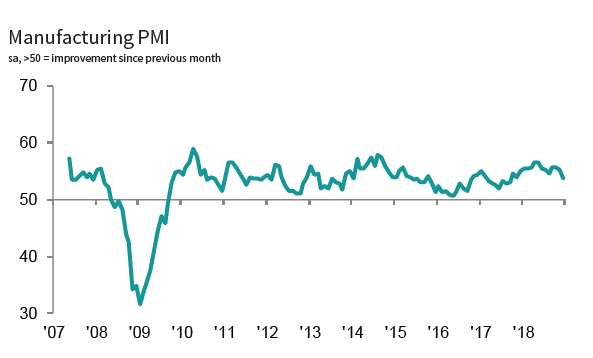
US PMI manufacturing finalized at 15-month low at 53.8
US PMI manufacturing was finalized at at 15-month low of 53.8 in December. Markit added that "new order growth eases to 15-month low" and "business confidence lowest since October 2016".
Chris Williamson, Chief Business Economist at IHS Markit said:
"Manufacturers reported a weakened pace of expansion at the end of 2018, and grew less upbeat about prospects for 2019. Output and order books grew at the slowest rates for over a year and optimism about the outlook slumped to its gloomiest for over two years. The month rounds of a fourth quarter in which manufacturing production is indicated to have risen at only a modest annualised rate of about 1%.
"Some of the weakness is due to capacity constraints, with producers again reporting widespread difficulties in finding suitable staff and sourcing sufficient quantities of inputs. However, the survey also revealed signs of slower demand growth from customers, as well as rising concerns over the impact of tariffs. Just over two thirds of manufacturers reporting higher costs attributed the rise in prices to tariffs.
"Growth was led by strengthening demand for consumer goods, and robust growth was also reported for investment goods such as plant and machinery. But producers of intermediate goods – who supply inputs to other manufactures – reported the weakest rise in new orders for over two years, hinting at increased destocking by their customers.
"A shift to inventory reduction was highlighted by purchasing activity in the manufacturing sector rising at the weakest rate for one and a half years in December, providing further evidence that companies have become increasingly cautious about spending amid rising uncertainty about the outlook."
Canada PMI manufacturing dropped to lowest since Jan 2017
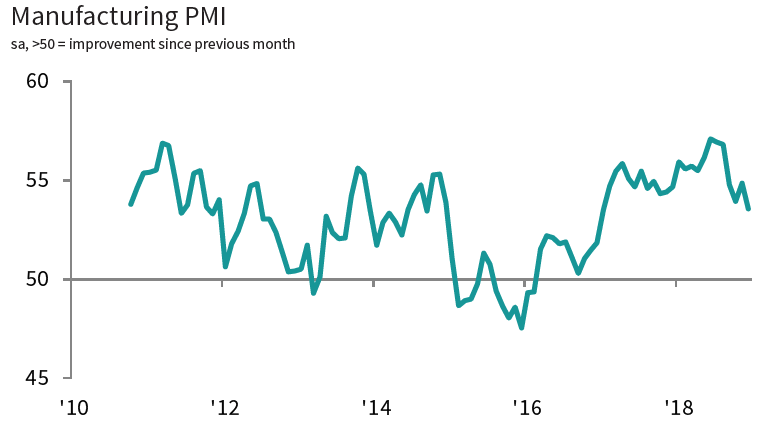
Canada PMI manufacturing dropped to 53.6 in December, down from 54.9. That's also the lowest level since January 2017. Markit noted "softer rates of output and new order growth" and "export sales stagnate at the end of 2018".
Christian Buhagiar, President and CEO at SCMA said:
"December data signalled a loss of momentum for manufacturers at the end of the year, with stagnating export sales and softer energy sector demand the key factors behind an overall slowdown in production growth. Survey respondents also commented that global trade tensions has led to greater risk aversion among clients. As a result, manufacturing companies have curtailed their expectations for output growth in 2019, with business optimism easing to its lowest for almost three years.
"Quebec was a notable outperformer in December as manufacturing conditions improved at the fastest pace for four months. Meanwhile, manufacturers in Ontario saw softer overall growth than in November, while those based in Alberta & British Columbia experienced the weakest upturn for just over two years."
XAU/USD Outlook: Spot Gold Advances on Risk-off Mode and Cacks Key Fibo Barrier
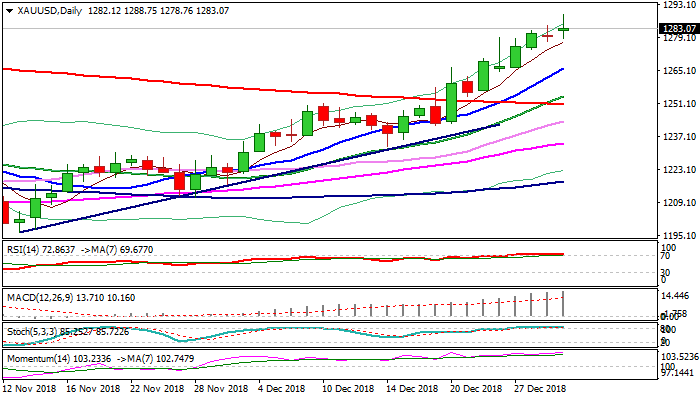
Spot gold hit new 6 1/2 month high at $1288 on Wednesday, in extension of recovery phase which started from $1160 in mid-Aug 2018. The yellow metal remains well supported by renewed risk-ff mode as f=rising concerns about global growth slowdown prompted investors into safe-haven assets. Today's rally cracked important barrier at $1286 (Fibo 61.8% of $1365/$1160), but close above here is needed to generate stronger bullish signal. Bullish daily and weekly techs continue to support, however, overbought conditions warn that bulls may take a breather before clear break above $1286 pivot. Slow stochastic on daily chart is turning lower and forming bear-cross, which could be seen as initial signal. Corrective dips are expected to offer better buying opportunities as overall environment is bullish and favors further advance. Rising 10SMA offers solid support at $1266, which is expected to contain corrective actions.
Res: 1286; 1288; 1300; 1309
Sup: 1277; 1266; 1253; 1250
Canadian Dollar Steady, Focus on Manufacturing PMIs
USD/CAD has posted small gains in the Wednesday session. Currently, the pair is trading at 1.3657, up 0.13% on the day. On the release front, there are no major events. The U.S. and Canada will both release manufacturing PMIs, which gauge the strength of the manufacturing sector. On Wednesday, the U.S. will release ADP nonfarm payrolls and unemployment claims.
The Canadian dollar remains under pressure, posting weekly losses for six straight weeks. The wobbly currency even lost ground during a quiet Christmas week. USD/CAD has jumped 3.7% since mid-November, as turmoil in the equity markets has soured risk appetite and made minor currencies like the Canadian dollar less attractive. The volatility in U.S. markets was especially pronounced last week, as stocks plunged but then rebounded. There is widespread concern that the global trade war will continue to take a bite out of the global economy, which could mean more headwinds for the Canadian dollar, a commodity currency.
Another factor hurting the Canadian dollar, which is sensitive to commodity prices, is the sharp drop in oil prices. WTI crude, which is currently selling at $44 a barrel, has plunged 39% in just three months. Weaker economic conditions worldwide could mean that oil prices will remain depressed in the coming months.
White House said Democrat’s deal to end shutdown a non-starter
Latest comments from the White House suggest there is still no end in sight for the partial government shutdown. Press Secretary Sarah Sanders said "The Pelosi plan is a non-starter because it does not fund our homeland security or keep American families safe from human trafficking, drugs, and crime." But she also emphasized that Trump remains committed to "an agreement that both reopens the government and keeps Americans safe."
It's reported that right after taking control of the House, Democrat will vote on a two-part package on Thursday, intending to end the shutdown. The first part is a bill to fund the Department of Homeland Security through February 8, plus USD 3B for border "fencing" and USD 300M for technical and equipment for border security. The second part will fund the unfunded federal agencies through September 30. But no funding for the Trump demanded border wall would be provided in the package.
EUR/USD Mid-Day Outlook
Daily Pivots: (S1) 1.1412; (P) 1.1498; (R1) 1.1550; More.....
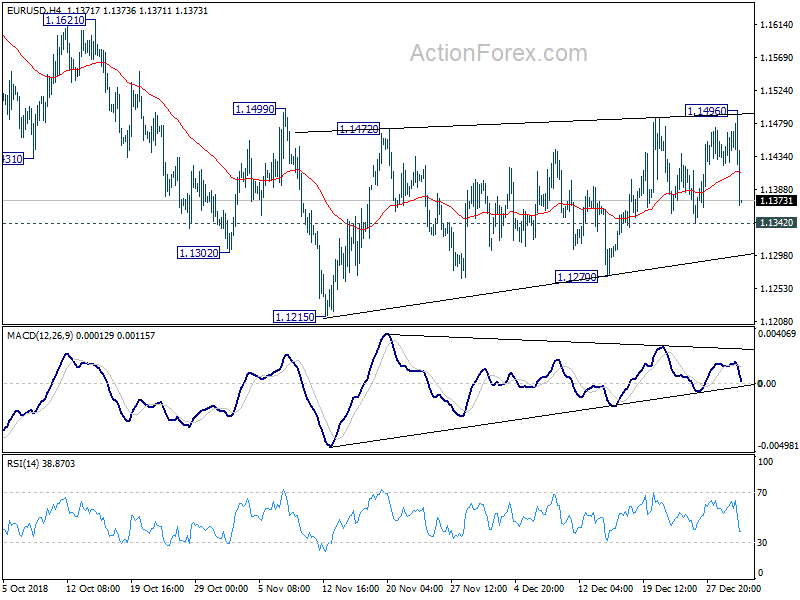
Despite edging higher to 1.1496, EUR/USD quickly reversed. As it's staying above 1.1342 minor support intraday bias remains neutral first. On the downside, break of 1.1342 will target 1.1270 support first. Break there will revive the bearish case that down trend from 1.2555 is still in progress. EUR/USD should then target 1.1186 key fibonacci level next. On the upside, however, sustained break of 1.1496 will revive the case of near term reversal, on bullish convergence condition in daily MACD. Bias will be turned back to the upside for 1.1621 resistance first. Break will target 1.1814 key resistance next.
In the bigger picture, as long as 1.1814 resistance holds, down trend down trend from 1.2555 medium term top is still in progress and should target 61.8% retracement of 1.0339 (2017 low) to 1.2555 at 1.1186 next. Sustained break there will pave the way to retest 1.0339. However, break of 1.1814 will confirm completion of such down trend and turn medium term outlook bullish.
GBP/USD Mid-Day Outlook
Daily Pivots: (S1) 1.2693; (P) 1.2729; (R1) 1.2783; More....
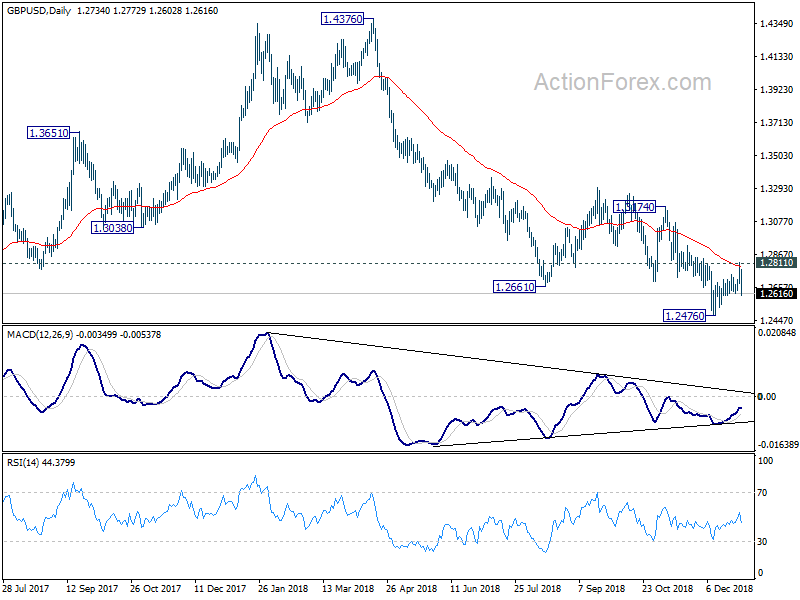
GBP/USD's break of 1.2615 minor support suggests that rebound from 1.2576 has completed at 1.2814 already, after rejection by 1.2811 resistance. Intraday bias is turned back to the downside for 1.2476 first. Break there will resume larger decline from 1.4376. However, considering bullish convergence condition in daily MACD, firm break of 1.2811/4 will be an early signal of trend reversal and bring further rally to 1.3174 resistance.
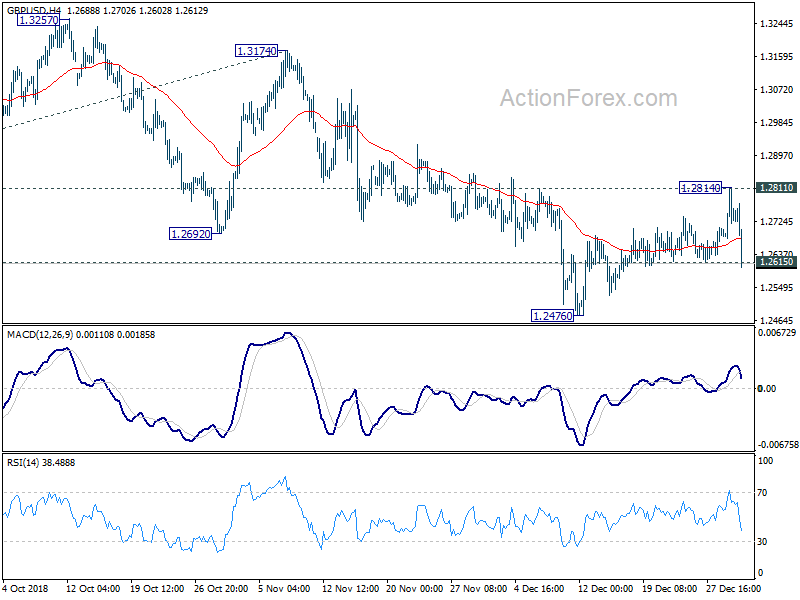
In the bigger picture, whole medium term rebound from 1.1946 (2016 low) should have completed at 1.4376 already, after rejection from 55 month EMA. The structure and momentum of the fall from 1.4376 argues that it's resuming long term down trend from 2.1161 (2007 high). And this will now remain the preferred case as long as 1.3174 structural resistance holds. GBP/USD should target a test on 1.1946 first. Decisive break there will confirm our bearish view.
GBP/JPY Mid-Day Outlook
Daily Pivots: (S1) 138.58; (P) 139.33; (R1) 140.59; More...
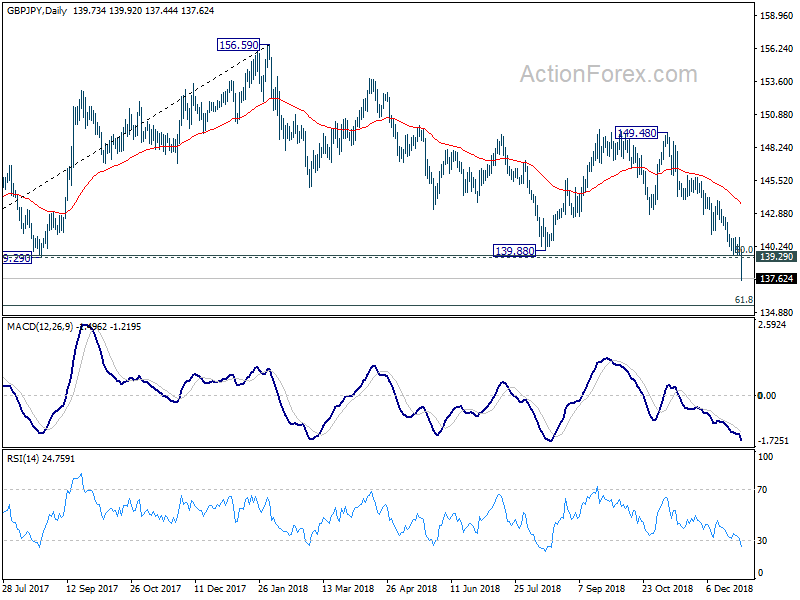
GBP/JPY's fall accelerates to as low as 137.44 so far today. 139.29 key support is firmly taken out with no sign of bottoming yet. Intraday bias remains on the downside for 135.43 long term fibonacci level next. On the upside, break of 140.93 resistance is needed to indicate short term bottoming. Otherwise, outlook will remain bearish even in case of recovery.
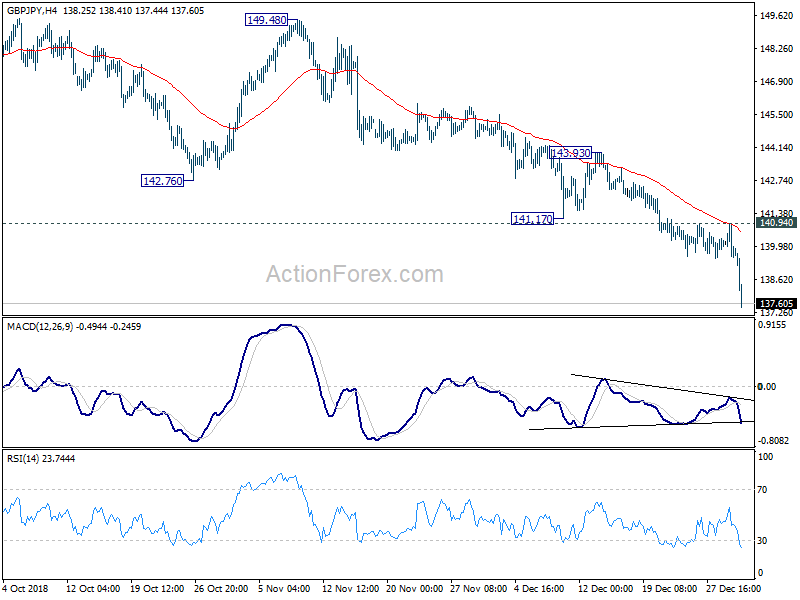
In the bigger picture, firm break of 139.29 cluster support (50% retracement of 122.36 to 156.59 at 139.47) confirms completion of up trend from 122.36 (2016 low) at 156.59. Outlook is now turned bearish for 61.8% retracement at 135.43 first. Sustained break will pave the way back to 122.36 low.