Sample Category Title
Canadian Retail Sales Start Q4 on a Disappointing Note
Canadian retail sales advanced 0.3% m/m in October, a slight improvement over last month's revised 0.1% release (previously reported as 0.2%). This came against consensus expectations of a 0.5% increase. Disappointingly, accounting for price changes reveals a flat volumes print.
The uptick was mostly led by increases in sales at motor vehicles and parts dealers, up an impressive 1.3% on the month (+0.6% in real terms). Sales at gasoline stations also advanced 1.9% in both nominal and real terms. Excluding those two volatile categories, retail sales were down 0.4%.
This was the first month in which cannabis stores were incorporated in retail trade data. Partly due to this, sales at miscellaneous stores recorded a strong 4.5% increase. Excluding cannabis, sales in this category were up 1.1%.
Consistent with slowing housing market data (especially resales), furniture and home furnishing stores saw declines of 1.5% (-1.8% in real terms). Building materials and gardening equipment stores also reflected of housing market softness, falling 0.9% (-1.4% in real terms).
Regionally, retail sales were mixed, increasing in only 5 out of 10 provinces. Notable increases were seen in Ontario (+1.1%) and Quebec (+0.8%). Sales declined in Alberta for the third consecutive month (-1.8%). Performance across the Atlantic provinces was mixed.
Key Implications
The release is relatively disappointing given the flat volumes print. To make matters worse, last month's print was revised slightly downwards. Nevertheless, it likely doesn't change much, especially given today's solid real GDP data. The retail picture, however, remains that of moderating consumer spending.
Housing market weakness continues to reflect in lower sales at home, furniture, and gardening stores. What's puzzling, however, is that rising borrowing costs have only sent auto sales sideways, with no major downturn as of yet.
Going forward, healthy labour markets and wages will likely be slightly offset by the impact of rising borrowing and debt service costs. This is likely to shift growth slightly away from consumer spending to investment going forward, in line with the Bank of Canada's expectations (and ours).
Canada: Solid October GDP Gives Q4 a (Needed) Solid Start
Canadian economic activity expanded by 0.3% month-on-month in October. The growth came from a healthy base, as 15 of 20 major industries expanded on the month.
On the service side (up 0.3% m/m as a whole), notable strength was reported in finance and insurance (+0.9%) and wholesale trade (+1.0%), with the latter more than reversing its September pull-back. Transportation and warehousing was an exception, as rotating strikes at Canada Post contributed to a -0.3% change in October.
Output in the goods-producing sectors (+0.3%) was driven by a robust expansion of manufacturing activity (+0.7%), supported by the machinery and primary metals subsectors. Utilities output was also up (+1.5%), helped by extreme snowfall in Alberta and cool weather across the country in October. The mining, quarrying, and oil and gas sector was up modestly as a whole (+0.2%). A rebound in oil and gas after earlier shutdowns helped offset softness in the mining subsectors.
Key Implications
Not too shabby. After a couple of months treading water, the Canadian economy recorded a solid expansion in October. The breadth of the expansion was particularly encouraging, even as construction activity remained a weak point for a fifth straight month.
This breadth will come into play in the months and quarters ahead. November saw the worst of the discounts on Canadian oil blends, and voluntary production curtailments are likely to weigh on activity (see our earlier report). This will sap overall growth, even before mandatory production cuts come into effect in January, expected to drag 2019Q1 growth lower by roughly a percentage point (as discussed in our latest Quarterly Economic Forecast).
Even with today's data, we are tracking Q4 growth at a modest 1.7% (q/q saar), below the Bank of Canada's October forecast of 2.3%. With the oil sector still facing elevated uncertainty due to low (and volatile) global prices, and core inflation measures well-contained, the urgency to hike interest rates has clearly lessened.
The balance of risks, as well as the realities of statistical release timings, continue to favour a pause until spring 2019 to ensure that economic dynamics generally, and the oil sector in particular, are indeed moving as we (and they) would like them to.
USD/JPY Mid-Day Outlook
Daily Pivots: (S1) 110.53; (P) 111.57; (R1) 112.33; More..
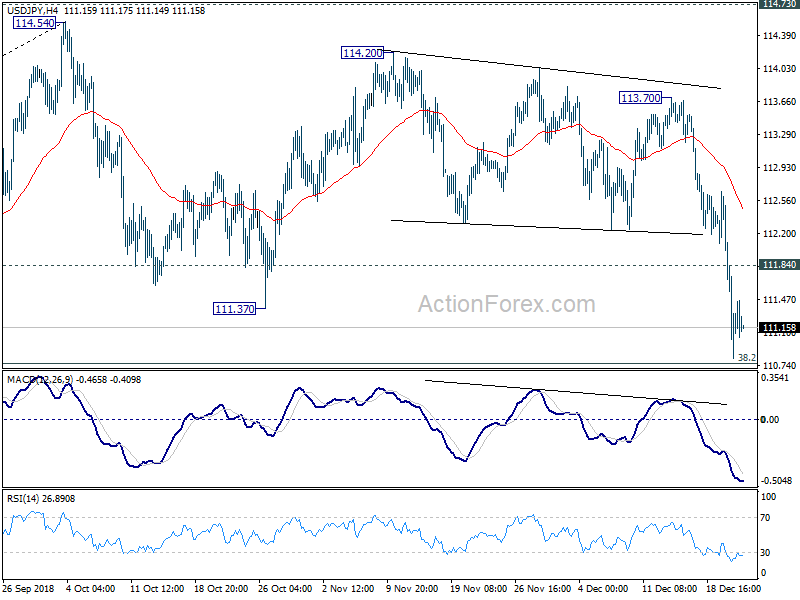
No change in USD/JPY's outlook. Price actions from 114.54 are viewed as a consolidation pattern. We'd continue to expect downside to be contained by 38.2% retracement of 104.62 to 114.54 at 110.75 to bring rebound. On the upside, break of 111.84 minor resistance will turn bias back to the upside for rebound to 4 hour 55 EMA (now at 112.46). However, firm break of 110.75 will dampen our view and target 61.8% retracement at 108.40.
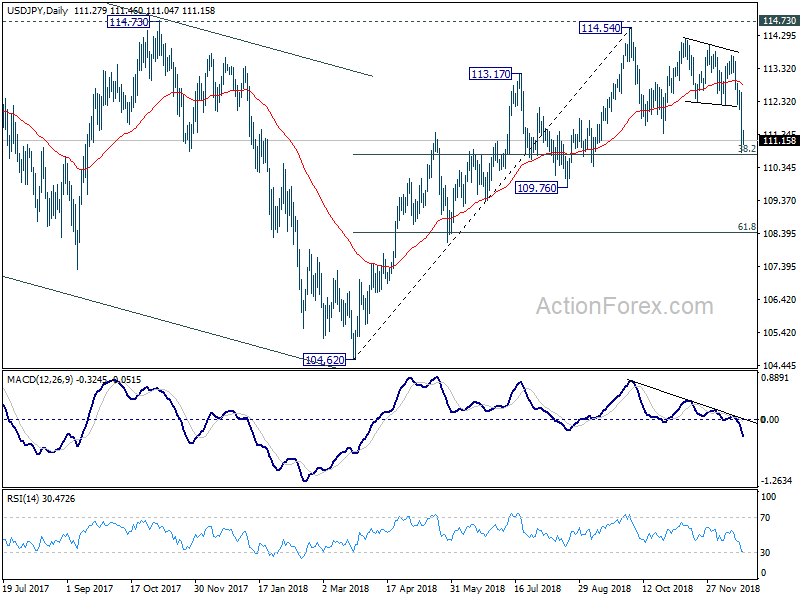
In the bigger picture, corrective fall from 118.65 (2016 high) should have completed with three waves down to 104.62. Decisive break of 114.73 resistance will likely resume whole rally from 98.97 (2016 low) to 100% projection of 98.97 to 118.65 from 104.62 at 124.30, which is reasonably close to 125.85 (2015 high). This will stay as the preferred case as long as 109.76 support holds. However, decisive break of 109.76 will dampen this bullish view and turns outlook mixed again.
Risk Aversion Eased ahead of Holiday, But Yen Remains Strongest
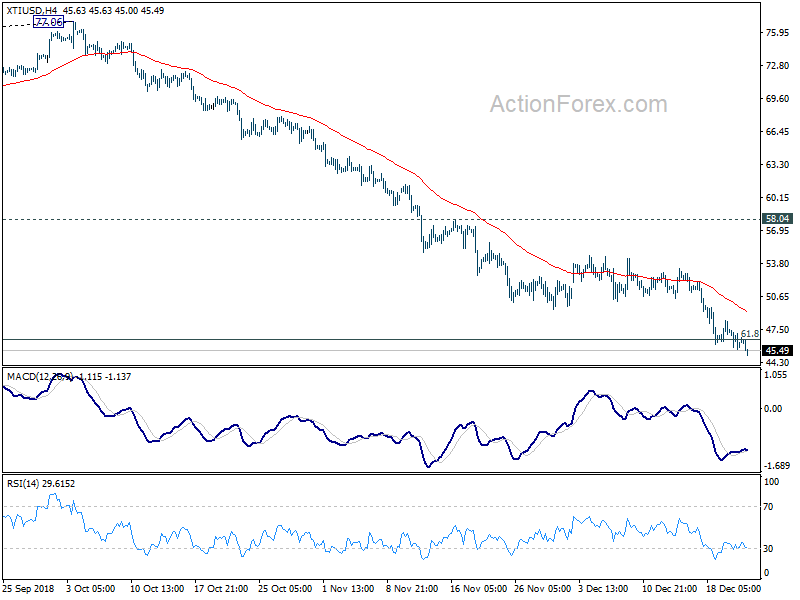
Yen remains the strongest one for today even though risk aversion eased a bit ahead of long holiday weekend. Dollar is following as the second strongest, reversing a lot of post FOMC losses against Euro and Swiss Franc. Commodity currencies remain generally weak. But today, it's Canadian Dollar that's leading the way down. Stronger than expected Canada GDP data provided little help. The Loonie follows WTI crude oil lower, as the latter is now risking 45 handle.
Technically, EUR/JPY is showing sign of downside acceleration and should have a take on 126.63 support soon. But for now, USD/JPY is holding on to 110.75 key fibonacci level and consolidates in tight range around 111.20. The development has actually dragged down EUR/USD. But EUR/USD is holding above 1.1364 minor support, so further rise remains mildly in favor.
In other markets, in Europe at the time of writing, FTSE is down -0.05%, DAX is up 0.16%, CAC is down -0.06%. German 10 year yield is up 0.0162 at 0.249. Italian 10 year yield is up 0.0456 at 2.785. Earlier in Asia, Nikkei dropped -1.11%, Hong Kong HSI rose 0.51%, China Shanghai SSE dropped -0.79%, Singapore Strait Times dropped -0.15%. Japan 10 year JGB yield rose 0.0085 to 0.039.
US Q3 GDP revised down to 3.4%, ex-transport durable orders contracted
Released from US, Q3 GDP growth was finalized at 3.4% annualized, revised down from 3.5%. GDP price index was revised up from 1.7% to 1.8%. Durable goods orders rose 0.8% in November, much lower than expectation of 1.8%. Ex-transport orders even dropped -0.3% versus expectation of 0.3%.
On the other hand, Canada GDP rose 0.3% mom, in October, above expectation of 0.2% mom. Headline retail sales rose 0.3% mom, below expectation of 0.6% mom. Ex-auto sales rose 0.0%, below expectation of 0.3%.
UK Q3 GDP finalized at 0.6%, services the strongest contributor
UK Q3 GDP growth was finalized at 0.6% qoq, unrevised. Annually, GDP grew 1.5% yoy, revised up by 0.1%. ONS noted that "services remained the strongest contributor to growth in the output approach to GDP in Quarter 3 2018, with growth easing slightly from the previous quarter; construction and manufacturing also contributed positively to growth."
At the same time, ONS also said "In comparison with the same quarter a year ago, the UK economy has grown by an unrevised 1.5%. This is a slight pickup from previous quarters in the year, although the longer-term picture remains one of relatively subdued growth compared with historic standards"
Also from UK, current account deficit widened to GBP -26.5B in Q3, larger than expectation of GBP -22.2B. Public sector net borrowing rose to GBP 6.3B in November, below expectation of GBP 7.0B
From German, Gfk consumer sentiment was unchanged at 10.4 in January.
Japan cabinet approved record fiscal 2019 budget
Japan Prime Minister Shinzo Abe's Cabinet approved budget for fiscal 2019. The general account budget would rise for the seventh straight years, to JPY 101.5T, comparing to current fiscal year's initial estimate of JPY 97.7T.
Of the JPY 101.5T, around JPY 2T will be spent specifically to ease the impact from the planned sales tax hike in October 2019, from 8% to 10%. Measures will include shopping vouchers to help low income households.
However, stimulus measures will altogether hit JPY 6.5T, far exceeding the estimated increase in sale tax revenue. Some economists noted that Abe has now set the precedence that rise in tax would actually be delaying fiscal reform.
Nevertheless, Finance Minister Taro Aso emphasized that "we were able to manage both needs of economic revival and fiscal consolidation with this budget."
Released from Japan, national CPI core slowed to 0.9% yoy in November, down from 1.0% yoy and missed expectation of 1.0% yoy.
USD/JPY Mid-Day Outlook
Daily Pivots: (S1) 110.53; (P) 111.57; (R1) 112.33; More..
No change in USD/JPY's outlook. Price actions from 114.54 are viewed as a consolidation pattern. We'd continue to expect downside to be contained by 38.2% retracement of 104.62 to 114.54 at 110.75 to bring rebound. On the upside, break of 111.84 minor resistance will turn bias back to the upside for rebound to 4 hour 55 EMA (now at 112.46). However, firm break of 110.75 will dampen our view and target 61.8% retracement at 108.40.
In the bigger picture, corrective fall from 118.65 (2016 high) should have completed with three waves down to 104.62. Decisive break of 114.73 resistance will likely resume whole rally from 98.97 (2016 low) to 100% projection of 98.97 to 118.65 from 104.62 at 124.30, which is reasonably close to 125.85 (2015 high). This will stay as the preferred case as long as 109.76 support holds. However, decisive break of 109.76 will dampen this bullish view and turns outlook mixed again.
Economic Indicators Update
| GMT | Ccy | Events | Actual | Forecast | Previous | Revised |
|---|---|---|---|---|---|---|
| 23:30 | JPY | National CPI Core Y/Y Nov | 0.90% | 1.00% | 1.00% | |
| 07:00 | EUR | German GfK Consumer Confidence Jan | 10.4 | 10.3 | 10.4 | |
| 09:30 | GBP | Public Sector Net Borrowing Nov | 6.3B | 7.0B | 8.0B | 5.6B |
| 09:30 | GBP | Current Account Balance (GBP) Q3 | -26.5B | -22.2B | -20.3B | -20.0B |
| 09:30 | GBP | GDP Q/Q Q3 F | 0.60% | 0.60% | 0.60% | |
| 09:30 | GBP | Total Business Investment Q/Q Q3 F | -1.10% | -1.20% | -1.20% | |
| 13:30 | CAD | Retail Sales M/M Oct | 0.30% | 0.60% | 0.20% | 0.10% |
| 13:30 | CAD | Retail Sales Ex Auto M/M Oct | 0.00% | 0.30% | 0.10% | |
| 13:30 | CAD | GDP M/M Oct | 0.30% | 0.20% | -0.10% | |
| 13:30 | USD | GDP Annualized Q/Q Q3 T | 3.40% | 3.50% | 3.50% | |
| 13:30 | USD | GDP Price Index Q3 T | 1.80% | 1.70% | 1.70% | |
| 13:30 | USD | Durable Goods Orders Nov P | 0.80% | 1.80% | -4.30% | |
| 13:30 | USD | Durables Ex Transportation Nov P | -0.30% | 0.30% | 0.20% | |
| 15:00 | EUR | Eurozone Consumer Confidence Dec A | -4 | -4 | ||
| 15:00 | CAD | BoC Business Outlook Survey | ||||
| 15:00 | USD | Personal Income Nov | 0.30% | 0.50% | ||
| 15:00 | USD | Personal Spending Nov | 0.30% | 0.60% | ||
| 15:00 | USD | PCE Deflator M/M Nov | 0.20% | |||
| 15:00 | USD | PCE Deflator Y/Y Nov | 2.00% | |||
| 15:00 | USD | PCE Core M/M Nov | 0.20% | 0.10% | ||
| 15:00 | USD | PCE Core Y/Y Nov | 1.90% | 1.80% | ||
| 15:00 | USD | U. of Mich. Sentiment Dec F | 97.6 | 97.5 |
US Q3 GDP revised down to 3.4%, ex-transport durable orders contracted
Released from US, Q3 GDP growth was finalized at 3.4% annualized, revised down from 3.5%. GDP price index was revised up from 1.7% to 1.8%. Durable goods orders rose 0.8% in November, much lower than expectation of 1.8%. Ex-transport orders even dropped -0.3% versus expectation of 0.3%.
On the other hand, Canada GDP rose 0.3% mom, in October, above expectation of 0.2% mom. Headline retail sales rose 0.3% mom, below expectation of 0.6% mom. Ex-auto sales rose 0.0%, below expectation of 0.3%.
USD/CAD extends recent up trend in early US session to as high as 1.3563 so far.
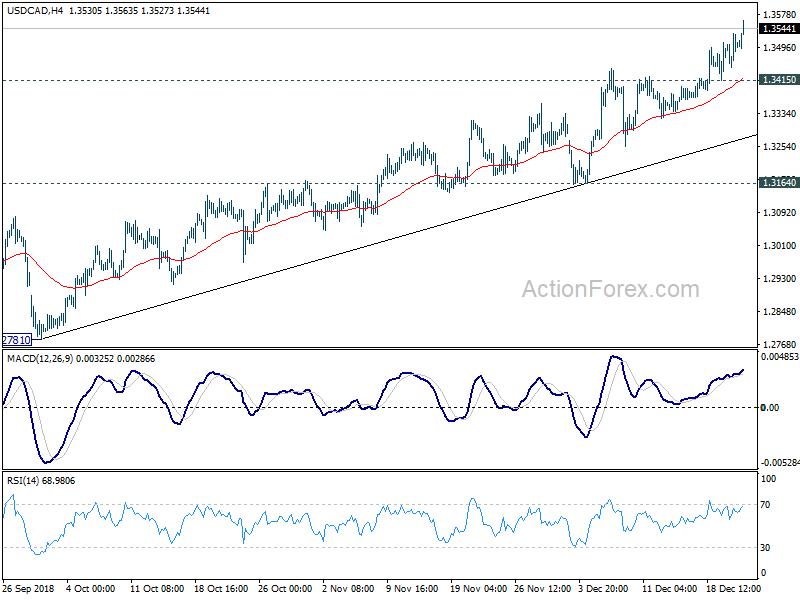
But that's mainly because WTI crude oil is extending recent free fall to as low as 45.00.
Investors Sprint to Safety ahead of Christmas Break
The pain felt across global equity markets intensified today as growing fears of a U.S. government shutdown crippled risk sentiment.
It has been a remarkably terrible trading week for financial markets amid concerns over rising U.S. interest rates, decelerating global growth, Brexit uncertainty and chaos in Washington. The absence of appetite for risk was clearly reflected in Asia this morning as stocks closed broadly lower. In Europe, shares are trading in a depressed fashion and this negative mood is likely to infect Wall Street this afternoon. With geopolitical risk factors weighing heavily on investor confidence, financial markets remain at threat of concluding 2018 on a risk-off tone.
While market activity is expected to drop significantly next week ahead of the upcoming Christmas holiday break, investors should remain diligent. With the economic calendar virtually void of Tier 1 economic reports, there could be some semblance of stability just before the New Year.
Is the Dollar bull party over?
It has not been the best of trading weeks for the Dollar despite the Federal Reserve raising interest rates and even sounding less dovish than expected.
Fears over slowing economic growth in the United States is clearly threatening the Dollar’s status as a safe-haven currency. With the flattening U.S. Treasury yield curve earlier in the week flashing warning signals to investors, the Dollar has been mostly depressed and unloved. With the Federal Reserve adopting a data-dependent approach towards monetary policy normalisation, there will be a strong focus on U.S. economic data moving forward. Investors will be keeping a close eye on the pending U.S. GDP data which should offer fresh insight into the health of the largest economy in the world. Dollar bulls are likely to be injected with fresh inspiration if the GDP report dishes out an upside surprise.
Commodity spotlight – Gold
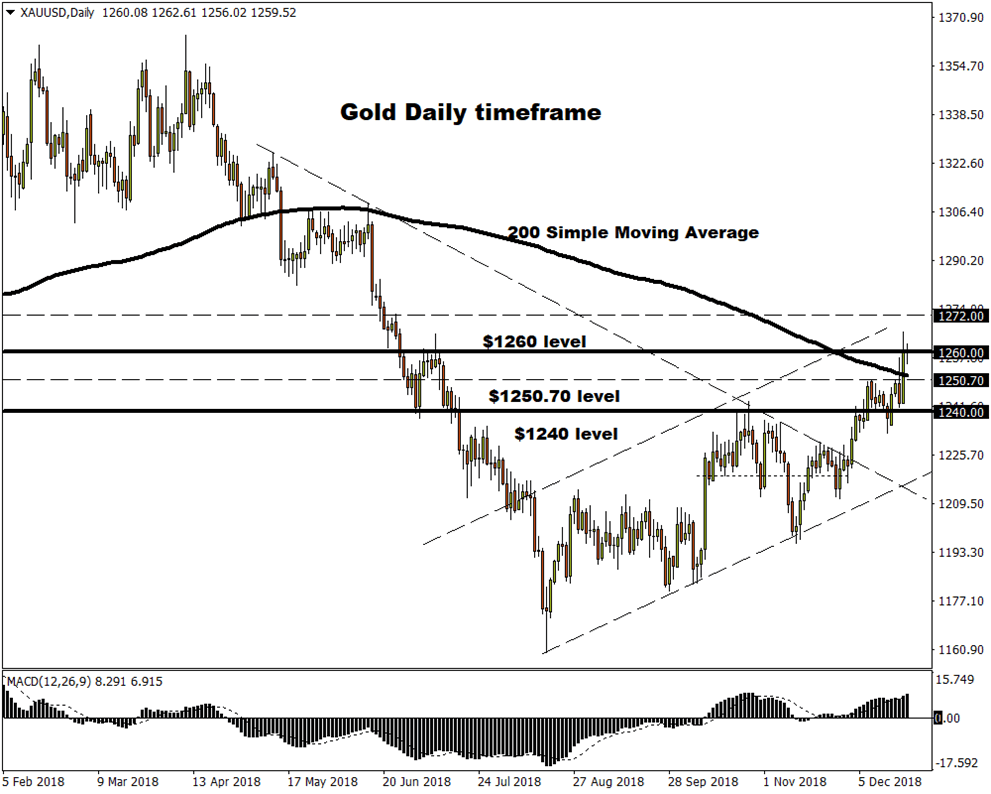
Gold has clearly benefited from the market chaos this week with prices trading around $1,260 as of writing.
The combination of Dollar weakness, volatile equity markets and expectations of fewer rate hikes in 2019 boosted buying sentiment towards the yellow metal. With prices already breaking above the $1,260 level, the next key level of interest can be found at $1,272. Gold has the potential to shine into 2019 if bulls are able to secure a yearly close above $1,260.
Canadian Dollar Steady ahead of US, Canadian GDPReports
USD/CAD has gained over 1 percent this week and continues to post gains on Friday. Currently, the pair is trading at 1.3535, up 0.21% on the day. Earlier in the day, the pair touched a high of 1.3541, its highest level since June 2017. On the release front, there are a host of key events on both sides of the border, so traders should expect some movement from the pair in the North American session. In the U.S., the highlight is Final GDP for the third quarter, with an estimate of a strong 3.5% gain. Durable good orders is expected to rebound with a gain of 1.6%. As well, the Core PCE Price Index, which is the Federal Reserve’s preferred gauge of inflation, is forecast to edge up to 0.2%. Will we see some improvement in Canadian data? Retail sales is expected to edge up from 0.2%, up from 0.1%, while the markets are counting on GDP rebounding with a gain of 0.2%, after a decline of 0.1% a month earlier.
The Canadian dollar has taken a beating since November, plunging 3.0% in that period. Turmoil in the equity markets in recent weeks has elevated risk apprehension and left investors with less enthusiasm for risk currencies like the Canadian dollar. Global trade tensions remain high, as U.S-China trade talks are yet to begin. The U.S. has said that it will impose further tariffs on China on March 1, unless the sides can reach agreement on a wide range of issues. It’s hard to see how an agreement can be reached in a matter of weeks, which could spell more trouble for the Canadian dollar in the New Year.
Another factor weighing on the Canadian currency is the sharp drop in oil prices. WTI Crude has fallen to $45 a barrel, as a recent OPEC cut in production failed to curb the downward spiral. Oil prices have fallen by 35% since mid-October, putting pressure on the Canadian dollar.
Investors reacted coolly to the Federal Reserve rate statement earlier this week. A rate hike had been expected, and the Fed delivered with a quarter-point hike, the fourth of the year. Investors were also looking for a Christmas gift from the Fed, in the form of a dovish rate statement. There was speculation that the Fed would “compensate” investors, given that the markets have been in turmoil for weeks and the U.S. economy appears to be cooling down.
However, the Fed was not in a giving mood, signaling that it plans to continue raising rates in 2019. Policymakers did not remove the phrase “further gradual increases” from their statement, and Fed Chair Jerome Powell added that the “lower end” of the neutral rate range has been achieved. Investors had counted on a more dovish stance from the Fed and responded with a thumbs-down, sending the Canadian dollar lower.
DAX – Market Volatility Continues On Disappointment Over Fed Statement
After sharp losses on Thursday, the DAX has rebounded with considerable gains on Friday. Currently, the DAX is at 10,585, up 0.54% on the day. On the release front, German GfK Consumer Confidence remained pegged at 10.4, edging above the estimate of 10.3 points. It’s a busy day in the U.S., highlighted by Final GDP for the third quarter, with an estimate of a strong 3.5% gain.
Equity markets have shown plenty of volatility in December, and this trend has continued this week. The catalyst was the Federal Reserve rate statement, which soured the markets and sent equities lower. Investors had expected a rate hike, which the Fed delivered. However, there was hope for a dovish rate statement, given that the markets have been in turmoil for weeks and the U.S. economy appears to be cooling down. Instead, policymakers maintained plans to continue raising rates. Most significantly, policymakers did not remove the critical phrase “further gradual increases” from their statement. At the same time, the dot plot forecast was lowered for 2019, from three rate rises to two.
Just a few months ago, the markets were predicting a “rate hike every quarter” for 2019, but the Fed has made a U-turn in monetary policy, as policymakers respond to economic data which is pointing to slower growth. The policy of gradual rate hikes bears much of the responsibility for the volatility in the markets, and the message from the Fed that more hikes are coming will likely mean that the volatility will continue in December and into the New Year.
EUR/USD – Euro Rally Takes Pause, Investors Eye U.S. GDP And Durable Goods Orders
EUR/USD has posted slight losses in the Friday session. Currently, the pair is trading at 1.1422, down 0.20% on the day. On the release front, German GfK Consumer Confidence remained pegged at 10.4, edging above the estimate of 10.3 points. It’s a busy day in the U.S., highlighted by Final GDP for the third quarter, with an estimate of a strong 3.5% gain. Durable good orders is expected to rebound with a gain of 1.6%. As well, the Core PCE Price Index, which is the Federal Reserve’s preferred gauge of inflation, is forecast to edge up to 0.2%.
The euro has climbed over 1.0% this week, and EUR/USD pushed close to the 1.15 line on Thursday. The dollar was broadly lower on Thursday, as investors reacted coolly to the Fed’s rate statement. The statement was less dovish than the markets wanted, as policymakers continued to stick with their policy of gradual increases. The Fed downscaled its forecast for rate hikes in 2019. from three hikes to two. Just a few months ago, the markets were predicting a “rate hike every quarter” for 2019, but the Fed has made a U-turn in monetary policy, as policymakers respond to economic data which is pointing to slower economic growth.
Aside from disappointment over the Fed statement, the euro also was boosted from an important development on the domestic front. Italy’s populist government has been on a collision course with the EU over its budget, which provides for hefty spending. The EU had argued that the budget breaches its financial rules and had threatened financial sanctions against Rome. However, the deadlock appears over, as the parties announced on Wednesday that Italy had agreed to lower its deficit target to 2.04%, down from its original target of 2.4%.
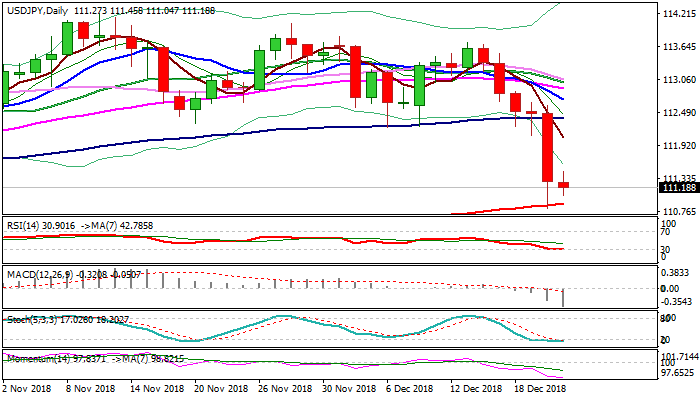
USD/JPY Outlook: The Dollar Consolidates After 1% Fall, Bears Look For Extension Below Key 200SMA/Fibo Supports
The pair consolidates after the biggest one-day fall since early Jan on Thursday.
Strong risk-off mode on growing concerns about global growth and fall in oil prices keep the dollar under pressure, with no positive impact from less dovish than expected Fed.
Strong bearish acceleration on Thursday was contained by key supports at 110.90/76 zone (200SMA/Fibo 38.2% of 104.63/114.54 ascend), where bears may take a breather on oversold daily studies and profit-taking after 1% fall on Thursday.
The pair is on track for the biggest weekly fall since early Feb, which could add to negative outlook.
Corrective upticks should be capped under 112.00/20 zone to keep bearish bias for renewed attack at 200SMA/Fibo pivotal supports, clear break of which would risk extension towards psychological 110.00 support at 109.77 (21 Aug trough).
Res: 111.45, 112.04, 112.20, 112.46
Sup: 110.90, 110.76, 110.00, 109.77