

Sample Category Title
(ECB) Monetary Policy Decisions
At today's meeting the Governing Council of the European Central Bank (ECB) decided that the interest rate on the main refinancing operations and the interest rates on the marginal lending facility and the deposit facility will remain unchanged at 0.00%, 0.25% and -0.40% respectively. The Governing Council expects the key ECB interest rates to remain at their present levels at least through the summer of 2019, and in any case for as long as necessary to ensure the continued sustained convergence of inflation to levels that are below, but close to, 2% over the medium term.
Regarding non-standard monetary policy measures, the net purchases under the asset purchase programme (APP) will end in December 2018. At the same time, the Governing Council is enhancing its forward guidance on reinvestment. Accordingly, the Governing Council intends to continue reinvesting, in full, the principal payments from maturing securities purchased under the APP for an extended period of time past the date when it starts raising the key ECB interest rates, and in any case for as long as necessary to maintain favourable liquidity conditions and an ample degree of monetary accommodation.
The President of the ECB will comment on the considerations underlying these decisions at a press conference starting at 14:30 CET today.
DAX: Stays Capped Below 11,000
- ECB is expected to confirm an end to the asset purchases program,
- All policy rates are expected to remain at current levels until summer 2019 (Main Refinancing at 0%, deposit facility at -0.4%, and marginal lending facility at 0.25%),
- And all the eyes will be on ECB’s economic indicators forecast. Taking into consideration the latest deterioration in the Eurozone data, the ECB is likely to which we believe they will downgrade their GDP and Inflation projections (dovish) taking into consideration the latest deterioration in the Eurozone data.
DAX
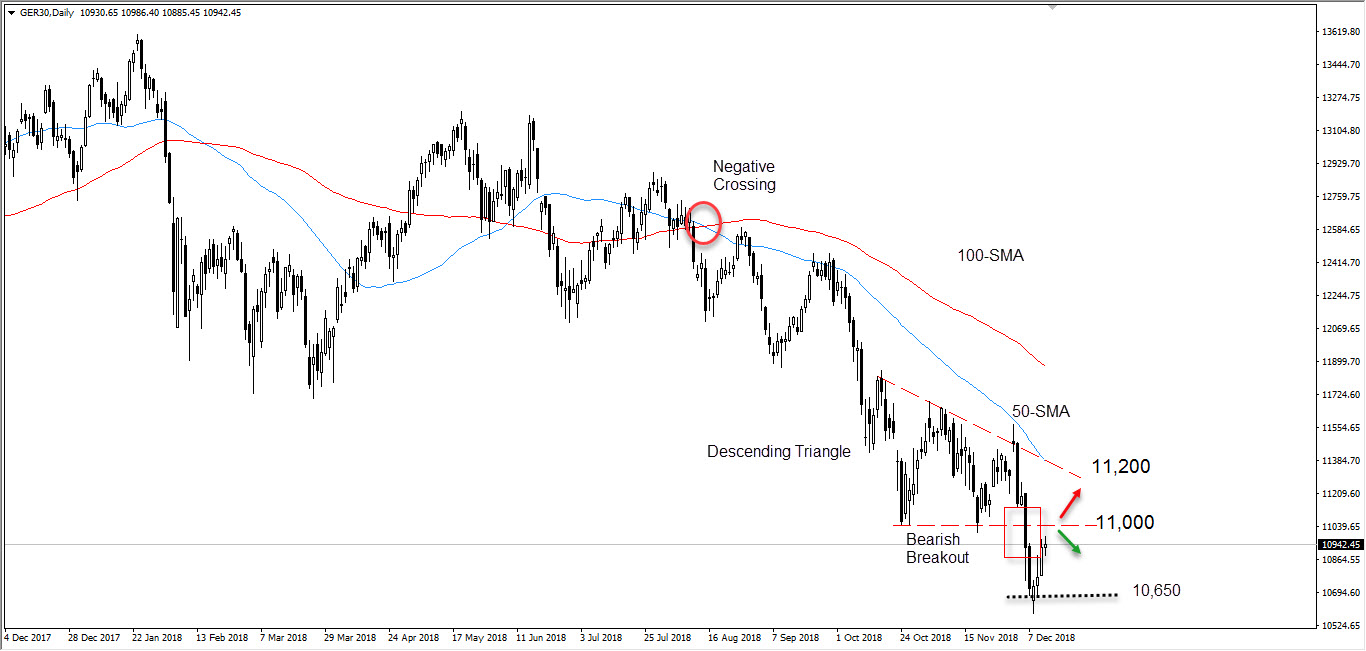
Prices are holding up well this morning, but a push through the 11,000 resistance regions is needed to suggest further gains toward the major level at 11,200.
However, the bias remains bearish on Dax as the market is trading below the 11,000 mark. So, we expect an eventual test down and through the previous lows at 10,650 is a likely scenario to look out for.
DAX Drops As German CPI Dips, ECB Meeting Next
The DAX index has lost ground in the Thursday session. Currently, the index is at 10,932, down 0.43% on the day. In economic news, investors are keeping a close eye on the ECB, which holds its policy meeting and is scheduled to wind up its stimulus program. German Final CPI dropped to 0.1%, matching the estimate. On Friday, Germany and the eurozone release manufacturing PMIs.
Last week was dismal for the equity markets, and the DAX lost plunged 6.4 percent. Risk apprehension has subsided this week, and the DAX has responded with gains of 2.1 percent. Although the U.S. and China remain embroiled in a nasty trade war, the markets moved higher after U.S. and Chinese trade negotiators spoke by telephone. China’s economy has been weakened by the trade war, raising hopes that the Chinese will be more flexible in trade talks with the United States. However, the arrest of a senior executive of a Chinese technology company in Vancouver and the angry Chinese response is the latest obstacle which could put a cloud over the talks.
After three years of stimulus, the ECB is expected to finally wind up the bank’s bond purchase program at the Thursday policy meeting. Through the program, the ECB purchased some 2.5 trillion euros in assets. The program was implemented in order to kick-start the economy and raise ultra-low inflation levels. Inflation has moved closer to the ECB target of around 2 percent, and the eurozone economy performed well earlier in the year. This prompted the ECB to announce that it would wind up the program in December. However, economic conditions have deteriorated in recent months, as the nagging U.S.-China trade war has weighed on the global economy and hurt the export and manufacturing sectors in Germany and the eurozone. Although the timing may not be ideal, the ECB is likely to stick with its pledge to wind up stimulus, since a change in stance would severely hurt its credibility. At the same time, the ECB is expected to fully reinvest the proceeds and maintain its bond holdings as long as is needed, in order to boost inflation. The ECB target of around 2 percent has remained elusive, and weak economic activity in the eurozone in the second half of the year is weighing on inflation levels.
EUR/USD – Euro Steady Ahead Of ECB Meeting
EUR/USD has is steady in the Thursday session. Currently, the pair is trading at 1.1380, up 0.10% on the day. The ECB holds its policy meeting and is expected to wind up its stimulus program. German Final CPI dropped to 0.1%, matching the estimate. In the U.S., the key event is unemployment claims, which is expected to drop to 226 thousand. On Friday, Germany and the eurozone release manufacturing PMIs, and the U.S. will publish retail sales reports.
After three years of stimulus, the ECB is expected to finally wind up the bank’s bond purchase program at the Thursday policy meeting. Through the program, the ECB purchased some 2.5 trillion euros in assets. The program was implemented in order to kick-start the economy and raise ultra-low inflation levels. Inflation has moved closer to the ECB target of around 2 percent, and the eurozone economy performed well earlier in the year. This prompted the ECB to announce that it would wind up the program in December. However, economic conditions have deteriorated in recent months, as the nagging U.S.-China trade war has weighed on the global economy and hurt the export and manufacturing sectors in Germany and the eurozone. Although the timing may not be ideal, the ECB is likely to stick with its pledge to wind up stimulus, since a change in stance would severely hurt its credibility. At the same time, the ECB is expected to fully reinvest the proceeds and maintain its bond holdings as long as is needed, in order to boost inflation. The ECB target of around 2 percent has remained elusive, and weak economic activity in the eurozone in the second half of the year is weighing on inflation levels.
Eurozone PMIs Expected To Turn Higher In December But Outlook Remains Clouded
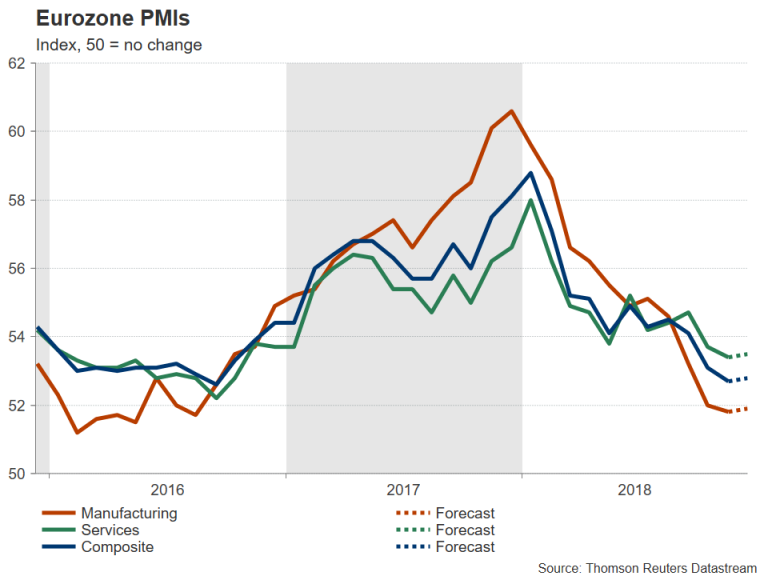
The Eurozone's flash PMIs from IHS Markit will be hitting the headlines on Friday at 0900 GMT. The closely watched indicators of economic activity in the euro area have been pointing downwards since the turn of the year, but there have been some signs lately that growth is at a turning point. While the euro stands to gain from any upturn in growth, Italy and Brexit woes are likely to limit any significant rebound in the currency.
The composite PMI, which combines both the manufacturing and services PMIs, fell to a two-year low of 52.7 in November as growth in the bloc's largest economy, Germany, slowed to a four-year trough. Italy was another underperformer but the PMIs for other Eurozone countries were more encouraging, with output up in France, Spain and Ireland.
However, even in Germany, whose economy contracted by 0.2% in the third quarter, appears to be seeing some sort of a turnaround. Exports from Germany rebounded by more than expected in October, while industrial output posted a surprise increase during the same month. German business confidence is also improving, with the ZEW economic sentiment for December beating analysts' expectations. The recent easing of Sino-US trade tensions could be one of the factors contributing to the brightening outlook.
The Eurozone composite PMI is forecast to inch up to 52.8 in the preliminary reading for December, with the manufacturing and services PMIs expected to rise by 0.1 percentage points each to 51.9 and 53.5, respectively.
But even if the current trade truce between China and the US was to lead to a more permanent and enhanced trade arrangement between the two countries, there are several risks closer to home still weighing on investor morale in the euro area. The potential dangers to the Eurozone economy from Britain crashing out of the EU without a deal, Italy not backing down on its plans to raise its 2019 budget deficit target, and the US imposing higher tariffs on European car imports have not fully subsided and are very much present.
This implies traders will want to see more evidence that growth is recovering before concluding that the Eurozone is out of the woods. The political uncertainties, weakening growth outlook and possibility of higher US trade barriers have recently dragged the euro to 16½-month lows even as the European Central Bank prepares to end its asset purchases at the end of December.
A positive surprise in the PMI figures could help the single currency break above the nearest key resistance at the $1.14 handle. Clearing this hurdle would open the way for the next major obstacle – the 38.2% Fibonacci retracement of the downleg from $1.1815 to $1.1213, at $1.1443. Higher up, the 50% Fibonacci could be targeted by the bulls at $1.1514.
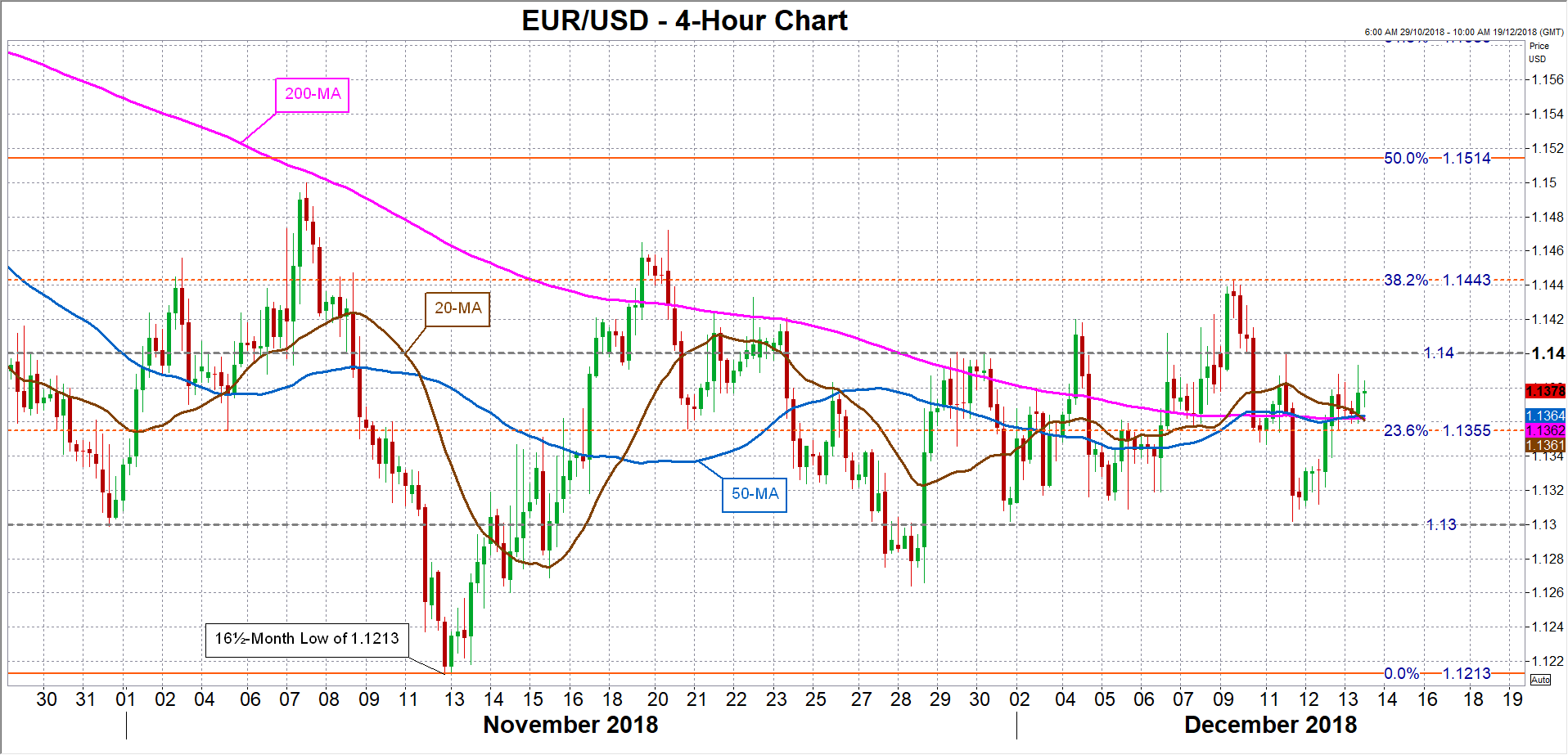
However, another miss in the Eurozone PMIs would deepen the gloomy sentiment for the region and could pull the euro below the immediate support zone between the moving averages around $1.1362 and the 23.6% Fibonacci retracement at $1.1355. A dip below this region would bring into scope the psychological $1.13 level, while sharper losses would risk a breach of the 16½-month low of $1.1213 set in November.
GBPUSD Testing Critical Resistance Level
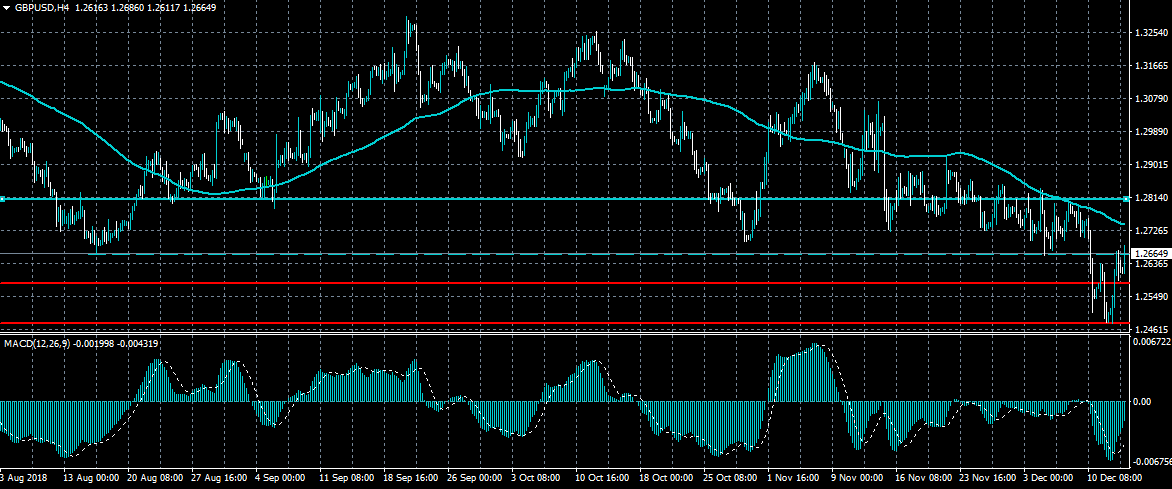
The British pound has continued to advance against the US dollar during the European trading session, as sterling stages a relief rally after British Prime Minister Theresa May survived Wednesday’s leadership challenge. The GBPUSD pair is currently probing the neckline of the bearish head and shoulders pattern, at 1.2657. If bulls can hold price above this key area, further advancement towards the 1.2730 level appears possible.
The GBPUSD pair is only bearish while trading below the 1.2657 level, key technical support is found at the 1.2600 and 1.2500 levels.
If the GBPUSD pair trades above the 1.2657 level, key resistance is found at the 1.2730 and 1.2800 levels.
USDJPY Losing Bullish Momentum
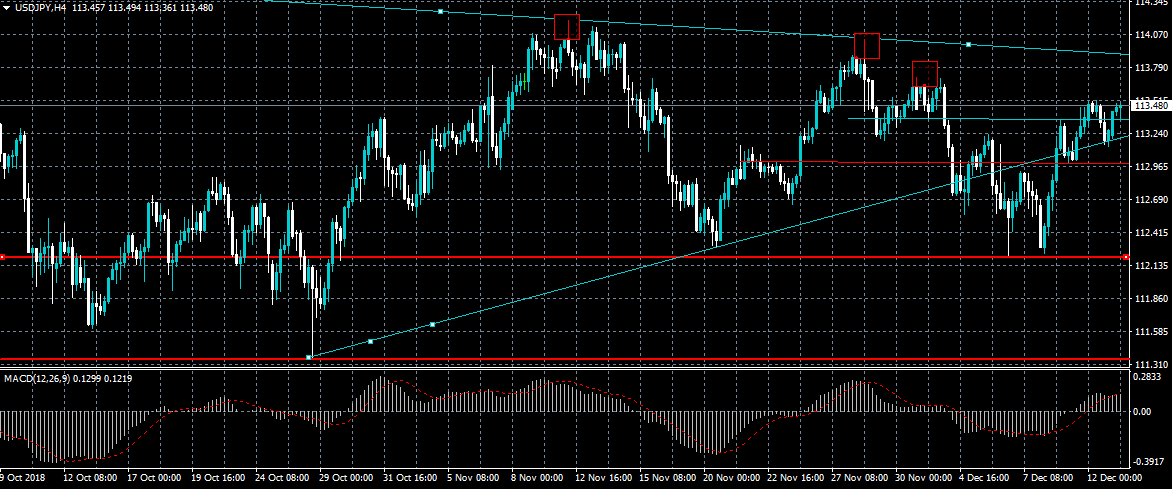
The US dollar is consolidating around the best level of the trading week against the Japanese yen currency, as demand grows for riskier asset classes. The USDJPY pair is starting to lose bullish momentum, as buyers struggle to reach the 113.70 resistance level. The Moving Average Convergence Divergence indicator is also showing signs of upside exhaustion on the four-hour time frame.
The USDJPY pair is only bullish while trading above the 113.20 level, key resistance is found at the 113.70 and 114.00 levels.
If the USDJPY pair trades below the 113.20 level, key support is found at the 112.90 and 112.50 levels.
Pound Sterling Odds Of Parity Slashed
Thursday December 13: Five things the markets are talking about
Euro equities have relinquished early gains while U.S futures and Asian stocks advanced as capital markets weigh up the latest progress in Sino-U.S trade relations.
Sterling (£1.2658) remains somewhat better bid after the U.K’s PM, Theresa May, survived an attempt to oust her (200 vs. 117). She is expected to travel to Brussels today to attempt to salvage a Brexit deal with her authority under question and her party bitterly divided.
The PM continues to face hardened opposition to her Brexit deal at home. It remains “nearly impossible” to predict the Brexit outcome, but most scenarios point to continued political infighting, sterling volatility and weak business investment resulting from the ongoing uncertainty.
Global trade tensions have eased a tad, as China reiterated its officials have been in close contact with U.S counterparts on negotiating details of a deal, and after resuming purchases of American soybeans.
The EUR (€1.1377) has found support after Italian PM Conte said he would propose a significant cut to the country’s budget deficit target for 2019 in a bid to avoid sanctions from Brussels for breaching E.U rules. Italy will now aim for a deficit of +2.04% of GDP, down from +2.4%, the level, which it had previously earmarked for 2019.
The ‘big’ dollar has steadied against G10 currency pairs, while sovereign bond prices have drifted higher after overnight losses and crude prices remain under pressure on renewed fears of a global glut.
On tap: The ECB is expected to end asset purchases at its final policy meeting of this year this morning (07:45 am EDT). Elsewhere, China industrial production and retail sales data for November is due tomorrow.
1. Stocks mixed results
In Japan, equities touched a one-week high overnight with sentiment lifted by signs of reduced Sino-U.S trade tensions, and technology firms got a boost from a rally for U.S peers. The benchmark Nikkei share average ended the session up +0.99%, while the broader Topix rallied +0.62%.
Down-under, Aussie shares closed slightly higher, supported by gains in miners as market sentiment improved after China took steps to ease trade tensions with the U.S. The S&P/ASX 200 index ended the session up +0.1%, the third consecutive day of gains. In S. Korea, the Kospi was up +0.62%.
In China, stocks rallied overnight as expectations of further policy measures to aid the economy led to gains across the board. The blue-chip CSI300 index ended up +1.6%, while the Shanghai Composite Index rallied +1.2%.
In Hong Kong, equities finished higher on Thursday as signs of easing Sino-U.S trade tensions and on expectations of stronger policy support for China’s cooling economy. At the close of trade, the Hang Seng index was up +1.3%, while the China Enterprises Index also gained +1.3%.
In Europe, regional bourses trade mixed following two straight days of strong gains. U.S index futures trade higher, while Brexit worries return to focus.
U.S stocks are set to open in the ‘black (+0.18%).
Indices: Stoxx600 -0.15% at 349.48, FTSE -0.02% at 6,878.97, DAX -0.05% at 10,924.24, CAC-40 -0.05% at 4,907.04, IBEX-35 +0.53% at 8,900.00, FTSE MIB +0.38% at 19,017.50, SMI +0.07% at 8,848.50, S&P 500 Futures +0.18%
2. Crude prices steady as Sino-U.S trade tensions ease
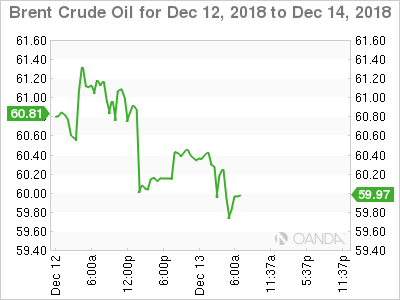
Oil prices have steadied overnight, under pressure from high inventories, but supported by a drawdown in U.S crude inventories and on signs that the Sino-U.S trade war may be easing.
Brent crude oil is unchanged at +$60.15 per barrel, while U.S light crude is steady at +$51.15.
Global supply of the ‘black stuff’ has outstripped demand over the last two quarters, inflating inventories and pushing crude prices to its lowest level in 12-months at the end of November.
Note: OPEC and other big producers, including Russia, agreed last week to reduce supply to try to trim the surplus.
A drop in U.S. crude inventories this week is also supporting prices. EIA data yesterday showed that U.S crude inventories fell by -1.2M barrels in the week to Dec. 7, compared with expectations for a decrease of -3M barrels.
An EIA statement said that “the oil market should gradually rebalance and move into a supply deficit by Q2, 2019, if OPEC and the other large producers stick to their deal last week to reduce output.”
OPEC said yesterday that demand for its crude in 2019 would fall to +31.44M bpd, -100K bpd less than predicted last month and +1.53M bpd less than it currently produces.
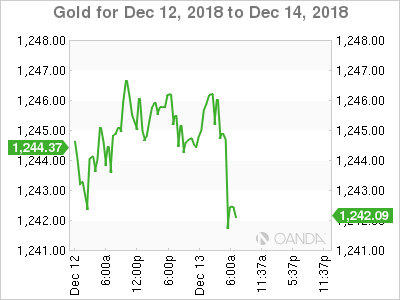
Ahead of the U.S open, gold was little changed overnight as the ‘big’ dollar steadied and stocks rallied. Spot gold was steady at +$1,245.55 per ounce, while U.S gold futures were up +0.1% at +$1,251.2 per ounce.
3. Central bank monetary policy
No surprises from the Swiss National Bank (SNB) this morning as it kept its deposit rate at -0.75% and continued to say the CHF ($1.1285) was “highly valued” while repeating its longstanding willingness to intervene in currency markets if needed. The market expects the SNB to stay on hold well into next-year. In its policy statement there was a reduction in its 2019 inflation forecast to +0.5% from +0.8% and a cut to its 2020 forecast to +1% from +1.2%. The bank cited lower oil prices and a more moderate economic growth outlook.
Later this morning, the European Central Bank’s (ECB) last meeting of the year should confirm that its +€2.7T asset purchase programme (APP) will be terminated at the end of the month. Recent, disappointingly soft, economic data may not have been overly supportive of such a move, but there seems to be a clear consensus that there is no longer the need to provide additional monetary stimulus every month. Expect ECB President Draghi to emphasise that the central bank’s stance will remain very accommodative and also flexible in respect to the incoming economic data.
In Norway, Norges central bank kept rates steady at +0.75%, as expected, and the decision was unanimous. They reiterated that the outlook and balance of risks imply a gradual interest rate increase in the years ahead. They see the next rate increase as most likely in Mar 2019 as underlying inflation is close to the inflation target of +2%. The fall in oil prices suggests that wage growth may also be lower than projected in the period ahead.
In Turkey, Central Bank of the Republic of Turkey (CBRT) leaves the one-week repo rate at +24%, as expected. They reiterated that could deliver additional tightening if needed and that factors affecting inflation will be closely monitored.
4. Pound sterling odds of parity slashed
PM May has survived a confidence vote, but this does not yet mean her Brexit deal will get through parliament – sterling still faces the prospect of a ‘no deal’ Brexit taking place in March 2019. GBP (£1.2655) has extended its rally, +0.3% ahead of the NY open. In the U.K, bookies are quoting at 6/1 that the EUR/GBP exchange rate trades at €1.0 by the time January is upon us, this is down from odds of 9/1 earlier in the week.
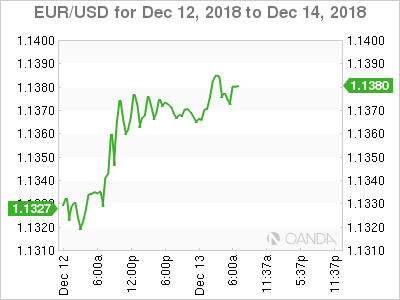
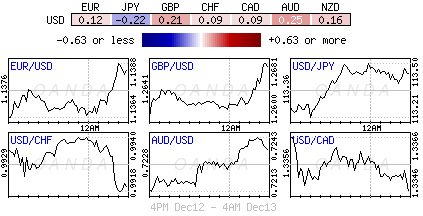
EUR/USD is little changed at €1.1375 ahead of the ECB rate decision. Draghi is expected to announce that QE is to end this year, and reaffirm his intent to hike rates after next summer. The market will also be focusing on the new staff forecasts. With the ECB likely to recognize the ongoing slowdown in Q4, we could see some very minor tweaks to the growth and inflation forecasts.
Elsewhere, the Japanese yen has dipped -0.1% to ¥113.45, the weakest in more than a week.
5. China’s FDI falls
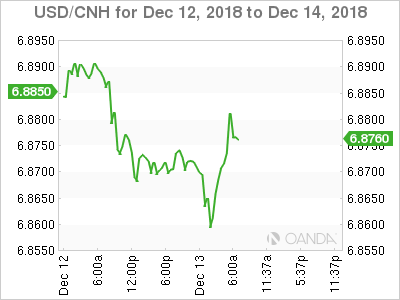
Data overnight showed that China’s foreign direct investment (FDI) into China fell -1.3% in the first 11-months of the year to ¥793.27B from a year earlier.
In November, FDI into China dropped -26.3% y/y to ¥92.11B and in the January-November period, foreign direct investment into China from the U.S increased +3.7% from a year earlier.
EUR/USD Climbs To 1.1420 Level
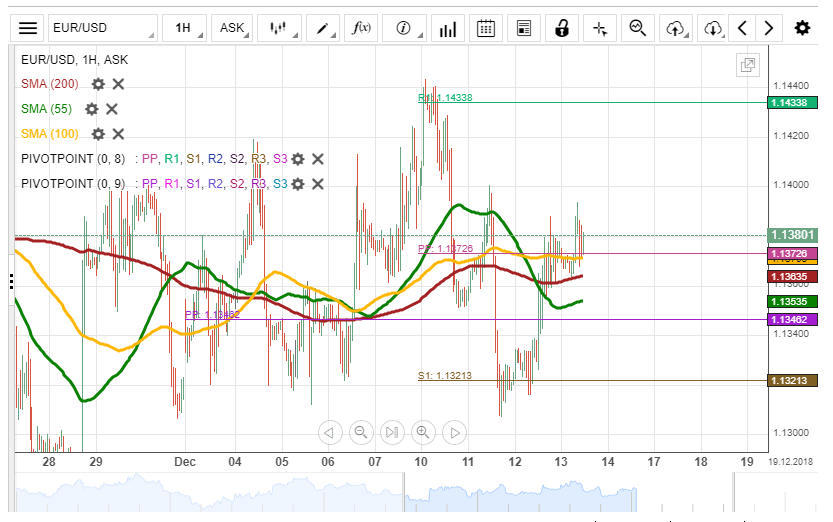
During Wednesday's trading session, the European Single Currency broke most of the technical indicators to pierce the weekly PP at the 1.1368 mark . On Thursday, the rate was supported by the 100-hour SMA to trade at the 1.1380 level.
In regards to the near-term future, it is expected that the European Single Currency will continue to surge upwards to trade near the weekly R1 at 1.1438 mark. The 100-hour simple moving average will support the surge during the trading session.
On the other side, the European Single Currency could depreciate against the US Dollar during today's EU Main Refinancing Rate release at 12:45 GMT to push the currency exchange rate to trade near the monthly pivot point at the 1.1346 mark.
GBP/USD Will Trade In The Pattern
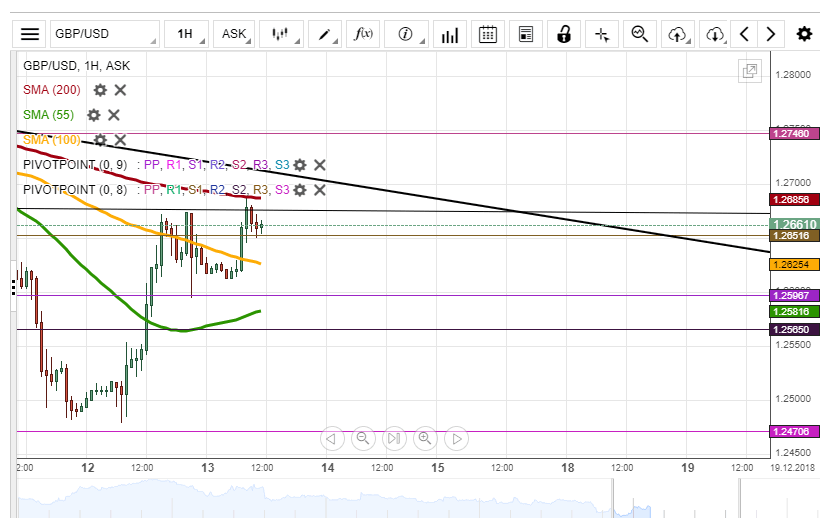
During Wednesday's trading session, the currency exchange rate was resisted by the 100-hour to end the trading session at the 1.2631 mark. During Thursday's morning hours, the British Pound broke the resistance of the 100-hour simple moving average to trade at the 1.2682 mark.
In regards to the near-term future, most likely, the 200-hour SMA will try to resist the currency exchange rate to push the rate to trade sideways during the trading session on Thursday. Besides, it is expected that the British Pound will continue trading in the medium pattern at the 1.2555 level.
On the other side, the British Pound could break the resistance of the 200-hour simple moving average to trade above the weekly pivot point at the 1.2750 level
 .
.