Sample Category Title
Another Patchy Session On Wall Street
Markets
Another patchy session on Wall Street overnight as despite the recent bearishness regarding US-China tensions unwinding, the market is back fretting about global growth after the ECB painted a less than rosy picture about the Eurozone economy while expressing grave concerns about economic growth slowdown. Mario Draghi didn’t even attempt to blur the lines when he suggested the balance of risks to the euro recovery was tilting to the downside, in the face of protectionism and political uncertainty.
Indeed, even though the Eurozone runs a large current account surplus, foreigners have been substantial net sellers of European equities and the Euro for that matter for those specific reasons.
Oil Markets
The petroleum markets have turned higher again in New York trade testing above the $53 WTI, amid the ongoing debate whether last week’s OPEC+ production cuts for 2019 were enough to support a price recovery.
While tirelessly crunching the latest IEA data, traders are focusing on a couple of critical assumptions.
The International Energy Agency monthly report provided another viewpoint, with its 415,000-bpd downward revision to non-OPEC supply for 2019 raising its projected call on OPEC crude oil to 31.7 mmbpd.
Also, the possibility of unplanned outages resulting in a broader drop in OPEC supply, with Iran and Venezuela, not surprisingly topping the risk list. Its thought these possible outages could effectively double down on the OPEC production cuts from last week.
On a separate bullish fillip, unnamed sources suggested Saudi Arabia is set to target the US with an acute export cut. After swamping markets with oil in November, OPEC is serious about reversing the supply glut while risking the ire of Trump on this one.
Interesting, this curious announcement comes on the heels of the US having its first taste of energy independence since 1940 after when US oil moved into net export territory last week.
But indeed, it’s a fickle market, and I suspect it won’t take much to wipe that bull smile away in a hurry given that risk sentiment can pivot on a dime on any negative trade headline. US-China trade war has been a huge negative for global growth. And by extension oil prices as well.
Gold Market
USD remains an essential driver for gold price action so Gold prices pulled back from the top of recent ranges as the dollar gained against the EUR after a slightly dovish ECB statement.
And despite a slightly more positive outlook on US-China trade, Gold should hold a bid into next week FOMC as bullish tactical plays come to the fore expecting the Fed to wax dovish and send the dollar lower. This view is supported by the plethora of recent dovish comets from the Fed
Again few clear signals as we move into Asia trading session but I suspect position squaring will dominate today price action.
Currency Markets
Euro
The ECB was entirely in line with expectations. All boxes were ticked: rates left unchanged, the asset purchase program would come to an end this month and monetary policy guidance was left unchanged as “at least through the summer of 2019”. The ECB also noted that it would fully reinvest QE proceeds for an extended period after the first-rate rise. The Euro fell but is trading off overnight lows as trader’s position for December FOMC meeting which does undoubtedly offer up a cunning opportunity to express bearish USD views after an expanded chorus of Fed members, including Jay Powel, have been lyrically dovish.
Forget the ECB who checked all the expected boxes, what’s critical for the EUR near-term sentiment is Friday’s Eurozone PMI numbers. The most important driver for the EUR has been weak EU economic growth so any positive glean for today EU PMI will be seized upon instantly as a definite shift in this growth metric is the most important signpost for the Euro.
Japanese Yen
Volumes are very low in USDJPY suggesting it remains a very low conviction trade. While differentials look attractive but let’s face it, rate differentials have been an inferior driver of FX throughout the year. Cross Yen continues to trade well on the back of positive US-China developments.
The Malaysian Ringgit
I must admit I’m a bit surprised the Ringgit hasn’t traded with a more positive bias as US-China trade tensions improve while the local unit should find support form a probable Fed pause in 2019. Indeed caught in year-end malaize with local investors now fretting over oil markets 2019 outlook
Eco Data 12/14/18
[php_everywhere instance="1"]
US Retail Sales in Focus as Fed Meeting Comes into View
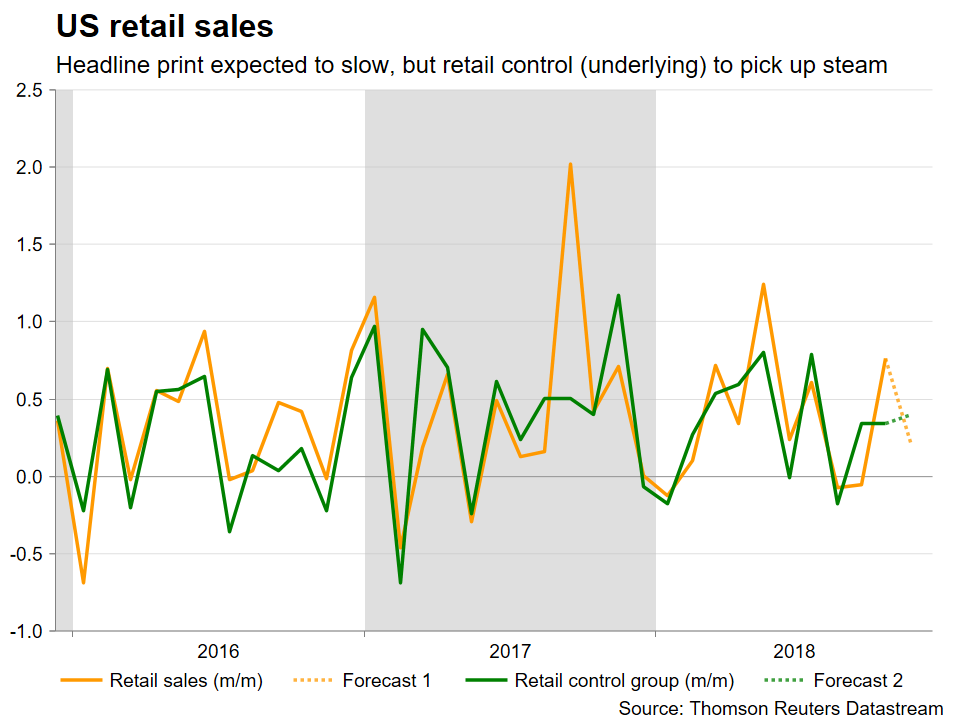
The US will see the release of its latest retail sales figures on Friday, at 1330 GMT. This will be the final tier-one data set ahead of the Fed’s highly anticipated meeting next week, so it may prove especially important for the dollar.
Retail sales are expected to have slowed to 0.2% m/m in November, from 0.8% previously. Likewise, the core print that excludes automobile sales is expected to rise by 0.2%, after clocking in at 0.7% in October. Yet, a ray of hope is provided by the retail control group – the measure that excludes autos, gasoline, and construction materials, and which is used in GDP calculations. That is anticipated to have ticked up to 0.4% in monthly terms, from 0.3% previously. If confirmed, it would signal that the anticipated weakness in the other metrics is owed mainly to volatile items, and thus isn’t an ominous sign for economic growth.
Turning to the greenback, it has held up quite well recently, with the dollar index trading near 18-month highs, even despite a considerable dovish repricing in Fed rate hike expectations. Markets have grown skeptical of whether the Fed will actually raise rates at all next year in the face of a slowing economy, to the point where Fed funds futures now suggest a mere 70% probability for just one quarter-point hike for the whole of 2019.
The currency’s resilience in such conditions suggests it may not require much support from monetary policy to stay in demand, especially since most of its major peers are facing troubles of their own, and hence aren’t particularly attractive at this stage.
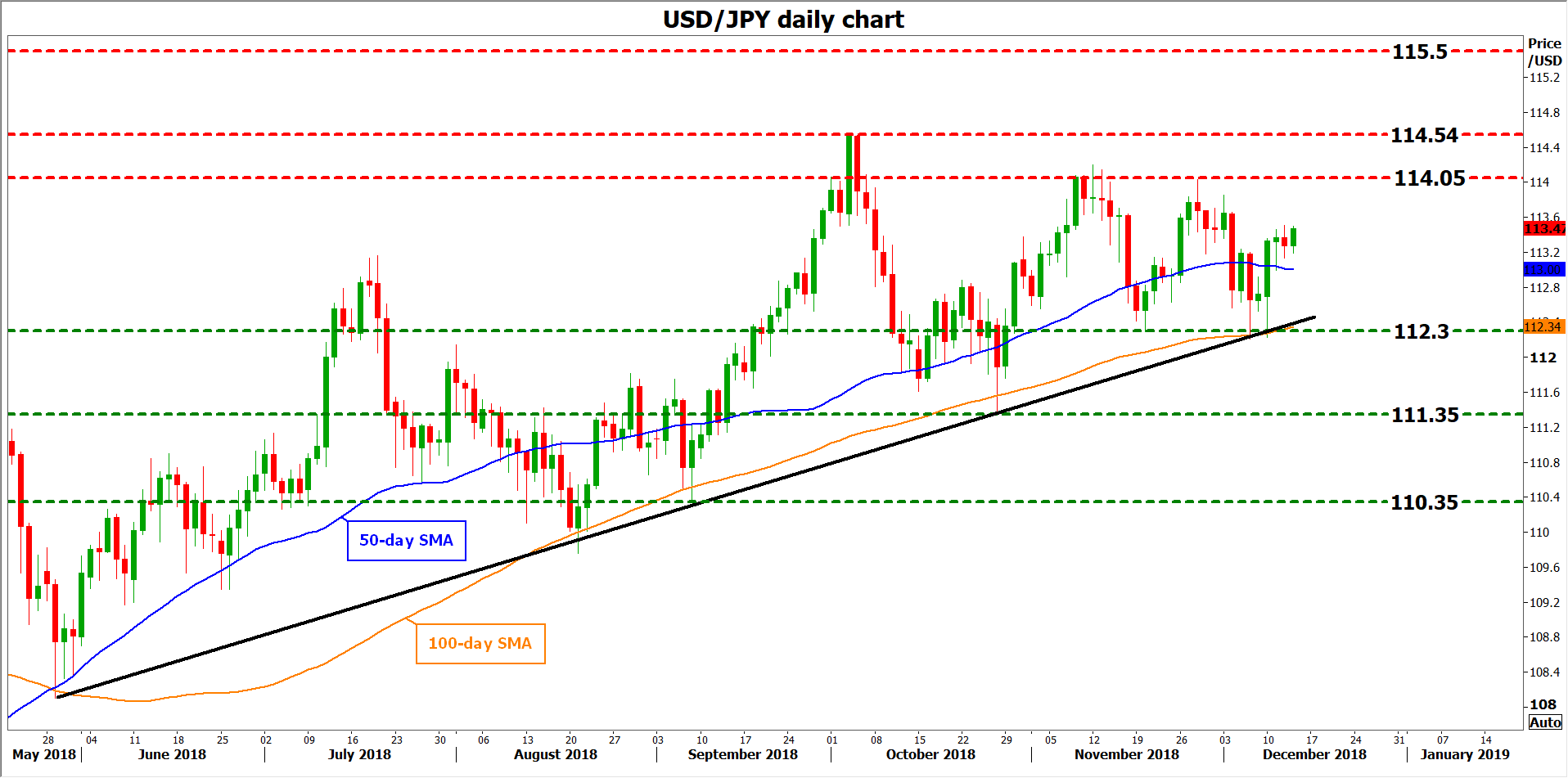
A solid set of data could make investors more confident that a rate increase next year will indeed take place, and perhaps help the dollar regain some ground. Looking at dollar/yen technically, resistance to advances may be found at 114.05, the high of November 28, before the 1-year peak of 114.54 comes into view. Even higher, the top of March 2017 at 115.50 would attract attention. On the other hand, immediate support to declines may come near the 50-day simple moving average (SMA), at 113.00. A downside break could open the way for a test of 111.35, the October 26 low.
In the big picture, the signals the Fed sends next week will probably be the most crucial determinant for the currency’s direction. Assuming the central bank does raise rates as expected, attention will turn to the 2019 rate projections, where investors seem to anticipate a downward revision to signal two hikes during that year, from three currently. Note, however, that the risk of those projections remaining unchanged at three hikes may be greater than perceived, as survey-based measures of the economy like the ISM PMIs remain at very healthy levels, while “hard” economic data have not really deteriorated much. The implication is that if the Fed “stays the course”, the dollar could soar.
Aussie Looks to Key Chinese Data as Trade Talks Remain in the Spotlight
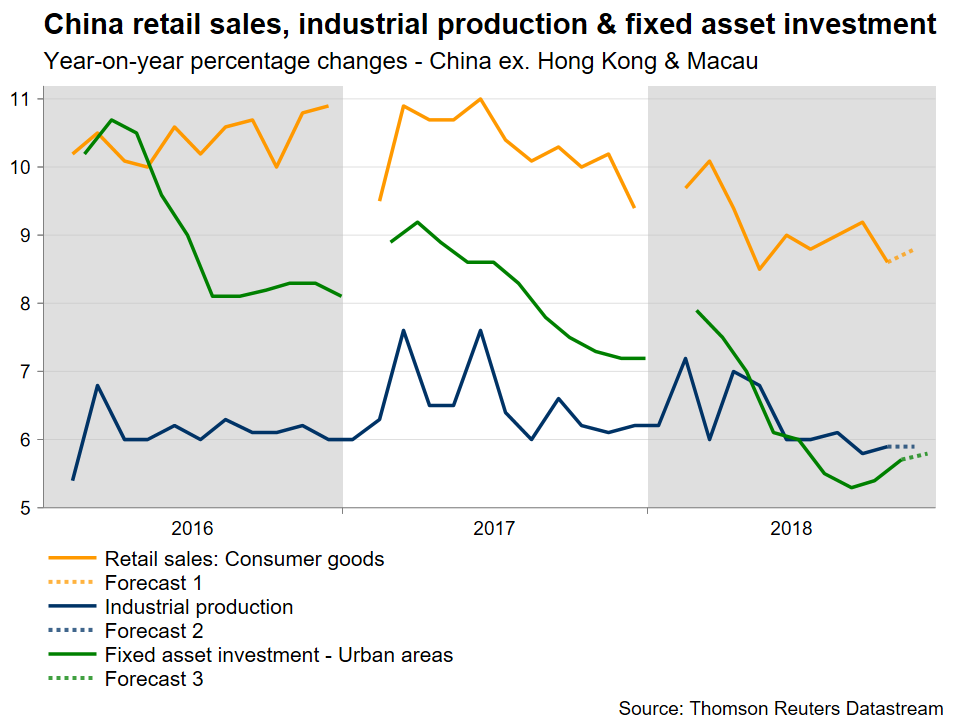
China’s latest industrial production, retail sales, and fixed asset investment figures will hit the markets early on Friday, at 0200 GMT. Forecasts point to an acceleration in the latter two, which may alleviate some worries around a slowdown in economic growth, and potentially help the yuan and the “China-sensitive” aussie to recover some ground. In the bigger picture, the most crucial variable for both currencies may be how US-China trade talks evolve.
The Chinese economy has slowed somewhat in recent quarters, generating concerns that the trade standoff with the US is already impacting growth; worries that Chinese authorities sought to address by announcing plans to ease both monetary and fiscal policy. Hence, investors will be monitoring incoming economic data closely, for signs of whether this pattern is continuing, or abating.
In November, the nation’s retail sales are forecast to have accelerated to 8.8% in yearly terms, from 8.6% previously. Likewise, fixed asset investment is projected to have risen by 5.8%, after clocking in at 5.7% in October. Meanwhile, industrial production is anticipated to have grown at 5.9%, the same pace as previously.
An overall strong set of prints could calm some concerns around a further slowdown in Chinese growth, and thereby help the yuan – as well as the Australian dollar – to recover some poise. The aussie is usually viewed as a liquid proxy for “China plays”, given the close trading relationship between the two economies. Speculators often favor it over the yuan, as shorting the Chinese currency for instance implies taking on the added risk of being caught on the wrong side of policy intervention by the nation’s authorities.
Beyond economic data, the other – and likely more important – determinant for these two currencies will be how trade talks between the US and China play out. Despite encouraging signals lately suggesting China is considering to open its economy further to foreign firms, it’s probably too early to confidently say that these negotiations will indeed bear fruit. It remains to be seen whether any concessions China makes, particularly on forced technology transfer and intellectual property protection, will be enough to appease the US administration.
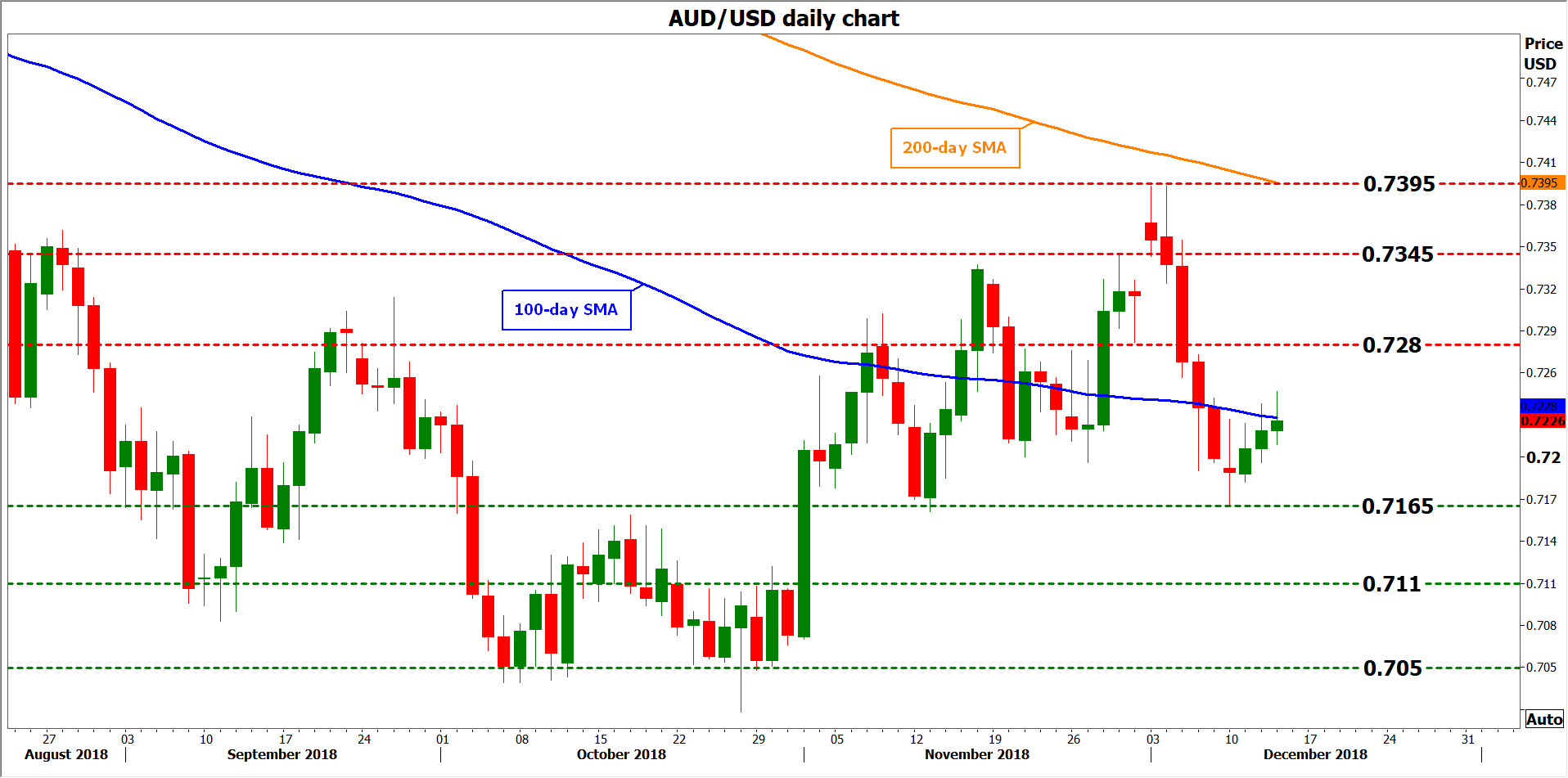
Looking at aussie/dollar technically, immediate resistance to advances may be found near the 0.7280, marked by the inside swing low on November 30. Even steeper bullish extensions could aim for the 0.7345 zone – defined by the November 29 peak. On the flipside, initial support to declines could come around the December 10 low at 0.7165, before the inside swing high of October 29 at 0.7110 comes into view.
Sunset Market Commentary
Markets
Global core bonds gained ground ahead of the ECB meeting as the recent rebound in risky assets slowed. Asian equities closed today’s session in green, but more caution kicked in as Europe joined trading. With no economic data to steer traders, EU equity indices alternate in green and red throughout the day. The German Bund moved sideways awaiting the ECB rate decision and president Draghi’s press conference afterwards. The ECB didn’t alter its policy rate (as widely expected). President Draghi said that risks remained “broadly balanced”, but added this time that the balance of risks is moving to the downside. Next, the ECB lowered its GDP forecast to 1.9% this year (vs. 2.0% previously) and 1.7% in 2019 (vs. 1.8%), while the inflation forecast was little up. The end of the APP program was officially announced, but the bank promised to keep reinvesting maturing bonds without specifying for how long. In the end, nothing really changed except a slightly more cautious tone. Draghi succeeded as markets hardly moved. The German yield curve edged lower with changes ranging from -1.3 bps (10-yr) to -2.4 bps (5-yr). Little eco data in the US as well to guide trading today, except for the jobless claims. Claims dropped from 233k in October to 206k in November but didn’t affect bond trading. US yield curve currently moves south. Changes range from -0.6 bps (2-yr) to -1.4 bps (5-yr). Peripheral spreads are close to unchanged.
Trading in the EUR/USD cross rate was an area of calm of late and the ECB policy and press conference were not able to unlock the EUR/USD stalemate. The ECB slightly revised down the 2018 and 2019 growth forecast. The ECB president described the risk to the outlook as broadly balanced, but moving to the downside. Draghi summarized the ECB assessment as ‘continuing confidence with increasing caution’. This assessment was hardly a surprise for markets. The ECB also maintains the capital key as the reference for its reinvestment policy. The fact that there was no concession at all in favour of peripheral countries maybe was also a marginal euro negative. EUR/USD trades currently in the 1.1340. So, the ECB press conference clearly isn’t a EUR/USD game-changer. USD/JPY is also gaining a few ticks. US jobless claims falling back to the a low 206 000 maybe was a marginal USD supportive, too. USD/JPY is trading in the 113.60 area.
Sterling regained some ground yesterday as markets anticipated that PM would ‘survive’ the confidence vote within her own party. This assessment turned out to be true and May’s survival removed the risk of a highly disorderly political development. The sterling rebound slowed yesterday evening, but there were still some very cautious follow-through gains today. UK PM May is heading to Brussels. However, markets (and the UK PM) are well aware that any changes to the Brexit deal will be difficult. The EU is at best prepared to give some ‘clarifications’, which almost certainly won’t be enough to please hardline Brexiteers within the conservative party. In technical trading, sterling still enjoyed some minor relief as more negative/disorderly scenario has been avoided and as the way toward a not-to-hard Brexit isn’t formally closed. However, today’s sterling gain shows no convincing momentum. EUR/GBP trades in the 0.8970 area. Some modest euro softness is probably also in play. Cable (1.2660 area) also gains a few ticks in a daily perspective.
News Headlines
The Norwegian central bank kept policy rates stable at 0.75% and reiterated its March 2019 hiking intentions. The latter was a surprise/relief to markets as they feared the central bank would postpone a second hike giving the recent volatility and severe oil price drop. The Norwegian krone jumped higher but couldn’t sustain gains.
Switzerland’s national bank held the deposit interest rate unchanged at -0.75%. The bank showed no intention whatsoever to abandon these crisis-era settings anytime soon, citing the Swiss franc’s recent strength and mounting global risks. 2019 inflation forecasts were revised to 0.5%, down from 0.8%.
USD/JPY Mid-Day Outlook
Daily Pivots: (S1) 113.10; (P) 113.31; (R1) 113.48; More..
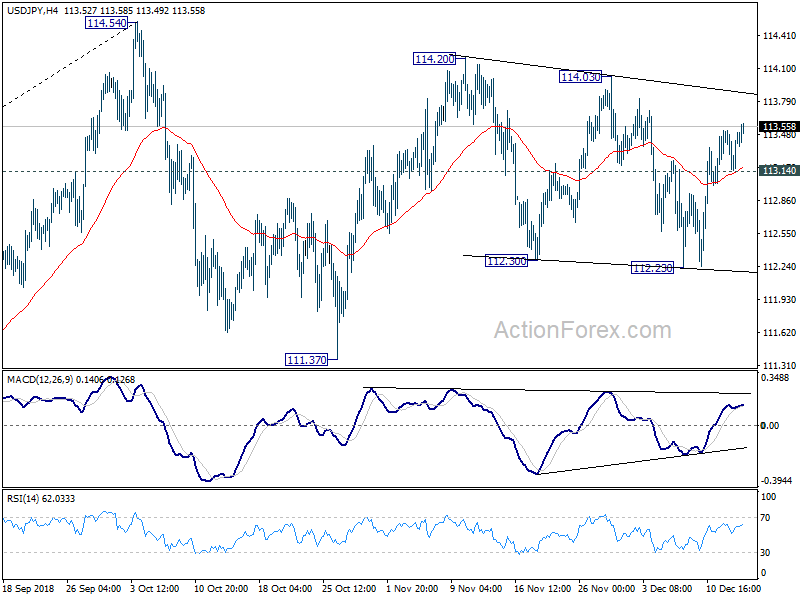
Intraday bias in USD/JPY remains on the upside as rebound from 122.23 is in progress for 114.03 resistance. Break of 114.03 will resume rebound from 111.37 and target 114.54 key resistance next. On the downside, below 113.14 minor support will turn bias the downside for 112.23 and below. Overall, price actions 114.54 are seen as a consolidative pattern. In case of deeper fall, downside should be contained by 38.2% retracement of 104.62 to 114.54 at 110.75 to bring rebound. Larger rise from 104.62 is expected to resume later.
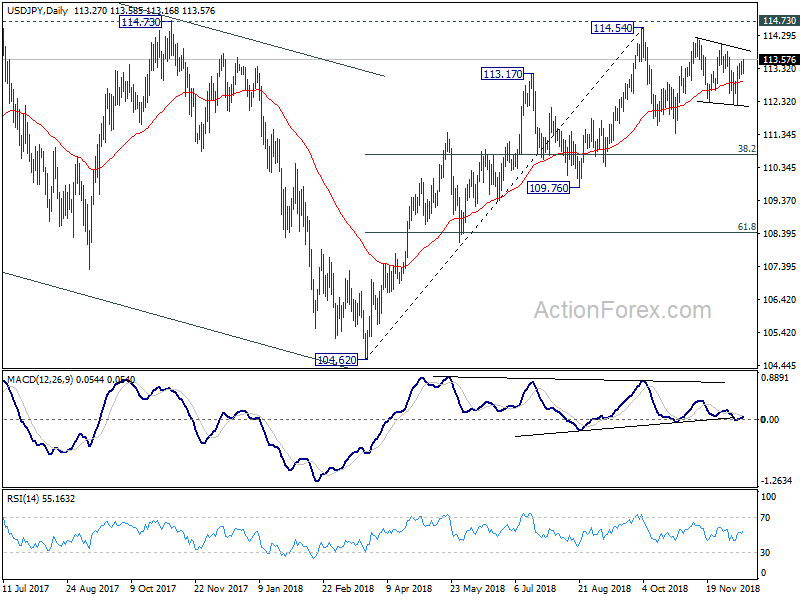
In the bigger picture, corrective fall from 118.65 (2016 high) should have completed with three waves down to 104.62. Decisive break of 114.73 resistance will likely resume whole rally from 98.97 (2016 low) to 100% projection of 98.97 to 118.65 from 104.62 at 124.30, which is reasonably close to 125.85 (2015 high). This will stay as the preferred case as long as 109.76 support holds. However, decisive break of 109.76 will dampen this bullish view and turns outlook mixed again.
USD/CHF Mid-Day Outlook
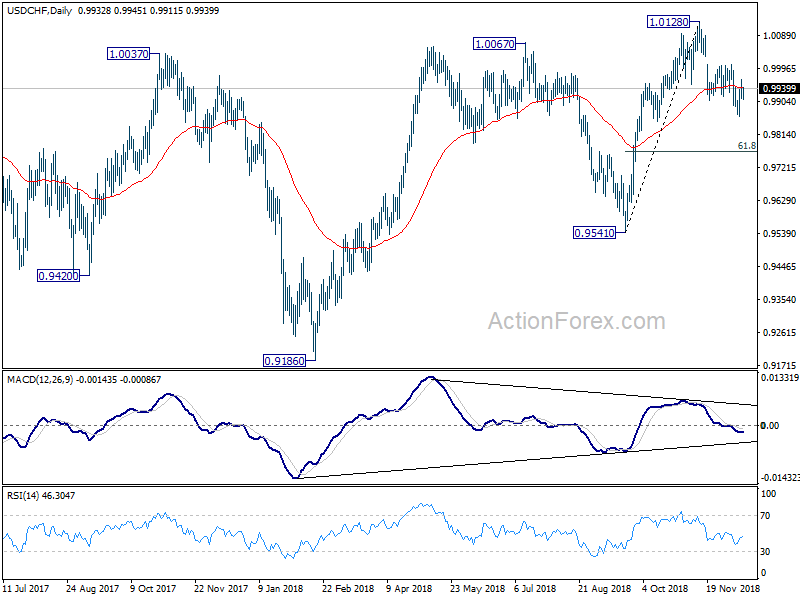
Daily Pivots: (S1) 0.9882; (P) 0.9911; (R1) 0.9959; More...
No change in USD/CHF's outlook and intraday bias remains neutral first. On the upside, break of 1.0008 resistance will indicate that pull back from 1.0128 has completed. Intraday bias would be turned back to the upside for retesting 1.0128 first. On the downside, below 0.9862 will target 0.9848 support first. Sustained break there will confirm near term reversal and target 61.8% retracement of 0.9541 to 1.0128 at 0.9765 and below.
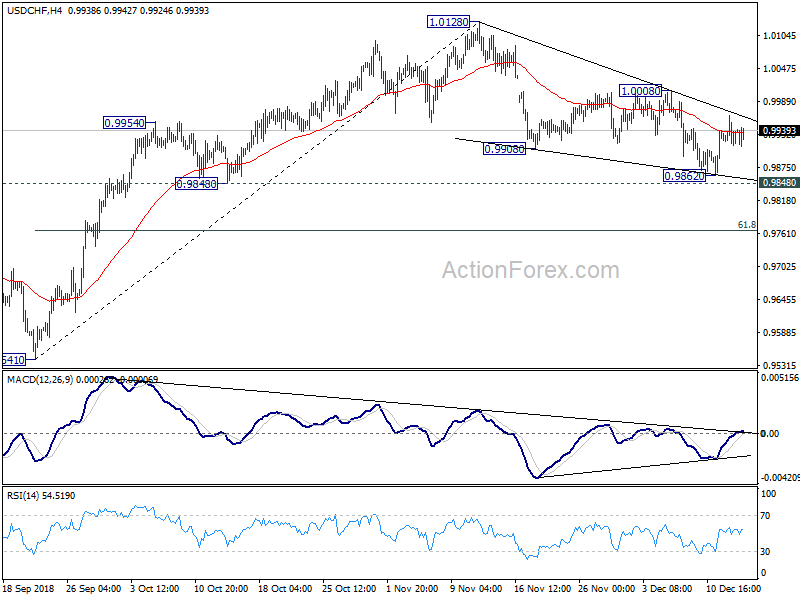
In the bigger picture, rise from 0.9541 could have topped at 1.0128. But as long as 0.9541 support holds, we'd still expect rise from 0.9186 to resume at a later stage. Break of 1.0128 will target 1.0342 key resistance. However, break of 0.9514 will pave the way back to 0.9186 low.
GBP/USD Mid-Day Outlook
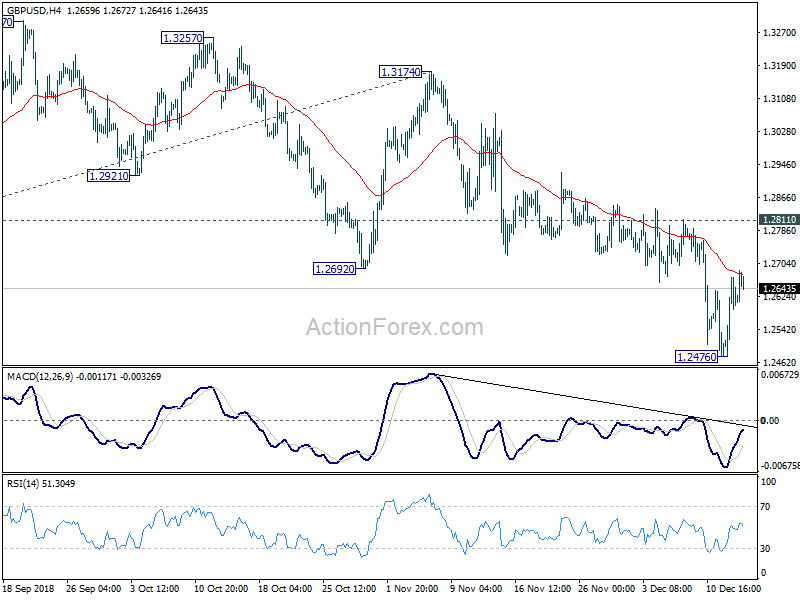
Daily Pivots: (S1) 1.2512; (P) 1.2592; (R1) 1.2708; More...
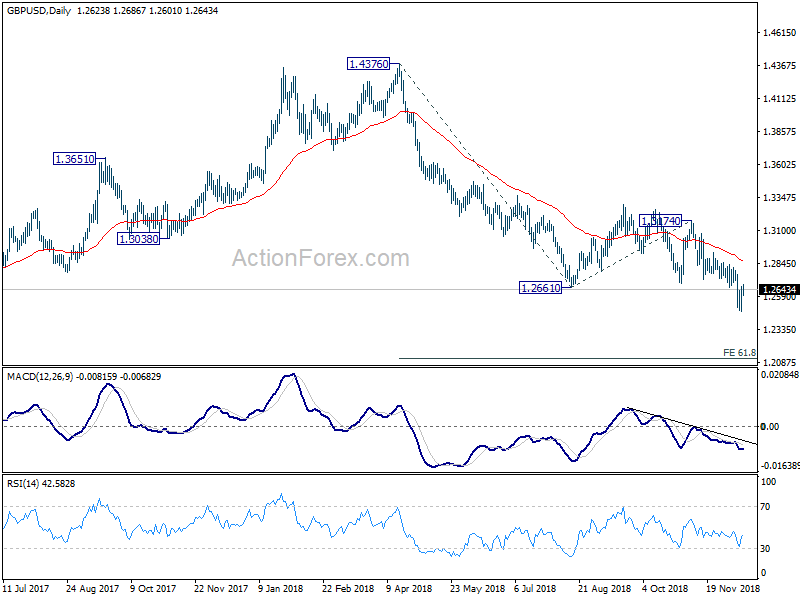
Intraday bias in GBP/USD stays neutral for the moment. Corrective recovery from 1.2476 might extend higher. But upside should be limited by 1.2811 resistance to bring fall resumption. On the downside, break of 1.2476 will extend larger down trend from 1.4376 to 61.8% projection of 1.4376 to 1.2661 from 1.3174 at 1.2114. However, firm break of 1.2811 will be an early signal of trend reversal and turn focus back to 1.3174 resistance.
In the bigger picture, whole medium term rebound from 1.1946 (2016 low) should have completed at 1.4376 already, after rejection from 55 month EMA. The structure and momentum of the fall from 1.4376 argues that it's resuming long term down trend from 2.1161 (2007 high). And this will now remain the preferred case as long as 1.3174 structural resistance holds. GBP/USD should now target a test on 1.1946 first. Decisive break there will confirm our bearish view.
UK 100 Stock Index Gains Momentum after Touching 2-Year Low
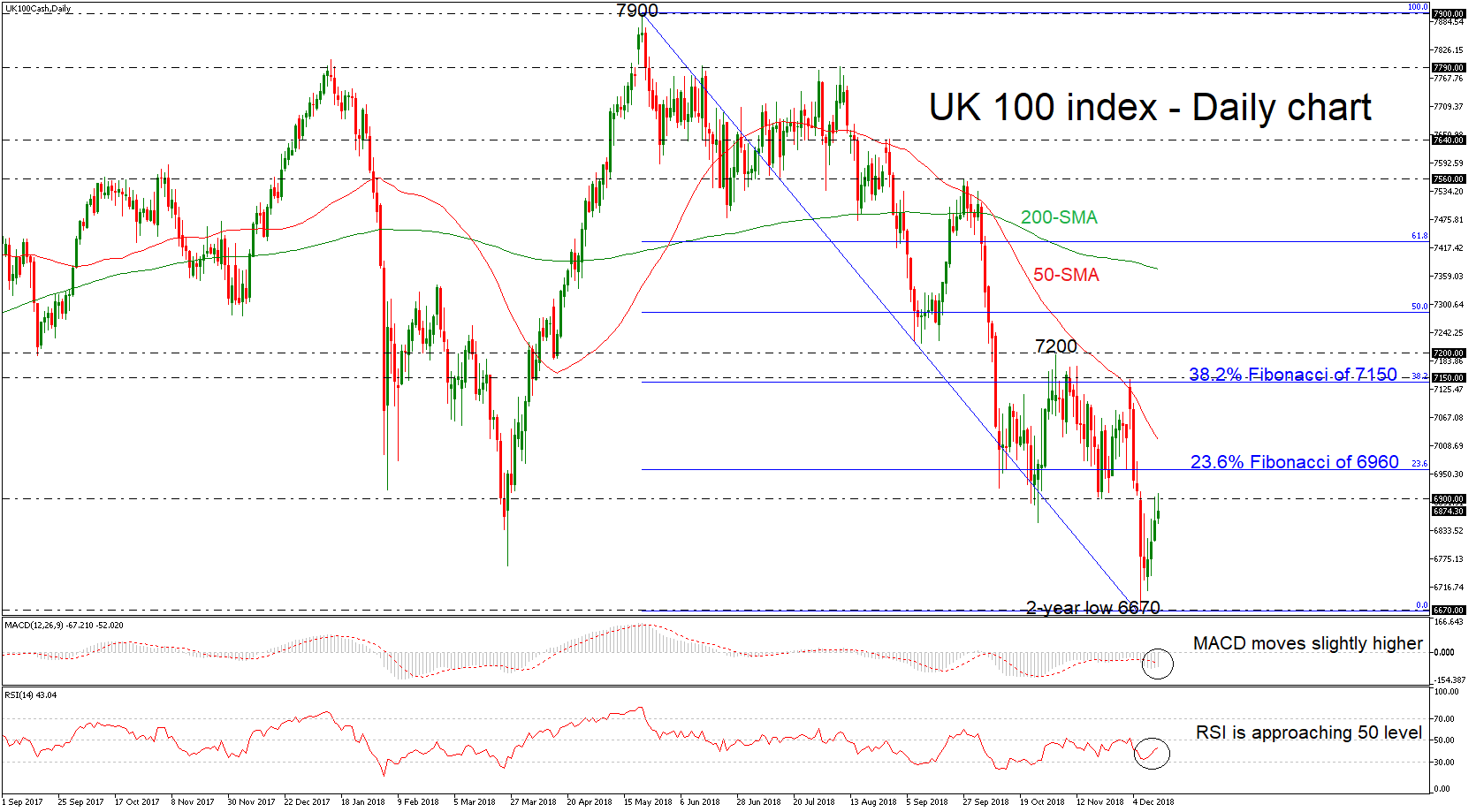
UK 100 stock index (FTSE 100) has rebounded somewhat after falling to two-year low of 6670 on December 6 and momentum indicators now suggest that the market sentiment might get better as the RSI is moving higher in the negative territory. The MACD also looks to be changing direction, moving higher to meet its red trigger line in the negative zone.
If the price manages to continue bullish actions and surpass 6900, the 23.6% Fibonacci retracement level of the downleg from 7900 to 6670, around 6960 could come in focus. Further up the index could rest around the 38.2% Fibonacci near 7150 as it did in early December, while a violation of this point may shift attention towards the 7200 resistance.
However, should bearish dynamics dominate, the market might revisit the two-year trough of 6670. Below that, the area around 6520, identified by the low on November 2016, could be another potential barrier for traders.
Overall, the downfall from 7900 is still active and hence the outlook remains negative. The 50-day simple moving average (SMA) has further increased distance below the 200-day SMA, hinting that the downward pattern might hold for longer.
EUR/USD Mid-Day Outlook
Daily Pivots: (S1) 1.1327; (P) 1.1357; (R1) 1.1399; More.....
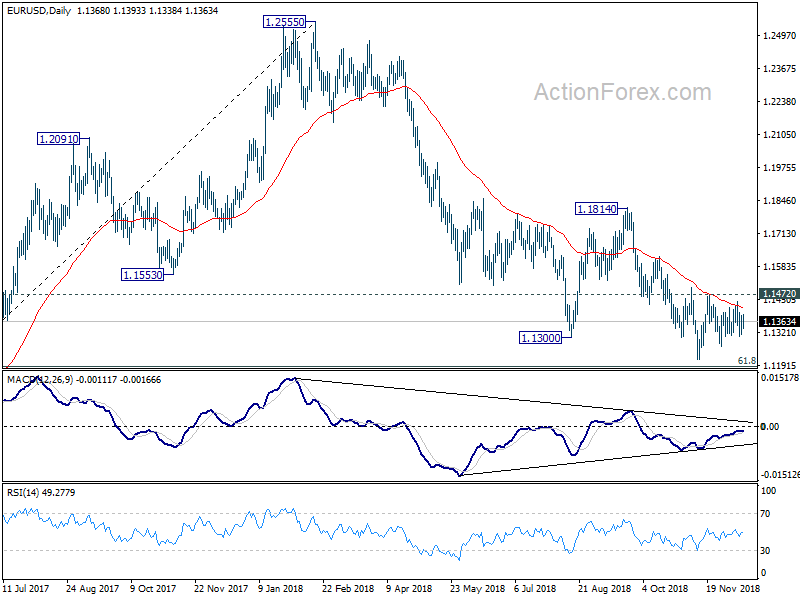
No change in EUR/USD's outlook as it's bounded in consolidation in range of 1.1267/1472. Intraday bias remains neutral for the moment. On the downside, break of 1.1267 will target 1.1215 low first. Firm break there will resume larger down trend from 1.2555 for 1.1186 fibonacci level next. However, considering bullish convergence condition in daily MACD, firm break of 1.1472 will be suggest medium term bottoming and turn outlook bullish for 1.1814 resistance instead.
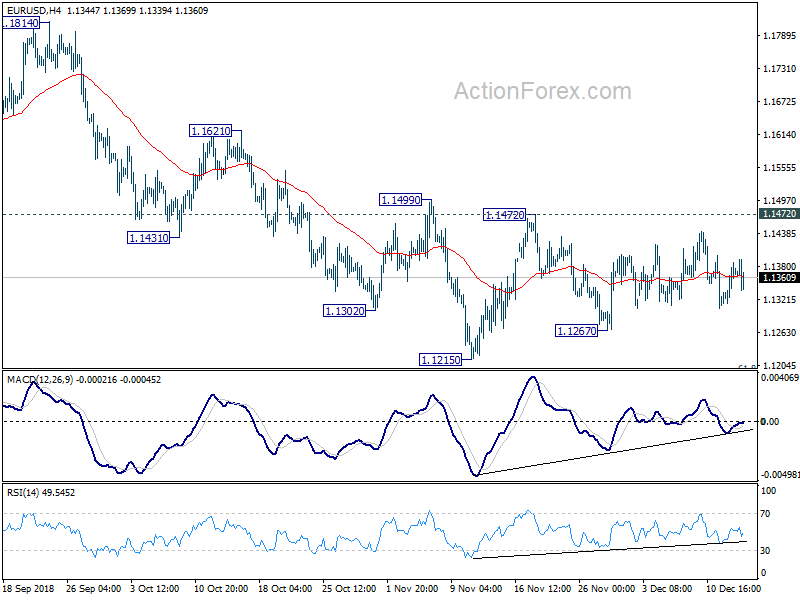
In the bigger picture, as long as 1.1814 resistance holds, down trend down trend from 1.2555 medium term top is still in progress and should target 61.8% retracement of 1.0339 (2017 low) to 1.2555 at 1.1186 next. Sustained break there will pave the way to retest 1.0339. However, break of 1.1814 will confirm completion of such down trend and turn medium term outlook bullish.