Sample Category Title
ECB Turns A Little More Cautious On The Economy
- No major change in ECB thinking but increased attention on weaker outlook
- Marginal downgrades to projections sees inflation not reaching target until 2021
- Draghi highlights ‘optionality’ in future policy
- End of net Asset Purchases a recalibration rather than a tightening
- Limited market reaction suggests entrenched ‘lower for longer’ view on rates
The main message from yesterday’s ECB meeting is that the central bank remains on a long and slow path to policy normalisation and, while no change to that path is envisaged at this point, it continues to emphasise it has both the flexibility and the capacity to adjust policy if required.
New ECB projections show minor downward adjustments to growth and suggest it may take until 2021 rather than 2020 to reach the ECB’s inflation goal. While the ECB continues to see risks to the outlook as broadly balanced, it notes that ‘the balance of risks is moving to the downside’. Accordingly, the pronouncements underpin the view now prevailing in markets that ECB policy rates look set to remain ‘lower for longer’.
Although ECB president Draghi repeatedly acknowledged a softer trend in recent Euro area activity indicators, this was not deemed significant enough to prevent the ECB from confirming the planned end to net purchases under its Asset Purchase Programme this month.
The key task for Mr Draghi at the regular press conference was to strike a balance that avoided either ignoring or over‐reacting to recent signs of a clearly weaker trajectory in Euro area economic growth. The ECB did this by tweaking growth and inflation forecasts lower and through Mr Draghi’s lengthy discussion of current ECB thinking and the flexibility it offered in terms of future policy
‘Optionality’ a key element of ECB policy
The ECB president summarised the Governing council’s assessment, describing it as one of ‘continuing confidence with increasing caution’. Importantly if understandably, he remained quite evasive on future policy changes such as any shift in the timing of interest rate changes or the possible introduction of a new Targeted Long Term Refinancing Operation (TLTRO) or even the technical details related to the reinvestment of its Asset Purchase Programme (a press release issued after the press conference was not notably more informative).
Mr Draghi noted that in current circumstances of ‘great uncertainty’, the formulation of the ECB’s guidance ‘wants to keep optionality as a dominant feature’. This could be interpreted as suggesting that in the event of a further deterioration in growth and inflation prospects, tweaks to policy could readily emerge.
Such tweaks might include a new TLTRO, which Mr Draghi said the ECB were ‘reflecting’ upon but had not discussed substantively. There could also be scope to alter the maturity timeframe of APP reinvestments or other related measures that could would not violate ‘the principle of market neutrality’ but might be presented as a form of policy easing or at least as copper‐fastening a commitment to a ‘lower for longer’ policy stance.
By indicating that reinvestments would be distributed over a year to ensure a regular market presence on the part of the ECB and signalling a ‘gradual’ adjustment towards the amended ECB capital key, the ECB has retained a significant measure of flexibility in managing reinvestments that allow for at least the possibility of policy focussed purchases
Growth seen slower but still solid
Given the poorer trajectory of the Euro area economy of late, it is not entirely surprising that the ECB might be examining its policy options in some detail. However, Mr Draghi was firm both in his argument that any slowdown will be contained and also in his assertion that the markets understanding of the ECB’s reaction function meant financial conditions had already eased to at least partly offset the slowdown.
Mr Draghi suggested that, in the view of the ECB, a climate of uncertainty is one of the reasons if not the main reason for softer growth of late and this development was responsible for the increase in risk premia of late. To the extent that uncertainty rather than more fundamental factors is driving current weakness, it is likely to prove more limited and transitory and, consequently, presents less of an argument for any policy response.
Mr Draghi’s opening statement also emphasised the continuing solidity of Euro area domestic demand although new ECB projections show marginally weaker consumer spending growth for 2018 and a slightly larger and lasting downgrade to investment through to 2021. In the same vein, Mr Draghi also highlighted improving wage growth but the new projections envisage marginally weaker wage growth in 2019 and 2020 than those of three months ago although an acceleration is seen in the ECB’s initial estimate for 2021.
While higher oil prices necessitate an upward adjustment to the forecast for 2018, the ECB’s new inflation projections for coming years are also marginally lower than those of three months ago. Significantly, ‘core’ inflation is cut from 1.8% to 1.6% for 2020 and only reaches the 1.8% pace consistent with the ECB’s targeted ‘below, but close to, 2%' in 2021. While it can be argued that such changes are both marginal and largely technical, they serve to paint a picture of a longer journey to reach the ECB’s desired outcomes and a correspondingly slower path to policy normalisation
Markets not surprised or worried
There was little market reaction to the ECB’s pronouncements or projections or to the long signalled decision to end APP net purchases. There was some initial spread tightening that could reflect the flexibility inherent in the new parameters for reinvestment purchases. In this respect it could be argued that the ECB is seen to be implementing a non‐tightening recalibration of policy.
This suggests that investors interpret the ECB’s stated commitment to keep policy rates ‘at present levels at least through the summer of 2019, and in any case for a s long as necessary..’ as very much an open ended promise that in the absence of dramatic changes in economic conditions will keep the ECB on the sidelines for some significant time
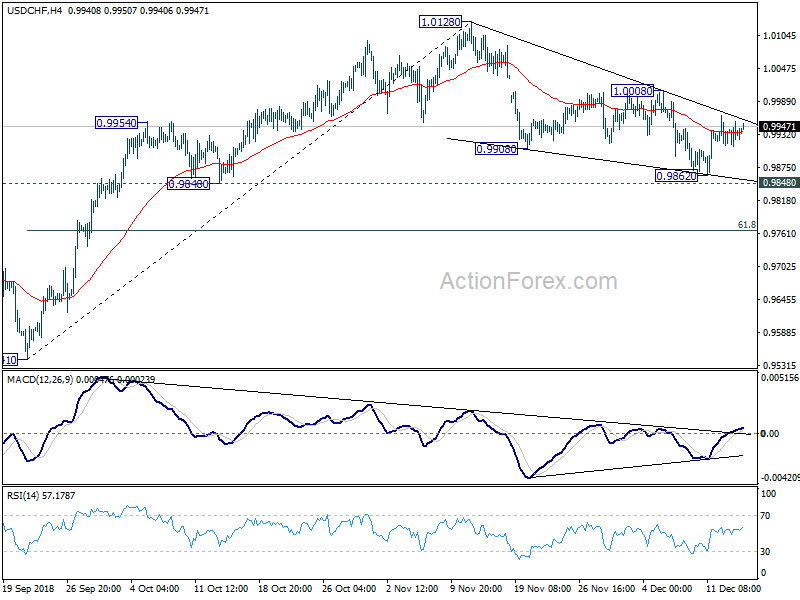
USD/CHF Daily Outlook
Daily Pivots: (S1) 0.9915; (P) 0.9935; (R1) 0.9958; More...
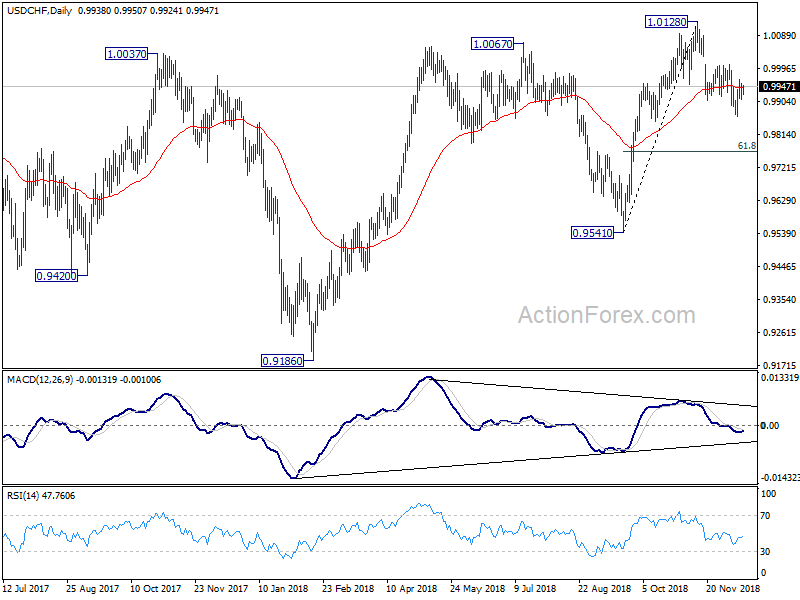
Intraday bias in USD/CHF remains neutral at this point. On the upside, break of 1.0008 resistance will indicate that pull back from 1.0128 has completed. Intraday bias would be turned back to the upside for retesting 1.0128 first. On the downside, below 0.9862 will target 0.9848 support first. Sustained break there will confirm near term reversal and target 61.8% retracement of 0.9541 to 1.0128 at 0.9765 and below.
In the bigger picture, rise from 0.9541 could have topped at 1.0128. But as long as 0.9541 support holds, we'd still expect rise from 0.9186 to resume at a later stage. Break of 1.0128 will target 1.0342 key resistance. However, break of 0.9514 will pave the way back to 0.9186 low.
USD/JPY Daily Outlook
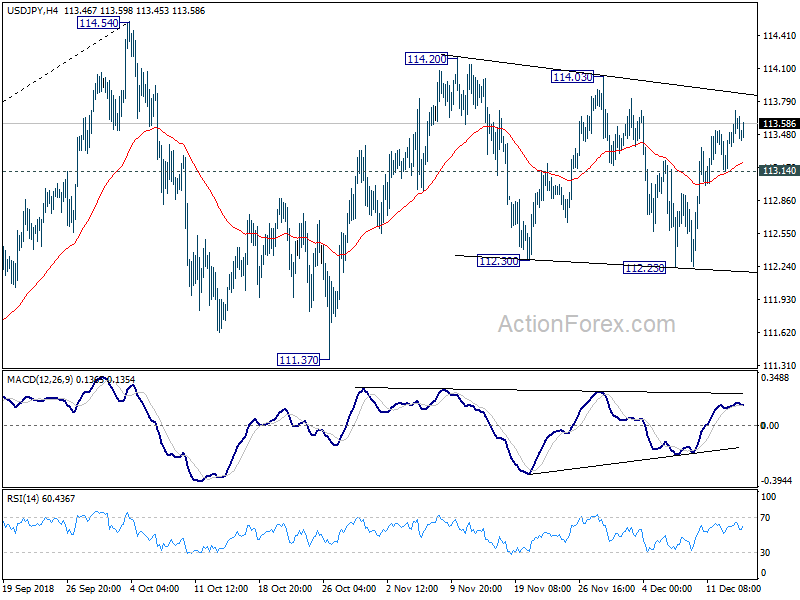
Daily Pivots: (S1) 113.30; (P) 113.50; (R1) 113.82; More..
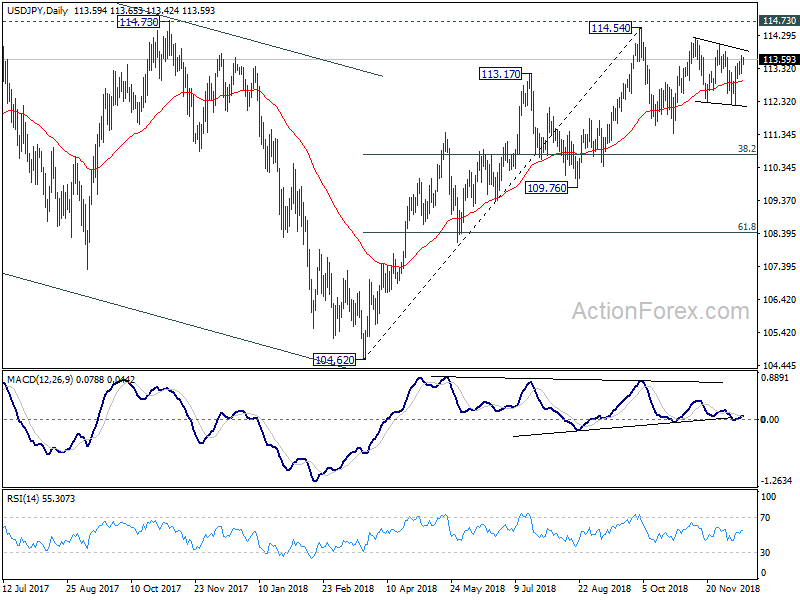
With 113.14 minor support intact, intraday bias in USD/JPY remains on the upside for 114.03 resistance. Break there should resume rebound from 111.37 and target 114.54 key resistance next. On the downside, below 113.14 minor support will turn bias the downside for 112.23 and below. Overall, price actions 114.54 are seen as a consolidative pattern. In case of deeper fall, downside should be contained by 38.2% retracement of 104.62 to 114.54 at 110.75 to bring rebound. Larger rise from 104.62 is expected to resume later.
In the bigger picture, corrective fall from 118.65 (2016 high) should have completed with three waves down to 104.62. Decisive break of 114.73 resistance will likely resume whole rally from 98.97 (2016 low) to 100% projection of 98.97 to 118.65 from 104.62 at 124.30, which is reasonably close to 125.85 (2015 high). This will stay as the preferred case as long as 109.76 support holds. However, decisive break of 109.76 will dampen this bullish view and turns outlook mixed again.
USD/CAD Daily Outlook
Daily Pivots: (S1) 1.3335; (P) 1.3359; (R1) 1.3381; More...
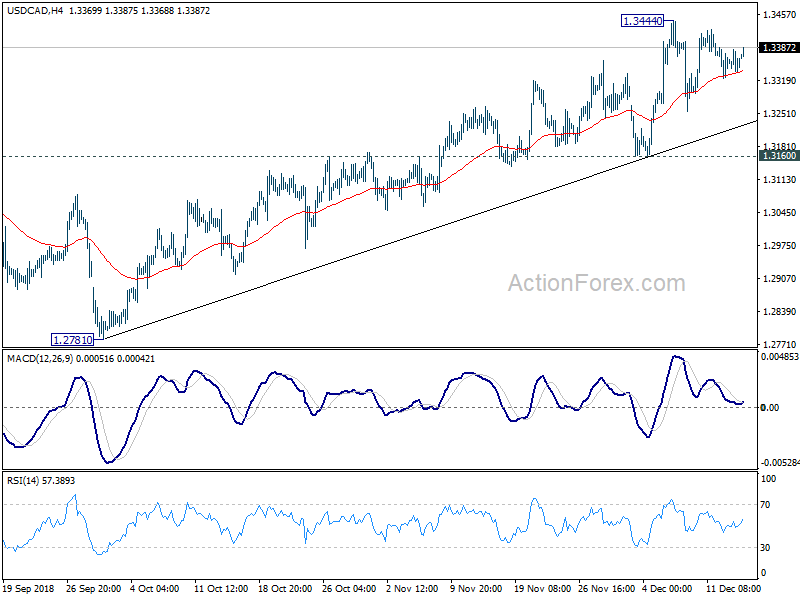
USD/CAD is staying in consolidation below 1.3444 and intraday bias remains neutral first. Near term outlook remains bullish with 1.3160 support intact, and further rally is expected. On the upside, break of 1.3444 will turn bias back to the upside. Larger rally from 1.2061 should target 1.3685 fibonacci level next.
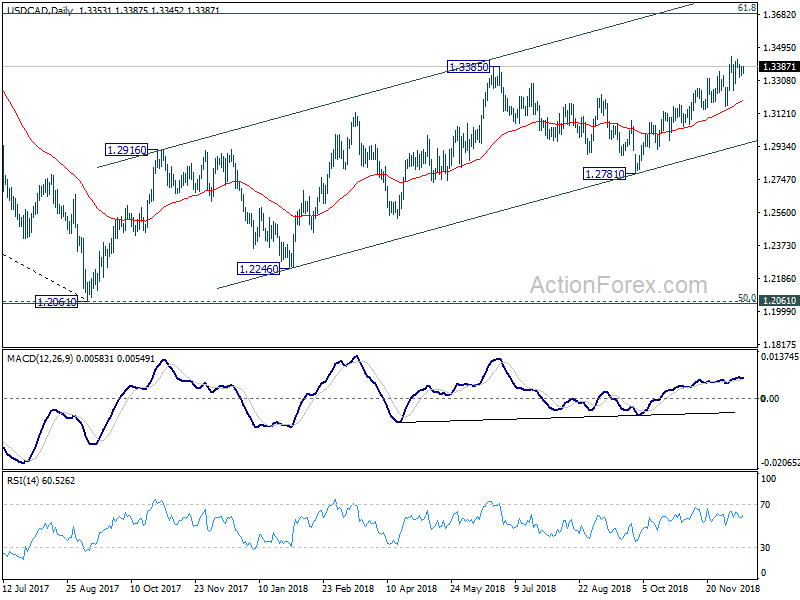
In the bigger picture, up trend from 1.2061 (2017 low) is still in progress and should target to 61.8% retracement of 1.4689 (2016 high) to 1.2061 at 1.3685. This will remain the preferred case as long as channel support (now at 1.2949) holds.
AUD/USD Daily Outlook
Daily Pivots: (S1) 0.7210; (P) 0.7229; (R1) 0.7245; More...
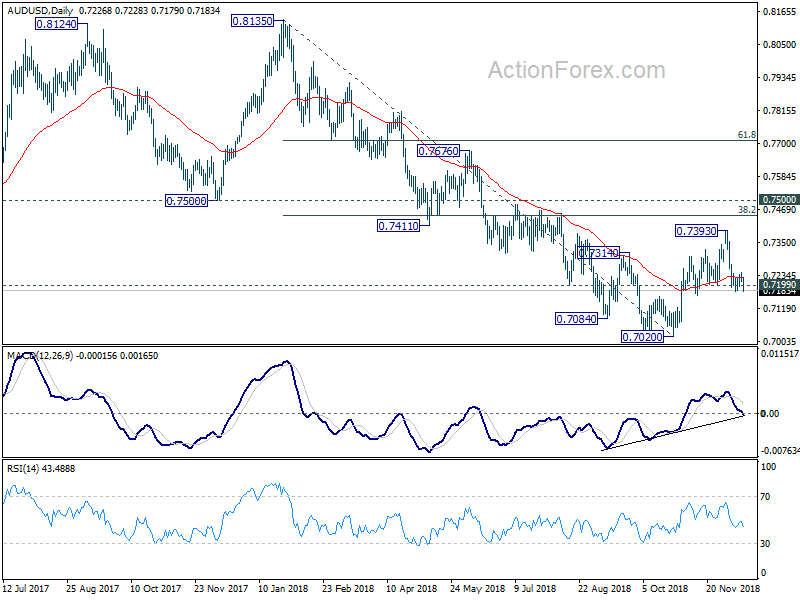
AUD/USD drops notably after failing to sustained above 4 hour 55 EMA. Focus is back on 0.7199 support. Sustained trading below 0.7199 will confirm completion of corrective rebound from 0.7020. And, deeper fall should then be seen back to retest 0.7020 low. On the upside, above 0.7246 minor resistance will turn bias back to the upside. In that case, corrective rise from 0.7020 would extend to 38.2% retracement of 0.8135 to 0.7020 at 0.7446 before completion.
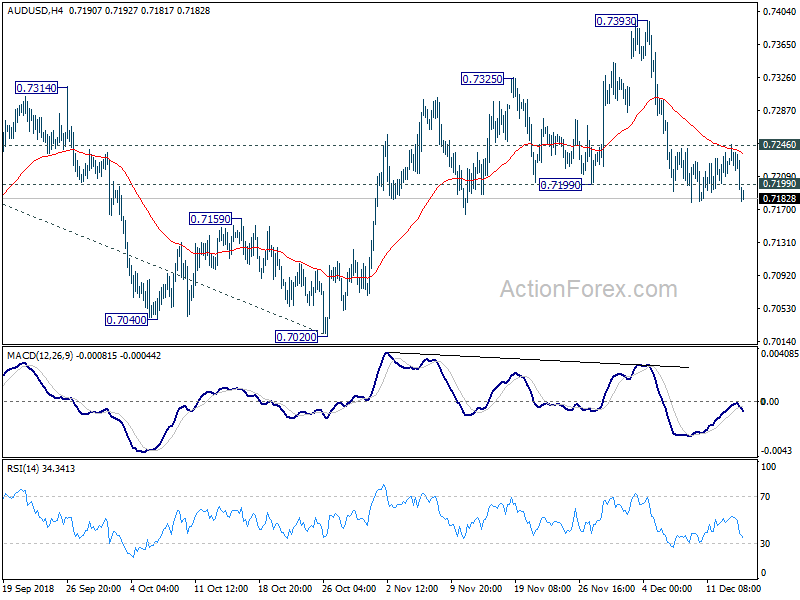
In the bigger picture, a medium term bottom is in place at 0.7020 ahead of 0.6826 key support (2016 low). Stronger rebound might be seen to correct the whole fall from 0.8135 high. But we'd expect strong resistance from 0.7500 support turned resistance to limit upside. Medium term fall from 0.8135 should resume and extend to take on 0.6826 low at a later stage, after the correction from 0.7020 completes.
Forex Technical Analysis: EUR/USD, USD/JPY, GBP/USD
EUR/USD
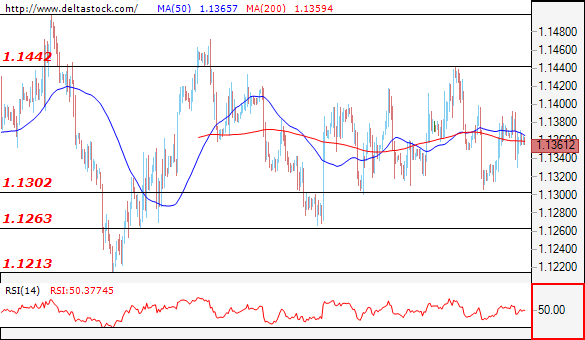
Current level - 1.1361
We may expect another test at 1.1300-1.1320. The first resistance for the move upwards is around 1.1400, followed by 1.1450.
| Resistance | Support | ||
| intraday | intraweek | intraday | intraweek |
| 1.1350 | 1.1450 | 1.1300 | 1.1210 |
| 1.1400 | 1.1500 | 1.1260 | 1.0850 |
USD/JPY
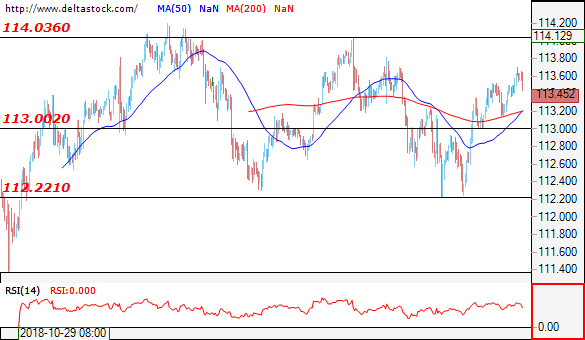
Current level - 113.45
We can say the breakthrough of 113.00 was successful. The first resistance for the move upwards is the 113.80 zone. Historically strong resistance is 114.00 and for rallies further we'll have to see a successful break of that level, otherwise a failed test can bring the pair to 112.00.
| Resistance | Support | ||
| intraday | intraweek | intraday | intraweek |
| 113.65 | 114.50 | 113.00 | 112.20 |
| 114.00 | 116.20 | 112.50 | 111.60 |
GBP/USD
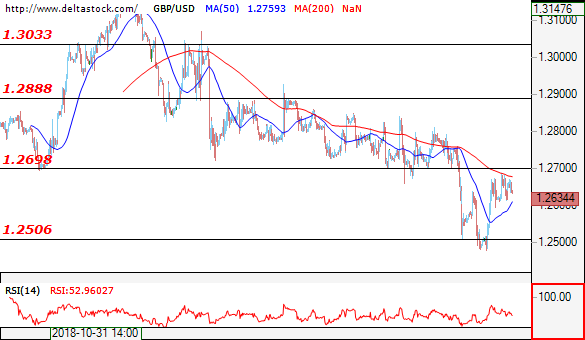
Current level - 1.2634
The unsuccessful breakthrough of the support at 1.2500 led to a new test at 1.2700. If the test is successful, the next resistance zone is around 1.2900.
| Resistance | Support | ||
| intraday | intraweek | intraday | intraweek |
| 1.2600 | 1.2880 | 1.2500 | 1.2360 |
| 1.2690 | 1.3030 | 1.2460 | 1.2140 |
Weak Chinese Data Sent Asian Stocks and Aussie Lower
Asian stocks are under pressure today as weaker than expected data from China prompted growth worries. New Zealand and Australian Dollar are trading as the weakest ones for today. Sterling follows as the third weakest as UK Prime Minister Theresa May got nothing but vague assurances from the EU summit. On the other hand, Yen is lifted by risk aversion. Dollar follows as second strongest as focus turns to US retail sales. Euro is steady even though ECB delivered a mildly dovish shift yesterday.
Technically, AUD/USD's is back below 0.7199 support. Sustained trading below will confirm near term reversal and target 0.7020 low. Euro remains mixed in range. EUR/GBP and EUR/AUD recovered well ahead of 0.8931 and 1.5596 support, thus maintaining near term bullishness. But EUR/USD and EUR/JPY are stuck in range, maintaining near term bearishness. A focus today is whether Sterling has completed this week's recovery and would revisit near term low.
In other markets, Nikkei closed down -2.02% at 21374.83. Hong Kong HSI is currently down -1.56%, China Shanghai SSE is down -1.23%, Singapore Strait Times is down -1.12%. 10 year JGB yield is down notably by -0.0197 at 0.035.
UK got vague assurances from EU over Irish backstop
The assurances that UK Prime Minister Theresa May got from the EU were rather vague and they unlikely to appease the MPs. But at the time same, it's reported that May has been vague in her requests too. It caused some griefs from European Commission President Jean-Claude Juncker. He said at a press conference that "I do find it uncomfortable that there is an impression perhaps in the UK that it is for the EU to propose solutions". And, "It is the UK leaving the EU. And I would have thought it was rather more up to the British Government to tell us exactly what they want."
After yesterday's EU summit, EU27 leaders concluded their positions on Brexit in a five point statement. Firstly, it's "not open for renegotiation". Secondly EU wishes to "establish as close as possible a partnership" with the UK in the future. Thirdly, the backstop is intended as an "insurance policy" to prevent hard Irish border. And EU has "firm determination to work speedily on a subsequent agreement" so that "the backstop will not need to be triggered". Fourthly, if the backstop were triggered, "it would apply temporarily, unless and until it is superseded by a subsequent agreement that ensures that a hard border is avoided." Fifthly, EU calls for preparedness for all possible Brexit outcome.
Japan tankan capex surged, PMI manufacturing improved
Economic data released from Japan today are not bad. Based on the results of the Tankan survey, it's unlikely for BoJ to ease monetary further. Yet, it's not time for the central bank to start stimulus exit too.
- Large manufacturing index was unchanged at 19 versus expectation of a drop to 17.
- Large manufacturing outlook dropped notably by -4 to 15, missed expectation of 16.
- Large non-manufacturing index rose 2pts to 24, above expectation of 21.
- Large non-manufacturing outlook also rose 2pts to 24, above expectation of 20.
- Large all industry capex rose 14.3% in Q4, beat expectation of 12.7%.
PMI manufacturing improved to 52.4, up from 52.2 and beat expectation of 52.3. Markit noted that "new order growth accelerates despite exports declining to sharpest extent in over two years". However, "business confidence drops for seventh straight month to lowest since October 2016".
Joe Hayes, Economist at IHS Markit, said in the release that "Japan's manufacturing sector closed 2018 with a strong finish." But the data also "bring some cautious undertones to the fore,". In particular "Export orders declined at the fastest pace in over two years, while total demand picked up only modestly. Confidence also continued to fall, a seventh straight month in which this has now occurred." He added "the prospects heading into 2019 ahead of the sales tax hike still appear skewed to the downside."
Elsewhere
New Zealand BusinessNZ manufacturing PMI dropped -0.2 to 53.5 in November. China retail sales rose 8.1% yoy in November, below expectation of 8.8%. Industrial production rose 5.4% yoy, below expectation of 5.9%. Fixed assets investments rose 5.9% ytd yoy, matched expectations.
Looking ahead, Eurozone PMIs will be the main focus in European session. US will release retail sales, industrial productions, PMIs and business inventories.
AUD/USD Daily Outlook
Daily Pivots: (S1) 0.7210; (P) 0.7229; (R1) 0.7245; More...
AUD/USD drops notably after failing to sustained above 4 hour 55 EMA. Focus is back on 0.7199 support. Sustained trading below 0.7199 will confirm completion of corrective rebound from 0.7020. And, deeper fall should then be seen back to retest 0.7020 low. On the upside, above 0.7246 minor resistance will turn bias back to the upside. In that case, corrective rise from 0.7020 would extend to 38.2% retracement of 0.8135 to 0.7020 at 0.7446 before completion.
In the bigger picture, a medium term bottom is in place at 0.7020 ahead of 0.6826 key support (2016 low). Stronger rebound might be seen to correct the whole fall from 0.8135 high. But we'd expect strong resistance from 0.7500 support turned resistance to limit upside. Medium term fall from 0.8135 should resume and extend to take on 0.6826 low at a later stage, after the correction from 0.7020 completes.
Economic Indicators Update
| GMT | Ccy | Events | Actual | Forecast | Previous | Revised |
|---|---|---|---|---|---|---|
| 21:30 | NZD | BusinessNZ Manufacturing PMI Nov | 53.5 | 53.5 | 53.7 | |
| 23:50 | JPY | Tankan Large Manufacturing Index Q4 | 19 | 17 | 19 | |
| 23:50 | JPY | Tankan Large Manufacturers Outlook Q4 | 15 | 16 | 19 | |
| 23:50 | JPY | Tankan Large Non-Manufacturing Index Q4 | 24 | 21 | 22 | |
| 23:50 | JPY | Tankan Large Non-Manufacturing Outlook Q4 | 24 | 20 | 22 | |
| 23:50 | JPY | Tankan Small Manufacturing Index Q4 | 14 | 13 | 14 | |
| 23:50 | JPY | Tankan Small Manufacturing Outlook Q4 | 8 | 11 | 11 | |
| 23:50 | JPY | Tankan Small Non-Manufacturing Index Q4 | 11 | 9 | 10 | |
| 23:50 | JPY | Tankan Small Non-Manufacturing Outlook Q4 | 5 | 6 | 5 | |
| 23:50 | JPY | Tankan Large All Industry Capex Q4 | 14.30% | 12.70% | 13.40% | |
| 0:30 | JPY | PMI Manufacturing Dec P | 52.4 | 52.3 | 52.2 | |
| 2:00 | CNY | Retail Sales Y/Y Nov | 8.10% | 8.80% | 8.60% | |
| 2:00 | CNY | Industrial Production Y/Y Nov | 5.40% | 5.90% | 5.90% | |
| 2:00 | CNY | Fixed Assets Ex Rural YTD Y/Y Nov | 5.90% | 5.90% | 5.70% | |
| 4:30 | JPY | Industrial Production Y/Y Oct F | 4.20% | 5.90% | 5.90% | |
| 8:00 | EUR | France Manufacturing PMI Dec P | 50.7 | 50.8 | ||
| 8:00 | EUR | France Services PMI Dec P | 54.8 | 55.1 | ||
| 8:30 | EUR | Germany Manufacturing PMI Dec P | 51.7 | 51.8 | ||
| 8:30 | EUR | Germany Services PMI Dec P | 53.5 | 53.3 | ||
| 8:30 | EUR | Eurozone Manufacturing PMI Dec P | 51.9 | 51.8 | ||
| 8:30 | EUR | Eurozone Services PMI Dec P | 53.4 | 53.4 | ||
| 13:30 | USD | Retail Sales Advance M/M Nov | 0.40% | 0.80% | ||
| 13:30 | USD | Retail Sales Ex Auto M/M Nov | 0.50% | 0.70% | ||
| 14:15 | USD | Industrial Production M/M Nov | 0.30% | 0.10% | ||
| 14:15 | USD | Capacity Utilization Nov | 78.60% | 78.40% | ||
| 14:45 | USD | Manufacturing PMI Dec P | 55.1 | 55.3 | ||
| 14:45 | USD | Services PMI Dec P | 55 | 54.7 | ||
| 15:00 | USD | Business Inventories Oct | 0.50% | 0.30% |
GBPUSD Starts To Drift Lower
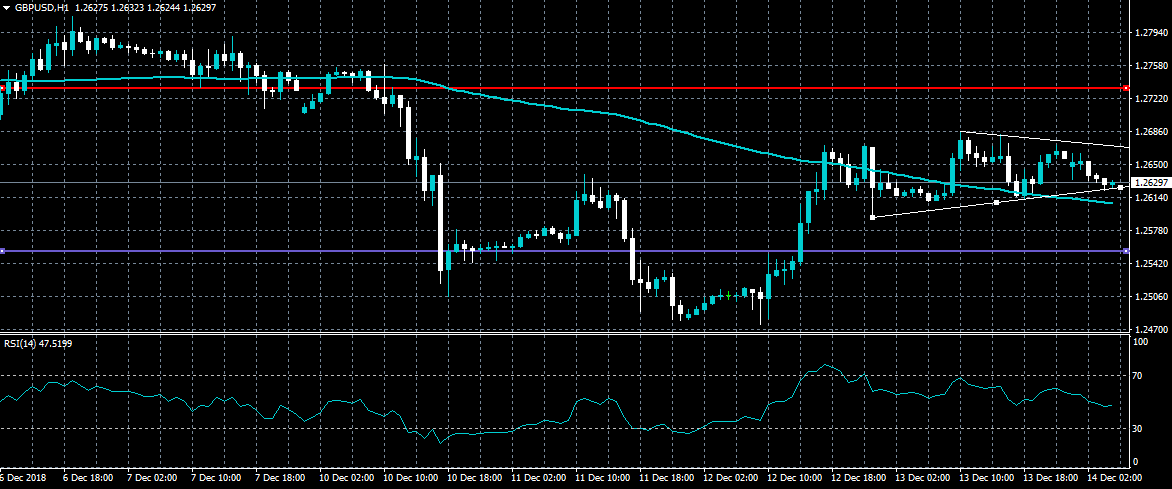
The British pound is drifting towards the 1.2600 level against the US dollar after buyers failed to hold price above the neckline of the bearish head and shoulders pattern. The one-hour time frame is showing that the GBPUSD pair is trading inside a pennant pattern. A clear break below the 1.2600 level exposes further downside for the GBPUSD pair towards the 1.2550 level.
If the GBPUSD pair trades below the 1.2665 level, buyers may test towards the 1.2700 and 1.2730 resistance levels.
If the GBPUSD pair trades below the 1.2600 level, key support is found at the 1.2550 and 1.2480 levels.
USDJPY Under Rising Wedge
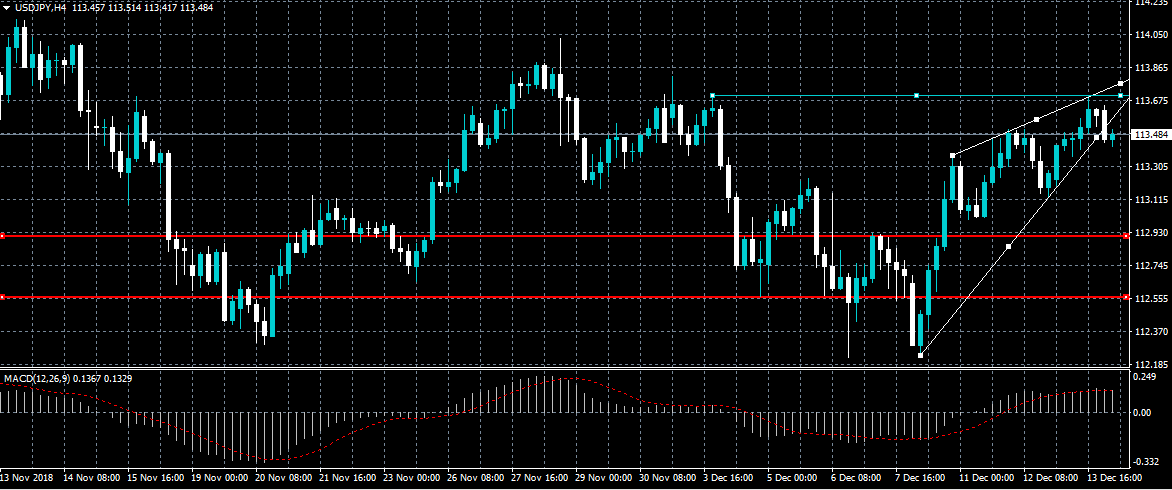
The US dollar is reversing earlier gains against the Japanese yen currency after technical failure before the important November swing-high. The USDJPY has fallen outside of a well-defined rising wedge pattern on the one-hour timeframe, putting further bearish pressure on the pair. If price continues to trade lower, we may see the formation of a bearish head and shoulders pattern.
The USDJPY pair is intraday while trading below the 113.50 level, key support is found at the 112.90 and 112.50 levels.
If the USDJPY pair trades below the 113.50 level, key resistance is found at the 113.80 and 114.00 levels.
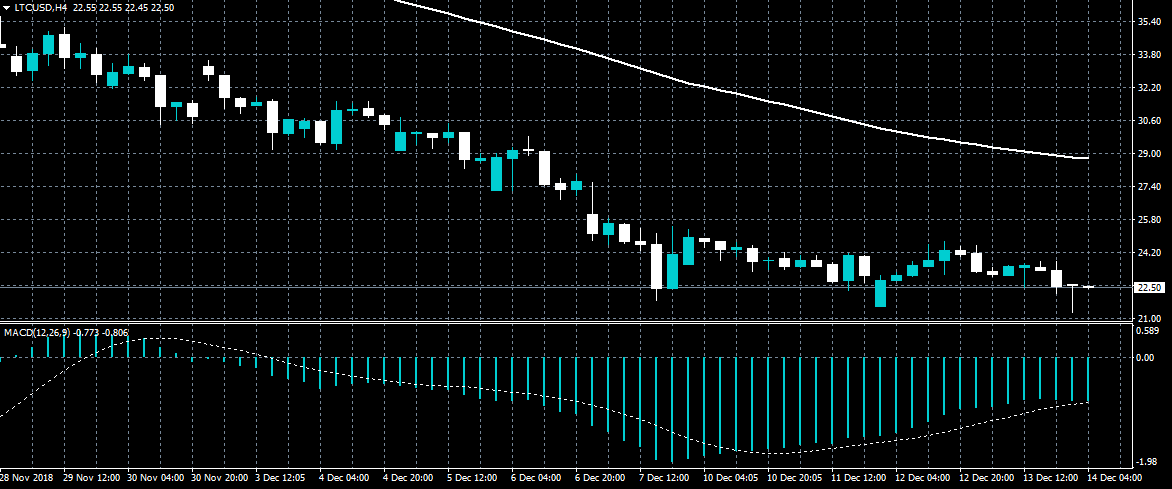
LTCUSD $21.30 Now Key Support
Litecoin continues its recent long-term downtrend on Friday, with the ninth largest cryptocurrency by market capitalization falling to a new yearly trading low, of $21.30. Short-term bulls have been unable to establish a clear trading bottom, with price still creating bearish lower lows. A test of the $20.00 support level seems inevitable as the broader cryptocurrency market remains under heavy selling pressure.
The LTCUSD pair is strongly bearish while trading below the $25.00 level, key support is found at the $20.00 and the $17.80 levels.
If the LTCUSD pair moves above the $25.00, buyers will be encouraged to test the $27.50 and $30.00 resistance levels.