Sample Category Title
Greenback Eyes Fed Chair Powell’s Speech
- Dollar flirts with 1½-year highs as Fed's Clarida “sticks to script” on hikes; remarks by Fed Chair Powell today at 1700 GMT will be key
- Stocks briefly slip on rumors of car tariffs but recover on Kudlow's optimism
- Pound remains under pressure as political uncertainty reigns
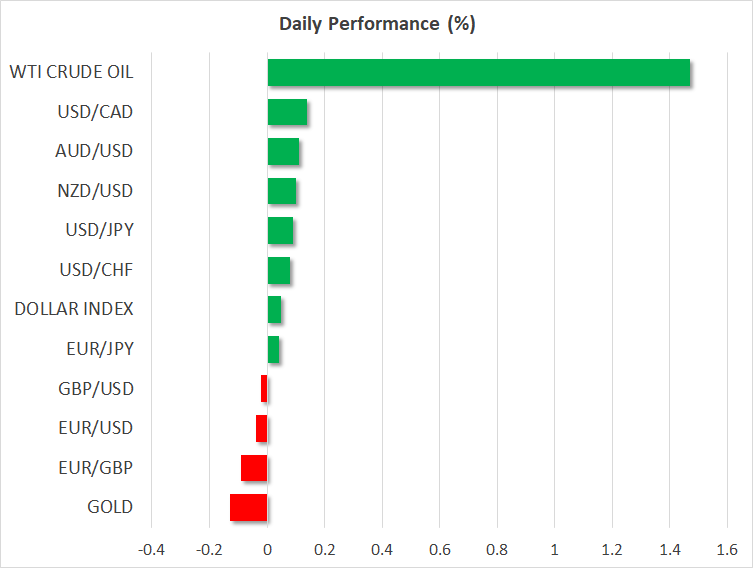
Dollar firms after Clarida's remarks, and amid whispers of car tariffs
The greenback shined bright once again on Tuesday, with the dollar index soaring to come within breathing distance of its recent 1½-year highs. The initial catalyst were remarks by Fed Vice Chair Clarida, who maintained a broadly confident tone on the economy's outlook and the prospect of future rate hikes, likely confounding some investors who had anticipated a more cautious stance.
The second wave of dollar strength came on the back of safe-haven demand, after reports President Trump may impose tariffs on car imports as early as next week. The news likely generated speculation that even if a US-China truce is agreed this week, the next chapter in the broader trade saga may be an EU-US showdown, considering Europe is all but certain to reply in kind to any tariffs.
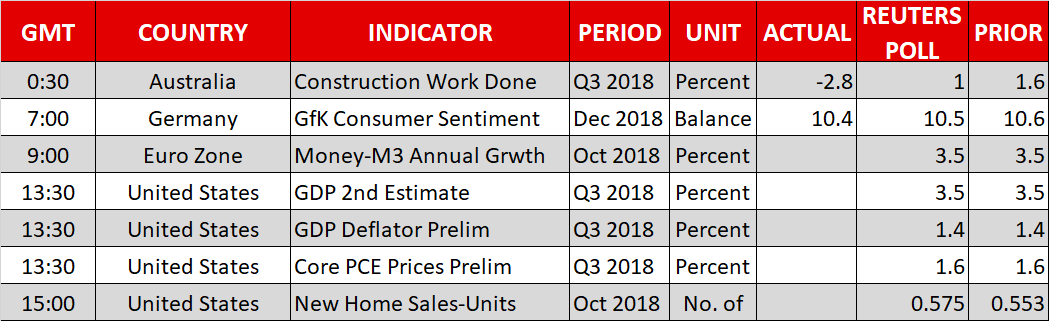
Key events for the dollar continue today, as Fed Chair Powell speaks at 1700 GMT. Recall markets are currently only pricing in a little more than one rate hike in 2019. Hence, if Powell echoes a similar message to Clarida, hinting that raising rates three times next year is still “the plan”, then the dollar index could well sail past the 1½ year highs it is currently flirting with. The second estimate of US GDP for Q3 and new home sales for October are also due out.
Stocks slip on tariff rumors, but recover on Kudlow's “optimism”
US stock markets took a hit after the reports Trump may impose tariffs on imported autos soon, briefly turning red on the day. However, the dip was short-lived and equities recovered to close higher, after White House top economic advisor Kudlow said “there is a good possibility we can make a deal” at the upcoming Trump-Xi meeting. Risk-sensitive currencies like the aussie and kiwi moved in the same fashion as US equity indices.
In the big picture, while the two leaders may reach a truce on Saturday that helps bring some short-term relief to the markets, it's doubtful whether it will be anything more than a “pause” in an otherwise ongoing conflict. Neither side seems willing to blink on the big issue yet – forced intellectual property transfer.
Sterling remains in the doldrums
The pound remained under selling interest, without any major Brexit developments to speak of. No news seems to be bad news at the moment, as investors continue to grapple with the uncertainty of whether Parliament will reject the Brexit deal, and what happens next if so. The consensus is that PM May does not currently command the numbers to pass it, and as long as that remains the general expectation, the pound will likely find it difficult to rally.
There are two caveats, though. Firstly, one shouldn't underestimate Theresa May's resilience; if anyone could somehow turn the tide, it's her. The fact markets are increasingly pricing in a rejection makes it easier for the pound to gain if anything changes this narrative. Second, if the deal is rejected, while that may initially hurt the pound, it could also raise the probability for another referendum, any serious suggestion of which would see the currency soar.
Today, focus will turn to the BoE, which will release the results of banks' stress tests 1630 GMT. This includes their performance under different Brexit scenarios, so sterling-traders will pay attention.
Other highlights for today
Beyond the above-mentioned US data, there are no other tier-one releases on the economic calendar.
In energy markets, the EIA will release its crude inventory data at 1530 GMT. Expectations are for another build in stockpiles, albeit a smaller one than previously.
Besides Fed Chair Powell, we have three ECB speakers on the agenda: Coeure (1205 GMT), Vice President Guindos (1300 GMT), and Praet (1520 GMT).
EU Leaders Are Expected To Extend Existing Sanctions On Russia
Several senior European politicians on Tuesday raised the possibility of new sanctions against Russia to punish it for capturing three Ukrainian vessels at sea, an incident the West fears could ignite a wider conflict. A Russian minister said further sanctions would solve nothing and that the incident should not be used to derail the Minsk accord, which aims to end fighting in eastern Ukraine between Kiev’s forces and pro-Russian separatist rebels.
Russian assets have come under pressure on financial markets amid concerns that possible new sanctions could hurt the economy, though the rouble on Tuesday clawed back some earlier losses as investors bet any sanctions would not be swift. Russia opened fire on the Ukrainian boats and then seized them and their crews on Sunday near Crimea – which Russia annexed from Ukraine in 2014. Moscow and Kiev have tried to pin the blame on each other for the incident.
President Vladimir Putin told German Chancellor Angela Merkel by phone on Monday that Moscow was ready to provide more details to bolster its version of events. Moscow says Kiev deliberately provoked it in order to trigger a crisis. Merkel, who also spoke on Monday with Ukraine’s President Petro Poroshenko, called for de-escalation and dialogue. Senior German conservative Norbert Roettgen, a close Merkel ally, said the European Union may need to toughen its sanctions against Russia, imposed partly over Moscow’s annexation of Crimea. Poland and Estonia, both hawkish on Russia, expressed support for more sanctions. EU foreign ministers are due to discuss the crisis on Dec. 10. EU leaders are expected later next month to agree to extend existing sanctions on Russia, diplomats said.
Morgan Stanley: Equity Market Correction Completed By Only 50%
Elon Musk's cringe-inducing Twitter meltdown, the rise and fall of bitcoin, and the record-breaking oil plunge — for some 2018 can't end soon enough. But be careful for what you wish for as the bear that has rampaged through the stock market is expected to return in the new year, according to one Wall Street strategist.
“The Rolling Bear market is now better understood by the consensus; and more importantly, it is better priced, with forward price/earnings falling 18% from peak to trough. In short, while 90% of the price damage has been done by this bear, we've likely only served 50% of the time,” said Mike Wilson, an equity strategist at Morgan Stanley, in a note to clients.
The strategist predicted a rehash of this year in 2019, forecasting a price target of 2,750 for the S&P 500, with the index likely stuck between 2,650 and 2,800 for the bulk of the year. Wilson said he sees the large-cap index falling as low as 2,400 in a worst-case scenario and rallying to 3,000 if all goes well. Yet, despite Wilson's belief that 2019 will feature more of the same from 2018, the issues driving the market will be different. If this year has been characterized by lower valuations despite strong earnings growth, 2019 is likely to be more about disappointing growth and subdued valuation as the economy slows and inflationary pressure picks up, he said.
The projection comes as Fed Vice Chairman Richard Clarida on Tuesday confirmed that the central bank will press ahead with gradual rate increases but will remain flexible as “monetary policy is not on a preset course.” Against this backdrop, Wilson recommended investors focus on value stocks — shares of companies with decent fundamentals that are priced below peers. He also upgraded consumer staples to overweight and noted that his team maintains a “modest” preference for large-cap stocks over small caps.
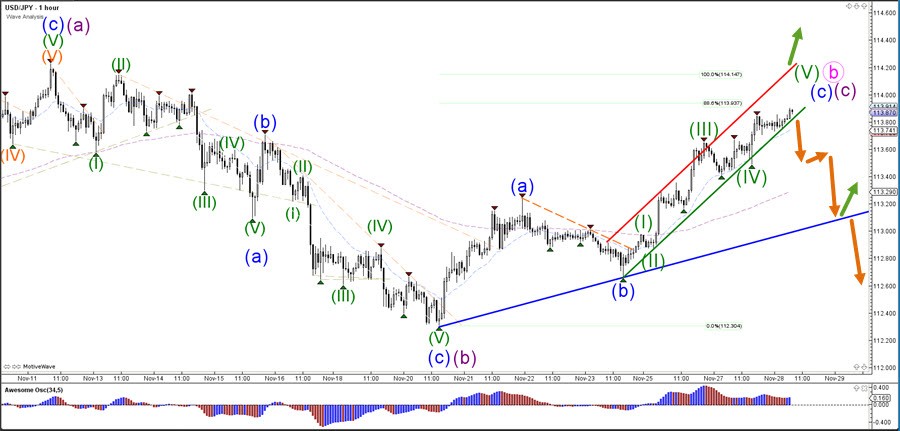
USDJPY Reversal Zoneat Deep 88.6% Fibonacci Target
The ABCDE (purple) triangle chart pattern could be part of a larger bearish ABC (pink) wave pattern.
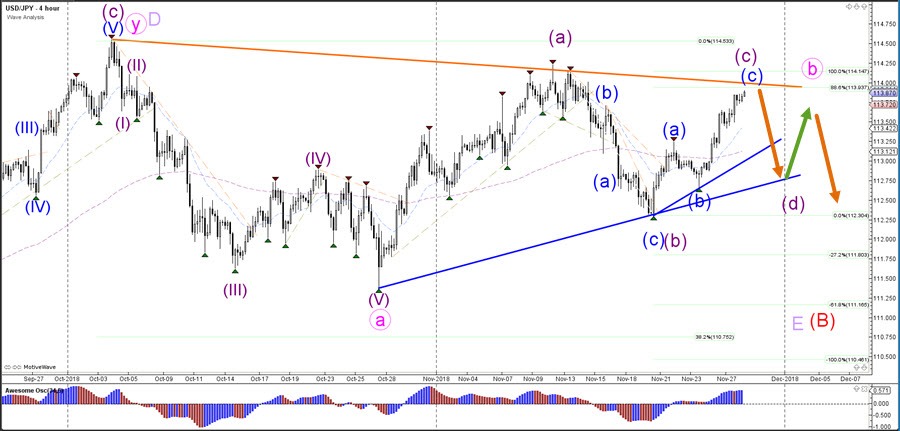
The USD/JPY is either showing a wave C (blue) as shown in the image or the alternative wave pattern for this bullish momentum could be a wave 3. A bearish bounce at the 88.6% Fib and break below the uptrend channel could indicate the end of the wave 5 (green) of wave C (blue) and the start of a bearish swing.
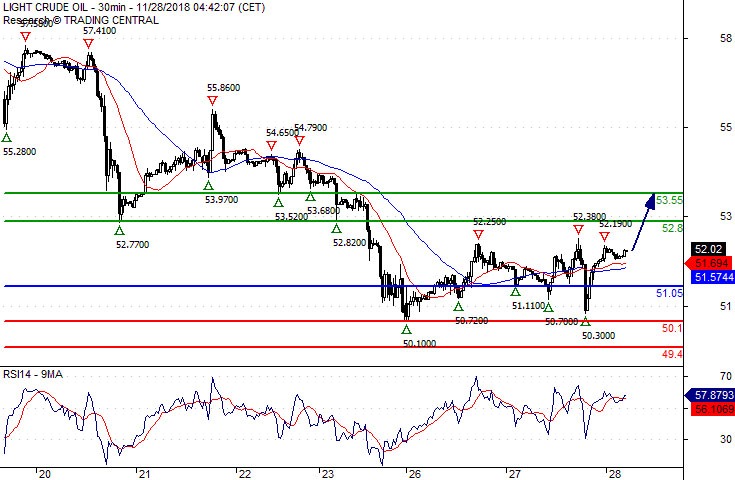
Crude Oil Rebound In Sight
Pivot (invalidation): 51.05
Our preference Long positions above 51.05 with targets at 52.80 & 53.55 in extension.
Alternative scenario Below 51.05 look for further downside with 50.10 & 49.40 as targets.
Comment The RSI calls for a bounce.
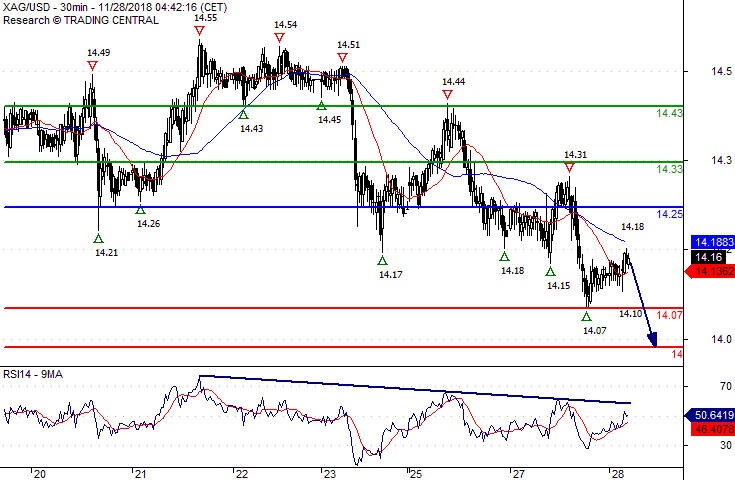
Silver Spot Key Resistance At 14.2500
Pivot (invalidation): 14.2500
Our preference Short positions below 14.2500 with targets at 14.0700 & 14.0000 in extension.
Alternative scenario Above 14.2500 look for further upside with 14.3300 & 14.4300 as targets.
Comment The RSI is capped by a declining trend line.
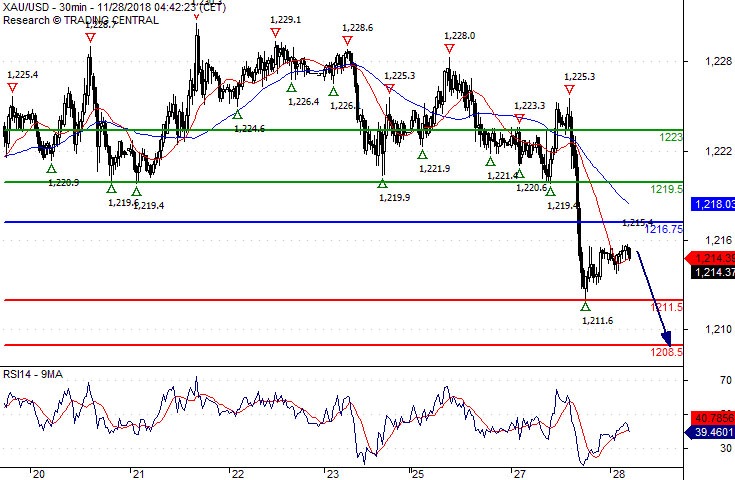
Gold Spot Key Resistance At 1216.75
Pivot (invalidation): 1216.75
Our preference Short positions below 1216.75 with targets at 1211.50 & 1208.50 in extension.
Alternative scenario Above 1216.75 look for further upside with 1219.50 & 1223.00 as targets.
Comment The RSI is mixed to bearish.
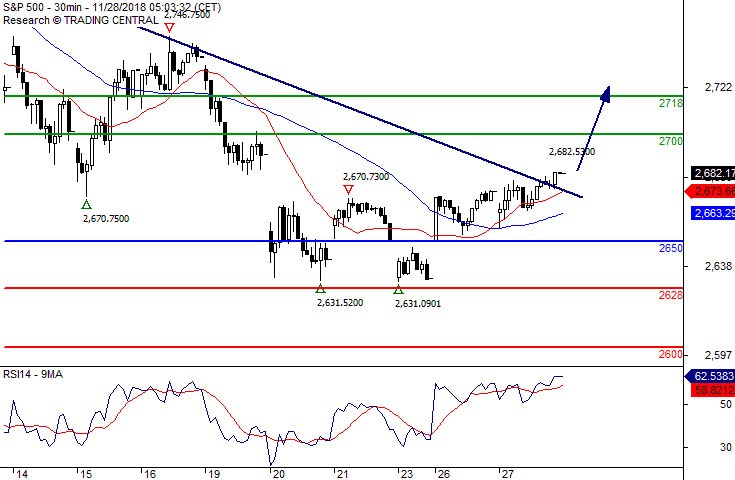
S&P 500 Further Advance
Pivot (invalidation): 2650.00
Our preference Long positions above 2650.00 with targets at 2700.00 & 2718.00 in extension.
Alternative scenario Below 2650.00 look for further downside with 2628.00 & 2600.00 as targets.
Comment The RSI advocates for further advance.
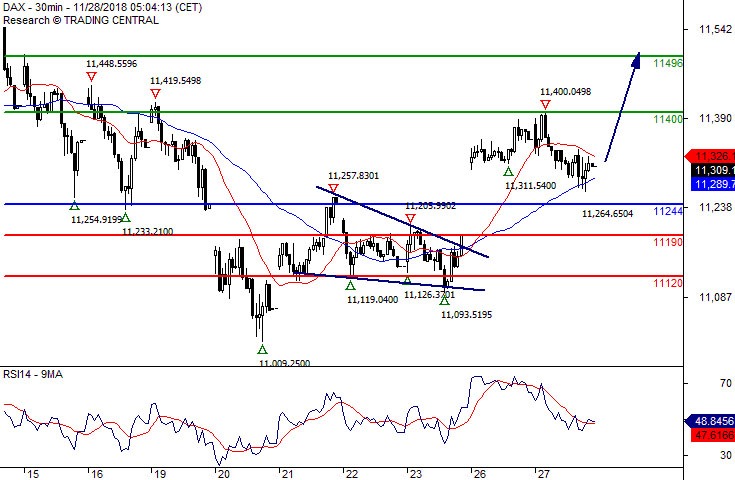
DAX Bullish Bias Above 11244.00
Pivot (invalidation): 11244.00
Our preference Long positions above 11244.00 with targets at 11400.00 & 11496.00 in extension.
Alternative scenario Below 11244.00 look for further downside with 11190.00 & 11120.00 as targets.
Comment Even though a continuation of the consolidation cannot be ruled out, its extent should be limited.
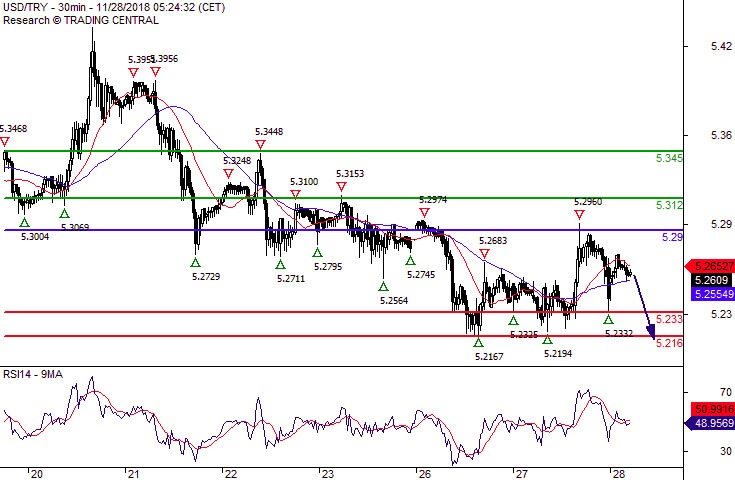
USD/TRY Turning Down
Pivot (invalidation): 5.2900
Our preference Short positions below 5.2900 with targets at 5.2330 & 5.2160 in extension.
Alternative scenario Above 5.2900 look for further upside with 5.3120 & 5.3450 as targets.
Comment As Long as the resistance at 5.2900 is not surpassed, the risk of the break below 5.2330 remains high.