Sample Category Title
Eco Data 11/28/18
[php_everywhere instance="1"]
Japanese Inflation Improves but Yen Falls to 2-Week Low
The Japanese yen has ticked higher in the Tuesday session. In North American trade, USD/JPY is trading at 113.70, up 0.09% on the day. On the release front, Japanese SPPI ticked higher to 1.3%, above the estimate of 1.2%. It was a similar trend for BoJ Core CPI, the preferred inflation indicator for the Bank of Japan. The indicator edged higher to 0.6%, just above the forecast of 0.5%. This marked the highest level in seven months. In the U.S., CB Consumer Confidence dipped to 135.7, missing the estimate of 135.7 points. On Wednesday, the U.S. publishes Preliminary GDP for the third quarter, with a forecast of 3.6%.
Japanese officials will be keeping a close eye on the G-20 summit in Argentina later this week. President Trump will meet with Chinese President Xi Jinping, and the stakes could not be higher, given the full-blown trade war between the world’s two largest economies. Japan has close economic ties with both countries and the ongoing tariff spat threatens to dampen Japan’s export sector.
Will we see a thaw in the tariff spat, or will Trump and Xi take shots at each other’s policies? Last week, White House advisor Larry Kudlow warned that the summit could be the scene of a direct confrontation between the parties. However, President Trump has a knack of reaching agreements with his adversaries despite hostile rhetoric, so it’s entirely possible that the parties will agree to continue negotiating, which could lift the mood of investors and boost the equity markets.
In Japan, SPPI and BoJ Core CPI both edged higher, but the yen was unable to capitalize on Tuesday. Last week, National Core CPI, which excludes volatile food prices, came in at 1.0% on an annualized basis, for a second straight month. The BoJ’s target of around 2 percent remains elusive and inflation could face further headwinds, as the slowdown in China and the ongoing global trade war takes a bite out of the country’s export sector. As well, lower oil prices could also hamper inflation. There is little reason to expect that inflation will gather any upward momentum and some analysts are forecasting that inflation in 2018 will fall below the 1 percent level.
Today’s top mover: GBP/NZD in near term consolidation, medium term bearish
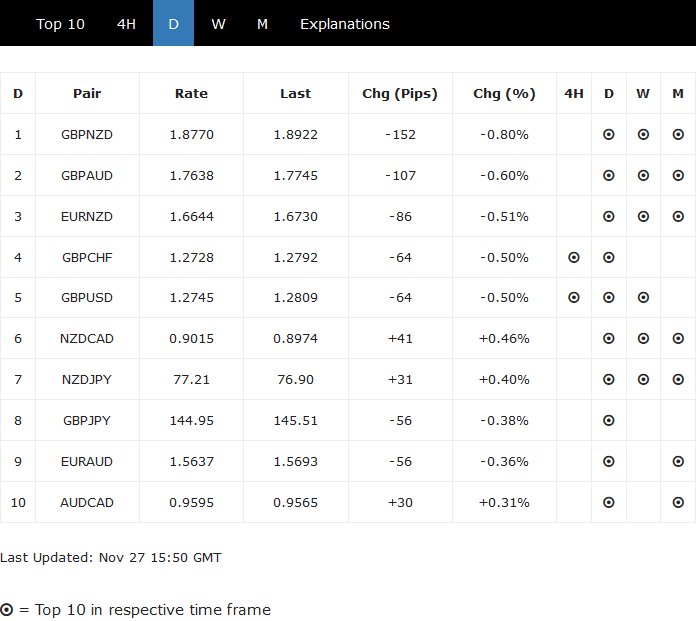
GBP/NZD is the biggest mover today as Sterling suffered renewed selling. On the other hand, Kiwi and Aussie remain firm despite rally in Dollar.
Nevertheless, GBP/NZD is staying above 1.8659 support despite today's fall. It's technically staying in consolidation and more sideway trading could be seen. But even in case of another recovery, upside should be limited by 1.9282 resistance to bring fall resumption.
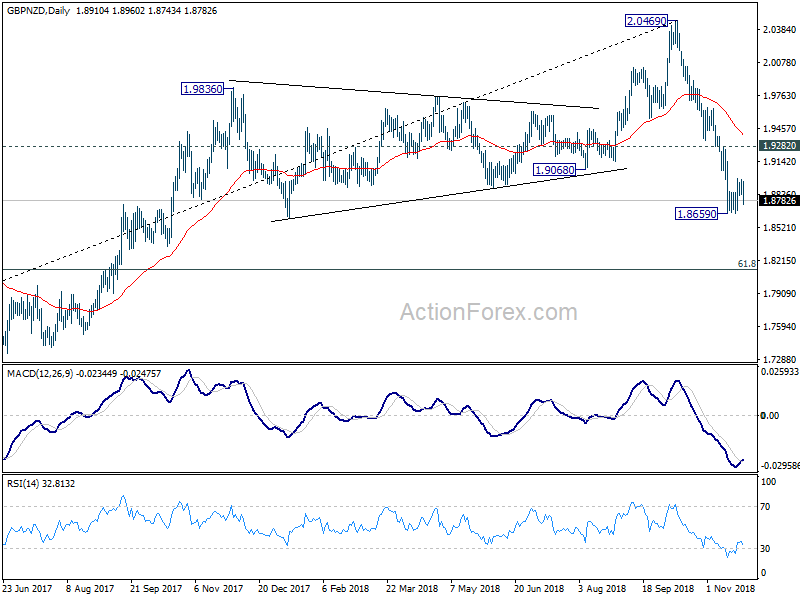
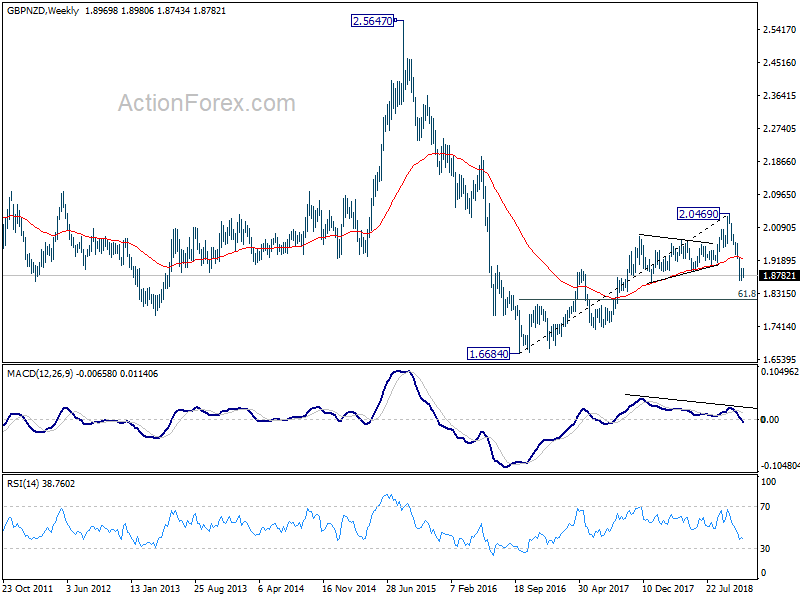
In our view, the medium term corrective rise from 1.6684 (2016 low) should have completed at 2.0469. Fall from 2.0469 is still in progress. Break of 1.8659 would target 61.8% retracement of 1.6684 to 2.0469 at 1.8130.
Aussie Looks to Domestic Data for Support Amid Ongoing Market Rout
The Australian dollar ended three weeks of strong gains last week and is possibly headed for a second weekly loss as market sentiment takes another turn for the worse. But as trade tensions rage on and Chinese growth slows, the Australian economy is enjoying strong growth and rising employment. The focus over the next week will be on how well the fundamentals stood up during the third quarter. The raft of Q3 indicators will start on Wednesday with construction work done (0030 GMT), followed by capital expenditure on Thursday (0030 GMT).
Construction work done in Australia bounced back in the first half of the year after a big plunge at the end of 2017 and was up 1.6% quarter-on-quarter in Q2. It is expected to have risen by a further 1% q/q in the July-September period. But a weaker figure is possible as tighter lending regulation by the country’s central bank, the Reserve Bank of Australia, is being blamed for the recent weakness in the construction sector, mainly as a result of a slowdown in residential construction activity.
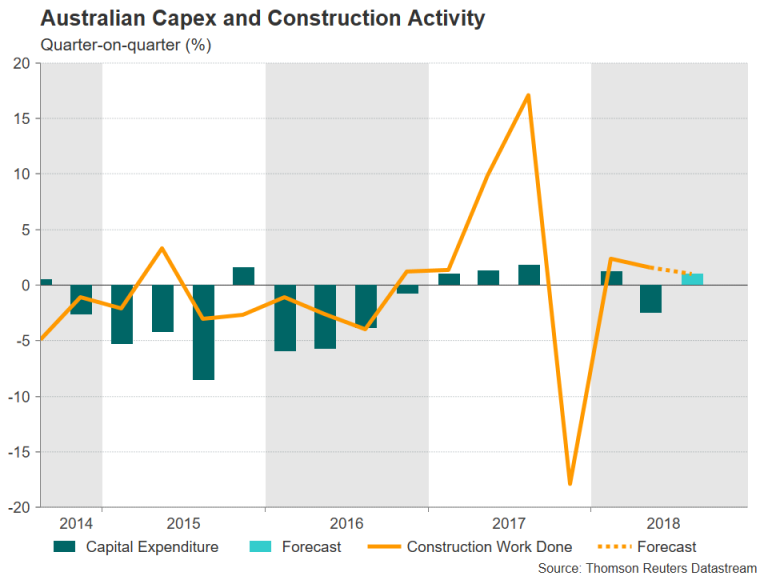
Business spending is also expected to have recorded positive growth during the third quarter, having fallen by 2.5% q/q in the prior three months. Capital expenditure is forecast to have grown by 1% q/q in Q3. Of particular interest for investors from the capex numbers will be whether non-mining investment continues to trend higher as this is vital for offsetting the decline in mining investment. A more modest increase than anticipated, or even a second consecutive quarterly drop in capex, is unlikely to weigh too heavily on GDP growth in Q3. However, a deteriorating trend would not bode well for future growth prospects.
The aussie is not expected to see very dramatic moves from this week’s data but should still see notable reaction as the figures will be a precursor to next week’s GDP release, due on December 5. If the data surprise to the upside, aussie/dollar might be able to rise past immediate resistance around 0.7260, which is near the 50-period moving average and the 23.6% Fibonacci retracement of the upleg from 0.7018 to 0.7337. However, there’s likely to be an even stronger obstacle slightly higher around 0.7275. A break above this level would clear the path for re-challenging November’s 2½-month high of 0.7337.
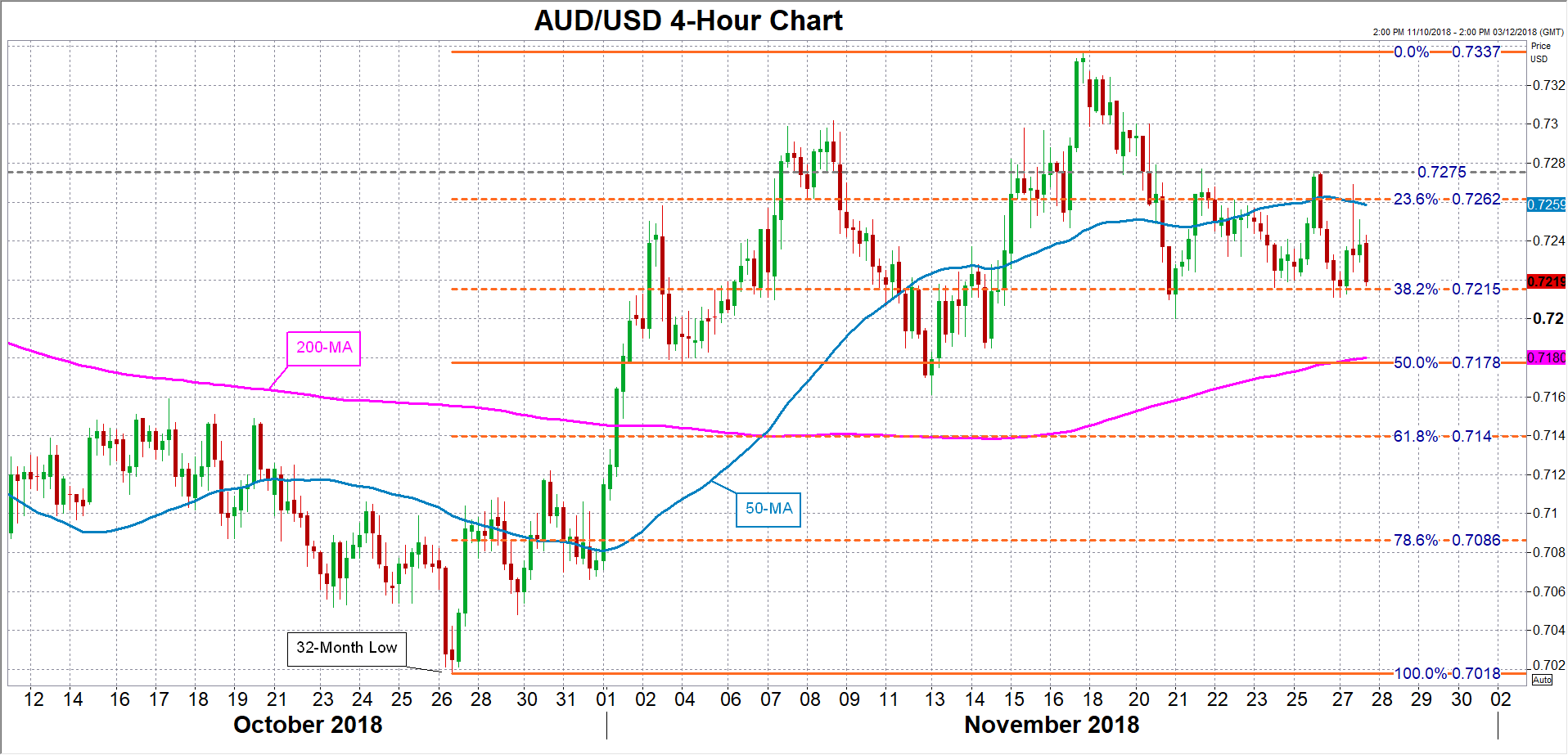
On the other hand, should the data raise concerns that the Australian economy is losing some steam, aussie/dollar could slip below the current support area around 0.7215, which is the 38.2% Fibonacci retracement level. Falling below this level could accelerate the decline towards the 50% Fibonacci at 0.7178, just below the 200-period moving average. A drop below the 50% Fibonacci would increase the downside risks for the pair and bring into focus the 61.8% Fibonacci at 0.7140.
USDTRY Outlook: Bears Could Extend Towards Key Supports at 5.00/4.82; Turkey CPI Data Eyed for Fresh Signals
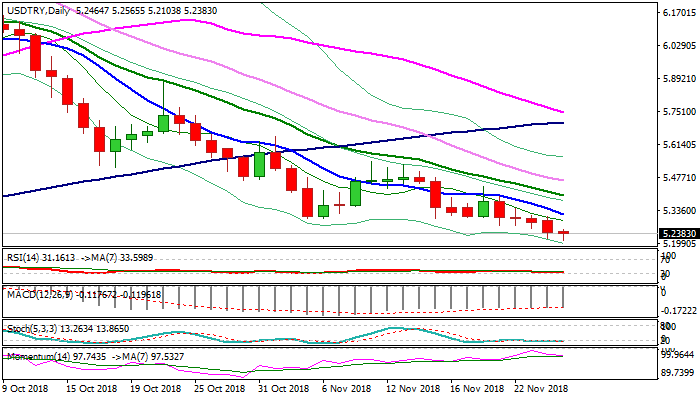
The USDTRY hit new nearly four-month low at 5.21 on Tuesday in extension of wave C (which commenced from 6.8379, 30 Aug lower top), of five-wave cycle from all-time high at 7.1074 (13 Aug). Extended third wave, eyes 200SMA (5.1174) break of which would open FE123.6% at 5.0316 and risk attack at strong support zone between 5.00 and 4.82 (psychological 5.00 support; FE138.2% and Fibo 38.2% of 2008/2018 ascend). The CBRT's ultra-tight policy works in favor of lira's bulls for now, along with significantly improved sentiment after Turkey released detained US pastor. Focus turns towards release of Turkey's CPI data next Monday, as strengthening lira and strong fall in oil prices, could push the inflation higher. Pullback from new record high is still seen as correction rather than direction change, with sustained break below 4.82 required to generate stronger reversal signal. Therefore, lira's recent bulls are expected to face strong headwinds from key 5.00/4.82 support zone.
Res: 5.2565; 5.3197; 5.3430; 5.3950
Sup: 5.2100; 5.1808; 5.1174; 5.0316
Trump may impose auto tariffs next week, Dollar lifted and Euro dips
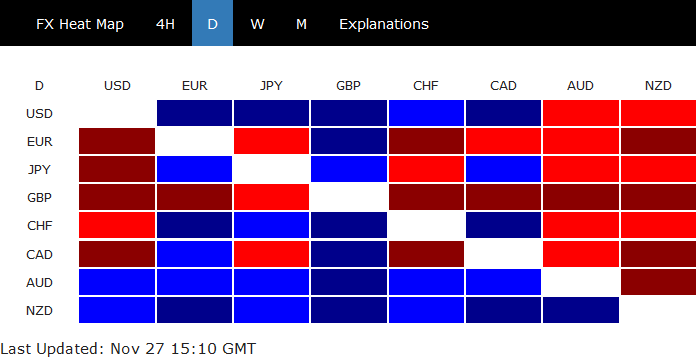
Dollar appears to be lifted by reports that Trump is ready to impose 25% auto tariffs as soon as next week after G20. The Wirtscharfts Woche reported that the Commerce Department recommended "as broad a policy as possible". And tariffs could be imposed to all countries except Canada and Mexico. That is, EU, Japan and South Korea could be included.
US consumer confidence dropped to 135.7, remains at historically strong levels
US Conference Board Consumer Confidence dropped to 135.7 in November, down from 137.9, missed expectation of 136.0.
In the release, it's noted that
- "Despite a small decline in November, Consumer Confidence remains at historically strong levels."
- "Consumers' assessment of current conditions increased slightly, with job growth the main driver of improvement.
- Expectations, on the other hand, weakened somewhat in November, primarily due to a less optimistic view of future business conditions and personal income prospects.
- Overall, consumers are still quite confident that economic growth will continue at a solid pace into early 2019.
- However, if expectations soften further in the coming months, the pace of growth is likely to begin moderating."
Sunset Market Commentary
Markets
Global core bonds are trading mixed today. German Bunds paired gains throughout the day and US Treasuries traded flat up until Fed VP Clarida’s speech. US President Trump ended yesterday’s uplift in risk sentiment on financial markets by signaling that he will likely push forward with plans to increase tariffs on $200 billion of Chinese goods if there’s no progress in US-China trade talks at the G20 summit in Argentina later this week. European equities opened volatile after a senior Chinese official said Trump and Xi agreed to reach a mutually beneficial agreement. German Bunds opened higher but gradually paired most of those gains throughout the day. The Italian government reiterated its willingness to lower the 2019 budget deficit as it is not worthwhile to “go to war” with the EU. By delaying the citizens’ income, possibly to the summer of 2019, it wants to lower the deficit to 2.2%. Italian BTP’s initially climbed on the news, but paired those gains. US Treasuries moved sideways today but eventually moved lower after Fed’s vice chairman Clarida’s speech. He repeated that the US economy is robust and the labour market remains healthy. He expects the expansion to continue in 2019, countering growing concerns of a slowdown. Clarida’s comments weighed on US Treasuries. The US yield curve edged slightly higher with changes ranging from +0.5 bps (2-yr) to +1.5 bps (10-yr). German yields declined with changes from -0.8 bps (30-yr) to -1.3 bps (5-yr).
The dollar held strong yesterday, given the improvement in global risk sentiment. Global (equity) markets didn’t find a clear directional bias today as US president Trump and Chinese officials gave different signals on the progress in the US-Sino trade talks going into this week’s G20 meeting. Fed’s vice-chair Clarida held a cautiously positive tone, supporting the process of gradual Fed normalization. However his comments had little impact on the dollar. The dollar in general and EUR/USD in particular show no clear trend. EUR/USD is hovering in the lower half of the 1.13 big figure. USD/JPY remains well bid even as risk sentiment turned less buoyant. The pair is trading near 113.60.
GBP-investors are closely monitoring UK PM May’s campaign to broker the Brexit deal to the UK parliament and even directly to UK citizens. Focus turned to her Northern Irish audience as the UK PM visited Belfast. There were few indications that the DUP, which is supporting May’s government, will approve the deal at the Dec 11 vote in Parliament. The DUP objections to the deal are not new. However, the party explicitly reiterating its call for PM to drop the backstop clause, only illustrated that it will be extremely difficult for PM May to avoid a chaotic outcome of the Brexit procedure. Sterling dropped lower this morning as the first headlines on Northern Ireland hit the screens. EUR/GBP jumped to the 0.8885 area. Sterling selling slowed later in the session. Even so, the political debate on Brexit again didn’t provide any reason to turn more positive on the UK currency. CBI November retail data were stronger than expected, but had little impact on sterling. EUR/GBP is trading in the 0.8870 area. Cable dropped temporary below 1.2750, but has currently rebounded to the 1.2775 area.
News Headlines
The Fed’s monetary policy is set to enter a more unpredictable phase. Rate setting going forward will be based more on economic data and less on forecasts of how the economy is expected to develop in the future. 2019 also means the end of quarterly rate hikes since all Fed meetings will be live, i.e. accompanied by a press conference.
Sweden is one important step closer towards a new government since the country faced a political impasse following the elections of September 9. The Center Party leader Annie Loof told she would accept the Social Democrat Stefan Lofven as prime minister if her party’s demand, including lower taxes, were met.
Fed Bullard: No doubt the US economy will slow in 2019 and 2020
St. Louis Fed President James Bullard said "I don't have any reason to doubt the economy will slow in 2019 and 2020. It would be much tougher for the Fed to continue to raise at this pace in a slowing economy relative to where we have been."
He also warned that "the good news won't last forever, and if potential growth really is at 1.8 percent the economy is going to return to some level more like that." He added, "the question in my mind is what are we trying to control? We have already been preemptive...We took all this action and it has put us in good shape."
And, "if we had not had these surprises to the upside my story would have looked better in retrospect than it does," Bullard said. "As a baseline most forecasts have the economy slowing down...That is the basic structure we are working with going into 2019."
GER 30 Index Moves above 2-Year Low But Medium-Term Outlook Remains Bearish
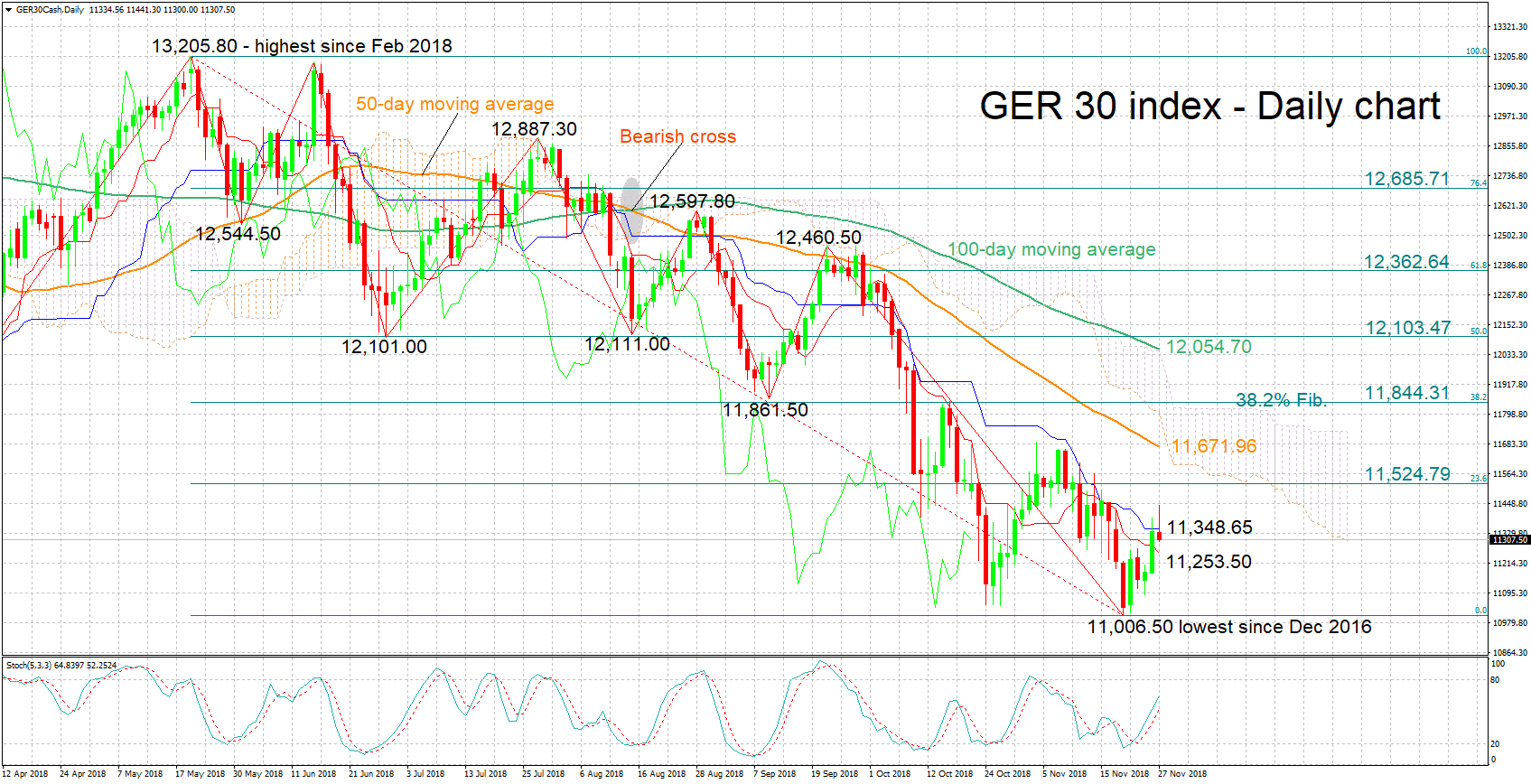
The Germany 30 index gained ground after touching a two-year nadir of 11,006.50 last week and is currently trading roughly 300 points above the aforementioned bottom.
Despite the move up, the Tenkan- and Kijun-sen lines remain negatively aligned, which is indicative of a bearish short-term bias. However, the Kijun-sen has halted its decline, pointing to weakening negative momentum. Moreover, the stochastics are giving a bullish signal in the very short term, as the %K line is above the %D one and both are heading higher.
Immediate resistance to a stronger move up seems to be coming around the current level of the Kijun-sen at 11,348.65. An upside violation would turn the attention to 11,524.79, this being the 38.2% Fibonacci retracement level of the downleg from 13,205.80 to 11,006.50. Higher, the focus would turn to the 50-day moving average line at 11,671.96 – the Ichimoku cloud top lies close to this point – and then to the zone around the 38.2% Fibonacci mark at 11,844.31.
On the downside, a first line of support could occur around the Tenkan-sen at 11,253.50. Additional declines would increasingly bring within scope the two-year low of 11,006.80, with the region around it also encapsulating the 11,000 mark that may hold psychological importance. Lower still, the zone around 10,800 that halted advances numerous times in 2016, could also act as support.
The medium-term picture continues to look bearish. Evidently, the index is in a downtrend, recording lower highs and lower lows. In addition, trading activity is taking place below the 50- and 100-day MAs, as well as below the Ichimoku cloud.
To conclude, the medium-term outlook is negative, while the bearish short-term bias is being challenged at the moment. Year-to-date, the index is down by 15.2%.