Sample Category Title
Sterling and Euro Turn Weaker, But Dollar Struggles to Extend Gain
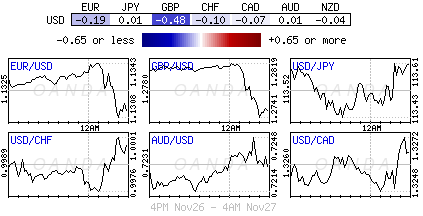
Sterling and Euro are trading as the weaker ones today, in otherwise mixed markets. Dollar appeared to be lifted by Trump's renewed threats to China on tariffs. He said it's "highly unlikely" to drop the planned tariff hike on Jan 1 and more could come if no deal is made with Xi this week. But there is no committed follow through buying the greenback yet. US futures now point to lower open, with European indices slightly in red. But Yen also got no sustainable momentum. Australian and New Zealand Dollar are the strongest ones but they're just stuck in familiar range.
In other markets, at the time of writing, FTSE is down -0.31%, DAX down -0.37%, CAC down -0.32%. German-Italian spread is staying below 300. WTI crude oil is consolidating at around 51.3. Gold is consolidating around 1225. Earlier in Asia, Nikkei closed up 0.64%. But Hong Kong HSI, China SSE and Singapore Strait Times were down, by -0.17%, -0.04% and -0.10% respectively.
Technically, GBP/USD's break of 1.2764 minor support would likely bring retest on 1.2661 low soon. GBP/JPY is having an eye on 144.02 minor support and break will resume recent decline from 149.48. While downside momentum is a bit unconvincing, EUR/AUD is still on track for 1.5519 low.
EU to push reform of three WTO functions in upcoming G20 summit
Defending multilateral rules-based international order would be a focus of EU in the upcoming G20 summit in Argentina later this week. European Commission President Jean-Claude Juncker and European Council President Donald Tusk outlined the key issues in a joint letter today, including global confidence, fair globalisation and trade, climate change, Africa-Europe Alliance etc.
On trade, they warned that "the rules-based multilateral trading system is facing a deep crisis" and the "entire system" is at risk. They also criticized that "the longstanding G20 commitments to keep markets open, to fight protectionism and support the multilateral trading system, risk becoming empty words."
EU will promote "a positive trade agenda, including the reform of the three functions of the World Trade Organisation (negotiating, monitoring and dispute settlement functions". And it urged that "G20's support can be instrumental in providing political impetus to the trade discussions in Geneva".
UK PM May to have TV debate with Corbyn on Brexit
UK Prime Minister Theresa May issued a TV debate challenge to Labour's Jeremy Corbyn on Brexit. And Corbyn swiftly accepted. The debate could be held on December 9, just two days ahead of Commons vote on the deal. Eventually, other parties' representatives may also join.
Separately, Cabinet Office Minister David Lidington warned today that "There's no plan B because the European Union itself is saying the deal that is on the table is the one that we have had to compromise over." He added "there is a bit of wishful thinking on the part of some people that a preference expressed by politicians in the UK will somehow lead to a different plan, an alternative being offered."
And, "There is a binary choice for the House of Commons to make: they can accept the deal that is on table, that is a compromise but I think is a good compromise for our national interest, or they can vote it down. The EU 27 is very clear they are not going to reopen this package." Lidington also admitted that "If the vote were today, it would be a difficult one to win, but I think that we have time between now and (Dec. 11) to make the case."
On the data front
UK CBI reported sales rose to 19 in November, up from 5 and beat expectation of 10. New Zealand trade deficit widened to NZD -1.295M in October, above expectation of NZD -850M. Japan corporate services price index rose 1.3% yoy in October versus expectation of 1.2% yoy.
GBP/USD Mid-Day Outlook
Daily Pivots: (S1) 1.2782; (P) 1.2823; (R1) 1.2849; More...
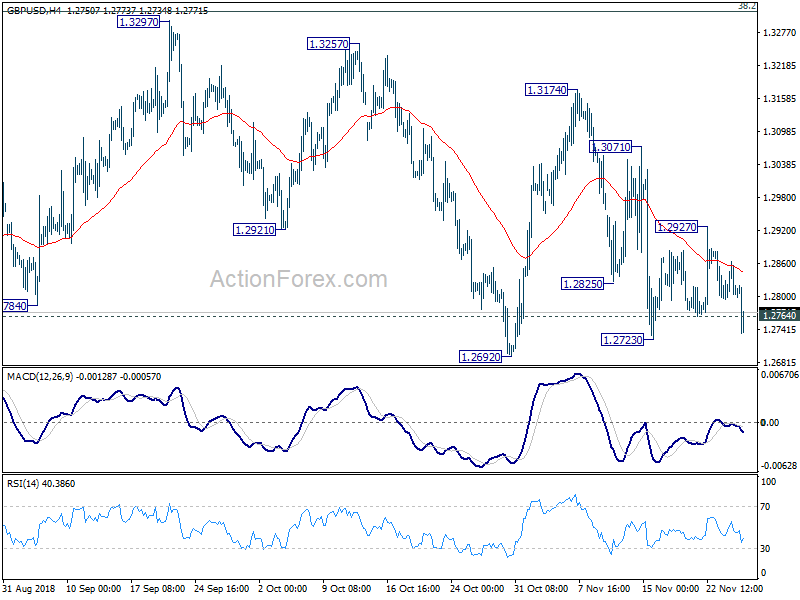
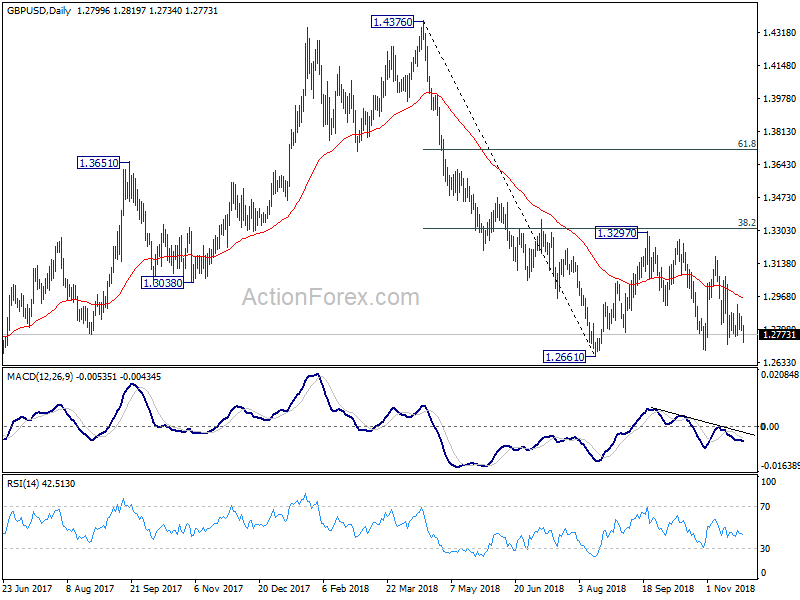
GBP/USD's break of 1.2764 minor support suggests the choppy fall from 1.3174 is resuming. Intraday is back on the downside for 1.2723 first. Break would bring retest of 1.2661 key support level next. On the upside, above 1.2927 will turn bias back to the upside for another rebound. But after all, price actions from 1.2661 are viewed as a consolidation pattern. Even in case of strong rebound, upside should be limited by 1.3316 fibonacci level to bring down trend resumption eventually.
In the bigger picture, whole medium term rebound from 1.1946 (2016 low) should have completed at 1.4376 already, after rejection from 55 month EMA. The structure and momentum of the fall from 1.4376 argues that it's resuming long term down trend. And this will be the preferred case as long as 38.2% retracement of 1.4376 to 1.2661 at 1.3316 holds. However, firm break of 1.3316 would bring stronger rebound to 61.8% retracement at 1.3721. And, the eventual depth of the fall from 1.4376, and the chance of hitting 1.1946 low, will depend on the strength of the interim corrective rebound from 1.2661.
Economic Indicators Update
| GMT | Ccy | Events | Actual | Forecast | Previous | Revised |
|---|---|---|---|---|---|---|
| 21:45 | NZD | Trade Balance (NZD) Oct | -1295M | -850M | -1560M | -1596M |
| 23:50 | JPY | Corporate Service Price Y/Y Oct | 1.30% | 1.20% | 1.20% | 1.10% |
| 11:00 | GBP | CBI Reported Sales Nov | 19 | 10 | 5 | |
| 14:00 | USD | House Price Index M/M Sep | 0.40% | 0.30% | ||
| 14:00 | USD | S&P/Case-Shiller Composite-20 Y/Y Sep | 5.30% | 5.50% | ||
| 15:00 | USD | Consumer Confidence Index Nov | 136 | 137.9 |
EU to push reform of three WTO functions in upcoming G20 summit
Defending multilateral rules-based international order would be a focus of EU in the upcoming G20 summit in Argentina later this week. European Commission President Jean-Claude Juncker and European Council President Donald Tusk outlined the key issues in a joint letter today, including global confidence, fair globalisation and trade, climate change, Africa-Europe Alliance etc.
On trade, they warned that "the rules-based multilateral trading system is facing a deep crisis" and the "entire system" is at risk. They also criticized that "the longstanding G20 commitments to keep markets open, to fight protectionism and support the multilateral trading system, risk becoming empty words."
EU will promote "a positive trade agenda, including the reform of the three functions of the World Trade Organisation (negotiating, monitoring and dispute settlement functions". And it urged that "G20's support can be instrumental in providing political impetus to the trade discussions in Geneva".
EU's "Facts and figures about the European Union and the G20" booklet here.
DAX Slips on Trump Talks Tough about China
The DAX index has posted losses in the Tuesday session. Currently, the DAX is trading at 11,328, down 0.47% on the day. On the release front, there are no German or eurozone events. On Wednesday, Germany releases GfK consumer sentiment and the U.S. publishes Preliminary GDP for the third quarter.
Investors are keeping an eye of the G-20 summit in Argentina, which begins on Friday. President Trump will meet with Chinese President Xi Jinping, and the stakes could not be higher, given the full-blown trade war between the world’s two largest economies. Will we see a thaw in the tariff spat, or will Trump and Xi take shots at each other’s policies? Last week, White House advisor Larry Kudlow warned that the summit could be the scene of a direct confrontation between the parties. However, President Trump has a knack of reaching agreements with his adversaries despite hostile rhetoric, so it’s entirely possible that the parties will agree to keep negotiating, which could lift the mood of investors and boost the equity markets.
Brexit was in the spotlight on the weekend, as the 27 EU leaders approved the withdrawal agreement as well as the political declaration on economic relations between Britain and the EU after Brexit. The European leaders were in a surly mood, taking pains to warn Britain not to try to squeeze more concessions out of the EU. Dutch Prime Minister Mark Rutte summed up the European position, declaring “there is no Plan B”. The EU has signaled that the deal signed on Sunday is “take it or leave it” – if the U.K. doesn’t sign on, the result will be a no-deal “brutal Brexit”, which could be catastrophic for the British economy.
EURAUD Returns Back Below 20-Day SMA, Ready To Re-Test 5-Month Low
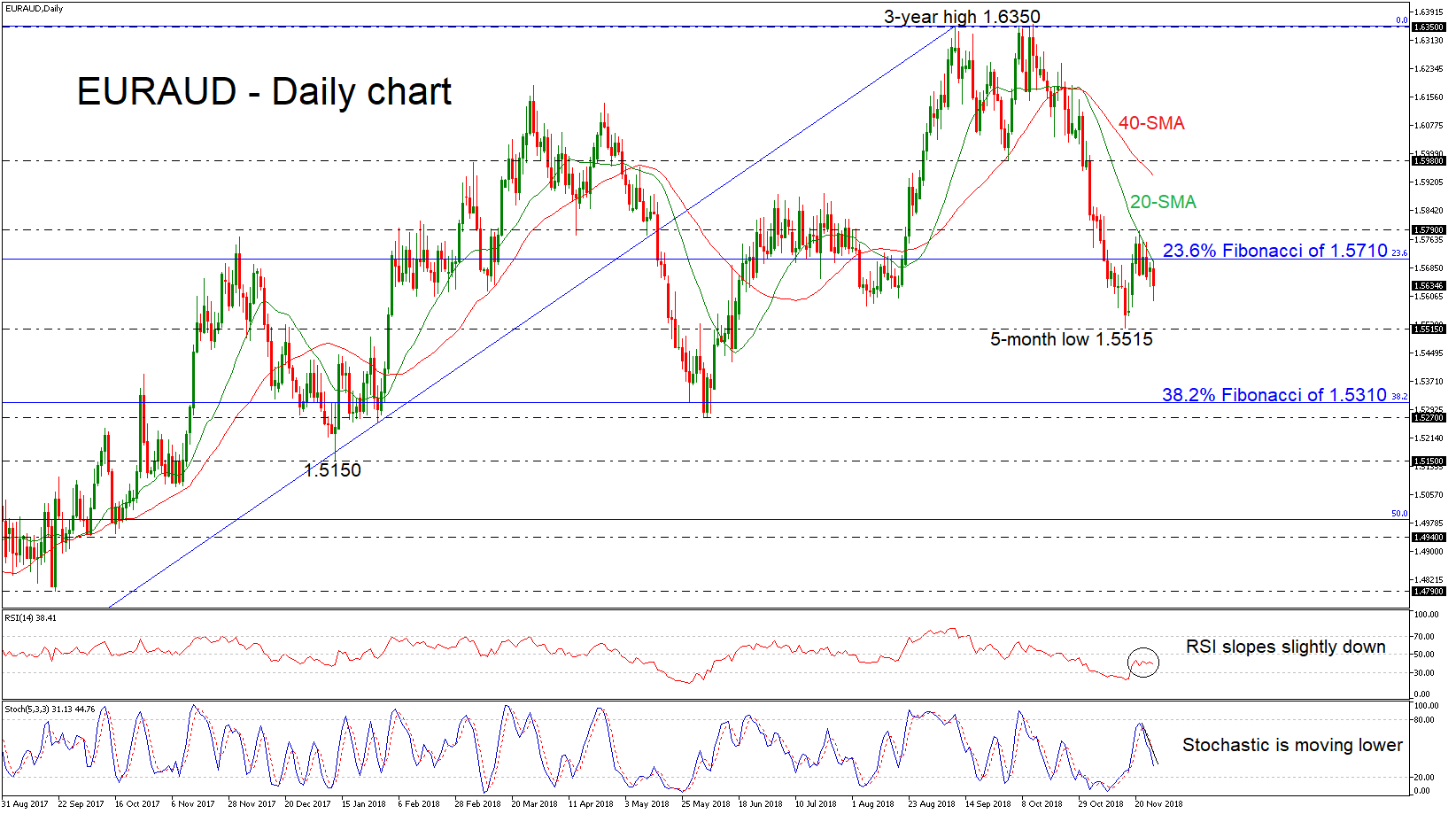
EURAUD is pushing aggressively lower, following the bounce off the 20-day simple moving average (SMA) earlier in the day. Technically, the RSI remains in the negative zone and is turning lower, while the stochastic oscillator is strengthening its negative momentum, approaching the 20 level. Both are confirming the recent bearish run in the market in the short-term.
Should the pair stretch south, November 15’s low of 1.5515 could provide immediate support before the pair touches the 38.2% Fibonacci retracement level of the upleg from 1.3620 to 1.6350, around 1.5310. Slightly lower the pair could touch the 1.5270 barrier, taken from the trough on June 5.
On the other hand, a recovery could retest the 23.6% Fibonacci mark of 1.5710 before attention turns to 1.5790, the high on November 21. Moving higher, the 40-day SMA near 1.5940 and the 1.5980 area should attract attention, while a significant rally above that region could last until 1.6350, the peak on October 11.
To sum up, EURAUD hovers below strong upside obstacles, increasing the chances for a continuation of the negative view.
WTI Oil Outlook: Bears Are Taking A Breather Ahead Of Psychological $50 Support
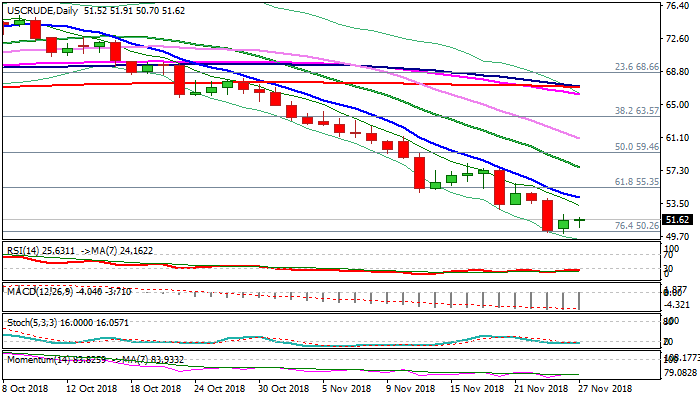
WTI oil trades within extended but limited consolidation on Tuesday, near the lowest level in past almost fourteen months ($50.09) and ticks ahead of psychological $50 support. Bears may take a breather before eventually breaking lower, in usual reaction on approach to key points, but strong negative sentiment and bearish techs remain intact and keep focus at the downside. The latest negative signal came from Saudi Arabia's rise in oil production which reached all-time high in November, adding to negative outlook. Focus turns towards OPEC's meeting next week, as the cartel is expected to confirm signals of reducing output as a step to stabilize oil market. This would put broader bears on hold, however, initial bullish signal could be expected on break above falling 10SMA ($54.26).
Res: 52.22, 52.76, 54.26, 54.80
Sup: 50.26, 50.00, 49.10, 46.99
U.S. Indices Aiming For A 5% Increase
A significant market decline often indicates a market correction phase. Last Friday, index S&P 500 closed on the lowest levels for the last six months, losing 10.2% from the September peaks, and marking its entry into the market’s correction phase.
However, the market reactions so far signal that the demand for stock hasn’t changed, and thus the correction phase may not arrive in the near future, as expected.
On Monday, index S&P500 has increased by more than 1.5% while the futures for the index have shown an upturn today morning.
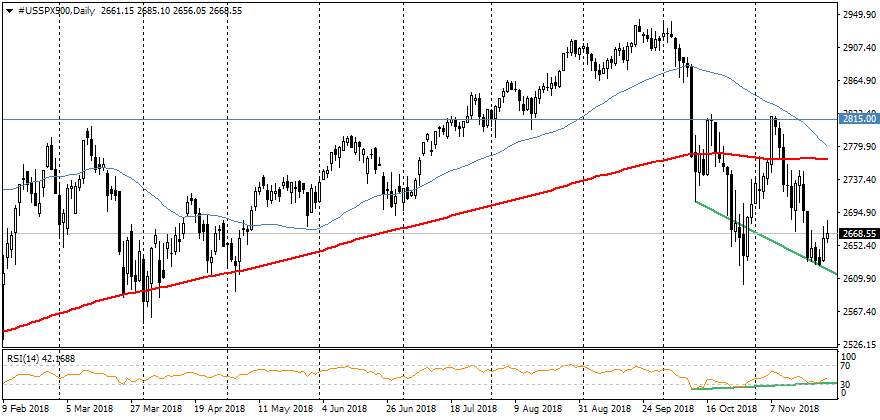
Moreover, the technical indicator –Relative Strength Index – highlights the weakness of the downward trend, taking into account the sequence of the highest lows. However, results show a clear divergence from the price dynamics, since the decline in November was much more profound than in October. Often, such a divergence between the price and the RSI precedes a significant, upcoming rebound.
An important resistance area is situated near 2810, which is 4.7% higher than the current levels, and could become a target for the market bulls.
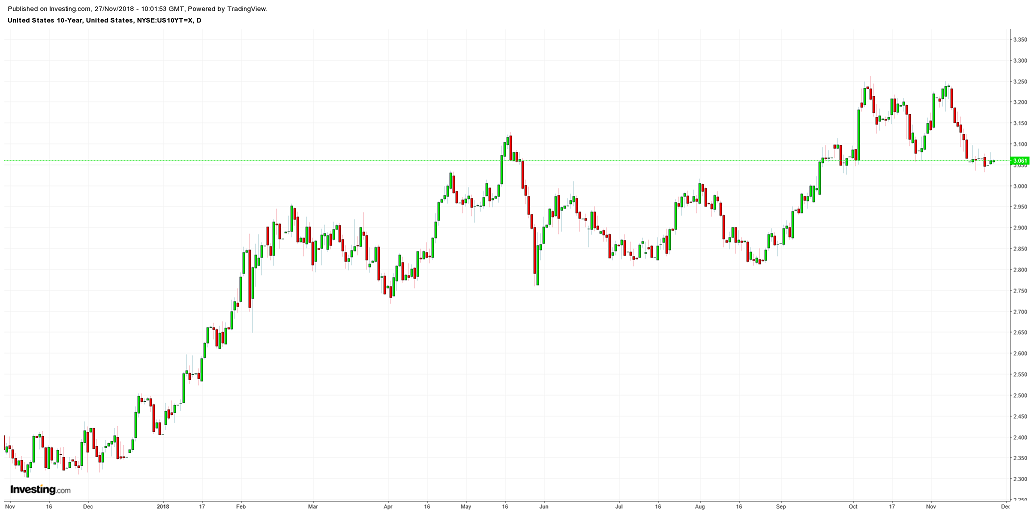
Among all the support factors, is also the yield decline in the U.S. treasuries, which in turn makes the assets with fixed return less attractive to investors. The yield of 10-year US government bonds reversed to decline from 3.25% to 3.05% twice in November and October, which as a result triggered increased demand for stocks. The latest trigger for the decline was Powell’s recent comments that the Fed could pause the rates’ raises next year, in light of the slowdown of the economy.
Investors should also pay attention to the moderation of the inflationary pressure, after the oil prices collapse. Today and tomorrow, the markets may get further clarification in regard to the Fed’s position and the evaluation of the latest data. Later today, the Fed’s Vice Chairman will give out a speech, followed by the Fed’s Chairman, Jerome Powell, on Wednesday. The confident sentiment prevalent in the economy, and the intentions to stay on course, for 3 or more rate hikes next year, may trigger the dollar to see a rally in the future. However, there is a higher probability towards a shift to a more precautionary stance, that can increase the pressure on the dollar and strengthen stocks.
Bitcoin Price Will Bottom At 85% Discount To All-Time High
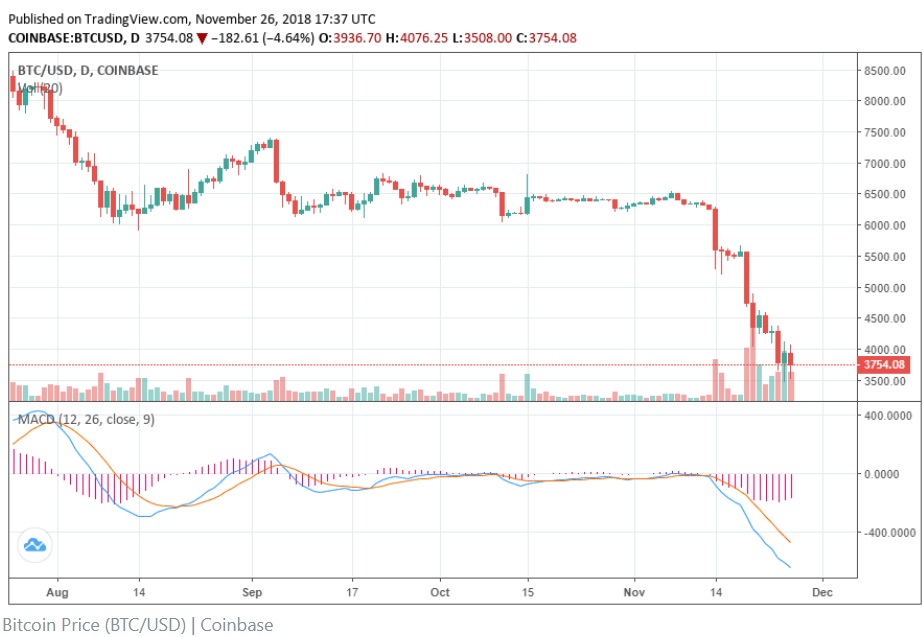
Anthony Pompliano, who works in Morgan Creek’s Digital Assets division, told CNBC’s Squawk Box on Monday that he believes the Bitcoin price is essentially going to bottom out with an 85% reduction in value from its previous all-time high. Prefacing that his forecast is based on previous experience in the crypto markets, he said: “85% from the all-time high is about where we’ll end up. Puts it around $3,000. Came close over the weekend but probably a little bit more to fall.”
He went on to explain to the host, who spoke of lost confidence among Bitcoin investors and the prospect of them returning to the market following their recent heavy losses, that he feels Bitcoin was overvalued and is now seeing a healthy correction.
“Bitcoin was overvalued in December ‘17. There’s more sellers than buyers this year. So the price goes down. But there’s three things you gotta remember. The first is, this is a transaction settlement layer. It’s the most secure in the world. It’s got to be worth something. It can’t be worth zero.” “The second is it’s the best performing asset class in the last ten years. It’s outperformed S&P, Dow, Nasdaq, et cetera, during the longest bull run. And so it experienced two 80% drops during that time, but the asset’s still up over 400% in the last two years,” he continued. “And the third thing is: that was all done by retail.”
Morgan Creek owns a partnership called the Digital Asset Index Fund with Bitwise Asset Management, which enables large institutional clients to get convenient exposure to digital assets like Bitcoin, Ethereum, and the myriad of tokenized assets therein.
GBPUSD Testing Wedge Support
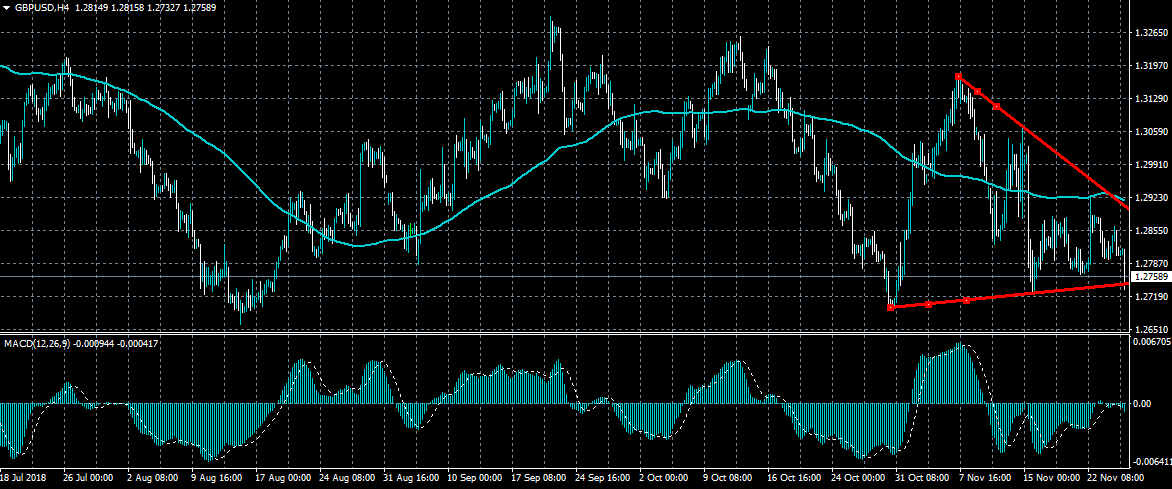
The British pound has moved sharply lower against the US dollar during the European session, as UK political concerns weigh on sterling sentiment. The GBPUSD pair is now testing critical trendline support from the wedge pattern on the four-time frame. A clear break below the wedge pattern will likely trigger further technical selling towards the 2018 trading low, at 1.2662.
The GBPUSD pair is strongly bearish while trading below the 1.2750 level, key technical support is found at the 1.2695 and 1.2662 levels.
If the GBPUSD pair trades above the 1.2775 level, key resistance is found at the 1.2810 and 1.2857 levels.
USDJPY Supported BY Rising MACD
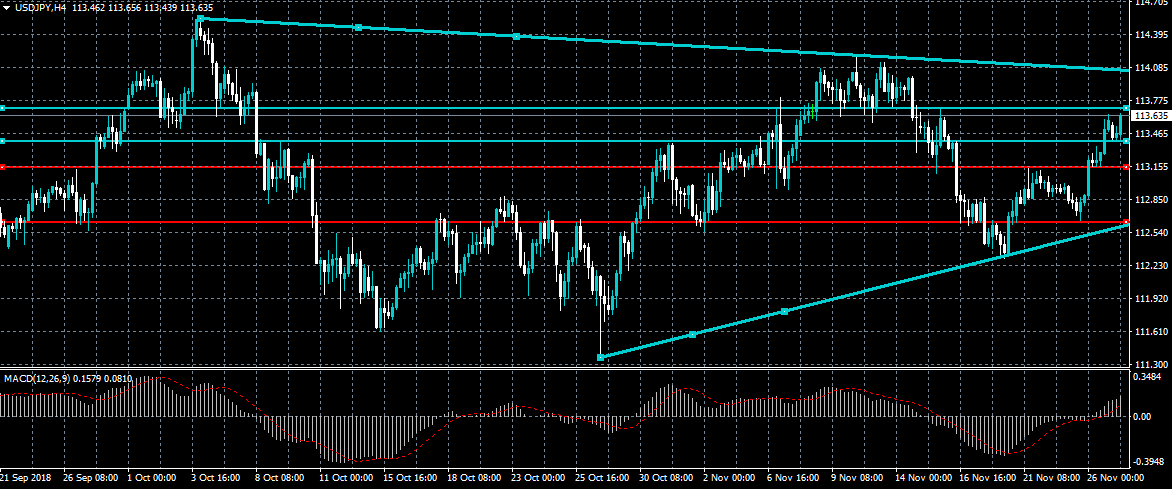
The US dollar has continued to rise against the Japanese yen during the European trading session, as the greenback surges higher across the board. The recent strong move higher in the USDJPY pair is also receiving technical confirmation, as the MACD indicator on the four-hour time frame trends higher. A clear breach of the 113.70 level exposes further upside towards the important 114.19 level.
The USDJPY pair is strongly bullish while trading above the 113.70 level, key resistance remains at the 114.19 and 114.54 levels.
If the USDJPY pair trades below the 113.40 level, key technical support is found at the 113.15 and 112.60 levels.
Sterling Falls On Brexit Vote Worries, Trump Weighs In
Tuesday November 27: Five things the markets are talking about
U.S stock futures are lower; along with European shares while gains in Asian equities were capped overnight after President Trump’s comments on further Chinese tariff hikes casted doubt on an ending to a trade war between the worlds two largest economies.
U.S Treasuries and the ‘big’ dollar are holding steady ahead of Thursday’s FOMC minutes for clues to future interest rate policy.
Elsewhere, euro-zone bonds have rallied this morning; while the ‘single’ unit remains under pressure as concerns persist that the eurozone economy is slowing. The pound is lower as the market considers the prospects for parliamentary approval of the Brexit deal.
Elsewhere, emerging market currencies are weaker overnight and their equities traded little changed. Bitcoin has steadied, trading atop of $3,700 after plummeting -14% yesterday.
On tap: Presidents Trump and Xi Jinping plan to meet at the G-20 that starts on Friday. Fed Reserve Vice Chairman Richard Clarida speaks in NY today and Chair Powell speaks tomorrow. G20 meeting is to be held in Argentina from Nov 30-Dec 1.
1. Global equities mixed results
Japanese stocks rallied overnight, lifted by a gain stateside Monday and as a weaker yen supported exporters, although fresh concerns about Sino-U.S trade tensions capped gains. The Nikkei share average ended the day +0.64% higher, while the broader Topix added +0.73%.
Down-under, Aussie stocks ended higher overnight, with financial stocks leading gains after regulators gave lenders more time to implement new capital rules on loans. The S&P/ASX 200 index climbed +1% at the close of trade after falling -0.78% Monday. In S. Korea, the Kospi stock index rallied, lifted by gains in auto shares, while investors remained cautious over Trump’s new trade remarks on the Sino-U.S trade quarrel. The Kospi was up +0.79%.
In China, equities closed lower overnight after U.S President Trump seemed to nullify hopes of a trade truce with Beijing, while investors remained on the sidelines amid a slowdown in global growth. The Shanghai Composite index ended flat, while the blue-chip CSI300 index closed -0.1% lower.
In Hong Kong, stocks eased slightly on Tuesday, as market remained wary of potential volatility inspired by this weekends G20 summit and the pace of interest rate hikes in the U.S. The Hang Seng index was down -0.2%, while the Hang Seng China Enterprises index fell -0.1%.
In Europe, regional bourses trade mixed. The Italian budget and Brexit developments continue to be in the forefront – Italy confirmed their 2019 budget but was still considering lowering it, while the UK Parliament will vote on the proposed Brexit deal on the Dec 11.
U.S equities are set to open little changed (-1%).
Indices: Stoxx600 -0.15% at 357.80, FTSE -0.25% at 7,018.75, DAX -0.06% at 11,347.30, CAC-40 -0.03% at 4,993.28, IBEX-35 +0.24% at 9,113.15, FTSE MIB -0.12% at 19,210.50, SMI -0.40% at 8,893.50, S&P 500 Futures -0.11%
2. Oil falls on record Saudi output; eyes G20 and OPEC, gold lower
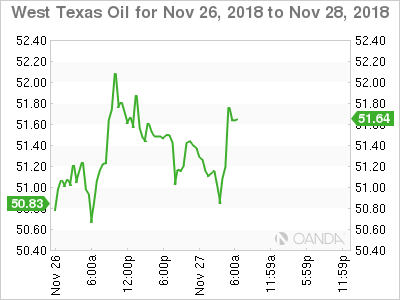
Oil prices remain under pressure, depressed by record Saudi Arabian production, despite the kingdom trying to persuade other exporters to agree output cuts ahead of next week’s OPEC meeting.
Brent crude oil is down -70c a barrel at +$59.78, while U.S light crude is -75c lower at +$50.88.
Data Monday showed that Saudi Arabia raised oil production to an all-time high this month, pumping +11.1M to +11.3M bpd in November.
Note: Oil prices are down -30% since early October, weighed down by an emerging supply overhang and widespread financial market weakness.
The market is now waiting for the outcome of this weeks G20 meeting in S. America and next week’s OPEC meeting.
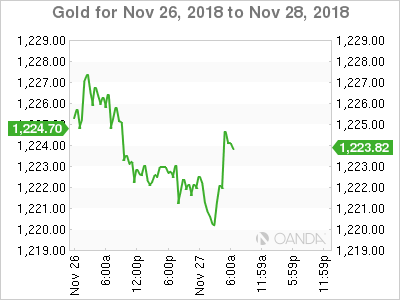
Ahead of the U.S open, gold prices are a tad lower as the ‘big’ dollar holds firm outright, and while investors await for clues on the pace of future U.S interest rate hikes and the outcome of the G20 summit. Spot gold is -0.1% lower at +$1,220.97 per ounce, while U.S gold futures are down -0.2% at +$1,220.2 an ounce.
3. U.S trade worries pushes Bund yields to three-month lows
German bund yields are trading atop of their three month lows this morning after President Trump brought global trade conflicts back into the fore, fuelling concerns about the outlook for the global economy.
Trump said yesterday that he expects to raise tariffs on Chinese imports and also said that the Brexit agreement may make trade between the U.S and London more difficult.
The yield on German 10-year Bunds has dropped -3 bps to +0.33%, its lowest print since early September.
Elsewhere, the yield on 10-year Treasuries is unchanged at +3.05%, while in the U.K, the 10-year Gilt yield has fallen -3 bps to +1.375%, the lowest in more than a week. The spread of Italy’s 10-year BTP’s over Bunds has increased +2 bps to +2.9245%.
4. Dollar little changed
President Trump is expected to move ahead with plan to increase China tariffs to +25% on $200B worth of goods – iPhones made in China could be included in new round of tariffs.
Trumps ‘hawkish’ comments on trade is helping the U.S dollar to maintain a firm tone – his remarks are very much par for the course on attempted deal making.
GBP/USD (£1.2759) trades atop of new two-week lows, as concerns over the upcoming Brexit vote remains a headwind for sterling.
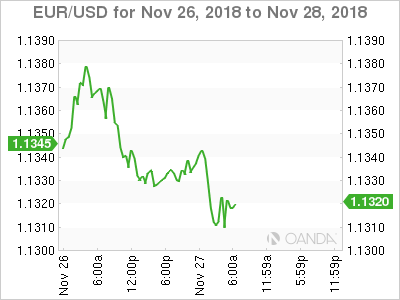
EUR/USD (€1.1317) is steady, as Italy appears to be less confrontational with a willingness to negotiate, as the government seems aware of the implications of its actions.
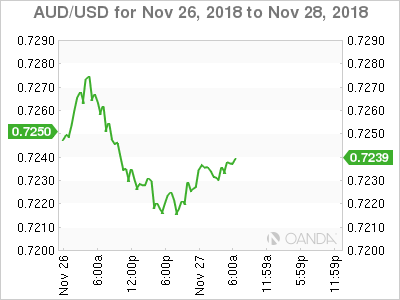
Elsewhere, yen has decreased less than -0.05% to ¥113.60, the weakest in more than a week.
5. Aussie general election
Australia’s conservative government are looking at a general election next May, as PM Morrison brings the budget forward to April 2.
“It is absolutely our intention to deliver the budget before the election, and to deliver a surplus budget,” he says.
The announcement means the election will be held on either May 11 or 18, with the minority government lagging badly behind Labor opponents in opinion surveys that indicate conservatives could lose as many as 20 seats.
Morrison has indicated that a mid-year budget update would be delivered on Dec. 17.
Note: PM Morrison has suffered another blow to his minority government’s position overnight with Victoria’s Julia Banks announcing her departure to stand as an independent due to frustration at internal party divisions over energy and climate-change policies, as well as women’s issues.