

Sample Category Title
Trump: Fed is a much bigger problem than China
Trump expressed his dissatisfaction on Fed Chair Jerome "Jay" Powell again yesterday. He told the Washington post that "So far, I'm not even a little bit happy with my selection of Jay. Not even a little bit." He went further and said "Fed is a much bigger problem than China".
He added "and I'm not blaming anybody, but I'm just telling you I think that the Fed is way off-base with what they're doing." He pointed to China and Euro being "accommodative". But "we're not getting any accommodation".
Trump complained again that "I'm doing deals, and I'm not being accommodated by the Fed." And, "they're making a mistake because I have a gut, and my gut tells me more sometimes than anybody else's brain can ever tell me."
UK PM May to tell Scotland: Brexit deal protects jobs
UK Prime Minister Theresa May will continue her nationwide Brexit deal sales tour today and Scotland is the next destination. May is expected to say "it is a deal that is good for Scottish employers and which will protect jobs." And, the agreement would create a new free trade area of "unprecedented economic relationship that no other major economy has."
May would also add that "at the same time, we will be free to strike our own trade deals around the world – providing even greater opportunity to Scottish exporters."
China ambassador to US: Using treasuries as weapon could backfire
Chinese ambassador to the US, Cui Tiankai, said that no one in Beijing is thinking seriously about using US treasuries as a weapon in trade war. HE said that it could "backfire". Cui emphasized that "We don't want to cause any financial instability in global markets. This is very dangerous, this is like playing with fire".
Cui repeated the usual Chinese rhetoric that "we are against any trade war", but China would "fight to safeguard our own interests." And he also criticized so far "I have not seen sufficient response from the U.S. side to our concerns." He emphasized "we cannot accept that one side would put forward a number of demands and the other side just has to satisfy all these things."
Australia Construction Work Surprised to the Downside, Contracting Sharply
Construction work was much weaker than expected in Q3, at -2.8% vs an expected +0.9% market and +0.6% Westpac.
Detail
Weakness was broadly based.
Engineering -4.5%; residential -1.0% and non-residential building -2.4%.
Comment
The Q3 result is a surprise, although we are mindful that construction work can be volatile quarter to quarter, impacted by weather disruptions.
We anticipated a rise in construction activity in Q3 underpinned by strength in public construction, with a focus on public transport projects. There is considerable upside to public works and we expect this to drive construction work higher over coming quarters.
The decline in residential building work is less surprising. We assess that home building is at a turning point currently given the pull-back in approvals. Home building activity is expected to decline in 2019 and to contribute to some slowing in overall economic growth in 2019.
For Q3, the sharp fall in construction work will dent GDP growth. We are currently on a GDP forecast of 0.7%qtr, 3.4%yr. Risks to this number are now clearly to the downside. Although, we are mindful that jobs growth was robust in the quarter at 0.7% and with full-time employment up 0.8% - a labour market performance which suggests the economy continued to move ahead at a solid pace in the period. Tomorrow we receive an update on business investment, with the capex survey, ahead of the national accounts on Wednesday December 5.
RBNZ eased its loan-to-value limits on mortgage lending, as expected
The Reserve Bank's six-monthly Financial Stability Report revealed two changes to regulatory policy settings, which will have opposing effects on financial conditions.
The first was the expect easing of the loan-to-value ratio (LVR) restrictions on housing lending. The quota for over-80% LVR loans to owner-occupiers will be raised from 15% to 20%, and the effective LVR cap for investors will be raised from 65% to 70%. Both of these will take effect from 1 January next year.
While household debt levels remain high, the rates of growth in house prices and mortgage lending have moderated to be broadly in line with income growth. The RBNZ noted that “if banks’ lending standards are maintained we expect to further ease LVR restrictions over the next few years”.
We expect the response to these changes will be similar to what we saw after the easing of the LVR limits last November. Banks took up the extra leeway for high-LVR lending, though they maintained a sizeable buffer below the maximum. There was a small, temporary lift in house price growth, but it’s difficult to separate the impact of the LVR changes from the decline in mortgage rates at the time.
There has been quite a sharp fall in mortgage rates in recent weeks, which could help to boost house prices in the early part of next year just as the new LVR limits take effect. However, other policies aimed at dampening housing speculation, such as the extended bright-line test for taxing capital gains and the impending phasing-out of negative gearing, are expected to keep house price growth contained over the coming years.
The second announcement was that banks will be expected to hold more regulatory capital on their balance sheets. The review of capital requirements has been under way for some time, and today was just a preliminary decision – a consultation paper will be released next month. Higher capital requirements provide banks with a greater buffer against unexpected losses, but they tend to increase the average cost of funding (as equity is a more expensive form of funding than debt or deposits). This change would represent a tightening of financial conditions, to go with the easing via the LVR changes.
White House Kudlow: Xi has an opportunity to change the tone and the substance of trade talks
White House economic adviser Larry Kudlow said the dinner meeting between Trump and Xi at G20 this week could "turn the page" on a US-China trade war. But so far, he complained that China's "responses have disappointed because ... we can't find much change in their approach". He urged that "President Xi has an opportunity to change the tone and the substance of these talks". And "Trump has indicated he is open - now we need to know if President Xi is open."
Kudlow also said that in Trump's view "there is a good possibility that a deal can be made, and that he is open to that." But he also emphasized "certain conditions have to be met". Some issues including intellectual property theft, forced technology transfer, ownership of American companies in China, high tariffs and non-tariff barriers on commodities, and commercial hacking, must be solved.
However, if there is no progress, Kudlow said Trump is prepared to raise tariffs on $200 billion of imports to 25 percent from current levels of 10 percent on January 1. In addition, Trump could add tariffs on another $267 billion of imports. Kudlow said regarding Trump's stance on this that "as we've all learned, he means what he says".
Market Morning Briefing: Dollar Index Could Rise More Towards Its Previous High Of 97.69
STOCKS
Our bullishness over the last few days (for the G3) has worked out well enough so far, but now some more push on the upside is needed. China and India could be vulnerable.
As expected, the Dow (24748.73, +108.49, +0.44%) has moved up to 24750, recovering from an intra-day dip to 24419.16. It needs to show some more muscle today to rise up to 25000 over today-tomorrow, else there will a bit of a danger of a dip back to 24500 which will not be bullish at all.
Contrary to expectation, the DAX (11309.11, -45.61, -0.40%) dipped yesterday instead of rising towards 11600. However, Supports at 11200 and 1100 are still available.
Good rally in the Nikkei (22085) yesterday, which is continuing today, in line with expectation. This is potentially bullish for the longer term as well, but we need a rise past 22500 as confirmation.
The Shanghai (2571.7) is treading water or we may even say drifting lower, waiting for the Trump-Xi meeting over Friday-Saturday. Maybe we have to be ready to see a decline towards 2500 or lower.
The Nifty (10685.60, +57.00, +0.54%) rose a little more yesterday, approaching the crucial Resistance at 10725. As mentioned yesterday, failure to break above 10725-10800 can push the Nifty down to 10500-300 in the medium term. Maybe we have to be ready for that. The corresponding Resistance on the Sensex (35513.14, +0.45%) comes in at current level and could push the market down towards 34500.
COMMODITIES
Precious metals look bearish for the near term while the Crude prices could see a slight rise with immediate trend being sideways.
Brent (60.50) and WTI (51.84) have risen slightly. As mentioned yesterday, Brent could attempt a rise to 62 which is the immediate resistance while WTI may test 53. From there a decent fall is expected back towards 58 and 50 respectively.
Brent –WTI spread (8.58) could bounce a little towards 9 before again declining towards 7 in the medium term.
Gold (1214.20) has come off from immediate daily resistance at 1230 and while that holds, a re-test of 1210-1200 looks possible in the near term. Unless the price manages to break above 1230, range trade within 1200-1230 region may continue in the near term.
Silver (14.11) has also dipped and could test support near 13.80 on the downside. Near term looks bearish for the next 1-2 sessions.
Copper (2.7230) is also trading weak and could test 2.65 before bouncing back towards 2.80/85.
FOREX
Dollar Index has crucial resistance coming up near 97.69 – if this breaks, it would be a bullish indicator. Watch supports at 1.12, 1.274 and 0.719 on Euro, Pound and Aussie. USDINR could stay below the 71.30/10 resistance.
Euro (1.1292) : While below immediate resistance at 1.130-1.131, preference is for Euro to dip in the next couple of sessions, targeting 1.125 on the downside. A test of crucial support at 1.12 could follow in the next week. Alternatively, a break above 1.13 in today’s session might lead to an interim rise to 1.135, from where it might then again come off.
Dollar Index (97.39) could rise more towards its previous high of 97.69, where we can see resistances on 3 day and weekly candles. Whether this resistance holds or breaks could be crucial for the Dollar Index – a break past this resistance could be a sign of bullishness towards 99-100 in the next 1-2 months.
Dollar-Yen (113.79) could test resistance on daily candles near 114.0-114.1 in the next 1-2 sessions. Next 1-2 weeks could see some ranging between 114 on the upside and 112.5 on the downside.
Pound (1.2742) is testing crucial support on weekly candles near current levels, a break below which could be very bearish. On weekly line chart, it has already broken below the 1.28 support making it look very bearish in the next few weeks. Only a rise above 1.2800-1.2825 in the next couple of sessions could negate the downside below 1.274 – otherwise, preference is for bearishness.
Aussie (0.7236) has important support provided by the 8 weeks MA at 0.7193 and immediate resistance on daily candles at 0.725. A break below 0.719 could again open up possibility of a test of 0.71 in the near term.
Euro-Yen (128.50) – Immediate resistance near 128.75 could continue to hold for Euro Yen. If Euro falls towards 1.12 and Dollar Yen stays below 114, Euro Yen could fall towards support near 127.5 in the next week.
Dollar Rupee (70.7675): Dollar Rupee is likely to remain below 71.30/10 resistance and could test 70.40/20 in the near term.
INTEREST RATES
There were seemingly different voices from the Fed yesterday, with the market interpreting Richard Clarida's remarks as "staying on course" with rate hikes, while Bullard might have been more dovish.
Whatever that be, the US Bond yields have not dipped as yet, with the 2Yr (2.83%) and 10Yr (3.06%) remaining where they were on Monday. Perhaps the market wants to see the US GDP data today and hear what Jerome Powell talks at the Economic Club of New York today. Then tomorrow is the release of Minutes of the November FOMC meeting. From the shape of the 2Yr chart, though, it looks like there is a two-way possibility.
Depending on whether Powell will like to be remembered as the man who pushed USA into recession (or not), the 2Yr (2.83%) can either rise sharply towards 2.87-2.90% or break below rising trendline to test 2.80% and then fall lower. The US 5Yr (2.89%) seems to have room to fall to 2.82%, so to that extent, the 2Yr might tilt towards the downside.
Or, could it be that Powell might want to be remembered as the only man who stood up to Trump? Let us see. Today and tomorrow should be interesting.
In India, the 10Yr GOI (7.7338%) has been creeping up a little over the last two days, but now faces immediate Resistance at 7.75% and then stronger Resistances at 7.80% and 7.90%. Our preference is for a dip towards 7.70-7.65-7.60%.
Gold Price Facing Many Hurdles Near $1,235
Key Highlights
- Gold price failed to surpass the $1,236 and $1,239 resistances and declined against the US Dollar.
- There is a key bearish trend line formed with resistance at $1,232 on the 4-hours chart of XAU/USD.
- The US Housing Price Index in Sep 2018 increased 0.2% (MoM), less than the +0.4% forecast.
- Today, the US Gross Domestic Product for Q3 2018 (Preliminary) will be released, which is forecasted to increase 3.5%.
Gold Price Technical Analysis
There was a decent upward move recently above the $1,220 and $1,230 levels in gold price against the US Dollar. However, the price failed to gain pace above the $1,236 and $1,239 resistances and later declined.
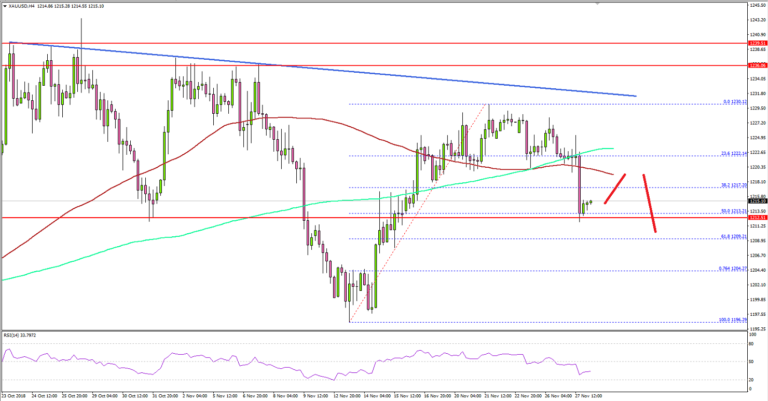
The 4-hour chart of XAU/USD indicates that the price topped near the $1,240 level once, and then at $1,239, $1,236, and finally near $1,230. The recent rally paused near the $1,230 and later the price declined below $1,225.
There was also a break below the 38.2% Fib retracement level of the last wave from the $1,119 low to $1,230 high. Since, the price broke the $1,217 support area and settled below the 100 simple moving average (red, 4-hours), there could be more losses towards $1,210.
An intermediate support is near $1,213 and the 61.8% Fib retracement level of the last wave from the $1,119 low to $1,230 high. On the upside, an initial resistance is near the $1,230 high.
More importantly, there is a key bearish trend line formed with resistance at $1,232 on the same chart. Finally, buyers need to push the price above $1,240 for a sustained upward move. If not, there is a risk of a downside move towards $1,213 and $1,210.
Looking at major pairs, EUR/USD failed to stay above 1.1350 and declined. Similarly, there was a downside break below the 1.2800 support in GBP/USD.
Economic Releases to Watch Today
- Germany’s GfK Consumer Confidence for Dec 2018 – Forecast 10.5, versus 10.6 previous.
- US Gross Domestic Product Q3 2018 (Preliminary) – Forecast 3.5% versus previous 3.5%.
- US Core Personal Consumption Expenditures for Q3 2018 (QoQ) (Preliminary) – Forecast +1.6%, versus +1.6% previous.
- Germany’s GfK Consumer Confidence for Dec 2018 – Forecast 10.5, versus 10.6 previous.
Dinner For Two, Please
Dinner for two, please
Amidst the trade war headline frenzy and fading optimism regarding the Trump -Xi meeting is a stark reminder that no one, friend or foe, is spared the wrath of President Trump when it comes to his America first policies. Indeed, the President propensity to generate marking moving headlines kept investors walking on eggshells even more so when he called out General Motors for their decision to close some US plants.
But despite risk asset wobbling across the board overnight, the S&P 500 did advance for the second day in a row after White House economic advisor Kudlow says Presidents Xi and Trump will meet for dinner, Saturday, December 1, on the sidelines of the G20 meeting. But something tells me humble pie will not be on the dessert menu.
But overall storm-tossed price action across all asset highlighted investors nervousness around the Xi-Trump event. US automotive and technology stocks traded heavy on fears of more US-imposed tariffs, while Kudlow and China advisor Liu, were quick to support their leadership mandates
Fedspeak
Fedspeak did take the back seat to a looming trade crisis, but Clarida did appeal to dispel the markets dovish notion from last weeks speech, but ultimately Fed policy will revolve around data dependency. Bullard, Bostic, Evans and George – were largely ignored as the market pivots to Chair Powell’s upcoming speech Wednesday. But overall the US dollar continues to hold a decent bid on haven demand and further buttresses by more clarity on the Fed narrative
Oil Markets
The market opinions have shifted from surging Saudi production and President Trump’s ongoing vocal support for lower prices although the market remains wary over President Trump’s grip on the Saudi decision-makers in the wake of the Khashoggi murder. Notwithstanding the Russians stay in wait and see mode, there remains a high level of uncertainty none the less
Traders are doggedly focused on the upcoming G20 meeting, and subsequently, the December 6 OPEC meeting and are providing a counterpoise to the bearish elements in the markets as a cut of 1.0 mmbpd remains a generalised consensus expectation at this point.
This week’s API inventory data is taking a back seat to the more significant production cut narrative, and predictably the markets had a very muted reaction to a larger than expected inventory build as prices have held relatively steady but did trigger some mild profit taking none the less.
Gold Markets
Gold remains a USD driven storyline very much. And while the risk of equity market drawdowns, to favour gold buying on the dips and for geopolitical tail hedges. But the strong dollar narrative that is unfolding into year end and possibly beyond is providing a significant headwind for prices.
US equities survived the wrath of Trump headline onslaught while Fed Clarida presented a more balanced interpretation of Fed policy overnight and if anything, the market is viewing his comments with a hawkish glint.
A negative session for Gold overnight
The Malaysian Ringgit
The market remains very much in neutral awaiting some on the Xi-Trump meeting. With headline risk dominating the landscape it doesn’t make much sense taking a view based on the headline roulette wheel
Gold Slides As Trump Tariff Threats Boost U.S Dollar
Gold has posted sharp losses in the Tuesday session. In North American trade, the spot price for one ounce of gold is $1212.37, down 0.87% on the day. In economic news, CB Consumer Confidence dipped to 135.7, missing the estimate of 136.2 points. On Wednesday, the U.S. publishes Preliminary GDP for the third quarter, with a forecast of 3.6%.
Investors will be keeping a close eye on the G-20 summit in Argentina later this week. President Trump will meet with Chinese President Xi Jinping, and the stakes could not be higher, given the full-blown trade war between the world’s two largest economies. President Trump has taken a tough line ahead of the summit, threatening to raise the tariffs from 10 percent to 25 percent on $250 billion worth of Chinese goods. If Trump makes good on his threat, we could see sharp volatility in the currency markets, with the U.S dollar likely making sharp gains. However, the unpredictable Trump is known to prefer to reach a deal whenever possible, so his sharp rhetoric could be some grandstanding ahead of his crucial meeting with Xi. If the two leaders can “agree to disagree” and continue talking, investors will breathe a deep sigh of relief.
The Federal Reserve is also keeping an anxious eye on the U.S-China trade war, and there is growing speculation that it will scale back its rate hike plans for 2019. Just a few months ago, there had been talk of up to four rate increases next year, but with the U.S economy slowing signs of slowing down, the Fed could respond with just two or three hikes. A December hike is widely expected, with the CME Group pegging the odds at 79 percent. However, after that, the Fed is likely to remain on the sidelines until at least March 2019.