

Sample Category Title
Daily Markets Broadcast
Sentiment improves in global equity markets
US equities rebounded on Monday, with the battered tech sector leading the rebound while consumer-focused counters were lifted by reports of heavy spending during Black Friday and Cyber Monday shopping season. The apparent willingness from Italy to be flexible regarding its 2019 budget plans helped European indices. China shares could be pressured by comments yesterday by Trump that the next set of tariffs on Chinese imports will likely go ahead.
US30USD Daily Chart
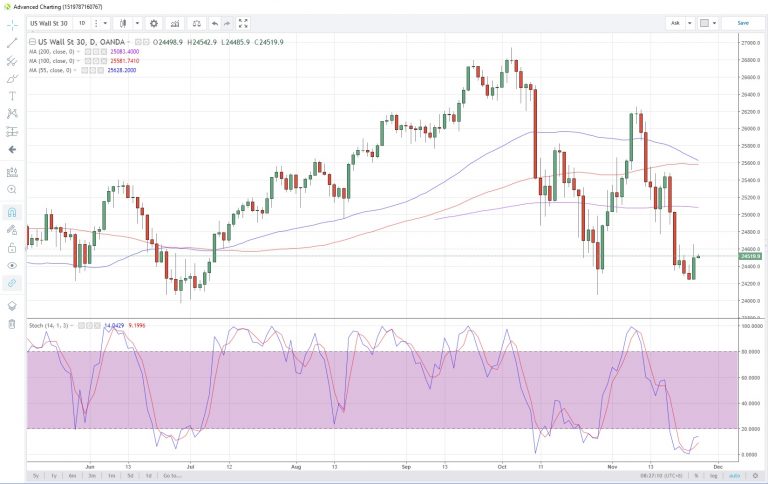
The US30 index snapped a two-day losing streak with the biggest one-day advance in 2-1/2 weeks
The index is still holding above the October low of 24,066. Daily momentum indicators have adopted a more positive tone
On the data front, S&P/Case-Shiller house prices for September are due today. They’re expected to show a smaller gain of +5.3% y/y in September. We also have speeches from a trio of Fed members: Bostic, Evans and George. Let’s see if there is more caution about headwinds for the US economy.
DE30EUR Daily Chart
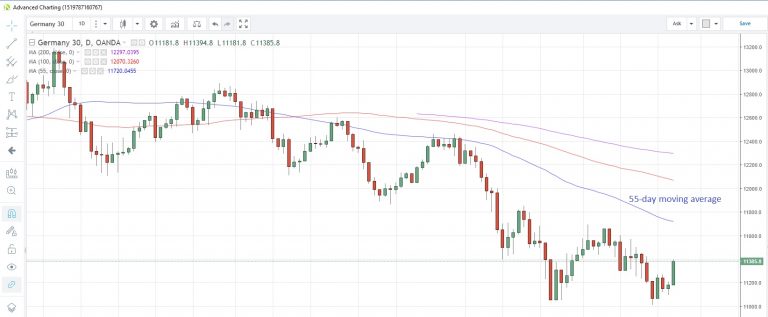
The Germany30 index advanced for a second day yesterday, buoyed by a perceived softening by Italy on its budget stance. Yesterday’s gains were the most in a month
The index is heading toward the 200-week moving average at 11,511 while the 55-day moving average is at 11,720
No economic data of note today. ECB’s Mersch is scheduled to speak later.
CN50USD Daily Chart
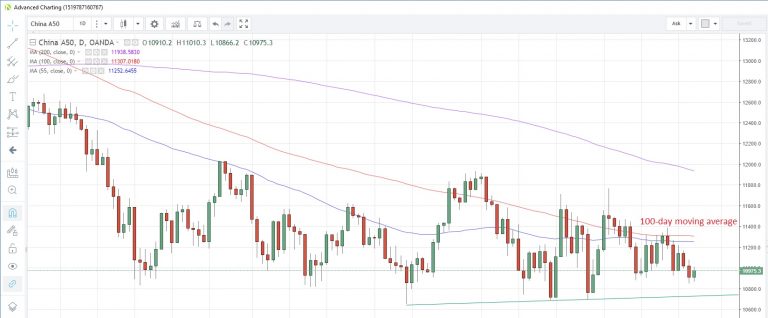
China shares managed to post gains yesterday, the first in three days, but could struggle today following Trump’s latest tariff comments
The 55- and 100-day moving averages at 11,253 and 11,307, respectively, could act as resistance points
Local newspaper China Daily reports that the government is planning additional measures to support the private sector.
UK corrected Trump’s false claim on Brexit deal
Without knowing the details, Trump questioned if the Brexit deal with EU with hamper trade with the US. But UK PM May's office quickly clarified and corrected Trump's claim.
Trump said to reporters outside the White House that "I think we have to take a look seriously whether or not the UK is allowed to trade." And, he added, "because right now if you look at the deal, they may not be able to trade with us."
May's office then said "the political declaration we have agreed with the EU is very clear we will have an independent trade policy so that the UK can sign trade deals with countries around the world — including with the US." And, "we have already been laying the groundwork for an ambitious agreement with the US through our joint working groups, which have met five times so far."
Markets Are Dancing To A More Positive Beat
Markets
The markets were dancing to a more positive beat overnight as equities, oil and yields all found a place in investor’s hearts amidst increased optimism around the Italy-EU budget impasse and upcoming Xi/ Trump trade summit.
However, the US-China meeting is more than just about trade, it’s about spanning the vast cultural divide and therein lies a significant opportunity to begin to mend ideological difference between the worlds leading free economy and the worlds best example of state-directed capitalism while making positive strides over global security. It’s a huge deal and why its so extremely important both sides get it right! Let’s hope the markets don’t end up with a case of misplaced optimism,
Of course, President Trump wants to keep China between a rock and a hard tweet after he echoed his advisor’s hawkish tariff views when during an interview with WSJ he stated, ‘highly unlikely’ that US would hold off on the increase to 25% on USD200 billion of goods.” WSJ
The markets veered mildly negative to the headline, but this is familiar Trump tune traders have become all too accustomed
Oil Markets
Oil markets will remain in focus this week.
Oil prices staged a relief rally overnight as the great bottoming out debate sets in after chatter and speculation picked up that a global rebalancing agreement to cut output will come out of a sideline meeting between Saudi Crown Prince Mohammed bin Salman and Russian President Vladimir Putin at this weeks G-20.
But as OPEC’s next balancing act unfolds it will be tough to defeat the bearish markets forces in play while delivering a production cut with enough sting without provoking the ire of President Trump.
We’re at a very tricky phase in this OPEC cycle which makes anchoring oneself to any level difficult as a plethora of options remains on the table which is providing structureless price discovery. While I usually view an overnight $2.00 price recovery in oil as a significant move, but when it comes after a $4.00 dive, it suggests the markets are not out of the woods by any stretch of the imagination.
Gold markets
Improved risk sentiment and a stronger US dollar took some lustre of gold appeal overnight. But what remains essential for gold prices this week is Fedspeak and correctly do the Feds pivot to a definitive pause in 2019.
Currency markets
There will be intense scrutiny on the Fed message this week after last week’s material policy pivot in the Fed narrative, In early 2018 the Fed identified specific economic fair winds including domestic fiscal stimulus, too loose monetary policy and a stronger foreign growth input which caused a repricing higher in the Fed 2019 rate hike trajectory. However, last week the Fed in a coordinated fashion walked back some of the more hawkish elements around global growth and domestic fiscal stimulus. This week’s Fedspeak, namely Powell, Williams and Clarida’s speeches, should help clear up some debate around the Fed baseline expectations.
The Euro
Even though Italy spreads narrowed the Euro was dogged by a very unimpressive IFO echoing what the advanced Eurozone PMI’s told us on Friday – the momentum in the Eurozone economy is sputtering. Undoubtedly the ECB will get jittery about the uneven Eurozone economic recovery while plummeting oil prices certainly don’t help on the headline inflation front.
ECB President Draghi statement before the Hearing of the Committee on Economic and Monetary Affairs of the European Parliament didn’t precisely topple the apple cart, but coming on the back of the soft data prints, traders became rattled when Draghi suggested “The data that have become available since my last visit in September have been somewhat weaker than expected.” But by all accounts, the soft data does suggest the ECB will tread lightly which could lead the Euro to struggle into year end.
Japanese Yen
It seems the only 24 hours cycles when the USDJPY moves over 40-50 pips are when traders have the wrong position. While the market was not overly short USDJPY, there was a lean to the downside after last weeks risk-off events. So, when risk asset recovered yesterday, and US yields move higher, layered stops were triggered taking the market to 113.70. But checking around the market messengers this morning, positions appear light given the risk events this week in G-20 and OPEC headline noise.
The Malaysian Ringgit
Global risk sentiment has improved overnight while oil prices are trying to put in a base. Both factors are favourable for the beleaguered Ringgit. Also, the relative calm in the RMB complex is helping regional sentiment.
Trump Postures Ahead Of Xi Meeting
Risk trades rallied Monday but the tone may quickly shift with Trump talking once again about aggressive China tariffs. The US dollar led the way while the yen lagged. CFTC positioning data showed fresh bets against the euro. Just before the US close, the Premium short in the DAX was closed for 300 pts gain, with notes highlighting how high the current move could go and whty the other Index long remains open. More details found in today's Premium video.
USD/JPY rose by more than half a yen and the Nasdaq climbed 2% Monday in an upbeat start to the week. Futures, however, slipped after the close when Trump said he expected to hit China with higher tariffs in January. He said it was highly unlikely the rise to 25% tariffs on Jan 1 would be delayed and that all Chinese goods could soon be hit with tariffs.
The commodity currencies slid after the comments were published. The question is whether the comments were posturing or reality. Trump meets with Xi on Friday in Buenos Aires and he undoubtedly wants the Chinese leader to believe that he's not bluffing. At the same time, does it make sense to believe Trump would hit businesses and consumers with tariffs that will undoubtedly slow growth in 2019? The tempered market reaction reflects that skepticism. At the same time, the market didn't believe Trump would ever implement tariffs.
CFTC Commitments of Traders
Speculative net futures trader positions as of the close on Tuesday. Net short denoted by - long by +. This week's report was delayed because of the US holiday.
EUR -47K vs -37K prior GBP -43K vs -47K prior JPY -100K vs -102K prior CHF -20K vs -19K prior CAD -6K vs -3K prior AUD -59K vs -58K prior NZD -19K vs -22K prior
The moves were small but there is fresh interest in selling the euro as the economic data deteriorates. On Monday, Draghi conceded the numbers have been disappointing since September but there was no commitment to alter forward guidance.
UK PM May to visit Northern Ireland to sell her Brexit deal
The UK Parliament is set to vote on the Brexit withdrawal agreement on December 11. Prime Minister Theresa May will start her nationwide tour today to secure the vote. Northern Ireland and Wales are her destinations today.
For Norther Ireland, May said in a statement on her visit that "having been told by the EU that we would need to split the UK in two, we are leaving as one United Kingdom." And, "my deal delivers for every corner of the UK and I will work hard to strengthen the bonds that unite us as we look ahead to our future outside of the EU."
May is also expected to highlight the benefits of her deal for businesses and said it has support from manufacturers who "need to be able to trade freely across the border with Ireland and have unfettered access to the rest of the United Kingdom's market".
Italy to stick with 2019 budget for now, wait for technical analysis of the plan
Italy decided to stick with their 2019 budget after meeting between Prime Minister Giuseppe Conte and his two deputies, Matteo Salvini and Luigi Di Maio. In a joint statement, the three said that "the objectives that have already been fixed are confirmed." Also, "as far as the on-going discussions with European institutions are concerned, we agreed to wait for the technical analysis of the proposed reforms which have the most important social impact to quantify precisely the cost."
Full statement of the coalition government here.
Meanwhile, it's reported that they're still flexible in adjusting the details of the plan so as to avoid disciplinary actions by the European Commission. For example, the so called citizen's income plan could be delayed for a month or two which could save billions.
FX Daily
Asia’s improved equity mood continued in Europe and US trade. ECB’s Draghi remained optimistic on Eurozone growth and inflation and Italy rallied on budget hopes. The US dollar slid in the London morning but then reversed in NY, leaving AUD/USD at 0.7230. Spot iron ore tumbled almost -7% to 4 month lows. Today’s calendar is light ahead of US data on consumer confidence and house prices.
AUD/USD followed the broad USD swings, rallying from 0.7230 in the Sydney afternoon to around 0.7275 in the London morning, then back to 0.7230 by early Sydney trade Tuesday. There was no apparent correlation with the ongoing slide in iron ore prices, with the benchmark spot price in China printing -6.8% at $64.45/tonne, a low since July and Dalian futures settling -2.1%.
NZD/USD similarly traced 0.6780 to 0.6815 and back. AUD/NZD slipped from 1.0685 to 1.0655, despite the improved risk sentiment.
EUR/USD round-tripped from 1.1330 to 1.1385 and back. ECB speakers, notably Chief Economist Praet and President Draghi, noted the moderation in recent data had been deeper than expected and that uncertainties such as protectionism had risen. Nevertheless they maintained their view that the economy was still in line with their projections and their bond purchases are set to end in December. However, the moderation means that the ECB will maintain significant monetary stimulus.
Germany’s November IFO business survey slipped more than anticipated (business climate 102.0, exp. 102.3, prev. 102.9) but broadly remained at elevated levels and in the range of the past 18 months. Italian equity and bond markets rallied sharply on reports that the government would make changes to its budget.
UK PM May appeared in parliament to affirm the ratification of the Brexit plan by the EU-27 leaders. She restated that there is no other option and that parliament should vote for the deal. However, the reception was decidedly dismissive, highlighting the difficulty facing May and her Cabinet over the next two weeks with the parliamentary debate now announced for 11th December. GBP/USD wandered around the mid-1.28s, for little net change.
USD/JPY however found clear direction, rising from 112.90 in the Sydney morning to 113.60 late NY, supported by the rise in equity markets and US bond yields.
The Dallas Fed manufacturing index posted a steep fall in November to 17.6, well below expectations (24.5) from 29.4 last month, a 15 month low. The detail showed broad-based declines across new orders, employment and CAPEX intentions, the recent plunge in energy prices a likely culprit for weaker sentiment in the Dallas region.
Interest rates
The US 10yr treasury yield rose from 3.05% to 3.09%, while 2yr yields eked a slightly lower range of 2.82%-2.84%. Fed fund futures repriced the chance of the next rate hike on 19 December at 80% (from 75%).
Event risk
Australia’s data calendar remains quiet ahead of the inputs to Q3 GDP which start tomorrow with construction work done. New Zealand releases trade data for October.
The US data calendar is reasonably busy but probably not market-moving. Sep S&P/Case-Shiller homes price are expected to show house price growth slowly losing momentum, around 5.2%yr. Nov Conference Board consumer confidence is anticipated to remain well above average, around 136.0 from 137.9 in Oct. Fedspeak involves Vice Chair Clarida on ‘Data Dependence and U.S. Monetary Policy” and regional Fed presidents Bostic, Evans and George on a panel at The Clearing House Annual Conference in NY.
Eco Data 11/27/18
[php_everywhere instance="1"]
British pound steady as EU approves Brexit deal
GBP/USD has posted slight gains in the Monday session. In North American trade, the pair is trading at 1.2829, up 0.10% on the day. It’s a quiet start to the week, with no major releases. On Tuesday, the U.K. releases CBI Realized Sales and the BRC Shop Price Index. The U.S. will release CB Consumer Confidence, which is forecast to dip to 136.2 points.
On Sunday, 27 European Union leaders gathered in Brussels and gave their approval to the Brexit withdrawal agreement, as well as a political declaration on economic relations between Britain and the EU after Brexit. At the meeting, EU leaders took pains to warn British parliamentarians that the EU will not agree to reopen the agreement. Dutch Prime Minister summed up the mood in Brussels, saying “there is no Plan B”. The EU has signaled that the deal signed on Sunday is “take it or leave it” – if the U.K. doesn’t sign on, the result will be a hard Brexit which could be catastrophic for the British economy. Prime Minister May joined the summit on Sunday and again urged British lawmakers to approve the deal, saying it met most of Britain’s demands. Still, May will have an uphill battle pushing the deal through parliament, with the Labor party and many Conservative MPs set to vote against the deal.
The markets have grown accustomed to strong economic numbers from the U.S, but quarterly GDP readings have been falling throughout 2018. This has led to speculation that the Federal Reserve could ease up on its interest rate hikes next year. Only a few weeks ago, there were expectations that the Fed might raise rates each quarter in 2019, but the mood has become more cautious. The U.S.-China trade war has caused a slowdown both economies, and President Trump’s $1.5 trillion tax cut has boosted the economy, but its effect on the economy is fading. A slowdown in the U.S economy would further exacerbate difficult conditions for the global economy, which is already feeling the effects of the global trade war.
WTO indicator dropped to lowest since Oct 2016, exports orders weakest since 2012
WTO's World Trade Outlook indicator dropped notably from 100.3 to 98.6 according to data released today. That's the lowest level since October 2016, with declines in all component indices. WTO said in the release that it signals trade growth in the coming months is "expected to be below-trend".
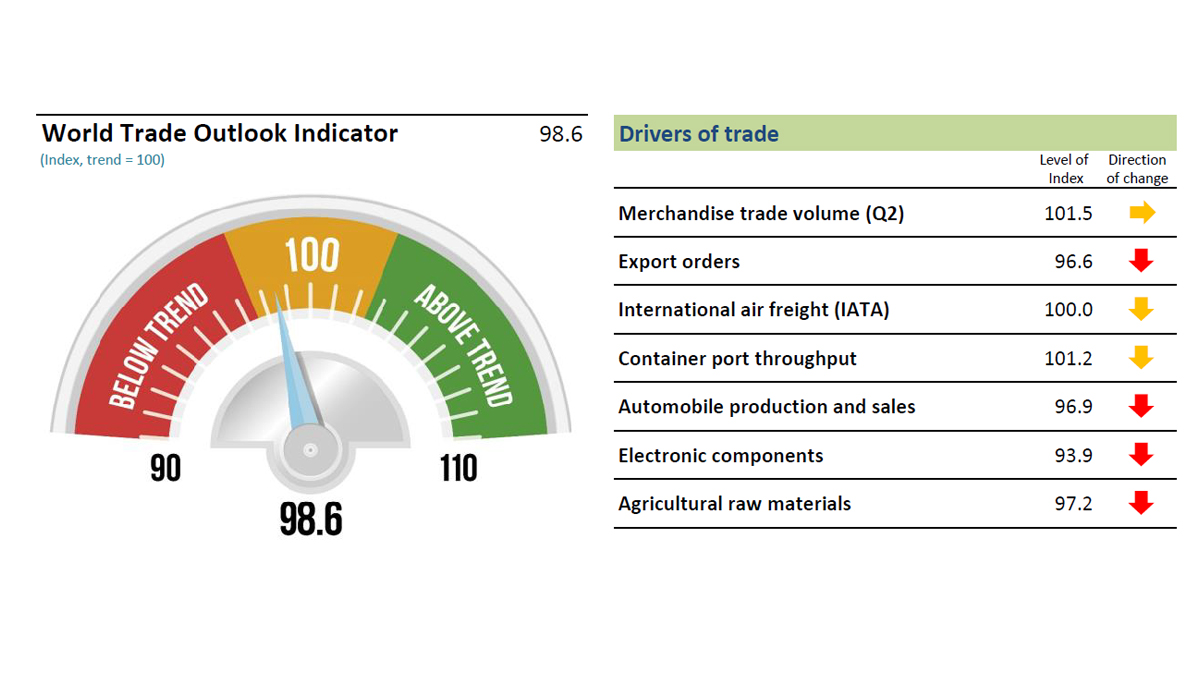
WTO said that "the continued moderation in the overall WTOI index was driven by the steady decline in the export orders index (96.6), which remains below trend and is approaching the weakest point recorded in 2012 during the eurozone crisis". And, "The latest results are consistent with the WTO's downgraded outlook for global trade issued in September amid escalating trade tensions and tighter credit conditions in important markets. The revised forecast anticipated trade expansion to slow to 3.9% in 2018 and 3.7% in 2019 from 4.7% in 2017."