

Sample Category Title
Consolidation Phase
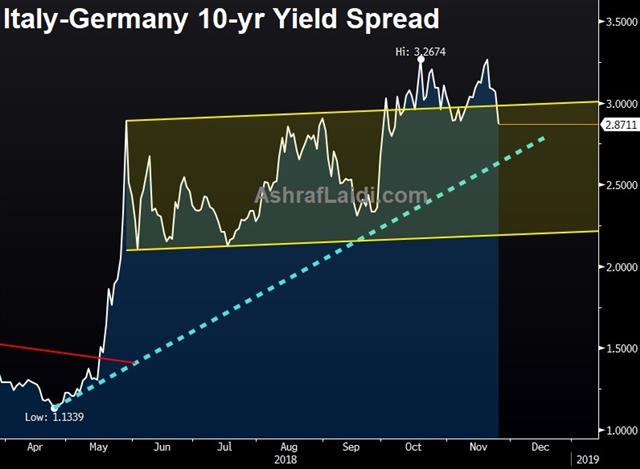
A busy week lies ahead for central bank watchers and trade war enthusiasts as Fed officials pile on their views ahead of the 2-week blackout period and Trump-Xi meeting gets under way later this week. All currencies are up against the US dollar with the exception of the Japanese yen as global indices push higher across the board. EUR retests the 1.1380s after Armando Siri (econ adviser to Salvini) said to Il Messaggero that “a little fine-tuning of the budget” remains possible. The Italy-German 10-year spread falls to a 7-week low of 2.87%. ECB president Draghi is due to speak today to the EU Parliament at 14:00 London time and again on Thursday. On Wednesday, Fed Chair Powell speaks at the always interesting Economic Club of NY. The Fed minutes of the Nov 8 meeting will be issued on Thursday. Four other Fed officials are expected to appear later this week, so watch out for any signs of reduced Fed hawkishness. On Friday, an additional Premium long was issued on a major equity index, based on favourable seasonality patterns.
Sunset Market Commentary
Markets
Global core bonds lost ground today with US Treasuries underperforming German Bunds. Risk sentiment improved over the weekend as oil prices stabilized. All Asian indices except the Chinese closed today’s session with gains. European equities continued and edged immediately higher to hold on to those gains throughout the day. The improvement in risk sentiment pushed German Bunds south. Weaker than expected German IFO numbers had little to no impact. ECB President Draghi addressed the European Parliament today. He admitted that recent economic data have been weaker than expected but repeated a gradual slowdown is normal. As expected, he did not make any key alterations to the ECB’s guidance. Italy’s Deputy PM’s Salvini and Di Maio signaled a new openness to make some modifications to the 2019 budget and added that a downward adjustment of Italy’s 2019 budget deficit is not unthinkable. Investors welcomed the Italian willingness, pushing Italian BTP’s higher. The German yield curve moved north with changes ranging from +0.9 bps (2-yr) to +2.1 bps (10-yr). US equities are currently continuing the improved sentiment and move gradually higher. The Chicago Fed Nat Index printed 0.24 in October, up from 0.17 a month before and higher than the 0.18 consensus. US yields rallied higher with moves from 2.1 bps (30-yr) to 3.4 bps (5-yr). Peripheral bonds spreads over the German 10-yr yield decrease with Greece (-18 bps), Italy (-16 bps) and Spain (-8 bps) outperforming.
EUR/USD suffered on both sides of the fraction last Friday as weak (German and EMU) PMI’s made markets ponder the ECB’s hiking intentions. Meanwhile the fragile risk environment and tumbling oil price supported the dollar. But the euro entered calmer waters today. An improved risk sentiment, tentative signs of the Italian government to amend the budget proposal, (temporarily) narrowing US/EMU interest rate differentials and even the Brexit agreement on Sunday were all to some extent euro supportive. The common currency edged gradually higher before losing some ground ahead of Draghi’s hearing at the European Parliament. The ECB chair basically repeated the economic assessment he elaborated during the October policy meeting. Without going into any details, he acknowledged the softer than expected data but stresses that at least a part is related to a temporary weaker momentum (e.g. the German car industry). The ECB remains confident about inflation with core measures expected to pick-up towards the end of the year because of the ongoing economic expansion, the ECB’s monetary policy and wage inflation. The euro reacted as one could expect, trading virtually stable and close to 1.136, up from 1.134 this morning. USD/JPY is heading north (113.4) in today’s risk on environment.
The UK and EU rubber stamped the Withdrawal agreement and the political declaration on the future ties between the two blocs yesterday. As the decision was widely expected, it did not affect sterling materially. Today’s economic calendar didn’t provide markets with inspiration either, leaving sterling’s intraday swings confined to a rather narrow range. The pound losing a few ticks vs. the euro during early trading hours was mainly due to euro strength following a conciliatory tone from Italy. The move reversed soon after, keeping EUR/GPB stable vs. its Friday close. Cable rose slightly, changing hands at around 1.285. Markets gave sterling a break today after a turbulent month. But the Queen’s money may soon face a new test as PM May planned a vote in the British Parliament on December 12. Expect some erratic sterling trading in the run-up to this so called ‘meaningful vote’.
News Headlines
US Federal Reserve Vice Chairman Quarles will succeed BoE’s Carney as chairman of the Financial Stability Board (FSB) for the next three years. Dutch central bank president Knot will serve as vice chair and take over from Quarles in December 2021. The FSB is the world’s most important international body to monitor the global financial system.
ECB Draghi: Prevailing uncertainties call for patience, prudence and persistence calibrating policy
ECB President Mario Draghi told the ECON committee of the European Parliament today that data since September have been "weaker than expected". And, the "loss in growth momentum mainly reflects weaker trade growth, but also some country and sector-specific factors."
But he tried to talk down the slowdown as he said "A gradual slowdown is normal as expansions mature and growth converges towards its long-run potential." Also, "some of the slowdown may also be temporary." He maintained that "underlying drivers of domestic demand remain in place." On prices, Draghi reiterated that "recent developments confirm the Governing Council's earlier assessments of the medium-term inflation outlook."
And ECB therefore "continues to anticipate that, subject to incoming data confirming our medium-term inflation outlook, net asset purchases will come to an end in December 2018." But he also emphasized that "prevailing uncertainties still call for patience, prudence and persistence in calibrating our monetary policy stance." And, "significant degree of monetary policy stimulus will be maintained, even after the end of net asset purchases."
USD/JPY Mid-Day Outlook
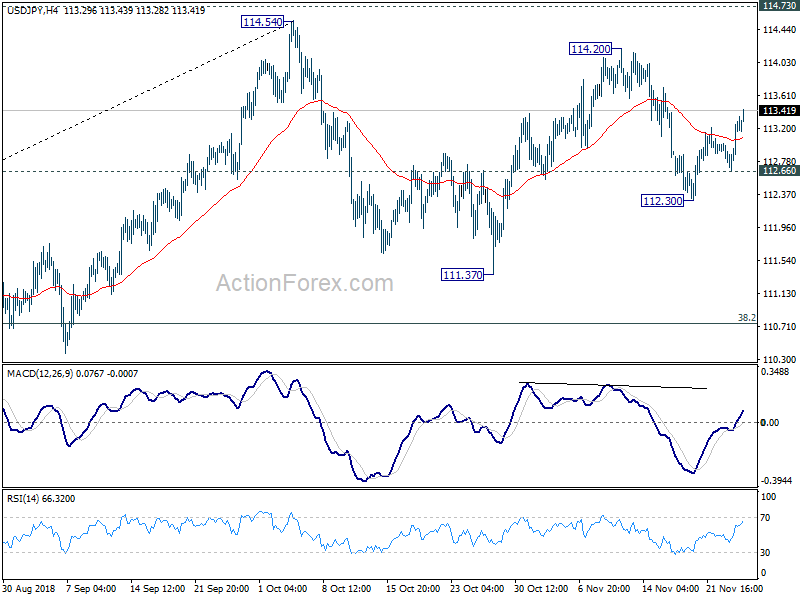
Daily Pivots: (S1) 112.75; (P) 112.88; (R1) 113.10; More..
Intraday bias in USD/JPY remains on the upside as rebound from 112.30 is in progress for 114.20/73 key resistance zone. Decisive break there will resume larger rally from 104.62. On the downside, break of 112.66 minor support will extend the fall from 114.20, likely towards 111.37 support. But after all, price actions from 114.54 are seen as a consolidation pattern. Hence, even in case of deep decline, should be contained by 38.2% retracement of 104.62 to 114.54 at 110.75 to bring rebound.
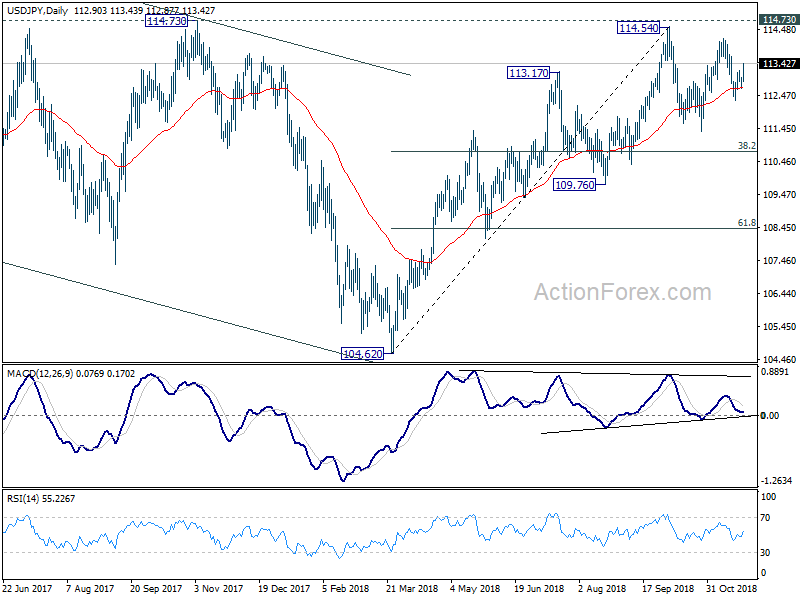
In the bigger picture, corrective fall from 118.65 (2016 high) should have completed with three waves down to 104.62. Decisive break of 114.73 resistance will likely resume whole rally from 98.97 (2016 low) to 100% projection of 98.97 to 118.65 from 104.62 at 124.30, which is reasonably close to 125.85 (2015 high). This will stay as the preferred case as long as 109.76 support holds. However, decisive break of 109.76 will dampen this bullish view and turns outlook mixed again.
USD/CHF Mid-Day Outlook
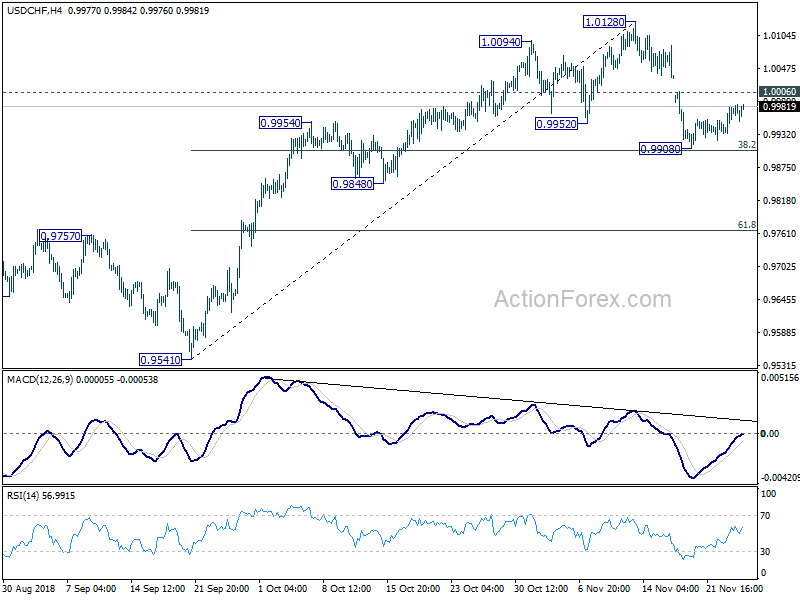
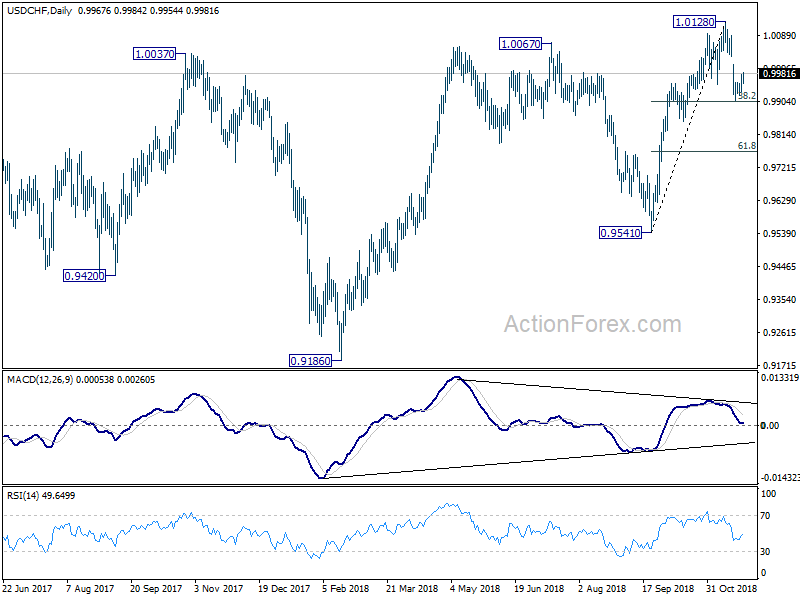
Daily Pivots: (S1) 0.9946; (P) 0.9963; (R1) 0.9992; More...
Intraday bias in USD/CHF remains neutral as consolidation from 0.9908 continues. On the upside, break of 1.0006 minor support will argue that the pull back from 1.0128 has completed. Intraday bias will be turned back to the upside for retesting 1.1028. However, on the downside, break of 38.2% retracement of 0.9541 to 1.0128 at 0.9904 will target 0.9848 key support level.
In the bigger picture, the pullback from 1.0067 has completed at 0.9541 already. And rise from 0.9186 is likely resuming. Firm break of 1.0067 will pave the way to retest 1.0342 key resistance. We'd be cautious on strong resistance from there to limit upside to bring another medium term fall to extend long term range trading. However, break of 0.9848 near term support will dampen this view and bring deeper decline back to 0.9541 support and possibly below.
GBP/USD Mid-Day Outlook
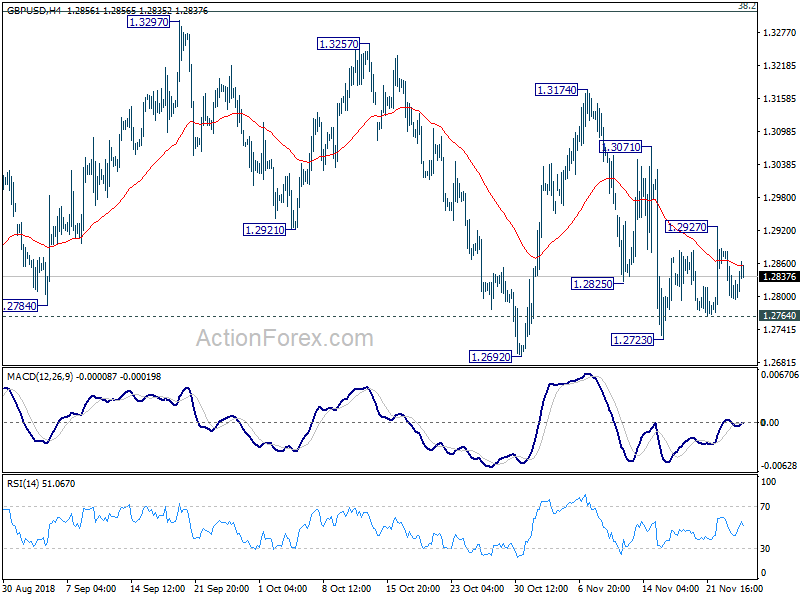
Daily Pivots: (S1) 1.2782; (P) 1.2833; (R1) 1.2866; More...
GBP/USD is staying in tight range of 1.2764/2927 and intraday bias remains neutral for the moment. On the upside, above 1.2927 will turn bias to the upside for 1.3071 resistance first. On the downside, break of 1.2764 will extend the fall from 1.3174 to 1.2661 key support level. Overall, price actions from 1.2661 are viewed as a consolidation pattern. Even in case of strong rebound, upside should be limited by 1.3316 fibonacci level to bring down trend resumption eventually.
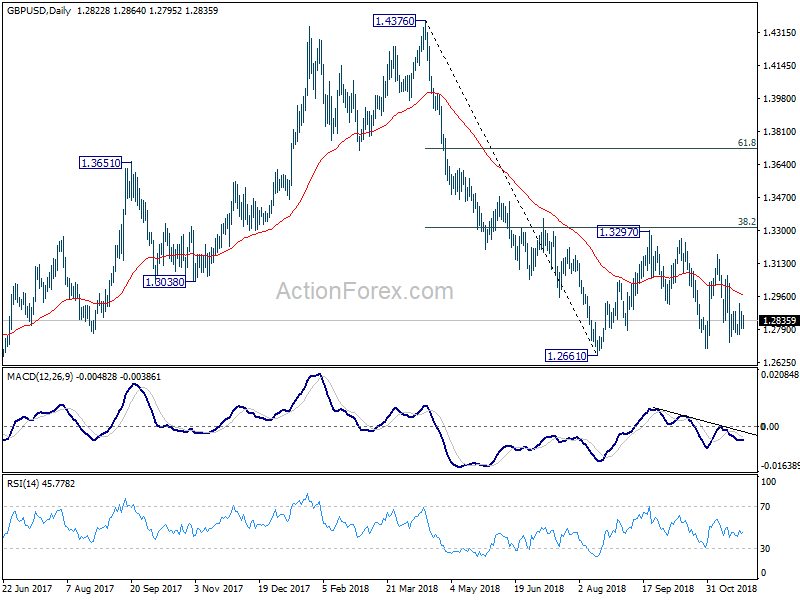
In the bigger picture, whole medium term rebound from 1.1946 (2016 low) should have completed at 1.4376 already, after rejection from 55 month EMA. The structure and momentum of the fall from 1.4376 argues that it's resuming long term down trend. And this will be the preferred case as long as 38.2% retracement of 1.4376 to 1.2661 at 1.3316 holds. However, firm break of 1.3316 would bring stronger rebound to 61.8% retracement at 1.3721. And, the eventual depth of the fall from 1.4376, and the chance of hitting 1.1946 low, will depend on the strength of the interim corrective rebound from 1.2661.
XAUUSD Outlook: Consolidation to Likely Extend as Market Eyes Powell; Fed Minutes and US/China Talks for Stronger Direction Signals
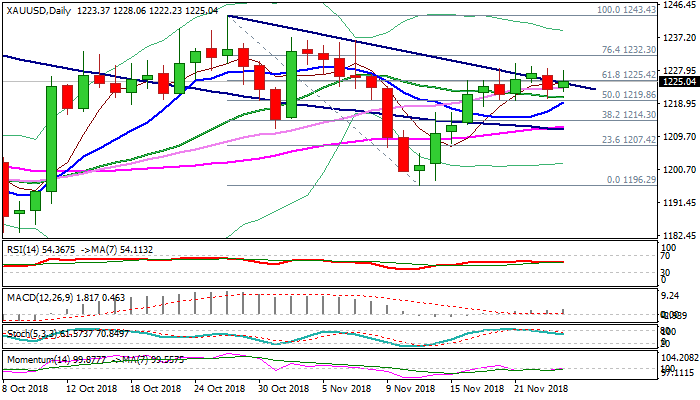
Spot gold edged higher on Monday but remains within choppy range between $1220 and $1230, as bull-leg from $1196 lost traction on attempts above pivotal barriers at $1225 (Fibo 61.8% of $1243/$1196/bear-trendline off $1243 high).
Bullishly aligned daily techs continue to underpin, but the yellow metal may stay in extended consolidation, awaiting stronger signals from key events due later this week.
Fed chief Powell is due to speak on Wednesday, addressing the economic outlook; Minutes of Fed's latest policy meeting will be released late Thursday and G20 meeting will start on Friday, with focus on Trump – Xi talks over persisting trade conflict.
Powell is expected to point at steady US economy growth, but the outlook could be overshadowed by rising concerns over possible global growth slowdown, which could also impact Fed's decision to hike interest rates once more this year in FOMC December meeting.
Markets will be also closely monitoring the outcome of US/China Presidents, as further delay in US implementing increased tariffs on imports from China would leave space for further negotiations, in order to avoid escalation of trade conflict that could have strong impact on world's markets.
Gold would appreciate on signals increased tensions between world's two biggest economies, with positive impact to be additionally boosted by signs that Fed may pause in December.
Conversely, positive news would prompt investors into dollar and increase pressure on the yellow metal.
Recent consolidation floor at $1220, reinforced by rising 10SMA, marks pivotal support, loss of which would weaken near-term structure and risk deeper pullback. Bullish scenario requires firm break above cracked Fibo barrier at $1225 as initial bullish signal, which would be boosted by break above $1230/32 (range top/Fibo 76.4% of $1243/$1196) for extension towards $1237 lower platform and possible stretch towards key barrier at $1243 (26 Oct high).
Res: 1228; 1230; 1232; 1237
Sup: 1222; 1220; 1214; 1212
Pound Has No Will To Rise
At the beginning of the last November week, the British Pound reached stability, but chances for a new decline are still very high.
The key topic for the Pound is still the Brexit talks. Last weekend, countries-members of the European Union approved the Brexit agreement, while the European Commission President Jean-Claude Juncker already said that “the Brexit is not a humiliation for Britain” and “the Brexit deal drafted by the Prime Minister Theresa May is the best deal possible for Britain”. The United Kingdom’s exiting the European Union will start on March 29th 2019 and the agreement will take effect on the following day. Juncker told the media that it was sad seeing the UK exiting the EU.
However, in order for everything to start working as it should, the agreement has to be approved by the European Parliament and then by the House of Commons of the UK. The British government is currently focused on working out the Brexit plan and consulting with the country’s Parliament. Apart from this, there are negotiations with business structures and social agencies representatives, so that the government could make the Brexit strategy more comfortable for domestic structures.
Investors are a little bit worried by forthcoming popular votings. Some mention a possibility of a double voting, which may cause panic on the market. Right now, this possibility is very low, but one shouldn’t exclude this scenario.
The surprising thing is that the Pound hasn’t been able to regain positions after the EU Summit, although Brexit deal that was approved was really the best possible option at that moment. Apparently, the risks of voting in the British Parliament outweigh the benefits.
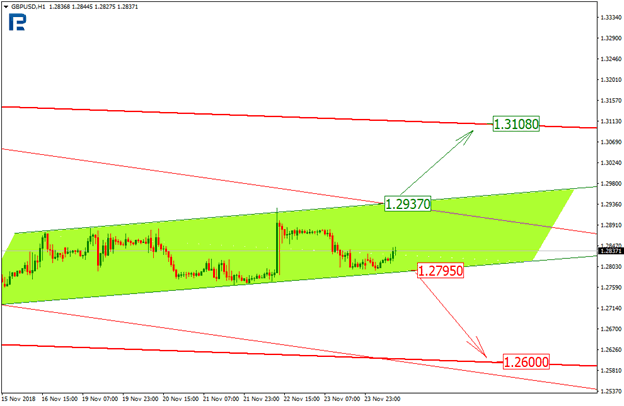
As we can see in the H1 chart, GBPUSD is trading upwards and correcting the previous mid-term downtrend. After testing the support line of the ascending channel, the price is trying to form a new rising impulse towards the resistance level at 1.2937. It’s quite interesting that this level almost matches the resistance line of the mid-term channel. If the price breaks this level, the next target will be the resistance line of the main channel at 1.3108. The support level for the current short-term movement is at 1.2795. If the instrument breaks it, “bears” may continue pushing the price towards the key support line at 1.2600.
CHFJPY Bullish Attempts Alive in Short Term; Neutral in Long-Term View
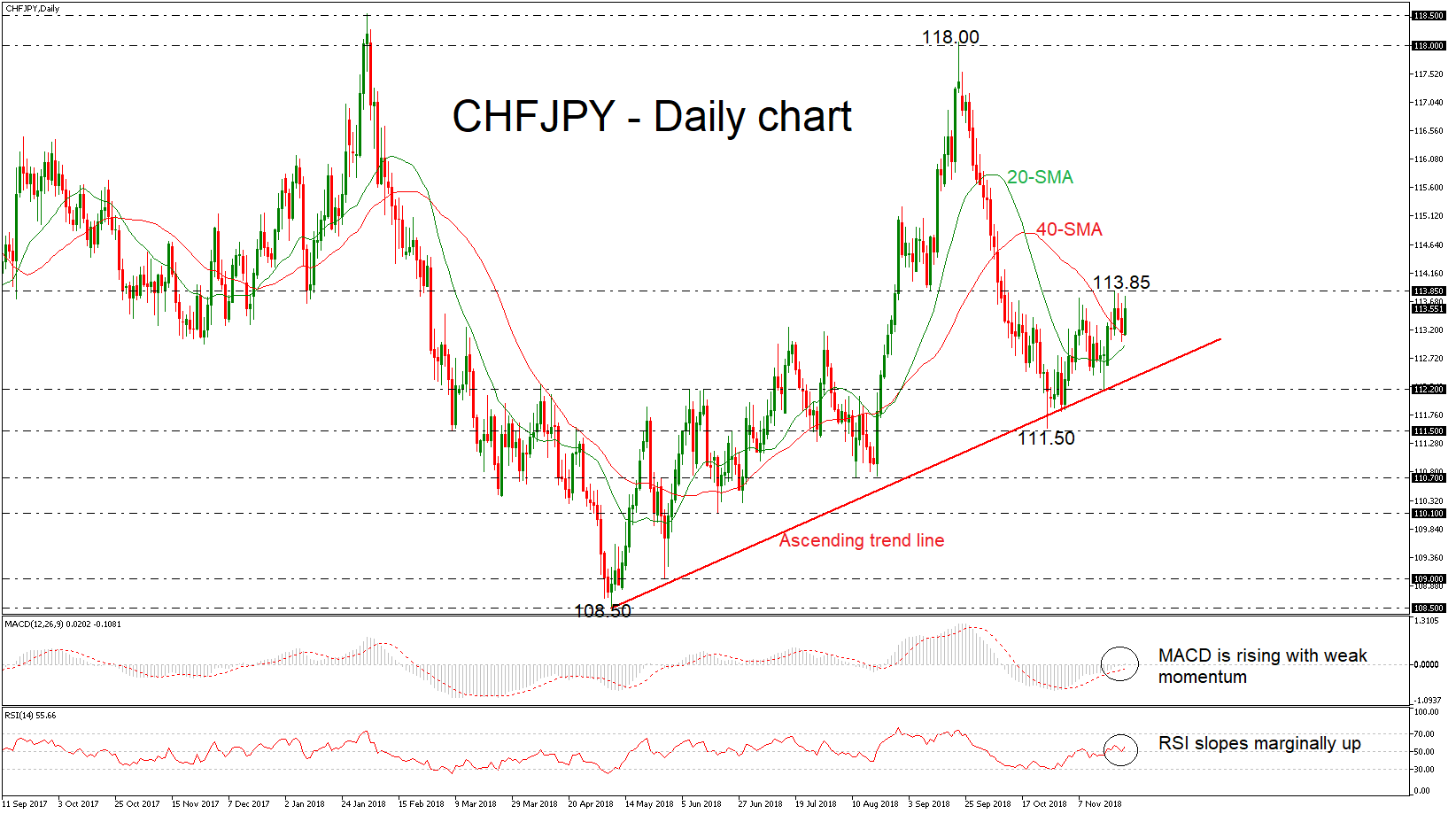
CHFJPY had a bullish start on Monday, with the price remaining above the 20- and 40-simple moving averages (SMAs) in the daily timeframe. These lines are ready to post a bullish crossover in the near future, suggesting that the recent rebound on the ascending trend line could continue. The RSI indicator is pointing slightly up in the positive zone, while the MACD oscillator is rising higher with weak momentum.
On the upside, resistance could occur around the 113.85 barrier, while a successful break of this level could retest resistance around 115.60 before eyes turn to the 118.00 handle, taken from the high on September 21. Higher that, the 118.50 barrier, registered on February 2, could be the next target.
A reversal to the downside, could find obstacles near the 20- and 40-SMAs, near the 113.00 handle. Falling lower, bears are eagerly awaited to retest the medium-term ascending trend line, where a decisive close below this line, could indicate that the rally off 108.50 might be running out of steam, with traders probably looking for support first at the 112.20 mark and then at the 111.50 level.
Overall, looking at the long-term timeframe, CHFJPY has been trading in a sideways channel since November 2016 with upper boundary the 118.50 barrier and lower boundary the 108.00 region.
Canadian Dollar Slightly Higher as Investors Look for Cues
The Canadian dollar has edged higher in the Monday session. Currently, USD/CAD is trading at 1.3209, down 0.22% on the day. There are no releases out of Canada or the U.S. on the schedule. On Tuesday, the U.S. releases CB Consumer Confidence, which is forecast to dip to 136.2 points.
There was good news on Friday, as Canadian consumer spending and inflation data improved. However, the Canadian dollar failed to take advantage and lost ground. CPI posted a gain of 0.3%, after two straight declines. This beat the estimate of 0.1%. Retail sales bounced back with a gain of 0.2%, after a decline of -0.1%. This was above the forecast of 0.1%. Inflation is within the Bank of Canada’s inflation target – on an annualized basis, CPI rose 2.4% in October and 2.2% in September.
The markets have grown accustomed to strong economic numbers from the U.S, but quarterly GDP reports point to a slowdown, and there has even been talk of a recession. This has led to speculation that the Federal Reserve could ease up on its interest rate hikes next year. Only a few weeks ago, there were expectations that the Fed could raise rates each quarter in 2019, but the mood has become more cautious. The U.S.-China trade war has caused a slowdown both economies, and President Trump’s $1.5 trillion tax cut has boosted the economy, but its effect on the economy is fading. A rollback in U.S rate hikes would make the greenback less attractive to investors, which would be good news for the Canadian dollar.