

Sample Category Title
Aussie Reverses Its Losses In The Asian Session
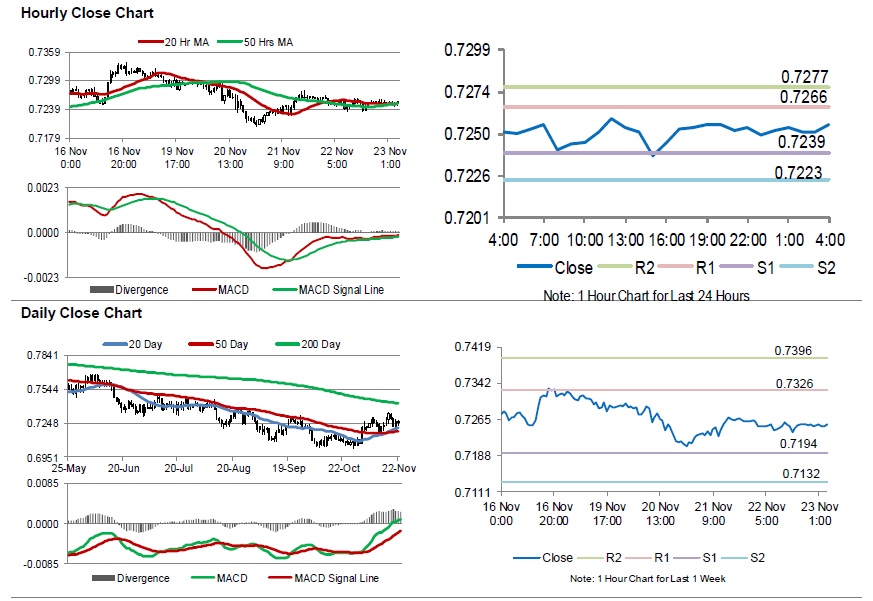
For the 24 hours to 23:00 GMT, the AUD declined 0.17% against the USD and closed at 0.7249.
LME Copper prices rose 0.1% or $4.0/MT to $6246.0/MT. Aluminium prices declined 0.2% or $3.5/MT to $1941.5/MT.
In the Asian session, at GMT0400, the pair is trading at 0.7255, with the AUD trading 0.08% higher against the USD from yesterday’s close.
Overnight data indicated that, Australia’s CBA flash manufacturing PMI remained unchanged at a level of 54.5 in November. Moreover, the nation’s preliminary services PMI rose to a level of 52.6 in November, compared to a level of 51.7 in the preceding month.
The pair is expected to find support at 0.7239, and a fall through could take it to the next support level of 0.7223. The pair is expected to find its first resistance at 0.7266, and a rise through could take it to the next resistance level of 0.7277.
In absence of key economic releases in Australia today, traders would keep an eye on global macroeconomic releases for further direction.
The currency pair is showing convergence with its 20 Hr and 50 Hr moving averages.
Gold: Yellow Metal Extends Its Gains In The Morning Session
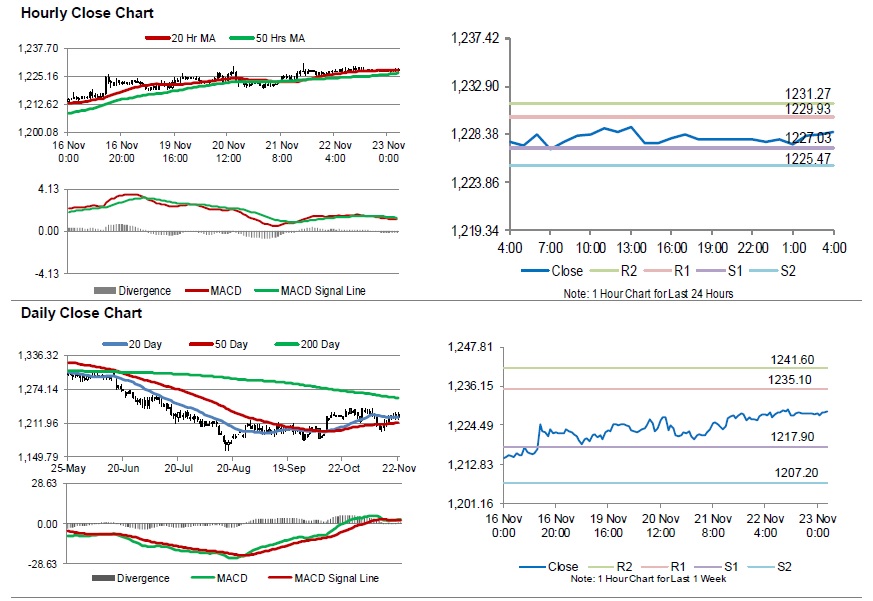
For the 24 hours to 23:00 GMT, Gold rose 0.13% against the USD and closed at USD1227.90 per ounce, amid weakness in the US dollar.
In the Asian session, at GMT0400, the pair is trading at 1228.60, with gold trading 0.06% higher against the USD from yesterday’s close.
The pair is expected to find support at 1227.03, and a fall through could take it to the next support level of 1225.47. The pair is expected to find its first resistance at 1229.93, and a rise through could take it to the next resistance level of 1231.27.
The yellow metal is showing convergence with its 20 Hr moving average and trading above its 50 Hr moving average.
Silver: White Metal Trading On A Stronger Footing This Morning
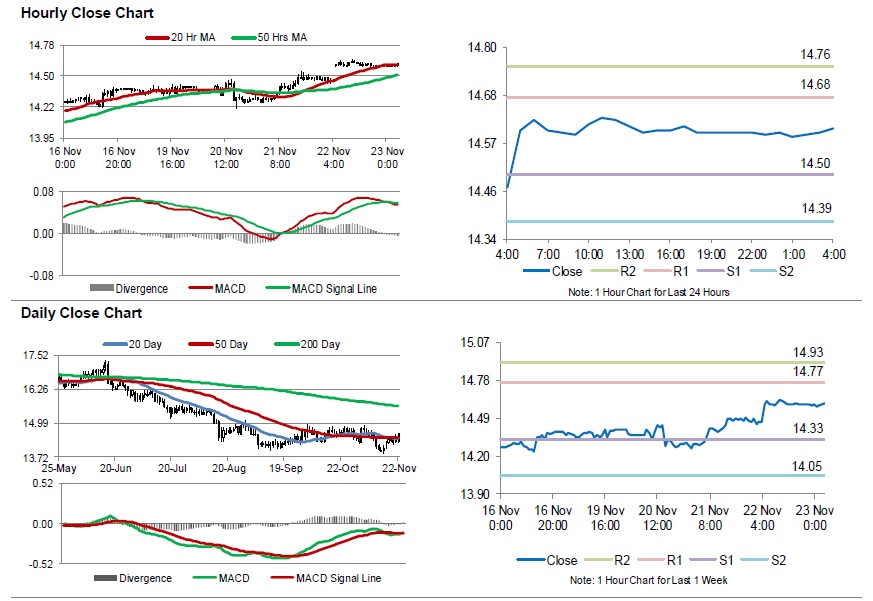
For the 24 hours to 23:00 GMT, Silver rose 0.79% against the USD and closed at USD14.59 per ounce, tracking gains in gold prices.
In the Asian session, at GMT0400, the pair is trading at 14.61, with silver trading 0.10% higher against the USD from yesterday’s close.
The pair is expected to find support at 14.49, and a fall through could take it to the next support level of 14.39. The pair is expected to find its first resistance at 14.68, and a rise through could take it to the next resistance level of 14.76.
The white metal is showing convergence with its 20 Hr moving average and trading above its 50 Hr moving average.
Crude Oil: Oil Trading Lower This Morning
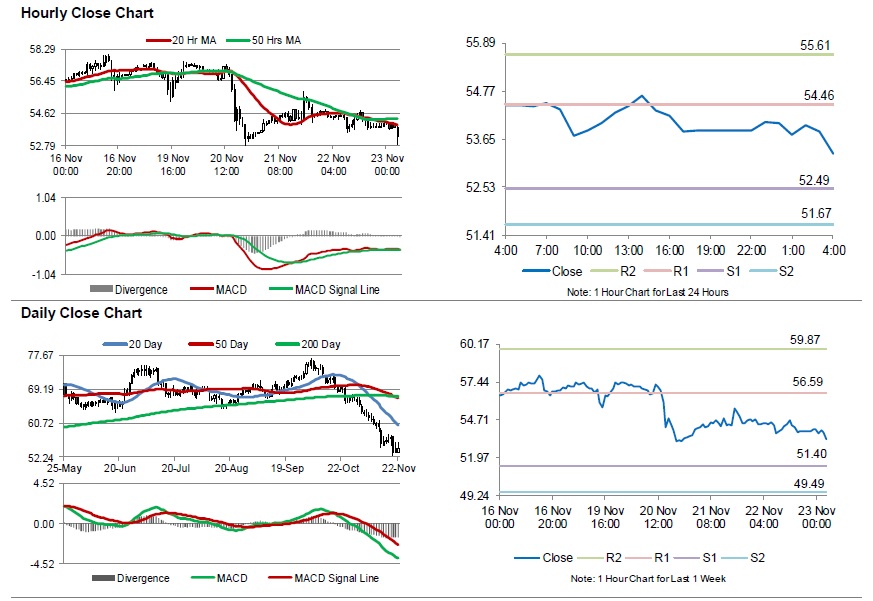
For the 24 hours to 23:00 GMT, Crude Oil declined 1.24% against the USD and closed at USD54.04 per barrel, amid increase in the US crude oil inventories.
In the Asian session, at GMT0400, the pair is trading at 53.31, with oil trading 1.35% lower against the USD from yesterday’s close.
The pair is expected to find support at 52.49, and a fall through could take it to the next support level of 51.67. The pair is expected to find its first resistance at 54.46, and a rise through could take it to the next resistance level of 55.61.
Crude oil is trading below its 20 Hr and 50 Hr moving averages.
AUD/USD And NZD/USD Monthly Outlook
AUD/USD found a strong support near 0.7040 and recovered. Similarly, NZD/USD climbed higher recently and broke the 0.6600 resistance area to move into a bullish zone.
Important Takeaways for AUD/USD and NZD/USD
- The Aussie Dollar found a strong buying interest near the 0.7040-0.7060 area against the US Dollar.
- There was a break above a major bearish trend line with resistance at 0.7180 on the daily chart of AUD/USD.
- NZD/USD also formed a crucial bottom near the 0.6420 level and recovered higher.
- There was a break above a key bearish trend line with resistance at 0.6550 on the daily chart.
AUD/USD Technical Analysis
After a major decline in the past few weeks, the Aussie Dollar finally found a strong support near the 0.7040 level against the US Dollar. The AUD/USD pair started a major upward move and climbed above the 0.7100 and 0.7200 resistance levels.
During the rise, the pair also broke the 50% Fibonacci retracement level of the last slide from the 0.7451 high to 0.7020 swing low. Besides, there was a close above the 0.7200 barrier and the 50-day simple moving average.
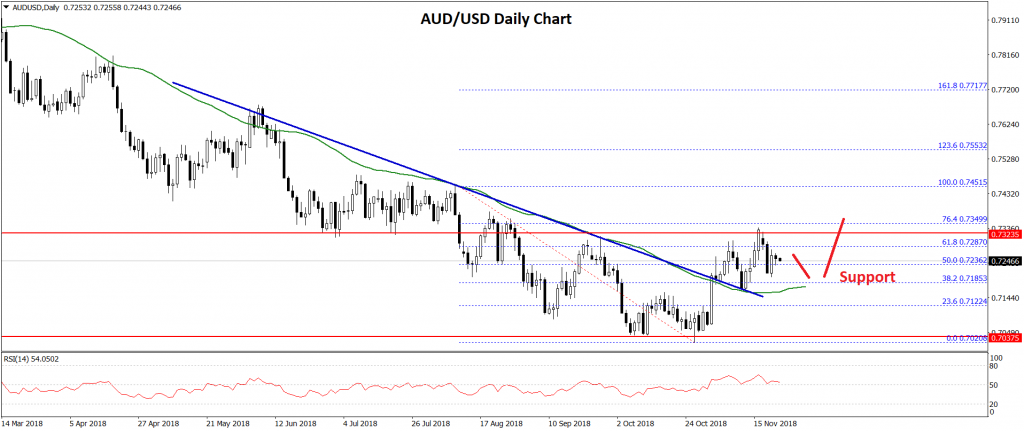
More importantly, there was a break above a major bearish trend line with resistance at 0.7180 on the daily chart. The pair even broke the 0.7300 resistance and traded towards the 0.7330 level.
The pair failed to break the 76.4% Fibonacci retracement level of the last slide from the 0.7451 high to 0.7020 swing low and later corrected lower.
However, the recent break above the 0.7250 level and the trend line suggests that the pair moved into a positive zone. Therefore, there are chances of more gains in the near term towards the 0.7400 level. If buyers remain in action, the pair could even test the 0.7530 level, which is near the 1.236 Fib extension level of the last slide from the 0.7451 high to 0.7020 swing low.
On the downside, the key supports are 0.7200 and 0.7180, below which the pair may decline back towards the 0.7100 level.
NZD/USD Technical Analysis
The New Zealand Dollar also gained traction recently after it formed a decent support at 0.6430 against the US Dollar. The NZD/USD pair traded higher and broke the 0.6500 and 0.6600 resistance levels to enter a positive zone.
During the rise, the pair cleared many hurdles near the 0.6600 level and the 0.6650 pivot zone. Moreover, there was a break above a key bearish trend line with resistance at 0.6550 on the daily chart.
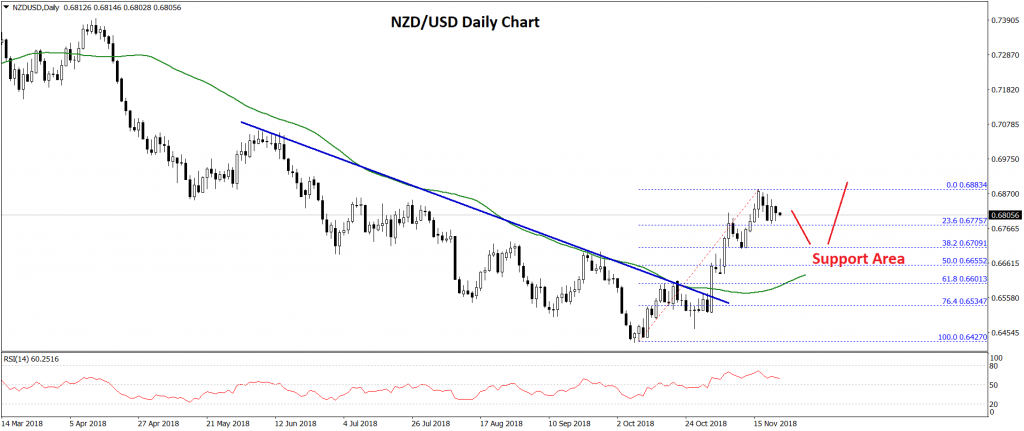
The pair settled above the 0.6700 resistance and the 50-day simple moving average. A new monthly high was formed at 0.6883 on FXOpen and the pair is currently consolidating gains.
An initial support is near the 0.6700 level and the 38.2% Fib retracement level of the recent upside move from the 0.6427 low to 0.6883 high. Below the 0.6700 support, the pair could test the key 0.6650 support.
The 0.6650 support also coincides with the 50% Fib retracement level of the recent upside move from the 0.6427 low to 0.6883 high. Therefore, dips from the current levels in the medium term remains supported near 0.6700 and 0.6650 levels.
On the upside, a break above the recent high at 0.6883 could spark more gains in NZD/USD above the 0.6850 level. The next major for buyers is at 0.7000, above which the pair could rise to 0.7200.
GBP/JPY Daily Outlook
Daily Pivots: (S1) 144.50; (P) 145.22; (R1) 146.18; More...
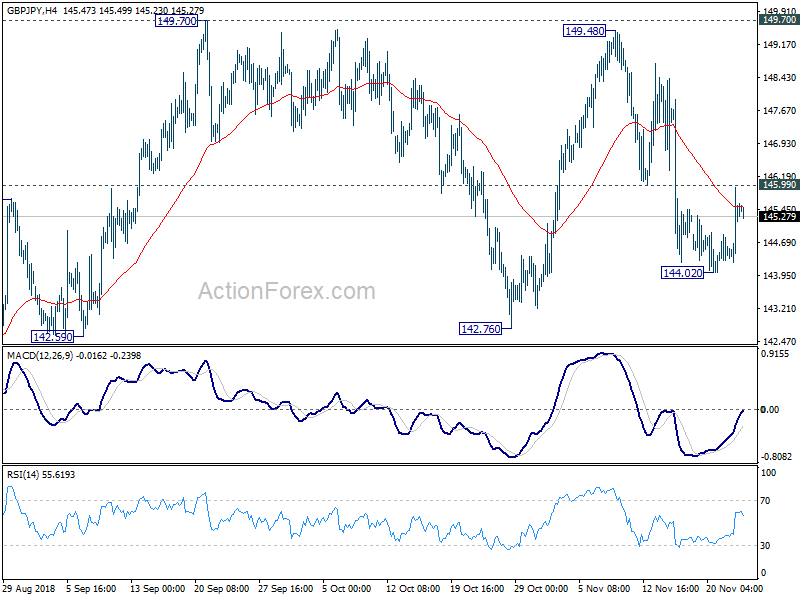
GBP/JPY is staying in consolidation above 144.02 temporary low and intraday bias remains neutral first. Also, with 145.99 resistance intact, further decline is in favor. On the downside, break of 144.02 will target 142.76 support first. Sustained break there will bring retest of 139.39/47 key support zone. On the upside, above 145.99 support turned resistance could bring stronger rebound. But near tem outlook will be neutral at best as long as 149.70 key resistance holds.
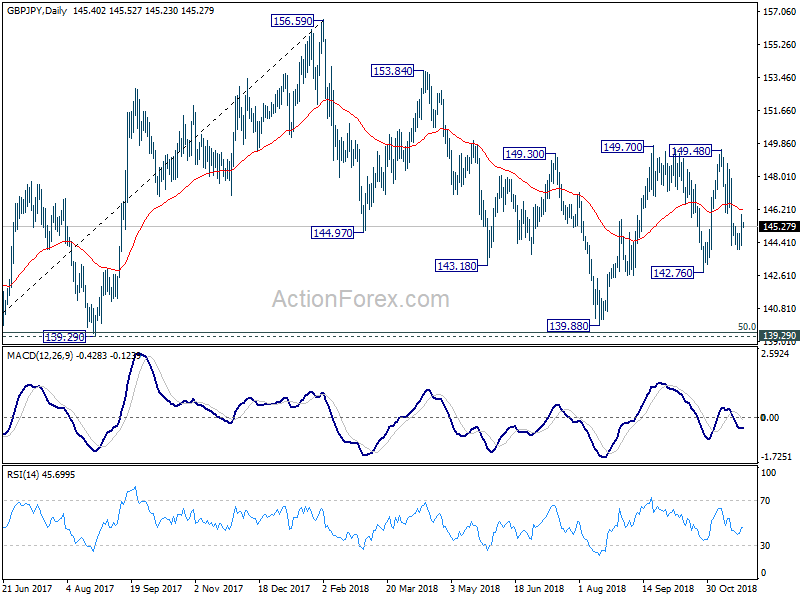
In the bigger picture, as long as 139.29 cluster support (50% retracement of 122.36 to 156.59 at 139.47) holds, up trend from 122.36 (2016 low) would still extend beyond 156.69 high. However, decisive break of 139.29/47 will suggest that such up trend is completed and turn outlook bearish. In that case, next target is 61.8% retracement at 135.43.
Sterling Vulnerable as Brexit Lift Fades, Markets Quiet Elsewhere
The forex markets are rather quiet today with major pairs and crosses bounded in tight range. Sterling was lifted by news that UK and EU agreed on the declaration on future relationship. But the boost is so far limited as bulls refuse to commit. Eyes will turn to the special EU summit on Sunday, where the withdrawal agreement as a whole would be endorsed by EU27 leaders.
For the week, Swiss Franc is overwhelmingly the strongest one. Pound and Dollar as the second and third strongest are relatively unconvincing. And the two's position could easily be taken before weekly close. And for now, Australian Dollar is the worst performing one for the week, followed by New Zealand Dollar and then Canadian.
Technically, EUR/GBP is held above 0.8824 minor support. GBP/JPY is also kept below 145.99 minor resistance. Thus, there is no confirmation of bottoming in Sterling. It remains vulnerable to another selloff. 0.8939 resistance in EUR/GBP and 144.02 support in GBP/JPY could come back into focus today. Another things to watch is whether Dollar would come back under pressure, in particular against Swiss Franc and Yen. It's about time the near term consolidations in both pair complete. So, 0.9908 in USD/CHF and 112.30 in USD/JPY will be watched too.
BoE Saunders: monetary policy implications of different Brexit outcomes could go either way
BoE known hawk Michael Saunders said in a speech that assuming a smooth Brexit, the MPC as a whole judged that further raise hikes are needed over time. And "my own hunch is that, conditioned on our Brexit assumptions, capacity pressures will probably build somewhat faster than envisaged in our latest Inflation Report projections, reinforcing upward pressure on pay growth." In that case, "we would probably need to return to something like a neutral stance rather earlier than implied by the current yield curve."
Nevertheless, he also acknowledged "that assumption of a smooth Brexit adjustment is itself uncertain". And, "any such resolution of Brexit uncertainties may change the economic outlook, perhaps substantially". More importantly, "the monetary policy implications of different Brexit outcomes could go either way, depending on the effects on supply, demand and the exchange rate."
In one example, Saunders said transition to a relatively close economic relationship with the EU could boost confidence and propel investment. The same factors could trigger rise in Sterling exchange rate. The next effect could be higher growth and lower inflation. In this case, it's unclear if more tightening is appropriate.
In another example, revert to WTO trading rules would weaken business confidence and hit investments and hiring. That would drags on growth but at the same time Sterling too. There would also be resultant boost to inflation reinforced by extensions of tariffs. And the net effect is higher inflation and lower growth. The monetary implications "could go in either direction.
ECB Mersch: Imperative for all Eurozone states to adhere to the common rules
ECB Executive Board member Yves Mersch said in a speech that "it is imperative for all Member States to adhere to the common rules", without naming Italy. And he emphasized " two principles that are at the heart of effective policy in a democratic society." "First, liability and control must be aligned, with important decisions taken only by those who will bear their consequences." "Second, the discharge of democratic control must lie at the level at which policy decisions are taken.
Separately, Chief Economic Peter Praet warned in a Handelsblatt interview published yesterday that "Italy's current financing conditions are much too tight for a country with weak growth and low inflation." For now, Praet didn't see any contagion effect so far. And, ECB won't intervene if the problems are confined only to Italy. ECB conducts monetary policy for the Eurozone as a whole.
ECB acknowledged "uncertainties and fragilities" in Eurozone economy
In the minutes for the October meeting released yesterday, ECB acknowledged "uncertainties and fragilities" in the economy. The members noted that risks to the economic outlook is skewed to the downside as driven by the uncertainties related to global trade. Yet, it reiterated the incoming data had not been able to derail Eurozone's strength. In short, the October meeting concluded that "the incoming data, while somewhat weaker than expected, remained overall consistent with an ongoing broad-based expansion".
More in ECB Might Keep Policy Rates Low for Longer, Given Downside Risk to Growth and Trade War
WTO: G20 new trade-restrictive measures surged to record, serious concern for international community
A WTO monitoring report released yesterday noted sharp rise in trade restrictive measures in G20 economies between mid-May and mid-Oct 2018. Trade covered of the measures adds up to USD 481B, six time larger than prior reporting period, and highest since record started in 2012.
A total of 40 new trade-restrictive measures were applied, averaging eight per month, including tariff increases, import bans and export duties. That's notably higher than almost six trade-restrictive measures per month during prior period. 33 new trade facilitating, including eliminating or reducing import tariffs and export duties. The number is in line with 2012-17 trend.
Commenting on the report, Director-General Roberto Azevêdo said "the report's findings should be of serious concern for G20 governments and the whole international community." And he warned "further escalation remains a real threat". And, "if we continue along the current course, the economic risks will increase, with potential effects for growth, jobs and consumer prices around the world."
On the data front
German will release Q3 GDP final today. Eurozone will also release PMIs. Later in the data, Canada retail sales and CPI will be the major focuses. US will release PMIs too.
GBP/JPY Daily Outlook
Daily Pivots: (S1) 144.50; (P) 145.22; (R1) 146.18; More...
GBP/JPY is staying in consolidation above 144.02 temporary low and intraday bias remains neutral first. Also, with 145.99 resistance intact, further decline is in favor. On the downside, break of 144.02 will target 142.76 support first. Sustained break there will bring retest of 139.39/47 key support zone. On the upside, above 145.99 support turned resistance could bring stronger rebound. But near tem outlook will be neutral at best as long as 149.70 key resistance holds.
In the bigger picture, as long as 139.29 cluster support (50% retracement of 122.36 to 156.59 at 139.47) holds, up trend from 122.36 (2016 low) would still extend beyond 156.69 high. However, decisive break of 139.29/47 will suggest that such up trend is completed and turn outlook bearish. In that case, next target is 61.8% retracement at 135.43.
Economic Indicators Update
| GMT | Ccy | Events | Actual | Forecast | Previous | Revised |
|---|---|---|---|---|---|---|
| 07:00 | EUR | German GDP Q/Q Q3 F | -0.20% | -0.20% | ||
| 08:15 | EUR | France Manufacturing PMI Nov P | 51.3 | 51.2 | ||
| 08:15 | EUR | France Services PMI Nov P | 55 | 55.3 | ||
| 08:30 | EUR | Germany Manufacturing PMI Nov P | 52.2 | 52.2 | ||
| 08:30 | EUR | Germany Services PMI Nov P | 54.5 | 54.7 | ||
| 09:00 | EUR | Eurozone Manufacturing PMI Nov P | 52 | 52 | ||
| 09:00 | EUR | Eurozone Services PMI Nov P | 53.6 | 53.7 | ||
| 13:30 | CAD | Retail Sales M/M Sep | 0.00% | -0.10% | ||
| 13:30 | CAD | Retail Sales Ex Auto M/M Sep | 0.30% | -0.40% | ||
| 13:30 | CAD | CPI M/M Oct | -0.40% | |||
| 13:30 | CAD | CPI Y/Y Oct | 2.20% | 2.20% | ||
| 13:30 | CAD | CPI Core Y/Y Oct | 1.90% | 1.90% | ||
| 13:30 | CAD | CPI Core - Median Y/Y Oct | 2.00% | 2.00% | ||
| 13:30 | CAD | CPI Core - Trim Y/Y Oct | 2.10% | 2.10% | ||
| 14:45 | USD | US Manufacturing PMI Nov P | 55.8 | 55.7 | ||
| 14:45 | USD | US Services PMI Nov P | 55 | 54.8 |
ECB Mersch: Imperative for all Eurozone states to adhere to the common rules
ECB Executive Board member Yves Mersch said in a speech that "it is imperative for all Member States to adhere to the common rules", without naming Italy. And he emphasized " two principles that are at the heart of effective policy in a democratic society." "First, liability and control must be aligned, with important decisions taken only by those who will bear their consequences." "Second, the discharge of democratic control must lie at the level at which policy decisions are taken.
Separately, Chief Economic Peter Praet warned in a Handelsblatt interview published yesterday that "Italy's current financing conditions are much too tight for a country with weak growth and low inflation." For now, Praet didn't see any contagion effect so far. And, ECB won't intervene if the problems are confined only to Italy. ECB conducts monetary policy for the Eurozone as a whole.
BoE Saunders: monetary policy implications of different Brexit outcomes could go either way
BoE known hawk Michael Saunders said in a speech that assuming a smooth Brexit, the MPC as a whole judged that further raise hikes are needed over time. And "my own hunch is that, conditioned on our Brexit assumptions, capacity pressures will probably build somewhat faster than envisaged in our latest Inflation Report projections, reinforcing upward pressure on pay growth." In that case, "we would probably need to return to something like a neutral stance rather earlier than implied by the current yield curve."
Nevertheless, he also acknowledged "that assumption of a smooth Brexit adjustment is itself uncertain". And, "any such resolution of Brexit uncertainties may change the economic outlook, perhaps substantially". More importantly, "the monetary policy implications of different Brexit outcomes could go either way, depending on the effects on supply, demand and the exchange rate."
In one example, Saunders said transition to a relatively close economic relationship with the EU could boost confidence and propel investment. The same factors could trigger rise in Sterling exchange rate. The next effect could be higher growth and lower inflation. In this case, it's unclear if more tightening is appropriate.
In another example, revert to WTO trading rules would weaken business confidence and hit investments and hiring. That would drags on growth but at the same time Sterling too. There would also be resultant boost to inflation reinforced by extensions of tariffs. And the net effect is higher inflation and lower growth. The monetary implications "could go in either direction.
Doubt Cast Over the FOMC’s Course
Key insights from the week that was.
The RBA’s minutes from their November meeting and a subsequent speech by Governor Lowe carried a confident but unhurried tone. Meanwhile the US economy showed early signs of the slowdown in activity that we anticipate will take growth back to trend over the coming year.
Beginning with the RBA, though the consumer is still seen as a ‘source of uncertainty’, the Board is more confident in the sector’s outlook. In the RBA’s view, on the back of strong gains for employment and a nascent acceleration in wages growth, consumption is set to support above-trend growth through 2019 and 2020, along with strength in infrastructure investment and non-residential construction. With the savings rate near historic lows, this requires an acceleration in income growth to the 3.0% annual pace currently being seen for consumption.
We remain unconvinced on growth, instead anticipating that it will slow back to trend in 2019. Housing and the consumer are critical to this view. On housing, in contrast to the RBA, Westpac anticipates that GDP will be materially affected by declining residential investment – a trend increasingly evident in dwelling approvals. On top of this investment effect, further declines in house prices will reduce household wealth and, we believe, impede consumers’ willingness to spend. Consumers’ spending capacity also continues to be restricted by a very modest wage uptrend, with full employment remaining elusive. The above outturn would clearly warrant the RBA remaining on hold not only through 2019, but also 2020.
Confidence in the real economy is also critical for the US. There the market has taken recent communications by FOMC officials as dovish overall, resulting in a paring back of near-term expectations for policy. For us, the ‘dovish’ remarks of the Committee are merely recognition that neutral is nearing and the growth cycle maturing, not that policy will shift abruptly.
Westpac remains of the view that, following a rate hike at their December meeting, the FOMC will increase the federal funds rate a further three times in 2019 to a September peak of 3.125%. At this level, the stance of policy will be mildly contractionary, but still accommodative enough to allow growth to persist at trend given the underlying strength of the US labour market. October’s weak durable goods orders and shipments update was in line with our view that growth in business investment will weaken over the coming year. However, as long as the consumer remains robust, which labour market strength and household wealth currently point to, the FOMC is unlikely to waver. Global risks are being watched, but will only affect policy if/ when they threaten domestic momentum.
Across the Atlantic, Brexit remains the focus. Negotiations achieved enough this week to allow the EU Summit on the matter to go ahead this weekend, but the key event to watch out for remains the UK parliament’s vote to pass or reject the current draft deal. On that matter there remains considerable uncertainty. For Europe more broadly, there was a subtle change in the ECB’s November meeting minutes. Risks continue to be considered broadly balanced with the broad-based expansion still intact, but a remark was made by a member “that a number of arguments pointed towards risks to the growth outlook tilting to the downside”. The ‘balance of risks’ will gain greater prominence in 2019 as the first rate hike of the cycle (potentially) comes into view.
Before closing out for the week, our New Zealand economics team has just released their latest quarterly update. Notable in this edition is the unusual pairing of stronger NZ GDP and inflation forecasts with softer RBNZ cash rate and currency profiles. Reconciling this divergence, it is increasingly evident that the RBNZ’s behaviour has changed, with the cash rate kept lower for longer than the RBNZ of old would have.