

Sample Category Title
Sunset Market Commentary
Markets
German Bunds remain steady today as US markets are closed due to Thanksgiving. Yesterday’s risk improvement didn’t continue today. Asian markets closed mixed this morning. European equity indices moved south at opening. With US markets closed and no economic data to steer trading, investor sentiment remained the main market driver. German Bund opened higher on safe haven flows. Some positive news/rumours reversed the downward trend before noon. European Council president Tusk announced that a draft agreement for Brexit had been sent to the member states. UK PM May hailed it “the right deal”. 5SM Deputy PM Di Maio signaled he might be open to make limited modifications to the Italian budget, pushing Italian BTP’s higher. The Italian retail bond sale closed at 1.3 billion euros, the lowest level since 2012. The ECB published its account of the October policy meeting. It acknowledged that “uncertainties and fragilities” impact the economy but agreed that the euro zone’s domestic strength will prevail. German Bunds paired their opening gains and hover around opening levels at the time of writing. German yields are moving in a mixed fashion with changes ranging from +0.2 bps (2-yr) to -1.2 bps (10-yr). Peripheral bond spreads were steady with only Greece outperforming (-5 bps).
Yesterday’s last minute dip in US equity markets revealed a fragile investor sentiment. This persisted during Asian and European trading hours. We shouldn’t draw too many conclusions from today’s price action however, given that the US is closed in observance of Thanksgiving. That said, European stock markets do flash red again after a short-lived rebound on Wednesday. The slightly negative sentiment didn’t prevent the euro from trading with a positive bias. The common currency was supported by easing Italian tensions as both Italy and the EC are still open for dialogue. EUR/USD later spiked temporarily on reports that the EU and UK reached an (at least political) agreement concerning the future ties (see below) but erased those gains soon after. The pair currently stabilizes close to the 1.14-handle, up from 1.1380 this morning. The trade weighted dollar (DXY) drifts further down in the 96.5 area. USD/JPY is floating clueless in a narrow 112.90-113.10 range.
Brexit is the main driver for sterling already for quite some time and that wasn’t different today. EUR/GBP initially hovered in the 0.8920 area early in the session as markets awaited the next steps the EU-UK brexit sage. Toward the end of the morning session, the EU and the UK announced that they reached an agreement on a political declaration on what their future relationship will look like. The agreement also pulled the trigger for a EU summit on Sunday where the EU member states have to give their fiat on this political declaration. Sterling jumped slightly less than one percent higher upon the announcement of the agreement. There was some uncertainty afterward as some details still have to be settled. However, sterling held its gains as it become clear that a summit will take place in any case. EUR/GBP trades currently in the 0.8855 area. Cable traded temporary north of 1.29, but is currently changing hands in the high 1.2880 area. Sterling profited today as another, highly symbolic hurdle in the brexit process has been conquered. That said, the focus will soon return to the political scene in the UK. Question remains whether this part of the story will remain sterling supportive.
News Headlines
The South-African central bank (SARB) raised its policy rate for the first time since 2016 by 25 bps to 6.75%. The board was entirely split on the decision with governor Kganyago’s vote decisive. The SARB presented a gloomier eco and inflation outlook, underlining the SARB’s difficult decision. Risks for the rand are omnipresent. USD/ZAR fell to the lowest level since mid-August.
USD/JPY Mid-Day Outlook
Daily Pivots: (S1) 112.73; (P) 112.96; (R1) 113.27; More..
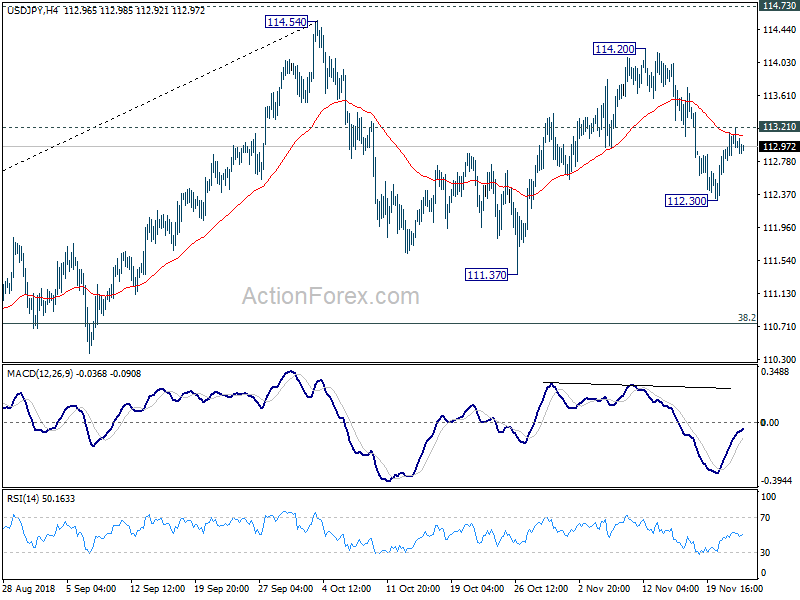
Intraday bias in USD/JPY remains neutral with focus on 113.21 resistance. Sustained break of 113.21 will indicate that fall from 114.20 has completed. And, intraday bias will be turned back to the upside for 114.54/73 key resistance zone. On the downside, below 112.30 will resume the fall from 114.20 to 111.37 support. Such decline is seen as the third leg of the consolidation pattern from 114.54. Downside should be contained by 38.2% retracement of 104.62 to 114.54 at 110.75 to bring rebound.
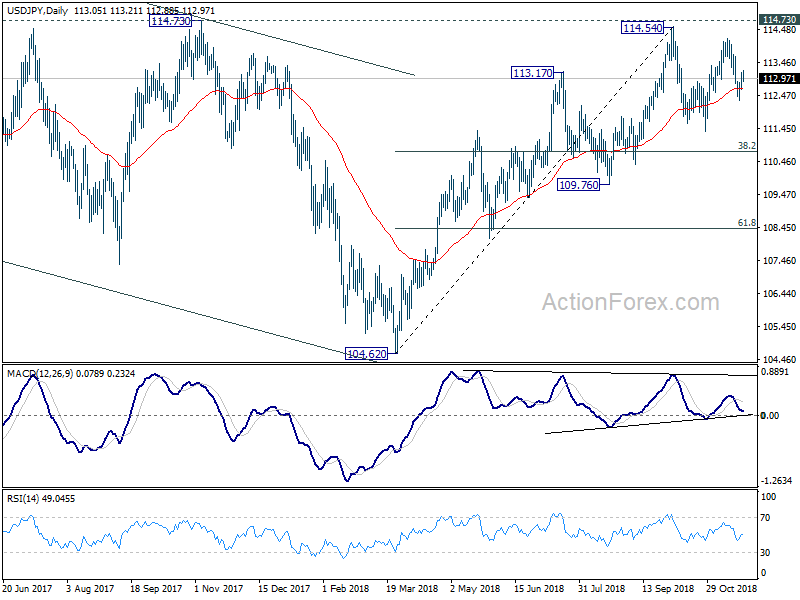
In the bigger picture, corrective fall from 118.65 (2016 high) should have completed with three waves down to 104.62. Decisive break of 114.73 resistance will likely resume whole rally from 98.97 (2016 low) to 100% projection of 98.97 to 118.65 from 104.62 at 124.30, which is reasonably close to 125.85 (2015 high). This will stay as the preferred case as long as 109.76 support holds. However, decisive break of 109.76 will dampen this bullish view and turns outlook mixed again.
USD/CHF Mid-Day Outlook
Daily Pivots: (S1) 0.9929; (P) 0.9944; (R1) 0.9960; More...
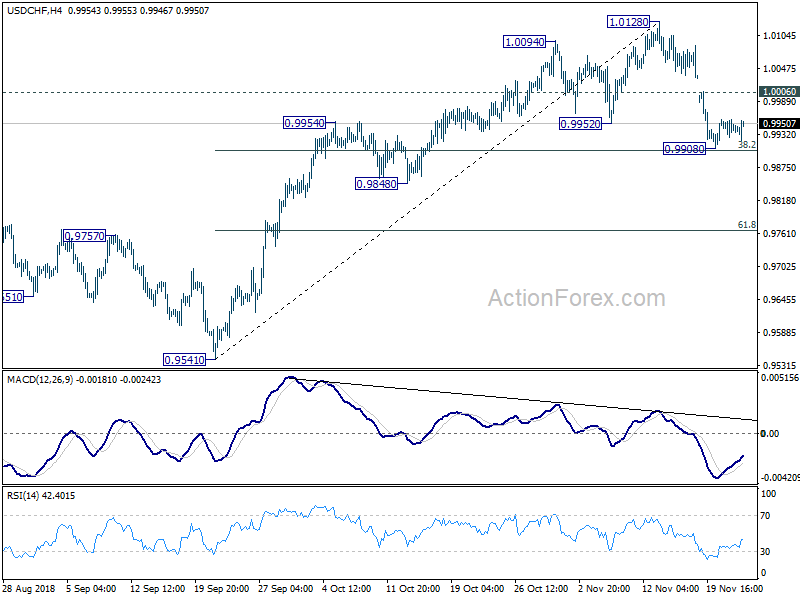
Intraday bias in USD/CHF remains neutral for consolidation above 0.9908 temporary low. Another fall could be seen with 1.0006 minor support intact. Break of 38.2% retracement of 0.9541 to 1.0128 at 0.9904 will target 0.9848 key support level. On the upside, above 1.0006 minor resistance will indicate that the pull back has completed. Intraday bias will be turned back to the upside for retesting 1.0128 high.
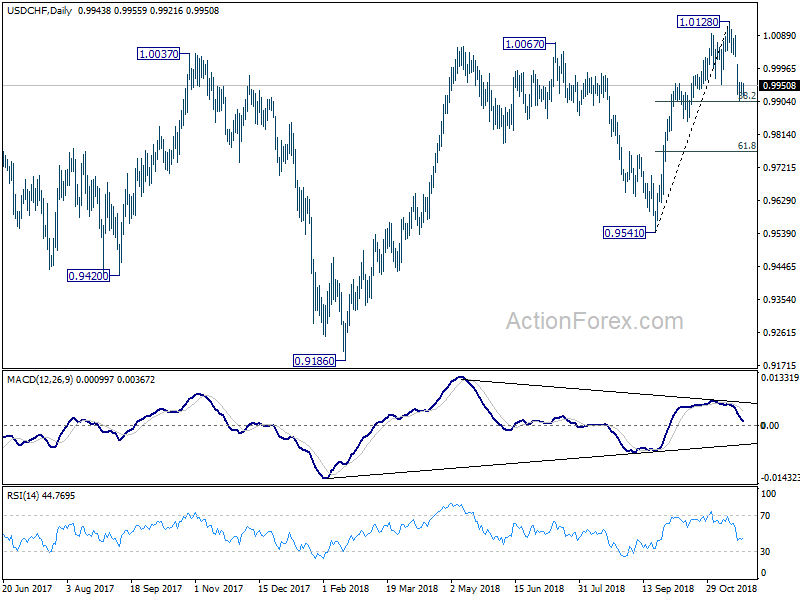
In the bigger picture, the pullback from 1.0067 has completed at 0.9541 already. And rise from 0.9186 is likely resuming. Firm break of 1.0067 will pave the way to retest 1.0342 key resistance. We'd be cautious on strong resistance from there to limit upside to bring another medium term fall to extend long term range trading. However, break of 0.9848 near term support will dampen this view and bring deeper decline back to 0.9541 support and possibly below.
EUR/USD Mid-Day Outlook
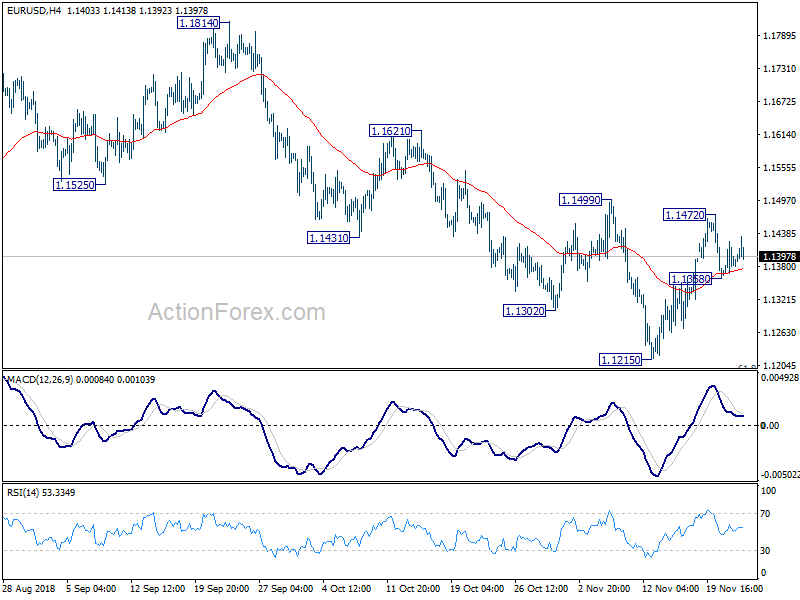
Daily Pivots: (S1) 1.1358; (P) 1.1392; (R1) 1.1418; More.....
EUR/USD is staying in range of 1.1358/1472 and intraday bias remains neutral first. Also, as long as 1.1499 resistance holds, outlook remains bearish. On the downside, break of 1.1358 minor support should bring retest of 1.1215 low first. Break will resume medium term down trend. However, on the upside, firm break of 1.1499 will indicate near term reversal and turn outlook bullish for 1.1814 resistance again.
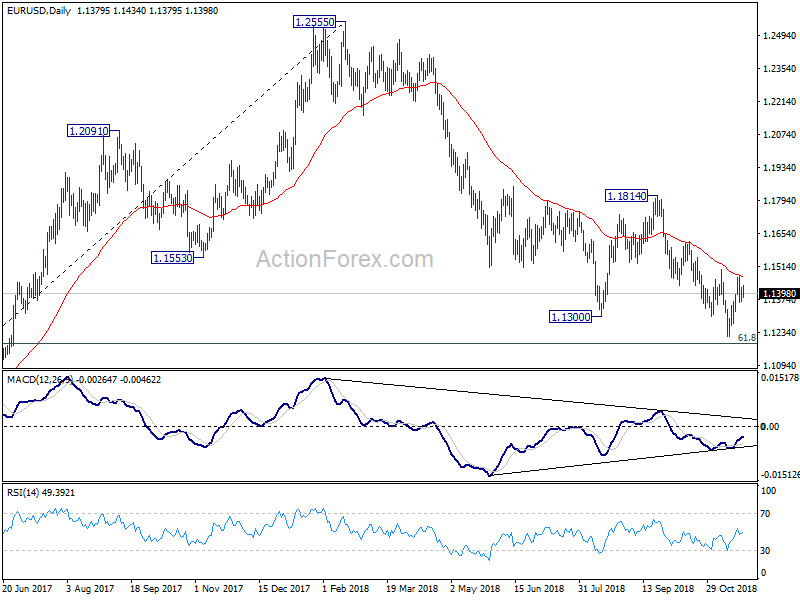
In the bigger picture, down trend from 1.2555 medium term top has just resumed and should target 61.8% retracement of 1.0339 (2017 low) to 1.2555 at 1.1186 next. Sustained break there will pave the way to retest 1.0339. On the upside, break of 1.1814 resistance is now needed to confirm medium term bottoming. Otherwise, outlook will stay bearish in case of strong rebound.
EURAUD Regains Ground Following Eebound on 5-Month Trough
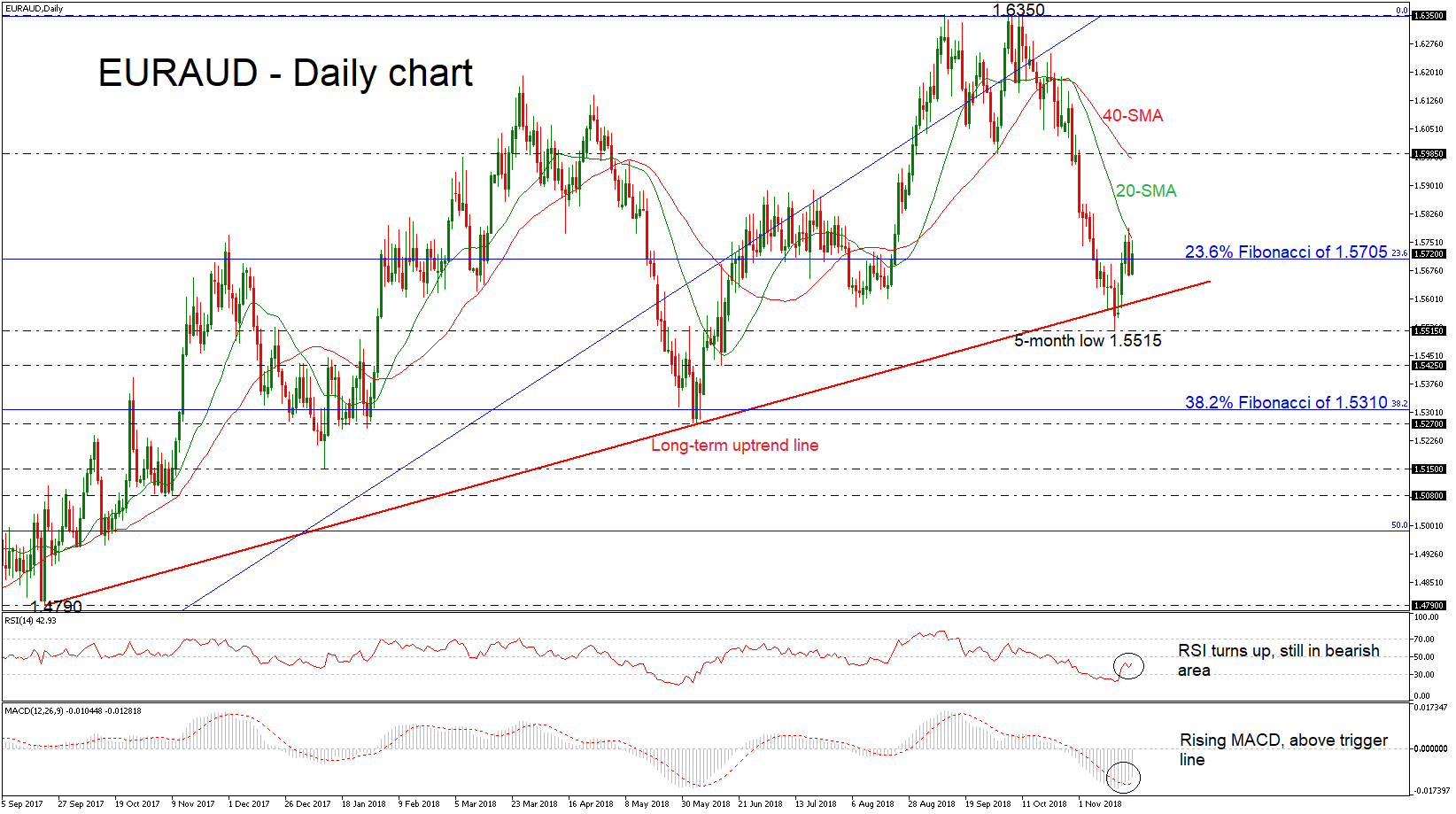
EURAUD has advanced considerably after it found support on the five-month low of 1.5515, achieved last Thursday, and ended the day below the rising trend line. However, the pair gained ground in the next couple of sessions, challenging the 20-day simple moving average near 1.5760.
Technically, the RSI remains in the negative zone, but is turning higher, while the MACD oscillator is strengthening its positive momentum above the trigger line and below the zero line. Both are confirming the recent upside run in the market.
Currently, the pair hovers marginally above the 23.6% Fibonacci retracement level of the upleg from 1.3625 to 1.6350, near 1.5705. In case of a significant leg above this area, the price could run towards the 1.5985 resistance, which holds near the 40-day SMA.
On the flipside, if the pair reverses back down and dives below the long-term ascending trend line, immediate support could come from the five-month low. Even lower, the 1.5425 could attract greater attention and any move lower could worsen the bearish outlook, opening the door towards the 38.2% Fibonacci of 1.5310.
To sum up, EURAUD hovers above the long-term uptrend line, which has been holding since September 2017, endorsing chances for more increases.
Canadian Dollar Quiet as US Markets Closed for Thanksgiving
The Canadian dollar has ticked lower in the Thursday session. In the North American session, USD/CAD is trading at 1.3228, down 0.03% on the day. On the release front, Canadian Corporate Profits posted a strong gain of 3.9%, marking a 4-month high. In the U.S, banks and stock markets are closed for Thanksgiving and there no indicators on the schedule. On Friday, Canada releases CPI and retail sales reports.
U..S stock markets fell sharply on Tuesday, dragged down by technological stocks. The Dow Jones and S&P 500 indices both gave up their year-to-date gains. The drop sent the Canadian dollar reeling, as investors avoided risk assets and USD/CAD jumped over 1 percent, pushing above the 1.33 level for the first time since late June. However, stock markets have recovered, as has the Canadian dollar, which posted gains on Wednesday. The sharp drop in the equity markets points to nervousness on the part of investors, as the nagging U.S-China trade dispute has taken a bite out of both economies, and investors are concerned that the conflict will dampen the current economic expansion in the United States and further corrections in global equity markets could mean more headwinds for the wobbly Canadian dollar.
This week’s turmoil in the stock markets has raised questions about the Federal Reserve’s monetary policy. The markets had expected the Fed to raise rates up to four times in 2019, but with more signs that the U.S. economy could slow in 2019, policymakers may ease up on the pace of rate hikes. The Federal Reserve remains on track to gradually raise rates in 2019, but the pace could be slower than anticipated just a few weeks ago. There’s no denying that the U.S economy is currently in great shape, with unemployment at historically low levels and the $1.5 trillion tax cut package boosting economic growth. However, the rosy picture could change next year. The U.S-China trade war is expected to take a bite out of U.S growth, and the stimulus from the tax cut will fade over time. Economic growth has been slowing, with third-quarter growth expected at 2.7%, down from 3.5% in the second quarter. A rate increase in December remains a strong possibility, with the odds of a rate hike standing at 76%.
GBP/USD Mid-Day Outlook
Daily Pivots: (S1) 1.2754; (P) 1.2787; (R1) 1.2810; More...
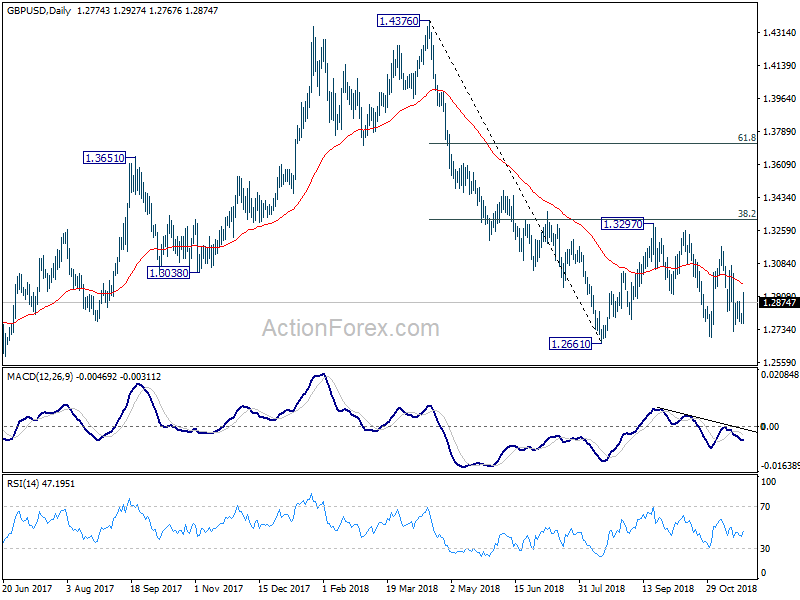
GBP/USD's strong rally today indicates that rebound from 1.2773 has resumed. And the development argues that consolidation pattern from 1.2661 is staring another rising leg. Intraday bias is back on the upside for 1.3071 resistance first. But overall, upside should be limited by 1.3316 fibonacci level to bring down trend resumption eventually. On the downside, below 1.2764 minor support will turn bias back to the downside for 1.2661. Firm break there will resume the larger down trend from 1.4376.
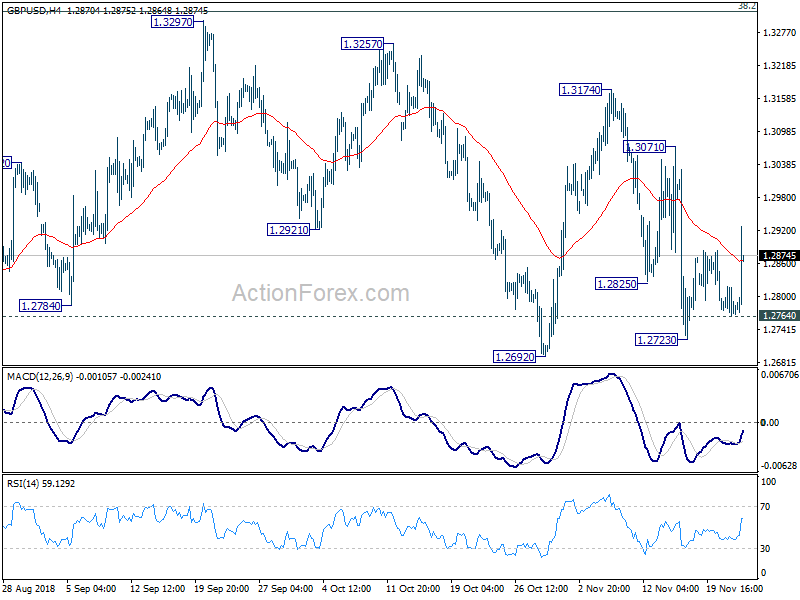
In the bigger picture, whole medium term rebound from 1.1946 (2016 low) should have completed at 1.4376 already, after rejection from 55 month EMA. The structure and momentum of the fall from 1.4376 argues that it's resuming long term down trend. And this will be the preferred case as long as 38.2% retracement of 1.4376 to 1.2661 at 1.3316 holds. However, firm break of 1.3316 would bring stronger rebound to 61.8% retracement at 1.3721. And, the eventual depth of the fall from 1.4376, and the chance of hitting 1.1946 low, will depend on the strength of the interim corrective rebound from 1.2661.
Pound Soars on Draft Brexit Agreement… But is the Rally Sustainable?
The pendulum has swung in favour of Sterling, as the bulls took control this afternoon following news that the EU and UK have agreed on a draft Brexit agreement.
With the European Union Council President Donald Tusk stating that the draft has been "agreed in principle at a political level", this certainly paves the way for the Brexit summit to go ahead on Sunday. While the Pound has the potential to remain buoyed in the near term as bulls exploit this welcome development, there are still some major headwinds down the road. Even if a breakthrough is achieved with EU leaders, the next major challenge will be for the draft Brexit agreement to be passed through parliament. With a strong sense of pessimism and negativity in the air over parliament approving any deal Theresa May brings forward, fears of a no-deal Brexit outcome will most likely weigh on the mind of many investors. A scenario where the UK ends up crashing out of the European Union with no deal in place will be the knock out blow for the British Pound.
The Pound's aggressive appreciation in response to today's Brexit headline continues to highlight how the currency remains extremely sensitive to Brexit developments. Although the GBPUSD has rallied over 130 pips in a span of less than an hour, the sustainable of the upside needs to be questioned. A failure for bulls to keep prices above the 1.2840 level could result in a move back towards 1.2800 and 1.2770, respectively.
Sterling Surges as UK and EU Agreed on Future Relationship, Now Awaits Reactions from May’s Cabinet
In an originally quiet holiday trading day, Sterling surges broadly as UK and EU agreed on the declaration on future relationship. The move, while strong, is relatively limited at this point. There seems to be some hesitation for Sterling bulls. They'd probably prefer to wait and see how the cabinet would respond to the declaration first. And of course, more resignations from the Cabinet would shake up the picture again. At this point, Euro is follow the Pound as the second strongest, and then Canadian Dollar. New Zealand and Australian Dollar are the weakest one for today, followed by Swiss Franc.
Technically, Sterling pairs will not catch most attention. Break of 0.8824 minor support in EUR/GBP will indicate rejection by 0.8939 resistance. And in that case, deeper fall would be seen back to 0.8655 support. GBP/JPY is also having focus back on 145.99 minor resistance. Break will indicate completion of pull back from 149.48 and GBP/JPY would head back towards 149.70 key resistance. GBP/USD's break of 4 hour 55 EMA could now bring stronger rise back to 1.3071 resistance and above.
In other markets, major European indices are all in red at the time of writing. FTSE is down -1.04%, DAX is down -0.78%, CAC is down 0.60%. German 10 year yield is down -0.013 at 0.365. Italian 10 year yield is down -0.039 at 3.441. German-Italian yield spread is still above 300. Earlier today, major Asian indices ended mixed. Nikkei gained 0.65%, Hong Kong HSI rose 0.18% and Singapore Strait Times added 0.09%. But China Shanghai SSE dropped -0.23%.
Sterling soars as UK and EU agreed declaration on future relationship
Sterling surges broadly on news that UK and EU have agreed on the draft political declaration on future relationship. It's reported EU and UK "agree to develop an ambitious, wide-ranging and balanced economic partnership." And "this partnership will be comprehensive, encompassing a free trade area as well as wider sectoral cooperation … will be underpinned by provisions ensuring a level playing field." Also, the relationship would respect "the integrity of the Union's Single Market and the Customs Union as well as the United Kingdom's internal market, and recognize the development of an independent trade policy by the United Kingdom beyond this economic partnership."
UK Prime Minister Theresa May hailed the draft declaration of future relationship with the EU as she spoke to reporters in Downing Street. She said , "The British people want this to be settled, they want a good deal that sets us on course for a brighter future … That deal is within our grasp and I am determined to deliver it."
She added "The agreement we've reached is between the UK and the European Commission. It is now up to the 27 leaders of the other EU member states to examine this agreement in the days leading up to the special EU council meeting on Sunday."
Regarding Gibraltar, May is confidence after speaking to Spanish Prime Minister Pedro Sanchez. She added "I am confident that on Sunday we'll be able to agree a deal that delivers for the whole UK family, including Gibraltar."
ECB accounts: Weaker growth in H2 2018 would have carry-over effect on 2019
In the accounts of Oct 24-25 monetary policy meeting minutes, ECB acknowledged that "recent data and survey results had been generally somewhat weaker than expected". However, the accounts also noted that incoming data were "still considered consistent with an ongoing broad-based expansion of the euro area economy" as embodied in September staff projections. The weaker growth momentum in 2018 "pointed to an economy that was growing more in line with potential".
Nevertheless, the accounts also noted that weaker growth pattern in H2 "would have a mechanical impact, via the carry-over effect, on the estimate for annual growth in 2019". Little information was currently available for Q4. "December 2018 Eurosystem staff projections, which would be available at the Governing Council's next monetary policy meeting, would provide an occasion for a more in-depth assessment."
On external risks ECB policymakers "considered that the uncertainties related to global factors remained prominent, and the risks related to the external environment were assessed to be tilted to the downside." Risks include "rising protectionism, vulnerabilities in emerging markets and financial market volatility." Also, the account noted that the limited impact from trade tensions was possible because "an adverse impact from trade tensions on more open economies was being offset by the presently more buoyant imports, particularly in the United States."
On inflation, ECB policymakers consider "medium-term outlook for inflation, as contained in the September 2018 ECB staff projections, had been broadly confirmed." The disappointing development in core inflation was "mainly due to services prices". And, "it was recalled that there were a number of special factors underlying services price developments, which were mainly related to administered prices. An increase in underlying inflation for the euro area was to be expected when these base effects disappeared.
Overall, "members widely agreed that patience, prudence and persistence with regard to monetary policy remained warranted".
BoJ Kuroda: Our slowdown in asset purchase different from Fed's tapering
BoJ is sometimes described as doing "stealth tapering" in slowing down its asset purchases. But Governor Haruhiko Kuroda told the parliament that the slowdown in purchases is different from Fed's tapering.
He said "the Fed's tapering is conducted intentionally and in several stages, as part of a normalization of monetary policy." However, "the slowdown in our government bond buying is different from the Fed's tapering".
Also Kuroda reiterated the message that there is no need to take additional easing. Instead, BoJ would maintain the current program patiently as it takes time to lift inflation to target.
Released from Japan, national CPI core was unchanged at 1.00% yoy in October, matched expectations.
GBP/USD Mid-Day Outlook
Daily Pivots: (S1) 1.2754; (P) 1.2787; (R1) 1.2810; More...
GBP/USD's strong rally today indicates that rebound from 1.2773 has resumed. And the development argues that consolidation pattern from 1.2661 is staring another rising leg. Intraday bias is back on the upside for 1.3071 resistance first. But overall, upside should be limited by 1.3316 fibonacci level to bring down trend resumption eventually. On the downside, below 1.2764 minor support will turn bias back to the downside for 1.2661. Firm break there will resume the larger down trend from 1.4376.
In the bigger picture, whole medium term rebound from 1.1946 (2016 low) should have completed at 1.4376 already, after rejection from 55 month EMA. The structure and momentum of the fall from 1.4376 argues that it's resuming long term down trend. And this will be the preferred case as long as 38.2% retracement of 1.4376 to 1.2661 at 1.3316 holds. However, firm break of 1.3316 would bring stronger rebound to 61.8% retracement at 1.3721. And, the eventual depth of the fall from 1.4376, and the chance of hitting 1.1946 low, will depend on the strength of the interim corrective rebound from 1.2661.
Economic Indicators Update
| GMT | Ccy | Events | Actual | Forecast | Previous | Revised |
|---|---|---|---|---|---|---|
| 23:30 | JPY | National CPI Core Y/Y Oct | 1.00% | 1.00% | 1.00% | |
| 12:30 | EUR | ECB Monetary Policy Meeting Accounts | ||||
| 15:00 | EUR | Eurozone Consumer Confidence Nov A | -3 | -3 |
ECB accounts: Weaker growth in H2 2018 would have carry-over effect on 2019
In the accounts of Oct 24-25 monetary policy meeting minutes, ECB acknowledged that "recent data and survey results had been generally somewhat weaker than expected". However, the accounts also noted that incoming data were "still considered consistent with an ongoing broad-based expansion of the euro area economy" as embodied in September staff projections. The weaker growth momentum in 2018 "pointed to an economy that was growing more in line with potential".
Nevertheless, the accounts also noted that weaker growth pattern in H2 "would have a mechanical impact, via the carry-over effect, on the estimate for annual growth in 2019". Little information was currently available for Q4. "December 2018 Eurosystem staff projections, which would be available at the Governing Council's next monetary policy meeting, would provide an occasion for a more in-depth assessment."
On external risks ECB policymakers "considered that the uncertainties related to global factors remained prominent, and the risks related to the external environment were assessed to be tilted to the downside." Risks include "rising protectionism, vulnerabilities in emerging markets and financial market volatility." Also, the account noted that the limited impact from trade tensions was possible because "an adverse impact from trade tensions on more open economies was being offset by the presently more buoyant imports, particularly in the United States."
On inflation, ECB policymakers consider "medium-term outlook for inflation, as contained in the September 2018 ECB staff projections, had been broadly confirmed." The disappointing development in core inflation was "mainly due to services prices". And, "it was recalled that there were a number of special factors underlying services price developments, which were mainly related to administered prices. An increase in underlying inflation for the euro area was to be expected when these base effects disappeared.
Overall, "members widely agreed that patience, prudence and persistence with regard to monetary policy remained warranted".