

Sample Category Title
EUR/USD – Euro Gains Ground, ECB Minutes Next
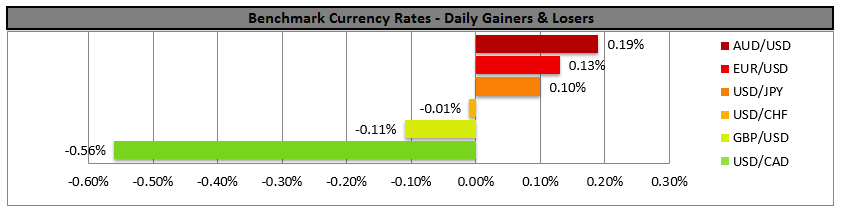
EUR/USD has posted small gains in the Thursday session. Currently, the pair is trading at 1.1426, up 0.35% on the day. U.S. banks and stock markets closed for Thanksgiving and there are no U.S events. Traders can expect an uneventful day in the currency markets. The ECB will release the minutes of its policy meeting in October and Eurozone consumer confidence is expected to come in at -3 points for a third straight month. On Friday, Germany releases Final GDP for the third quarter, with the markets braced for a decline of 0.2 percent. As well, the eurozone and Germany will release services and manufacturing PMI reports.
As the locomotive of the eurozone, the German economy is often viewed as the bellwether of the eurozone. A rare decline in German Preliminary GDP for Q3 has raised alarm bells – is the long German expansion over, or was this release just a blip? The drop of 0.2% marked the first decline in the German economy since 2015, and analysts are keeping a keen eye on the Final GDP, which will be released on Friday. This release is also expected at -0.2%, which could weigh on the euro. German officials attributed the weak Preliminary GDP reading to new emission standards for German cars, but it’s likely that the drop is reflective of a weaker global economy due to the ongoing trade war between the U.S. and China. The tariffs have already resulted in a slowdown in China’s economy, and the analysts expect a similar effect on the U.S. economy, as the ‘R’ word (recession) is already being whispered, even though the U.S economy is currently firing on all cylinders.
The Italian budget continues to be a bone of contention between Rome and Brussels, and the ball is now in the court of the EU, in particular, the European Commission, which is in charge of EU regulations. On Wednesday, the Commission rejected Italy’s draft 2019 budget, saying it was in breach of EU deficit and debt rules. Italy’s debt stands at a staggering 132% of GDP, and the EU is concerned that the high-spending budget could cause another debt crisis in the eurozone. The EU could impose severe financial sanctions on Italy, with fines of up to 0.2% of the country’s GDP. Senior Italian officials have vowed not to bend on the budget, but may have to reach a compromise with Brussels.
Bond And Forex Markets Signal About A Possible Reversal In Stocks
Markets diligently tried to defend their positions before the holidays in the USA. American indices had completed the trading on Wednesday almost unchanged, after losing about 4% in first two days of the week. The stocks of the energy sector companies had bounced off by 1-2% following the oil after a 6% plunge in the previous day.
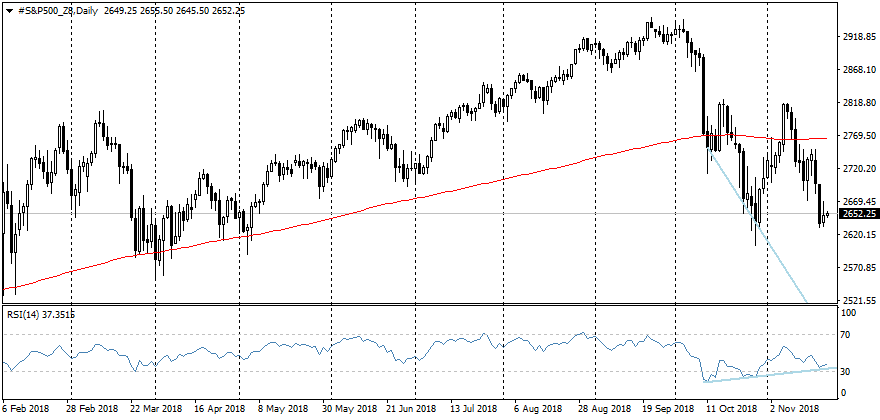
American markets are closed on Thursday, and on Friday there is going to be a shortened trading session with a significant part of the players staying away from the trading. This had reinforced the focus on the trading dynamics in the first half of the week.
As we have noted earlier, despite the negative dynamics of the market favorites in previous months and years, market participants are far from panic. Index VIX has been traded near 20 for about a month, keeping its position despite the decline in shares.
The easing of the Fed’s rhetoric last week has turned the dollar into decline, although this has not yet much affected the stock prices. The traders with shares are still afraid of possible problems with sales of the Apple stocks and are concerned about the exhaustion of the overall effect of tax reform on the economic growth.
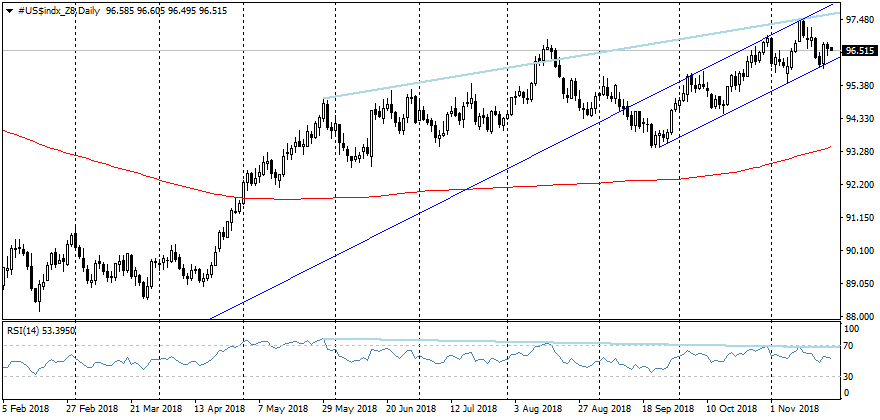
The foreign exchange market is often the first to react on the changes in external conditions. And it has already given its verdict to the Fed’s sentiment, throwing away the dollar from the multi-month highs. The development of this trend will soften the market’s financial conditions, strengthening support for the shares. 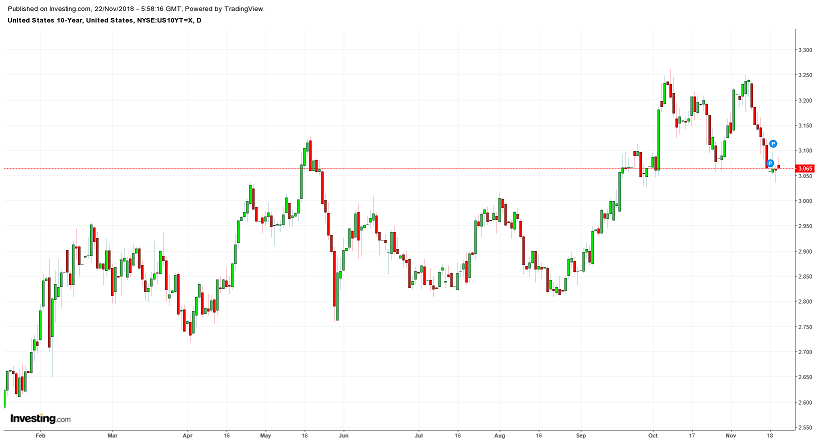
Moreover, the yield of the U.S. government bonds has been declining over the past two weeks. The yield of 10-years U.S. Treasuries had decreased from 3.25% to 3.06%. If at the initial stage this could be attributed to an increased demand for protective assets and was under the accompaniment of the dollar growth, the further yield decline (price growth) last week has related to the revision of the Fed’s policy expectations. Now it does not sound so unequivocally hawkish as in the start of October and that is also able to return the demand for stocks if this trend proves to be sustainable.
Following the decline in yield on the US debt market, the effect should soon emerge, which can seriously change the investor’s mood. Especially if the risks of the expanding trade wars and a sharp slowdown of the economy are not realized.
Oil Slips As U.S. Crude Inventories Swelled To Their Highest Level Since December 2017
Oil prices slipped on Thursday after U.S. crude inventories swelled to their highest level since December 2017 amid concerns of an emerging global glut, although the potential for a supply cut by OPEC prevented further drops. U.S. West Texas Intermediate (WTI) crude futures, were at $54.35 per barrel at 0534 GMT, 28 cents, or 0.5 percent below their last settlement. Front-month Brent crude oil futures were at $63.25 per barrel, down 23 cents, or 0.4 percent.
U.S. commercial crude oil inventories rose by 4.9 million barrels to 446.91 million barrels last week, the Energy Information Administration (EIA) said in a weekly report on Wednesday. That was the highest level since December last year. U.S. crude oil production remained at a record 11.7 million barrels per day (bpd), the EIA said.
“U.S. inventory data…continued to show significant supply builds, which comes on the back of sustained record U.S. crude oil production,” said Stephen Innes, head of trading for Asia-Pacific at futures brokerage Oanda in Singapore. Some analysts have warned that despite high global production, oil markets have little spare capacity to handle unforeseen supply disruptions. However, Innes said that once U.S. pipeline bottlenecks were alleviated, which he said he expected in 2019, “the entire notion of a tight global spare capacity argument goes down the well”.
A lot of U.S. and also Canadian oil is struggling to get to market because production increases have outpaced pipeline expansions to handle shipping the crude. As a result, Canada’s federal government is considering a proposal from its main oil producing province of Alberta to share the cost of buying rail cars to move oil stuck in the region to refineries in the United States.
The US Currency Has Slightly Decreased
The US dollar weakened slightly against a basket of major currencies. Yesterday, ambiguous economic statistics from the United States were published. Thus, core durable goods orders rose by 0.1% in October, while experts expected +0.4%. However, existing home sales rose to 5.22M instead of 5.20M. The US dollar index (#DX) closed in the negative zone (-0.14%). Today, trading volume and liquidity will be reduced due to Thanksgiving Day. We recommend reducing the risks when opening positions.
The euro may be under pressure, as it became known that the European Commission intended to punish Italy for the discrepancy of the budget project to the EU rules with a penalty of 0.2% of GDP. Earlier, the European Commission rejected the draft budget of Italy, which suggested a deficit of 2.4% of GDP in 2019. The Italian government was supposed to submit a new draft budget with a revised deficit before November 13. But yesterday, Italian Deputy Prime Minister, Matteo Salvini, made it clear that Italy did not intend to change plans.
The "black gold" prices continue to consolidate after a sharp collapse on Tuesday, November 20. At the moment, futures for the WTI crude oil are testing a mark of $54.40 per barrel.
Market Indicators
The US stock market recovered some losses: #SPY (+0.34%), #DIA (+0.06%), #QQQ (+0.76%).
The 10-year US government bonds yield has become stable. Currently, the indicator is at the level of 3.05-3.06%.
The news feed on 2018.11.22:
Today, the attention of financial markets participants will be focused on the minutes of the ECB monetary policy meeting at 14:30 (GMT+2:00).
EUR Strengthens On Hope For Italian Issue
The EUR strengthened despite Brussels taking the first step towards disciplining Italy about it's budget deficit. The European Commission stated yesterday that Italy was in breach of EU fiscal rules and should face EU action to reduce its deficit. Before the EU Commission's decision, hopes started to appear for a possible solution as Italian Prime Minister Conte expressed worries about the government bond and committed to reforms. Also Italy's Deputy Prime Minister Salvini, stated that he may be open to review the budget, however later retracted as he said that he was not open to discussion about the 2.4% deficit, according to media. Analysts point out that the market remains hopeful about the issue, as both sides have incentives to reach a compromise. Overall, we could see the issue lingering on and volatility could rise again for the common currency. EUR/USD spiked during the European session yesterday, breaking the 1.1385 (S1) resistance line (now turned to support), however corrected lower later on, teasing the prementioned support line. We could see the pair trading in a sideways movement, however the financial releases later today, as well as the Italian budget issue could affect the pair's direction. Should the bulls dictate the pair's direction we could see it breaking the 1.1430 (R1) resistance line and aim for the 1.1490 (R2) resistance barrier. On the other hand should the bears take over, we could see the pair breaking the 1.1385 (S1) support line and aim for the 1.1345 (S2) support hurdle.
Theresa May meets Juncker ahead of EU summit
UK's PM Theresa May met with EU Commission's President Juncker in an effort to secure a draft document regarding UK's post Brexit ties with the EU ahead of the EU summit. The EU leaders are to meet on Sunday in order to ratify the draft agreement about UK's withdrawal from the bloc and outline its future relationship with the UK. Main issues could include Spanish objections regarding Gibraltar, as well as fishing rights disputes from northern member states. Germany's Chancellor Merkel stated that she remains optimistic about a possible solution until Sunday, however didn't know how, as per media. In the inner political front, the DUP seems to be hardening its no-stance, while the Theresa May threatened with a possible no-Brexit in case her plan does not pass. A last minute attempt to renegotiate the deal seems as a remote scenario, however volatility could continue for the pound as headlines reel in. Cable, kept a sideways movement yesterday, however with some bearish tendencies as it continuously tested the 1.2780 (S1) support line. In the absence of any financial releases for both sides, we could see the pair be highly sensitive to any further Brexit headlines. Should the pair be under selling interest, we could see cable breaking the 1.2780 (S1) support line and aim for the 1.2700 (S2) support zone. Should on the other hand, the market favor the pair's long positions, we could see cable breaking the 1.2850 (R1) resistance line and aim for higher grounds.
In today's other economic highlights:
In the European session we could some volatility for EUR pairs as ECB will release the account of its last monetary policy meeting, while during the American session today, we get the preliminary release of Eurozone's consumer confidence indicator for November. As for speakers, BOC Council member Wilkins, ECB's Mersch and BoE's Saunders speak.
EUR/USD H4
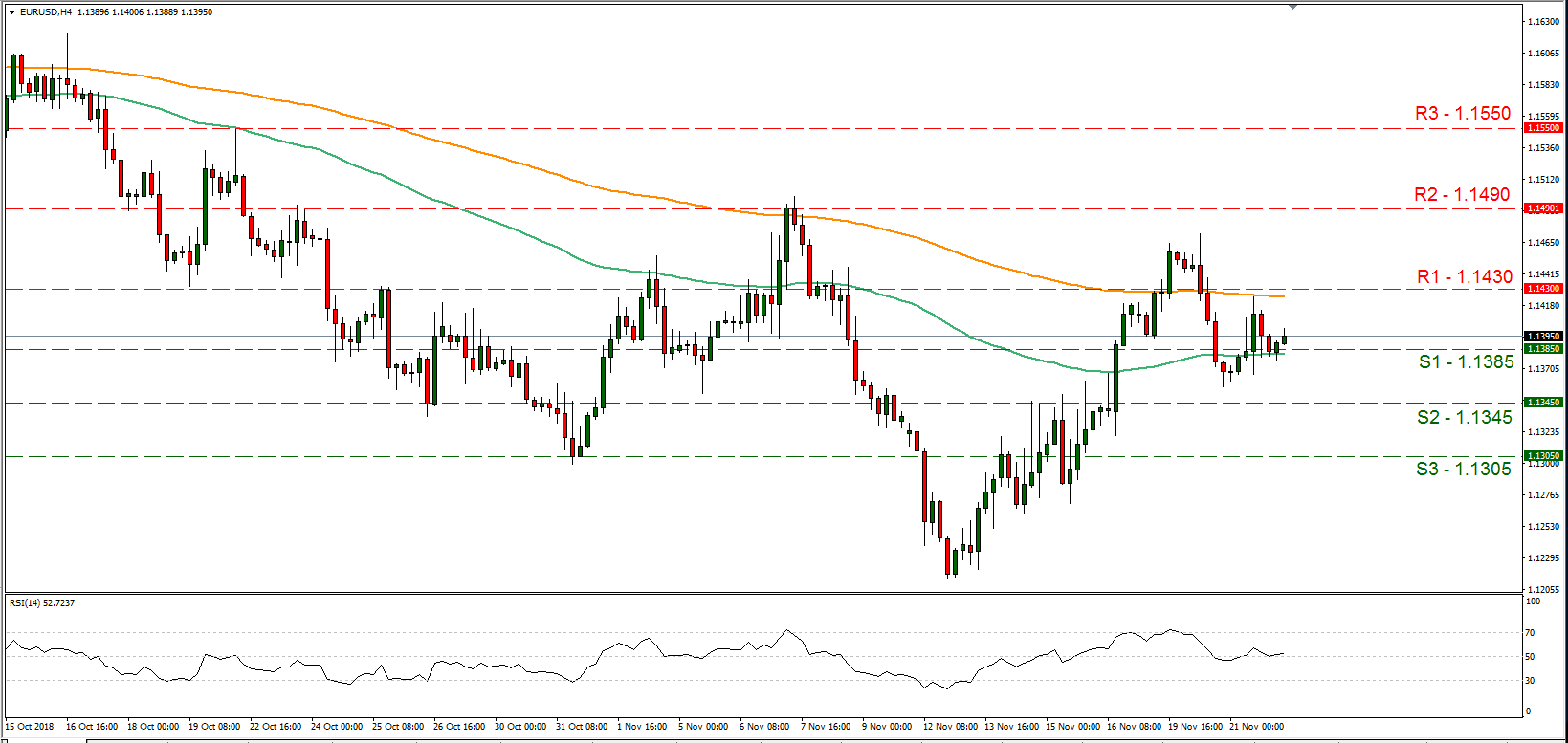
Support: 1.1385 (S1), 1.1345 (S2), 1.1305 (S3)
Resistance: 1.1430 (R1), 1.1490 (R2), 1.1550 (R3)
GBP/USD H4
Support: 1.2780 (S1), 1.2700 (S2), 1.2600 (S3)
Resistance: 1.2850 (R1), 1.2920 (R2), 1.3015 (R3)
SPECIAL REPORT: Why More Trouble Is Ahead For Stocks?
European stocks represent more value but the volatility index is telling us some different story which could make the U.S. stocks more desirable
Today in the markets trading volume is expected to remain reticent, as the biggest market in the world U.S is celebrating Thanksgiving holiday. Yesterday Wall Street have closed mostly positive but NASDAQ is the only U.S. index which is positive to the year to date. Even then there is nothing to be excited about here, as the year to date gains for the NASDAQ index is merely 1%.
As for the other side of the Atlantic, European markets have experienced some reprieve yesterday and traders have decided that it is time to shake off the pessimism. But the year to date performance for the European markets is really awful and it will take some serious commitment by the bulls to push the markets out of their current misery. The DAX index is down nearly over 12% YTD, IBEX has dropped over -10% YTD, Euro Stoxx 50 has plunged over -9.99% YTD and the FTSE has lost nearly -8.29% of it’s value YTD.
There is no doubt that the European markets present a much stronger and better opportunity for investors from a value perspective. But of course, this comes at a cost. There are some serious issues over in Europe; investors are feeling uncomfortable with the European Central Bank winding down it’s quantitative easing program, Italy is not complying with the European Union’s budget requirement and the current tussle is of serious nature. This is due to the face that the Italian government is of strong populist nature. On top of this, we also have the divorce process ongoing between the E.U. and the United Kingdom with no solution in sight
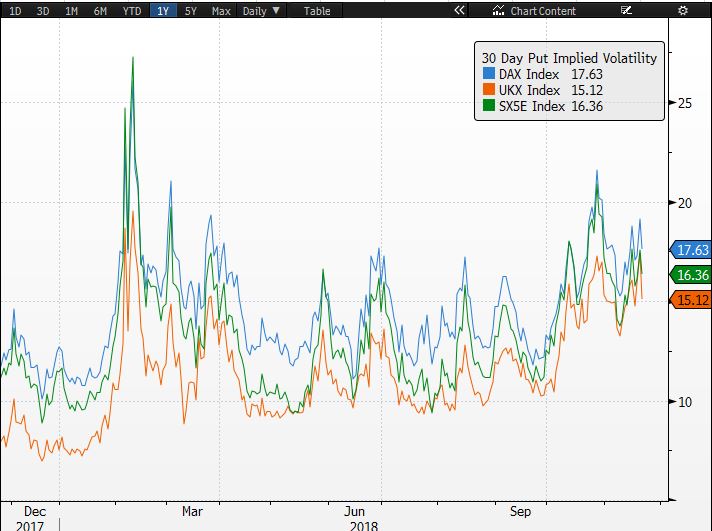
Under these circumstances, volatility is the word that comes to mind and by looking at the market performance for the Q3 one can really see serious spikes in various indices. The 30-day put implied volatility for DAX, the FTSE and Stoxx 50 have one theme in common; all of them are rising since September. This increase in volatility suggests that that the stock market over in Europe may continue it’s over downtrend till the end of this year and this can spill into the Q1 of next year. There is no light at the end of this tunnel yet.
Given the recent sell-off in FANG stocks due to some grave concerns about their future growth, the NASDAQ index’s 30-day volatility has blown out of it’s proportion by touching a level which we have not witnessed since 2011. By comparing apples with apples, 30-day volatility of S&P500, NASDAQ and Dow Jones chart with that of the earlier chart, the key take away is that the US stocks may look stable now but given the recent mammoth spikes in the volatility of three major US indices, the odds are high that we may see some serious sell off for the US stocks in the coming days. This may just remove that attractive element of valued stocks which we discussed earlier because the U.S stocks may become more cheaper. 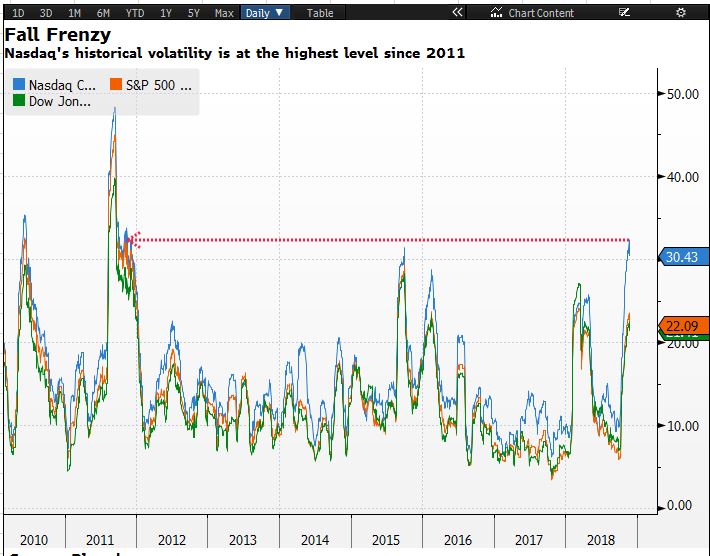
The SPX volatility index itself is up by 88% so far this year and 143% above from it’s 52-week low of 8.56. The Euro Stoxx 50 volatility index is up only 35% so far this year and 75% up from its 52-week low of 10.4. Comparing the two volatility indices explains that the volatility for the European and the U.S. stocks is increasing and in the coming days we could see some more sell-off. 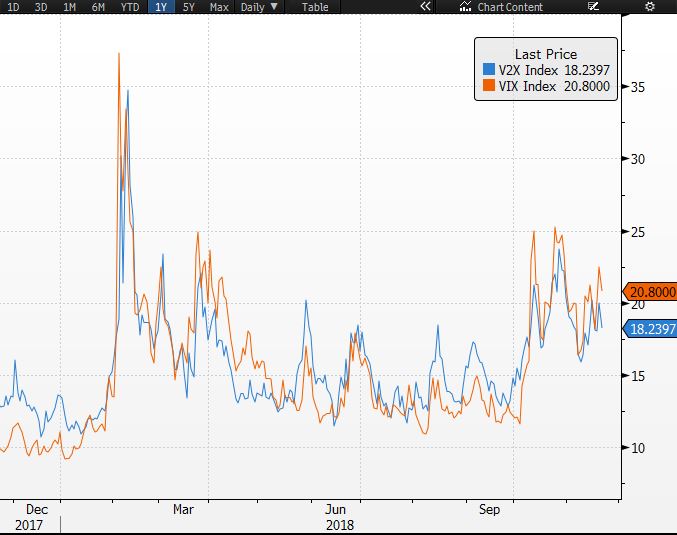
INDICES: S&P 500 Index Could See Some Bullish Move
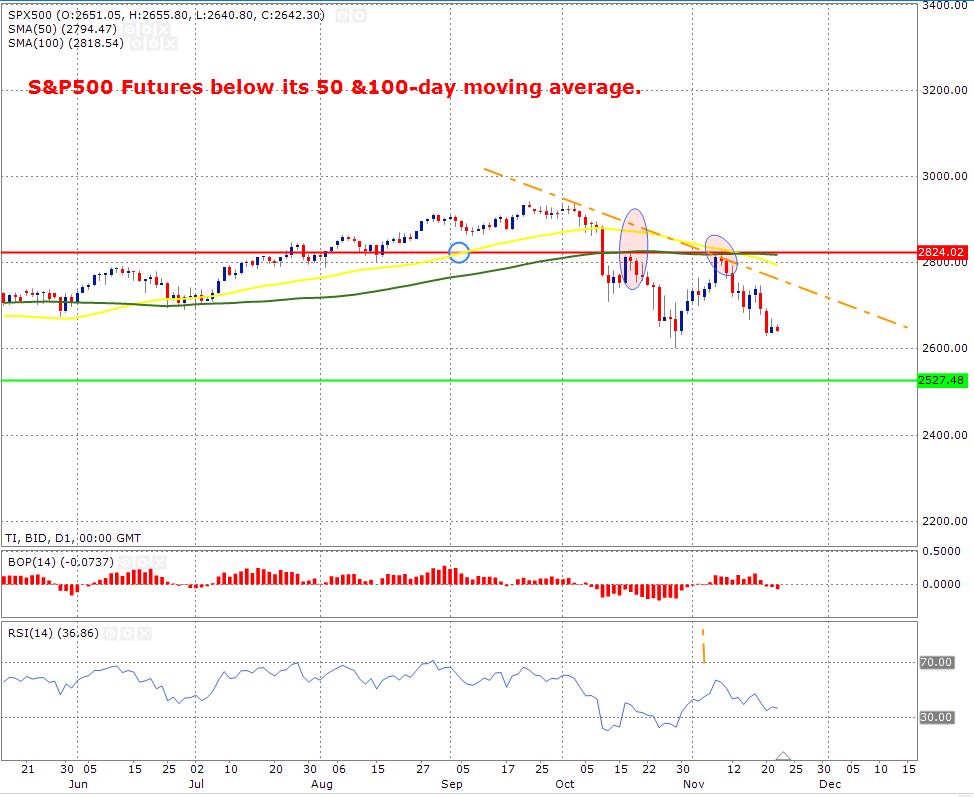
The S&P500 index is under the influence of the bearish selling pressure but this could change.
The S&P500 index is trading firmly below the downward trend line (shown n orange) on a daily time frame. The price formed a double top (shown by the two circles), this is a strong sell pattern. Statistically speaking, 90% of the time, the price moves lower after forming this pattern and this is what we have experienced in this case.
The balance of power shows that the bears have taken control of the price because the indicator is trading below the zero mark. The indicator further confirms that the momentum has shifted from the bulls to the bears. The RSI index is also confirming the same sentiment.
The 50-day moving average (shown in yellow) is trading below the 100-day moving average (shown in green), this provides another confirmation that the trend is skewed to the downside and the bulls need to break above the 50-day moving average to change the sentiment.
The support is shown by the green horizontal line.
The resistance is shown by the red horizontal line.
EURUSD Outlook: Fresh Upside Attempts Struggle At 30SMA On Holiday-Thinned Market
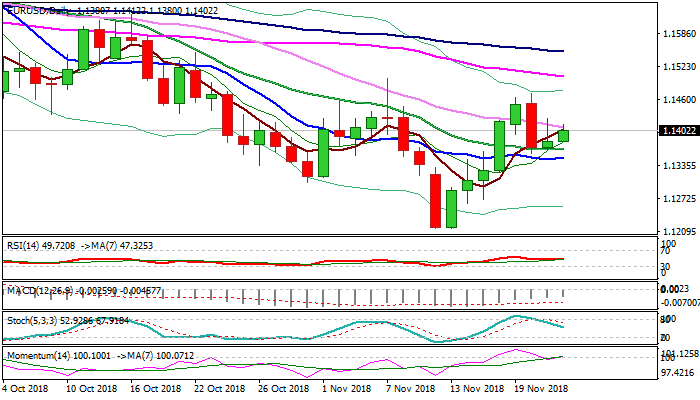
The Euro stands at the front foot in early Thursday's trading and probes again above falling 30SMA (1.1407) after Wednesday's recovery attempt stalled just above it and subsequent pullback signaled strong upside rejection on daily candle with long upper shadow. The dollar is lower on rebound of US stocks that reduces safe-haven demand and offers support to Euro. Sustained break above 30SMA is needed to continue recovery from 1.1360 zone, where recent weakness found footstep. Daily techs are mixed and lack firmer direction signals for now, while studies on lower timeframes are neutral/negative, signaling that recovery attempts may run out of steam again. Lower volumes are expected today as the US is shut for Thanksgiving holiday, with key event of the European session being minutes of the latest ECB policy meeting. Although markets do not expected anything substantially new from the ECB, the central bank may point on solid growth and inflation, which could shake holiday-thinned market. Focus turns towards Friday's releases of German GDP and EU PMI data, which could bring the single currency under fresh pressure as German GDP data signal contraction, while EU Services and composite PMI's are forecasted lower. Bears look for initial signal on break below 20SMA (1.1367), with close below 10SMA (1.1349) to confirm and open way for further weakness. Conversely, sustained break above 30SMA would sideline downside risk and shift near-term focus up.
Res: 1.1407, 1.1424, 1.1444, 1.1472
Sup: 1.1380, 1.1367, 1.1349, 1.1313
USD Index Can See More Weakness, Below 96.00
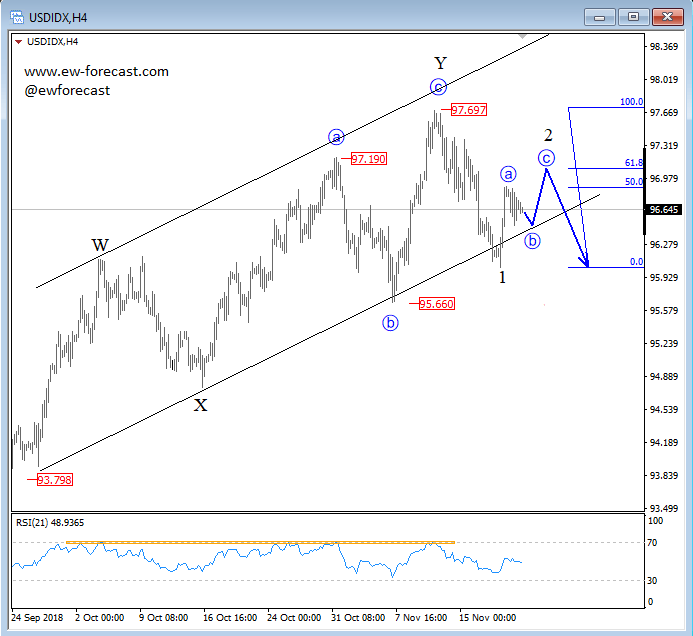
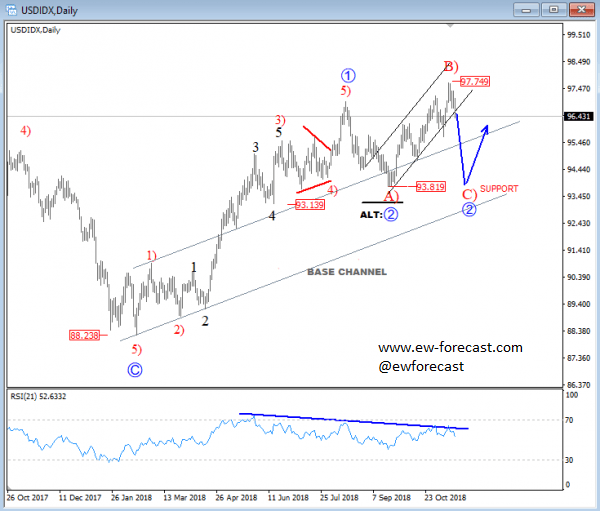
USD Index is recovering for the last 48 hours, but nothing significant yet. We see a bearish price action that can cause a lot more damage ahead, especially if current bounce proves to be corrective. The idea is that USD Index is headed south for a big wave C drop as shown on a daily chart(look below). However, it would be nice to see a daily close below 96.00 to confirm a turn.
USD Index, 4h
USD Index, Daily
Dollar Retreats A Bit As Risk Aversion Takes A Breather, ECB Minutes Due
Here are the latest developments in global markets:
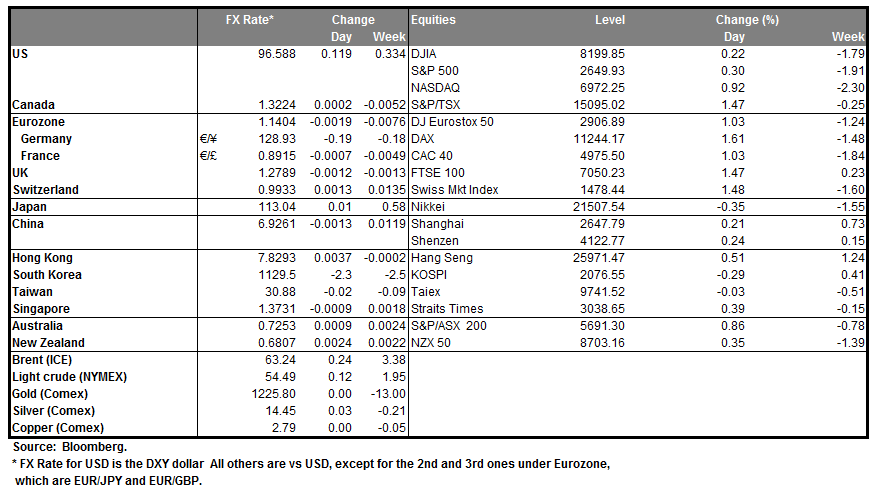
FOREX: The dollar index is a little lower on Thursday (-0.12%), extending losses from yesterday that were owed to disappointing US durable goods data and reports the Fed will debate whether to pause its hiking cycle early next year. The euro clawed back some of its recent losses, aided by optimism that the EU-Italy standoff may be resolved diplomatically.
STOCKS: Wall Street closed mostly higher on Wednesday for the first time this week, amid renewed optimism that a Sino-American “trade truce” may be on the cards. The tech-heavy Nasdaq Composite (+0.92%) outperformed the benchmark S&P 500 (+0.30%), while the Dow Jones was flat. US markets will remain closed for the Thanksgiving holiday today. Asia was mostly higher on Thursday, with indices in Japan and Hong Kong advancing, but those in China and South Korea ticking lower. In Europe, futures tracking all the major benchmarks were pointing to a lower open today.
COMMODITIES: Oil rebounded yesterday, recovering a small part of its recent losses, aided by stronger risk sentiment and a pullback in the dollar. The bounce came despite the EIA reporting another bigger-than-expected inventory build in its weekly report. Crude is on the back foot again today, with WTI trading at $54.30 per barrel and Brent near $63.00/barrel. In precious metals, gold is 0.17% higher today at $1,227 per ounce. The yellow metal continues to trade as a mirror image of the US dollar, showing little interest in other factors. Technically, a break above the downtrend line drawn from the peaks of May – which is being tested at the moment – and the $1,237 area, would turn the picture to firmly positive.
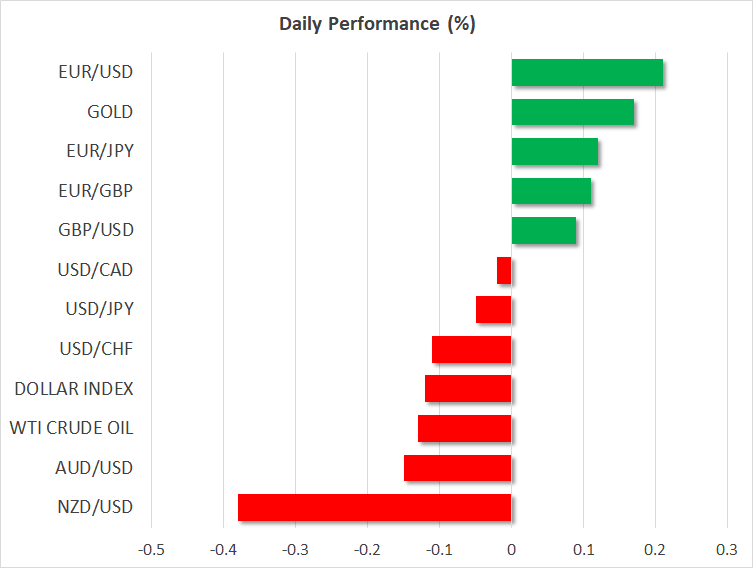
Major movers: Risk aversion takes a breather; dollar ticks lower
Global risk appetite recovered on Wednesday, with European and US equity markets advancing alongside commodity-linked currencies such as the aussie and loonie, while haven assets such as the Japanese yen surrendered ground. The key catalysts behind these moves were signs that Italy is ready to “blink” in its budget standoff with the EU, coupled with reports enhancing the narrative that a Sino-American “trade ceasefire” is looming.
In Italy, Finance Minister Tria hinted that his government would seek a shared solution with the European Commission over the highly-controversial budget, noting that the dispute is hurting the Italian – and by extent the European – economy. Investors evidently interpreted his comments as a signal that despite the broadly confrontational rhetoric, Rome is keen to avoid a prolonged and damaging showdown, sending Italian bond yields lower and the euro higher.
On the trade front, reports suggest White House advisor Peter Navarro has been excluded from attending the upcoming Trump-Xi Jinping meeting. Global stocks breathed a sigh of relief, as Navarro is probably the most hawkish US administration member towards China. Thus, his exclusion was seen as a sign Trump is indeed aiming to strike a deal. While a “ceasefire” next week now looks increasingly likely, and could provide some short-term relief to markets, it’s unlikely to spell the end of the broader dispute, as neither side appears willing to budge on the big issues just yet.
In the US, the dollar was pinned down by a story the Fed will consider pausing its hiking cycle early next year, citing “senior Fed officials”. Adding credence to such speculation, US durable goods disappointed, pointing to weak business investment in Q4. This is an ominous sign, as the latest collapse in oil prices argues for even weaker capital spending by energy firms going forward. That said, Fed rate-hike pricing is already quite cautious, implying that investors may want to see concrete evidence the US economy is slowing before repricing it in an even more dovish direction.

Day ahead: ECB minutes coming up; Brexit, Italian budget, Sino-US trade relations continue to generate attention
Thursday’s a light calendar day, with US markets being closed for the Thanksgiving holiday, something which is translating into thin trading volumes. That said, the ECB minutes pertaining to the Bank’s latest meeting will be attracting interest, with the themes of Brexit, the EU-Italy budget standoff and the Sino-US trade dispute remaining at play.
The official record of the ECB’s October meeting will be made public at 1230 GMT. Market participants will be looking for any signals the Bank’s policymakers are getting less confident about their rate normalization plans in light of not-so-encouraging economic releases out of the euro area.
The previous guidance signaled a move towards the latter part of 2019. At the moment, markets have marginally moved away from completely pricing in a 10bps rate increase in late 2019 and it will be interesting to see if ECB members’ views lend credence to that. If that’s the case, then the euro is expected to depreciate, to state the obvious.
On the data-front, eurozone flash consumer confidence data for November due at 1400 GMT are anticipated to show the relevant index falling to its lowest since May 2017. For comparison, US consumer confidence as gauged by the Conference Board rose to a fresh 18-year high in October.
Also euro-related are developments having to do with Italy’s budget. The European Commission yesterday identified the country as being in serious non-compliance with the budget rules. Market participants’ anxiety was eased to an extent though, as Italian PM Conte expressed concerns about rising Italian government bond yields and committed to reforms. However, investors may be complacent to an extent on this front, as the prospect of an EU-Italy clash is well on the table.
Sterling is again expected to remain sensitive to any Brexit headlines. PM May made reference to progress after her meeting with the EU’s Juncker yesterday, though a few sticking points remain at play. May will be given some time on Sunday to address the EU heads of state at the extraordinary Brexit summit taking place.
In terms of policymakers’ appearances, the Bank of Canada’s Wilkins (1445 GMT), the Bank of England’s Haldane (1600 GMT) and Saunders (2055 GMT), and the ECB’s Mersch (1700 GMT) are on the agenda.
Technical Analysis: EURJPY looks neutral in the short term
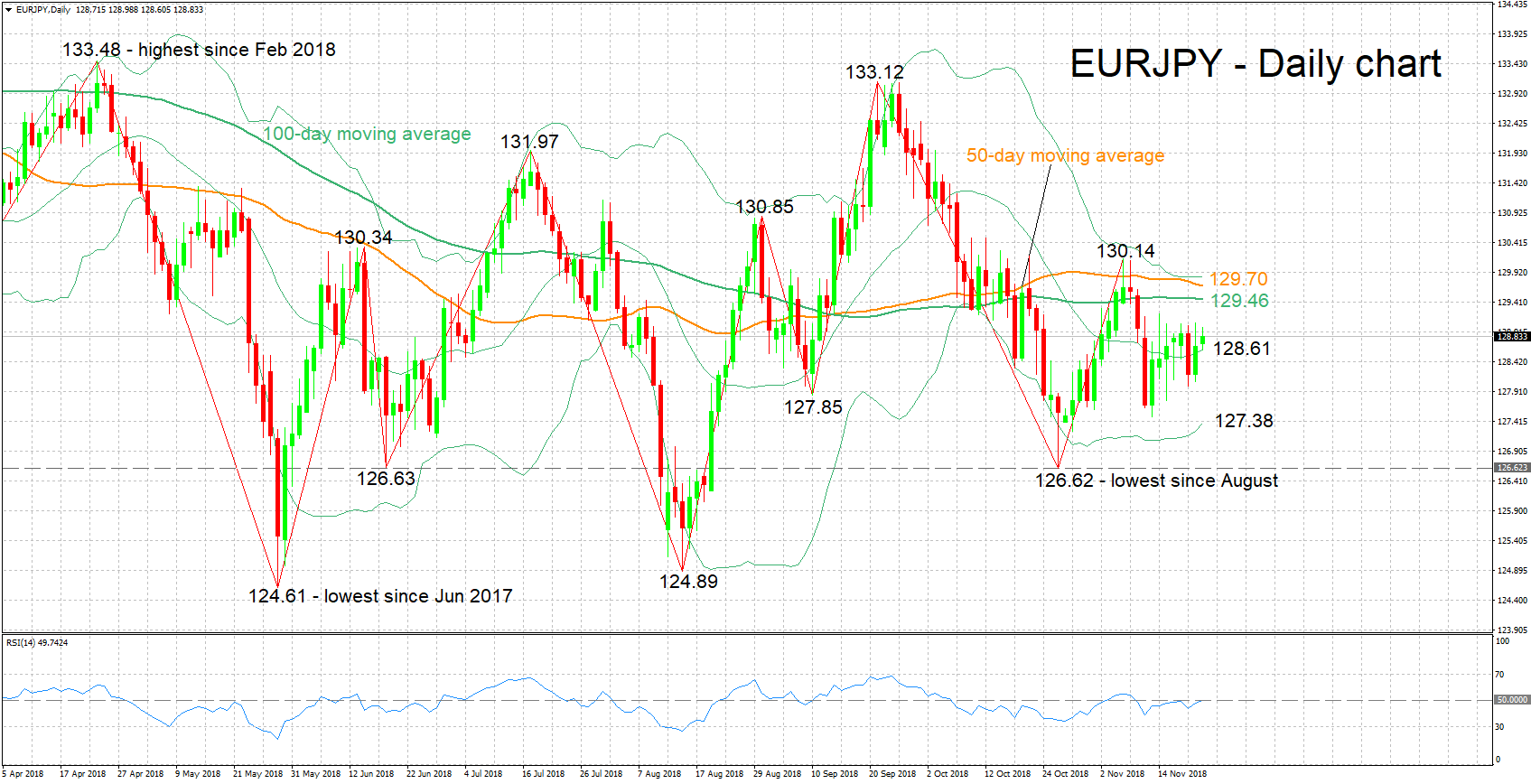
EURJPY has been moving within a relatively narrow range lately. The RSI, which has been hovering around the 50 neutral-perceived level throughout this period, is projecting a mostly neutral short-term picture for the pair.
Should today’s minutes show a relatively dovish ECB, then the pair is expected to depreciate. A violation of the middle Bollinger line – a 20-day moving average line – at 128.61 would turn the attention to the area around a previous bottom at 127.85 for additional support – not far below this point lies the lower Bollinger band at 127.38. Lower still, 126.62, the pair’s lowest since August would be eyed.
On the upside and in case of an upbeat ECB, resistance could come around the current levels of the 50- and 100-day moving average lines at 129.46 and 129.70 respectively, with the upper Bollinger band (129.83) also being part of the region around them. Not far above is a previous top at 130.14, with the zone around in including the 130 mark and another high from previous months as 130.34. Even higher, the area around the 131 handle would increasingly come into scope.
EU-Italian relations and risk-off flows can also move the pair.