Sample Category Title
US: Inflation Edges Higher in October, Mostly on Higher Energy Prices
Consumer prices rose 0.3% (month-on-month) in October, on par with expectations. Core CPI (excluding food and energy) prices were up a softer 0.2%, also on top of the median consensus estimate.
Inflation accelerated to 2.5% (year-on-year), up from 2.3% in September. Core CPI (excluding food and energy), meanwhile, edged down to 2.1% from 2.2%.
Core goods prices rose 0.3% on the month, reversing a 0.3% decline the month prior, while core services rose a soft 0.2%,slowing slightly from the previous two months.
Key Implications
Given the fall in oil prices in recent weeks, the rise in energy prices in October is likely to be reversed in November, taking some steam out of headline inflation.
The signal from core prices was mixed in October. While core goods prices picked up speed, this was offset by a slower rate of services growth.
Inflation is likely to move higher in the year ahead. Tariffs are not yet making an obvious mark on inflation, but with more likely in train, it is only a matter of time before they come through in higher consumer prices.
US Inflation as Expected in October
Highlights:
- All items CPI rose 0.3% in October, lifting the year-over-year rate to 2.5%. That remains below the 2.9% peak seen in June and July when energy prices were providing even more upward pressure.
- Gasoline prices were up 3% on a month-over-month, seasonally adjusted basis. If the first half of this month is any indication, that move will be reversed in November.
- Ex food and energy inflation rose 0.2% following back-to-back gains of just 0.1%.
- Core goods prices were essentially flat relative to a year ago, while non-energy services prices continued to grow near a 3% year-over-year rate.
Our Take:
There were no surprises in this morning’s October inflation report. Headline CPI ticked up to 2.5% year-over-year from 2.3% in the previous month. As expected, higher energy prices were the culprit. That move should be reversed in November with gasoline prices having fallen over the last month and oil prices continuing to trend lower, including an eye-watering loss yesterday. Core inflation saw a trend-like 0.2% month-over-month increase in October but the year-over-year rate edged down to 2.1%. That rate has been above 2% for six months now in one of the most sustained periods of near-target inflation this cycle. With the economy operating at or beyond its longer run capacity limits, it isn’t surprising that core inflation seems to have found a floor around the Fed’s objective. But at the same time there is little evidence that inflation is breaking out to the upside. And we’ve seen little impact of higher tariffs on consumer prices thus far—a US dollar that is 6% higher than a year ago is likely providing some relief on that front. Well-behaved inflation allows the Fed to continue raising rates gradually. But looking at a broader set of indicators, starting with 3.8% GDP growth over the last two quarters, it is clear that monetary policy accommodation is no longer needed. We expect a rate hike in December—the fourth this year—and a continuation of once-a-quarter moves in 2019.
Unsure if the Sell-off in Oil is Over
The dramatic selling across the Oil markets in recent days has come to a brief pause at time of writing on Wednesday, but many remain stunned by the acceleration in aggressive momentum that has transpired over the past couple of sessions.
We have not seen such a disastrous day for the Oil markets in terms of negative momentum like the one on Tuesday in around three years. But I think what we need to accept moving forward is that traders are waking up to the significant threat that slowing global growth in 2019 will weaken demand for commodities like Oil. It is fears over lower demand for Oil that acted as the catalyst for the severe selling that took place yesterday.
It is very much possible that the Oil markets have not yet found a floor in selling despite both Brent Crude and WTI declining significantly beyond 20% after their four-year highs just a few weeks back. This is because demand for Oil is a very speculative issue that is subject to revisions at any given point, but there is an agreed consensus that demand for Oil will be less than the supply available next year.
What this means in broader terms is that the oversupply and demand equation that completely dominated the atmosphere for Oil volatility all the way from the second half of 2014 until as recently as late 2017 is expected to become a major player once again next year.
This supply and demand equation also goes significantly beyond the newsflow around temporary waivers for Iranian Oil or even far out of the reach of President Trump making remarks over OPEC through Twitter, because the demand element is very much focused on global economic sentiment.
The global economic sentiment on the other hand continues to be dominated by a number of different external uncertainties, such as prolonged weakness in emerging markets due to Dollar strength and trade tensions between the United States and China.
These are just two of the several issues that have encouraged institutions like the IMF to downgrade global growth forecasts for next year, but when we see news come out like the headline this morning that the German economy has contracted for the first time since 2015 then we need to assess the multiple headwinds that the global economy is expected to encounter over the upcoming period.
This will naturally prompt concerns over less demand for Oil, which will weigh on its price and why it is probably better for the global economy that the price of Oil remains low on a historical level rather than return to four-year highs.
GBP/USD Mid-Day Outlook
Daily Pivots: (S1) 1.2857; (P) 1.2952; (R1) 1.3063; More...
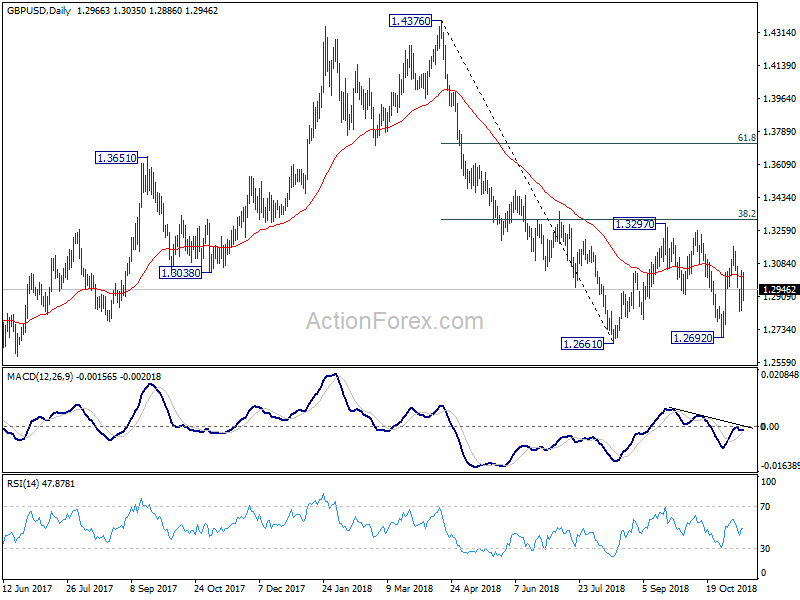
Intraday bias in GBP/USD remains neutral at this point. Overall outlook is unchanged that price actions from 1.2661 are viewed as a consolidation pattern. In case of stronger rise, strong resistance should be seen at 1.3316 fibonacci level to limit upside to bring down trend resumption eventually. On the downside, below 1.2825 will resume the fall from 1.3174 to 1.2661/92 key support zone. Decisive break there will resume larger down trend from 1.4376.
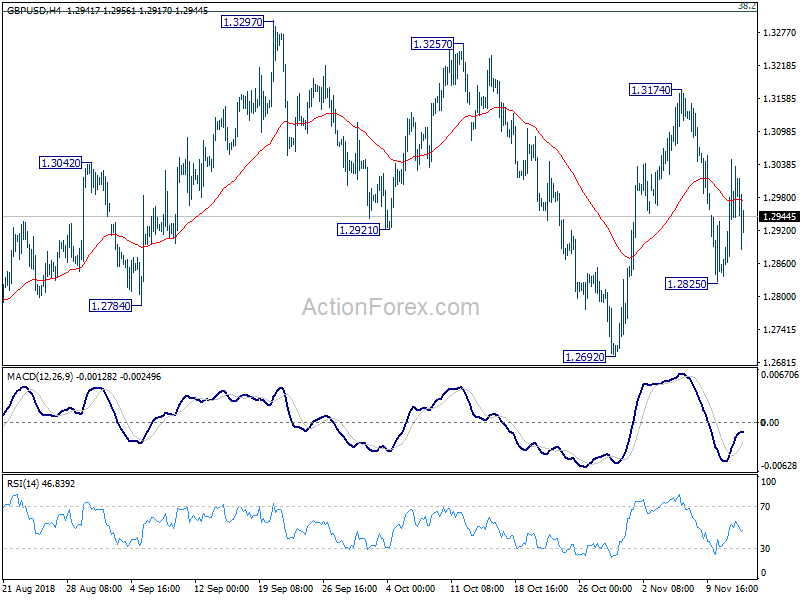
In the bigger picture, whole medium term rebound from 1.1946 (2016 low) should have completed at 1.4376 already, after rejection from 55 month EMA. The structure and momentum of the fall from 1.4376 argues that it's resuming long term down trend. And this will be the preferred case as long as 38.2% retracement of 1.4376 to 1.2661 at 1.3316 holds. However, firm break of 1.3316 would bring stronger rebound to 61.8% retracement at 1.3721. And, the eventual depth of the fall from 1.4376, and the chance of hitting 1.1946 low, will depend on the strength of the interim corrective rebound from 1.2661.
Sterling Turned Cautious as Markets Await May’s Brexit Cabinet Meeting
Sterling turned cautious as markets are now awaiting the result of UK Prime Minister Theresa May's Cabinet meeting on Brexit. The withdrawal agreement text should have been agreed with the EU. Approval by the Cabinet will give the green-light to EU chief negotiator Michel Barnier to declare that "decisive progress" is made for a November EU summit. May would tell the House of Commons the results after the meeting. Meanwhile, Barnier will also make a statement. It could be rather volatile for the Sterling in the upcoming hours.
Though for now, the Pound is trading as the second weakest one, next to Swiss Franc. Yen is the third weakest, partly due to weak GDP data, and partly due to persistent fall in JGB yield. New Zealand Dollar is the strongest one for now, followed by Canadian Dollar. Some support is seen as WTI crude oil dipped to as low as 54.85 but recovers to 56.70 for now. But that support for the Loonie could be brief. Euro is indeed the third strongest at this point, despite weak Germany data and Italy budget jitters. Dollar reacts little to CPI release but will turn focus to Fed Chair Jerome Powell's comments in the upcoming Asian session.
Technically, the forex markets are clearly in consolidation mode. For the Pound, break of 1.3741 resistance in GBP/USD and 149.70 in GBP/JPY are at least needed to prove its strength. Otherwise, we won't believe the move. While Dollar trades lower since yesterday, there is limited selling. We'd look for Dollar buyers to come back, probably after UK May settles her Cabinet.
In other markets, major European indices are trading higher at this point. FTSE is up 0.56%, DAX is up 0.61% and CAC is up 0.45%. German 10 year yield drops -0.0053 to 0.408. Italy 10 year yield rises 0.398 to 3.487. That is, German-Italian spread remains above 300. Earlier in Asia, Nikkei closed up 0.16%. But Hong Kong HSI, China Shanghai SSE and Singapore Strait Times all closed down, by -0.54%, -0.85% and -0.34% respectively. Japan 10 year JGB yield drops -0.0077 to 0.108, below 0.11 now.
US CPI rose to 2.5%, but core CPI slowed to 2.1%
US headline CPI accelerated to 2.5% yoy in October, up from 2.3% yoy and matched expectations. However, core CPI slowed to 2.1% yoy, down from 2.2% yoy and missed expectation of 2.2% yoy.
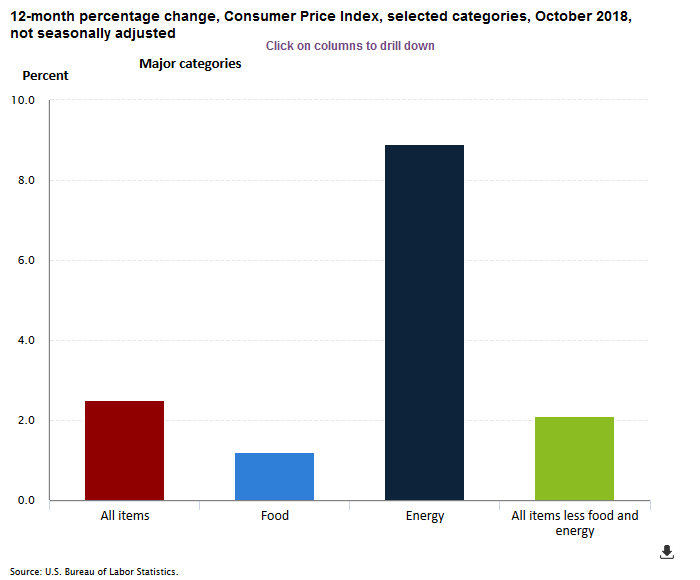
BLS noted that gasoline was responsible for "over one-third" of the headline advances. On the other hand, food index "decline slightly". For core CPI, ex-food and energy, medical care, household furnishing, motor insurance, tobacco all increased. But communications, new vehicles and recreation all declined.
UK CPI unchanged at 2.4%, core at 1.9%, Pound unmoved
UK Headline CPI was unchanged at 2.4% yoy in October, below expectation of 2.5% yoy. Core CPI was also unchanged at 1.9% yoy, below expectation of 2.0% yoy. RPI, too, was unchanged at 3.3% yoy, below expectation of 3.4% yoy.
ONS noted that the "large downward contributions to the change in the 12-month rate from food and non-alcoholic beverages, clothing and footwear, and some transport elements". They were offset by "contributions from rising petrol, diesel and domestic gas prices."
PPI input slowed to 10.0% yoy, down from 10.5% yoy, below expectation of 9.6% yoy. PPI output rose to 3.3% yoy, up from 3.1% yoy and beat expectation of 3.1% yoy. PPI output core was unchanged at 2.4% yoy, matched expectation.
Also from UK, house price index rose 3.5% yoy in September, accelerated from 3.1% yoy and beat expectation of 3.3% yoy.
German GDP contracted -0.2% qoq mainly due to foreign trade development
German GDP contracted -0.2% qoq in Q3, slightly better than expectation of -0.3% qoq. That's also the first quarter-on-quarter decline since Q1 2015. But that's a notable reversal from 0.5% qoq growth in Q2. The Federal Statistical Office noted that the slight decline in GDP was "mainly due to the development of foreign trade" as exports were down while imports were up in the quarter. "As regards domestic demand, there were mixed signals".
Economy Ministry said in its monthly report that "the upturn was merely disrupted during the third quarter". And, "once these special effects have dissipated, the German economy's upturn will continue."
Eurozone GDP rose 0.2% qoq in Q3, unrevised from preliminary reading. Industrial production dropped -0.3% mom in September versus expectation of -0.4% mom.
Italy to cut debt to 129.2% of GDP in 2019 to address EU concern
According to the new draft budget plan (DBP) submitted by Italy to the European commission, growth forecasts are held unchanged at 1.5% in 2019, 1.6% in 2020 and 1.4% in 2021. These are widely seen as overly optimistic as European Commission forecasts only 1.2% growth in 2019. The IMF projects only 1.0% growth in Italy in the same year. The budget deficit target was also held at 2.4% of GDP in 2012. Among that, Italy planned to raise its structural deficit by 0.8% of GDP. This is clearly a violation of EU's demand to cut by -0.6%.
However, the new draft showed fall debt as Italy planned to use funds equal to 1% of GDP from privatization. This is seen as an act to address EU's major concern on ballooning debt. Public debt is now estimated to fall to 129.2% of GDP in 2019, then further to 127.3% in 2020, and then 126.0% in 2021. Italy's debt stands at 130.9% this year.
The new DBP now risk triggering the Commission's penalty process. But Italian Deputy Prime Minister Matteo Salvini warned that "they've got it wrong if they are even just thinking of imposing fines on the Italian people." Economy Minister Giovanni Tria also insisted that fiscal expansion is necessary for the country.
ECB Knot: It's pertinent that Italy complies with EU budget rules
ECB Governing Council member Klaas Knot said today that "it's quite pertinent that Italy actually complies with the rules" of EU on budget. Or, he warned that "if it doesn't, the result is that spread will go up."
For now, Knot saw limited contagion from rising Italian yields. He added "we're not seeing an overall deterioration in credit conditions, we're not seeing an overall deterioration in financial conditions". And, "those would have to be the kind of things that we would first have to see before could contemplate changing our course of action."
Japan GDP contracted -0.3% qoq, exports contracted at fastest pace in over three years
Japan GDP contracted -0.3% qoq in Q3, matched expectation. Annualized rate showed -1.2% contraction, worse than expectation of -1.0%. GDP deflator dropped -0.3%, lowest than expectation of -0.2%. One detail to note is that exports contracted -1.8% qoq, fastest decline in over three years. It seems that the contraction in Q3 cannot be explained only by natural disasters. But the steep contraction in exports argued that US related trade tensions was also weighing on the economy of Japan. Though, it will take another quarter or two to really gauge the impact from protectionism.
Japan Economy Toshimitsu Motegi sounded confident and optimistic though. He said that "Japan's economy is expected to recover driven mainly by domestic demand. Though he also warned that "we need to be vigilant to the impact of overseas uncertainties, financial market volatility and how trade problems affect the global economy."
Also from Japan, tertiary industry index dropped -1.1% mom in September versus expectation of -0.4% mom. Industrial production dropped -0.4% mom versus expectation of -1.1% mom.
Latest set of data from China showed mixed picture
The latest set of macroeconomic data in China was mixed. Retail sales grew 8.6% yoy in October, weaker than consensus of, and September's 9.2%. Growth in industrial production and urban fixed asset investment improved. For the former, growth picked up to 5.9% yoy, from 5.8% in September. For the latter, growth accelerated to 5.7% in the first 10 months of the year, compared with 5.4% in the first 9 months.
China's economic policy has been torn between huge debt and slowing growth. The dilemma has been aggravated since Trump imposed the first trade tariff in July. The Chinese government has shifted its policy focus from deleveraging (credit tightening) to growth stimulation. We expect monetary and fiscal easing would be the key in China. With inflation eased, this should clear the hurdle for PBOC to loosen its monetary policy.
More in China's October Data Encourage More Easing From Government
GBP/USD Mid-Day Outlook
Daily Pivots: (S1) 1.2857; (P) 1.2952; (R1) 1.3063; More...
Intraday bias in GBP/USD remains neutral at this point. Overall outlook is unchanged that price actions from 1.2661 are viewed as a consolidation pattern. In case of stronger rise, strong resistance should be seen at 1.3316 fibonacci level to limit upside to bring down trend resumption eventually. On the downside, below 1.2825 will resume the fall from 1.3174 to 1.2661/92 key support zone. Decisive break there will resume larger down trend from 1.4376.
In the bigger picture, whole medium term rebound from 1.1946 (2016 low) should have completed at 1.4376 already, after rejection from 55 month EMA. The structure and momentum of the fall from 1.4376 argues that it's resuming long term down trend. And this will be the preferred case as long as 38.2% retracement of 1.4376 to 1.2661 at 1.3316 holds. However, firm break of 1.3316 would bring stronger rebound to 61.8% retracement at 1.3721. And, the eventual depth of the fall from 1.4376, and the chance of hitting 1.1946 low, will depend on the strength of the interim corrective rebound from 1.2661.
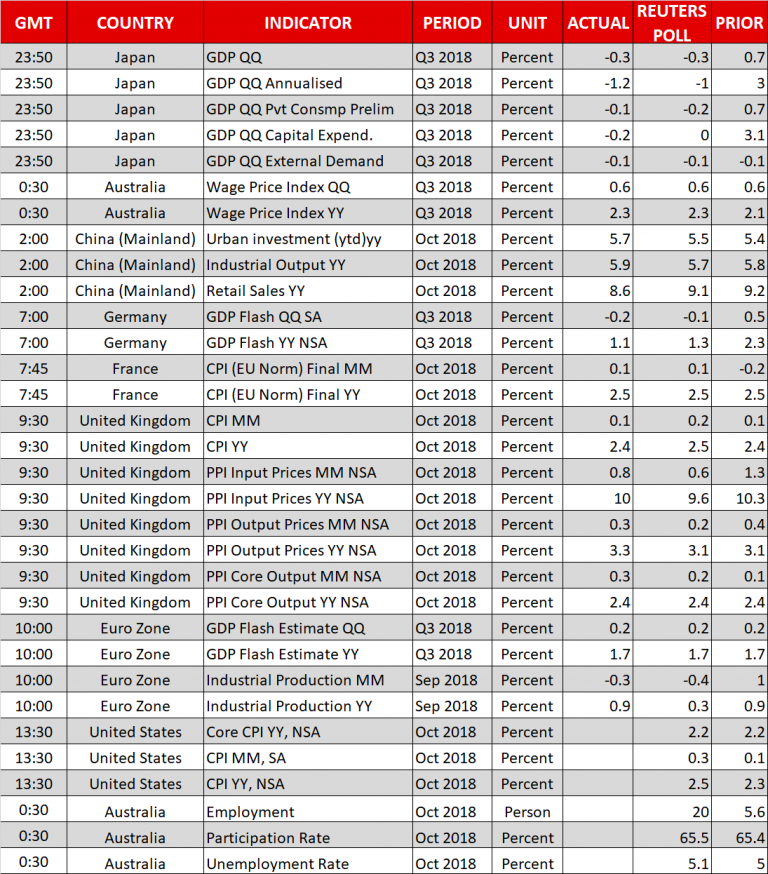
Economic Indicators Update
| GMT | Ccy | Events | Actual | Forecast | Previous | Revised |
|---|---|---|---|---|---|---|
| 23:30 | AUD | Westpac Consumer Confidence Nov | 2.80% | 1.00% | ||
| 23:50 | JPY | GDP Q/Q Q3 P | -0.30% | -0.30% | 0.70% | |
| 23:50 | JPY | GDP Deflator Y/Y Q3 P | -0.30% | -0.20% | 0.10% | 0.00% |
| 00:30 | AUD | Wage Price Index Q/Q Q3 | 0.60% | 0.60% | 0.60% | 0.50% |
| 02:00 | CNY | Retail Sales Y/Y Oct | 8.60% | 9.20% | 9.20% | |
| 02:00 | CNY | Industrial Production Y/Y Oct | 5.90% | 5.80% | 5.80% | |
| 02:00 | CNY | Fixed Assets Ex Rural YTD Y/Y Oct | 5.70% | 5.50% | 5.40% | |
| 04:30 | JPY | Tertiary Industry Index M/M Sep | -1.10% | -0.40% | 0.50% | 0.40% |
| 04:30 | JPY | Industrial Production M/M Sep F | -0.40% | -1.10% | -1.10% | |
| 07:00 | EUR | German GDP Q/Q Q3 P | -0.20% | -0.30% | 0.50% | |
| 09:30 | GBP | CPI M/M Oct | 0.10% | 0.20% | 0.10% | |
| 09:30 | GBP | CPI Y/Y Oct | 2.40% | 2.50% | 2.40% | |
| 09:30 | GBP | Core CPI Y/Y Oct | 1.90% | 2.00% | 1.90% | |
| 09:30 | GBP | RPI M/M Oct | 0.10% | 0.20% | 0.00% | |
| 09:30 | GBP | RPI Y/Y Oct | 3.30% | 3.40% | 3.30% | |
| 09:30 | GBP | PPI Input M/M Oct | 0.60% | 0.60% | 1.30% | 1.40% |
| 09:30 | GBP | PPI Input Y/Y Oct | 10.00% | 9.60% | 10.30% | 10.50% |
| 09:30 | GBP | PPI Output M/M Oct | 0.30% | 0.20% | 0.40% | |
| 09:30 | GBP | PPI Output Y/Y Oct | 3.30% | 3.10% | 3.10% | |
| 09:30 | GBP | PPI Output Core M/M Oct | 0.30% | 0.20% | 0.10% | |
| 09:30 | GBP | PPI Output Core Y/Y Oct | 2.40% | 2.40% | 2.40% | |
| 09:30 | GBP | House Price Index Y/Y Sep | 3.50% | 3.30% | 3.20% | 3.10% |
| 10:00 | EUR | Eurozone Industrial Production M/M Sep | -0.30% | -0.40% | 1.00% | 1.10% |
| 10:00 | EUR | Eurozone GDP Q/Q Q3 P | 0.20% | 0.20% | 0.20% | |
| 13:30 | USD | CPI M/M Oct | 0.30% | 0.20% | 0.10% | |
| 13:30 | USD | CPI Y/Y Oct | 2.50% | 2.50% | 2.30% | |
| 13:30 | USD | CPI Core M/M Oct | 0.20% | 0.20% | 0.10% | |
| 13:30 | USD | CPI Core Y/Y Oct | 2.10% | 2.20% | 2.20% |
AUDUSD Remains above SMAs in Narrow Range
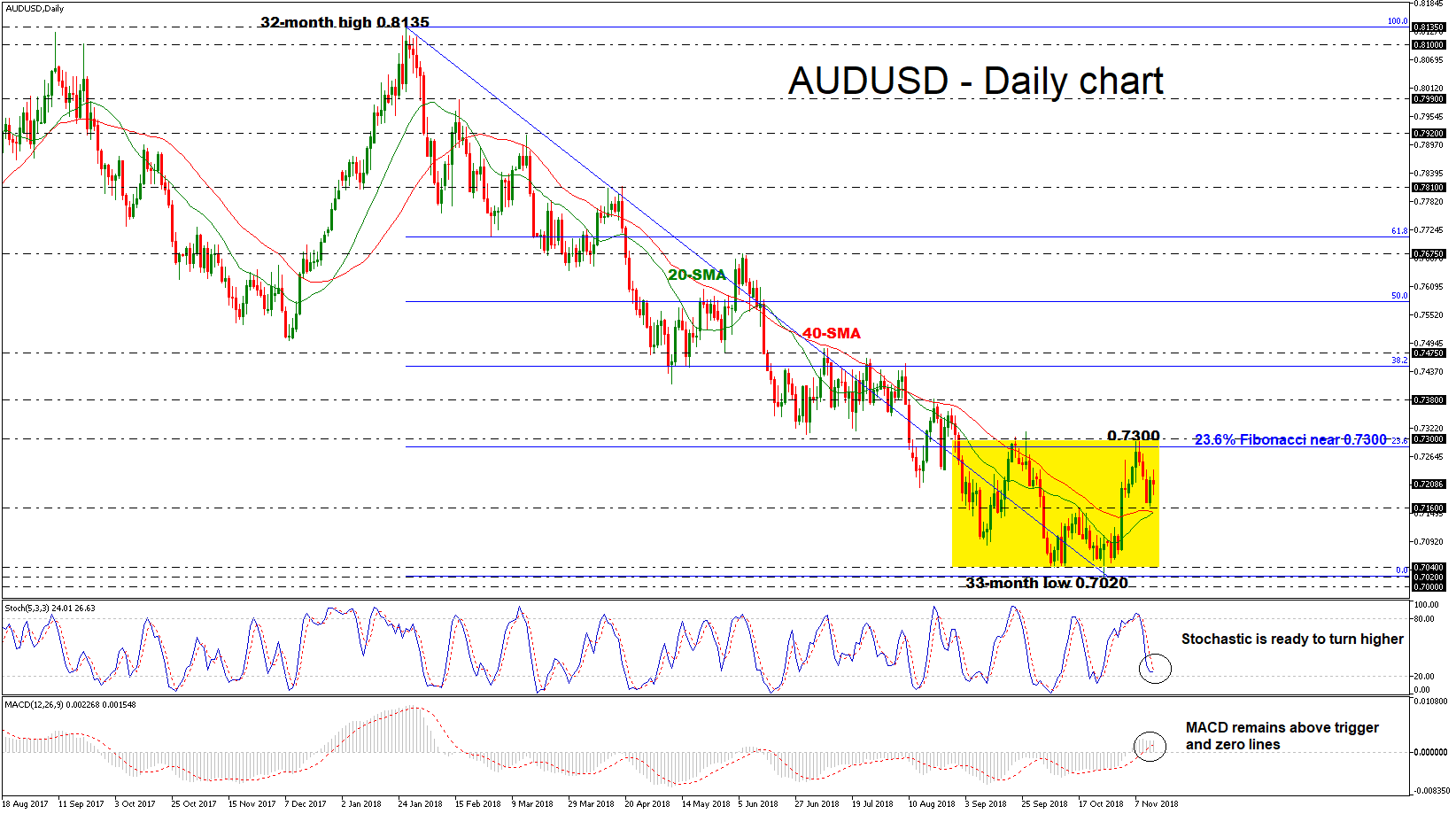
AUDUSD turned below the six-week high that posted in the preceding week and it currently stands above the 20- and 40-simple moving averages (SMAs), which are ready to post a bullish crossover. The stochastic oscillator is ready to tick higher near the oversold zone, while the MACD oscillator points marginally to the upside, above zero and trigger lines.
If the market manages to pick up speed, the 23.6% Fibonacci retracement level of the downleg from 0.8135 to 0.7020, around the 0.7300 handle could offer nearby resistance to the bulls. A significant close above this level could raise chances for further increases, shifting focus to the 0.7380 barrier, taken from the high on August 21.
Alternatively, should prices decline and slip below the 0.7160 support level, which stands near the moving averages, it could drive the pair towards the critical area within the 0.7000 psychological level and the 0.7040 mark, which encapsulates the 33-month low of 0.7020.
To summarize, AUDUSD has been developing within a narrow range with upper boundary the 0.7300 handle and lower boundary the 0.7040 support in the short-term. A decisive close outside of this region would create a new clearer direction.
Canadian Dollar Edges Higher, U.S. Consumer Inflation Beats Estimate
The Canadian dollar has edged higher in the Wednesday session. Currently, USD/CAD is trading at 1.3221, down 0.20% on the day. On the release front, there are no Canadian events for a third straight day. In the U.S, CPI improved to 0.3%, its strongest gain since January 2018. Core CPI improved to 0.2%, matching the forecast. On Thursday, Canada releases ADP nonfarm employment change. The U.S. will publish retail sales, the Philly Fed Manufacturing Index and unemployment claims.
With the U.S economy firing on all cylinders, the markets are expecting the Federal Reserve to continue raising rates. This sentiment was reinforced by Janet Yellen, former Fed chair. Yellen said on Tuesday that she expected the Fed to raise rates three or four times in 2019. This means that we can expect rate hikes once a quarter in 2019, barring a sharp downturn in the economy. The policy of gradual increases is good news for the U.S dollar, as higher interest rates means that the greenback is more attractive to investors. The Bank of Canada has taken a page out of the Federal Reserve’s book, saying that its policy of gradual rate hikes will continue into 2019. The BoC will have to continue raising rates if the Canadian dollar is to hold its own against the strong U.S. dollar.
US CPI rose to 2.5%, but core CPI slowed to 2.1%
US headline CPI accelerated to 2.5% yoy in October, up from 2.3% yoy and matched expectations. However, core CPI slowed to 2.1% yoy, down from 2.2% yoy and missed expectation of 2.2% yoy.
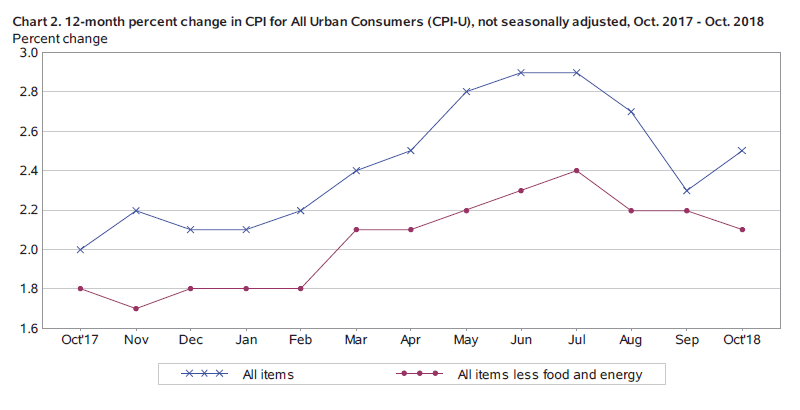
BLS noted that gasoline was responsible for "over one-third" of the headline advances. On the other hand, food index "decline slightly". For core CPI, ex-food and energy, medical care, household furnishing, motor insurance, tobacco all increased. But communications, new vehicles and recreation all declined.
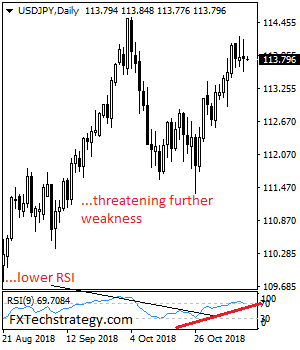
USDJPY Rejects Higher Prices On Loss Of Momentum
USDJPY rejects higher prices on loss of momentum leaving risk of a move lower. On the upside, resistance comes in at 114.50 level. Above here will turn focus to the 115.00 level. Further out, we expect a possible move towards the 115.50 level if the earlier level is taken out. On the downside, support comes in at the 113.50 level where a break will target the 113.00 level. A break through that level will turn focus to the 112.50 level and then lower towards the 112.00 level. On the whole, USDJPY faces further upside pressure medium term but with caution of a move lower.
Pound Awaits Cabinet Brexit Meeting; Powell’s Speech in Focus
Here are the latest developments in global markets:
- FOREX: Questions about whether the UK Parliament would ever accept the draft divorce deal approved by the UK and the EU on Tuesday derailed investors’ mindset early in the European session, and ahead of a Cabinet meeting later today. While forecasts are for the Cabinet to accept the agreement, investors think that the Parliament will vote against it, especially if the deal involves an extension of the transition period beyond 2020. Pound/dollar slid to 1.29 before inching up to 1.2941 (-0.22%), while pound/yen fell back to 147.40 (-0.14%). The euro also felt pressure from Brexit uncertainty, while Italy’s budget was another reason for investors to avoid buying the common currency after Rome refused to revise its draft budget targets opposed by the European Commission. The EU said it will respond on the Italian budget on November 21. Fears over US import tariffs on EU cars were running high as well, with the EU trade commissioner saying the EU will hit back with countermeasures if Washington proceeds with its tariffs. Earlier, flash data revealed that the German economy contracted surprisingly by 0.2% q/q in Q3, for the first time since Q2 2014. Euro/dollar pulled back by 0.12% to 1.1276, whereas euro/pound rose by 0.08%. Dollar/yen and the dollar index were flat at 97.35 and 113.85 respectively. In antipodean currencies, aussie/dollar and kiwi/dollar were mixed, with the former weaker by 0.14% and the latter stronger by 0.25%.
- STOCKS: European stocks were on the back foot on Wednesday at 1220 GMT as numerous factors, including the ongoing Italian budget standoff, tumbling oil prices, trade and an unexpected growth slowdown in Japan and Germany raised risk aversion in the markets. The pan-European STOXX 600 retreated by 0.42% to two-week lows, with all sectors being in the red. The blue-chip Euro STOXX 50 fell by 0.48%. The German DAX 30 declined by 0.33%, the French CAC 40 lost 0.43%, while the British FTSE 100 was steady. The Italian FTSE MIB was the worst performer, losing 0.89%. In Asia, equities closed mostly in the red, with Japanese stocks adding marginal gains to their performance. In the US, futures tracking the S&P 500, Dow Jones and Nasdaq 100 were in the red, flagging further losses to follow up later today.
- COMMODITIES: After a more than 7% free-fall in oil prices on Tuesday, discussions about a supply cut by OPEC and its allies seem to have resumed, with sources unveiling on Wednesday that the aforementioned oil producers may proceed with a 1.4 million bpd reduction in 2019. Despite raising output a few months ago, OPEC and its partners are now thinking to limit production to drain oversupply and avoid further price declines arising from a slowing global economy. On Tuesday the Paris-based EIA agency, which downgraded demand forecasts for non-OECD countries – key oil consumers – said that global oil supply will surpass demand throughout 2019. WTI crude was last seen slighly up at $55.79/barrel but close to one-year lows, while the London-based Brent was printing stronger gains at $65.95 (+0.73%) near 8-month lows. In precious metals, gold slipped by 0.20% to $1,200/ounce.
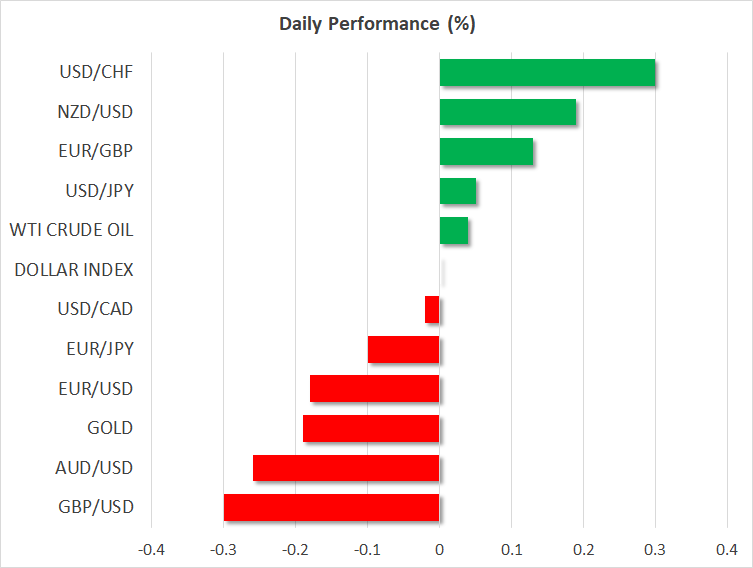
Day Ahead: US CPI figures and Australian employment report on the agenda; Brexit deal in center stage
In the remainder of the day traders will focus on the Brexit deal agreement, US consumer prices and the Australian employment report.
The US Bureau of Labor Statistics will publish figures on consumer prices for the month of October at 1330 GMT. The headline CPI is expected to stand at 2.5% y/y from 2.3% in the previous month. Excluding food and energy, the core index will likely remain unchanged at 2.2% y/y. Note that the Fed primarily compares its inflation target of 2.0% with the core PCE index instead and adjusts its monetary strategy accordingly, as this includes a wider range of consumer products. Yet any upside surprise in the CPI data may increase chances for steeper rate hikes by the Fed in 2019.
On the Brexit front, the UK PM Theresa May is scheduled to discuss with her Cabinet the details of the draft accord that reached on Tuesday with the EU at 1400 GMT. If the cabinet signs it off, the EU Commission is expected later to publish the details of the 500-page draft withdrawal agreement as well as the much shorter declaration on future economic and security relations. Sterling will likely see an improvement in case of a cabinet agreement on the draft text.
Meanwhile, in oil markets, investors will look forward to the API weekly report due at 2130GMT which tracks the level of the US crude, gasoline and distillates stocks as concerns over rising US output linger in the market.
Overnight, the Australian employment report is scheduled to be released at 0030 GMT. The unemployment rate is forecasted to tick up to 5.1% in October from 5.0% in the preceding month, which was the lowest jobless rate since April 2012. Moreover, the net change in employment is expected to show that the economy gained 20,300 jobs, more than September’s 5,600.
In terms of public appearances, Federal Reserve Vice Chair for Supervision Randal Quarles (permanent voter) will be giving a semiannual testimony at 1500 GMT. Later in the day and more importantly, Federal Reserve Chairman Jerome Powell will be discussing national and global economic issues with Dallas Fed President Robert Kaplan (non-voter) at 2300 GMT. Meanwhile, Bank of England deputy governor Dave Ramsden will be taking part in an online Q&A on the future of money.