

Sample Category Title
DAX Holds Steady Despite Dip in German Economy
The DAX index is almost unchanged in the Wednesday session, continuing the gains seen on Tuesday. Currently, the DAX is trading at 11,465, down 0.06% since the close on Tuesday. In economic news, German Preliminary GDP in the third quarter declined 0.2%, missing the estimate of -0.1%. Eurozone GDP dipped to 0.2%, matching the estimate. On Thursday, the eurozone releases trade balance.
European stock markets are under pressure on Wednesday, after Germany reported that the economy contracted in the third quarter for the first time since Q1 of 2015. However, the DAX has held its own, posting gains on Wednesday. Predictably, German officials tried to put a brave spin on the numbers. The Economy Ministry said that a 0.2% decline “isn’t a catastrophe” and that the economy would rebound in the fourth quarter. The ministry blamed the contraction on weakness in the auto sector due to new pollution standards. However, the well-respected ZEW research institute did not share this enthusiasm, saying on Tuesday that investors did not expect a rapid recovery from the current weakness. German ZEW Economic Sentiment posted a second straight soft release, with a reading of -24.1 points. This points to deep pessimism on the part of institutional investors and analysts.
The drama over the Italian budget continues on Wednesday, after Rome defiantly ignored a EU deadline on Tuesday to revise its budget. The government said it would stick to its deficit target of 2.4% and a growth forecast of 1.5%, which the EU argues breaches its fiscal rules. With the ball in the EU court, what happens next? The EU could respond with financial sanctions worth billions. The markets have already responded on Wednesday with a thumbs-down, as Italian bonds have climbed sharply and the Milan stock exchange is down one percent.
European Update: Sterling pares gain as Brexit optimism turns into cautiousness
Sterling reversed some of this week's gain as Brexit optimism has now turned into cautiousness. UK Prime Minister Theresa May will hold a Cabinet meeting shortly to secure support for her agreement with the EU. And she plan to issue Commons statement after that. EU's chief negotiator Michel Barnier also plans to make a statement today on the status, and hopefully, he would declare "decisive progress" for a November EU summit. The could be some more volatility in the pound in the upcoming hours.
For now, New Zealand Dollar remains the strongest one for today, followed by Canadian Dollar and then US Dollar. WTI crude oil dipped to as low as 54.84 but it's now back above 56. The recovery is giving Canadian a breath but that could be temporary. Meanwhile, Swiss Franc is trading as the weakest one, followed by Australian Dollar and then Sterling.
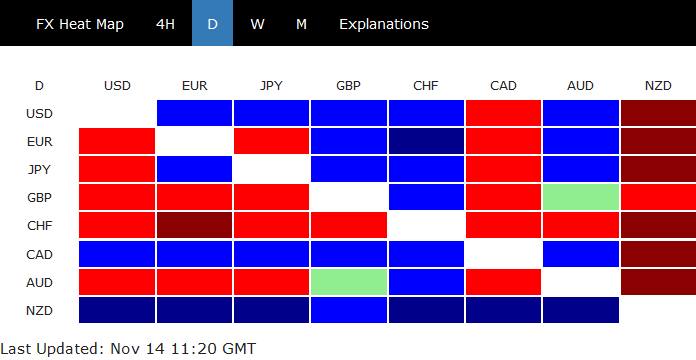
Economic data released today saw US CPI and core CPI stalled at 2.4% yoy and 1.9% yoy respectively. German GDP and Japan GDP contracted in Q3 and both were attributed to global trade tensions. US CPI will be the next focus.
In European markets, major indices are trading mildly softer today. At the time of writing:
- FTSE is down -0.02%
- DAX is down -0.34%
- CAC is down -0.42%
- German 10 year yield drops -0.018 to 0.396
- Italian 10 year yield is up 0.043 at 3.490. German-Italian spread is now at 310. That came after Italy refused to change its 2019 deficit target in the resubmitted plan to EU.
Earlier in Asia
- Nikkei closed up 0.16%
- But Hong Kong HSI dropped -0.54%
- China Shanghai SSE dropped -0.85%
- Singapore Strait Times dropped -0.34%
- Japan 10 year JGB yield dropped -0.0077 to 0.108. We haven't seen it below 0.11 for a while.
USDCHF Bullish, Trades Near 20-Month High
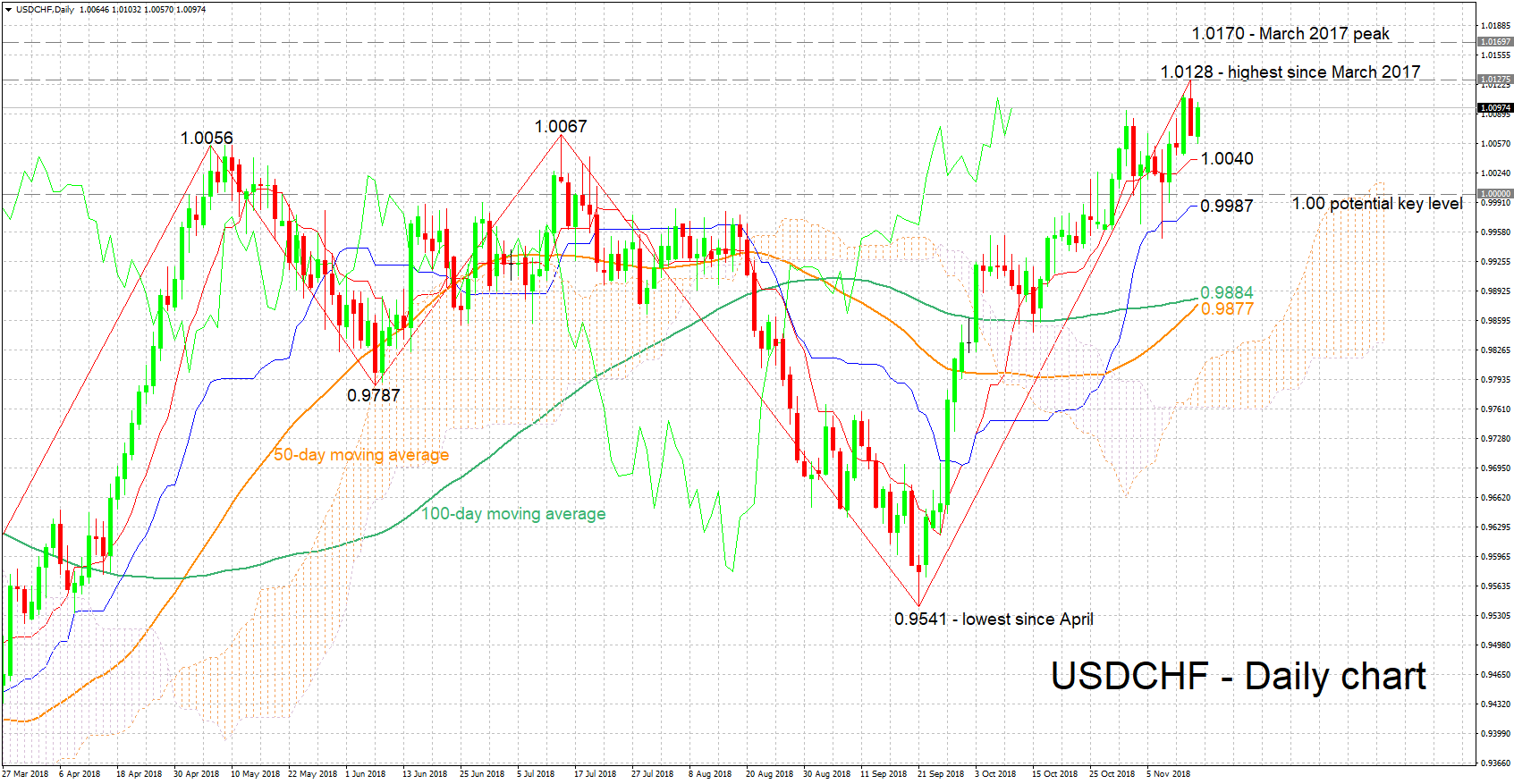
USDCHF is trading close to Tuesday’s high of 1.0128, the pair’s firmest since March 2017.
The short-term bias is clearly bullish, with the pair having recorded a remarkable rally from late September when it touched a multi-month low of 0.9541. Also attesting to the bullish momentum are the positively aligned Tenkan- and Kijun-sen lines. The Chikou Span though may be suggesting an overextended rally; a pullback in the near-term is not to be ruled out.
Further advances could meet resistance around yesterday’s high of 1.0128, with an upside violation bringing March 2017’s peak of 1.0170 within scope. Higher still, the 1.02 handle would be eyed.
On the downside, support could come around the current level of the Tenkan-sen at 1.0040; a couple of tops from previous months at 1.0056 and 1.0067 lie not far above this point. The zone around the parity level (1.00) and the Kijun-sen at 0.9987 would come into focus in case of steeper losses. Further below, the attention would turn to the region around 0.9925 which was congested between mid-April to late August.
The medium-term outlook is positive, with trading activity taking place above both the 50- and 100-day moving average lines, as well as above the Ichimoku cloud. Notice as well that the two MAs look highly likely to post a bullish cross in the coming sessions.
Overall, both the short- and medium-term pictures look positive at the moment.
AUDUSD Analysis: Pressure By SMAs
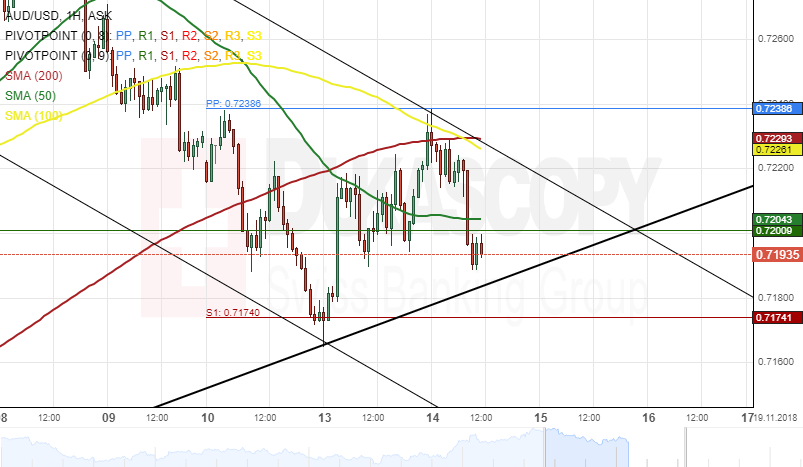
The Australian Dollar appreciated about 70 base points against the US Dollar on Tuesday. The currency pair breached both the 100– and 200-hour SMAs at 0.7228 during the end of the previous session.
However, after hitting the simple moving averages during the early hours of today's trading session, the exchange rate began to depreciate. By the middle of the European trading session, the pair has lost about 45 pips.
By and large, it is likely that bearish traders could push the rate towards the lower boundary of an uptrend line at 0.7174 today.
USDCAD Analysis: Likely To Maintains Channel
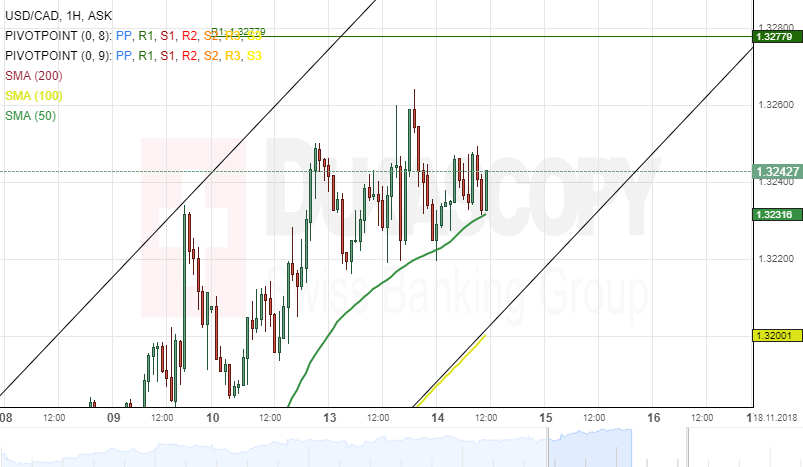
The price movement of the USD/CAD currency pair was guided by the 50-hour simple moving average on Tuesday. The US Dollar traded sideways against the Canadian Dollar yesterday.
As for the near future, it is likely that the US Dollar maintains the one-week ascending channel. The short-term target for bullish traders will be at the weekly R1 at 1.3277 today.
Although, the currency exchange rate might reverse from the current price level and aim at the 100-hour SMA at 1.3197 during the following trading session.
NZDUSD Analysis: Bullish Sentiment Today
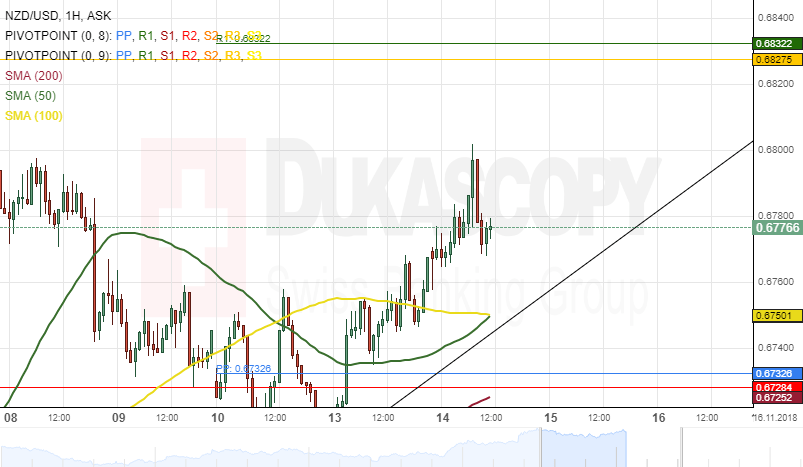
The New Zealand Dollar appreciated about 67 base points against the US Dollar on Tuesday. The currency pair breached both the 50-and 100-hour SMAs during yesterday's session.
Given that the three SMAs has fallen below the price level, the bullish momentum is likely to continue within this session. The possible target for the currency exchange rate will be at a resistance cluster formed by the combination of the weekly and the monthly PPs at 0.6832 today.
Furthermore, technical indicators demonstrate that the NZD/USD currency pair will continue its bullish sentiment during the following trading session.
EURJPY Analysis: Faces Strong Support Level
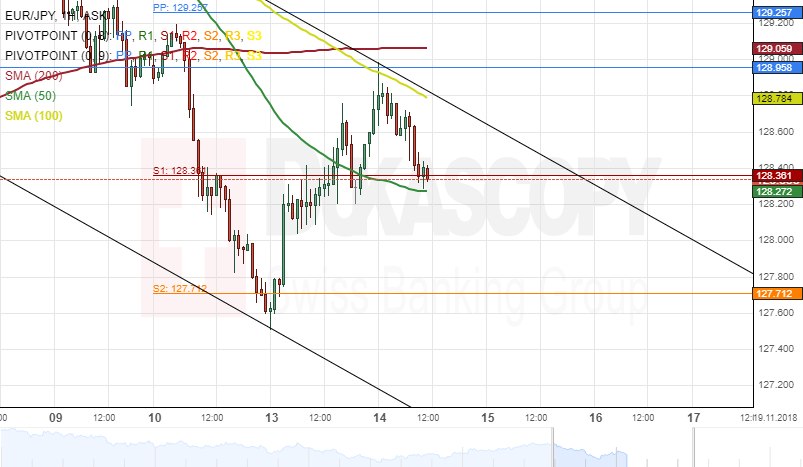
The single European currency appreciated about 120 base points against the Japanese Yen on Tuesday. This surge was briefly stopped by a resistance cluster formed by the monthly pivot point and the 100-hour simple moving average at the 128.95 area.
As for the short-term future, it is likely that the currency exchange rate continues to move south towards the weekly S2 at 127.71 during the following trading session.
However, a support cluster formed by the weekly S1 and the 50-hour SMA at 128.36 could hinder the EUR/JPY exchange rate from hitting the given target today.
Focus On Brexit, Italy And Oil
May's Brexit deal faces first test on Wednesday
It looks as though we're heading for another day in the red in equity markets, with events in Europe and the sell-off in oil markets stealing much of the headlines as investors once again take a step back from risk assets.
After months of hard negotiations, Theresa May has finally returned home with a deal on the exit terms which she will put before her cabinet today. This should be the easiest hurdle to overcome over the next month as she attempts to convince parliament that these are the best terms on offer. If May was to somehow fall at the first hurdle, it would be a humiliation of epic proportions which she may struggle to come back from. I imagine therefore that there is little chance of this happening, putting the focus on the parliamentary vote in the weeks ahead.
The usual crowd have been quick to criticize May's deal - even those that have yet to see it - claiming it's either a failure to deliver on the referendum, far worse than the deal we currently have or in the case of the DUP, is a betrayal to Northern Ireland. Naturally, these views may not represent the majority in parliament but they do represent a variety of groups that suggest a vote will be far from straightforward. May has a real task on her hands now that may make negotiations with the EU look like a walk in the park by comparison.
Rome on collision course with Brussels
It's not just the UK that Brussels needs to worry about, Italy on Tuesday re-submitted its draft budget without any changes to its fiscal deficit targets or its growth projections, putting it on a clear collision course with the European Commission. Rome did offer up asset sales of up to 1% of GDP as a sweetener for the deal but this is unlikely to be enough to appease the Commission.
Rome and Brussels have now effectively entered into a game of chicken, with the former banking on the latter not wanting to stir up more euroscepticism in the country and the latter having bond markets on its side and the ability to impose financial sanctions. It's going to be an interesting battle that could set a precedent for future battles between Brussels and other populist governments in the euro area and for that reason, I don't expect Brussels to back down. There may be some mild concessions but given the fragile position of Italy's bond market, I don't think they hold the strongest hand.
Oil pares losses but negative headlines keep appearing
Oil has stabilised a little today, even paring some of its losses at the moment, although today's gains pale into insignificance compared to the losses incurred on Tuesday. It seems we're seeing one negative headline after another for oil at the moment, whether it's Iranian sanctions waivers, inventory builds, record US output or lower demand growth forecasts.
The OPEC report on Tuesday forecast lower demand growth for the fourth consecutive month, which piled further pressure on oil prices and today IEA have revised up non-OPEC output for 2019, leaving demand unchanged for now. Even reports that OPEC+ are discussing a 1.4 million barrel per day cut is doing little to support prices which could remain under heavy pressure ahead of next month's meeting in Vienna. We may see some near-term support around $55 in WTI and $65 in Brent, with $50 and $60, respectively, being the next key levels below if the sell-off continues.
Sterling Braces For Wild Moves After Cabinet Meeting
Wednesday November 14: Five things the markets are talking about
European stocks have started today’s session deep in the ‘red,’ beating losses in Asia overnight and U.S futures, as the market considers the ongoing rout in oil market and a mixed bag of data on China’s economy and the latest trade developments.
Crude oil prices have extended their steep slide on market worries about weakening world demand and oversupply, while global stocks slumped as energy sector worries increased concern about a slow down in the global economy.
The U.S dollar trades within striking distance of its 18-month highs, while safe haven demand has Treasury and G7 sovereign yields under pressure. Italian yields also eased away from this morning’s high print despite Italy’s populist government standing firm on budget yesterday.
Sterling remains currency traders’ main focus as traders wait to see if PM Theresa May can persuade cabinet colleagues to back her Brexit plans today. The PM is due to meet her cabinet at 09:00 am EDT. The meeting is expected to last several hours.
If the Cabinet rejects the deal today, this would likely see the pound plummet (£1.2916), as it would not only mean prolonged uncertainty regarding the terms of the U.K’s exit from the E.U, but also increase the probability of a new general election.
On tap: U.S CPI is expected to have rebounded last month after easing in September (08:30 am EDT). Later this evening, Fed Chair Powell discusses national and global economic issues with Dallas Fed President Kaplan (06:00 pm EDT).
1. Stocks see mostly red
Most Asian stocks finished lower overnight as global growth worries persisted and Italy’s populist government escalated a row with the E.C over the country’s spending plans.
The outlier was in Japan, shares ended another volatile session a tad higher as tech companies and electronic component makers surged on short covering. The Nikkei average inched up +0.2%, rebounding from its two-week low print on Monday. The broader Topix index also closed +0.2% higher.
Down-under, financials and commodity stocks led declines in Aussie shares, pressured by concerns of slowing growth. Australia’s S&P/ASX 200 index slipped for a second consecutive session, closing -1.7% down. The benchmark closed -1.8% lower on Tuesday.
In S. Korea, the Kospi index weakened overnight due to a further fall in oil prices. Domestic investors were also cautious ahead of the financial regulator’s decision on alleged accounting rule violation by drug maker Samsung BioLogics. The index closed down -0.15%.
In China and Hong Kong, shares fell after the release of mixed economic data. The benchmark Shanghai Composite index dropped -0.9%, while Hong Kong’s Hang Seng index ended down -0.5%.
Note: Industrial production in China rose an annual +5.9% in October, exceeding market expectations for +5.8%. Retail sales climbed +8.6% y/y, missing forecasts for a gain of +9.2%, while fixed asset investment advanced an annual +5.7%, beating forecasts for +5.5%.
In Europe, regional bourses trade lower across the board continuing the volatility seen in recent weeks tracking lower Asian markets and weaker U.S futures this morning.
U.S stocks are set to open in the ‘red’ (-0.3%).
Indices: Stoxx600 -0.6% at 362.2, FTSE -0.5% at 7018, DAX -0.6% at 11402, CAC-40 -0.7% at 5066, IBEX-35 -0.6% at 9095, FTSE MIB -1.2% at 19000, SMI -0.6% at 8960, S&P 500 Futures -0.3%
2. Crude oil extends steep dive, gold prices steady
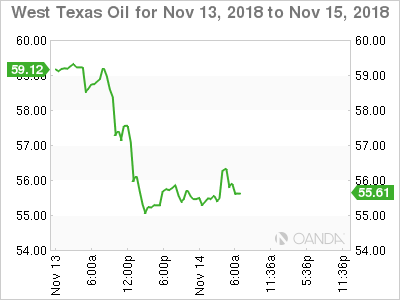
Oil prices have extended their steep slide overnight on the back of worries about weakening world demand and oversupply.
Brent crude is down -0.35% at +$65.24 per barrel after sinking -6.8% yesterday, while setting an eight-month low of +$64.61.
Note: Brent soared to a four-year high of +$86.74 in early October as the market waited for U.S sanctions on Iran, but prices have plummeted -25%in four weeks.
U.S West Texas Intermediate (WTI) crude futures trade at +$55.30 per barrel, for a loss of -0.7%, following a descent to a 12-month low of +$54.75 overnight.
OPEC warned yesterday that a supply glut could emerge in 2019 as the world economy slows and rivals increase production more quickly than expected.
Led by top exporter Saudi Arabia, OPEC has been making more public statements of late that they would start withholding crude in 2019 to tighten supply and prop up prices.
In its monthly report, IEA left its forecast for global demand growth for 2018 and 2019 unchanged from last month at +1.3M and +1.4M bpd, respectively, but cut its forecast for non-OECD demand growth. For H1 2019, based on its outlook for non-OPEC production and global demand, and assuming flat OPEC production, the IEA said the “implied stock build is +2M bpd.”
Note: Both OPEC and Russia are under pressure to reduce current production levels; this decision could be taken at the next OPEC meeting on Dec. 6. There are rumours that there is a proposal to cut oil output by up to -1.4M bpd for 2019.
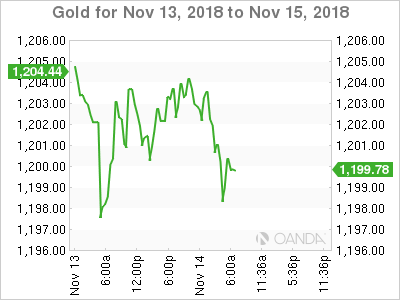
Ahead of the U.S open, gold prices are holding steady as the ‘big’ dollar eases away from its 18-month high print earlier in the week, easing amid a jump in the EUR (€1.1270) and the pound (£1.2969) on a draft Brexit agreement. Spot gold is little changed at +$1,202.08 per ounce, while U.S gold futures are up +0.1% at +$1,203.9 per ounce.
3. BTP yields rise as Italy sticks to deficit target
Italian government bond yields have backed up sharply this morning after Italy resent its 2019 budget to the E.C with “unchanged growth and budget deficit assumptions, but falling debt targets.”
Note: Italy’s first draft budget for 2019 was rejected last month for breaking E.U rules.
Italian BTP yields are +5 to +7 bps higher across the curve and the BTP/Bund yield gap has widened to +311 bps from around +303 bps from late yesterday.
Elsewhere, the yield on the U.S 10-year note has gained less than +1 bps to +3.14%. In Germany, the 10-year yield has fallen -2 bps to +0.39%, the lowest in two-weeks, while in the U.K, the 10-year Gilt yield has eased -4 bps to +1.484%.
4. U.K cabinet meeting in focus for sterling
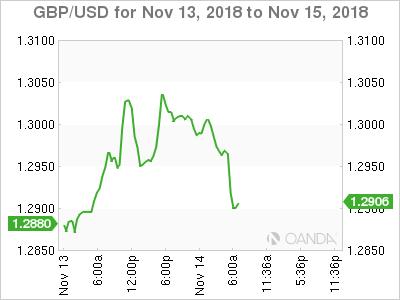
The focus for sterling this morning is the U.K Cabinet meeting (09:00 am EDT), when PM May’s Cabinet may approve the Brexit deal that reportedly has been reached between the U.K and the E.U this week.
Consensus expects the pound to find a ‘bid’ if the Cabinet signs off on the deal, because this would open the possibility for the agreement to be considered at an extraordinary E.U summit in late November, and for the U.K. Parliament to vote on it before the Christmas recess.
However, if the Cabinet rejects the deal at today’s meeting, this would likely send GBP (£1.2916) spiralling aggressively lower, as it would not only mean prolonged uncertainty regarding the terms of the U.K’s exit from the E.U, but also increase the probability of a new general election.
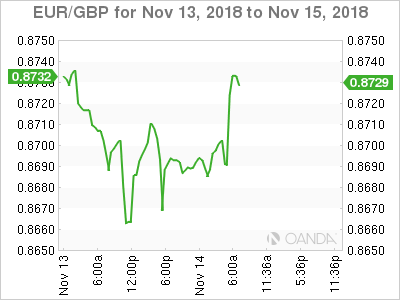
Elsewhere, EUR/USD (€1.2963) is slightly lower after Germany’s Q3 GDP (-0.2% vs. +0.5%) missed expectations and contracted for the first time in over four-years. German officials reiterated that slowdown was “temporary and largely related to the emission situation in the auto sector.”
SEK (€10.2733, +0.5%) is softer after Sweden Oct CPI came in below expectations. Some of the weakness was due to reposition of bets for the first potential Riksbank hike being pushed back to the February timeframe.
5. U.K inflation holds steady as fuel costs are offset by food
Data this morning from the ONS showed that annual inflation in the U.K held steady in October, as weak growth in prices for food and drink counterbalanced surging fuel costs.
Consumer prices rose +2.4% on year in October, matching the increase in September.
The figures would suggest that the Bank of England (BoE) remains on track to hike interest rates next year provided the U.K’s exit from the E.U goes smoothly. A bitter ‘divorce’ is expected to cause widespread economic disruption.
Note: Governor Carney signalled this month that they would need to nudge up interest rates two to three times in the next-three years to bring inflation back to its +2% goal.
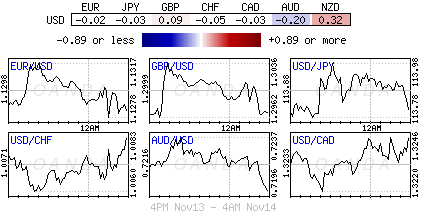
The Analytical Overview Of The Main Currency Pairs
The EUR/USD currency pair
Technical indicators of the currency pair:
Prev Open: 1.12176
Open: 1.12892
% chg. over the last day: +0.83
Day's range: 1.12762 – 1.13212
52 wk range: 1.1299 – 1.2557
EUR started to recover. During the yesterday“s trade, the EUR/USD quotes grew by more than 85% points. The trading instrument updated the local maximums. At the moment EUR/USD is consolidating. The key range is 1.12700-1.13100. A correction is possible soon. The investors are expecting important economic stats from the US. Positions should be opened from the key levels.
The Economic News Feed for 2018.11.14:
preliminary report on the GDP (EU) - 12:00 (GMT+2:00);
CPI Index (US) - 15:30 (GMT+2:00).
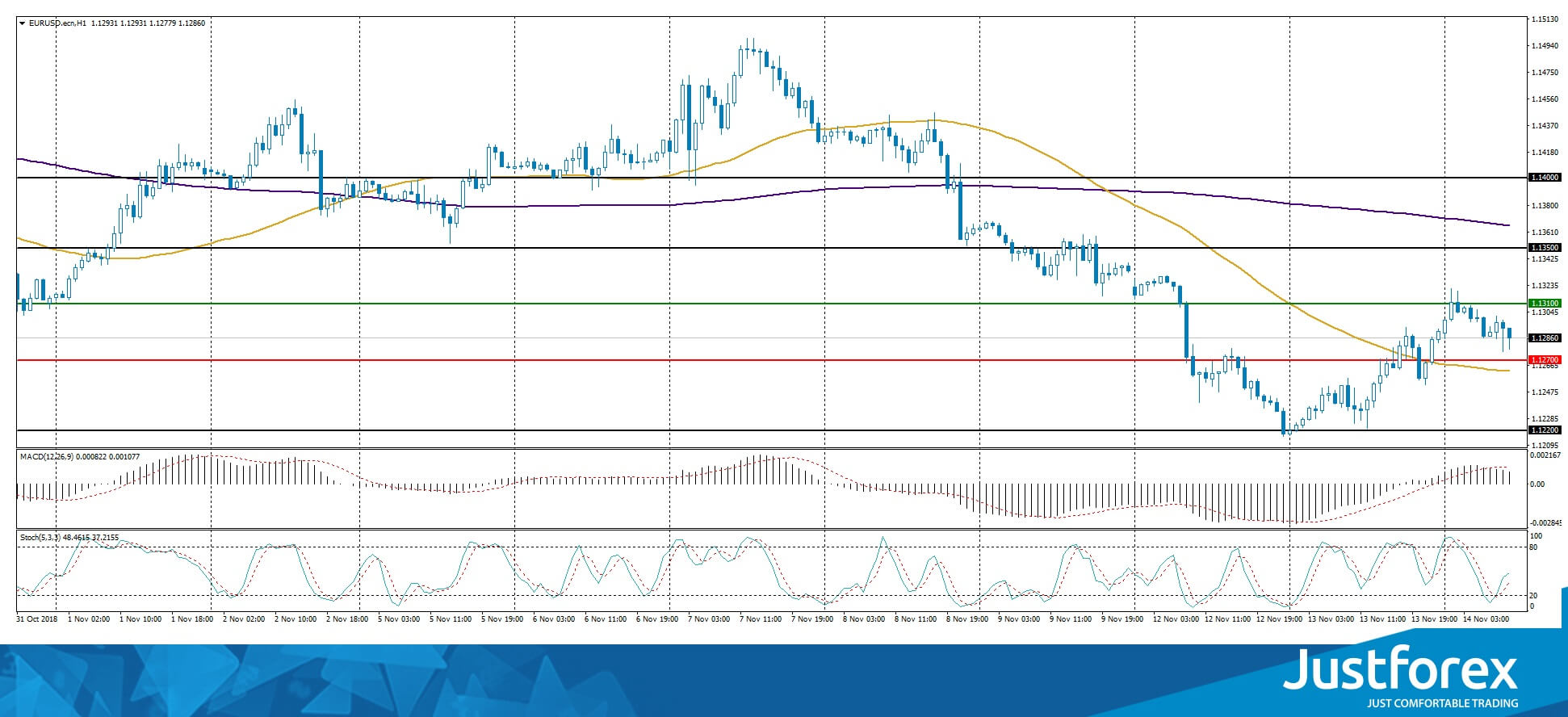
The indicators do not provide precise signals, the price fixed between 50 MA and 200 MA, which represent strong dynamic levels of support and resistance.
The MACD histogram is in the positive zone but below the signal line, which give a weak signal towards the purchase of EUR/USD.
The Stochastic Oscillator is in the neutral zone, the %K line is above the %D line, which indicates a bullish sentiment.
Trading recommendations
Support levels: 1.12700, 1.12200, 1.12000
Resistance levels: 1.13100, 1.13500, 1.14000
If the price closes above the support 1.13100, expect further correction. The movement will tend toward 1.13500-1.13800.
Alternatively, the price fixes below 1.13100, and you should consider selling EUR/USD. The movement will tend toward 1.12300-1.12000.
The GBP/USD currency pair
Technical indicators of the currency pair:
Prev Open: 1.28475
Open: 1.29710
% chg. over the last day: +1.28
Day's range: 1.29553 – 1.30348
52 wk range: 1.2662 – 1.4378
Yesterday the GBP/USD was showing some agressive purchasing. The quotes have grown by 150 points and updated the local maximums. Great Britain and the EU reached a preliminary conslusion on Brexit after some long negotiations. The pound can recover further. The key trading range is 1.29500-1.30150. Positions should be opened from these levels.
At 11:30 (GMT+2:00) Great Britain will publish a Customer Price Index.
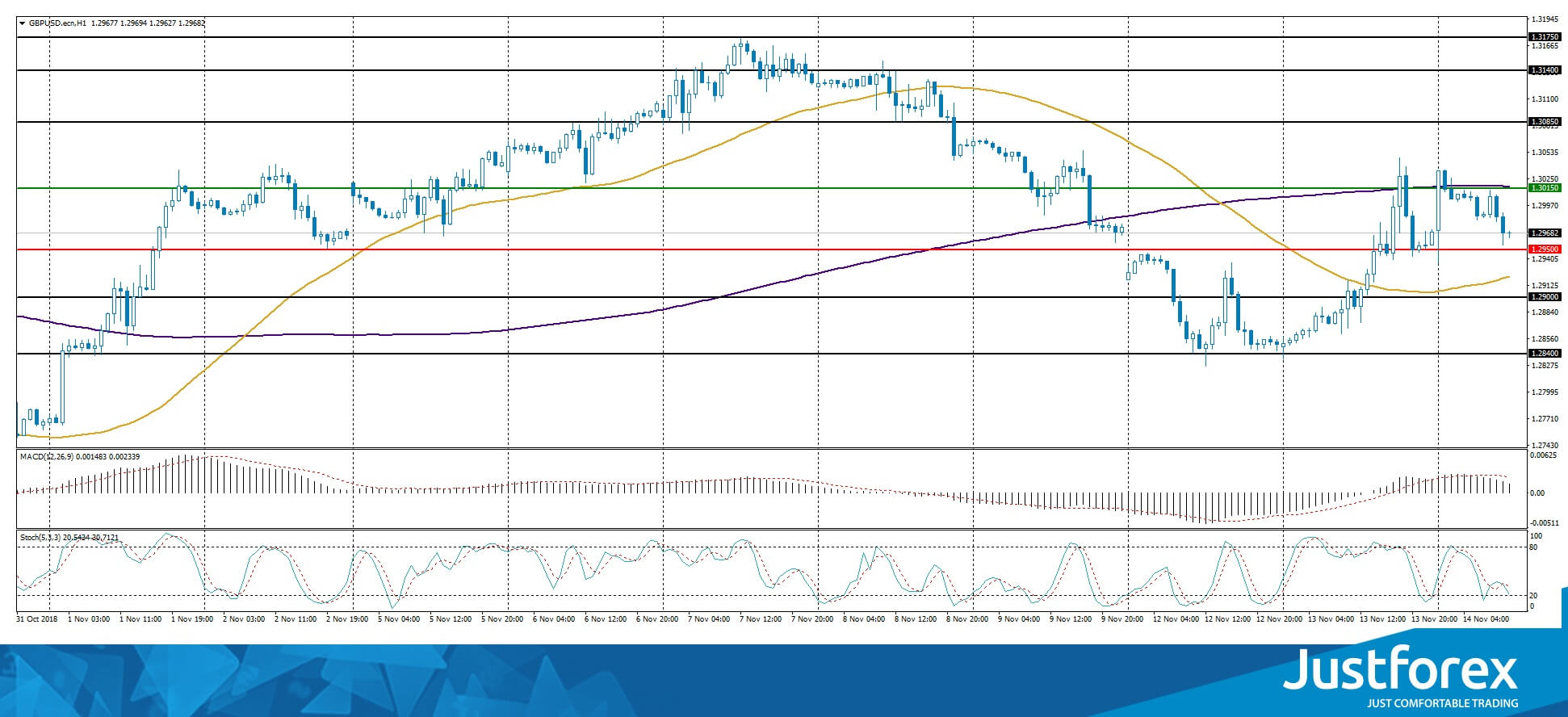
Indicators do not provide precise signals, the price fixed between 50 MA and 200 MA.
The MACD histogram is in the green but below the signal line, which gives a weak signal towards a purchase of GBP/USD.
The Stochastic Oscillator is around the overbought zone, the %K line crossed the %D. There are no signals at the moment.
Trading recommendations
Support levels: 1.28400, 1.27800
Resistance levels: 1.30150, 1.30850, 1.31400
If the price fixes above 1.30150 expect further growth of GBP/USD. The movement will tend toward 1.30750-1.31000.
Alternatively, the quotes can go down towards the round 1.29000.
The USD/CAD currency pair
Technical indicators of the currency pair:
Prev Open: 1.32434
Open: 1.32341
% chg. over the last day: -0.17
Day's range: 1.32182 – 1.32485
52 wk range: 1.2248 – 1.3387
The USD/CAD quotes keep consolidating. There is not singular trend. The key support and resistance levels are still 1.32150 and 1.32500. Positions should be opened from these levels. The market participants are expecting the inflation stats from the US.
The news feed for Canada is calm for today.
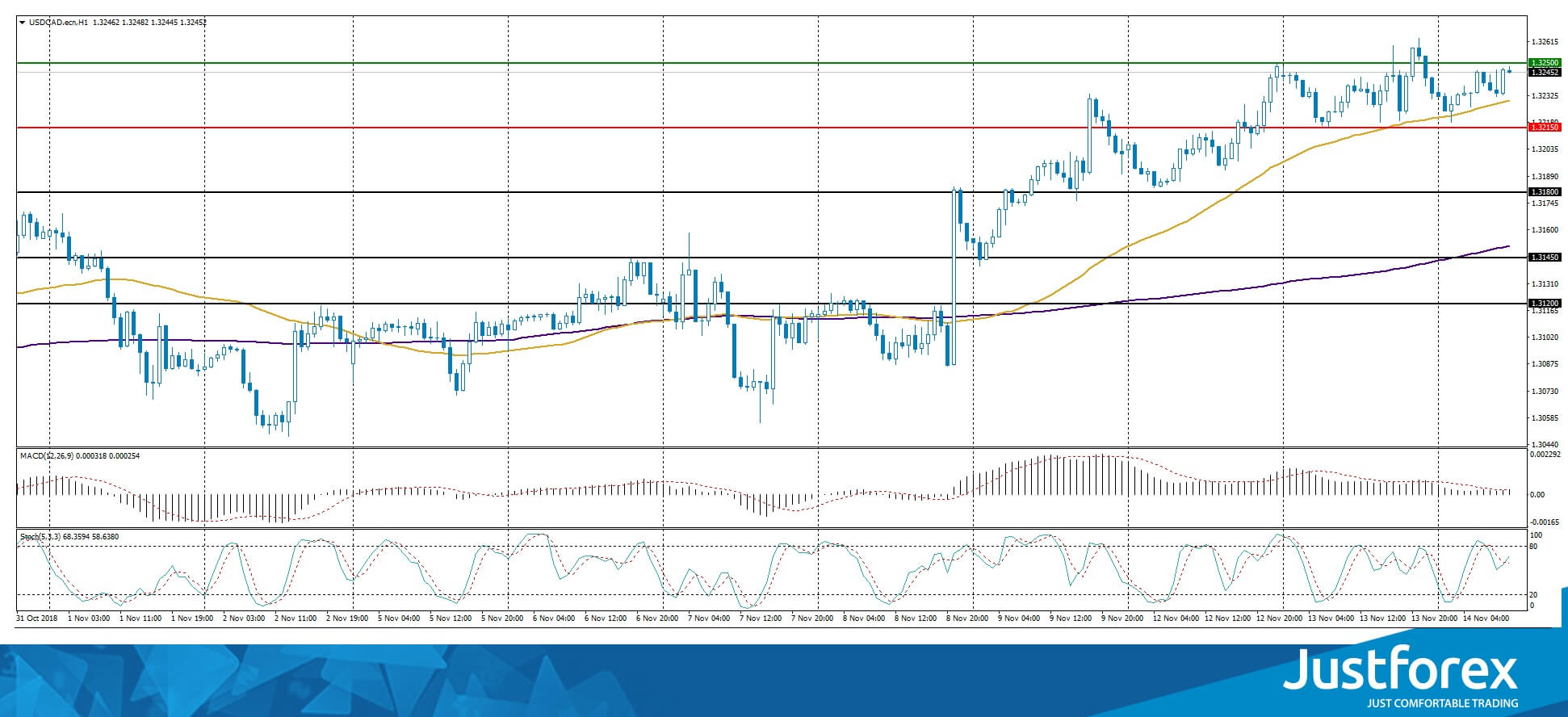
The price fixes above 50 МА and 200 МА, which indicates the power of the buyers`.
The MACD histogram is in the positive zone and keeps rising, which gives a signal towards a purchase of USD/CAD.
The Stochastic Oscillator is in the Neutral zone, the %K line crosses the %D line. There are no signals at the moment..
Trading recommendations
Support levels: 1.32150, 1.31800, 1.31450
Resistance levels: 1.32500, 1.33000
If the price fixes above 1.32500, consider purchasing USD/CAD. The movement will tend toward the round 1.33000.
Alternatively, the currency pair can descend to 1.32000-1.31800.
The USD/JPY currency pair
Technical indicators of the currency pair:
Prev Open: 113.832
Open: 113.784
% chg. over the last day: -0.03
Day's range: 113.752 – 113.989
52 wk range: 104.56 – 114.74
USD/JPY remains in the long flat. The technical picture is ambiguous. At the moment the local support and resistance are 113.700 and 114.000. Correction is highly possible due to the rapid growth since the end of October. You should keep an eye on the US Economic News Feed.
During the Asian trading session, Japan published rather weak GDP reports.
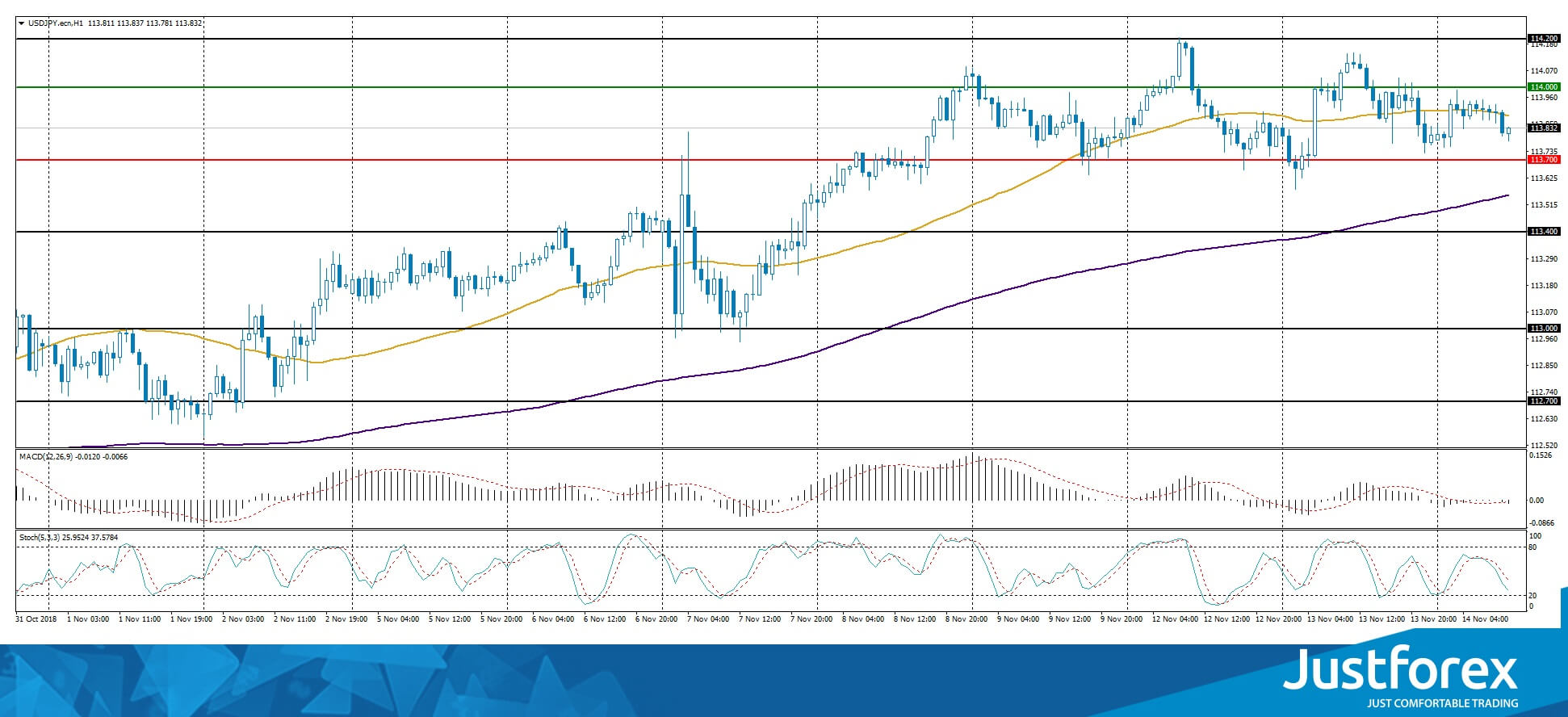
Indicators do not provide precise signals: the price crossed 50 МА.
The MACD histogram is around 0. There are no signals at the moment.
The Stochastic Oscillator is in the neutral zone, the %K line is below the %D line, which gives a weak signal towards the sale of USD/CAD.
Trading recommendations
Support levels: 113.700, 113.400, 113.000
Resistance levels: 114.000, 114.200, 114.500
If the price fixes above the round 114.000, expect futher growth of the USD/JPY quotes. The movement will tend toward 114.200-114.500.
Alternatively, the quotes can descend towards 113.500-113.300.