

Sample Category Title
Daily Markets Broadcast
Investors push Wall Street down further
US indices fell yesterday in modest activity due to the Veterans Day holiday. The Tech sector led declines amid concerns over demand for Apple's iPhones. European exchanges were lower on Brexit stalemate. Oil gave back early gains to drop for an 11th straight day.
US30USD Daily Chart
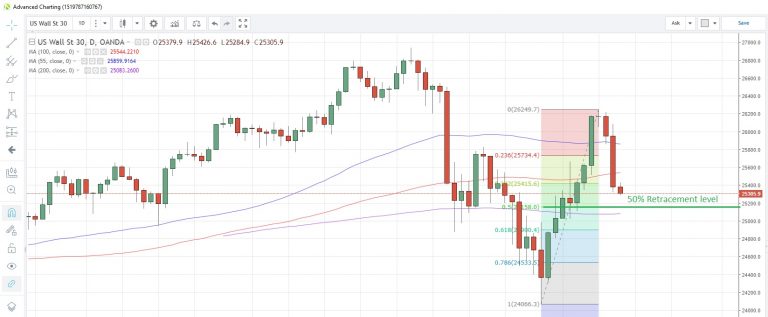
The US30 index fell for a second straight day yesterday amid souring investor sentiment in the Tech sector
The index closed below the 38.2% Fibonacci level of the Oct29 to Nov8 rally at 25,415. Next support level could be the 50% retracement of the rally at 25,158
No US data of note today, but we have Fedspeakers Brainard (dove, voter) and Daly (neutral, voter). Yesterday, Daly said wouldn't be surprised by a Dec rate hike, and at least a couple more in 2019.
DE30EUR Monthly Chart
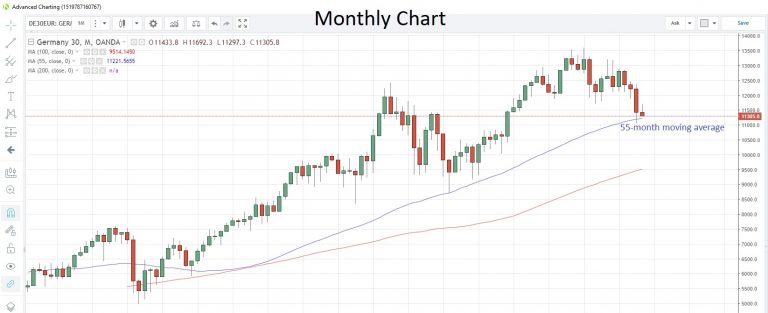
The Germany30 index fell the most in almost three weeks yesterday, as Brexit impasse continued to haunt sentiment. European Commission said it's ready to escalate its battle with Italy over its budget deficit
The index is heading toward the 55-month moving average at 11,221
Germany's inflation rate is expected to rise 2.5% y/y in October, the same pace as September. An acceleration would pile more pressure on the index.
HK33HKD Monthly Chart
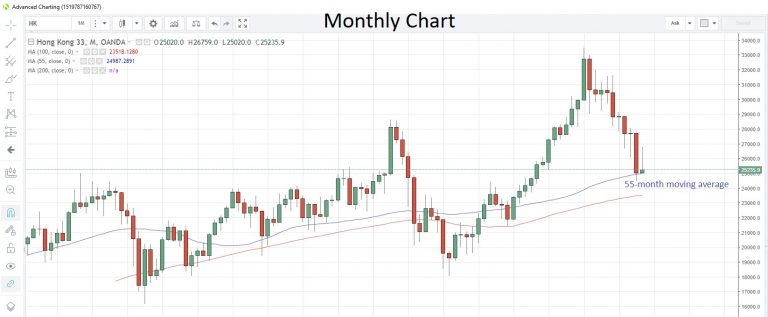
The HongKong33 index fell for a third day yesterday, Weak sentiment on Wall Street is expected to pressure the index today
The index has retreated further from the 55-day moving average at 26,542 and is sitting just above the 55-month moving average at 24,987
China's new loans and fixed asset investment data for October is scheduled for today. Numbers could influence China's direction, and hence Hong Kong's.
Risk Off Endures And The Greenback Surges
Equities
While risk aversion if flooding back into the fray. The US morning sell-off in the tech sector triggered the equity rout. Given that Apple shares are so widely held, nothing good ever comes of a 5 % decline on the back of concerns over iPhone sales. On the financial sector, 1 MDB continues to the rear is ugly head as Goldman Sachs stock took a tumble due to their strong connections with the troubled financier.
Investors are looking for answers but it hard to overlook the global growth slowdown, while the Trump administration seems set to exert pressure on China Trade. WSJ reports: “The Trump administration is broadening its China trade battle beyond tariffs with a plan to use export controls, indictments and other tools to counter the theft of intellectual property, according to people familiar with the matter.”
The spiralling equity markets leaked into other asset classes driving Crude prices lower while sending the USD skyrocketing as investor sought shelter under the umbrella of US treasuries. Rates flow, so far, have been all risk-off, duration buying.
A stronger USD which usually act as a wrecking ball through Asian equities and as risk off persists stocks in Asia should topple head over heels.
Oil Markets
Oil prices were hammered mercilessly overnight after President Trump took to the podium to admonish Saudi Arabia not to cut oil output as OPEC leaders tussle with oversupply concerns.
OPEC was coerced successfully by President Trump to raise supplies ahead of Iran sanctions only to be sideswiped by the US administration offering up far more Iran sanction waivers than expected, catching both producers and traders alike wholly wrong-footed. Which is at the root of this supply glut.
However, with trade wars remaining front and centre, the likely hood of a global economic slowdown increases and when you compound that with the impending shale oil shocker as US producer continue to pump, OPEC has their work cut out to tame the growing supply beast.
With the Eagle now passing the Bear on the global production front, one is left wonder just how determined Russia will be to cap supplies as the US could eat into Russia’s market share,
For today at least, it does appear President Trump can have his cake and eat it also.
The Euro
The Euro sliced through 1.1300 like a hot knife through butter and is now trading below the critical 1.1240 as the greenback rallied to June 2017 highs. Indeed, the USD is s King of the hill and the stars continue to align
There is no specific news to explain this move, but a lot of conjectures, and with more questions than answers, from my experience, this usually means the market isn’t short enough Euro going into year end.
But it was the strong USD sentiment along with several other factors like low liquidity and stop losses getting triggered that contributed to the deep dive towards 1.1200
USD strength, coupled with fermenting anxieties in both the equity and credit markets, led to risk-off trading. But there were hoards of real money flow behind the EURUSD move which was a significant signal even more so with US fixed income markets closed for Veterans Day.
As mentioned on Friday’s note: ” real money has been somewhat tentative so far according to my morning chats with other dealers in Singapore. Keep in mind that segment of the market was noticeably exiting longs post-midterm election and diving into anything with yield, i.e. EM currencies. So, for today and into early next week, we will be focused on real money flows.”
I suspect the strong USD narrative will be the dominant theme for the rest of the year after the market squared up a lot of its position going into the midterms. Given the favourable US growth differential along with an unwavering Fed, this all suggests the USD has more to run, With the US dollar likely to find support from this week’s CPI and Retail sales prints and with longer-term questions around Italy and other EU countries going unanswered, we could see a move into the 1.10’s in short order. The unsettling political noise that continues to permeate every pocket of EU capital markets is a firestorm just waiting to happen.
But its nose to the grindstone this week and no rest for the weary with some significant data points ahead. The US dollar will tether itself to US CPI and Retail sales, while the Euro is hoping for a de-escalation in Italian budgetary woes or even a positive German ZEQ survey would help. Indeed, it is getting desperate for the EURO bulls, but Monday’s USD rally remains at the forefront of market drivers.
The Pound
Despondency around Brexit has taken its toll on Cable today after the UK press was chock-full of dismay. I’m feeling a bit depressed for my colleagues in the UK that must put up with this in real life day in day out. Someone will need to get off their high-horse.
China
No grief for Chinese Singles though, after Alibaba logged CNY168.3bn in sales in 16 hours of its annual Singles’ Day extravaganza, setting up a new record. The Straits Times reports this “offers a glimpse of consumer sentiment in China as US tensions and a tit-for-tat tariff war depress stock markets and threaten to dampen the world’s No. 2 economy”. Indeed, we should never underestimate the purchasing power mainland consumer. Frankly, this number has inspired me to finally watch the hit movie “Crazy Rich Asians ” tonight.
Asia Currencies
The recent rebound in oil prices is a good reminder not to overextend risk in twin deficit currencies like the rupee, rupiah and peso as increasing volatility in the Oil path along with resurgent USD will continue to make life difficult for these primary speculator targets.
The Malaysian Ringgit
The Malaysian Ringgit is expected to struggle on some fronts. Traders are increasingly pricing in greater BNM vs FED policy divergence which makes Friday’s Q3 GDP print so incredibly crucial for the Ringgit, even more so with the BNM striking a dovish chord. On the optimistic side of the equation, we could get a reprieve as the 0 GST should have boosted consumption. Tax relief has some forecasters looking of Q3 GDP to rebound from 4.5 % in Q2 to 5.1 % for Q3. However, I think this would only be mildly positive for the Ringgit, but a miss below 5 % would persuade a quicker move to the
Gold Markets
All that glitters isn’t gold. With the Fed on track for a December rate hike and the dollar looks likely to hold a bid into year-end, the odds for Gold to test $1150 over the next few months seem more likely that a test of $ 1250. There is little to no haven appeal, and with the US leading indicators remaining robust suggesting the US services-based economy is firing on all cylinders suggesting the Fed will stay on track. The University of Michigan Survey and PPI came in above expectations, signalling consumer confidence remains strong. All that chatter about a Fed pause in 2019, is far too untimely suggesting that considering the economic growth slowdown around the globe, the USD should remain in good standing from growth differential perspective which could tarnish Gold appeal heading into year-end. Indeed, higher US interest rates and a stronger USD are flashing Red for Gold investors.
Eco Data 11/13/18
[php_everywhere instance="1"]
Elliott Wave Analysis: NZDUSD Intra-Day Correction
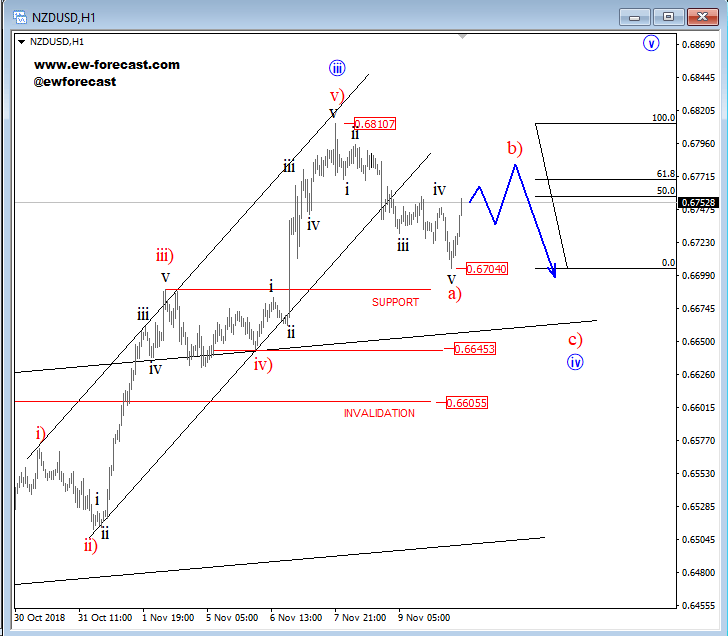
NZDUSD is currently recovering, ideally unfolding a temporary wave b) as part of a three-wave reversal within a wave four correction. Resistance and a new reversal into final wave c) of this correction can be around the Fibonacci ratio of 50.0 or 61.8, from where more weakness may follow.
NZDUSD, 1h
XAUUSD Outlook: Bears Extend and Pressure Pivots at $1201/00; US CPI Data Eyed for Fresh Signals
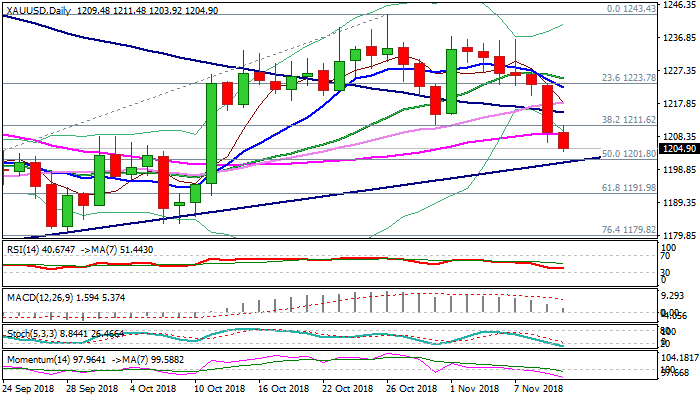
Spot gold dipped to $1203 low on Monday, in extension of last Friday's 1.9% fall, pressured by higher US dollar which holds near 16-month high against the basket of major currencies. The yellow metal holds in red for the seventh straight day, as Friday's long bearish candle (daily loss of 1.9%) weighs. Strong bearish momentum and daily MA's in negative setup maintain bearish stance for test of pivotal supports at $1201/00 (trendline support/Fibo 50% of $1160/$1243/psychological support, violation of which would spark fresh bearish acceleration. Daily cloud twists today ($1195) and is magnetic. Broken daily Kijun-sen ($1213) acts as solid barrier and expected to protect the upside. US inflation data, due on Wednesday, are eyed for fresh signals (Oct CPI m/m 0.3% f/c vs 0.1% prev/y/y 2.5% f/c vs 2.3% prev) which could put the yellow metal under further pressure on stronger than expected release.
Res: 1209; 1211; 1213; 1215
Sup: 1203; 1201; 1195; 1191
Sunset Market Commentary
Markets
Global core bonds gained ground today. After US equities closed last week’s session with substantial losses, Asian indices opened mixed this morning. Chinese equities outperformed on news that the Chinese government will study and implement new tax cuts. However, European bourses couldn’t maintain the positive momentum and are trading in red, pushing investors to safe havens. European bonds all gain on the deterioration of risk sentiment with the exception of Greece and Italy. Italian BTP’s jumped higher at openings as Italian media reported that the ECB could launch a new round of LTROs, though they weren’t able to hold on to those gains. BTP’s move south ahead of tomorrow’s budget deadline when the Italy has to present its revised budget proposal to the European Commission. The Italian Parliament budget watchdog sees a 2.6% deficit in 2019, as the government’s 1.5% growth projections for next year is too ambitious. The BTPs gradually edged lower throughout the day, also in the run-up of tomorrow’s auction. The Italian Treasury sells 3-, 7- and 20-yr bonds. Furthermore, there was no economic data to steer trading today. US markets were partially closed as well (Veteran’s Day). German yields are declining with the belly of the curve underperforming. Changes range from -1.4 bps (2-yr) to -2.2 bps (5-yr). Peripheral yield spreads over Germany widen with Italy (+5 bps) and Greece (+4 bps) underperforming.
The most striking event on global FX markets already happened this morning just before European traders returned from weekend: EUR/USD dropped below the bottom of the 1.13/1.1850 consolidation pattern that guided trading since end May. There was no high profile trigger for this break. Dollar resilience after last week’s US mid-term election and the Fed firmly holding to its intended rate hike path apparently were a sign for some remaining USD shorters to throw the towel. The break below the 2018 low caused some further stop losses USD buying/euro selling. Thin trading conditions (US Veterans’ Day holiday) probably also played a role. Lingering uncertainty on Italy and a cautious attitude on (European) equity markets maybe was a tentative supportive for the dollar, too. However, EUR/USD selling pressure eased during the session. EUR/USD trades in the 1.1265 area. USD/JPY decouples from the broader USD rally. The risk-off sentiment and negative pressure from EUR/JPY also weigh on the USD/JPY headline pair (113.80 area).
Sterling initially remained in the defensive today. Cable dropped below the 1.29 mark on broad USD strength. EUR/GBP also traded close too, mostly slightly above 0.8750 for most of the day as investors had again to acknowledge the binary risk of PM May potentially failing to secure a political majority to approve whatever deal that might be reached with the EU. During the afternoon, sterling jumped higher on press headlines referring to EU’s Barnier. He was said to have indicated that the main elements of a deal text might be finalized very soon. EUR/GBP trades again in the 0.8725 area. This scenario of course doesn’t solve the risk of political approval in the UK. So, more sterling volatility might be on the cards.
News Headlines
German CSU leader Seehofer announced to step down as party leader following this month’s dismal local election result which was the worst since 1950. He held that post since 2008. Seehofer wants to keep his function of interior minister in the national government.
The Financial Times reports that EU chief Brexit negotiator Barnier told diplomats that the main elements of an exit treaty are ready to be presented to the UK cabinet tomorrow.
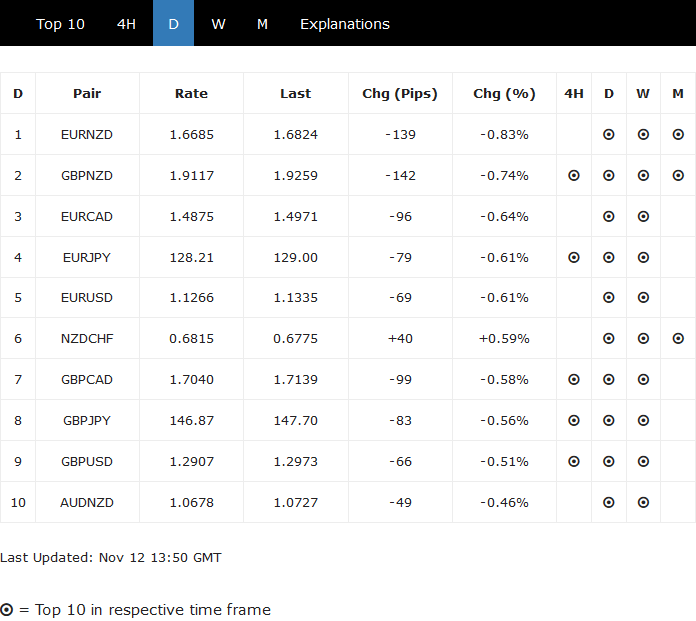
Today’s top mover: A very interesting picture in EUR/NZD
At the time of writing, EUR/NZD is the biggest loser for today. Just an hour or two ago, it should be GBP/NZD. But thanks to the current recovery, GBP/NZD is relegated to the second place.
Nevertheless, EUR/NZD does give us an interesting picture to study.
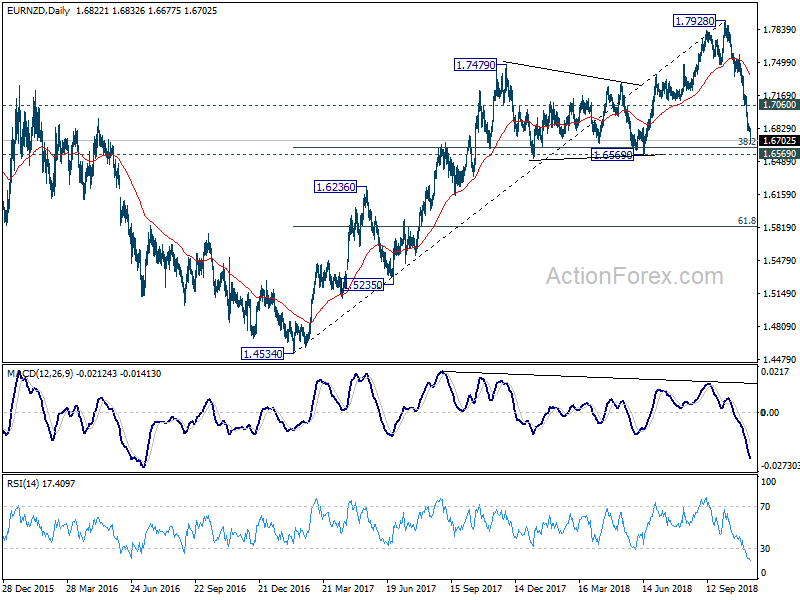
It's clear that 1.7928 is a medium term top. Firstly, the up trend from 1.4534 has completed a five-wave sequence. Secondly, bearish divergence conditions are seen in both daily and weekly MACD. EUR/NZD is now approaching a key support zone between 1.6569 and 38.2% retracement of 1.4534 to 1.7928 at 1.6631. Could this cluster support zone hold? Based on current momentum, it's rather hard to say.
Instead of predicting whether 1.6569/6631 would hold, we'll look at the implication of break or hold instead. Strong rebound from 1.6569/6631 and break of 1.7060 minor resistance will indicate completion of the decline 1.7928. More improtantly, with the end of wave four at 1.6569 defended, it will suggest that price actions from 1.7928 are merely forming a corrective pattern. That is, EUR/NZD is still in a medium to long term up trend and break of 1.7928 should be seen afterwards.
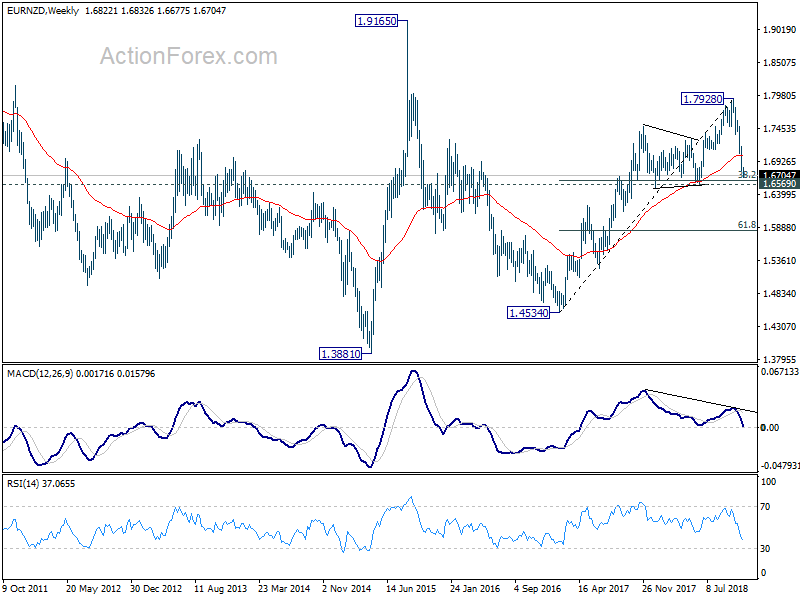
However, another possible interpretation is that price actions from 1.3881 (2015 low) could have just completed a three wave corrective pattern at 1.7928. And being the third leg of the pattern, rise from 1.4534 to 1.7928 is correct as an impulsive move. Sustained break of 1.6569/6631 will shift favor this very bearish case that could see EUR/NZD revisiting 1.3381/4534 zone in medium to long term.
Fundamentally, the latter bearish case got its arguements too. Markets were rather bearish on New Zealand Dollar due to dovish RBNZ outlook. RBNZ has just reiterated last week that it expected to keep OCR unchanged at 1.75% "through 2019 and into 2020". And, the next move could both be a hike or cut.
However, it should also be reminded that New Zealand just posted last week a stellar Q3 job data, which saw unemployment rate dropped to decade low. The data has already had some positive impact on Kiwi. Should improvement in employment and inflation persist, markets would continue to pare back bet on RBNZ cut or even turn to bet on a hike. And if situation in Eurozone worsen, ECB might keep interest unchanged even after summer of 2019. Flips in sentments on both sides could indeed set up a free fall in EUR/NZD back to 1.38/45.
Well, admittedly, it's really too far-fetched for now. But it would be an interesting pair to watch in the coming months.
Dollar Drive to Encourage Renewed Round of Pressure for Emerging Markets
The Dollar strength story has returned to the scene with a vengeance, and it represents a risk of crumbling its counterparts across the globe.
The Dollar Index has advanced to its highest level since June 2017 as trading commences for the new week, which represents a 17-month high for the Greenback and a milestone low for the likes of the Euro that has consequently declined to its lowest level since June 2017 on renewed Dollar strength.
More woes for emerging markets and the Chinese Yuan ahead?
This rally in the Greenback is going to ask a lot of questions over the resilience of its counterparts, but the largest risk that investors will probably be evaluating is what does this mean for emerging markets? Dollar strength was one of the key themes behind the prolonged weakness in emerging markets that took place over the summer, and this news over the Greenback rallying to new highs is going to bring questions over whether another round of emerging market weakness should be expected before we conclude 2018.
What will be one of the most interesting themes to monitor is whether this new round of Dollar strength is enough to push the Chinese Yuan “over the edge” and within touching distance of the psychological seven level against the USD. Dollar dynamics has been an ongoing challenge for emerging markets throughout this year, but the resilience of the Chinese Yuan to not meet 7 against the USD is seen as one of the last hurdles of defense for emerging markets before another brutal sell-off.
Basically, if this relentless drive for the Dollar persists further meaning more highs for the Greenback and if this is met with the Yuan finally breaching 7 against the Dollar we are looking at a combination for yet another round of pain for emerging markets before an already eventful 2018 concludes.
What has encouraged another rally for the Greenback? Trade tensions or Fed policy?
The other question to ask is what exactly is behind the push higher in the Greenback? Pointing the finger towards the Federal Reserve and central bank divergence regarding ambitious interest rate policy in the United States is the easy answer, but not necessarily the right one when you consider that the Fed has been consistent with its communications to raise US interest rates further for a long time. US interest rate policy in the United States has been priced into the USD a long time ago, meaning that there is likely a different culprit behind the renewed push for the USD.
I would personally attribute the move to growing skepticism over whether President Trump was sincere with his narrative that a trade deal with China might be close. While we haven’t seen any drastic changes to this narrative, we haven’t seen a continuation of this optimism either, which does suggest that this could have been a strategic ploy to put the pressure on China before the scheduled meeting at the G-20 summit in Argentina later this month.
We do overall maintain the view that a trade deal needs to be announced soon, otherwise it is very difficult to pinpoint when emerging markets can really bounce back. This means that a trade agreement is consequently needed for the Yuan, like many other emerging market assets to recover from a painful 2018.
Gold decline suggests Dollar drive driven by trade skepticism
Gold has fallen in line with the USD drive, meaning that the current rally in the Greenback is not a reflection of a safe-haven spree from traders. This does weigh in line with the view that investors are piling up bullish Dollar bets, which makes me more suspicious that this move has been encouraged by skepticism that a trade agreement with China can really be agreed in November.
Pound at risk once again to lower 1.20’s
The Pound has been another victim of a brutal day in the FX markets, but it is also suffering from a return of investor concerns over the daunting prospect of a hard-Brexit scenario.
The Pound can still fall further on hard-Brexit fears, and I would still not rule out the potential of a dive to the lower 1.20’s in the GBPUSD if the prospects over a deal between the United Kingdom and European Union being announced before year-end do deteriorate once again.
Euro could meet 1.10 before end of month
Another currency to keep an eye on this week is the Euro. The EURUSD has fallen below 1.13 and a sustained breakdown below these levels represent a risk that the EU currency can drop to 1.11 as soon as this week.
If concerns over the budget stand-off with Italy resurface and are met with pessimistic data out of Europe that an economic slowdown can’t be avoided, concerns that the ECB will not be able to raise EU interest rates next year will arise and we will be looking at a risk of the Euro potentially dropping below 1.10 before November concludes.
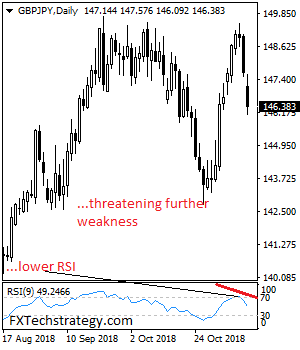
GBPJPY Challenges 146.00 Key Support Zone On Bearishness
GBPJPY challenges 146.00 key support zone on bearishness. This is a follow through lower on the back of its Friday losses. On the downside, support comes in at the 145.50 level where a violation will aim at the 145.00 level. A break below here will target the 144.50 level followed by the 144.00 level. Conversely, resistance comes in at the 147.00 level followed by the 147.50 level. A cut through that level will set the stage for a move further higher towards the 149.50 level. Further out, resistance resides at the 150.00 level. All in all, GBPJPY faces further downside pressure on further decline.
Sterling off low as main elements of Brexit text ready. But EU also said some key issues remain under...
Sterling is given a lift off today's low after Financial Times reported that the main elements of a Brexit treaty text are ready. According to EU chief Brexit negotiator Michel Barnier, the documents could be presented to the UK cabinet on Tuesday.
However, it should be noted that it's a "known" that the "main elements" are ready. A few weeks ago, it was like 95% completed. Now it maybe 99.9%. But it's not done until all is done. There is so far no news regarding the Irish backstop. So the piece of news is not so much news.
Also, Barnier briefed EU ministers on negotiation progress today. The post meeting statement is rather reserved. The EU statement noted:
---
The Commission's chief Brexit negotiator, Michel Barnier, informed the EU27 ministers of the situation following negotiations with the UK over the last few weeks. Michel Barnier explained that intense negotiating efforts continue, but an agreement has not been reached yet. Some key issues remain under discussion, in particular a solution to avoid a hard border between Ireland and Northern Ireland.
"In these final stages of the negotiations, ministers showed again today that we are determined to keep the unity of the EU 27. We have reconfirmed our trust in the negotiator. And we support his efforts to continue working towards a deal."
Gernot Blümel, Austrian Federal Minister for the EU, Art, Culture and Media
During the meeting, ministers however also recalled the need to continue the work at all levels on preparations for every possible scenario.
---
It doesn't sound like there is any breakthrough.