

Sample Category Title
Further Downside Expected In EURUSD
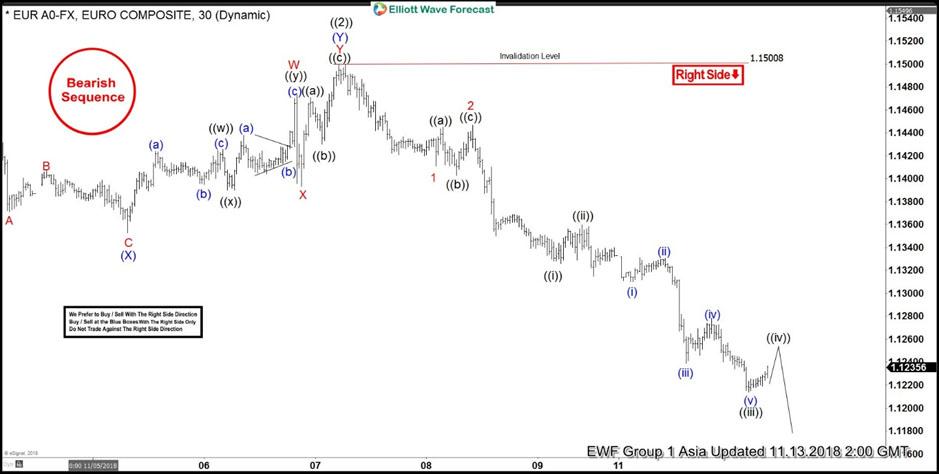
EURUSD has broken below Nov 1 low (1.13) and now the pair shows a 5 swing bearish sequence from Sept 24 high (1.1815), favoring further downside. Short term Elliott Wave view suggests that the move higher to 1.15 ended wave ((2)) in Primary degree. Internal of wave ((2)) unfolded as a double three Elliott Wave structure. Wave (W) of ((2)) ended at 1.1455, wave (X) of ((2)) ended at 1.135, and wave (Y) of ((2)) ended at 1.15.
Primary Wave ((3)) is currently in progress lower and the subdivision is unfolding as a zigzag Elliott Wave structure where Intermediate wave (A) of ((3)) is in play as an impulse Elliott Wave structure. Down from 1.15, Minor wave 1 ended at 1.1411 and Minor wave 2 ended at 1.1447. Minor wave 3 is further subdivided into another impulse of a lesser Minute degree. Minute Wave ((i)) of 3 ended at 1.1326, Minute wave ((ii)) of 3 ended at 1.1359, and Minute wave ((iii)) of 3 ended at 1.1214.
Near term, while rally fails below 1.15, expect pair to extend lower towards 1.111 – 1.118 area to end Intermediate wave (A) as 5 waves. Pair should then bounce in Intermediate wave (B) in 3-7-11 swing to correct cycle from Nov 7 high (1.15) before the decline resumes again. We don’t like buying the pair and prefer more downside as far as rally stays below 1.15.
EURUSD 1 Hour Elliott Wave Chart
Upbeat Chinese Trade Data Masked Impact of Trade War
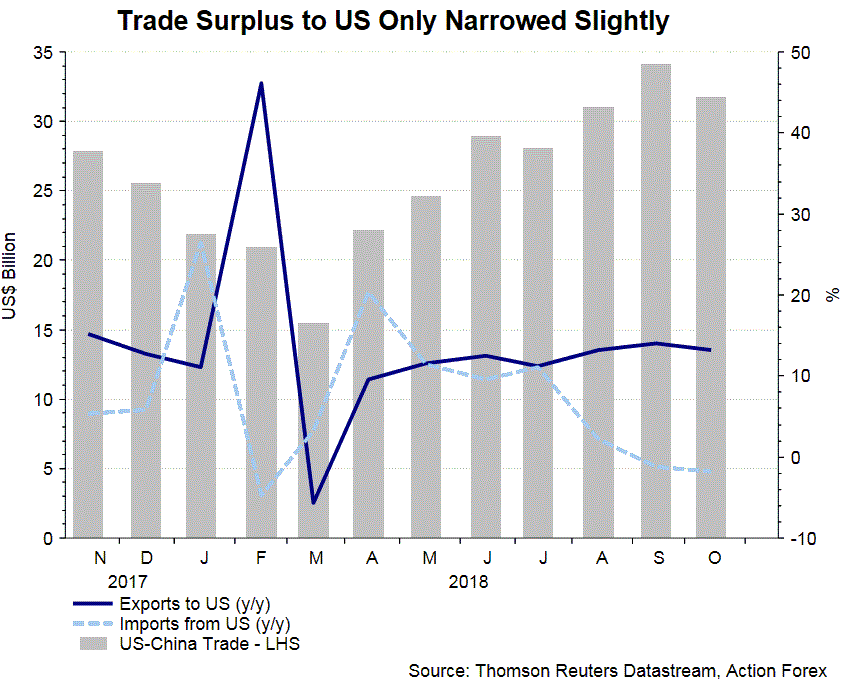
China’s trade surplus widened to US$ 34B in October. Exports grew +15.6% y/y, beating consensus of +11.7% and September’s +14.5%. Import expanded +21.4% during the month, exceeding market expectations of +14.5% and +14.3% in September. Interestingly, the headline trade data does not seem to be dragged by US’ trade tariff. Indeed, exports to the US rose +13.2% y/y. While it marked a slowdown from +14% in September, the drop was less significant than expected..
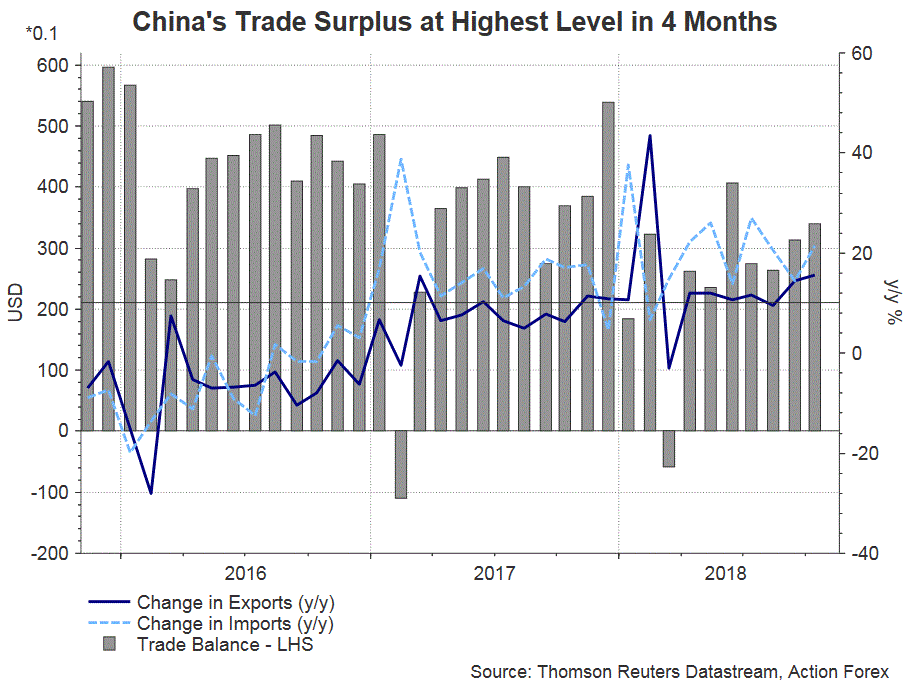
Looking into details, we found that the strong exports growth was due to increased shipment to emerging markets. Exports to Russia (+16.0% vs Sep’s +6.7%), Brazil (+22.8% vs Sep’s 3.6%), India (+24.2% vs Sep’s +20.0%), Korea (+7.7% vs Sep’s +2.7%), and Taiwan (+16.8% vs Sep’s +5%) together contributed +1% to headline growth. Economic activities appeared to have improved in these countries, as signaled in PMI reports. By contrast, export growth did not only drop in the US market, but also in other advanced economies, including EU (+14.6% vs Sep’s +17.4%) and Japan (+7.9% vs Sep’s 14.3%). This indicates China’s intention to shift its focus from the US, as well as other advanced economies, to the emerging markets. While the move away from the US is likely due to trade war, the lower growth in other advanced economies could be due to the moderation in economic activities in these countries.
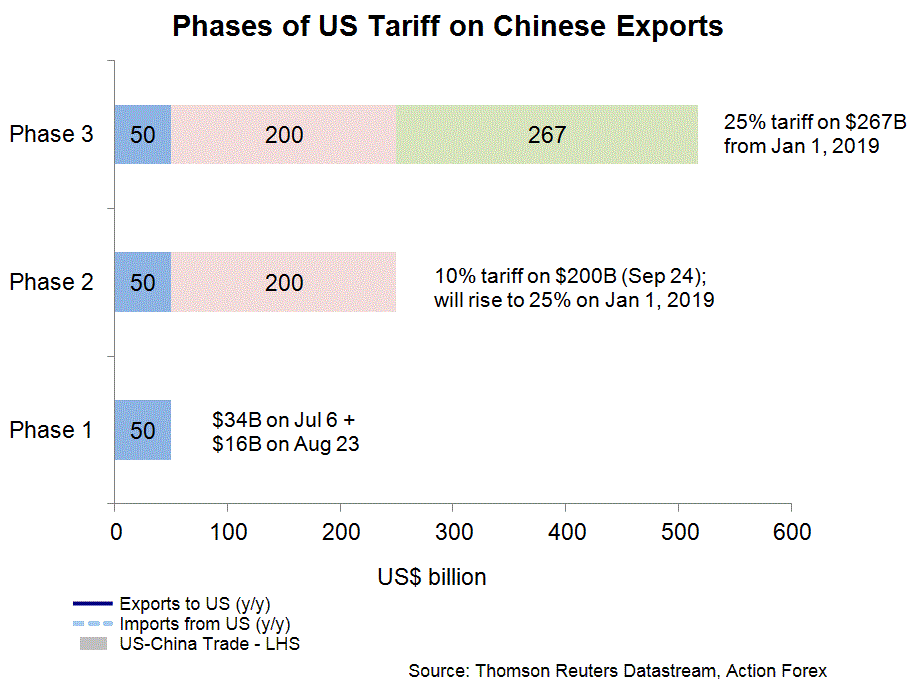
As we mentioned above, the moderation in exports growth to the US was insignificant, although the US extended the 10% tariff to US$200B of Chinese goods from September 24. We still see October’s exports distorted by the front-loading of shipping, as buyers sought to avoid another round of tariff in January 2019, when US would raise the tariff rate to 25% from the current 10%.
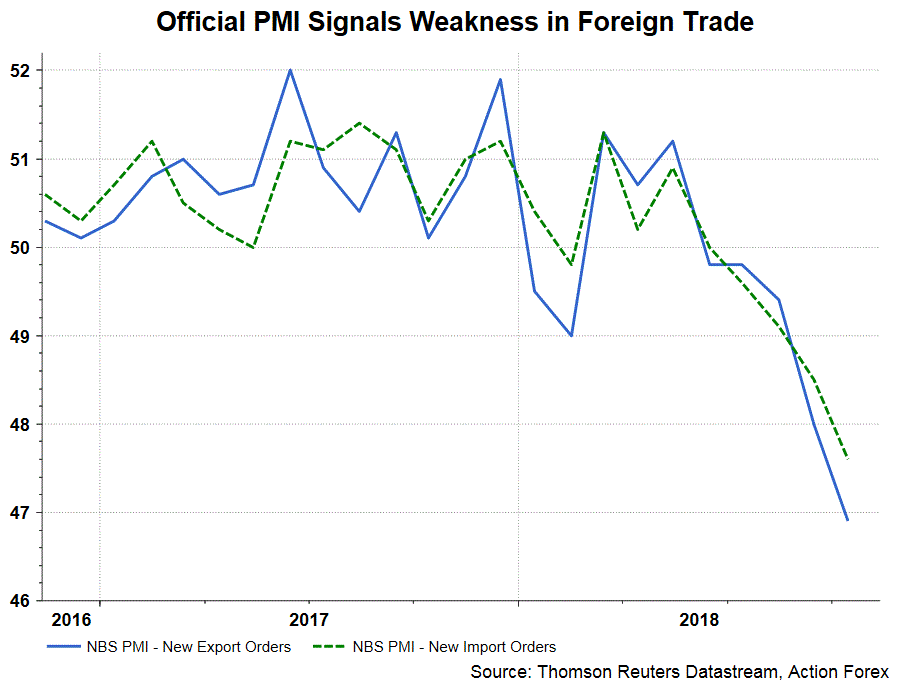
 The better- expected- than expected trade data appears contradictory to the government’s October PMI report released two weeks ago. Recall that manufacturing PMI fell -0.6 percentage point to 50.2 while non-manufacturing PMI declined -1 percentage point to 53.9. On trade activities, new orders remained in expansionary territory while export orders slipped to 46.9 from 48. A reading below 50 signals contraction. In analyzing PMI data, we should understand that it is a qualitative survey seeking response from purchasing managers on their perception of the industry. As such, their sentiment could be driven by factors other than the trade war. Meanwhile, China’s official PMIs focus on large corporations. This might signal that the impact of trade war could be more seriously experienced by small and medium firms.
Australia business confidence dragged down by employment, wage growth constrained
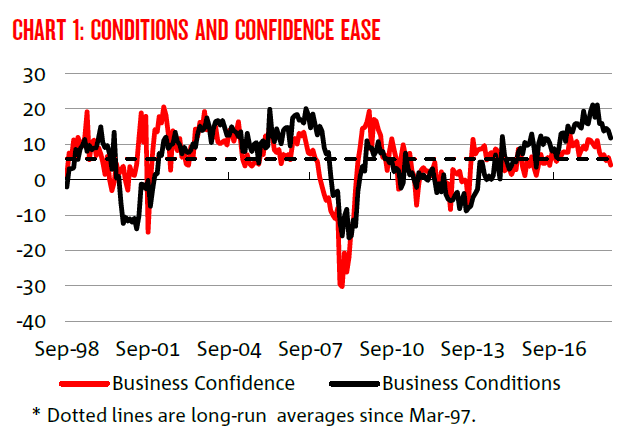
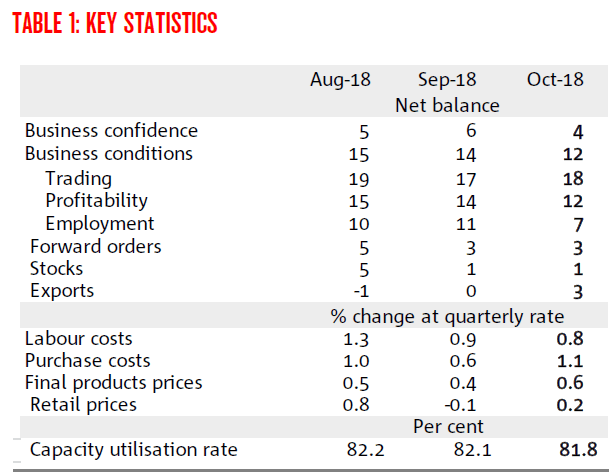
Australia NAB Business Confidence dropped 2pts from 6 to 4 in October. Business Conditions also dropped 2pts from 14 to 12. Alan Oster, NAB Group Chief Economist noted that "the decline in the month was driven by weakness in the employment component – though at these levels the survey still suggests ongoing employment growth at around 20k per month. At this rate we should see recent labour market gains maintained".
Also, it's noted in the release that "surveyed wage bill measures and the official wage price index suggest that enough spare capacity has remained in the labour market to constrain a significant pickup in wage growth". Hence, "September quarter wage data to be released later this week will show a small rise in the pace of growth but that overall wage growth will remain low relative to history."
The data certainly supports the "no rush" stance of RBA.
Stocks surge as Chinese VP Liu will visit US for trade shortly
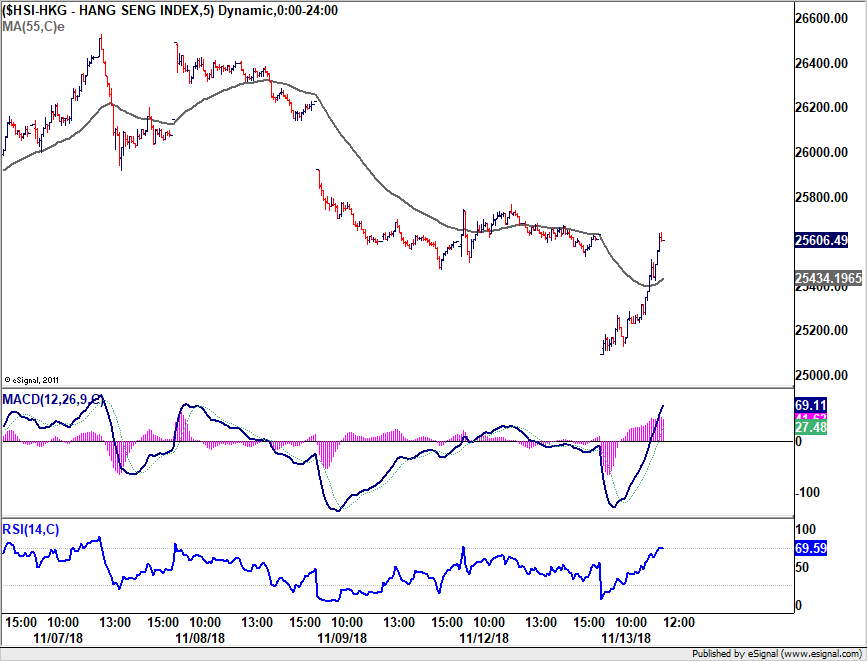
Hong Kong stocks opened the day sharply lower with HSI hitting as low as 25092.30. That followed -2.32% decline in DOW overnight. But sentiments were then lifted by US-China trade news. The HSI just had an over 500pts swing and is now at 25060.49, down just -0.1%. AUD/USD is also lifted notably after breaching 0.7182 minor support earlier today.
It's firstly reported that US Treasury Secretary Steven Mnuchin has resumed discussed with China Vice Premier Liu He on Friday. While there was certainly no breakthrough, it's a positive step on preparation for Xi-Trump meeting at G20 summit on November 30.
Then, another report emerged saying that Liu would visit the US shortly to carry on with the preparations. The Hong Kong SCMP newspaper said two sources, on both sides, have confirmed the development, even though there is no final schedule yet.
BoJ assets rose to JPY 553.6T, larger than Q2 GDP annualized
Latest data from BoJ showed that the central bank is holding JPY 553.6T of assets as of November 10. Among them, JPY 469.1T are Japanese government securities, accumulated through over five years of the Quantitative and Qualitative easing program.
The total assets now surpassed the countries' GDP. Based on Q2 (April to June) data, Japan's nominal GDP was annualized at JPY 552.8T. Q3's data might, due on Wednesday, might come in a bit lower due to natural disasters. Nevertheless, Japan is now the first among G7 countries to own a pool of assets larger than its own GDP.
The situation drew criticism that the ultra loose monetary policy is clearly not sustainable. Some noted that BoJ would suffer losses if it would have to raise interest rate. But that's not so much of an immediate problem. The bigger risk is that in case of real emergency, like a full blown disaster, BoJ will not be able to finance government bonds any more.
UK PM May: Brexit negotiations in the endgame, but significant issues remain
Addressing the lord mayor's banquet at the Guildhall in London on Monday night, UK Prime Minister Theresa May declared that "the negotiations for our departure are now in the endgame". She added, "we are working extremely hard, through the night, to make progress on the remaining issues in the withdrawal agreement, which are significant."
May believed that "both sides want to reach an agreement"even though "what we are negotiating is immensely difficult:". But she also emphasized that "this will not be an agreement at any cost".
Fed Daly: Premature to say Dec hike a definite, Fed not on autopilot
San Francisco Fed president Mary Daly said yesterday that her modal forecasts was for two to three more rate hikes over the next period. However, she also noted that "the exact timing not being certain". She went further saying that it's "premature" to say that a December rate hike is a "definite". And, "we have a lot of time between now and December to see how the economy unfolds."
Nevertheless, Daly still believed that Fed should gradually raise interest rates towards neutral. Her estimate of neutral rate is between 2.5 and 2.8%. For now, she'd "probably" pick the middle of the rate at around 2.7% as the neutral rate. She added that "gradual is helpful because it allows us to raise the rate, look around, evaluate, interpret the data and then, and only then, make another increase". And, "the frequency and size of any increase I think is something that we want to continue to have open and not be on autopilot." Also, she thought it's premature to discuss whether interest rate need to go into restrictive region.
Her comments came after giving a speech titled "A Strong Economy—But We Can Aim Higher". There she said that the current state of economy is "very good". But "some people are getting left behind". She said essentially all labor market indicates are "flashing bright green" and signaled the US labor market is "indeed at full employment". The "key exception is continued low rates of labor force participation". While monetary policy can't directly cure the participation problem, Fed can help by "keeping the expansion going". She also noted that there are "upside potential for US workforce participation".
Market Morning Briefing: EUR/JPY Has Support Near 127
STOCKS
The hesitation to move up in most Indices (mentioned yesterday) converted itself into a big fall yesterday, bring the markets close to some of the long-term Supports we mentioned yesterday. While those Supports hold, it can be debated Whether long-term bearishness has already kicked in. On the other hand, is the market already pricing in a global slowdown is a question we ask ourselves.
Big fall overnight in the Dow (23387, -602, -2.32%), pulled down by Apple, exceeding our bear target of 25500 for the week. Now, if the 25250-25000 psychological Supports do not hold, then the market will target range Support at 24500-24250. We would expect that to hold for some time, perhaps even produce a bounce.
The DAX (11325, -204, -1.77%) also saw a large fall yesterday, and may try to retest the long-term Support at 11051 in case the immediate Support near 11300 breaks.
The Nifty (10482.20, -103.00, -0.97%) and Sensex (34812.99) also fell yesterday. It is to be seen if they now attract Buyers between 11400-250 and between 34500-34000 respectively, as we currently expect them to. SGX Nifty is quoting near 10453.
The Nikkei (21579) has seen a massive fall today, already coming close to the 21500-250 long-term Support region mentioned yesterday. We have to see if this Support holds over the rest of the week.
Strikingly, the Shanghai (2624), which has often been the loss-leader this year, but had moved UP a bit yesterday, is showing only a minor loss today, perhaps on some optimism of a thaw in the US-China trade war.
As mentioned, we would not want to turn long-term bearish yet while mentioned Supports hold. Let us see how they fare in the next few days.
COMMODITIES
Almost all major commodities have important support levels and could bounce back in the medium term. The next few sessions could see the current fall to continue and gradually stabilize before a bounce is seen.
Resistance near 72 seems to be holding strong just now for Brent (69.41). Although we saw a bounce from last week’s low of 69.13, the rise has not been able to sustain as the price has fallen back to trade at 69.41 currently. Brent weekly line chart shows a possibility of testing 65 on the downside. Immediate fall towards 67 looks likely while below 72. A break above 72 if seen would initiate a reversal, negating the downside possibility.
WTI (59.20) is trading just above support levels near 58.0-58.50 and a bounce from here could be expected towards 65-66 levels in the next few sessions.
Gold (1204.50) has fallen in line with our expectation. Immediate channel support is visible near 1200 as seen on the 3-day and weekly candle charts. While 1200 holds, Gold could rise back towards 1225-1230 or even higher in the medium term.
Copper (2.6745) is trading slightly lower today. Support mentioned yesterday at 2.65 is still holding well. The 3-day candle show a possibility of testing 2.60 too on the downside but preference is for 2.65 to hold and produce a bounce towards 2.75-2.80 again in the medium term.
FOREX
Dollar Index (97.56) has moved above 97.50 mentioned yesterday. Immediate resistance is seen near 97.80-98.00 which is likely to produce some rejection in the near term. Break above 98 would open up chances of moving higher towards 99-100 in the longer run indicating weakness for major currencies against the Dollar. For now we watch price action near 98.
Euro (1.1233) could see a slight rise towards 1.1280 before again targeting lower levels of 1.1150-1.1100 in the near term. There is scope of falling further in the near term and a near term bottom could be seen near 1.11 or slightly lower as seen in the daily line chart. Near term looks bearish towards 1.11. The support mentioned yesterday at 1.13 has broken, now forcing us to look for a fall towards 1.11.
USD/JPY (113.71) seems to be breaking below yesterday’s mentioned support at 113.75 on the daily candles and while the fall sustains it could target 113 in the near term. View is bearish for the week while below 113.75.
Aussie (0.7178) is trading just above the immediate support near 0.7175-0.7150 mentioned yesterday and while that holds, a bounce back towards 0.7200-0.7250 could be expected. A break below 0.7150, if seen could take it down to 0.71 in the near term. Note that the pair has faced rejection from the 21-Week MA on the weekly line chart and while that holds, the pair is likely to remain bearish for the coming sessions.
Pound (1.2864) has been sharply falling from resistance near 1.32 since last week. The momentum indicates the fall to continue targeting 1.27 on the downside which is a decent support and could produce a bounce towards 1.28-1.29 in the longer run. Immediate view is bearish.
EUR/JPY (127.78) has support near 127 and while that holds, a bounce back to levels near 128.5-129.0 is possible.
USDINR (72.90) is likely to range in the 72.45-73.10 with a slight bearish bias in the near term. While the pair closed at 72.89/90 yesterday, we could see a test of 72.60 today within the mentioned range of 72.45-73.10.
INTEREST RATES
Yields, in general, are quoting a little lower in the developed world.
The US 10Yr is quoted lower at 3.15% on Bloomberg as compared to 3.18% a day before. The 2Yr (2.89%) and 30Yr (3.35%) also quote lower, compared to 2.93% and 3.39% respectively earlier. If the dip sustains then we might think of 3.10% and 3.00% on the 10Yr instead of 3.30% on the upside. Of course, a trend-change will need a break below 3.00%, which is not easy.
Importantly, he German-US 2Yr Spread (-3.51%) has moved up slightly from -3.54% earlier. There is an important near-term Resistance at current level. A break above -3.50%, if seen, will trigger a significant rise to -3.40%. This is to be watched over the next couple of days.
The Japanese 10Yr (0.10%) might have broken below the support at 0.11% mentioned yesterday. If the Yield does not bounce back from here today, we may have to look for 0.08-0.07% on the downside.
However, contrary to the dip in Yields in the G-3, In India, the 10Yr GOI is quoted higher at 7.8044%, implying that the important Support at 7.75% is holding for the while. We need to see if there is a fall again today, given that the October CPI has come in lower at 3.31% and Brent ($69.46) is again trading below $70.
GBP/USD Settles Below 1.3000 Ahead Of Jobs Report
Key Highlights
- The British Pound declined recently below the 1.3000 and 1.2940 supports against the US Dollar.
- There is a crucial bearish trend line in place with resistance at 1.3160 on the 4-hours chart of GBP/USD.
- The Italian Industrial Output in Sep 2018 declined 0.2%, less than the -0.7% forecast.
- Today, the UK Claimant Count figure for Oct 2018 will be released, which is forecasted to change by 4.3K.
GBPUSD Technical Analysis
This past week, the British Pound corrected higher sharply above 1.2900 against the US Dollar. However, the GBP/USD pair failed to break the 1.3170 and 1.3180 resistances, resulting in a fresh decline.
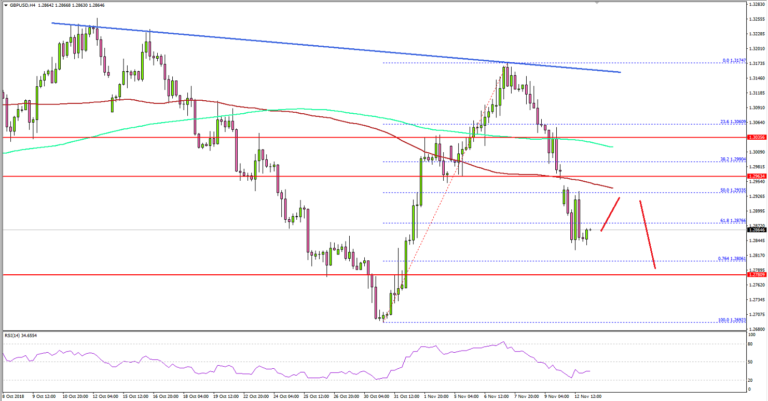
Looking at the 4-hours chart, the pair traded as high as 1.3174 and later started a sharp decline. The pair traded below the 1.3000 support area and the 100 simple moving average (red, 4-hours).
More importantly, there was a break below the 61.8% Fib retracement level of the last major upward move from the 1.2692 low to 1.3174 high. It seems like buyers lost control below 1.3000, which could result in more losses in the near term.
If there is a break below the 1.2800 support and the 76.4% Fib retracement level of the last major upward move from the 1.2692 low to 1.3174 high, the pair could slide towards the 1.2700 support.
On the other hand, if there is an upside correction, the pair may perhaps face sellers near the 1.2940 level and the 100 simple moving average (red, 4-hours). Besides, there is a crucial bearish trend line in place with resistance at 1.3160 on the same chart.
Overall, GBP/USD is currently trading in a bearish zone below 1.3000 and any major upward move is likely to face a lot of selling interest.
However, the UK Claimant Count figure for Oct 2018 and the ILO Unemployment Rate will be released today. If the outcome is positive, there are chances of a decent recovery above 1.2940 and 1.3000. If not, the pair could slide further below 1.2800 in the near term.
Economic Releases to Watch Today
- German Consumer Price Index for Oct 2018 (YoY) – Forecast +2.5%, versus +2.5% previous.
- German Consumer Price Index for Oct 2018 (MoM) – Forecast +0.2%, versus +0.2% previous.
- German ZEW Business Economic Sentiment Index for Nov 2018 – Forecast -25.0, versus -24.7 previous.
- UK Claimant Count Change Oct 2018 – Forecast 4.3K, versus 18.5K previous.
- UK ILO Unemployment Rate Sep 2018 (3M) – Forecast 3.0%, versus 2.7% previous.
Brexit, Apple, Goldman & More
There was no shortage of factors damaging stocks and spurring the US dollar. US indices had the highest rally since October technology companies were damaged by downgrade in outlook by Apple's suppliers and by Goldman Sachs' further engulfing in the Malaysia sovereign wealth fund scandal. The pound fluctuated +-100 pips before sinking later in the session as Brexit worries flared on talk that some cabinet members won't support current offers.The Premium DOW30 short trade hit its final target for 580-pt gain. Today's Premium video, titled "4-Point Plan" lays out the Ashraf's take on the future course for indices, yields and USDJPY. The US dollar was the top performer while the pound lagged. UK employment data is due up on Tuesday.
Cable fell 120 pips on Monday as the market's patience wears thin for a Brexit deal. Finding an Irish border deal that can be supported by May, the DUP, Conservatives the EU and UK parliament is proving to be a near-impossible task.
The main negotiators continue to highlight progress but repeated leaks highlight problems and discord. Cable made a huge jump at the start of last week but has now given most of it back in three days. There is still some breathing room before the 1.2662 August low but that's a critical level. The recent series of lower highs isn't encouraging.
The eurozone is facing its own problems as EUR/USD fell a full cent to start the week with the Italian deadlock continues as the ruling coalition continues to challenge Brussels' budget limits.
There was no help from stock markets as the S&P 500 tumbled nearly 2% led once again by technology shares. Apple fell to the 200-day moving average and is down 17% from the October high in a sign of how aggressive the selling has become.
Oil bulls continue to take a beating as the OPEC chatter led to a climb at the open followed by a wave of selling that sent WTI down $1.38 to $58.82 in an eleventh consecutive day of declines. USD/CAD rose to the highest since July with Canadian oil down to $16.
Looking ahead, UK fundamentals will briefly steal the spotlight on Tuesday with employment data due out at 0.930 GMT. The unemployment rate is expected to be steady at 4% with weekly earnings forecast to rise to 3.0% from 2.7%. A weak reading could send cable down to the August lows.