

Sample Category Title
Canadian Dollar Quiet as US, Canadian Banks Closed
The Canadian dollar has ticked higher in the Monday session. Currently, USD/CAD is trading at 1.3193, down 0.07% on the day. Canadian and U.S banks are closed for a holiday, so traders should not expect much movement from the pair on Monday. There are no Canadian events and just one minor event in the United States.
Inflation continues to rise higher in the United States. On Friday, the Producer Price Index (PPI) jumped 0.6%, its sharpest gain since January 2017. This easily beat the estimate of 0.2%. Core PPI was also sharp, with a gain of 0.5%, compared to a gain of 0.2%. Stronger inflation will reinforce expectations that the Fed will hike rates hike in December. Currently, the odds of a quarter-percent rate hike stands at 76%. On the consumer front, UoM consumer sentiment dropped to 98.3, down from 99.0 points. Still, this beat the forecast of 98.0 points.
The Canadian economy continues to perform well, but strong numbers have not been enough to boost a struggling Canadian dollar. This was underscored on Thursday by a superb reading from Ivey PMI, a key gauge of economic activity. The indicator surged to 61.8 in November, up sharply from 50.4 in October. This reading easily beat the estimate of 50.9 points. Earlier this week, Bank of Canada Governor Stephen Poloz said that the Bank would continue gradually raising rates from the current 1.75% to a “neutral stance” of between 2.5% and 3.5%. The magic question for investors is how quickly the BoC will move in this direction. The BoC has raised rates some five times in the past 15 months, and upcoming rate hikes will help make the Canadian dollar an attractive option for investors.
DAX Starts off Week With Sharp Losses as Market Volatility Continues
The DAX index has recorded sharp losses Monday session. Currently, the DAX is trading at 11,364, down 1.41% on the day. In economic news, there are no German or eurozone events. On Tuesday, Germany releases ZEW Economic Sentiment, with the markets braced for a poor reading of -24.2 points.
European stock markets continue to show volatility, as investors keep a nervous eye on two simmering issues. One is Brexit, where Prime Minister May is facing stiff opposition over her Brexit proposals. British and European negotiators met on the weekend but were unable to resolve the Irish border issue. The EU wants a backstop solution to be under the jurisdiction of the European Court of Justice, but the UK is unlikely to agree to such a proposal.
The standoff between Italy and the EU over Italy’s budget could escalate this week. The EU Commission has demanded that Italy revise its budget by Tuesday, which it argues raises Italy’s debt and is in breach of EU fiscal rules. If Italy refuses to comply, the EU could impose financial sanctions on Rome. For its part, the Italian government says that the economic slowdown requires an expansionary budget. Italy has suggested that it will lower its GDP forecast, in order to meet the EU requirements. Italy is the third largest economy in the eurozone, and the financial markets and the euro could react negatively if Rome and Brussels cannot resolve the crisis.
USD/CHF Mid-Day Outlook
Daily Pivots: (S1) 1.0037; (P) 1.0061; (R1) 1.0080; More...
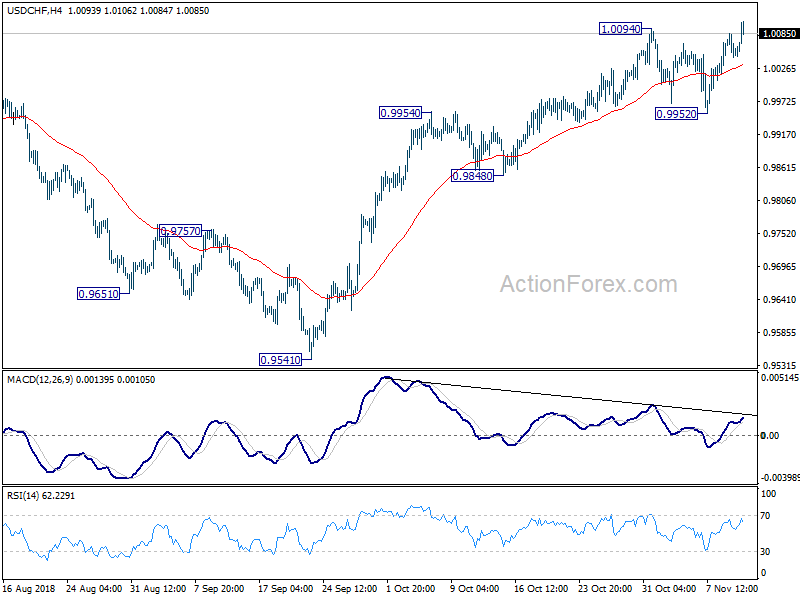
USD/CHF's break of 1.0094 resistance suggests rise resumption. Intraday bias is back on the upside. Current rally from 0.9186 would target 1.0342 key resistance. On the downside, break of 0.9952 support is needed to indicate short term topping. Otherwise, outlook will remain cautiously bullish as long as 0.9952 support holds.
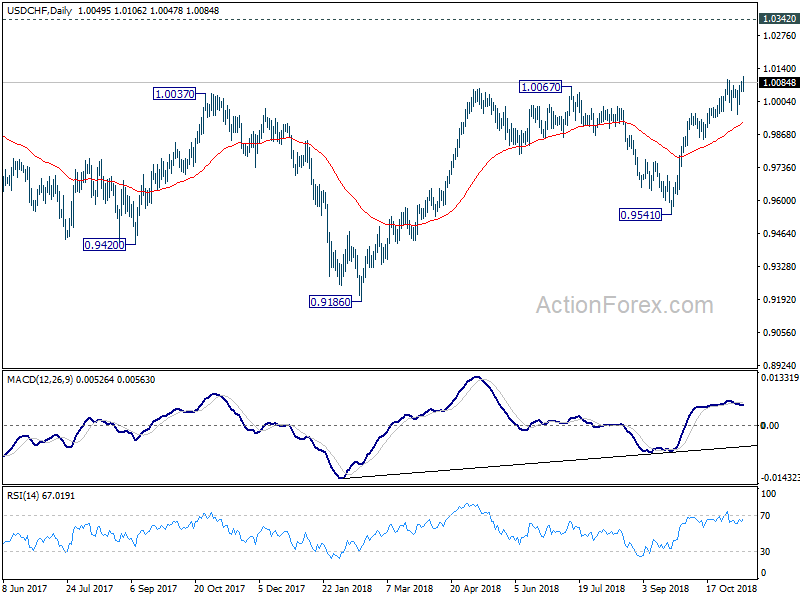
In the bigger picture, the pullback from 1.0067 has completed at 0.9541 already. And rise from 0.9186 is likely resuming. Firm break of 1.0067 will pave the way to retest 1.0342 key resistance. We'd be cautious on strong resistance from there to limit upside to bring another medium term fall to extend long term range trading. However, firm break of 0.9848 near term support will dampen this view and bring deeper decline back to 0.9541 support and possibly below.
USD/JPY Mid-Day Outlook
Daily Pivots: (S1) 113.60; (P) 113.85; (R1) 114.05; More..
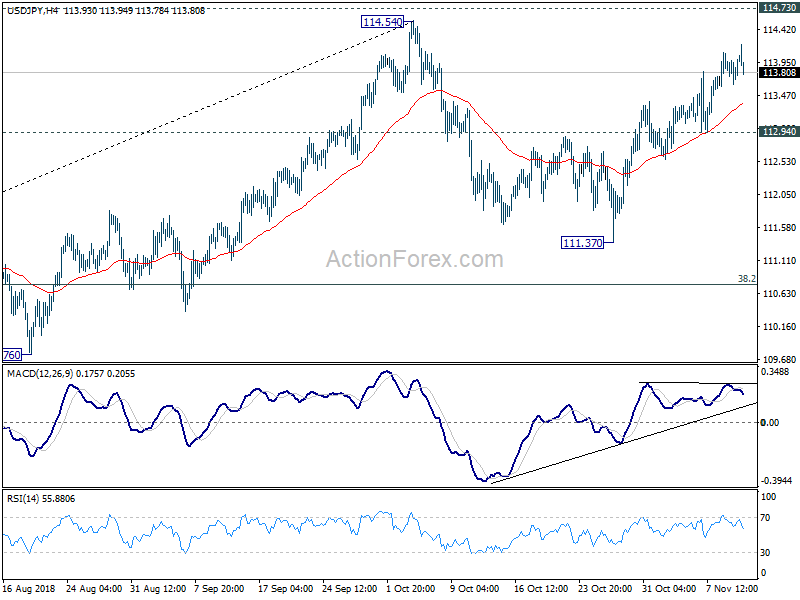
USD/JPY's rebound from 111.37 is still in progress. Despite diminishing upside momentum, further rise is still expected t 114.54/73 resistance zone. We'd be cautious on strong resistance from there to bring another fall to extend recent consolidation. Overall, rise from 104.62 is still in progress and decisive break of 114.73 will confirm resumption.
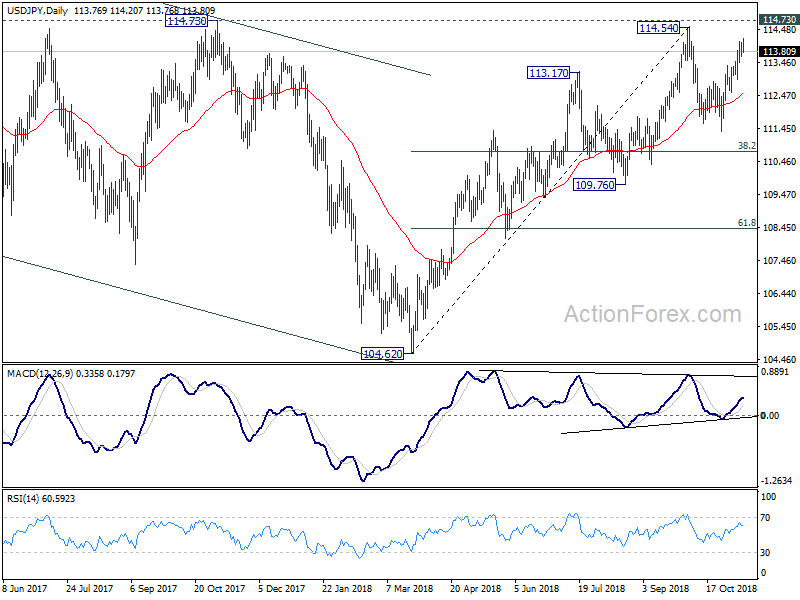
In the bigger picture, corrective fall from 118.65 (2016 high) should have completed with three waves down to 104.62. Decisive break of 114.73 resistance will likely resume whole rally from 98.97 (2016 low) to 100% projection of 98.97 to 118.65 from 104.62 at 124.30, which is reasonably close to 125.85 (2015 high). This will stay as the preferred case as long as 109.76 support holds. However, decisive break of 109.76 will dampen this bullish view and turns outlook mixed again.
GBP/USD Mid-Day Outlook
Daily Pivots: (S1) 1.2928; (P) 1.3003; (R1) 1.3047; More...
Intraday bias in GBP/USD remains on the downside as fall from 1.3174 is in progress. Deeper decline would be seen back to 1.2661/92 key support zone. Decisive break there will resume larger down trend from 1.4376. On the upside, above 1.2946 minor resistance will turn intraday bias neutral first. But recovery should be limited below 1.3174 resistance to bring fall resumption.
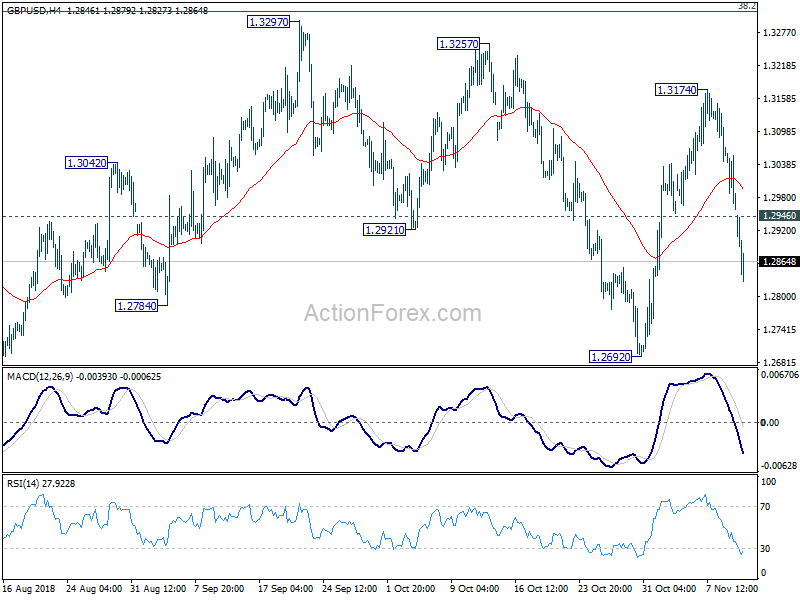
In the bigger picture, whole medium term rebound from 1.1946 (2016 low) should have completed at 1.4376 already, after rejection from 55 month EMA. The structure and momentum of the fall from 1.4376 argues that it's resuming long term down trend. And this will be the preferred case as long as 38.2% retracement of 1.4376 to 1.2661 at 1.3316 holds. However, firm break of 1.3316 would bring stronger rebound to 61.8% retracement at 1.3721. And, the eventual depth of the fall from 1.4376, and the chance of hitting 1.1946 low, will depend on the strength of the interim corrective rebound from 1.2661.
EUR/USD Mid-Day Outlook
Daily Pivots: (S1) 1.1311; (P) 1.1340; (R1) 1.1365; More....
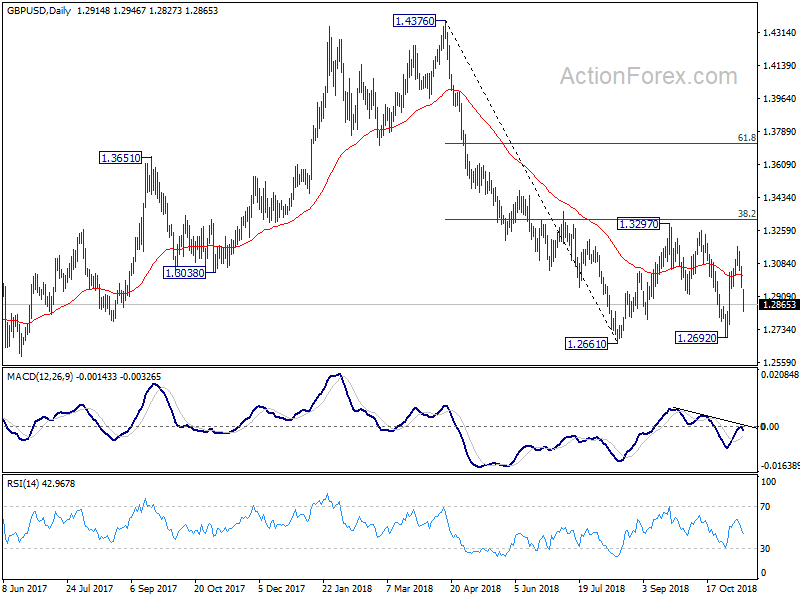
EUR/USD's accelerates to as low as 1.1240 so far. Break of 1.1300 key support confirms resumption of whole decline trend from 1.2555. Intraday bias stays on the downside for 1.1186 fibonacci level first. Break will target 61.8% projection of 1.2555 to 1.1300 from 1.1814 at 1.1038 next. On the upside, above 1.1330 minor resistance will turn intraday bias neutral first. But recovery should be limited below 1.1499 resistance to bring fall resumption.
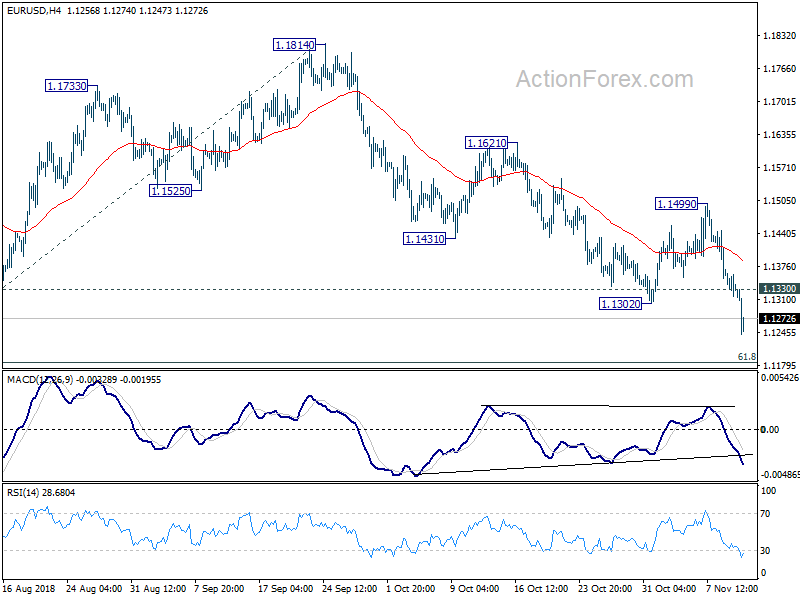
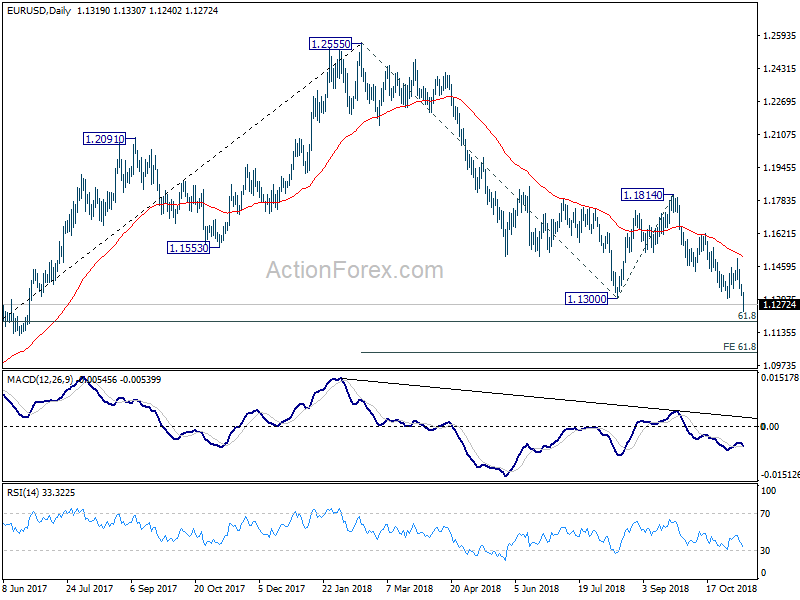
In the bigger picture, down trend from 1.2555 medium term top has just resumed and should target 61.8% retracement of 1.0339 (2017 low) to 1.2555 at 1.1186 next. Sustained break there will pave the way to retest 1.0339. On the upside, break of 1.1814 resistance is now needed to confirm medium term bottoming. Otherwise, outlook will stay bearish in case of recovery.
More Upside in Dollar after Breaking Key Resistance, Sterling Selloff Continues
Sterling continues to trade as the weakest one for today as negative Brexit news fly around. It's reported that European Council President Donald Tusk has given UK Prime Minister Theresa May a deadline for an extra November summit. And enough progress has to be made by this Wednesday night. So far, there is little hope to achieve anything significant within that short time frame. In particular, May is losing more support from her own party on the Irish backstop exit. That is, it's clear that May wouldn't have enough for for the plan if UK cannot quit the backstop unilaterally.
Euro is following as the second weakest on Italy-EU budget showdown. Italy will resubmit a new or revised plan tomorrow. There could be disciplinary actions by the European Commission if they're not satisfied with the plan. The development also drags down Swiss Franc. On the other hand, Canadian Dollar is the strongest one for today, partly because it's digesting last week's loss. And, it's partly because Saudi Arabia announced to cut oil exports by 500k bpd starting December. Dollar and Yen follow as the next strongest.
Technically, EUR/USD finally broke 1.1300 key support to resume medium term down trend from 1.2555. USD/CHF also broke 1.0094 resistance to resume recent rebound. GBP/USD's break of 1.2951 earlier today is a sign of weakness too. Condition is now set for more rally in Dollar. And 0.7182 minor support in AUD/USD starts to look vulnerable.
In other markets, FTSE is trading down -0.18% at the time of writing. DAX is down -0.86% and CAC is down -0.25%. German 10 year yield is down -0.023 at 0.386, back below 0.4 handle. Italian 10 year yield is up 0.051 at 3.449. German-Italian spread is back above 300. Earlier today, Nikkei closed up 0.09%, Hong Kong HSI up 0.12%, China Shanghai SSE up 1.22%, Singapore Strait Times down -0.32%. 10 year JGB yield closed down -0.0071 at 0.118, which is a sign of market cautiousness.
BoE Broadbent warns sequence of Brexit events in the coming months could change economic outlook materially
BoE Deputy Governor Ben Broadbent reiterated in a CNBC interview that the central bank's forecasts were "conditioned on an assumption that there will be a deal" on Brexit. In particular, there would be a "transition period agreed". And to him, a Brexit deal is still "the most likely outcome". However, he also emphasized that "the sequence of events over the next two to three months could change the outlook materially,"
On recent volatility in Pound exchange rate he noted "obviously, over time, every day there are headlines, positive, negative, which will send the currency in particular in one direction or the other."
On the economy, He said that "even though GDP (gross domestic product) growth has been weaker than certainly pre-crisis rates, it's been strong enough to allow the unemployment rate to fall further to reach 40-year lows and that in turn has been strong enough to push our wage growth which is momentarily higher since any time since the crisis,"
He added that "we've certainly seen stronger figures, not just in the official data but in many of the pay surveys, than we've seen for many years." And, the MPC "always believed that the same old rules applied — that as the labor market tightened you would begin to see faster wage growth, and that's indeed what we've seen."
Italy Maio: Respecting EU budget limit is suicidal
Italy was requested by the European Commission to submit a new or revised draft budget plan (DBP) by November 13, tomorrow, after rejection. Ahead of that Deputy Prime Minister Luigi Di Maio continued with populist rhetoric and said respecting EU budget limit is suicidal. The Prime Minister's office also denied that there would be cabinet meeting today. We'll see what revised plan they're going to re-submit to the European Commission tomorrow.
Nevertheless, it's also reported that Economy Minister Giovanni Tria is considering to tweak the plan by lowering 2019 growth forecast. According to Italian coalition government's own budget, 2019 GDP growth is projected at 1.5%. And, the budget deficit target is 2.4% of GDP. Tria has pledged last week to maintain the "pillars" of the budget. And clearly, the pillars don't necessarily include growth forecast.
La Repubblica reported that Tria could cut the growth estimate to 1.0%. On the other hand, Il Messaggero said he could cut the forecast to 1.2%. According to European Commission's own projections, Italy's growth would be at 1.2% in 2019. Also Tria might also look at automatic mechanism to cut public expenses to keep deficit under the 2.4% cap.
ECB VP de Guindos: Some risks are building up in the financial system
ECB Vice President Luis de Guindos warned in a speech today that while the fundamentals for solid growth rates over the next two years are still in place, some risks are building up in the financial system. The first one is that current US expansion is "now significantly longer than historical norms". A down turn in the US "could trigger a reassessment of riskier asset classes."
Secondly, "tensions have grown in emerging market economies: due to strong US Dollar and increased trade frictions. Such developments may "undermine global growth prospects and ultimately lead to abrupt increases in risk premia".
Thirdly, there were "re-emerging debt sustainability concerns" in Europe, both in public and private sector. And, "Italy is the most prominent case at the moment". Meanwhile, "strong market reactions to political events have triggered renewed concerns about the sovereign-bank nexus in parts of Europe" But contagion has been "limited" so far.
Bank of France: Q4 GDP to grow 0.4%
Bank of France manufacturing business sentiment indicator dropped to 103 in October, down from 104. The slowdown was "essentially because of a sluggish automobile sector."
Services business sentiment indicator was unchanged at 102. Construction business sentiment indicator rose to 106, up from 105. "Construction sector activity grew significantly, for both structural and finishing works."
Bank of France said according to the monthly index of business activity, GDP should grow 0.4% in Q4.
China MOFCOM: US trade friction has limited impact, but 2019 more adverse and complex
The Chinese Ministry of Commerce released Fall 2018 "China Foreign Trade Situation Report" today. In a statement, MOFCOM noted that China's foreign trade maintained a "stable and good trend" and in 2018 up to Q3. And, the current US-China trade friction has "limited impact" on China's foreign trade.
MOFCOM also noted that current international demand is "relatively stable". Domestic demand is "growing steadily". And conditions exist for steady growth in foreign trade. Nonetheless, with higher base effect, Q4's import and export growth could be dragged down.
Additionally, MOFCOM also said 2019 trade development will be "more adverse and complex". It noted increasing downside risks in the world economy and protectionism. The report urged measures like reducing burden on bother import and export businesses, and real implementation of trade policies.
Japan PM Abe to boost infrastructure spending to ensure recovery continues
Japanese Prime Minister Shinzo Abe is pushing for more public infrastructure spending in the upcoming fiscal year. At the Council on Economic and Fiscal Policy (CEFP) meeting today, Abe requested his cabinets to draw out plans with focuses strengthening infrastructure to withstand earthquakes and frequent flooding.
Economy Minister Toshimitsu Motegi said after the CEFP that "the prime minister asked me to take firm measures to ensure that our economic recovery continues." Motegi added that Abe also said "public works spending program expected at the end of this year should be compiled with this point in mind."
A preliminary public works plan will be compiled by the end of this month and the final version would be ready by the end of the year.
EUR/USD Mid-Day Outlook
Daily Pivots: (S1) 1.1311; (P) 1.1340; (R1) 1.1365; More....
EUR/USD's accelerates to as low as 1.1240 so far. Break of 1.1300 key support confirms resumption of whole decline trend from 1.2555. Intraday bias stays on the downside for 1.1186 fibonacci level first. Break will target 61.8% projection of 1.2555 to 1.1300 from 1.1814 at 1.1038 next. On the upside, above 1.1330 minor resistance will turn intraday bias neutral first. But recovery should be limited below 1.1499 resistance to bring fall resumption.
In the bigger picture, down trend from 1.2555 medium term top has just resumed and should target 61.8% retracement of 1.0339 (2017 low) to 1.2555 at 1.1186 next. Sustained break there will pave the way to retest 1.0339. On the upside, break of 1.1814 resistance is now needed to confirm medium term bottoming. Otherwise, outlook will stay bearish in case of recovery.
Economic Indicators Update
| GMT | Ccy | Events | Actual | Forecast | Previous | Revised |
|---|---|---|---|---|---|---|
| 23:50 | JPY | Domestic CGPI Y/Y Oct | 2.90% | 2.80% | 3.00% | |
| 06:00 | JPY | Machine Tool Orders Y/Y Oct P | -1.10% | 2.90% |
Dollar Index Registers Fresh Highs as Pound and Euro Struggle; Oil Holds Up
Here are the latest developments in global markets:
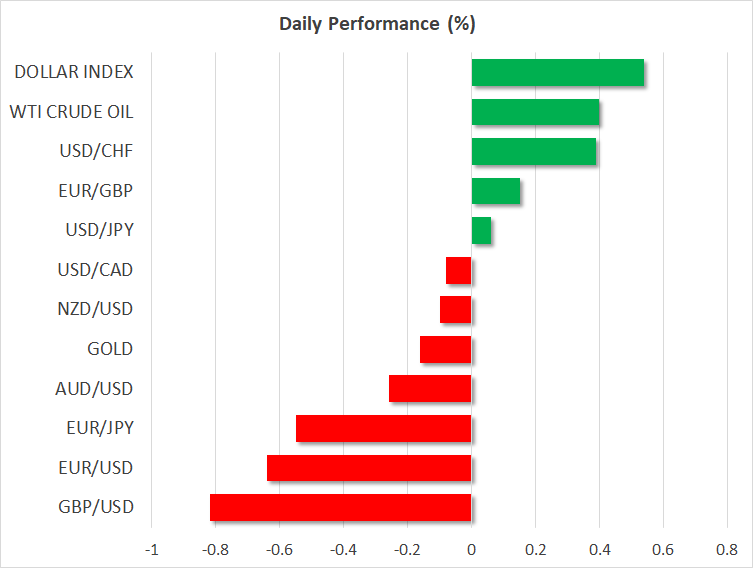
- FOREX: The dollar was overperforming early in the European session on Monday as political uncertainties in Europe and strong optimism on the US economy, persuaded traders to invest more in the greenback despite Trump’s Republicans losing control of the House of Representatives last week. The dollar index gained 0.60% to rise as high as 97.57, a level never seen since June 2017. Dollar/yen spiked to a five-week high of 114.20, but it soon returned to 113.91, near its opening price. The British pound was under severe pressure, diving by more than 1.0% to 1.2839 against the US dollar as Brexit concerns resurfaced. The UK Prime Minister keeps feeling pressure from her cabinet and it seems that she might not be able to secure an agreement this month as ministers continue to oppose her Brexit plan, a few months before the exit date. On Saturday, UK’s transport minister and brother of Boris Johnson, Jo Johnson, resigned from the government over his Brexit divisions. Pound/yen slipped by 0.87%, whereas euro/pound held on the upside, adding 0.37% to its performance. Meanwhile in the eurozone, the sentiment was not better as the clock was ticking down for Italy which has until tomorrow to revise its draft budget plan rejected by the EU. Rome however, has not shown any signs of compromise yet to lower the 2.4% deficit target for 2019. Besides Italy, trade is another topic of worry in the eurozone as US tariffs on EU cars will eventually take effect next year if the two sides fail to find common ground. On the monetary front, ECB member Luis de Guindos said that growth in the EU is turning to normal levels after an unusual progress in 2017, pointing to weakening external demand for the slowdown. Euro/dollar posted a fresh 1 ½ -year low at 1.1237 before inching up to 1.1260 (-0.67%). The antipodean currencies were on the back foot for the third straight day after a substantial rally last week. Aussie/dollar and kiwi/dollar pulled back by 0.32% and 0.18% correspondingly. Dollar/loonie was flat at 1.3210, slightly below Friday’s almost four-month high of 1.3231.
- STOCKS: Despite starting the day higher, European equities returned to negative territory at 1150 GMT as fears over Brexit, the Italian budget and the US-Sino trade war clouded sentiment in the markets. The pan-European STOXX 600 was down by 0.36% at 1130 GMT and the blue-chip Euro STOXX 50 was lower by 0.32%, with technology losing the most. The German DAX 30 declined by 0.74%, the French CAC 40 inched down by 0.21% and the Italian FTSE MIB pulled back by 0.53%. The British FTSE 100 retreated by 0.15%. In Asia, stocks closed mostly positive, while in the US futures tracking the S&P 500, Dow Jones and Nasdaq 100 were steady, pointing to a flat open.
- COMMODITIES: Oil prices opened with a gap higher on Monday after closing in the red for the fifth consecutive week on Friday. The market faced significant tailwinds today following news that OPEC and its allies have discussed a potential supply reduction to curb the fall in oil prices during the weekend. In addition, Saudi Arabia announced that it will proceed with a 500,000 bpd cut in December versus November. WTI crude was up by 0.50% on the day at $60.49/barrel and the London-based Brent was trading higher by 1.14% at $70.98/barrel. In precious metals, gold extended last week’s declines to a one-month low of $1203.36 (-0.21%), resuming its neutral profile from August 17.
Day Ahead: Calendar lacks important releases; focus turns to Brexit and Italian politics
With the economic calendar lacking releases, investors will turn their attention on Brexit and the Italian-EU budget standoff.
On the political front, the deadline for Italy to submit its revised budget to the EU Commission is on Tuesday. The Commission said that Italy’s deficit could end up as high as 2.9% in 2019, instead of 2.4% as Rome is insisting. On Friday, Italy’s finance minister Giovanni Tria mentioned that he has no intention of altering Italy’s 2019 spending plans, while comments by the Italian Deputy PM, Luigi Di Maio today signalled that an adjustment of the proposed plans by tomorrow is unlikely. Consequently, it would be interesting to see whether the EU will reject again the revised plan and potentially open the process for sanctions against Rome. However, no country has been sanctioned for breaking EU spending limits ever before.
The sharp sell-off in sterling today came obviously once again due to the lack of Brexit progress which played down hopes that a deal could be reached later this month as some government officials supported previously. The ongoing disagreement between the UK Prime Minister Theresa May and her Cabinet probably led May to call off a special cabinet meeting on Brexit today, even if government sources argued that a cabinet meeting was never on today’s schedule. On the positive side, James Slack, a spokesman to the UK PM expressed today hopes that ministers will continue to support May, adding that negotiations are ongoing although differences remain on the Irish border front.
In terms of public appearances, at 1930 GMT, Federal Reserve Bank of San Francisco President Mary Daly will be speaking on the economic outlook.
Noteworthy, that US bond markets will be closed on Monday due to the Veterans’ Day holiday.

Euro Skids to 17-Month Low
EUR/USD has picked up where it left off last week and continues to lose ground. Currently, the pair is trading at 1.1264, down 0.53% on the day. On the release front, there are no major releases out of the eurozone or the United States. On Tuesday, Germany releases ZEW Economic Sentiment, with the markets braced for a poor reading of -24.2 points.
Inflation continues to rise higher in the United States. On Friday, the Producer Price Index (PPI) jumped 0.6%, its sharpest gain since January 2017. This easily beat the estimate of 0.2%. Core PPI was also sharp, with a gain of 0.5%, compared to a gain of 0.2%. Stronger inflation will reinforce expectations that the Fed will hike rates hike in December. Currently, the odds of a quarter-percent rate hike stands at 76%. On the consumer front, UoM consumer sentiment dropped to 98.3, down from 99.0 points. Still, this beat the forecast of 98.0 points.
The standoff between Italy and the EU over Italy’s budget could escalate this week. The EU Commission has demanded that Italy revise its budget by Tuesday, which it argues raises Italy’s debt and is in breach of EU fiscal rules. If Italy refuses to comply, the EU could impose financial sanctions on Rome. For its part, the Italian government says that the economic slowdown requires an expansionary budget. Italy has suggested that it will lower its GDP forecast, in order to meet the EU requirements. Italy is the third largest economy in the eurozone, and the financial markets and the euro could react negatively if Rome and Brussels cannot resolve the crisis.
Oil Prices Jump After Saudi Arabia Announces December Supply Cut
Oil prices jumped more than 1.5 percent on Monday after top exporter Saudi Arabia announced a supply cut in December and other producers also considered reductions heading into 2019. Front-month Brent crude futures LCOc1, a benchmark for global oil prices, were at $71.59 per barrel at 0749 GMT, up 2 percent from their last close.
U.S. West Texas Intermediate (WTI) crude futures rose 1.6 percent to $61.15 per barrel. Saudi Arabia plans to reduce oil supply to world markets by 500,000 barrels per day (bpd) in December, its energy minister said on Sunday, as the country faces uncertain prospects in getting other producers to agree to a coordinated output cut. Khalid al-Falih told reporters that Saudi Aramco’s customer nominations would fall by 500,000 bpd in December versus November due to seasonal lower demand. The cut represents a reduction in global oil supply of about 0.5 percent.
Saudi Arabia is the de facto leader of the Organization of the Petroleum Exporting Countries (OPEC). An official from Kuwait, also an OPEC member, on Monday said that major oil exporters over the weekend had “discussed a proposal for some kind of cut in (crude) supply next year”, although the official did not provide any detail. U.S. energy firms last week added 12 oil rigs in the week to Nov. 9 looking for new reserves, bringing the total count to 886, the highest level since March 2015, Baker Hughes energy services firm said on Friday.
The rig count indicates U.S. crude output C-OUT-T-EIA, already at a record 11.6 million bpd, will increase further. “One thing that is abundantly clear, OPEC is in for a shale shocker as U.S. crude production increased to a record 11.6 million barrels per day and will cross the 12 million threshold next year,” said Stephen Innes, head of trading for Asia-Pacific at futures brokerage Oanda in Singapore.