

Sample Category Title
Daily Markets Broadcast
Wall Street dips as Fed holds rates
Most US indices fell yesterday after the Fed kept rates unchanged, but maintained its hawkish view on the economy and rate trajectory. Oil fell to new seven-month lows.
SPX500USD Daily Chart
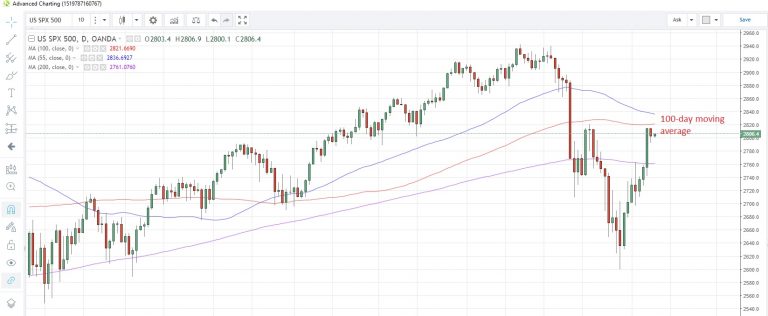
The SPX500 index fell for the first time this week yesterday, feeling pressure from the Fed’s hawkish rate outlook into December and 2019
The index failed to test the 100-day moving average 2,822, which has capped prices since the large drop on October 10
October’s producer price index is due today. Prices are seen rising at the same rate as September, +0.2% m/m and +2.6% y/y. Higher numbers could imply rising pipeline price pressure, which could hurt Wall Street.
DE30EUR Daily Chart
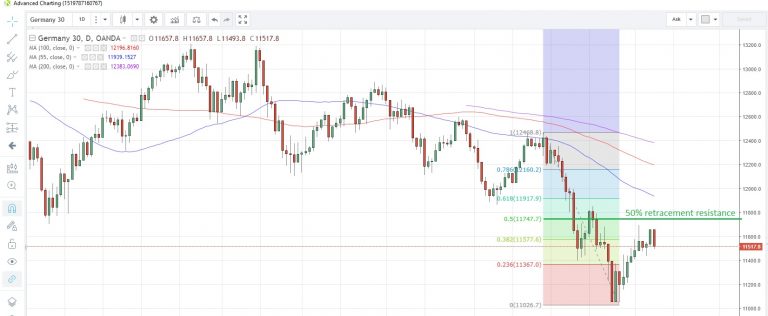
The Germany30 index slipped for the first time in three days yesterday after latest Brexit comments from the UK poured cold water on the idea that a deal would be concluded this week
The index held below the 50% retracement level of the September 27 to October 26 drop at 11,748
EU Commission said Italy’s 2019 debt-to-GDP ratio could be 2.9% compared to govt ceiling of 2.4%. The EU did not see Italian debt falling in 2019.
WTICOUSD Daily Chart
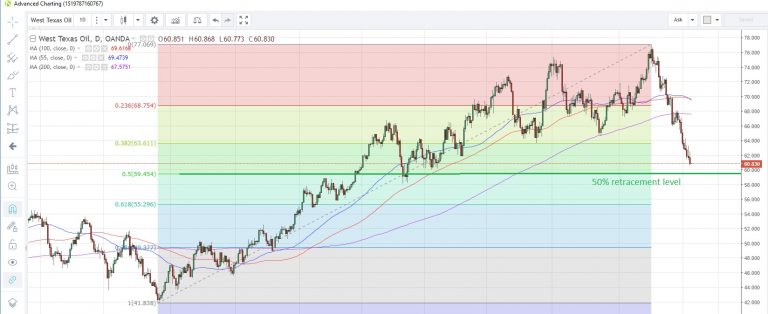
WTI fell for the ninth consecutive day yesterday. The drop from the October 3 high surpassed 20%, suggesting the commodity has entered a bear market
WTI could find support at the $59.454 level, which is 50% retracement of the advance from June 2017 to last month
Wednesday’s EIA crude inventory data showed an increase in stockpiles for the seventh straight week. 5.78 million barrels were added.
The Fed Affect
The Fed affect
After the questionable USD flop following midterms, the “Dollar weakness' story is quickly running out of favour. The Greenback was showing some Moxy in the early NY session, which was then supported as US jobless claims for this week chalked up another consensus reading and points to tight jobs markets. The dollar extended its gains after Fed accounted that “economic activity has been rising at a strong rate'.
Equities held on to early session losses as the Fed kept rates steady and failed to walk back any of the markets hawkish FOMC reads. Meanwhile, EM recovery is not getting much fuel as Dollar regained its strength. US yields have stalled from grinding higher, which is a tad surprising given the sluggish equity markets overnight.
If there was one interesting point that wasn’t brought up by the Fed it was nary a mention of Octobers mini-crash (highlighted by Bloomberg) Those waiting for a Powell put; you might be barking up the wrong tree as there are no signs of policy flip-flop from this sitting Fed chair. Suggesting, the Fed is a lock for a Dec rate hike.
Indeed, the dollar bulls are gaining momentum, but still, the air remains thick with caution. There is room for the dollar to move higher based on growth differential, carry and economic fundamental. But real money has been somewhat tentative so far according to my morning chats with other dealers in Singapore. Keep in mind that that segment of the market was noticeably exiting longs post-midterm election and diving into anything with yield, i.e. EM currencies. So, for today and into early next week, we will be focused on real money flows.
But on USDJPY we are keeping an eye on risk sentiment as we are in no means out of the woods when it comes to US-China trade relations. (more on that below)
Highlighting this morning calendar, we get the RBA statement on monetary policy as the first thing this morning Along with China CPI and PPI
Oil markets
Oil prices continue to slip-slide away ….
We’re in a bear market as prices continue to fall on supply concerns despite healthy demand from China but of course, that can be attributed to the commodity hoarding effect as China stockpiles ahead of Iran sanctions taking effect.
With US inventories on the rise, U.S. output hitting all-time highs and the EIA forecast that U.S. oil production will average 12.1 million bpd in 2019, all point to growing supply concerns. But when you factor in that Saudi Arabia and Russia have been ratcheting up production since June, there ‘s a good reason the bears are holding court and the primary reason why prices are plummeting.
But make no mistake, the US inventories are registering significant builds.
Looking ahead to the weekend – OPEC officials are gathering in Abu Dhabi amid talk of further production cuts and may offer some insight.
Gold Markets
Gold remains precariously perched this morning as the Feds stay on course the USD is back in favour. NO surprising the precious metal space is trading lower this morning. But with ETFs cutting both their Gold holding the bears are gradually regaining the upper hand.
China
It seems odds of more important Trump Xi meeting are still holding up, but I’m much less convinced that an emboldened President Trump will be so amenable, primarily when the Democratic side of the house support his views on China trade. Elements of that side of the floor might even be more hawkish if inside banter is to be respected. This hint tells me it remains uncertain when deals might be reached when both presidents meet later this month. So, China’s trade growth based on that narrative should slow as early as 2019
As for yesterday’s data, China reported strong commodities imports and exports in October, attributed in no small degree to front-loading of manufacturing in anticipation of a further rise in export tariffs starting next year. But for China bears like me you need to keep in in mind this will be a slow burn on the trade front and not a sudden tumult.
On the CNH, expect more pressure in the days ahead. China’s foreign exchange reserves fell more than expected to an 18m low in October amid rising US trade frictions not to mention China’s current account surplus is evaporating. And with US 2-year rates now above China for the first time since 2008 and a Fed locked on to December, the USDCNH should continue to push higher. On any sign of trade spat, this will be gravy to the mix.
Malaysian Ringgit
BNM held onto a neutral policy but this the language tinged with a dovish bias it supports the markets growing suspicions of a rate cut in the second half of 2019 if not a bit sooner. On that basis alone it would suggest the Ringgit has further to weaken even more so with Credit Rating Agencies peering over the markets shoulder.
Asia Press
The White House reports that US VP Pence will travel to Asia, November 11-18, representing Trump at three summits (ASEAN, APEC and East Asia Summit). His schedule includes meetings with leaders for JPY, KRW, AUD, MYR, INR and NZD but does not include mention of a meeting set with CNY leadership.
Press says South Korea “may' name a new finance minister today, according to Chosun.
Limited News from FOMC, December Rate Hike Hopes Unaltered
As widely anticipated, FOMC left the target range for the federal funds rate unchanged at 2.00-2.25% at its November meeting. The changes in the accompanying statement were limited. This is not unusual as the November meeting is in between important ones in September and December. No press conference and updated economic projections and median dot plots are accompanied. The lack of new information, thus, would not change the expectations for a December rate hike. Still, we are hoping to get some insight from the minutes, due three weeks from now, before December.
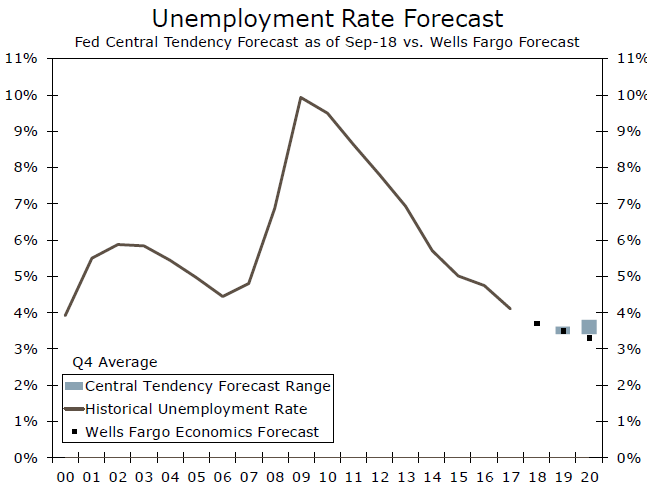
The Fed continued to judge the economic developments as strong. The members noted that the unemployment rate has “declined”, compared with September’s language of staying “low”. Indeed, the unemployment rate dropped two-tenths to 3.7% in September and steadied in October. This marks the lowest since December 1969. They also acknowledged that growth of business fixed investment has “moderated from its rapid pace earlier in the year”. In September, they noted that business fixed investment have “grown strongly”. This is likely a reference to the fact that investment in structures plunged -7.9% q/q in 3Q18 after strong growth over the previous two quarters.
These are all the changes in the statement, which did not touch what we, and the market, are interested in. There was no mention about a rate hike in December (though it should be a done deal). Neither was there discussion about the balance sheet reduction progress. There was no change in IOER or comments on the short term market rates. We expect to get at least some of the above details at the meeting minutes due in three weeks.
Given the upbeat economic developments, with unemployment rate at record low (persistently lower than the long term rate), growth rate remaining strong despite moderation from second quarter, inflation staying within Fed’s target range, the Fed is on track to raise the policy rate, by +25 bps, again in December. As we mentioned in the preview, the Fed should also announce to raise the IOER by +20 bps. Updated economic projections and median dot plots would also be released in the meeting.
Italy’s Costly Budget Ordeal: Fiscal Imprudence Non Grata
Highlights
- Italy's ruling coalition government has proposed spending plans intended to boost near-term growth, but at the cost of adding more debt down the road. As a result, the European Commission rejected the budget on October 23rd, asking for a revised budget within three weeks' time.
- The budget standoff has triggered investors to selloff Italian bank shares while also sending the sovereign spread with 10-yr German bunds surging. This is a likely a reflection of the increased chance of investor haircuts as the odds of an Italian bank bailout, backstopped in part by the ECB, in the years ahead have increased.
- A new budget, just days away, could include some marginal spending cuts, and possibly a VAT hike to ease concerns about the revenue side of the ledger. This should avoid a further deterioration in financial conditions as fears of a future economic crisis subside. However, this is unlikely to be the last standoff that we witness between the Italian government and the EU, suggesting further bouts of market volatility to come.
Now that U.S. midterm elections are out of the way, financial markets will return focus to other ongoing geopolitical themes, such as the budget standoff between Italy and the European Union (EU). Italy's populist governing coalition has proposed a budget that is deemed to violate EU fiscal rules. As a result, Italy now risks having its debt downgraded to junk status, further imperiling an ailing banking sector, and threatening to rekindle broader debt sustainability concerns in the periphery.
Italy has been struggling to boost growth and create jobs since the euro crisis. Growth has been gradually perking up in the last couple of years, and the unemployment rate has been improving. However, its coalition government, elected with a popular mandate, has put forward a spending plan intended to boost near-term growth at the cost of making its debt load less sustainable in the long-run.
At face value, the government spending plan contains some good ideas that should help kickstart a slumbering economy facing severe supply-side challenges. What's missing from the budget, however, is a plan to boost revenue and thus make the near-term spending more sustainable in the long-run. What's more, the anti-establishment rhetoric and actions of the coalition government is politicizing a generally mundane annual exercise at the potential cost of Italy's financial market access.
In the end, negotiations with the EU will likely result in Italy's government making some marginal spending and revenue concessions in order to reduce financial stress. But, this is unlikely to be the last standoff between the Italian government and the EU, suggesting further bouts of market volatility yet to come.
What's in the Budget
After weeks of consultation, the European Commission rejected Italy's 2019 budget proposal that would see the public deficit increase to 2.4% of GDP.1 All told, the budget would cost €37bn, with about 59% of spending expected to be debt financed. The major items include:
- Pension reform and early retirement. Up to 400k people could become eligible to retire at age 62. Currently the retirement age is 65. These changes are expected to take effect in February, and cost about €7bn.
- Universal basic income. Often deliberated, but rarely implemented, the budget follows through on the Five Star Movement's (M5S) campaign promise to allow for a means tested universal basic income of €780 per month for the least well-off. This is limited to Italians or foreigners legally resident for at least five years, and is intended to provide the necessary support to encourage people to get back into the job market. Similarly, the minimum pension is slated to rise to €780. Together, these measures are expected to improve the economic well-being of 6 million people, at a cost of €9bn-€10bn, including a €1bn effort to improve job centres.
- Tax amnesty and reform. A tax amnesty, largely anticipated to benefit wealthy Italians that have avoided paying taxes in Italy, is expected to raise more than €2bn in revenue. A flat tax of 15% is expected to affect more than a million self-employed including artisans with less than €65k in annual sales.
- No increase in the value-added tax (VAT) in 2019, and a reduction in the scheduled increase in 2020 and 2021. Although sales tax increases are unpopular, EU fiscal rules require a VAT increase when a government runs sustained general budget deficits. The budget scraps the scheduled increase that was set to take place in January that would have taken the VAT up 3 percentage points by January 1, 2021.2 The elimination of automatic VAT increases is expected to cost the Italian government about €12.5bn annually. However, the budget does book additional revenue of €640 million in 2019 due to increased taxes on gambling and some privatization of state assets.
- Public infrastructure. The budget calls for a €15bn increase in infrastructure investment over the next three years. This is in addition a boost in infrastructure spending by about €38bn over the next fifteen years.
- Spending cuts. A savings of €0.5bn a year is expected due to the realization of internal efficiencies, and another €0.5bn from reduced spending on managing and housing migrants. A further €330 million in annual savings are expected to be found by capping "golden" pensions at €4,500 a month.
Longer-Run Sustainability is the Key Concern
With a €22bn budget hole that could have been mitigated by the automatic VAT hikes, it is little wonder that the proposed budget has triggered concerned from both the European Commission and financial markets. Past Italian governments have promised to reduce the general budget deficit to about 0.7% of GDP, placing this budget about 1.7 percentage points off of previous promises. What's more, the proposed budget plan would end a fifteen year streak of successive primary budget surpluses in excess of 1%, a fact that has helped to keep borrowing costs in check.
Italy's defense of its budget is that other nations that have violated EU fiscal rules by posting large government deficits have not faced the same pushback. France is one such example. It is not considered in violation of EU fiscal rules due to its implementation of structural reforms. While often viewed as rigid framework, the Growth and Stability pact has some flexible elements, allowing, for example, European governments to run deficits in order to mitigate any economic drag from undertaking structural reforms. Italy's 2019 budget proposal does commit to a timeline for undertaking structural reforms, but it appears that the European Commission's values actions more than promises.
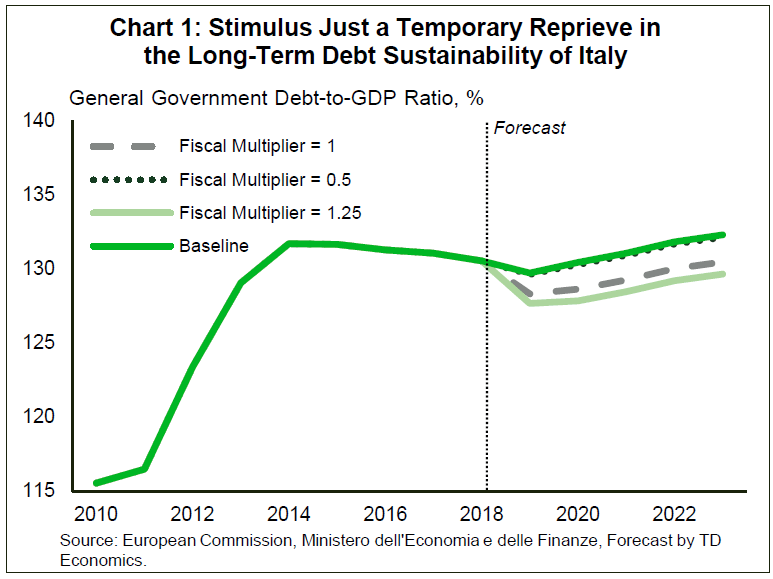
Ultimately, the greatest concern is what happens in the years ahead, after the fillip to growth provided by the spending boost outlined in the budget fades. Once slow growth returns, the only legacy of the stimulus may be a deterioration in Italy's debt-to-GDP ratio (Chart 1). This is problematic, because Italy's longer term prospects for growth are facing the challenge of an aging labour force that will raise its old-age dependency ratio and further stress finances. Labour market reforms such as those in the budget plan are a step in the right direction, but more will need to be done in order to prevent future labour shortages.
Financial Risks Loom Large
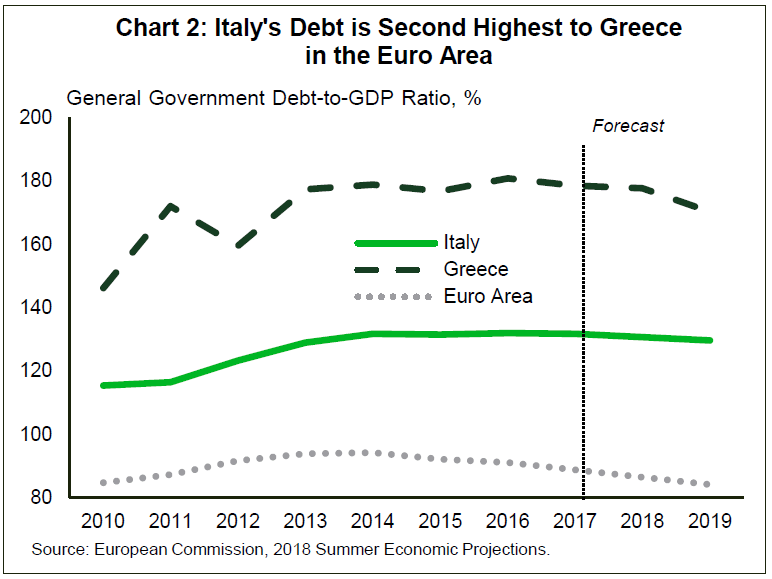
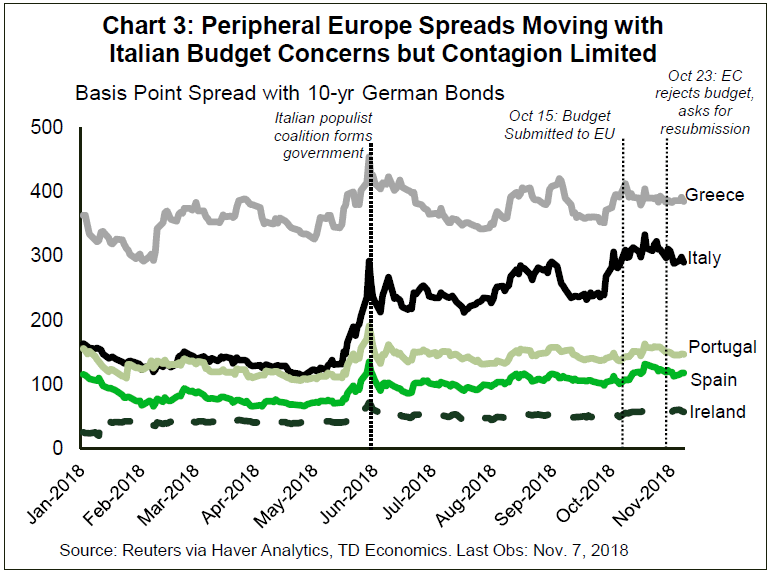
Economics and politics aside, the financial reality is that, like Greece and Japan, Italy has little fiscal space to engage in stimulus spending. At 130%, Italy's debt-to-GDP ratio is the second highest in the Euro Area after Greece (Chart 2). Italy has always had a difficult time building confidence with investors. Prior to the euro's adoption, Italian governments were notorious for running fiscal deficits and monetizing debt, stoking inflation and depreciating the lira. This lack of credibility continues to haunt Italy, despite being the third largest Euro Area economy and an important European financial centre. As a result, since the formation of the populist coalition government in June, interest rates on long-term Italian debt have risen on concerns of a return to fiscal imprudence, and are currently trading about 300 basis points higher than equivalent German debt (Chart 3) – remarkably only 40 basis points lower than Greece. This reflects concerns that mounting deficits will lead to an unsustainable rise in debt that could result in a bailout program, an Italian banking crisis, or both, thus implying haircuts for investors in the years ahead.
Indeed, investors in longer-term Italian debt and banks have good reason for concern. Although the trigger is the future rise in already elevated debt levels, the more immediate concern is what happens to Italian finances once the ECB begins normalizing monetary policy. This will inevitably lead to a repricing in Italian debt that is likely to exacerbate the sustainability issue.
With the ECB's bond buying program likely to end in December, the next step is to cease reinvestments. This could take place as early as 2020. Anticipation of this has already led investors to demand a higher premium to purchase lower quality debt. The recent downgrade in Italian bonds by ratings agencies is consistent with the fear that Italian sovereign bonds are inching closer to junk status, a development that would trigger financial market panic as concerns about broader contagion from an Italian economic crisis come to the fore. Layering on these concerns would be the potential for the ECB to cease reinvesting proceeds from the maturing of asset holdings in Italian debt if Italy was deemed ineligible due to its credit risk.
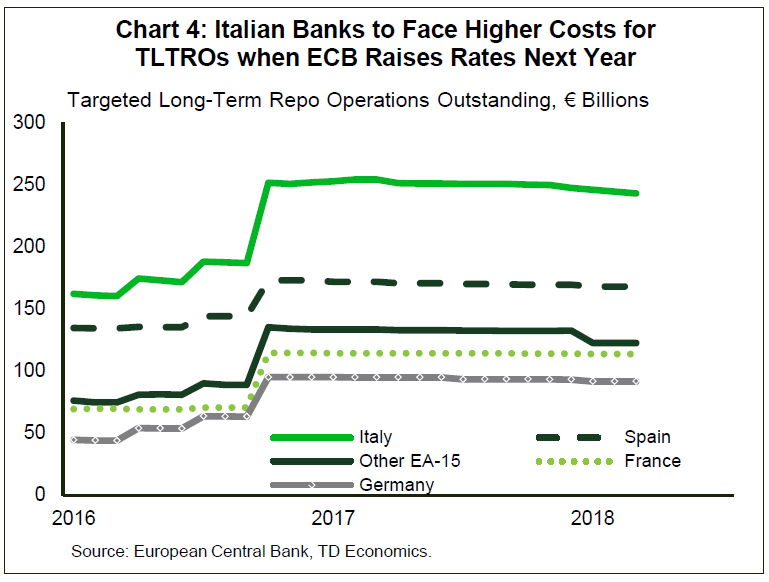
The risk doesn't end there. The combination of asset purchases and long-term repo operations announced by the ECB in 2016 helped drive Italian banks to purchase sovereign bonds as part of their efforts to recapitalize. As a result, solvency concerns have extended beyond the sovereign into the Italian banking sector already laden with a large pile of non-performing loans. As the ECB is set to move up short-term interest rates next fall, more than €250bn in targeted longer-term refinancing operations (TLTROs) will ultimately reprice higher in 2020, biting into profit margins and tightening lending conditions further (Chart 4). Italy's Finance Minister, Giovanni Tria, was quoted recently as saying that a move in the 10-year yield spread with German bunds to 400 basis points may be the point at which Italy would have to act in order to reduce stress on its banking sector.3 The move down in Italian bank shares this autumn is indicative that investors are already pricing in a chance of a banking sector default.
Low Risk of Budget Impasse Leading to Crisis
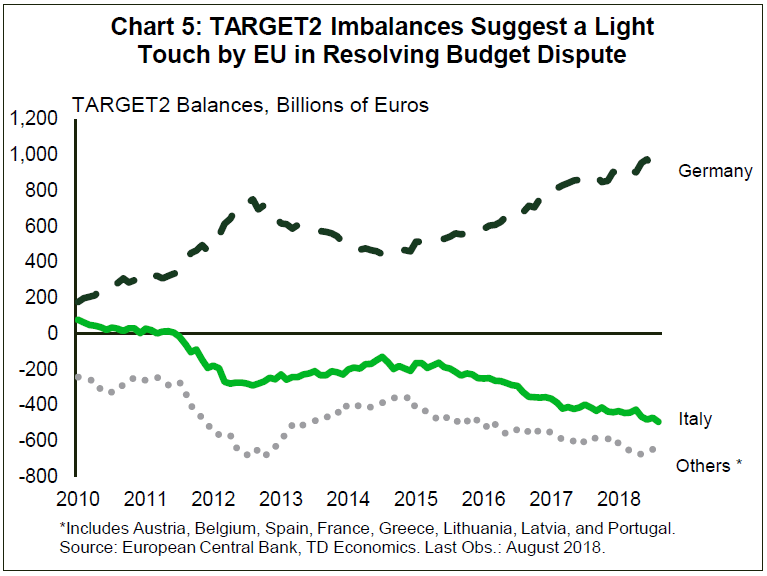
The fact of the matter is that, unlike Greece, Italy is too big to fail. This is further evident by the size of the TARGET2 balances owed to Italy's Euro Area peers, namely Germany (Chart 5). Having learned from the euro crisis, EU institutions are taking a more proactive stand to prevent the Italian economy from spiraling downward into a debt crisis. The unprecedented step taken by the European Commission to request a more sustainable 2019 budget is evidence of this proactive approach. What's more, the ECB is likely to step in and provide liquidity to European banks, including Italian ones, in the event of financial stress. This may include another longer-term repo operation that would reduce the pressure on bank margins as interest rates begin to rise next September.
In the days ahead, Italy is expected to produce a revised 2019 budget that is likely to feature marginal reductions in spending, and could well feature at least one VAT increase – a concession that should placate near-term revenue concerns. That said, even if the current budget ordeal is resolved without triggering a collapse in the ruling coalition government and fresh elections, a similar standoff is surely to happen again next year for the 2020 budget year.
All told, the budget standoff is proving to be a costly endeavour for all parties. However, it's unlikely to result in an Italian economic crisis. That said, if this proves to be a political rather than economic stand for the EU, future clashes all but guarantee more bouts of financial market volatility as investors question the future of the euro and European project.
End Notes
- Italian Fiscal 2019 Draft Budget: https://ec.europa.eu/info/sites/info/files/economy-finance/2019_dbp_it_en_1.pdf
- Schedule of VAT Increases for Italy: https://home.kpmg.com/xx/en/home/insights/2017/11/tnf-italy-vat-rate-increases-delayed-in-draft-budget-law-2018.html
- "Italy's Tria fails to halt market fears over budget talks with EU", Financial Times, October 9, 2018. https://www.ft.com/content/5c88e3c0-cbac-11e8-b276-b9069bde0956
Fed Stays on the December Rate Hike Path
As expected, the FOMC remained on hold at its policy meeting today, though constructive language on the economy keeps expectations high for another rate hike in December.
U.S. Economic Activity Remains "Strong"
As widely expected, the Federal Open Market Committee (FOMC) decided in a unanimous vote to leave its federal funds target rate range unchanged at 2.00%-2.25%. This was the last FOMC meeting without a press briefing. As such, the market's focus was entirely on the policy statement, with particular focus on the officials' updated assessment of the U.S. economy and whether any new signals were being sent as to a change in the Fed's projected pace of interest rate tightening–given the implicit acknowledgement last meeting that the funds rate may have entered neutral territory. With little change to the policy statement compared to September's meeting, today's statement maintains current policy expectations. The release of the meeting minutes on November 29 may provide policy watchers instructive updates to the discussions officials are engaging in over the future path for interest rates and the balance sheet, both hot topics within financial market circles.
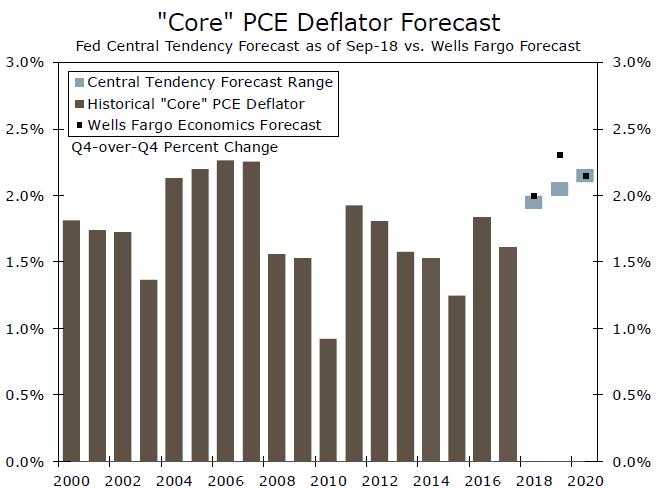
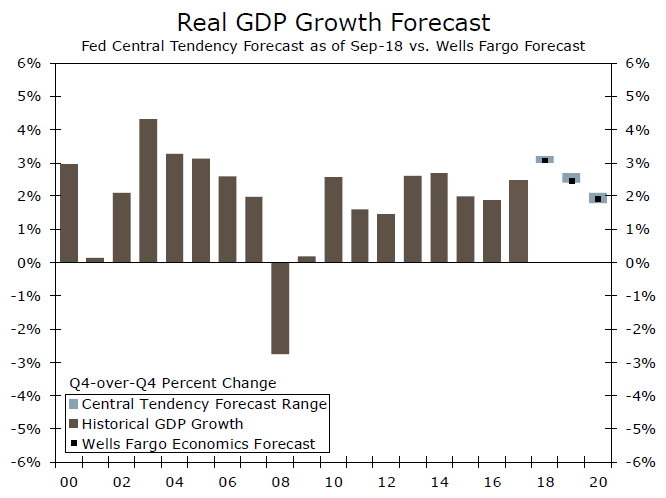
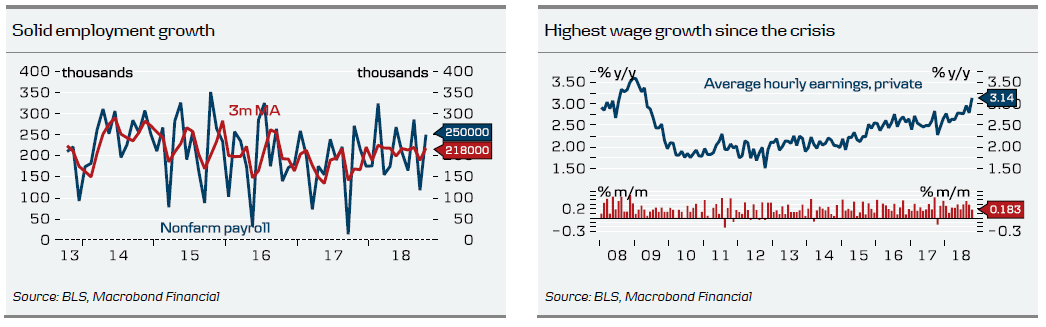
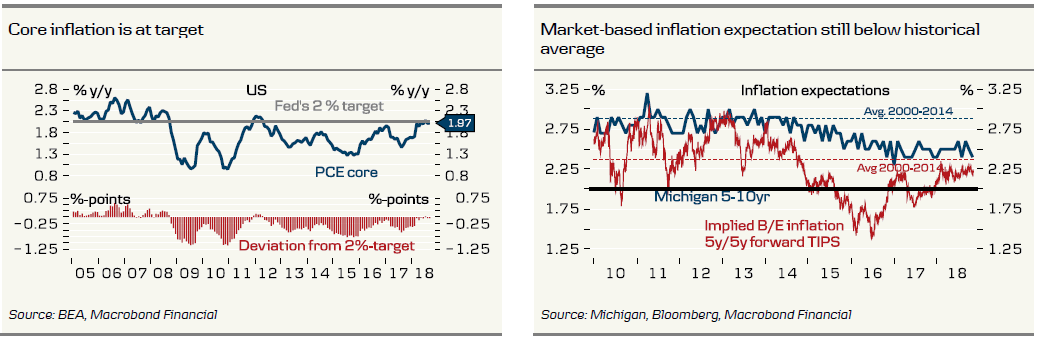
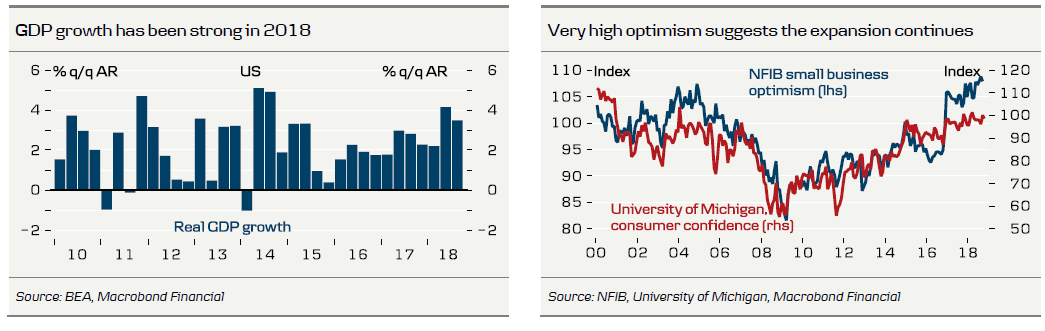
Within the policy statement, the FOMC maintained its characterization of the current pace of U.S. economic activity as "strong," unchanged from September and a sentiment with which we would agree. Officials' assessments of the labor market and household spending were also unchanged, with some form of a "strong" description. Indeed, nonfarm hiring has averaged an above-trend 218,000 monthly pace over the past three months, while the recently released third quarter GDP report showed real personal consumption expenditures rose at an annualized rate of 4.0%– marking a four-year high. The FOMC did, however, downgrade the assessment of business fixed investment following a decelerating pace of growth in the third quarter. As expected, there was no change in the statement's description of inflation or inflation expectations, with September core PCE inflation spot on the 2.0% target.
Fed Sticks With "Gradual" Tightening Plan
Collectively, there was little in today's statement that would suggest any change from the expectation for further gradual rate hikes. Forward guidance remained intact as the Fed sees the economy moving in the right direction against the pace of policy action taken so far. We look for GDP growth to continue to run above potential in the coming quarters, though it should generally decelerate as fiscal stimulus fades and monetary policy exerts greater headwinds on the economy. We expect the unemployment rate to steadily decline over the coming year as employers continue to add jobs to meet demand. Moreover, rising labor and material costs should continue to generate additional inflation pressures in 2019. As next year comes into view, we believe economic conditions will remain strong enough for the Fed to continue raising interest rates each quarter until Q3-2019, which if realized, pushes the federal funds target rate modestly into "restrictive" territory.
FOMC Review: No change to the Fed’s hiking plans
Fed is on autopilot and the destination is neutral
As expected, the Fed stayed on hold today and made no major change to the policy signals in the statement. The Fed usually does not make changes at the interim meetings without updated projections and a press conference. Notice that this was the last meeting without a press conference, as Jerome Powell has said that there will be one for every meeting from 2019.
We maintain our long-held view that the Fed is on autopilot and neutral is the destination. Based on speeches from the FOMC members, most are eager to raise the Fed funds rate to 3%, which is the Fed's estimate of the neutral rate, where monetary policy is neither expansionary nor contractionary. We believe the bar for the Fed to change its strategy is quite high, as the real economy is strong, optimism is high, inflation is on target, the unemployment rate is below NAIRU, wage growth is increasing and fiscal policy is expansionary.
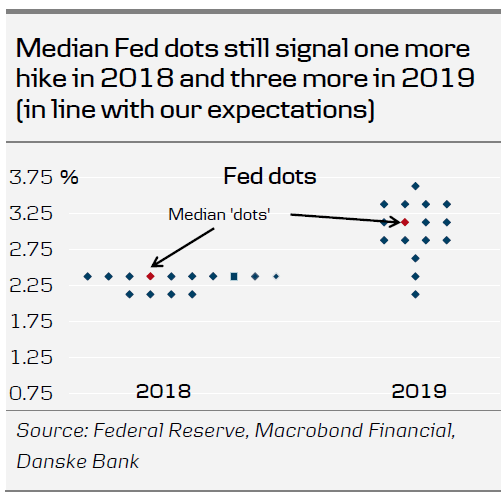
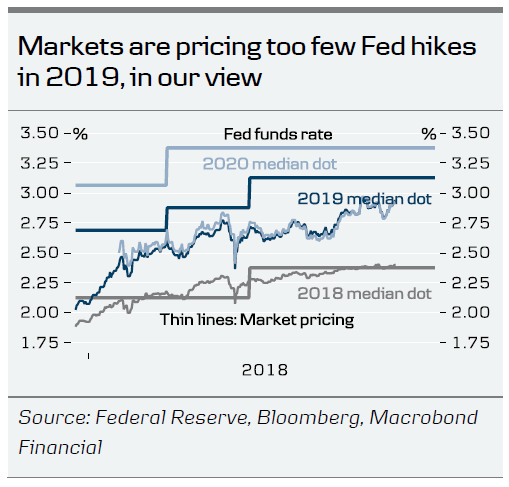
We expect the Fed to hike at the meetings in December, March and June, when it would reach the 3%. After that, we believe it will be more stop and go depending on how the economy is doing. We expect the Fed to hike once more in the second half of 2019, i.e. a total of four hikes from now until year-end 2019. In our view, markets are pricing too dovishly.
In June, the Fed made what it called a technical adjustment of the interest rate on excess reserves (IOER), as it rose only 20bp, against the increase in the target range of 25bp. The reason was that the effective Fed funds rate was trading too close to the upper end of the target range. Currently, the effective Fed funds rate is trading exactly at IOER, which is only 5bp below the upper end of the range. This increases the probability that IOER will be raised by only 15-20bp at the December meeting in order to anchor the effective Fed funds rate in the middle of the target range. We look forward to seeing whether the Fed discusses this in the minutes due on 29 November. The upward pressure on the effective Fed funds rate may also frontload discussions on the future monetary framework (a decision here may come as early as January, when the Fed usually makes changes to how it operates).
No news from FOMC is not particularly good news for US treasuries, as the Fed remains on autopilot for 3%. Short-term risk appetite sets the direction but the underlying trend is still towards higher US treasury yields. We continue to target 3.50% on a three- to six-month horizon (see FI Research 6 Next stop is 3.50% for 10Y US treasury yields , 15 October) .
EUR/USD a tad lower on the no-surprises Fed announcement and we still look for USD strength to remain towards year-end on the carry and cyclical support the greenback is set to enjoy for some time still (see FX Strategy - EUR/USD break of 1.13? Yes - and here's why , 6 November).
Fed Holds Rates Steady; December Hike Still Looks Very Likely
Highlights:
- The target range for the fed funds rate was held at 2.00-2.25% in a unanimous vote.
- We expect a rate increase in December which would be the fourth hike this year.
- These interim meetings (without updated economic projections) will become a bit more interesting next year when Chairman Powell begins holding press conferences at every meeting.
Our Take:
As expected, today’s FOMC meeting was very straightforward—no rate hike and only minor tweaks to the policy statement. The Fed took note of lower unemployment over the last two months and slightly softer business investment in the Q3 GDP figures. But otherwise their assessment was familiar—strong economic activity and household spending, and inflation near 2%. Risks to the outlook remain “balanced,” and further, gradual rate increases are expected. That guidance has become synonymous with hikes at every other meeting, a pattern we expect will continue with a move in December and four more rate increases next year. Markets are pricing in less tightening through the end of next year, even relative to the Fed’s ‘dot plot’ median of three hikes in 2019. We see little reason for policymakers to slow the tightening cycle, even as fed funds gets closer to most estimates of the ‘neutral’ rate. With unemployment at its lowest in nearly 50 years and the economy still carrying decent momentum (growth over the last two quarters was the best in four years) we think inflation risks are tilted to the upside.
Fed Leaves Funds Rate Steady, Widespread Strength Means All Systems Go for a Hike in December
As expected, the Federal Open Market Committee (FOMC) decided to maintain the target rate for the federal funds steady at 2 to 2 ¼ percent.
The statement's characterization of the economy was broadly unchanged from their previous statement. "The labor market has continued to strengthen and…economic activity has been rising at a strong rate." Indeed a variant of the word "strong" was again used five times in the statement.
The slight changes that were made merely reflect the latest data, such as the unemployment rate has "declined" instead of "stayed low". And, that household spending "continued to grow strongly" while business investment "has moderated from its rapid pace earlier in the year". These changes reflected the recent third quarter GDP release, and are not major new developments.
The decision was unanimous. The one compositional shift is that the new San Francisco Fed President Mary Daly cast her first vote as an FOMC member.
Key Implications
I can't see the difference. Can you see the difference? The changes in today's FOMC's statement versus September were quite minor. Basically reflecting another quarter of GDP data, and that today they left rates steady, and in September they hiked. This was about as "stay-the-course" rate decision as they come.
Treasury yields were up slightly in the immediate aftermath of the statement, with market participants perhaps expecting some acknowledgement of recent financial market volatility. There is nothing in the statement, nor in the recent economic data to suggest that FOMC members would move off their expectations for at least one more hike this year and continue to see three more hikes in 2019.
Eco Data 11/9/18
[php_everywhere instance="1"]
Fed left federal funds rate unchanged at 2.00-2.25% as widely expected. Full statement
Fed left federal funds rate unchanged at 2.00-2.25% as widely expected. Full statement below.
Federal Reserve Issues FOMC Statement
Information received since the Federal Open Market Committee met in September indicates that the labor market has continued to strengthen and that economic activity has been rising at a strong rate. Job gains have been strong, on average, in recent months, and the unemployment rate has declined. Household spending has continued to grow strongly, while growth of business fixed investment has moderated from its rapid pace earlier in the year. On a 12-month basis, both overall inflation and inflation for items other than food and energy remain near 2 percent. Indicators of longer-term inflation expectations are little changed, on balance.
Consistent with its statutory mandate, the Committee seeks to foster maximum employment and price stability. The Committee expects that further gradual increases in the target range for the federal funds rate will be consistent with sustained expansion of economic activity, strong labor market conditions, and inflation near the Committee's symmetric 2 percent objective over the medium term. Risks to the economic outlook appear roughly balanced.
In view of realized and expected labor market conditions and inflation, the Committee decided to maintain the target range for the federal funds rate at 2 to 2-1/4 percent.
In determining the timing and size of future adjustments to the target range for the federal funds rate, the Committee will assess realized and expected economic conditions relative to its maximum employment objective and its symmetric 2 percent inflation objective. This assessment will take into account a wide range of information, including measures of labor market conditions, indicators of inflation pressures and inflation expectations, and readings on financial and international developments.
Voting for the FOMC monetary policy action were: Jerome H. Powell, Chairman; John C. Williams, Vice Chairman; Thomas I. Barkin; Raphael W. Bostic; Lael Brainard; Richard H. Clarida; Mary C. Daly; Loretta J. Mester; and Randal K. Quarles.