

Sample Category Title
US 500 Index Eases Slightly after Sharp Flying Mode
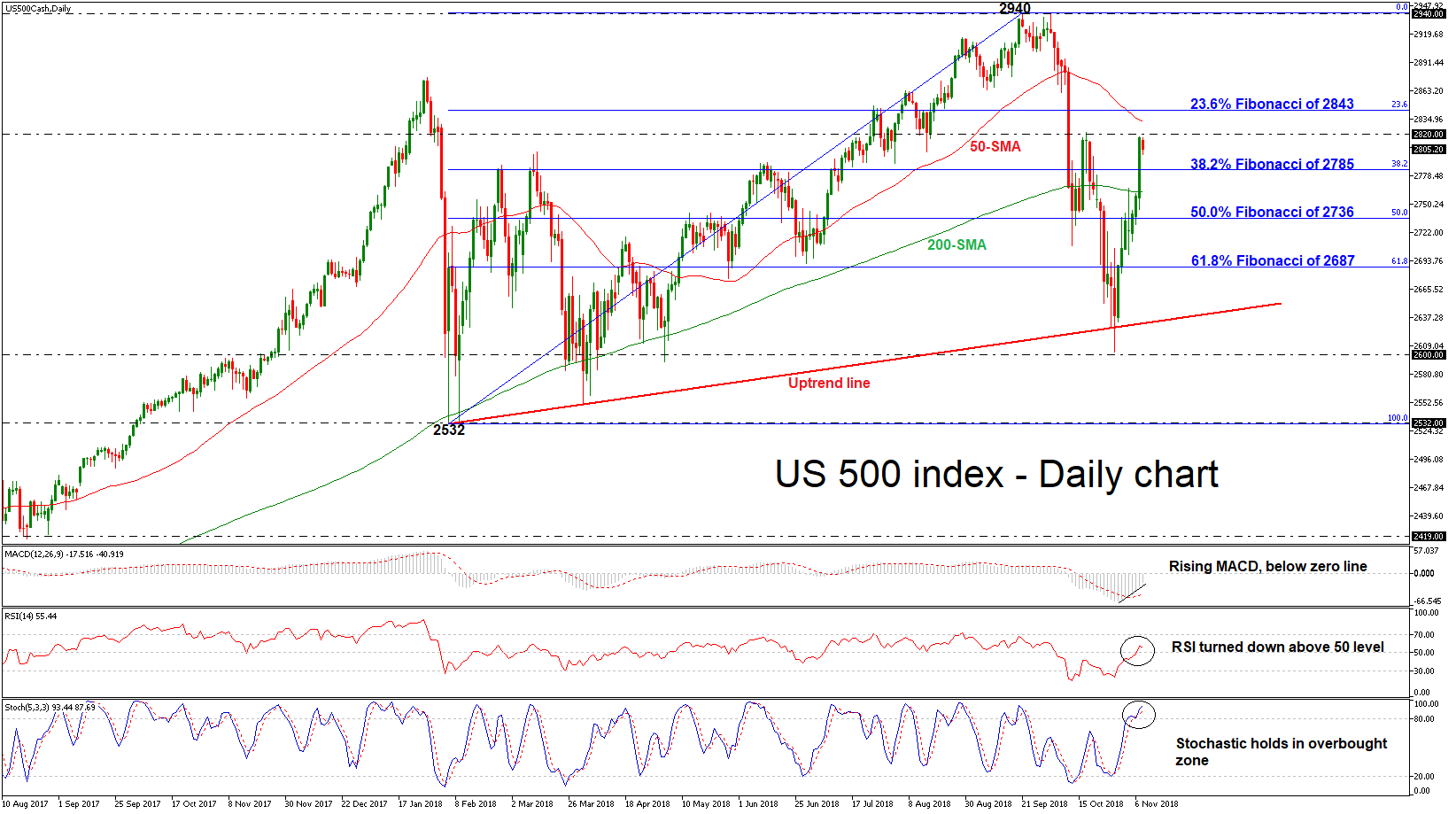
The US 500 index recorded considerable gains at the end of October and early in November, following the rebound on the 2600 support. The index has now crossed back above its 200-day simple moving average (SMA), which keeps the broader outlook cautiously positive.
Looking at short-term oscillators, the RSI is pointing downwards albeit above its neutral 50 level, detecting possible downside momentum. However, the MACD is moving higher in the negative territory, suggesting more gains. The stochastic oscillator is also pointing to positive momentum as it stands in the overbought zone in the daily timeframe.
Immediate resistance is coming from the 2820 barrier, taken from the latest highs, while slightly higher the 23.6% Fibonacci retracement level of the upleg from 2532 to 2940, around 2843 could act as major obstacle for the bulls. An upside break may see scope for advances towards the all-time high of 2940, achieved on October 3.
On the flipside, a reversal of the recovery in the market may meet initial support around the 38.2% Fibonacci of 2785. A downside break would send prices towards the 50.0% Fibonacci of 2736, with even steeper bearish extension eyeing the 61.8% Fibonacci of 2687.
To conclude, as long as the index continues to trade above the long-term upside support line, which has been holding since February 6 the bigger picture remains cautiously bullish.
USD/JPY Mid-Day Outlook
Daily Pivots: (S1) 113.06; (P) 113.44; (R1) 113.94; More..
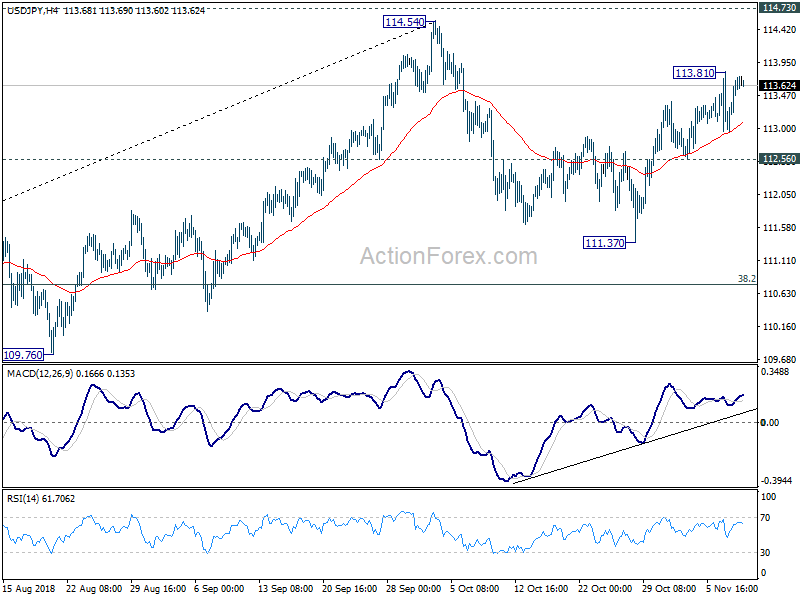
USD/JPY is staying in consolidation below 113.81 temporary top and intraday bias remains neutral. With 112.56 minor support intact, another rise is mildly in favor. On the upside, above 113.81 will extend the rebound from 113.37 to 114.54 resistance. We'd be cautious on strong resistance from there to limit upside to bring another fall. On the downside, break of 112.56 minor support will argue that the rebound has completed. And, in that case, the corrective pattern from 114.54 could have started the third leg for 111.37 support and possibly below.
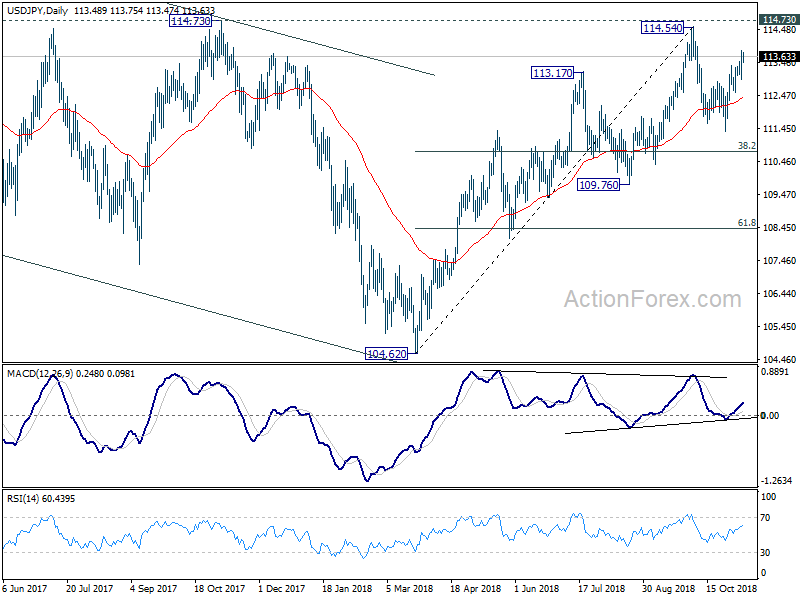
In the bigger picture, corrective fall from 118.65 (2016 high) should have completed with three waves down to 104.62. Decisive break of 114.73 resistance will likely resume whole rally from 98.97 (2016 low) to 100% projection of 98.97 to 118.65 from 104.62 at 124.30, which is reasonably close to 125.85 (2015 high). This will stay as the preferred case as long as 109.76 support holds. However, decisive break of 109.76 will dampen this bullish view and turns outlook mixed again.
USD/CHF Mid-Day Outlook
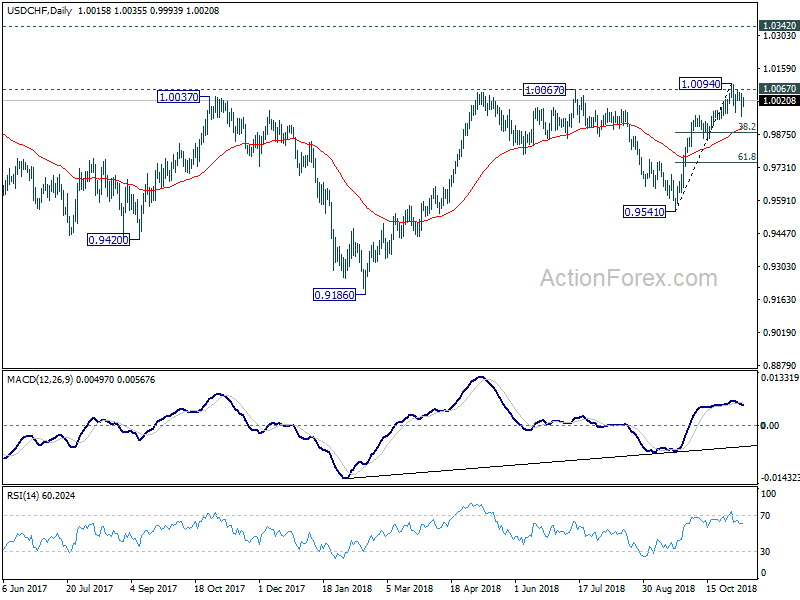
Daily Pivots: (S1) 0.9968; (P) 1.0010; (R1) 1.0067; More...
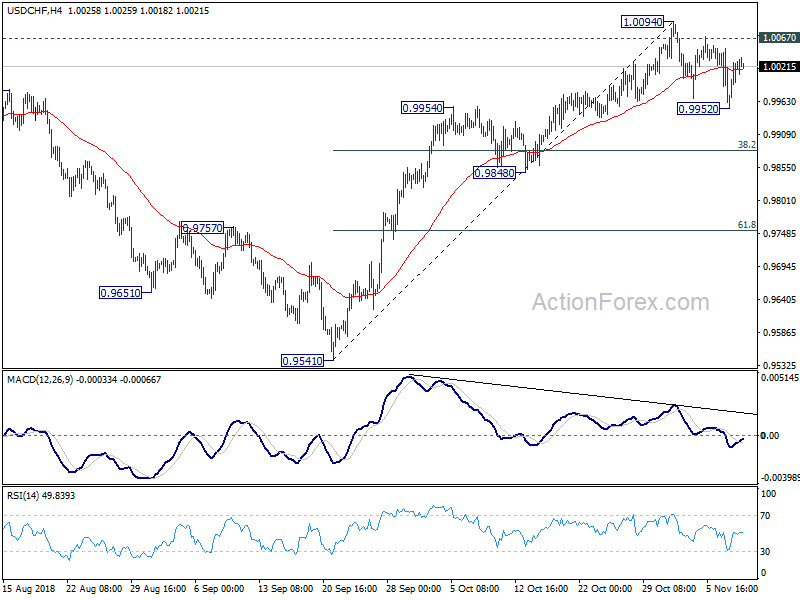
Intraday bias in USD/CHF remains neutral at this point. The consolidation pattern from 1.0094 might extend. And break of 0.9952 would target 38.2% retracement of 0.9541 to 1.0094 at 0.9883. We'd expect strong support from there to contain downside to bring rebound. Rise from 0.9541 is still in favor to resume. Break of 1.0094 will target 1.0342 key resistance next. However, decisive break of 0.9848 support will indicate reversal and turn outlook bearish.
In the bigger picture, the pullback from 1.0067 has completed at 0.9541 already. And rise from 0.9186 is likely resuming. Firm break of 1.0067 will pave the way to retest 1.0342 key resistance. We'd be cautious on strong resistance from there to limit upside to bring another medium term fall to extend long term range trading. However, firm break of 0.9848 near term support will dampen this view and bring deeper decline back to 0.9541 support and possibly below.
EUR/USD Mid-Day Outlook
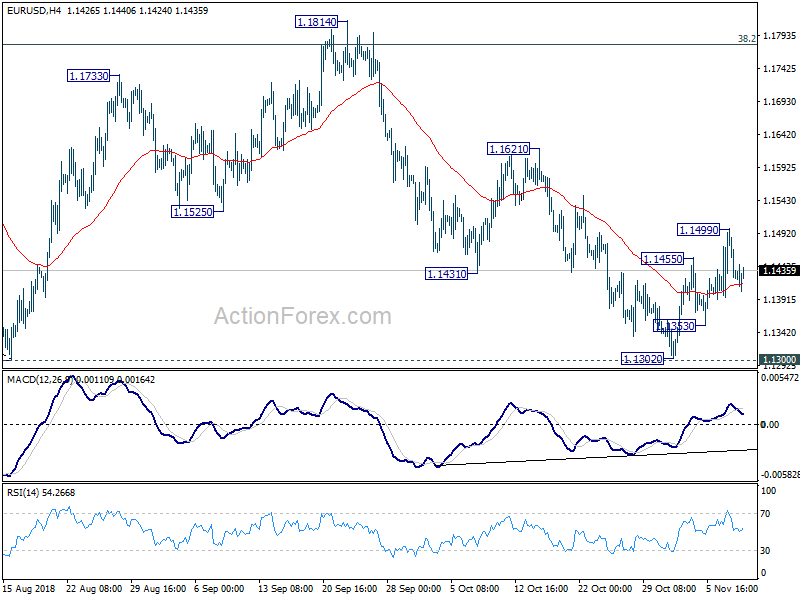
Daily Pivots: (S1) 1.1380; (P) 1.1441; (R1) 1.1486; More....
Intraday bias in EUR/USD remains neutral at this point. On the upside, break of 1.1499 will resume the rebound from 1.1302 and target 1.1621 resistance and possibly above. But price actions from 1.1300 are viewed as forming a consolidation pattern. Therefore, upside is expected to be limited by 1.1814 to bring down trend resumption eventually. On the downside, break of 1.1353 minor support will suggest that rise from 1.1302 has completed. In that case, retest of 1.1300 key support should be seen next.
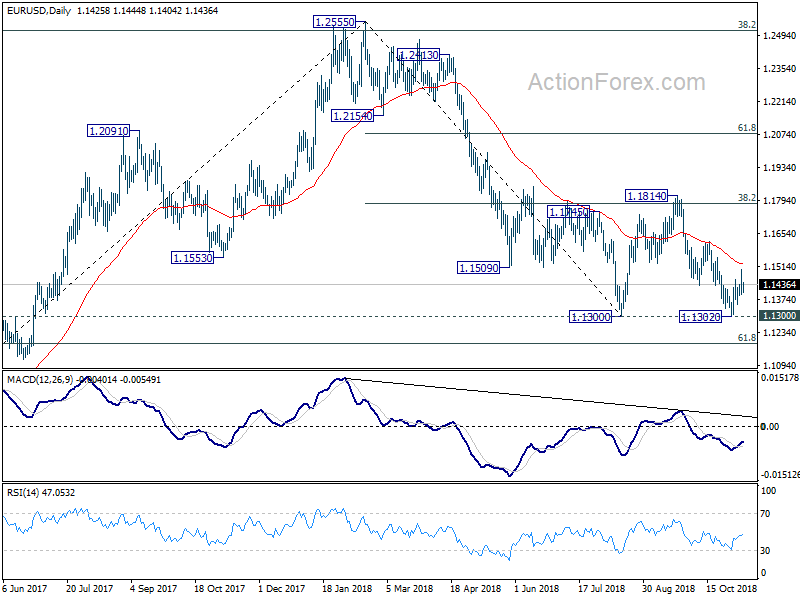
In the bigger picture, price actions from 1.1300 is seen as a corrective pattern. Decisive break of 1.1300 will resume the down trend from 1.2555 to 61.8% retracement of 1.0339 (2017 low) to 1.2555 at 1.1186 next. Sustained break there will pave the way to retest 1.0339. In case the consolidation from 1.1300 extends, upside should be limited by 1.1814 and 38.2% retracement of 1.2555 to 1.1300 at 1.1779. to bring down trend resumption eventually.
Canada: Housing Starts Post Better-than-Expected Gain in October
Canadian housing starts increased to 205.9k (annualized) units in October, 8.5% higher than the 189.7k level achieved in September. October's pace bested forecasts calling for an increase to 198k. However, on a longer-term six month moving average basis, starts edged slightly lower to 206.2k.
October's gain was concentrated in multi-family starts, which rose 17% to 149.1k units. Single-detached starts provided some offset, falling 9% to 56.8k units.
Urban starts were up in 5 of 10 provinces. Homebuilding increased in Ontario (+10.2k to 85.7k units) and Quebec (+9.0k to 43.1k units). Starts were also higher in B.C. (+4.4k to 29.9k units) and Saskatchewan (+3.3k to 6.1k units). In contrast, starts pulled back in every Atlantic Province except for New Brunswick (-4.1k to 5.4k units for the region overall), and were also lower in Manitoba (-3.6k to 5.0k units) and Alberta (-3.9k to 16.8k units).
Key Implications
As anticipated, starts increased in October, setting residential investment off on the right foot to begin the fourth quarter. It also helps offset what will likely be reported as a modest decline in October home sales when the national data is released next week.
On a trend basis, homebuilding has embarked on what has so far been an orderly slowdown, with softer demand feeding through to starts.
Looking ahead, modest demand growth should keep a lid on Canadian homebuilding during 2019 and 2020, implying less thrust from what was once a steady contributor to economic growth. Still, the likelihood of a steep downturn in homebuilding is remote, given that Canada's population is on the rise, the economic backdrop is decent and that markets are generally not overbuilt.
GBP/USD Mid-Day Outlook
Daily Pivots: (S1) 1.3076; (P) 1.3125; (R1) 1.3177; More...
Intraday bias in GBP/USD stays neutral for consolidation below 1.3174 temporary top. With 1.2951 minor support intact, further rise could still be seen to 1.3257/3297 resistance zone. However, as rise fro 1.2692 is seen as the third leg of consolidation pattern from 1.2661, we'd expect strong resistance from 1.3316 fibonacci level to limit upside to bring down trend resumption eventually. On the downside, below 1.2951 minor support will turn bias back to the downside for 1.2692 and then 1.2661 key support.
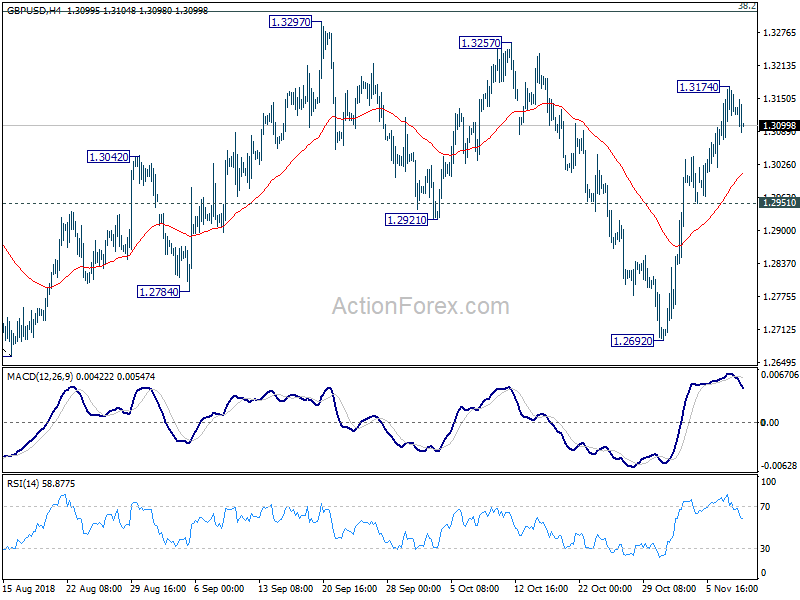
In the bigger picture, whole medium term rebound from 1.1946 (2016 low) should have completed at 1.4376 already, after rejection from 55 month EMA. The structure and momentum of the fall from 1.4376 argues that it's resuming long term down trend. And this will be the preferred case as long as 38.2% retracement of 1.4376 to 1.2661 at 1.3316 holds. However, firm break of 1.3316 would bring stronger rebound to 61.8% retracement at 1.3721. And, the eventual depth of the fall from 1.4376, and the chance of hitting 1.1946 low, will depend on the strength of the interim corrective rebound from 1.2661. 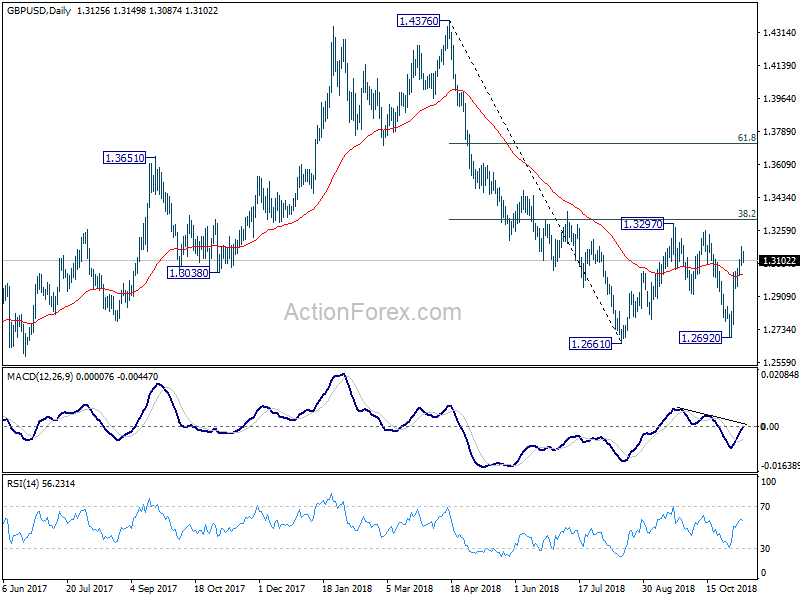
Dollar a Bystander ahead of Fed, Euro and Sterling Turn Soft
Dollar's decline slowed today, ahead of FOMC rate decision. But there is so far no momentum for a sustainable rebound. It's like trading mixed as a bystander for now. Instead, major movements are found in Euro and Sterling, which start to weaken mildly. Euro is somewhat weighed down by European Commission's new forecasts. The Pound, on the other hand, starts to lose steam as there is no positive Brexit news to give it another lift. Australian Dollar remains the strongest one for today but it's now followed by Canadian Dollar, which is having a comeback.
Technically, some pairs are clearly losing momentum just ahead of key resistance levels. Those include AUD/USD ahead of 0.7314, EUR/JPY ahead of 130.20 and GBP/JPY ahead of 149.70. It's a bit early to tell but these pairs could be building up a turnaround. Considering FOMC as background, USD/CHF and USD/JPY and USD/CAD are worth a watch today. All three are bounded in tight range this week, below 1.0094, 113.81 and 1.3170 resistance respectively. The pullbacks are all rather shallow in these three. In case of a Dollar comeback, these three may move first.
In other markets, European indices are mixed for the moment. FTSE is up 0.39% but DAX is down -0.16% and CAC is down -0.12%. German 10 year yield is up 0.0018 at 0.452. Italian 10 year yield is up 0.066 at 3.408. German-Italian spread stays below 300 for now. Major Asian indices closed higher except China. Nikkei gained 1.82%, Hong Kong HSI rose 0.31% and Singapore Strait Times added 0.91%. But China Shanghai SSE dropped -0.22%. Gold failed to stay above 1235 this week and it's now back pressing 1220.
US initial claims dropped to 214k, continuing claims lowest since 1973
US initial jobless claims dropped -1k to 214k in the week ended November 3. Four-week moving average of initial claims dropped -0.25k to 213.75k. Continuing claims dropped -8k to 1.623m in the week ended October 27, lowest since July 28, 1973. Four-week moving average of continuing claim dropped -7.5k to 1.64075m, lowest since August 11, 1973. From Canada, new housing price index rose 0.0% in September, housing starts rose to 206k in October.
Released earlier, German trade surplus narrowed to trade surplus narrowed to EUR 17.6B in September. Swiss unemployment rate was unchanged at 2.5% in October. From China, exports rose 15.6% yoy in October to USD 217.3B. Imports rose 21.4% yoy to USD 183.2B. Trade surplus widened to USD 34.0B. UK RICS house price balance dropped to -10 in October, lowest since September 2012. Japan machine orders dropped -18.3% mom in September. Current account surplus narrowed to JPY 1.33T.
Fed to stand pat and reiterates economy is strong, inflation on target
The upcoming focus will turn to FOMC rate decision and statement. Fed is widely expected to keep federal funds rate unchanged at 2.00-2.25%. Also, the accompanying statement would also reiterate the strength in the job market as well as strong rate of growth. Also, inflation is near Fed's target of 2%. The focus for the near term is another rate hike in December. Currently, fed funds futures are pricing in around 80% chance of that. For 2019, we'd probably only get more hints on Fed policy makers' view in next economic projections. But so far, it seems there is consensus among FOMC members that Fed would at least continue the rate hike till hitting neutral rate level.
More readings on FOMC:
- FOMC Preview – Affirming a Strong Economic Case for December Rate Hike
- Fed to Hold Rates; Unlikely to Signal Slower Tightening after Stocks Sell-Off, Trump Attack
Eurozone 2019 growth forecasts lowered, inflation to dive to only 1.6% in 2020
The European Commission lowered 2019 Eurozone growth forecast by 0.1% to 1.9%, then slow to 1.7% in 2020. HICP inflation forecast for both 2018 and 2019 are raised by 0.1% to 1.8%. However, HICP inflation is projected to slow down to 1.6% in 2020.
In the release European Commission warned that "rising global uncertainty, international trade tensions and higher oil prices will have a dampening effect on growth in Europe". And looking ahead "the drivers of growth are set to become increasingly domestic".
There are two interesting points to note. Firstly, inflation is forecast to move away from ECB's 2% target in 2020, reflecting further slowdown in activity. Does that mean ECB shouldn't raise interest rates in 2019? Secondly, Italy's budget deficit is projected at -2.9% of GDP in 2019, way higher than its government's own target of -2.4%. In 2020, Italy's deficit is even projected to exceed EU's limit of -3%.
This is a quick summary:
GDP growth at
- 2.1% in 2018 vs 2.1% (Summer) vs 2.3% (Spring)
- 1.9% in 2019 vs 2.0% (Summer) vs 2.0% (Spring)
- 1.7% in 2020
HICP inflation at
- 1.8% in 2018 vs 1.7% (Summer) vs 1.5% (Spring)
- 1.8% in 2019 vs 1.7% (Summer) 1.6% (Spring)
- 1.6% in 2020
Tria: EU forecasts of Italy deficit inaccurate and incomplete
Italian Economy Minister Giovanni Tria complained that the new budget deficit forecasts for Italy by European Commission released today. The Commission projected Italy's deficit to hit 2.9% of GDP in 2019. Even worse, Italy's deficit is projected to hit 3.1% in 2020, breaking EU's 3% limit. This is much higher than Italy's own target of 2.4% in 2019.
Tria said "the European Commission's forecasts for the Italian deficit are in sharp contrast to those of the Italian government and derive from an inaccurate and incomplete analysis." Though, Tria also said that the projections would not affect the "continuation of constructive dialogue" with the Commission. And, the coalition government is committed to the 2.4% deficit target.
ECB: Ongoing broad-based expansion to continue, markets revised up interest rate expectations
ECB's monthly bulletin paints an upbeat picture on the Eurozone economy. In short, even though incoming information was "somewhat weaker than expected", they remains consistent with "ongoing broad-based economic expansion". The expansion is supported by " domestic demand and continued improvements in the labour market. Risks are "broadly balanced".
On prices, measures of underlying inflation "remained generally muted but stand above earlier lows". At the same time "Supply chain price pressures for non-energy industrial goods in the HICP continued to increase." "Wage growth developments point to increasing domestic cost pressures."
Also, ECB noted that the EONIA forward curve shifted slightly upwards over the review period. And, that indicates "market participants revised up their interest rate expectations for longer horizons."
UK Hunt: Brexit negotiation in final stage but seven days is probably pushing it
UK Foreign Minister Jeremy Hunt said in Paris today that Brexit negotiation is in a "final stage". Regarding EU, he said "I am confident that we will reach an agreement because it is in all sides interest to reach an agreement." However, he also emphasized that "seven days is probably pushing it", referring to question whether the agreement could be done within seven days.
Domestically, Hunt said "we are confident that we will be able to get a final deal through parliament for the simple reason that Theresa May is not going to sign up to a deal that is inconsistent with the letter and spirit of the referendum."
RBNZ Orr refuses to rule out rate cut, but NZD stays firm
New Zealand Dollar stays firm after RBNZ left OCR unchanged at 1.75% as widely expected. In the accompanying statement, RBNZ maintained the intention to keep OCR unchanged "through 2019 and into 2020".
The language that the "the direction of our next OCR move could be up or down" was removed. Instead, RBNZ said "there are both upside and downside risks to our growth and inflation projections. As always, the timing and direction of any future OCR move remains data dependent.". That at first glance looked like the central bank is moving away from the possibility of a cut. However, Governor Adrian Orr made it clear in the press conference that "it would be pointless to remove that option", regarding a cut.
Orr also talked down the pick-up in GDP growth in the June quarter as "partly due to temporary factors". Instead, he pointed to businesses surveys which "suggest growth will be soft in the near term". While employment is "around its "maximum sustainable level", core inflation remains below 2% target mid-point, "necessitating continued supportive monetary policy".
More readings on RBNZ
- RBNZ Affirmed the Next Move Can be Up Or Down, Despite Upbeat Data
- First Impressions of the RBNZ's Monetary Policy Statement
China-US trade shrank sharply in October, exports down -8.5%, imports down -12.9%
Trade data from China showed sharp decline in trade between the US and China in October, clearly a result of tariffs. To highlight, exports to US dropped -8.5% mom. Imports from US dropped even more by -12.9% mom. One might argue that imports from EU also dropped -12.5% mom. Admittedly, that could be a warning sign of slowdown in the Chinese economy. But over the year, imports from EU did rose 12.3% yoy.
In USD term, exports rose 15.6% yoy in October to USD 217.3B. Imports rose 21.4% yoy to USD 183.2B. Trade surplus widened to USD 34.0B, below expectation of USD 36.3B.
In CNY terms, exports rose 20.1% to CNY 1490B. Imports rose 26.3% to 1257B. Trade surplus widened to CNY 234B, above expectation of CNY 209B.
More details in this quick note.
GBP/USD Mid-Day Outlook
Daily Pivots: (S1) 1.3076; (P) 1.3125; (R1) 1.3177; More...
Intraday bias in GBP/USD stays neutral for consolidation below 1.3174 temporary top. With 1.2951 minor support intact, further rise could still be seen to 1.3257/3297 resistance zone. However, as rise fro 1.2692 is seen as the third leg of consolidation pattern from 1.2661, we'd expect strong resistance from 1.3316 fibonacci level to limit upside to bring down trend resumption eventually. On the downside, below 1.2951 minor support will turn bias back to the downside for 1.2692 and then 1.2661 key support.
In the bigger picture, whole medium term rebound from 1.1946 (2016 low) should have completed at 1.4376 already, after rejection from 55 month EMA. The structure and momentum of the fall from 1.4376 argues that it's resuming long term down trend. And this will be the preferred case as long as 38.2% retracement of 1.4376 to 1.2661 at 1.3316 holds. However, firm break of 1.3316 would bring stronger rebound to 61.8% retracement at 1.3721. And, the eventual depth of the fall from 1.4376, and the chance of hitting 1.1946 low, will depend on the strength of the interim corrective rebound from 1.2661.
Economic Indicators Update
| GMT | Ccy | Events | Actual | Forecast | Previous | Revised |
|---|---|---|---|---|---|---|
| 20:00 | NZD | RBNZ Official Cash Rate | 1.75% | 1.75% | 1.75% | |
| 23:50 | JPY | BOJ Summary of Opinions | ||||
| 23:50 | JPY | Machine Orders M/M Sep | -18.30% | -8.90% | 6.80% | |
| 23:50 | JPY | Current Account (JPY) Sep | 1.33T | 1.36T | 1.43T | |
| 00:01 | GBP | RICS House Price Balance Oct | -10.00% | -2.00% | -2.00% | |
| 03:00 | CNY | Trade Balance (USD) Oct | 34.0B | 36.3B | 31.7B | |
| 03:00 | CNY | Trade Balance (CNY) Oct | 234B | 209B | 213B | |
| 05:00 | JPY | Eco Watchers Survey Current Oct | 49.5 | 48.9 | 48.6 | |
| 06:45 | CHF | Unemployment Rate Oct | 2.50% | 2.50% | 2.50% | |
| 07:00 | EUR | German Trade Balance Sep | 17.6B | 21.2B | 18.3B | 18.2B |
| 09:00 | EUR | ECB Economic Bulletin | ||||
| 10:00 | EUR | European Commission Economic Forecasts | ||||
| 13:15 | CAD | Housing Starts Oct | 206K | 195K | 189K | |
| 13:30 | CAD | New Housing Price Index M/M Sep | 0.00% | 0.10% | 0.00% | |
| 13:30 | USD | Initial Jobless Claims (NOV 3) | 214K | 214K | 214K | 215K |
| 15:30 | USD | Natural Gas Storage | 56B | 48B | ||
| 19:00 | USD | FOMC Rate Decision (Lower Bound) | 2.00% | 2.00% | ||
| 19:00 | USD | FOMC Rate Decision (Upper Bound) | 2.25% | 2.25% |
US initial claims dropped to 214k, continuing claims lowest since 1973
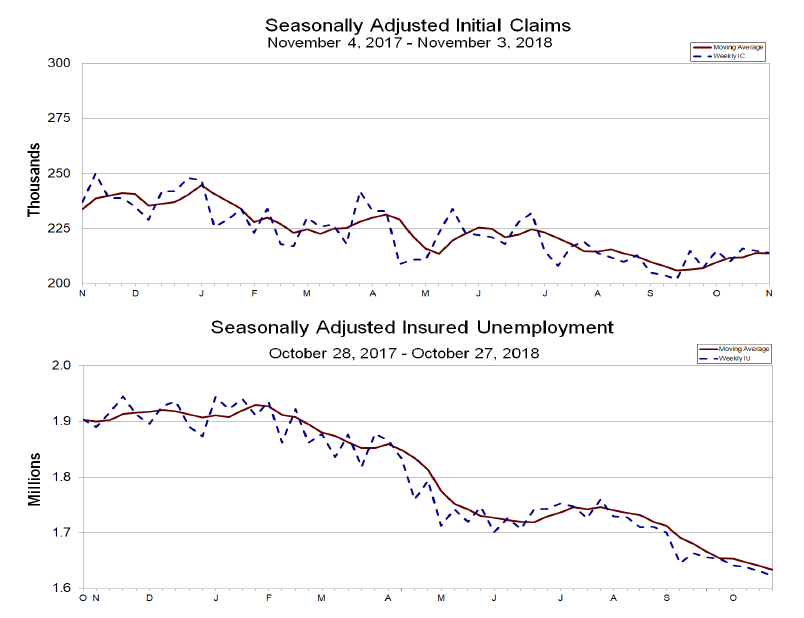
US initial jobless claims dropped -1k to 214k in the week ended November 3. Four-week moving average of initial claims dropped -0.25k to 213.75k. Continuing claims dropped -8k to 1.623m in the week ended October 27, lowest since July 28, 1973. Four-week moving average of continuing claim dropped -7.5k to 1.64075m, lowest since August 11, 1973.
Dollar Remains Bullish ahead FOMC Rate Decision
Here are the latest developments in global markets:
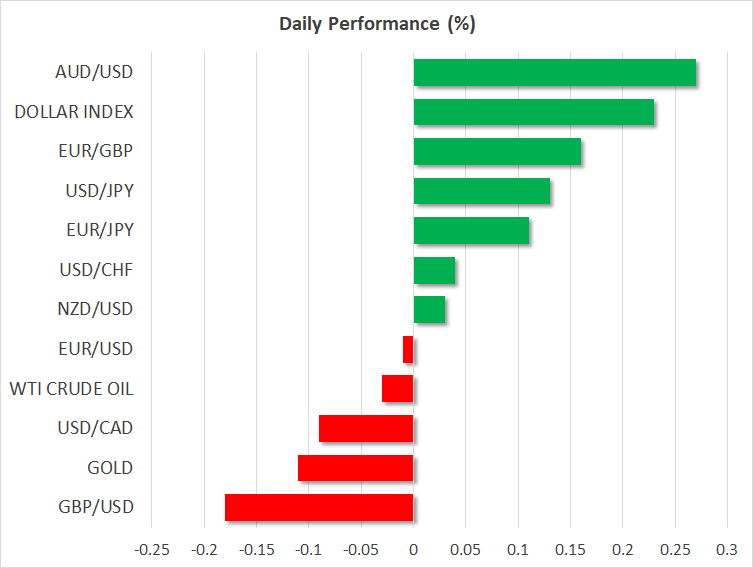
- FOREX: Expectations that the Fed will continue to signal further monetary tightening when it keeps rates steady at the conclusion of the FOMC meeting later today probably helped the dollar index to move higher by 0.22% as the market took a breath after the US midterm elections. Dollar/yen traded up by 0.13% at 113.66, near one-month highs. Meanwhile in the Eurozone, the European Commission revised the bloc’s economic growth for 2019 downwards to 1.9% y/y from 2.0% before, and projected further growth weakness in the next two years as expected. Separately, forecasts for the Italian deficit indicated that the Eurozone and Italian views on this matter are divided as Brussels anticipates the Italian deficit to surpass 3.0% in 2020, whereas the Italian government pledged to keep it below 2.4%. The European Commissioner, Pierre Moscovici said that he is still expecting a revised Italian budget by November 13. Euro/dollar was moving sideways around 1.1422, while euro/yen and euro/pound were up by 0.13%. Pound/dollar inched below 1.3100 after reports that a Cabinet meeting in which the UK PM will try to unite ministers on the Brexit front is unlikely to take place this week, with the pair losing 0.16% in the day. Pound/yen reached a new one-month high at 148.49 but it soon reversed below it to settle near opening levels. The antipodean currencies were in positive terittory, with aussie/dollar and kiwi/dollar gaining 0.33% and 0.06% respectively. Dollar/loonie eased slightly below the 1.3100 handle (-0.11%).
- STOCKS: European stock indices were mixed at 1200 GMT. The pan-European STOXX 600 and the blue-chip Euro STOXX 50 were trading higher by 0.25% and 0.30% respectively. The German DAX 30 retreated by 0.17% led by losses in the healthcare sector, while the French CAC 40 and the Spanish IBEX 35 were flat. The British FTSE 100 rose 0.30%, whereas the Italian FTSE MIB declined by 0.62%. US stocks skyrocketed yesterday, however, futures tracking the major indices were flashing red today, pointing to a negative open.
- COMMODITIES: Oil prices moved south, with West Texas Intermediate crude turning flat in the day at $61.66/barrel and the London-based Brent falling by 0.24% to $71.90. The yellow metal was weaker by 0.08% on the back of a stronger dollar as investors digested the US midterm elections results and turned their attention to the Federal Reserve meeting later today.
Day ahead: FOMC to leave rates unchanged; Chinese inflation & RBA monetary statement awaited
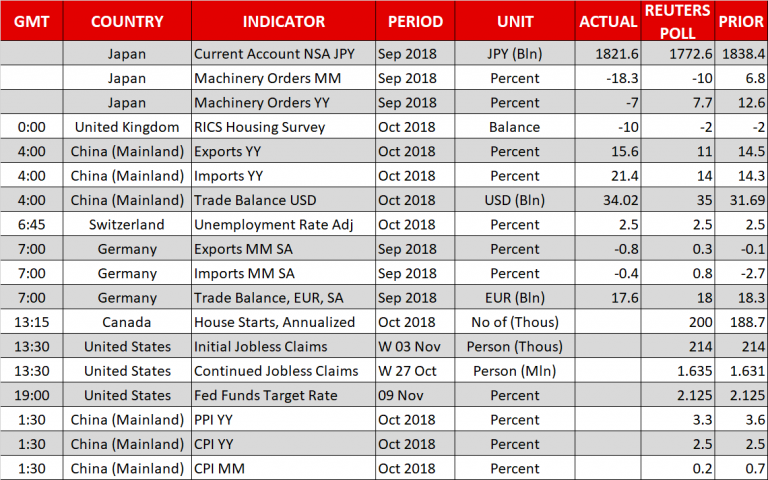
Later on Thursday, the Federal Open Market Committee will conclude its two-day policy meeting, with the rate announcement scheduled for release at 1900 GMT. Policymakers are expected to stay on course and leave borrowing costs unchanged this time at 2.00% – 2.25%, while in December they are projected to deliver the fourth-rate hike for this year.
Even though the gathering might prove uneventful as no press conference or new economic projections are on the agenda, investors will carefully read the statement to identify any tweaks in the language and rate guidance for 2019 given the recent sell-off in stock markets but the still-robust economic figures . In case the rate statement takes a surprisingly amore hawkish point of view than previously, then the dollar may gain more, and vice versa. Note that this will be the last meeting without a press conference as the Fed chief Jerome Powell plans to start holding a press conference for each of the eight meetings set every year from 2019 onwards.
Following the FOMC rate decision, the focus will shift to China where the National Bureau of Statistics will update its Consumer and Producer price indices. Forecasts suggest that year-on-year, consumer prices grew at the September’s pace of 2.5% in October, the highest since March, while on a monthly basis, the measure slowed down from 0.7% to 0.2%. The Producer Price Index is also anticipated to lose strength for the fourth consecutive month, falling by 0.3 percentage points to 3.3% y/y in October. While the People’s Bank of China aims to stand pat on monetary policy despite rising uncertainties in US-Sino trade relations, a beat in the data might provide additional tailwinds to the Chinese yuan as well as to the Australian currency since China is Australia’s top export partner. Recall that Chinese exports and imports increased much faster than analysts projected, driving country’s trade surplus to 34 billion US dollars, the biggest mark printed since July.
In other data of interest, US initial jobless claims for the week ending November 3 will be available for review at 1330 GMT, while earlier at 1315 GMT Canada will be publishing readings on housing starts. Although interesting, both measures are usually not market movers.
Overnight in Australia, traders will be waiting for the RBA monetary policy statement accompanied with new quarterly economic projections to come out at 0030 GMT. A more confident RBA on the back of a stronger GDP growth in Q2 and positive developments in the labor market may add sparkle to the aussie. Recall that on Tuesday the Bank decided to hold interest rates unchanged at record lows, with markets looking forward to hearing whether policymakers continue to see the next move in rates to be up.
On the political front, Brexit will continue to keep traders busy as a row of headlines have been supporting that a solution is drawing nearer in the past couple of days, making it appear increasingly realistic. Yet as the story lacks sufficient detail, investors are likely to hold some cautiousness until they get a clear picture on the issue. Pressure is now on the British Prime Minister, Theresa May, who will push hard to persuade the Cabinet to accept her Brexit offer probably next week, after a failed attempt on Tuesday.
As for today’s public appearances, ECB board member Benoit Coeure will be delivering a keynote speech regarding the role of central banks at 1415 GMT in Berlin, while in Stuttgart, ECB governing councilmember Ewald Nowotny is set to speak at 1600 GMT. ECB chief, Mario Draghi will be giving introductory remarks during his exchange of views with the House of Representatives in Dublin at 1520 GMT.
Tria: EU forecasts of Italy deficit inaccurate and incomplete
Italian Economy Minister Giovanni Tria complained that the new budget deficit forecasts for Italy by European Commission released today. The Commission projected Italy's deficit to hit 2.9% of GDP in 2019. Even worse, Italy's deficit is projected to hit 3.1% in 2020, breaking EU's 3% limit. This is much higher than Italy's own target of 2.4% in 2019.
Tria said "the European Commission's forecasts for the Italian deficit are in sharp contrast to those of the Italian government and derive from an inaccurate and incomplete analysis." Though, Tria also said that the projections would not affect the "continuation of constructive dialogue" with the Commission. And, the coalition government is committed to the 2.4% deficit target.