Sample Category Title
(FED) Federal Reserve Issues FOMC Statement
Information received since the Federal Open Market Committee met in September indicates that the labor market has continued to strengthen and that economic activity has been rising at a strong rate. Job gains have been strong, on average, in recent months, and the unemployment rate has declined. Household spending has continued to grow strongly, while growth of business fixed investment has moderated from its rapid pace earlier in the year. On a 12-month basis, both overall inflation and inflation for items other than food and energy remain near 2 percent. Indicators of longer-term inflation expectations are little changed, on balance.
Consistent with its statutory mandate, the Committee seeks to foster maximum employment and price stability. The Committee expects that further gradual increases in the target range for the federal funds rate will be consistent with sustained expansion of economic activity, strong labor market conditions, and inflation near the Committee's symmetric 2 percent objective over the medium term. Risks to the economic outlook appear roughly balanced.
In view of realized and expected labor market conditions and inflation, the Committee decided to maintain the target range for the federal funds rate at 2 to 2-1/4 percent.
In determining the timing and size of future adjustments to the target range for the federal funds rate, the Committee will assess realized and expected economic conditions relative to its maximum employment objective and its symmetric 2 percent inflation objective. This assessment will take into account a wide range of information, including measures of labor market conditions, indicators of inflation pressures and inflation expectations, and readings on financial and international developments.
Voting for the FOMC monetary policy action were: Jerome H. Powell, Chairman; John C. Williams, Vice Chairman; Thomas I. Barkin; Raphael W. Bostic; Lael Brainard; Richard H. Clarida; Mary C. Daly; Loretta J. Mester; and Randal K. Quarles.
Gold Slide Continues after US Election, Fed Decision Next
Gold continues to lose ground this week. In Thursday’s North American session, the spot price for one ounce of gold is $1224.17, down 0.21% on the day. On the release front, unemployment claims remained pegged at 214 thousand. Later in the day, the Federal Reserve winds up its policy meeting and will release a rate statement.
The Fed is widely expected to maintain interest rates, after raising rates by 25 basis points in September. The markets will be combing through the rate statement, as the tone of the statement could move the U.S dollar. The Fed has sounded hawkish in the September statement, acknowledging the booming U.S economy and reiterating that it planned to continue its stance of gradually raising rates. If the Fed statement gives a thumbs-up to the economy, gold could continue to slide.
Gold prices are down this week, as risk appetite has improved. Investors were relieved as the U.S mid-term election ended in a split decision. The Democrats regained the House of Representatives but the Republicans maintained control of the Senate. Had the Democrats taken both houses, President Trump would have been reduced to a lame duck, unable to push forward his market-friendly policies. If Trump is serious about bipartisan cooperation, he can still advance his plans for increased fiscal stimulus and lower taxes, but he will need support from the Democrats.
British Pound Pauses from Rally, Fed Statement Next
GBP/USD has ticked lower in the Thursday session. In North American trade, the pair is trading at 1.3112, down 0.12% on the day. There are no British events on the schedule. In the U.S., unemployment claims remained pegged at 214 thousand. Later in the day, the Federal Reserve winds up its policy meeting and will release a rate statement. On Friday, the U.K releases GDP and Manufacturing Production.
The pound has enjoyed a strong week, gaining 1.22% in that time. The pound is currently at its highest level in three weeks, boosted by broad weakness from the U.S dollar. GBP/USD is unchanged on Thursday, but traders can expect some movement from the pair on Friday, with the release of GDP reports. Preliminary GDP for Q3 is expected to post a strong gain of 0.6%, after a 0.4% gain in Final GDP in the second quarter. A strong GDP release would likely reignite the pound rally.
After digesting the results of the U.S. midterm elections, investors will be focusing on the Federal Reserve, which will hold its monthly policy meeting. The Fed is widely expected to maintain interest rates, after raising rates by 25 basis points in September. The markets will be combing through the rate statement, as the tone of the statement could move the U.S dollar. The Fed has sounded hawkish in the September statement, acknowledging the booming U.S economy and reiterating that it planned to continue its stance of gradually raising rates. The Fed is expected to raise rates in December, which would mark a fourth hike in 2018, and continue with at least three rate hikes in 2019.
Today’s top mover: AUD/JPY completed double bottom, medium term trend in bullish reversal
AUD/JPY is so far the biggest gainer today, up 32 pips or 0.39% at the time of writing.
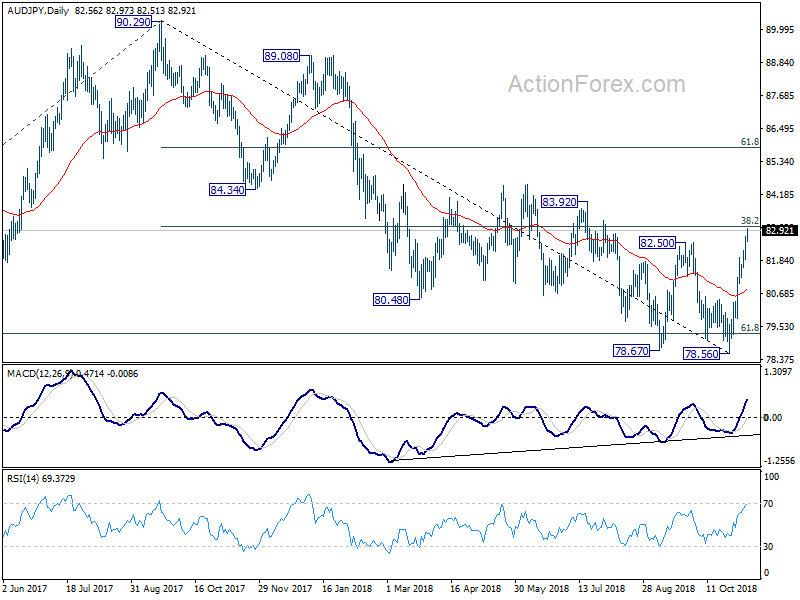
The cross experience quite significant technical development this week. The break of 82.50 resistance completed a double bottom reversal pattern (78.67, 78.65). Bullish convergence condition is seen in daily MACD. And it drew support from 61.8% retracement of 72.39 to 90.29 at 79.22. Adding all together, the down trend from 90.29 should have completed at 78.56. The structure suggests fall from 90.29 to 78.56 is a corrective move.
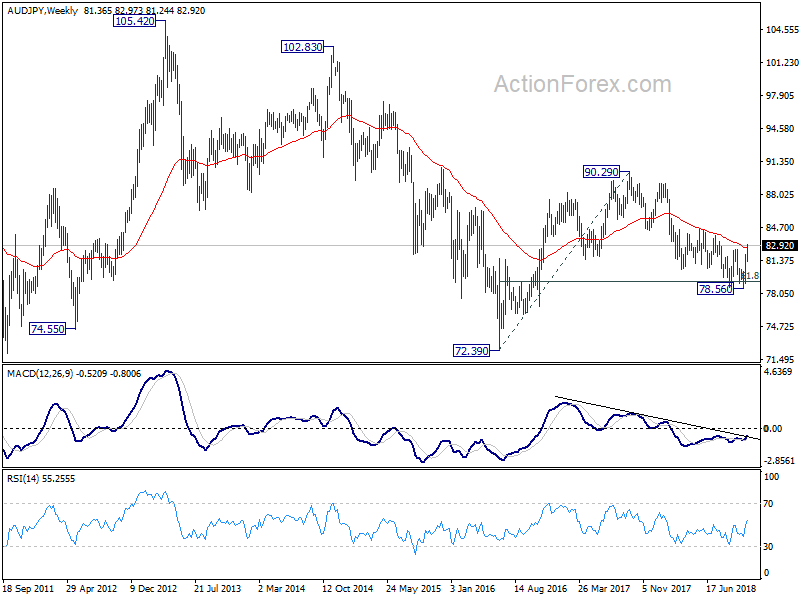
Now, near term outlook will remain bullish as long as 81.94 support holds. Sustained break of 38.2% retracement of 90.29 to 78.56 at 83.04 will have 55 week EMA firmly taken out too. In that case, further rally should be seen to 61.8% retracement at 85.80 and above. From a longer term perspective, such development would also argue that rise from 72.39 is resuming and raise the chance of breakthrough through 90.29 in medium term.
UK Preliminary GDP Due as Brexit Talks Pick Up Momentum
The first estimate of UK GDP for Q3 will hit the markets on Friday, at 0830 GMT. Forecasts point to an acceleration in growth, which may help sterling to extend its latest gains. That said, economic data in general are likely to play second fiddle to any developments in the Brexit negotiations, with politics likely to overshadow economics in driving the pound over the coming weeks.
The UK economy is anticipated to have grown by 0.6% on a quarterly basis in Q3, a notably faster pace than the 0.4% recorded in Q2. Such a quarterly print would drive the yearly expansion rate higher to 1.5%, from 1.2% in the previous quarter. Besides the headline GDP number, this release will also feature the preliminary data on business investment for the relevant quarter, which are likely to act as a gauge of whether Brexit uncertainties are causing firms to curtail their investment plans. Investment is forecast to have risen by 0.2% in quarterly terms, a rebound following a decline of 0.7% previously.
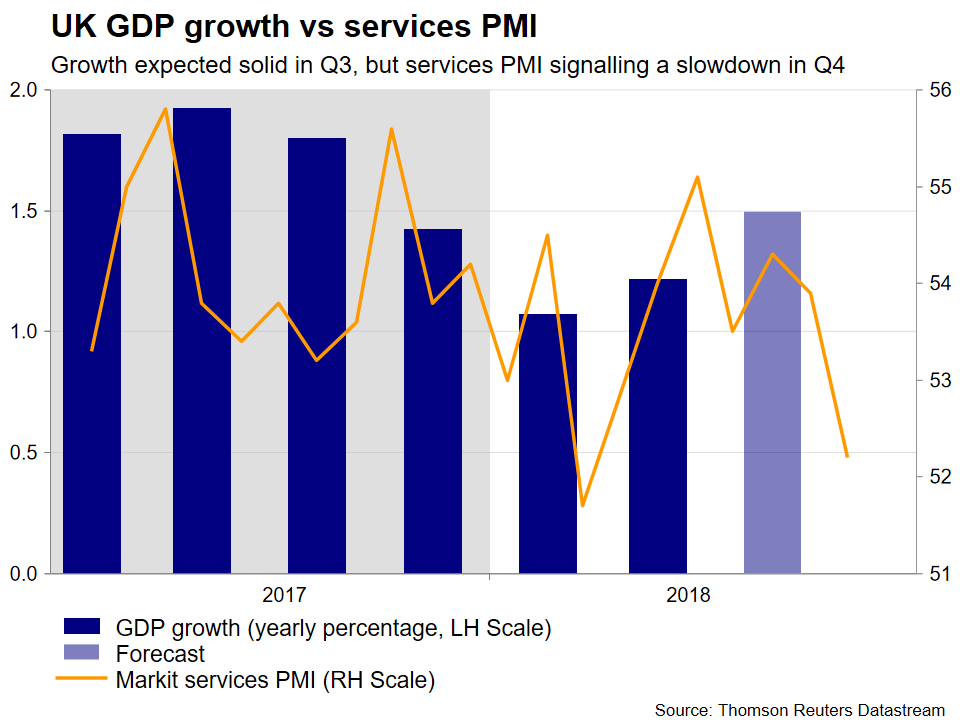
A GDP print of 0.6% in Q3 would be in line with the Bank of England’s (BoE) latest growth forecasts and hence, while it may support the pound a little on the news it is unlikely to significantly spur bets for faster rate increases by the Bank moving forward. Looking at market pricing derived from UK overnight index swaps, investors don’t expect policymakers to raise rates again until September 2019 – a pricing so pessimistic relative to the state of the UK economy that it likely incorporates concerns around Brexit as well. In other words, markets are betting the BoE will stay sidelined until the Brexit fog clears somewhat, which implies political developments could continue to eclipse economic ones in driving sterling over the coming weeks.
Turning to the latest on Brexit, optimism is currently riding high that a deal may be clinched before long, following reports that the UK government is working on a compromise proposal that could be presented to the EU later this month. Accordingly, the British pound has been riding this wave of newfound confidence, posting considerable gains lately as investors unwound some of their prior short-bets on the currency.
While an agreement indeed appears to be inching closer, the reality is that any deal will also need to be approved by the UK Parliament, which may be much trickier than it seems at first glance. Thus, lots of twists and turns likely remain before the Brexit saga concludes, implying that even if the pound ends the year higher from here, it will likely be a volatile and bumpy trip, and not all smooth sailing.
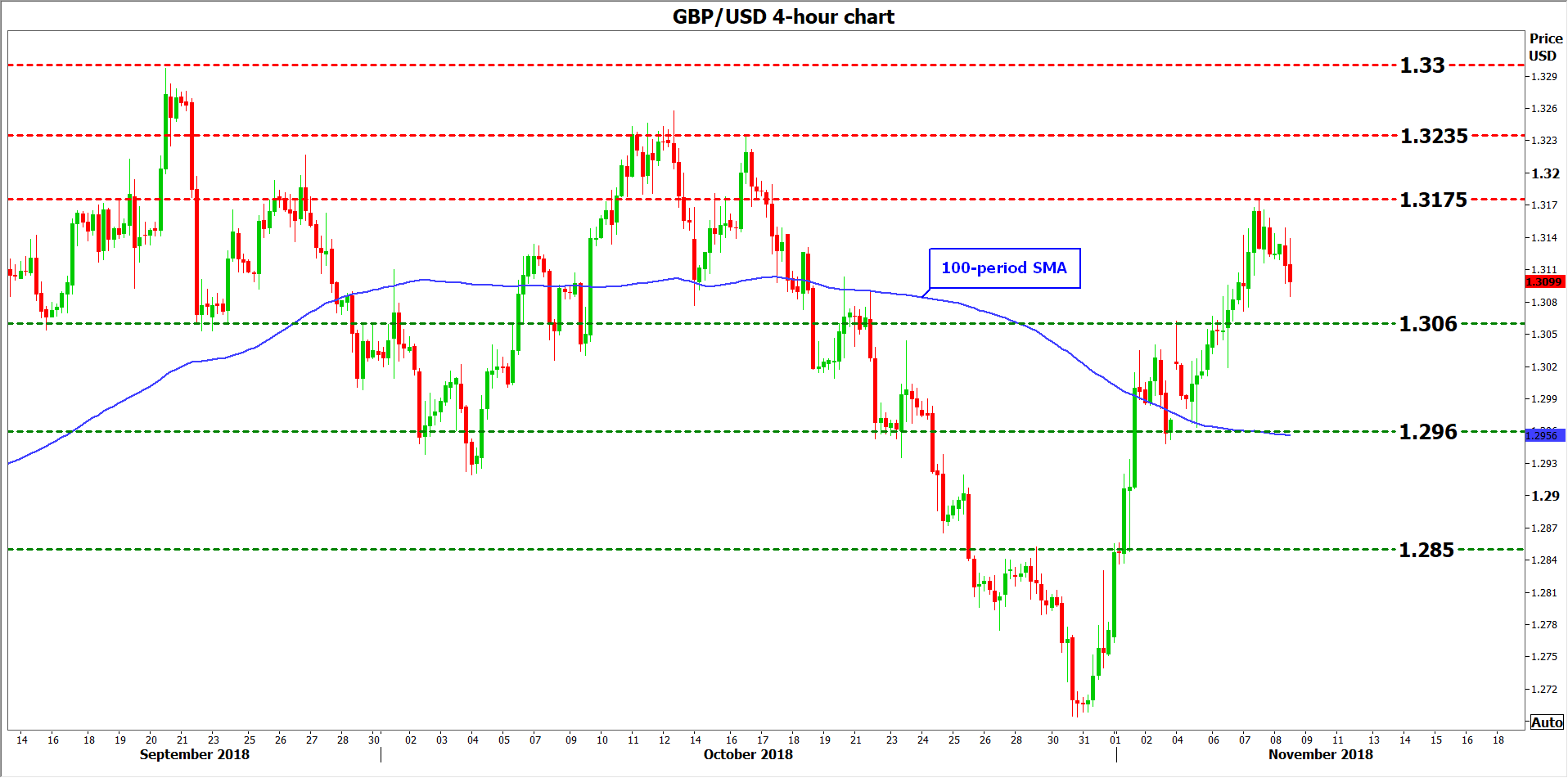
Technically, further advances in sterling/dollar could encounter initial resistance near 1.3175, the peak of November 7. An upside break could open the way for the 1.3235 area, defined by the October 16 highs, with even steeper bullish extensions potentially aiming for 1.3300, the September 20 top.
On the other hand, a pullback in the pair may meet a first wave of support around 1.3060, a zone marked by the inside swing high on November 4. If the bears pierce below it, then buy orders may be found near the November 5 lows at 1.2960, before the 1.2850 area attracts attention – this being the inside swing high of October 29.
Sunset Market Commentary
Markets:
Global core bonds are trading mixed with US Treasuries outperforming German Bunds. European equities were unable to continue yesterday’s rally. Investors looked ahead of the Autumn Economic Forecasts of the European Commission and the FOMC rate decision of tonight. The Commission lowered the 2019 euro-area GDP prediction from 2.0% to 1.9% this morning, a move substantiated by growing tensions in the global economy, Italy’s fiscal battles and the risk of an overheating US economy. Italian BTP’s edged lower at opening in the run-up to the EC forecast. It projects that Italy’s economy will expand only 1.2% in 2019, whereas Rome projected growth at 1.5%. This will cause the deficit to reach 2.9% next year and 3.1% in 2020, in breach with the EU fiscal rules. Italy’s government has until November 13 to resubmit its budget proposal, but FM Tria responded that the Commissions forecasts are not correct and reiterated that Italy has no intention to alter its 2.4% deficit for 2019. Italian BTO futures underperform, pushing Italian yields higher. The Italian 10-yr yield moves back north of 3.4%. German yields are mixed and close to opening levels. Moves vary between -0.1 bps (2-yr) and +0.3 bps (30-yr). The US yield curve bull flattens ahead of tonight’s Fed meeting with changes ranging from -1.2 bps (2-yr) to -3.2 bps (30-yr). Spreads over the German 10-yr yield remain little changed, with the exception of Italy (+8 bps).
The outcome of the US midterm elections turned out quite neutral for US yields and for the dollar. An initial decline in both variables was reversed towards the end of yesterday’s session. The US risk rally slowed in Asia this morning. European equity markets failed to extend gains. The market focus turned to the EC autumn forecasts and, even more to this evening’s Fed policy decision/statement. The ECB expects EMU growth to slow down to 1.9% next year and 1.7% in 2020. The Commission also openly rejected the growth forecasts of the Italian government with negative impact on the country’s budget deficit and debt metrics. The forecasts weighed on BTP’s, but there was little reaction of the euro. EUR/USD hovered in a sideways range in the lower half of 1.14. FX markets are counting down to this evening’s Fed policy statement. We expect the Fed to maintain its assessment on the economy and to signal further policy normalization. We don’t expect Powell and co to give too much weight to the recent rise in market volatility. Such scenario could support a further increase in US yields and in the dollar.
Sterling recently enjoyed a nice rally as markets reacted to ‘rumours’ that the UK and the EU are close to a Brexit deal. It looked like this rally could continue as PM May was said to broker a Brexit deal text within her cabinet. However, the GBP-rally finally slowed without additional positive news from the political scene. EUR/GBP tested the 0.87 big figure, but no sustained break occurred. The pair trades currently again in the 0.8725 area. Cable lost a few ticks and hovers near the 1.31 big figure, but this move was partially due to USD strength.
News Headlines:
EUR/SEK dropped below 10.285 support this morning. Comments by Riksbank governor Ingves triggered the break. He said the central bank needs to be vigilant when it comes to inflation, a reference ex-ECB president Trichet often used to flag an imminent rate hike. The Riksbank said until now that it could start its tightening cycle either at the December of February policy meeting. Ingves comments suggest a December hike (65% market implied probability).
The EC expects growth in the EMU to slow in the coming years with risks ranging from US economic policies over Brexit to fiscal stimulus in high-debt countries. The EMU is expected to grow 2.1% this year, 1.9% in 2019 and 1.7% in 2020. The EC was more pessimistic than Italy on growth and deficit which was quickly rebuffed by the Italian government as a sloppy and outdated analysis.
EUR/GBP Mid-Day Outlook
Daily Pivots: (S1) 0.8688; (P) 0.8719; (R1) 0.8734; More...
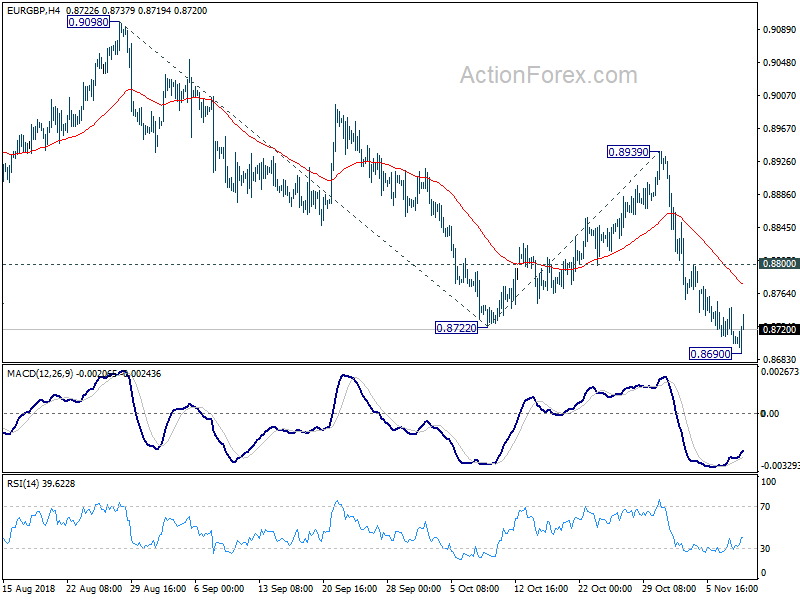
Intraday bias in EUR/GBP is turned neutral with 4 hour MACD crossed above signal line. Some consolidations would be seen first. But as long as 0.8800 minor resistance holds, another fall is expected. Break of 0.8690 will extend whole fall from 0.9098 to 0.8620 support first. Break will target 100% projection of 0.9098 to 0.8722 from 0.8939 at 0.8563 next. However, break of 0.8800 will turn focus back to 0.8939 resistance instead.
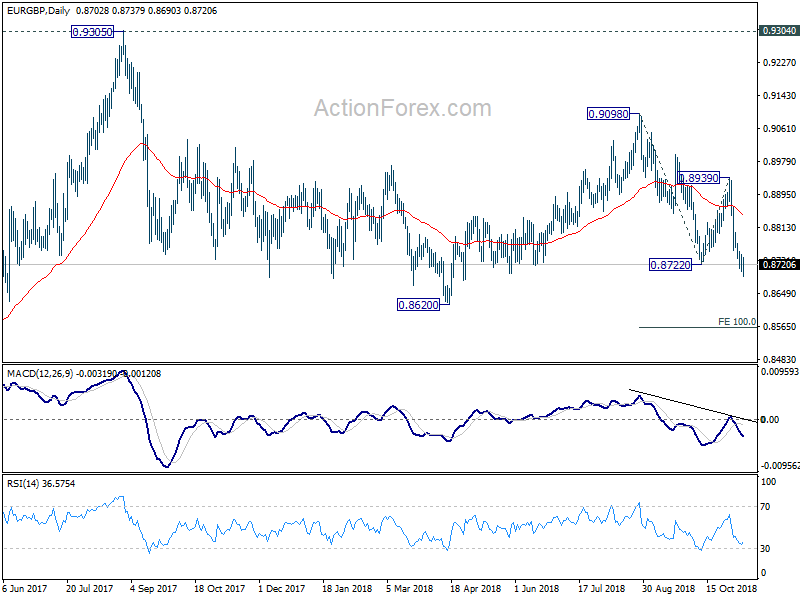
In the bigger picture, EUR/GBP is seen as staying in long term range pattern started at 0.9304 (2016 high). On the downside, break of 0.8722 will extend the falling leg through 0.8620 support. On the upside, break of 0.9097 will target 0.9304 resistance instead.
GBP/JPY Mid-Day Outlook
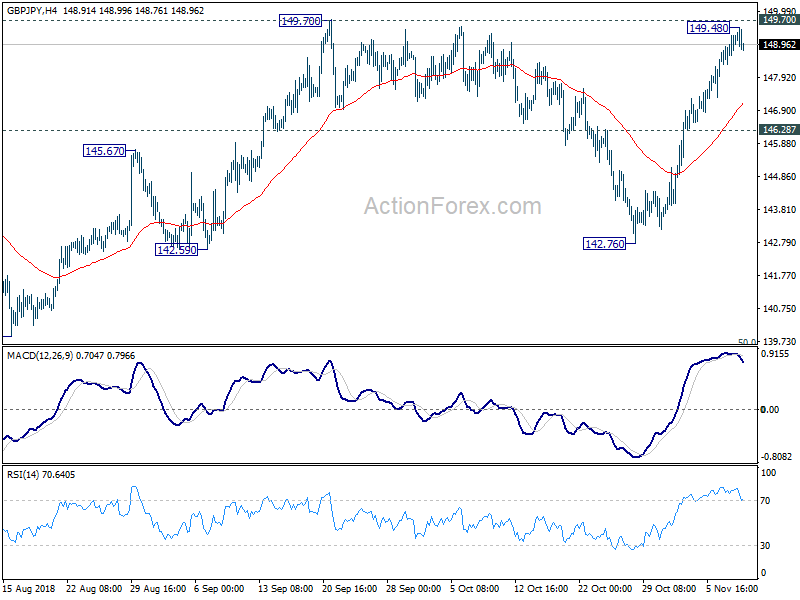
Daily Pivots: (S1) 148.51; (P) 148.88; (R1) 149.43; More...
GBP/JPY retreats mildly ahead of 149.70 resistance. With 4 hour MACD crossed below signal line, intraday bias is turned neutral first. As long as 142.76 support holds, further rally is in favor. On the upside, decisive break of 149.70 will resume whole rise from 139.88 and target 153.84/156.59 resistance zone. On the downside, below 146.28 minor support will turn bias back to the downside for 142.76 instead.
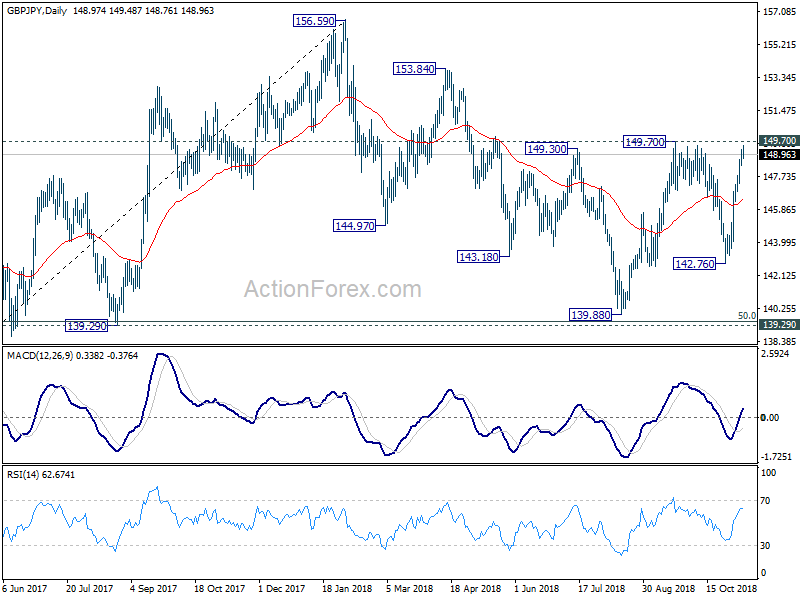
In the bigger picture, as long as 139.29 cluster support (50% retracement of 122.36 to 156.59 at 139.47) holds, up trend from 122.36 (2016 low) would still extend beyond 156.69 high. However, decisive break of 139.29/47 will suggest that such up trend is completed and turn outlook bearish. In that case, next target is 61.8% retracement at 135.43.
Italy PM Conte: European Commission has no ground to question our forecasts, we’re not a problem to EU
Italian Prime Minister Giuseppe Conte issued a formal statement in response to European Commission's new forecasts published today.
Conte criticized that the 2019 growth forecasts for Italy "underestimate the positive impact of our economic maneuver and our structural reforms." He emphasized that with the government's estimate, growth will increase while debt and deficit will decrease. And there is "no grounds for questioning the validity and sustainability of our forecasts."
He also said "Italy is not at all a problem for the Eurozone and European Union, but rather will contribute to the growth of the whole continent." And, the structural reforms will "give greater impetus to the growth compared to the EU Commission."
Conte's full statement in Italian here.
As a reminder, in EU's warning letter dated October 10, European commission has already criticized that "the macroeconomic forecast underlying Italy's budgetary plans has not been endorsed by the Parliamentary Budget Office (PBO), Italy's independent fiscal monitoring institution. At first sight, this appears not to respect the explicit provision of Regulation 473/2013 (Article 4(4)) calling for the macroeconomic forecast to be produced or endorsed by an independent body."
Elliott Wave Analysis: EURUSD Intra-day View
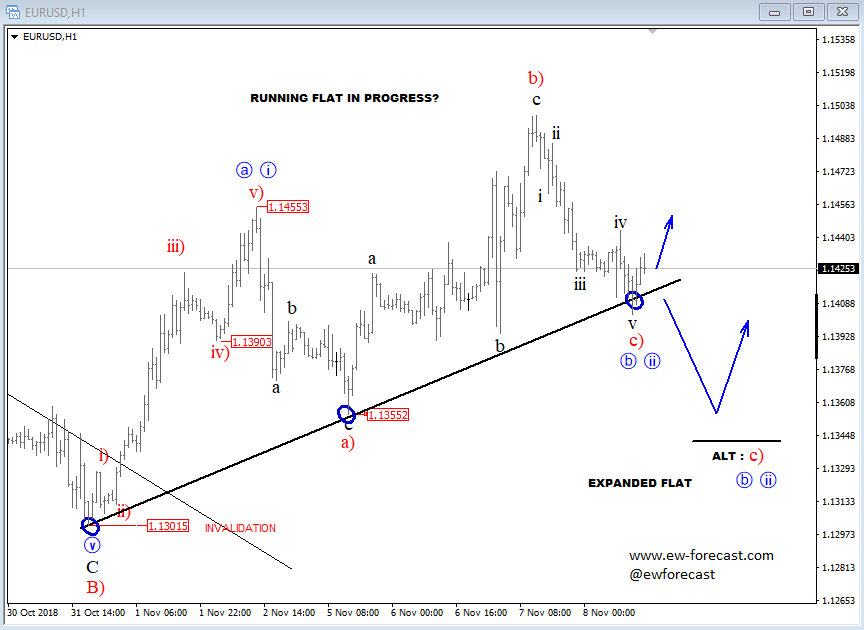
Hello traders and welcome back to the US session. EURUSD turned sharply down, but we still think that it can be a part of a correction, so we are tracking two possibilities here. Either it's a running flat correction, while it's trading above that trendline connected from 1.1300 lows or it's a big expanded flat, where price may go all the way back below previous wave a) swing low, where 1.1350 area can be retested. However, we remain bullish while it's above 1.1300 invalidation area, just keep in mind that we need an impulsive five-wave bounce to confirm a low in place.
EURUSD, 1h