

Sample Category Title
Markets Lower On Hawkish Fed
Fed stays the course despite sell-off
European equity markets are expected to open slightly in the red on the final trading day of the week, taking a cue from Asia overnight where stocks came under pressure following Thursday’s Fed decision.
Just as the feel-good factor was beginning to return to the markets, buoyed by the result of the US midterms, the Fed swooped in and brought everyone back down to earth. Any hope that the central bank would soften its hawkish stance in response to the October scare was quickly dashed as the Fed made the usual marginal adjustments to the statement and put off anything more significant until next month.
This was always likely to be the case as November wasn’t really a “live” meeting, meaning there was no press conference and no real chance of a rate hike. This gives the Chairman no real opportunity to explain any changes so they were always likely to shy away from doing anything too drastic, especially as the market has since calmed down a little. Should any more periods of volatility and selling break out, I would expect that to be addressed in December.
While this isn’t really a significant shift, it is weighing on sentiment a little, although this could be nothing more than some profit taking after the midterm-induced rally. I guess we’ll see how investors respond over the next few sessions and into the weekly close, which may offer some insight into how much risk there is perceived to be.
Brexit silence brewing deal optimism
One area where there is likely to be perceived risk is the UK which will be in the spotlight on Friday. It’s gone very quiet on the Brexit front, something many are taking as a sign that serious negotiations are taking place in private in an attempt to get a deal wrapped up this month. It seems politicians like their holiday period too and don’t want this scuppering their plans next month and so media sparring has been replaced by real negotiation and talk of concessions on red lines. Or as it will probably turn out to be, fudges that allow all sides to save face and get something through parliament.
The potential for a deal to be announced any day brings with it an element of weekend risk for the pound, both to the upside and downside. I don’t believe talks will fall apart this late in the day as it’s in no one’s interest but they could and a weekend announcement could make for a nasty open on the Monday. As for today, we’ll have to settle for GDP, manufacturing and investment data from the UK to drive early volatility and moves.
Oil pares losses ahead of JMMC meeting
Oil is trading a little bit higher on the day after entering bear market territory on Thursday. The tide has well and truly turned for Brent and WTI over the last month, something I’m sure oil ministers from around the world will be all-too aware of. It’s surprising then that heading into the JMMC meeting this weekend, traders remain resolutely bearish on crude, despite the potential for further output cuts to be discussed in order to address the recent supply demand dynamics and, of course, price.
Gold drifts lower on stronger dollar
Gold continues to drift lower at a very gradual price, weighed on by returning risk appetite earlier in the week and the dollar over the last 48 hours, with the Fed giving it an extra kick higher. This decline in Gold is very gradual though which suggests to me a certain resilience in Gold bulls and if the dollar fails to build on these gains, which I suspect it might, they may feel emboldened going into year-end.
ECB Research: TLTRO3 – Italy To Be Main Beneficiary
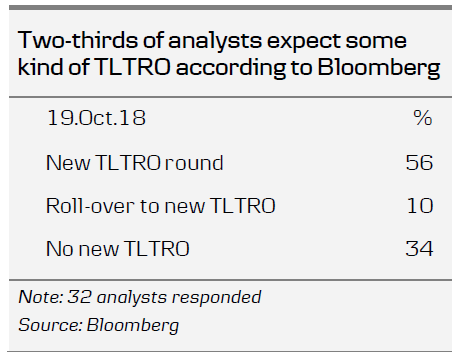
Targeted longer term refinancing operations (TLTRO) - the silent measure that supports loan growth - have returned to the market's attention recently on speculation about the potential for another round/extension of TLTRO and we concur. During the ECB's October press conference, President Mario Draghi said that governing council members (GC) had mentioned the TLTRO without going into detail. Since then, starting just a few hours later, several GC members have mentioned the measure. Since this summer, we have argued that another TLTRO round could be in the pipeline given the new regulatory requirements implemented from July 2019 and that the fragility as well as dependency of southern European banks could be a risk for the banking sector should this terminate. We stress the ECB has not announced a TLTRO3 measure yet but that it is our expectation there will be another round. A recent Bloomberg survey of analysts suggested two-thirds expect some sort of TLTRO.
Current rules - expected to be applied again
We expect another round of TLTROs, which would have similar characteristics as the TLTRO2s, i.e. banks can take up to 30% of the banks' eligible loan stock (loans to households excluding house purchases and loans to non-financial corporations) (for details see TLTRO2 6 EUR11bn of voluntary repayments , 22 June). We expect the new round to be announced in Q1 19 and implemented in Q2 19, before the TLTRO2.1 operation has less than 1Y to maturity. While the ECB's GC has not yet discussed this in detail, we consider it would be a politically 'easy' measure to deploy, as it is supports lending growth and is collateralised (unlike the APP). Further, it would be part of the 'dovish tightening' style that we have seen from the ECB over the past few years. We expect a maturity of three to four years.
New additional take up at TLTRO3 – possibly EUR100-150bn
The parameters for another round of TLTRO are not clear, as the economic expansion and the health of the banking sector are significantly different from when TLTROs were first deployed in 2014. The following things, among others, are uncertain. Could the ECB choose to extend the current operations (and not offer new liquidity)? Could it use a floating rate strategy instead of its fixed MRO/deposit rate? What would be the maturity? This means that estimating the take-up of the TLTRO3 is difficult; in the following we assume the 30% limit on eligible loan stock will be applied and fixed rate, i.e. applying the MRO/ deposit rate prevailing at the time of allotment. The latter is a strong argument for larger take-up due to the carry possibility and the prospect of the ECB hiking rates in H2 19. We do not expect there to be any stigmatisation prevailing in the TLTRO3, unlike the LTROs in 2011/12.
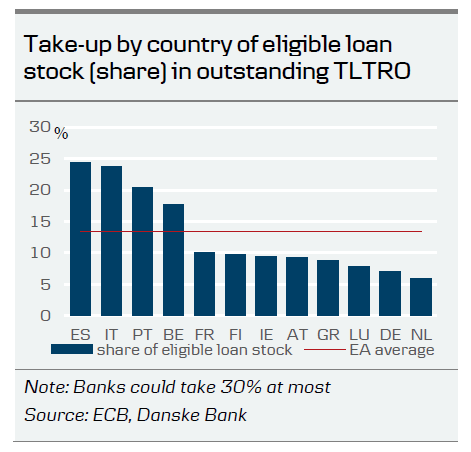
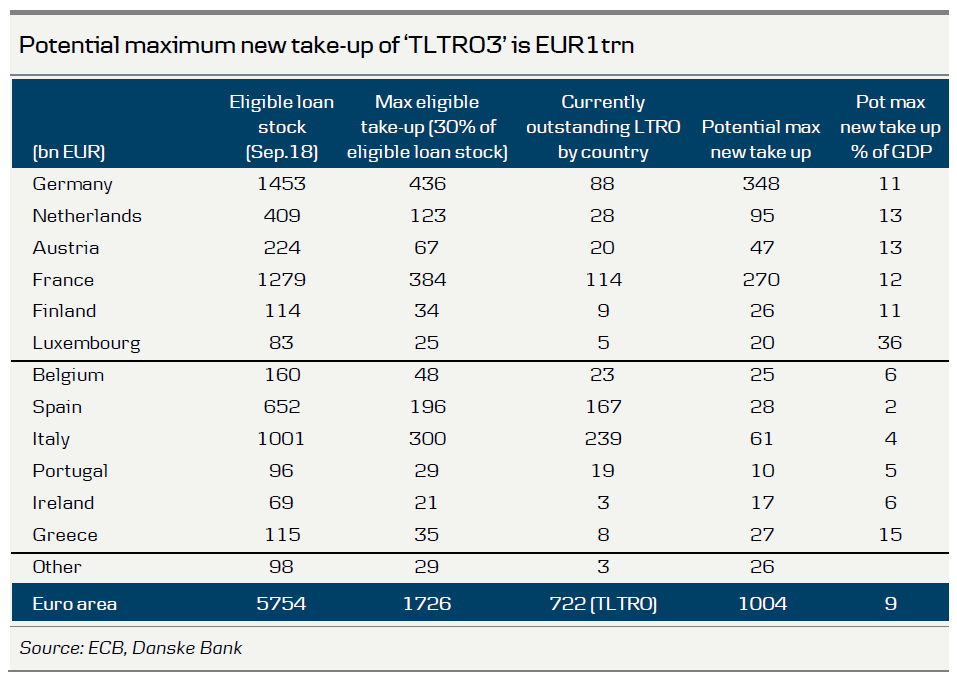
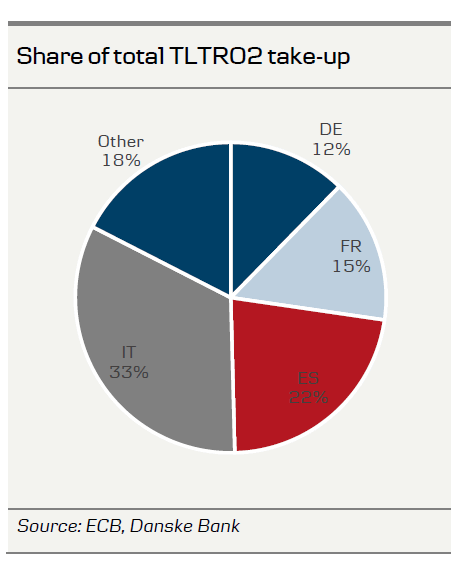
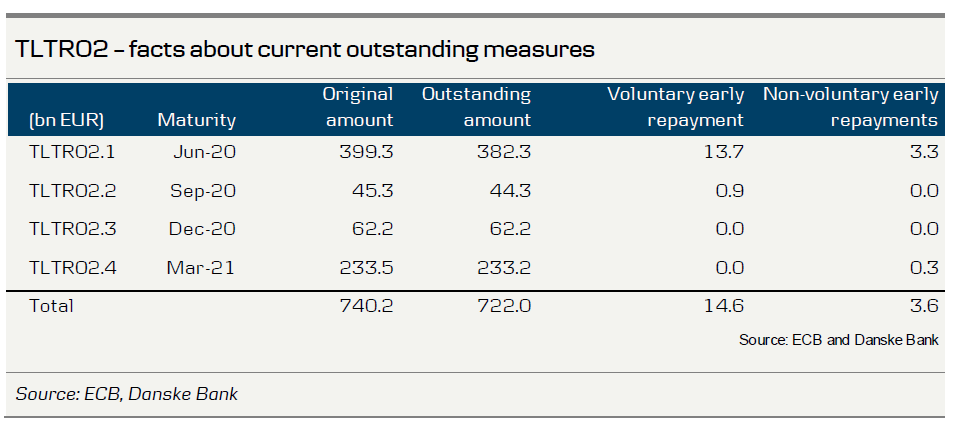
We estimate the maximum total eligible take-up could be up to an additional EUR1trn (as of September 2018). The current eligible loan stock is EUR1,726bn, significantly higher than the EUR722bn currently outstanding (see table on page 1). However, we do not expect the take-up to be anywhere close to such a number, as additional capacity from the main takers in the TLTRO2 are very limited (Spain and Italy took more than 50% in TLTRO2). The Spanish and Italian bank sectors took around 25% of the maximum of 30% in TLTRO2.
Uncertainty about the new take-up is high at this stage but we expect around EUR100-150bn in additional funds could be taken (on top of the rollover possibility), with most take-up in the larger countries. Given the current political/market turmoil, we expect Italian banks, in particular, to be very active in the operations and come very close to the 30% limit. However, as euro area banks may use them simply as three- or four-year liquidity operations, we may see a large take-up ahead of the first rate hike, should the rules remain at MRO/deposit rate prevailing at the time of allotment.
Early repayment – small and expected to continue to be small
So far, we have only seen a small voluntary early repayment from the banks, as banks have little incentive to do so (see TLTRO2 – EUR11bn of voluntary repayments, 22 June). TLTRO2.1 and TLTR2.2, which are the only operations to have had early voluntary repayments, have seen early repayments of EUR13.7bn and EUR0.9bn, respectively
Support for the southern European banking sectors
As mentioned above, the largest take-up in TLTRO2 was taken by Italy and Spain, with close to 15% of GDP taken (24% of eligible loan stock) to support their fragile banking sectors. Since then (2014-16), the Spanish banking sector has seen a strong improvement following the bank recapitalisation in the midst of the crisis and supported by the recovery/expansion of the economy in general. However, the Italian banking sector remains fragile, with the sovereign-bank feedback loop (the so-called ‘doom loop’) still alive and kicking amid the current political challenges in Italy (see Italian Politics Monitor - The gloves are off, 23 October). Therefore, given the health and current stance of European banks, we believe the main beneficiary of another round of TLTROs would be Italy.
Impact on economic growth
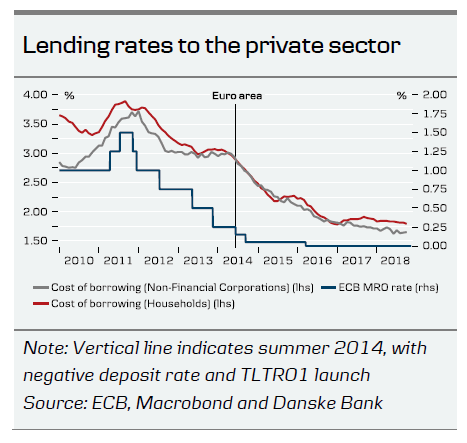
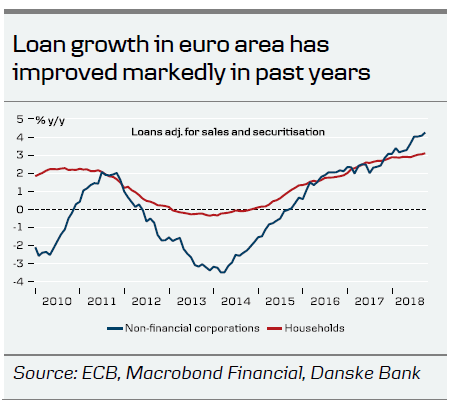
It is difficult to estimate the economic growth impact of the TLTROs. While it is not a bazooka-like instrument such as the ECB’s Asset Purchase Programme (APP), it is a solid tool that supports loan growth, which plays an integral part in the ECB’s toolbox. Even though the economic impact is difficult to estimate, the TLTRO (together with APP and forward guidance) has supported the transmission mechanism of lower rates to the private sector. Lending rates to households and non-financial corporations have declined by almost 2pp since the first TLTRO was launched in summer 2014. This leads us to conclude that the existing TLTROs (together with the above-mentioned measures) have had a significant positive lasting impact on lending growth, as well as pushing lending rates lower, while any additional TLTRO impact on lending rates may have a diminishing, but still nonnegative, impact on the euro area as a whole
Fed Remains On Track For December Hike
Market movers today
In Norway, inflation data for October is due out. We estimate core inflation slowed to 1.8% y/y, from 1.9% y/y in September. For more see Scandi markets overleaf.
In the UK, focus remains on Brexit, where we have seen mixed signals on whether the UK Cabinet is about to reach an agreement on the UK's backstop proposal (backstop is the solution to avoid a harder border if negotiations on the future relationship breaks down). Besides this, we are due to get the monthly GDP figure for September (and hence the first full estimate for growth in Q3), which we estimate rose 0.1% m/m. We believe it is likely GDP grew 0.6% q/q in Q3.
In the US, preliminary consumer confidence from the University of Michigan is due out in the afternoon.
Selected market news
The positive risk sentiment in financial markets seen earlier this week did not last long. Asian stock markets fell 1-2% overnight, while the USD stayed strong and the 10Y US yield continues to trade around this year's peak of 3.23%. The oil market sold off further yesterday, with the price of Brent crude falling below USD71/bbl.
Chinese inflation data for October was published overnight. It came in roughly as expected 6 PPI was 3.3% y/y, down from 3.6% y/y in September, and CPI was 2.5% y/y, unchanged from the previous month. Hence, inflationary pressures remain muted in the Chinese economy and do not constrain the People's Bank of China from keeping an easy stance on monetary policy.
Money-supply growth in Japan is also worth keeping an eye on. Both growth in M2 and M3 money supply slowed in October to 2.7% y/y and 2.3% y/y, respectively.
Finally, the Reserve Bank of Australia kept monetary policy unchanged but signalled that higher rates are to come amid a sound economy but downplayed the likelihood of a near-term move.
As expected, the Fed stayed on hold today and made no major change to the policy signals in the statement, which means the Fed is still on track to hike rates again in December. A few in the market had speculated that the Fed would cut interest on excess reserves (IOER) by 5bp at this meeting, as the effective Federal funds rate had crept higher leading up to the meeting. However, the Fed could instead make an adjustment hike of 15-20bp of IOER in December following a widely expected 25bp hike of its target rate (see FOMC Review 6 No change to the Fed's hiking plans , 8 November).
Elliott Wave Analysis: GBPJPY In Correction Before Next Leg Higher
Short Term Elliott wave view in GBPJPY suggests that the decline to 142.77 ended wave (2) in Intermediate degree. Up from there, the pair rallies as an impulse and ended Minor wave A at 149.49. Minor wave B pullback is currently in progress to correct cycle from Oct 26 low (142.77) before the next leg higher. We can see internals of wave A unfolded in 5 waves where Minute wave ((i)) ended at 144.39, Minute wave ((ii)) ended at 143.19, Minute wave ((iii)) ended at 147.77, Minute wave ((iv)) ended at 146.83, and Minute wave ((v)) ended at 149.49
Subdivision of Minute wave ((iii)) and ((v)) further reveals another 5 waves of a lesser Minutte degree (blue color), fulfilling the rule of an impulse wave. This rally from 142.77 low to 149.49 high completed Minor wave A of a larger degree and ended cycle from Oct 26 low. Pair should now pullback in Minor wave B to correct this cycle in the sequence of 3, 7, or 11 swing before the rally resumes, provided that pivot at 142.77 low stays intact.
Minor wave B pullback is currently proposed to take the form of a zigzag where Minute wave ((a)) of B is in progress as a diagonal. Afterwards, pair should bounce in Minute wave ((b)) of B before turning lower in Minute wave ((c)) of B. We can measure potential target for Minor wave B pullback with more precision once Minute wave ((a)) and ((b)) swing have formed. The potential target for Minute wave ((c)) of B should be at the area of 100% – 123.6% fibonacci extension of Minute wave ((a)) of B.
A rough estimate of 50 – 61.8% fibonacci retracement can be used for the time being to estimate the Minor wave B target while waiting for the Minute wave ((a)) and ((b)) to fully form. A 50 – 61.8% Fibonacci retracement of Minor wave A comes at 145.3 – 146.1 for potential support area where Minor wave B pullback can complete. We don’t like selling the pullback and expect buyers to appear again when the Minor wave B pullback is complete in 3-7-11 swing.
GBPJPY 1 Hour Elliott Wave Chart

EUR/USD Daily Outlook
Daily Pivots: (S1) 1.1329; (P) 1.1388; (R1) 1.1423; More....
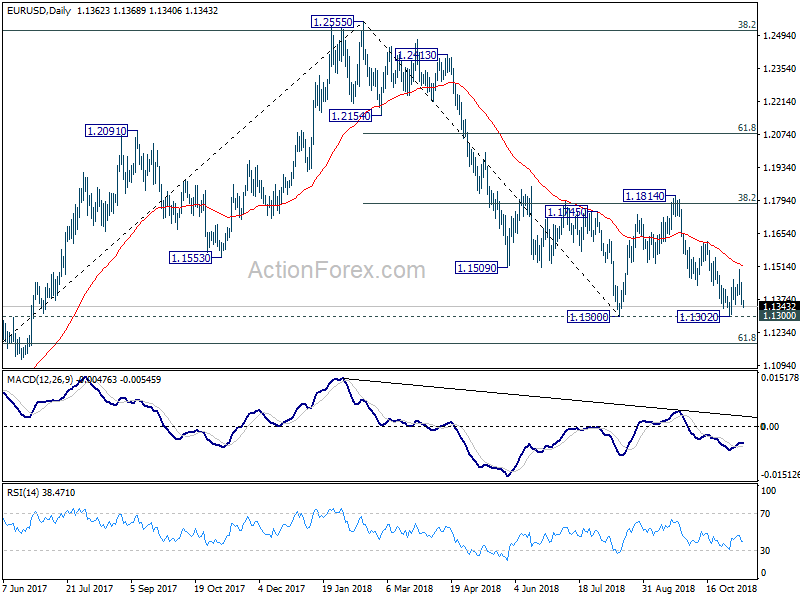
EUR/USD's break of 1.1353 minor support argues that corrective rebound from 1.1302 has completed at 1.1499 already. Intraday bias is turned back to the downside for 1.1300 key support. Decisive break there will resume down trend from 1.2555 to 1.1186 fibonacci level next. On the upside, break of 1.1499 will resume the rebound from 1.1302 to 1.1621 resistance instead.
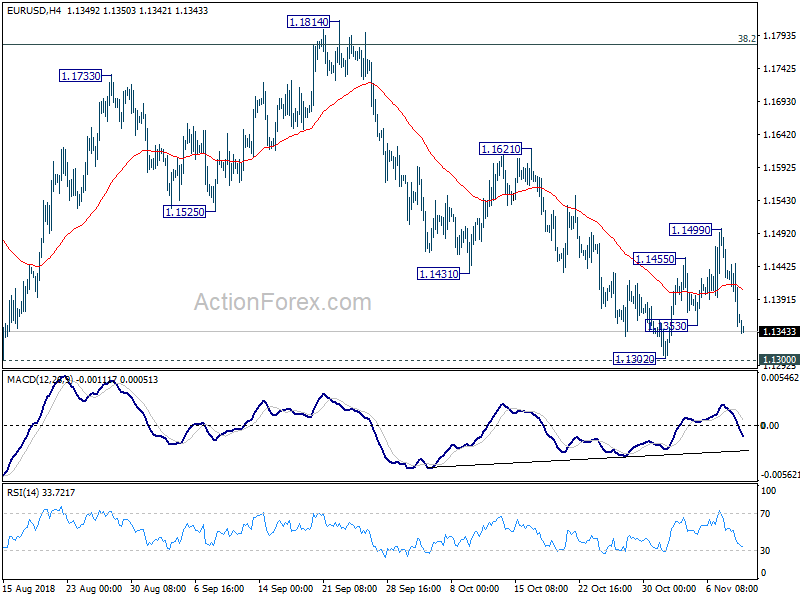
In the bigger picture, price actions from 1.1300 is seen as a corrective pattern. Decisive break of 1.1300 will resume the down trend from 1.2555 to 61.8% retracement of 1.0339 (2017 low) to 1.2555 at 1.1186 next. Sustained break there will pave the way to retest 1.0339. In case the consolidation from 1.1300 extends, upside should be limited by 1.1814 and 38.2% retracement of 1.2555 to 1.1300 at 1.1779. to bring down trend resumption eventually.
GBP/USD Daily Outlook
Daily Pivots: (S1) 1.3020; (P) 1.3086; (R1) 1.3126; More...
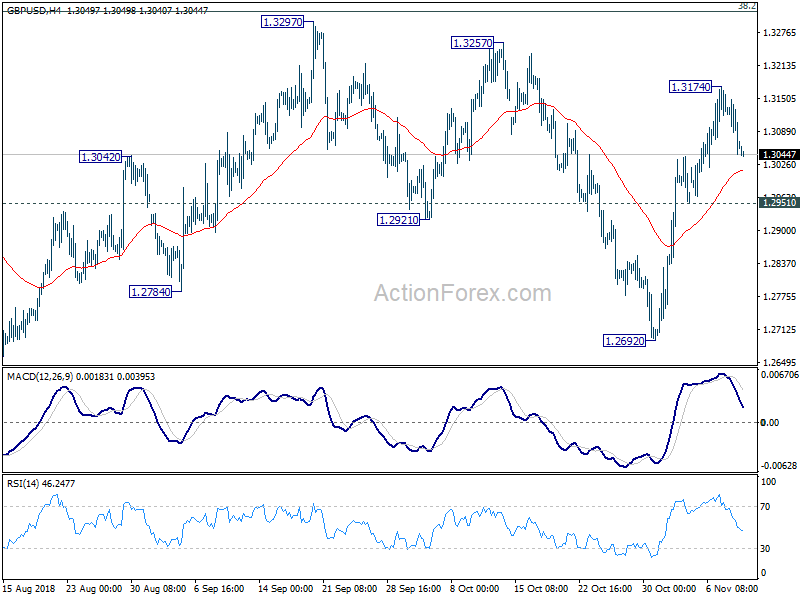
GBP/USD's retreat from 1.3174 extends lower today but stays above 1.2951 support. Intraday bias remains neutral and another rise could still be seen. On the upside, above 1.3174 will target 1.3257/3297 resistance zone. However, as rise from 1.2692 is viewed as the third leg of consolidation pattern from 1.2661, we'd expect strong resistance from 1.3316 fibonacci level to limit upside to bring down trend resumption eventually. On the downside, below 1.2951 minor support will turn bias back to the downside for 1.2692 and then 1.2661 key support.
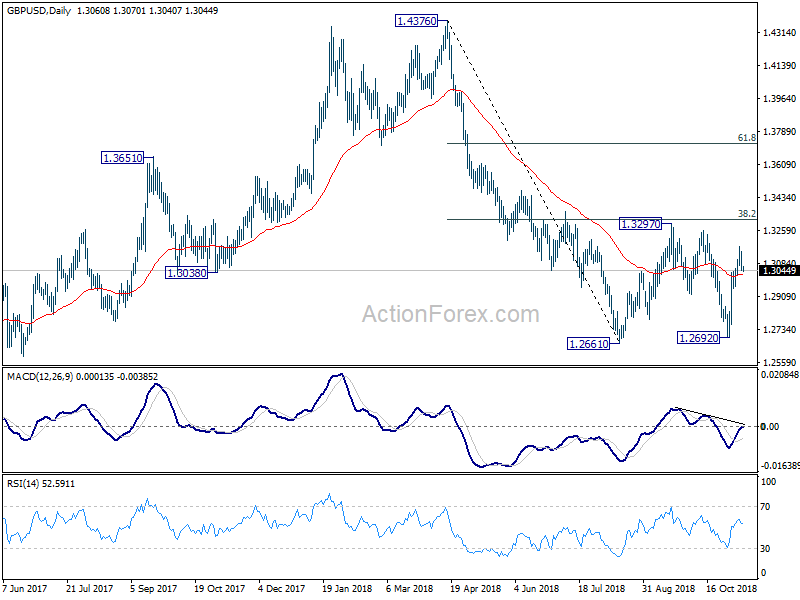
In the bigger picture, whole medium term rebound from 1.1946 (2016 low) should have completed at 1.4376 already, after rejection from 55 month EMA. The structure and momentum of the fall from 1.4376 argues that it's resuming long term down trend. And this will be the preferred case as long as 38.2% retracement of 1.4376 to 1.2661 at 1.3316 holds. However, firm break of 1.3316 would bring stronger rebound to 61.8% retracement at 1.3721. And, the eventual depth of the fall from 1.4376, and the chance of hitting 1.1946 low, will depend on the strength of the interim corrective rebound from 1.2661.
USD/CHF Daily Outlook
Daily Pivots: (S1) 1.0022; (P) 1.0047; (R1) 1.0086; More...
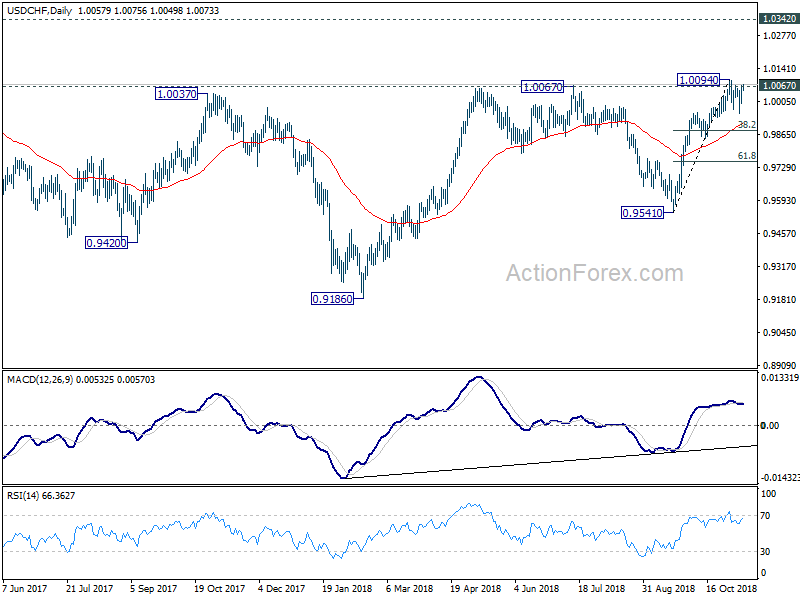
USD/CHF's rebound from 0.9952 extends higher today but it's limited below 1.0094 so far. Intraday bias remains neutral first. On the upside, break of 1.0094 and sustained trading above 1.0067 will confirm resumption of whole rise from 0.9541. USD/CHF should then target 1.0342 key resistance next. On the downside, below 0.9952 will extend the consolidation from 1.0094 with another decline. But we'd expect strong support from 38.2% retracement of 0.9541 to 1.0094 at 0.9883 to contain downside to bring rebound
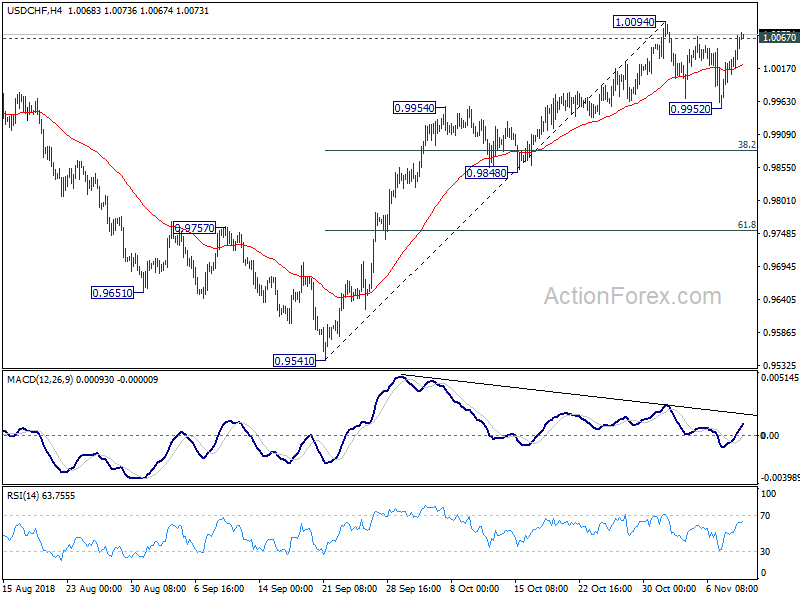
In the bigger picture, the pullback from 1.0067 has completed at 0.9541 already. And rise from 0.9186 is likely resuming. Firm break of 1.0067 will pave the way to retest 1.0342 key resistance. We'd be cautious on strong resistance from there to limit upside to bring another medium term fall to extend long term range trading. However, firm break of 0.9848 near term support will dampen this view and bring deeper decline back to 0.9541 support and possibly below.
EU Forecasts Slowdown In Euro-Zone’s Economic Growth
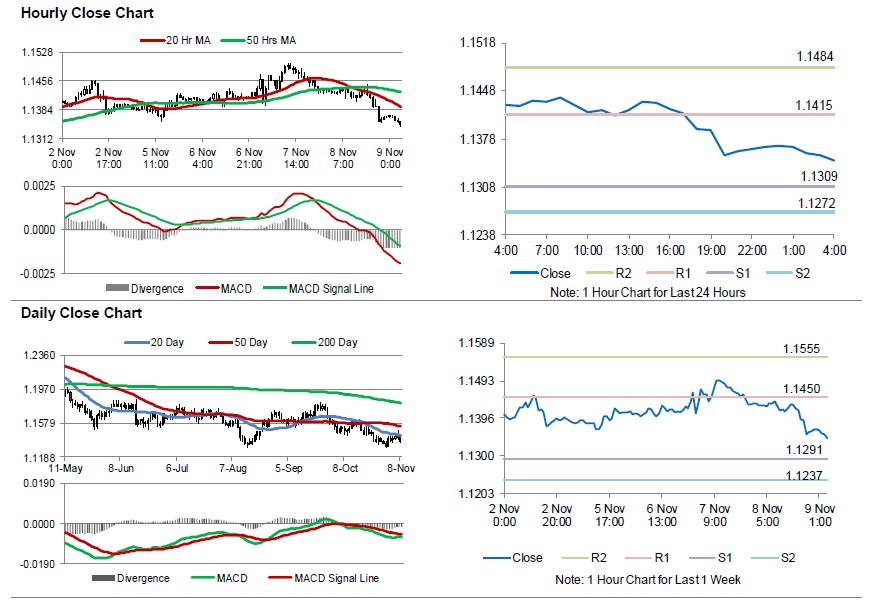
For the 24 hours to 23:00 GMT, the EUR declined 0.57% against the USD and closed at 1.1367, after the European Commission lowered the country's growth forecast.
The European Commission, in its Autumn forecast, warned that economic growth in the euro area would decelerate over the next two years. As a result, in the near term, economic growth is expected to continue at about the same pace as in the first half of the year, resulting in a growth of 2.1%. Real GDP was projected to grow 1.9% in 2019, which was slower than the 2.0% forecasted earlier.
Data indicated that Germany's seasonally adjusted trade surplus widened to €18.4 billion in September, from a trade surplus of €17.2 billion in the previous month. Market participants had envisaged for the nation to post a trade surplus of €20.0 billion.
The US dollar gained ground against a basket of currencies, after the Federal Reserve (Fed) kept its key interest rate unchanged and hinted at further rate hike in December. The Fed, in its latest monetary policy meeting, decided to keep its benchmark interest rate unchanged at 2.25%, as widely expected. The central bank stated that the economy expanded at a strong pace along with robust employment growth. Moreover, the bank reiterated that it expects gradual increase in interest rates, with further interest rate hike in December. However, the Fed cautioned over the slowdown in business investment growth.
Other data showed that the US seasonally adjusted initial jobless claims dropped to a level of 214.0K in the week ended 03 November 2018, in line with expectation and recording its lowest level in 45 years. In the previous week, initial claims had recorded a revised reading of 215.0K.
In the Asian session, at GMT0400, the pair is trading at 1.1346, with the EUR trading 0.18% lower against the USD from yesterday's close.
The pair is expected to find support at 1.1309, and a fall through could take it to the next support level of 1.1272. The pair is expected to find its first resistance at 1.1415, and a rise through could take it to the next resistance level of 1.1484.
Amid lack of economic releases in the Euro-zone today, traders would look forward to the US producer price index for October and the Michigan consumer sentiment index for November, slated to release later in the day.
The currency pair is trading below its 20 Hr and 50 Hr moving averages.
USD/JPY Daily Outlook
Daily Pivots: (S1) 113.64; (P) 113.88; (R1) 114.28; More..
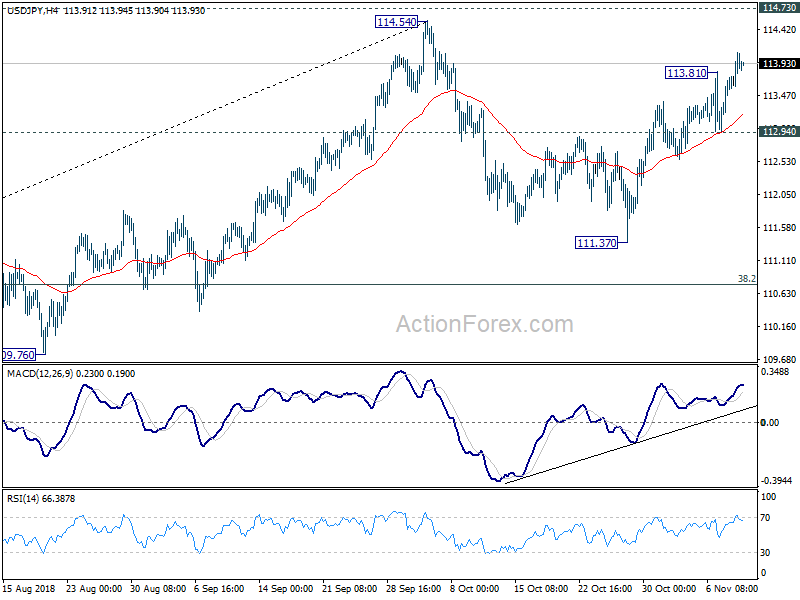
USD/JPY's break of 113.81 temporary top suggests that rebound from 111.37 has resumed. Intraday bias is back on the upside for 114.54 resistance. At this point, we'd be cautious on strong resistance from there to limit upside to bring another fall to extend the consolidation pattern from 114.54. On the downside, break of 112.94 minor support will argue that the rebound has completed. And, in that case, the corrective pattern from 114.54 could have started the third leg for 111.37 support and possibly below.
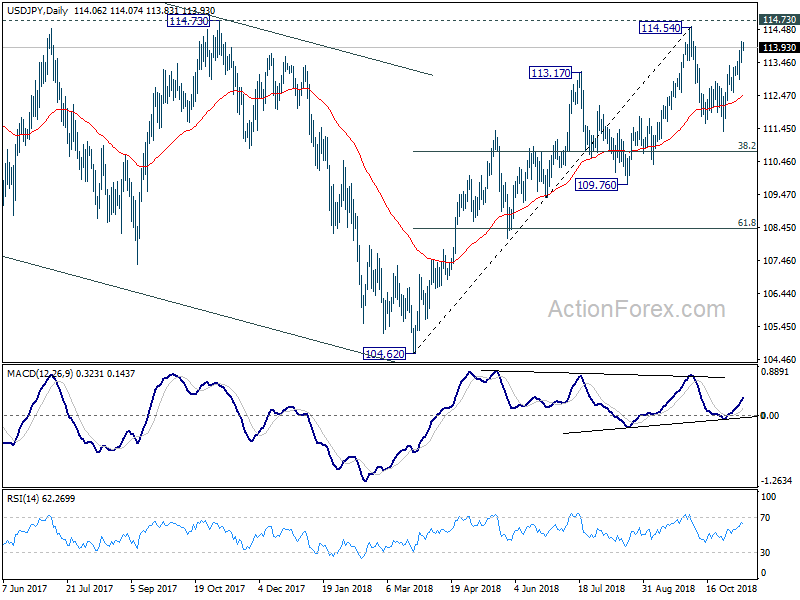
In the bigger picture, corrective fall from 118.65 (2016 high) should have completed with three waves down to 104.62. Decisive break of 114.73 resistance will likely resume whole rally from 98.97 (2016 low) to 100% projection of 98.97 to 118.65 from 104.62 at 124.30, which is reasonably close to 125.85 (2015 high). This will stay as the preferred case as long as 109.76 support holds. However, decisive break of 109.76 will dampen this bullish view and turns outlook mixed again.
British Pound Extends Its Losses In The Morning Session
For the 24 hours to 23:00 GMT, the GBP declined 0.48% against the USD and closed at 1.3067.
In the Asian session, at GMT0400, the pair is trading at 1.3049, with the GBP trading 0.14% lower against the USD from yesterday’s close.
The pair is expected to find support at 1.3012, and a fall through could take it to the next support level of 1.2975. The pair is expected to find its first resistance at 1.3118, and a rise through could take it to the next resistance level of 1.3187.
Moving ahead, traders would keep an eye on UK’s 3Q gross domestic product along with trade balance data, construction output, industrial production and manufacturing production, all for September, slated to release in a few hours
The currency pair is trading below its 20 Hr and 50 Hr moving averages.
