Sample Category Title
AUDUSD Outlook: Strong Bullish Acceleration On Positive Data/Weaker Greenback Generates Initial Bullish Signal
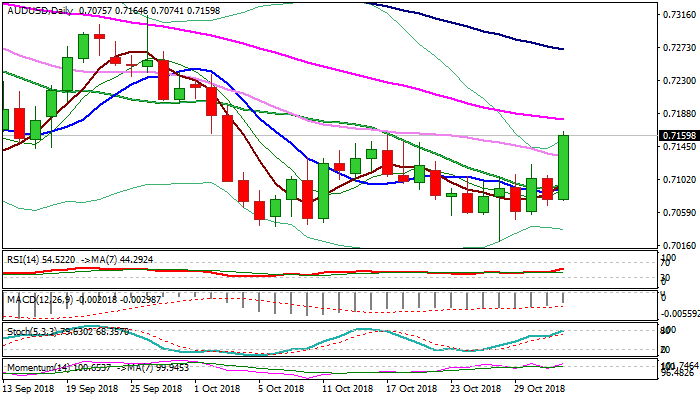
The Australian dollar advanced over 1% in Asian trading on Thursday and eventually broke above multi-day congestion.
Fresh rally pressures key near-term static support at 0.7159 (17 Oct high) and eyes another pivot at 0.7180 (55SMA), break of which would signal reversal.
The Aussie was inflated by weaker US dollar and received strong boost from widening Australian trade surplus in Sep, as well as stronger than expected China’s Caixin Manufacturing PMI.
Fresh bullish momentum on daily chart supports the advance, with broken 30SMA offering initial support at 0.7131 and strong supply at 0.71 zone (converged 5,10, 20SMA’s).
Res: 0.7180, 0.7202, 0.7245, 0.7271
Sup: 0.7131, 0.7100, 0.7074, 0.7050
GBPUSD Outlook: Sterling Rallies On Positive Brexit News, Reversal Signal Is Forming On Weekly Chart
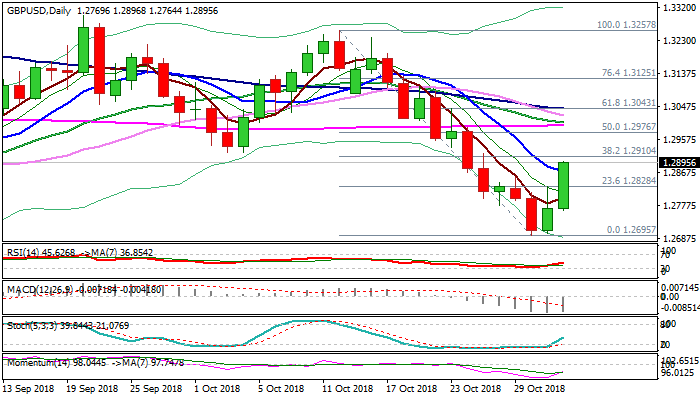
Sterling rallied 0.8% in Asia on Thursday and extends recovery rally from ten-week low at 1.2695, driven by renewed optimism over Brexit talks, after media report that UK PM May reached deal with the EU on financial services.
Brexit theme remains pound's key driver, as recent pessimism after UK/EU talks stalled, pushed sterling lower across the board.
Fresh rally threatens to more seriously dent larger bears, as recovery rally hit one-week high at 1.2883 and cracked important barrier at 1.2870 (falling 10SMA) and eyes another pivotal barrier at 1.2910 (Fibo 38.2% of 1.3257/1.2695 fall).
Sustained break here would generate reversal signal and turn near-term focus higher. Improving daily techs support the notion, as momentum turned north and attempts to create bull cross and slow stochastic trend higher after reversal from oversold territory, showing a plenty of space for recovery extension. Close above 1.2910 pivot would open strong resistances in 1.2980 / 1.3000 zone (daily cloud base/psychological barrier, reinforced by converging 20/55SMA's). BoE is widely expected to keep the policy unchanged on today's meeting, but little impact from cb's decision could be expected as positive Brexit news overshadow the event. It will be also interesting to see cable's weekly close, as current action is shaped in weekly hammer which could be strong reversal signal and undermine month-long downtrend from 1.3257. However, a number of events are due today / Friday and cleare picture could be expected after release of US NFP data.
Res: 1.2910, 1.2921, 1.2976, 1.3000
Sup: 1.2870, 1.2828, 1.2764, 1.2695
EURUSD Outlook: Bears Might Get Squeezed More On Break Above Double-Fibo Barrier At 1.1423
The Euro accelerates higher on Thursday after broader bears stalled ticks ahead of key support at 1.1300 on Wednesday and fresh weakness of the dollar, accompanied with strong advance of British pound, provide relief to the single currency.
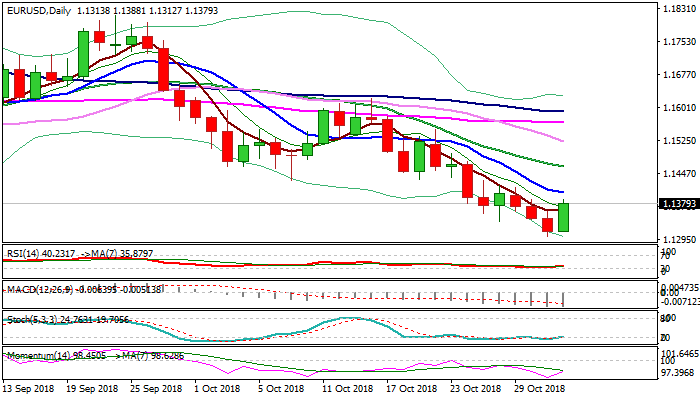
Recovery rally approaches significant barrier at 1.1403 (falling 10SMA) break of which would generate bullish signal for extension towards pivotal double-Fibonacci barrier at 1.1423 (Fibo 23.6% of 1.1815/1.1302 and Fibo 38.2% of 1.1612/1.1302 bear-leg, also the base of falling thick 4-hr cloud).
Sustained break here would sideline immediate bears and signal stronger recovery.
Daily slow stochastic emerges from oversold territory and momentum turns up, supporting scenario.
With empty calendar from the EU today, the Euro will be looking for signals from the BoE MPC meeting and US data and will be focusing Friday’s US jobs report for fresh direction signals.
Res: 1.1403, 1.1423, 1.1465, 1.1499
Sup: 1.1361, 1.1335, 1.1314, 1.1300
Super Thursday: GBP/USD Huge Bullish Momentum Precedes MPC Statement
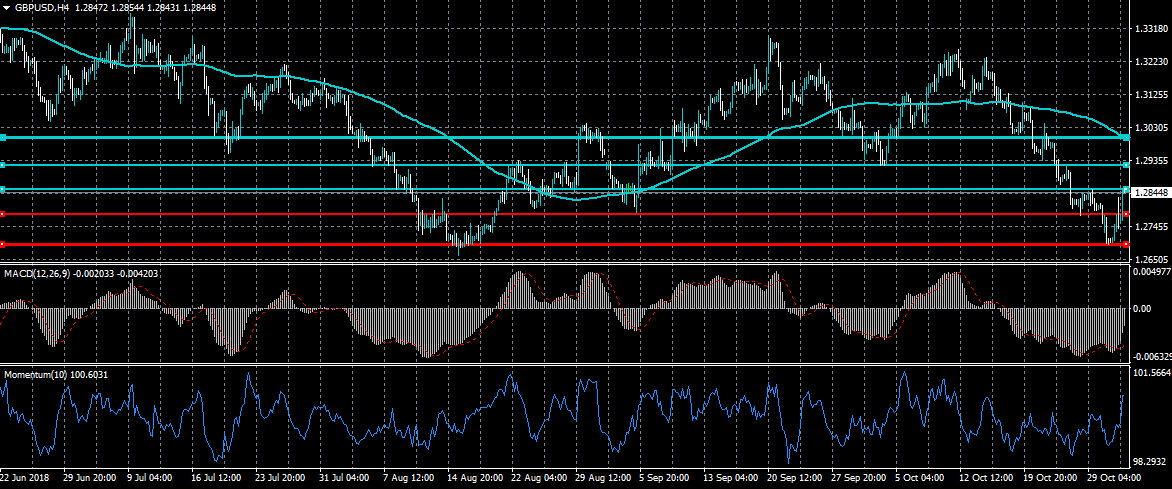
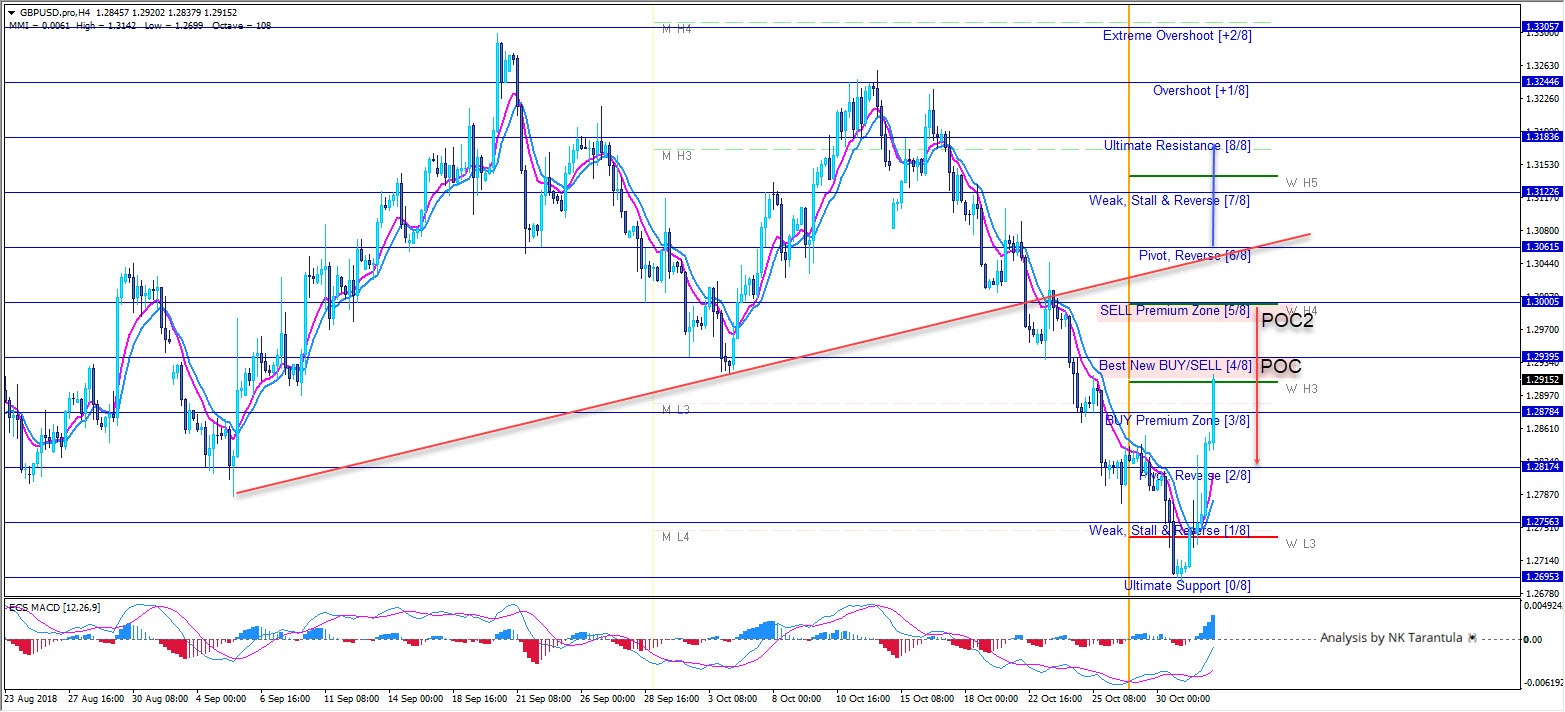
The GBP/USD has made a direct bounce prior to MPC Official Bank Rate Votes. The bullish impulse is still a retracement in downtrend. According to Dominic Raab (Secretary of State for Exiting the European Union) Brexit Deal might be expected by Nov 21.
This headline sparked a huge bullish momentum in the GBP but don’t forget that we have Super Thursday event today. The vote for interest rates and governor Carney comments along with MPC statement will decide the next move in the GBP/USD.
Technically 1.2915-35 zone is the selling spot for the GBP/USD Considering huge bullish momentum, this move could extend 1.2980-1.3000. Rejections might target 1.2878 and 1.2817. Depending on the interest votes and MPC statement next move should be decided. If the GBP/USD spikes above 1.3060 then the uptrend has been shaped up again. At this point 4h chart points down to possible rejection.
Market Recovery Continues, Sterling Soars On Brexit Reports
Is the sell-off over or just getting started?
Onwards and, hopefully, upwards is the collective feeling in the markets on Thursday as investors bid farewell to red October and welcome a new month that will ideally be more positive.
The final day of the month was far more positive than the 22 days, or so, that preceded it which many will hope is a sign of better things to come. The timing of this sudden shift was curious, with some suggesting it may have been more a case of month end moves, perhaps some portfolio rebalancing, but I guess that will become more clear in the coming days. The early signs are good though with strong gains seen across Europe, FTSE 100 aside, and US futures making steady gains also.
The FTSE 100 is being held back by the rally in the pound this morning, as a stronger pound is typically bad for the index due to companies within it making the large bulk of their profits outside the country. The inverse relationship was particularly prevalent after the Brexit vote when the slump in the currency was not only not matched by the UK index but actually drove strong gains.
Sterling rallies on Brexit deal on financial services
The pound is on a tear higher on reports that the UK and EU have agreed on a deal that would give UK financial services companies continued access to the EU after Brexit. This comes following reports on Wednesday that Dominic Raab – Brexit Secretary – expected a Brexit deal by 21 November, although this date was later described as more of an aspiration than an expectation, which would suggest negotiations have accelerated since the meeting in October, when the prospect of a special November EU summit was dashed.
Assuming all of these reports are correct, this is a huge step forward for negotiations which is why the pound is looking so bullish. Sterling is up more than 1% on the day and if we are finally seeing real progress towards a deal, the potential upside is huge. People have become very pessimistic on a Brexit deal in recent months which has been gradually priced into the pound, so naturally a Brexit deal should be very bullish for the currency.
BoE forecasts key on Super Thursday
It’s Super Thursday which means the pound is unlikely to move out of the spotlight as the day progresses. The Bank of England will announce its latest interest rate decision and release new economic forecasts and minutes alongside it. As was the case earlier in the week, the forecasts will be based on a number of Brexit assumptions and will more than likely be taken with a pinch of salt given that negotiations are still happening.
That said, their outlook for interest rates in the event of a smooth Brexit will be of interest, especially if forecasts are raised as they were in the budget. We’ll get more insight on this in the press conference after with Governor Mark Carney and his colleagues, which is always an eventful affair. Naturally, Brexit is the biggest driver for the pound at the moment but traders will still be keenly following this and markets will respond accordingly.
Gold rallies in risk on markets while oil sells of on oversupply concerns
The improvement in risk appetite isn’t harming Gold, which has benefited greatly from safe haven flows over the last month. This is because the dollar is under early pressure as the pound and euro rally in response to the Brexit news. A weaker dollar is typically bullish for the yellow metal as it makes it cheaper for non-dollar buyers. Today is a primary example of how Gold moves are not always straightforward and also how, despite being a traditional safe haven, it may benefit greatly from a Brexit deal.
Oil on the other hand is faring less well this morning, trading down around 1% and threatening to extend its losses to four consecutive days. These declines follow another inventory build on Wednesday, as reported by EIA, just as traders are becoming increasingly concerned about the prospect of an oversupplied market. Interestingly, this is not too long after prices of Brent and WTI peaked at a near four year high on the opposite concerns, with traders now fearing slower global growth and therefore lower demand.
Canadian Employment Data Eyed As BoC Turns Increasingly Data Dependent
Employment numbers will be watched out of Canada on Friday at 12:30 GMT as investors are on the lookout for fresh rate clues after the Bank of Canada said it could move quicker in removing monetary stimulus. The BoC’s increased confidence on the rate outlook hasn’t transpired to a stronger Canadian dollar, however, as market pricing of future rate hikes hasn’t shifted dramatically, according to overnight index swaps.
Jobs growth is anticipated to have slowed in October, following a 63.3k surge in September. Employment is expected to have risen by 10k last month, while the unemployment rate is forecast to hold steady at 5.9%. There’s been a notable cooling off in the labour market in 2018 with a patchier employment growth compared to 2017, which was characterized by solid jobs gains each month. Moreover, growth in full-time jobs has been very weak since May and this has coincided with an easing in wage growth.
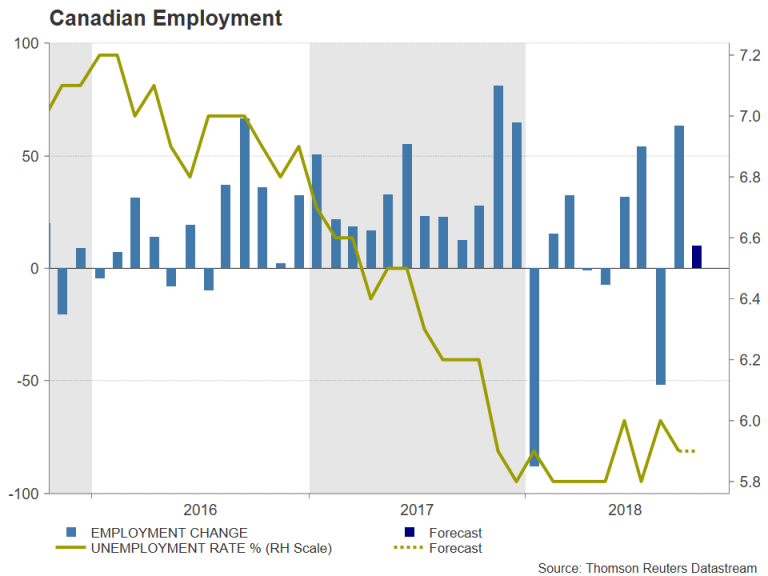
If this trend was to continue over the next few months, the Bank of Canada would have less reason to speed up the pace of interest rate increases. However, with an economy considered to be operating near full capacity, softer wage growth may not necessarily deter the BoC from raising rates more aggressively in the coming months.
With uncertainty surrounding Canada’s trading relations with its southern neighbours removed, and businesses upbeat about the year ahead, the Bank of Canada is firmly on track to raise its overnight target rate a few more times over the next 12 months. However, this was already priced in by the markets and investors are not anticipating more than one increase per quarter at this point, despite the BoC dropping reference to “gradual approach” from its policy statement at its meeting on October 24.
While policymakers have been keen to stress that the change in the statement language meant that the pace of tightening could be faster or slower, depending on the data, it’s clear that the BoC intends to keep hiking rates. Speaking before a parliamentary committee on Tuesday, BoC Governor Stephen Poloz reiterated this view, saying “the policy rate will need to rise to neutral to achieve our inflation target”.
The BoC’s hawkish stance doesn’t appear to be doing much for the Canadian dollar, however. Even the boost from the announcement of the NAFTA deal was short-lived and the loonie has been weakening during the past month. The global risk-off environment and lower oil prices have been weighing on the loonie. But given a more data-dependent BoC, Friday’s employment report could still trigger some short-term moves in forex markets.
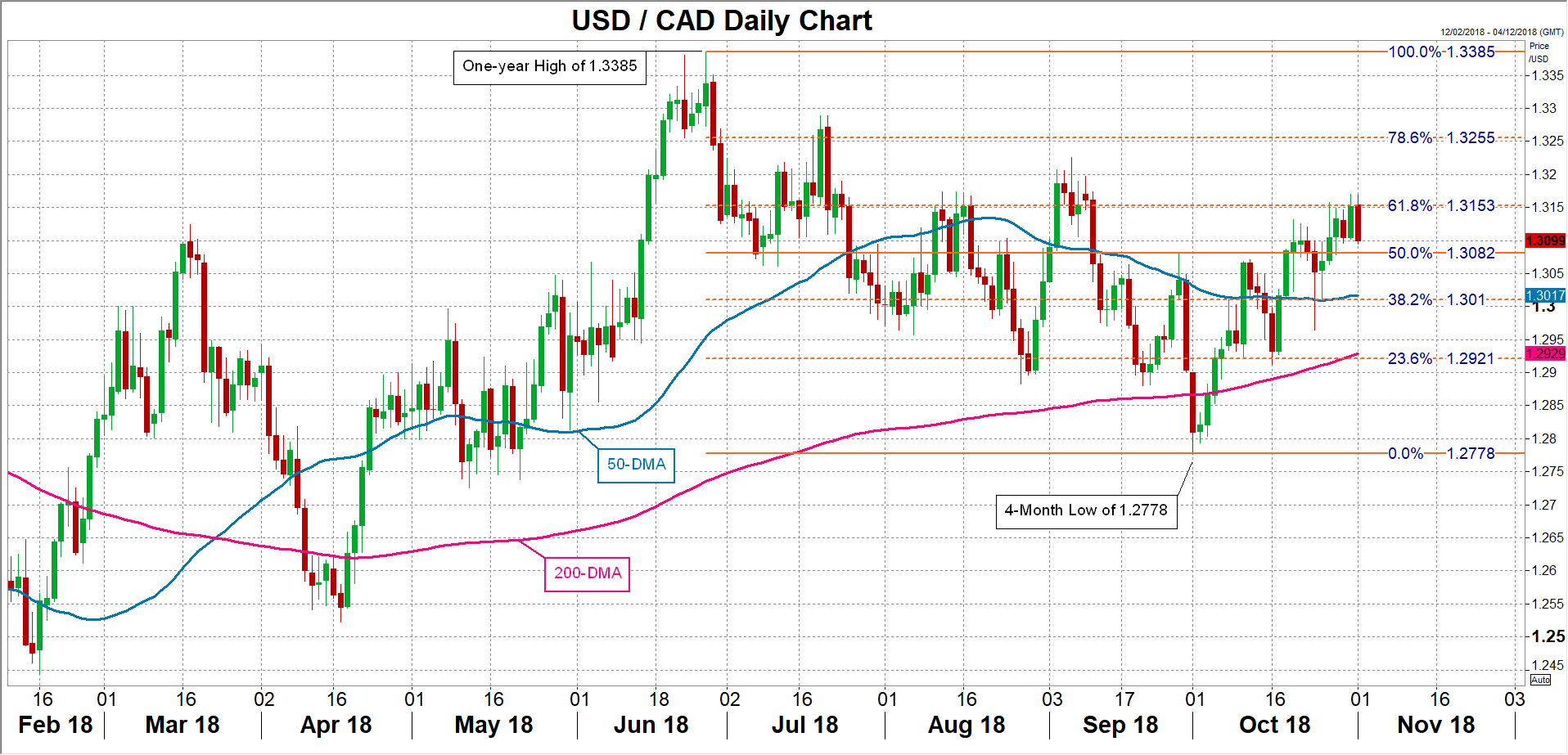
A stronger-than-expected report could pull dollar/loonie initially towards the 50% Fibonacci retracement of the downleg from 1.3385 to 1.2778, around 1.3082. A drop below the 50% Fibonacci would drive the pair towards the 50-day moving average, which is converging with the 38.2% Fibonacci around 1.3010. Should there be an even sharper rally for the loonie, the pair could slip as low as the 23.6% Fibonacci at 1.2921, which is being intersected by the 200-day moving average.
However, should the jobs data fall short of analysts’ forecasts, dollar/loonie could break above the immediate resistance at the 61.8% Fibonacci at 1.3153. A climb above this level would open the path for the 78.6% Fibonacci at 1.3255. Clearing this zone would put the pair back within range of June’s one-year high of 1.3385.
Sterling Soars On News Of Brexit Services Deal, Ahead Of BoE Policy Decision
Here are the latest developments in global markets:
FOREX: The dollar index is down by a little more than 0.4% on Thursday, looking set to post its first daily decline in four sessions. The British pound, and to a lesser extent the euro, benefited from reports that UK financial services firms will continue to have access to EU markets after Brexit. Meanwhile, the antipodeans aussie and kiwi outperformed, likely lifted by the broader improvement in risk sentiment, as well as fresh signals that China’s leadership is considering more stimulus measures.
STOCKS: Wall Street closed higher for a second session on Wednesday, with the tech-heavy Nasdaq Composite (+2.08%) outperforming the S&P 500 (+1.09%) and Dow Jones (+0.97%). The positive sentiment failed to carry over into Asia though, which was mixed on Thursday. Japanese and South Korean indices edged lower, though Chinese and Hong Kong markets climbed, aided by news that China is planning further stimulus measures to cushion its economy. In Europe, most major indices were set to open flat today according to futures. The main exception was the UK FTSE 100, which was due to open lower amid a strengthening pound.
COMMODITIES: Oil was down on Thursday, extending the losses it recorded in the previous session. The losses followed the weekly EIA crude inventory data, which showed stockpiles rising for the sixth consecutive week, lending some credence to recent warnings by Saudi Arabia that the market may see oversupply later this year. In precious metals, dollar-denominated gold is up by an astounding 0.8% today at $1,225 per ounce, capitalizing on the correction lower in the greenback.
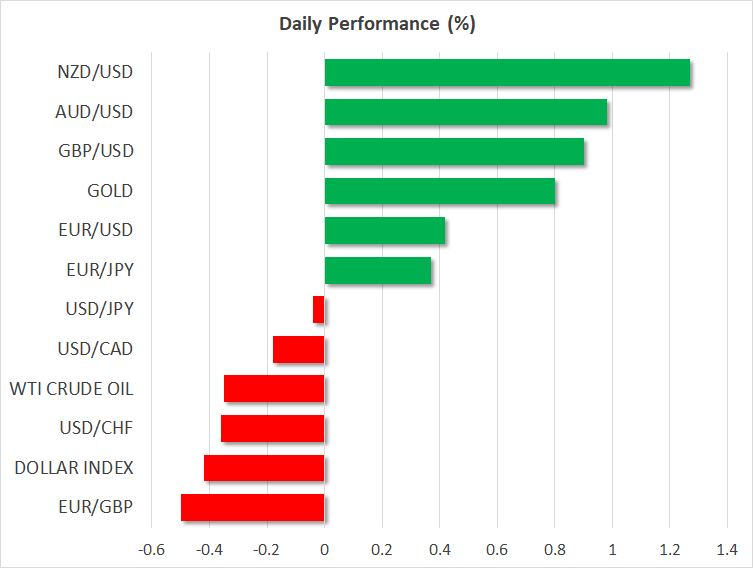
Major movers: Sterling soars on Brexit financial services deal; antipodeans skyrocket
The British pound surged overnight, gaining more than 0.9% versus the dollar, following reports that the UK and EU have reached an agreement that would allow UK financial services companies continued access to European markets post Brexit. The pound was already on the front foot on Wednesday, lifted by a letter from Brexit Secretary Raab to the UK Parliament, which noted he expects to finalize a deal with the EU by November 21. The optimistic headlines may have caught markets by surprise given the absence of any encouraging signals lately, leading to a rapid covering of prior short-bets on the pound.
Crucially though, there was no mention to the real sticking point, the Irish border. Until there’s news of progress on that front too, one may be forgiven from being too upbeat. In the words of PM May: “nothing is agreed until everything is agreed”. Separately, striking a deal with the EU is an entirely different beast to passing it through the UK Parliament. Hence, although Brexit optimism is currently riding high, lots of obstacles and twists likely remain before an actual deal is signed, implying that it won’t be all smooth sailing higher for the pound. Today, the currency will get its cue from the BoE rate decision, but overall, monetary policy considerations may play second fiddle to political ones until the Brexit fog has lifted.
Meanwhile, the rising sterling-tide also lifted the euro, helping euro/dollar to gain 0.4% and establish some distance from its 16-month lows at 1.1300, which it tested yesterday. Accordingly, the dollar index is on the retreat today as the euro and sterling are recovering ground, though it still remains at relatively elevated levels.
Strikingly, the antipodeans aussie and kiwi are outperforming even the pound today, having soared by 0.98% and 1.25% respectively against the dollar. The aussie got a modest lift from stronger-than-expected trade data out of Australia overnight. Overall though, the main driver behind this rebound may have been the recovery in risk appetite, as well as fresh hints yesterday from China for further stimulus, amid growing signs the economy is losing momentum.
Day ahead: Bank of England decides amid Brexit news; ISM manufacturing PMI due; Apple releases earnings
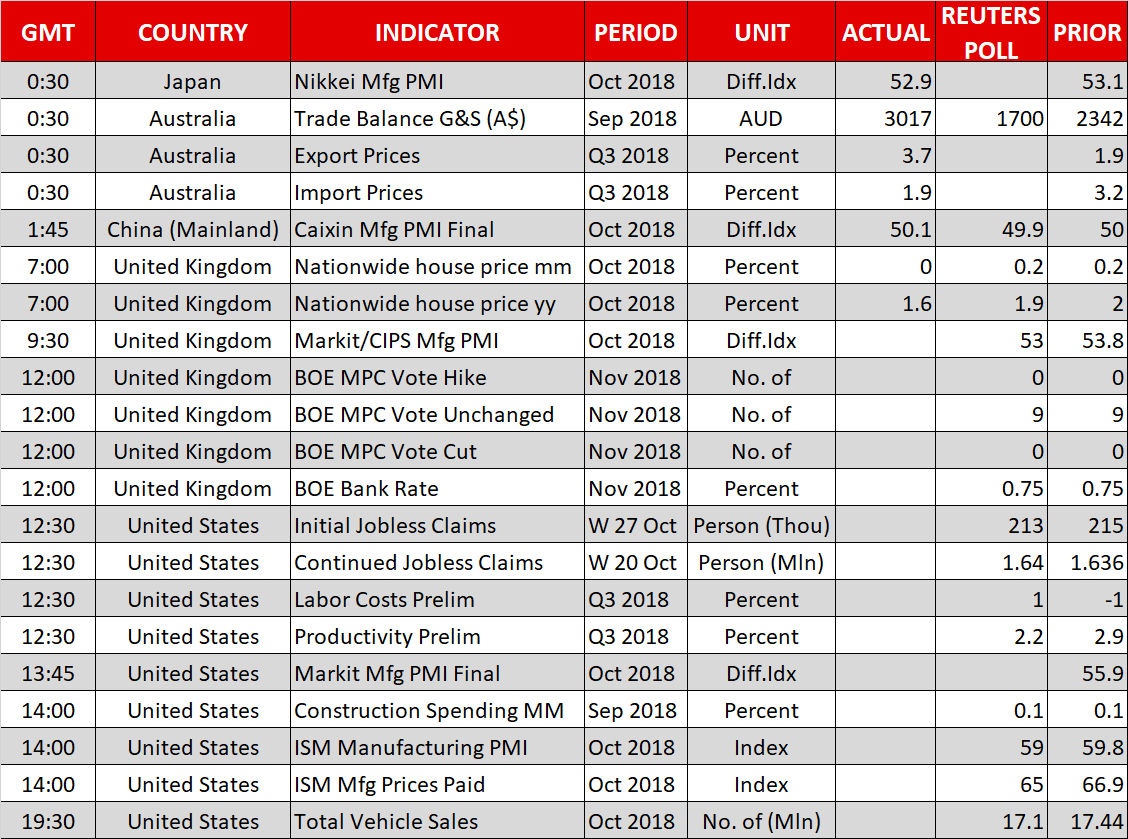
The Bank of England’s (BoE) guidance upon completion of its monetary policy meeting will be in focus during Thursday’s trading. The most important US release is the ISM’s manufacturing PMI.
At 1200 GMT, the BoE’s monetary policy decision will be made public. The Bank’s members are expected to unanimously vote in favor of keeping rates on hold. Given that no rate change is anticipated, the focus will fall on the central bank’s communication – what conditions are needed for further policy tightening (?) –, as well as on updated inflation and GDP forecasts. Governor Carney will be holding a press conference at 1230 GMT, with his comments closely watched for positioning on sterling.
Any remarks on Brexit by the Bank – by Carney himself during the press conference – will also be generating attention, especially in the aftermath of reports that PM May has arrived at a deal with Brussels that would give UK financial services companies access to EU markets after Brexit. It remains to be seen whether the British currency will maintain the positive momentum spurred by those news.
Ahead of the BoE decision, at 0930 GMT, the UK will be on the receiving end of Markit’s manufacturing PMI for October. That’s expected to ease to 53.0 from 53.8 in September.
The ISM’s manufacturing PMI for October scheduled for release at 1400 GMT is projected to fall to 59.0, from September’s 59.8. Nevertheless, this would still constitute a robust figure that is comfortably above the 50 threshold that separates sectoral expansion from contraction. Markit’s corresponding PMI print for the US will be hitting the markets a little earlier (1345 GMT).
Other US data are on the agenda as well, such as weekly jobless claims due at 1230 GMT, though these tend not to act as market movers. Total vehicle sales out at 1930 GMT are also typically not market-moving for FX markets, but they have their own interest amid the rising rate environment in the US which is generally negative for automobile sales.
Bank of Canada Senior Deputy Governor Wilkins will be giving a speech at 1700 GMT.
Apple, the world’s largest company by market cap, will be releasing quarterly results after the closing bell on Wall Street.
Technical Analysis: GBPUSD possible bullish tilt in the short-term
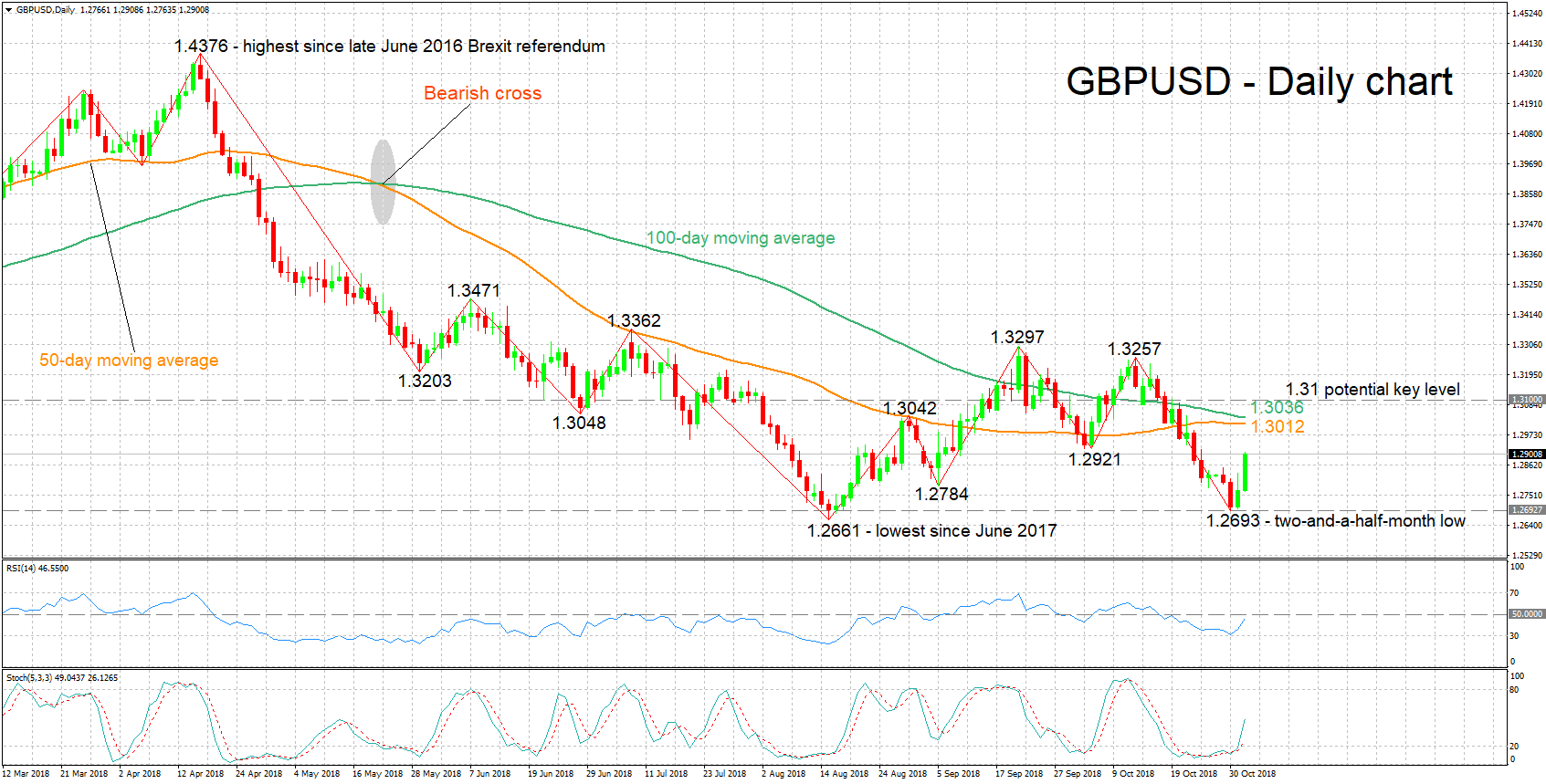
GBPUSD has posted considerable gains after touching a two-and-a-half-month low of 1.2693 on Tuesday. The RSI is in bearish territory below 50 though it has moved sharply higher after coming close to oversold levels; this signals a possible change of short-term momentum towards a bullish direction. The stochastics are also giving a bullish signal in the very short-term: the %K line has moved above the slow %D one and both lines are heading higher.
A relatively upbeat Bank of England is expected to allow the pair to build on gains. A move above a previous low at 1.2921 may see the pair meeting resistance around the current levels of the 50- and 100-day moving average lines at 1.3012 and 1.3036 respectively; the zone around these includes the 1.30 round figure, as well as a bottom (1.3048) and a top (1.3042) from previous months. Further above, the 1.31 handle would come within scope.
On the downside and in case of a cautious (dovish) BoE, support could come around a previous bottom at 1.2784, while lower still, Tuesday’s trough of 1.2693 would be eyed.
Brexit news can move the pair as well.
Positive Start Of The Month And Weakening Of The USD After Frightening October
American markets added on Wednesday, finishing the last trading session of October by a growth of 1.1% on S&P500 and 1.0% of DJI. However, October became the worst in the last 10 years, causing a decline of major U.S. indices by more than 7%.
On Thursday morning, the markets show mixed dynamics. Futures on S&P500 develop their rebound, while Asian bourses have turned to a decline after a strong start of the day.
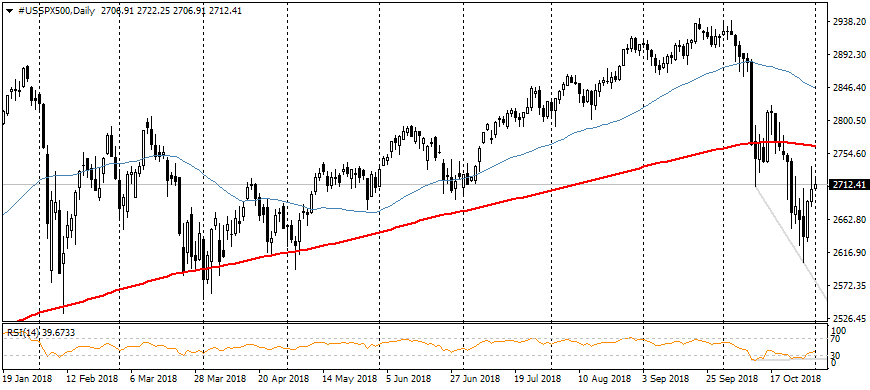
Since morning the dollar in the global market has been rolling back from 16-month highs, reflecting a timid growth of optimism at the beginning of a new month. The dollar returned to growth in October following the downward decline in stock indices. The future prospects of the US currency are largely related to the dynamics of economic performance, where an employment report is the closest major event. 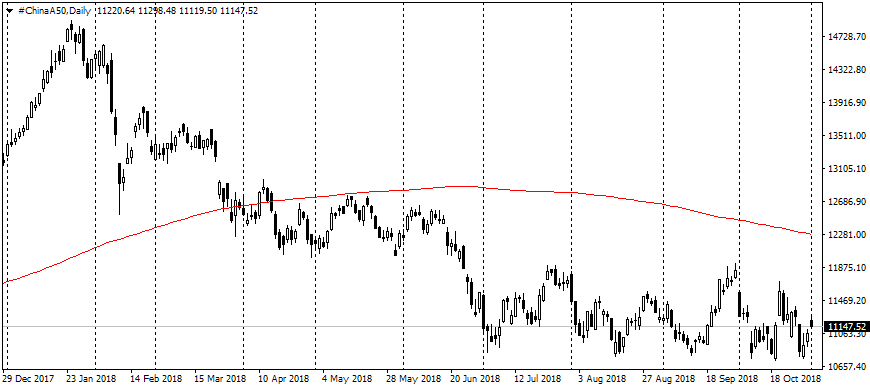
Maintaining strong growth rates will reduce fears that the Fed is excessively rigid, raising rates roughly once a quarter if the economy experiences a noticeable slowdown. In this regard, the markets focus on tomorrow’s payrolls report. Preliminary data show the persistence of a tight labour market.
Often strong American statistics support the dollar, but this time it can weaken it. There is a pretty simple explanation for that. Markets take a constant plan to raise the rates of the Fed policy, and the dynamics of the economy as a variable, and fluctuations in economic data increase or reduce the attractiveness of investments in shares in comparison to the bonds.
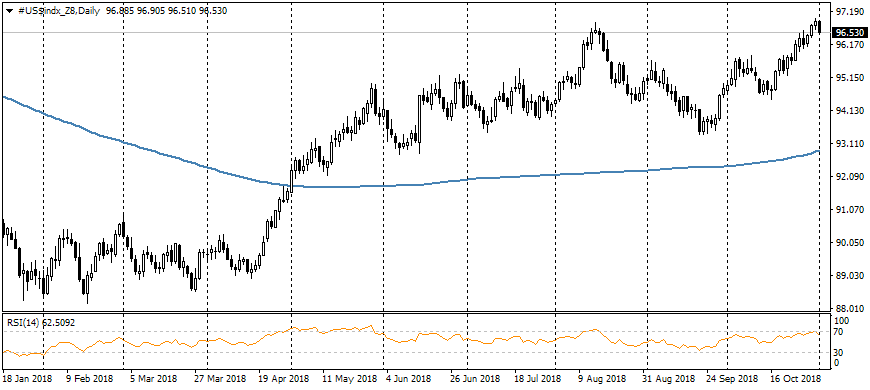
The dollar in October showed itself as a decent barometer of the demand for risks, adding after the sale in the markets. In short-term, it seems, the pendulum swung towards the risky assets, which promulgated growth on the inflow of new money at the beginning of the month. However, it is worth remembering that all the key problems that were pressing on the markets last month remain valid: the fears of excessive austerity of the Fed policy, global slowdown, intensified trade wars, and geopolitical tensions on The Middle East.
All these factors can return focus to the market in the coming days, resuming pressure on global indices and returning the dollar to growth.
The US Dollar Is In The Positive Zone Again
The US currency continued to strengthen against a basket of major currencies. The US dollar was supported by optimistic data on the ADP nonfarm employment change in October. The figure counted to 227K, while experts expected 189K. The US dollar index (#DX) closed in the positive zone (+0.11%). In the near future technical correction is not excluded.
Yesterday, economic reports from the Eurozone and Canada were also published. According to preliminary data from Eurostat, the Eurozone consumer price index rose in October to 2.2% (y/y) instead of the forecasted value of 2.1% (y/y). Canada GDP growth (m/m) counted to 0.1% in August, while investors expected the figure to be at the level of 0.0%. Today, during the Asian trading session, Caixin manufacturing PMI has been published in China, which counted to 50.1 instead of 49.9. Demand for the pound has grown significantly. According to The Times, London and Brussels reached a preliminary agreement in the field of financial services. The Bank of England meeting is in the focus of attention.
The "black gold" prices are consolidating after a sharp collapse during yesterday's trading. At the moment, futures for the WTI crude oil are testing a mark of $65.00 per barrel.
Market Indicators
Yesterday, the main US stock indices closed in the positive zone: #SPY (+1.07%), #DIA (+1.00%), #QQQ (+2.35%).
At the moment, the 10-year US government bonds yield is at the level of 3.15-3.16%.
The news feed on 01.11.2018:
The index of economic activity in the UK manufacturing sector at 11:30 (GMT+2:00);
The Bank of England interest rate decision at 14:00 (GMT+2:00);
ISM manufacturing PMI in the US at 16:00 (GMT+2:00).
GBPUSD Buyers Back In Control Above 1.2785
The British pound has moved sharply higher against the US dollar after news that the UK has struck a Brexit deal with the EU over the financial services industry. The GBPUSD pair has an intraday bullish bias while trading above the 1.2785 level and is now supported by rising MACD and Momentum indicators. The Bank of England interest rate decision later today is the key risk-event for sterling on Thursday.
The GBPUSD pair is intraday bullish while trading above the 1.2785 level, key resistance is now found at the 1.2850 and 1.2930 levels.
If the GBPUSD pair moves below the 1.2785 level, sellers may test towards the 1.2730 and 1.2700 support levels.