

Sample Category Title
WTI Oil Outlook: Bears Look For Further Extension After Falling Over 11% In Oct
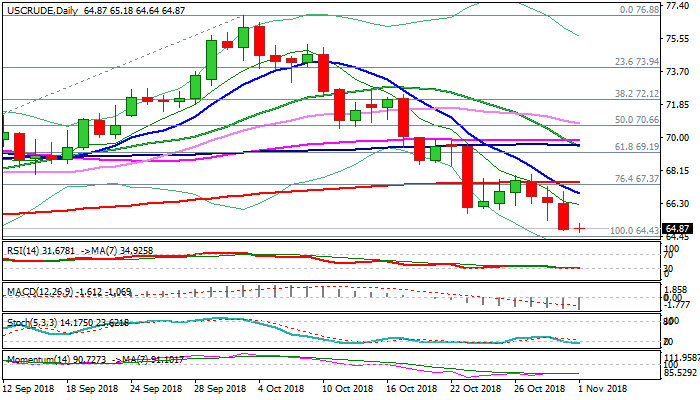
WTI oil is holding within narrow consolidation just above key support at $64.43 (16 Aug low) after strong fall previous day (WTI contract was down over $2 on Wednesday).
Oil prices were additionally pressured by increased output from OPEC (the highest production since 2016) which aims to prevent any shortage in the oil market when US sanctions on Iran start on 04 Nov) and disappointing PMI data from China which signal that the economy is weakening and could negatively affect demand from the world’s second biggest economy.
WTI ended the month of October with over 11% fall, which marked the biggest monthly loss since July 2015.
Steep downtrend from $76.88 (03 Oct peak) remains intact and looks for break below $64.43 pivot to extend weakness towards next key supports at $63.66/57 (top of rising daily cloud / Fibo 38.2% of $42.04/$76.88 uptrend).
Bears so far show no signs of fatigue but daily indicators are entering oversold zone and warn that bears may take a breather before attempts to break $63.66/57 pivots.
Falling 10SMA offers solid resistance (currently at $66.87) and should ideally cap corrective upticks.
Res: 65.18, 65.73, 66.87, 67.50
Sup: 64.43, 64.00, 63.66, 63.00
USDJPY Outlook: Neutral Near-Term Mode Looks For A Catalyst, US NFP Data In Focus
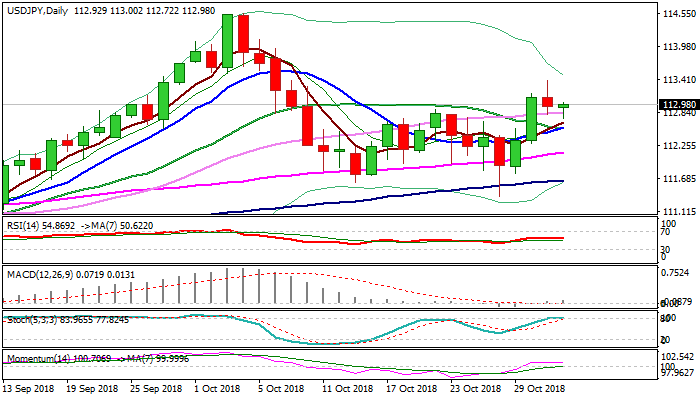
The pair holds in neutral mode on Thursday after bulls from 111.37 low stalled at strong Fibo barrier at 113.33 but subsequent pullback failed to clearly break below initial support at 112.83 (30SMA), keeping near-term action within tight range.
Weaker dollar across the board made bulls to run out of steam, but yen also stands at the back foot after BoJ kept ultra-low rates and signaled that effort to hit its inflation target could be delayed by persisting global trade tensions as well as Japan’s slow wage growth.
Sideways-moving daily indicators support current neutral stance, with direction signals expected on violation pivotal points on both sides.
Bears could expect signal on break below converged 10/20SMA’s (112.55), while break and close above cracked 113.33 barrier (Fibo 61.8% of 114.54/111.37 descend) would signal continuation of near-term upleg from 111.37 (26 Oct low).
US Non-Farm payrolls data on Friday could provide stronger signal. Forecasts show 190K jobs created in Oct, well above previous month’s 134K which could boost the greenback on release near/above consensus.
On the other side, another key release, average hourly earnings, is expected to dip in Oct (0.2% f/v vs 0.3% in Sep) which could sour the sentiment and pressure the greenback on release at/below forecast.
Res: 113.16, 113.33, 113.80, 114.10
Sup: 112.83, 112.55, 112.24, 112.13
Bitcoin Bear Market Could Last 18 More Months
Bitcoin prices and trading volume might keep plummeting, and the current bear market could last another 18 months. That’s the sobering assessment of Arthur Hayes, the CEO of the Bitcoin Mercantile Exchange (BitMEX), the world’s largest bitcoin derivatives trading platform. Hayes started trading crypto full-time in 2013 after losing his job as an equities trader at Citibank. The Hong Kong-based executive said the trading patterns today resemble the “nuclear bear market” he witnessed in 2014.
Cryptocurrency trading volumes recently plunged to a new year low following the summer slump. Hayes said volume could drop more in the coming months. “We think trading volumes could fall further from where they are now,” he said. This is a stunning about-face from the exuberant $50,000 year-end bitcoin price target Hayes set back in June 2018. At the time, he said BTC prices were just one positive regulatory decision away from rocketing past $20,000 on its way to $50,000 by December 2018. That does not appear realistic given current market conditions.
Jonathan Levi, the CEO of blockchain startup Hacera, agreed. “The price of bitcoin is undoubtedly in a bear market, but in the application of bitcoin and other blockchain projects we are in fact in a bull market,” Levi said. “Most of the EU banks are actively investing in blockchain, and that all originally stems from bitcoin.” While many in the crypto community are in panic mode over the market’s current downswing, cryptocurrency evangelists who have followed the market since its inception are not worried over short-term blips.
Bitcoin Bear Market Could Last 18 More Months: BitMEX CEO, CCN, Nov 01
Trade War Impact Deepens Across Asia, But ‘Real Economic Shock’ Yet To Hit
The economic impact of the intensifying trade war between Washington and Beijing appeared to deepen last month with factory activity and export orders weakening across Asia, but analysts warned the worst was yet to come. In a sign conditions for exporters and factories were deteriorating, manufacturing surveys showed marginal growth in China, a slowdown in South Korea and Indonesia and a contraction in activity in Malaysia and Taiwan.
Those figures follow weaker-than-expected industrial production data from Japan and South Korea on Wednesday, with output in the latter shrinking the most in over 1-1/2 years. By contrast, the U.S. ISM manufacturing survey for October due later on Thursday was expected to show a much faster growth pace than in Asia, albeit a tad slower than in September, supporting the outlook for further Federal Reserve rate hikes.
Worryingly, the prospects for higher U.S. rates could feed back more market pain for the region’s externally vulnerable economies — Indonesia, India and the Philippines, which have already been forced to raise rates to mitigate a sell-off in currencies, stocks and bonds. China’s manufacturing sector barely grew last month after stalling in September and export orders contracted further, according to a private sector manufacturing report. An official survey on Wednesday showed the manufacturing sector expanding at its weakest pace in over two years, hurt by slowing demand both externally and domestically.
But absent any deal between Trump and Chinese leader Xi Jinping, who are expected to attend a G20 summit this month in Buenos Aires, the recently introduced 10 percent tariffs on $200 billion of Chinese goods will be raised to 25 percent and other tariffs may be placed on the remaining $250 billion-or-so of Chinese products which escaped the initial rounds.
Trade war impact deepens across Asia, but ‘real economic shock’ yet to hit, Reuters, Nov 01
BOE Interest Rate Decision Amidst Renewed Brexit Hopes
BoE is to announce its interest rate decision today (12:00, GMT) and is widely expected to remain on hold at +0.75%. Currently, GBP OIS imply a probability of 98.35% for such a scenario and market focus could turn to the accompanying statement and the inflation report. A rather tight labor market and high inflation rate could provide grounds for a more hawkish tone, while a rather low growth rate and Brexit uncertainty could advise caution. The picture is blurred even further as news reports stated that UK and EU have reached a deal that could give UK financial firms access to the European markets. Philip Hammond's recent statements about the end of austerity and the new budget, could improve the outlook for the GDP growth rate, however it is not expected to have been incorporated in BoE's forecasts yet. Media also report that UK Brexit secretary Raab expects a deal by November 21st, providing further hopes for a soft Brexit. The pound jumped on the news, however volatility for GBP pairs could be on, as the BoE's interest rate decision is due out later today.
Cable rallied on the news, breaking the downward trendline incepted since the 16th of October and the 1.2780 (S1) resistance line (now turned to support) and during today's Asian session, tested the 1.2850 (R1) resistance level. As the prementioned downward trendline was clearly broken, we lift our bearish bias. Should the positive sentiment for the pound continue, we could see cable continuing to trade in a bullish market, but the overall direction may be dependent on the outcome of the BoE interest rate decision as well. Should the bulls continue to drive the pair, we could see it breaking the 1.2850 (R1) resistance line and aim if not break the 1.2920 (R2) resistance hurdle. Should on the other hand the bears take over, we could see the pair breaking the 1.2780 (S1) support line.
JPY strengthens as risks rise
USD/JPY dropped yesterday as the yen strengthened on further worries regarding the US-Sino trade relationships. Analysts point out that the Yen's role as a safe have had weakened this year by higher returns of the USD. They also point out that in face of the growing risk of a worsening in the US-Sino trade war and the potential of a slowing in US growth rate, the yen may start gaining ground in the coming months. Volatility for JPY could continue should there be further headlines about the US-Sino relationships.
USD/JPY dropped yesterday breaking the upward trendline incepted since the 26th of October and tested the 112.72 (S1) support line. As the prementioned downward trendline was broken, we lift our bullish bias, in favour of a sideways scenario, however the pair's future direction could include bullish tendencies as the US employment report for October tomorrow, could provide support for the USD. Should the market favour the pair's long positions once again we could see it breaking the 113.25 (R1) resistance line and aim for the 113.95 (R2) resistance level. Should on the other hand, the pair come under selling interest, we could see it breaking the 112.72 (S1) support line and aim for the 112.15 (S2) support zone.
In today's other economic highlights:
In the European session today we get from the UK the Manufacturing PMI for October and from the Czech Republic CNB's interest rate decision. In the American session the US Manufacturing PMI for October is due out. Also be advised that Bitcoin corrected somewhat after Monday's drop and should you be interested in the cryptomarket keep an eye out for our weekly crypto outlook due out later today.
USD/JPY H4
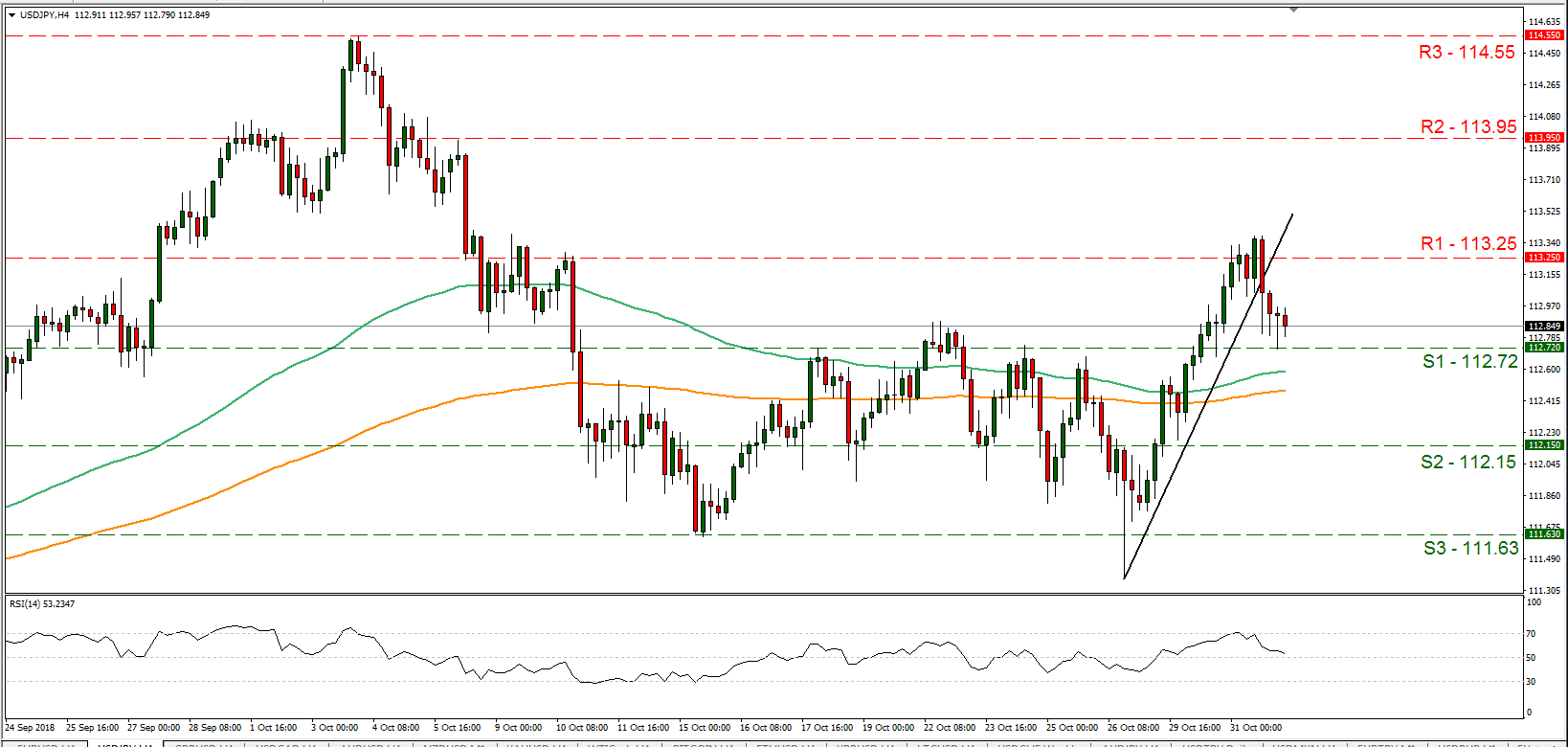
Support: 112.72 (S1), 112.15 (S2), 111.63 (S3)
Resistance: 113.25 (R1), 113.95 (R2), 114.55 (R3)
GBP/USD 4H
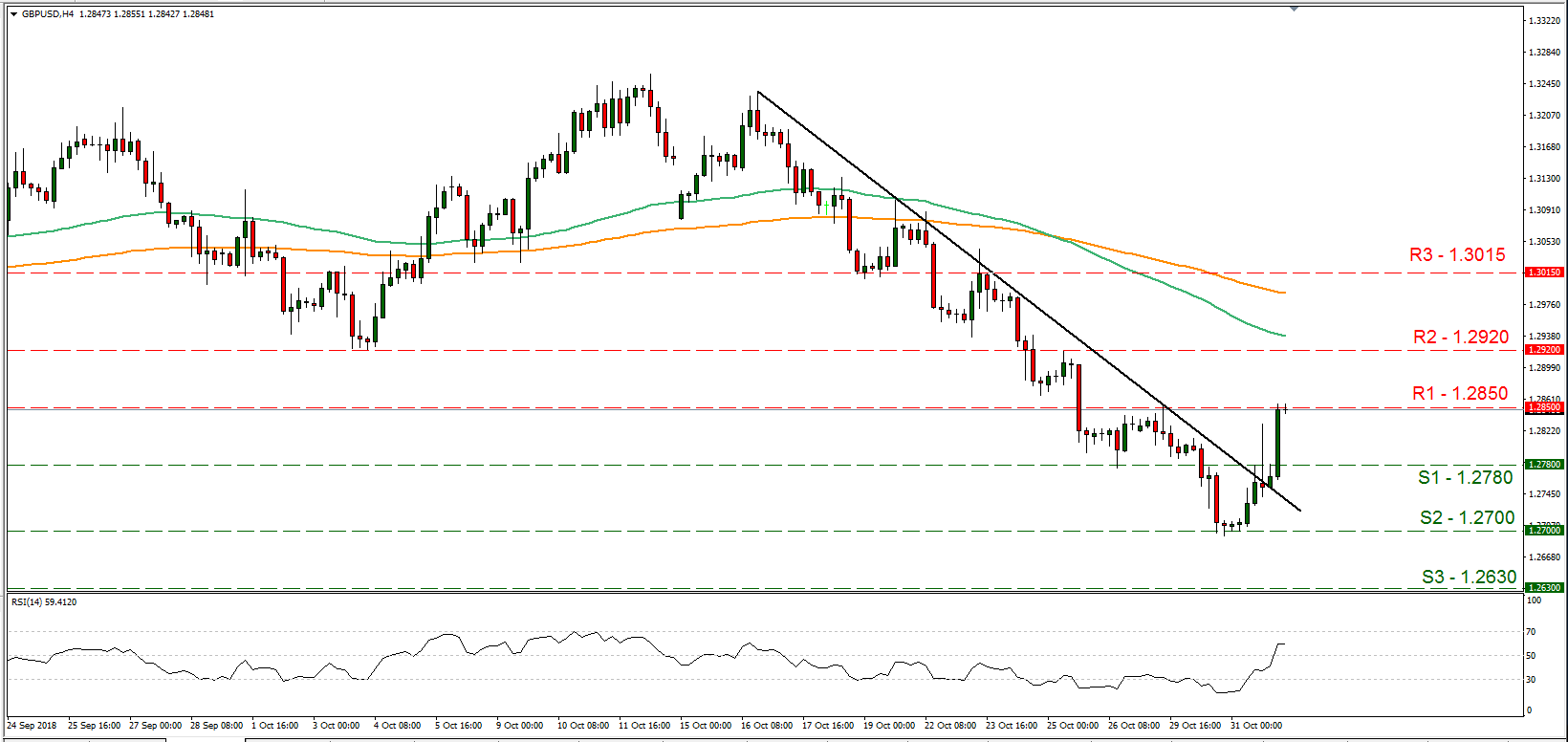
Support: 1.2780 (S1), 1.2700 (S2), 1.2630 (S3)
Resistance: 1.2850 (R1), 1.2920 (R2), 1.3015 (R3)
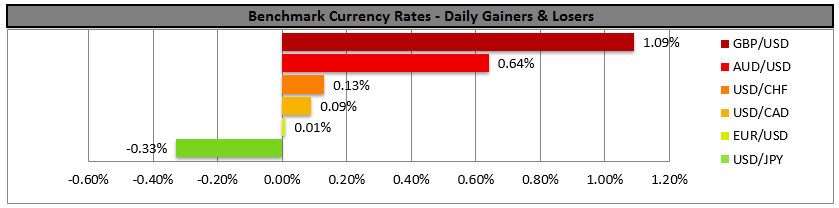
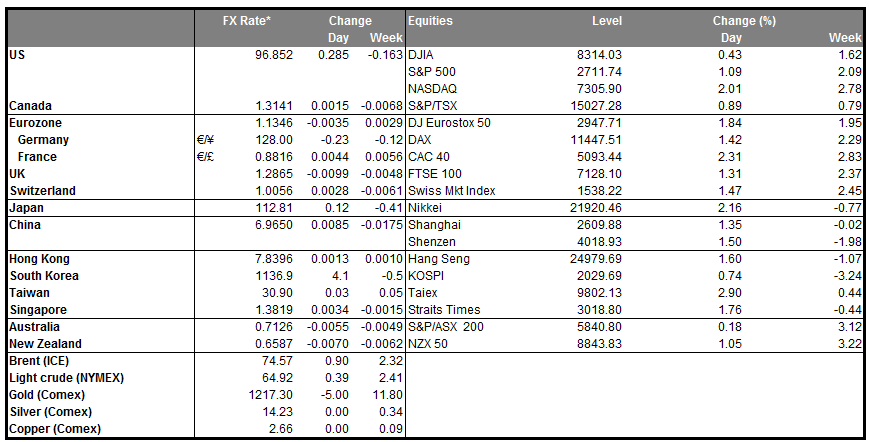
Into US session: Sterling resilient ahead of BoE, Dollar continues to reverse
Entering into US session, all eyes will be on BoE Inflation Report. The Pound remains broadly strong today, except versus Australian and New Zealand Dollar. The boost from Brexit optimism is rather solid. UK Prime Minister spokesman James Slack said that the news regarding a Brexit financial services deal with the EU are merely speculations. But markets didn't listen. Sterling also shrugged of much weaker than expected PMI manufacturing, which Markit described as "worrying turnaround.
On the other hand, Dollar suffers broad based selling pressure today. There isn't any special fundamental news driving the decline. But rather, traders simply took profit as EUR/USD closed in 1.13 key support level. Perhaps today's ISM manufacturing or tomorrow's non-farm payroll report could give back some strength to Dollar. For now, Dollar bulls just refuse to commit. Yen is trading as the second weakest, followed by Canadian Dollar.
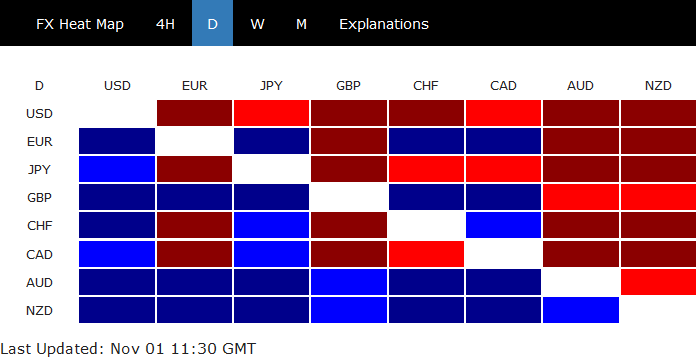
In European markets, major indices are trading up so far today:
- FTSE is up 0.49%
- CDAXAC up 0.84%
- CAC up 0.41%
- German 10 year yield is up 0.0187 at 0.408, back above 0.4
- Italian 10 year yield is down -0.0805 at 3.352. That is, spread with German is below 300 now.
Earlier in Asia:
- Nikkei dropped -1.06% to 21687.65
- Singapore Strait Times rose 1.39% to 3060.85
- Hong Kong HSI rose 1.75% to 25416.00
- China Shanghai SSE rose only 0.13% to 2606.24. Life above 2600 is not easy.
Brexit Breakthrough Hopes Lift Sterling
Wednesday October 31: Five things the markets are talking about
October was the worst month in six-years for global equities, and despite a 48-hour reprieve on the final two-day’s of trading as investors balanced portfolios, November begins with regional bourses providing some mixed results.
The earnings season has carried on with pockets of weakness overseas on concerns surrounding trade; input costs, and while strong growth in the U.S, for now, largely offsets tariffs.
U.S Treasury prices are lower despite the ongoing heartache in equity markets pushing the U.S benchmark yield back above +3.15%.
Sterling has rallied aggressively overnight ahead of today’s Bank of England (BoE) monetary policy decision (08:00 am EDT) on reports that PM Theresa May and E.U negotiators have reached a tentative agreement that would give U.K. financial services companies continued access to European markets after Brexit.
Elsewhere, the Chinese yuan has rallied from his decade low outright; along with commodity currencies (CAD, AUD and NZD) as Chinese leadership signals that further stimulus measures are being planned.
Speaking of commodities, oil has extended its decline after its worst month in more than two-years.
On tap: U.S ISM manufacturing PMI (10:00 am EDT).
1. Stocks mixed results
In Japan, the Nikkei fell overnight, pressured by large cap mobile phone companies, who make up +80% of the index, said lower service fees will start hitting the bottom line in the next fiscal year. The Nikkei share average dropped -1.06%, while the broader Topix fell -0.85%.
Down-under, the Aussie benchmark index closed slightly higher overnight as shares in BHP rallied over +6.2% on the announcement of +$10.4B shareholder return. The S&P/ASX 200 index rose +0.18%. In S. Korea, the Kospi stock index dropped -0.26% overnight, snapping two-session gains, as concerns linger over a Sino-U.S trade row.
In China, shares rallied Thursday after a tough October that saw the country’s blue-chip index drop more than -8%, on news that leaders are to continue to take steps to support domestic markets. The Shanghai Composite index was up +0.1%, while the blue-chip CSI300 index was up +0.75%. In Hong Kong, the Hang Seng Index was up +1.75%.
In Europe, regional indices trade mixed with underperformance in the FTSE as Brexit optimism pushes the pound (£1.2905) higher, with the BoE rate decision along with the quarterly inflation report in focus.
U.S stocks are set to open in the ‘black (+0.3%).
Indices: Stoxx600 +0.48% at 363.32, FTSE -0.07% at 7,123.16, DAX +0.60% at 11,516.75, CAC-40 +0.20% at 5,103.61, IBEX-35 +0.79% at 8,964.00, FTSE MIB +0.81% at 19,204.50, SMI +0.44% at 9,041.50, S&P 500 Futures +0.33%
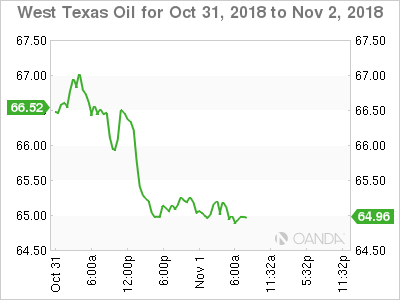
2. Oil prices fall on signs of rising supply, gold higher
Oil prices have extended their losses overnight, pressured by signs of rising supply and by growing concerns that demand may weaken on the prospect of a global economic slowdown.
Brent crude for January has dropped -37c, or -0.49%, to +$74.67 per barrel, while West Texas Intermediate (WTI) crude futures have declined -29c to +$65.02 a barrel.
Note: Both benchmarks posted their worst monthly performance in two-years yesterday – Brent was down -8.8% for the month and WTI lost -10.9%.
Crude prices are again under pressure from a trifecta of reasons.
Prices are pressured after data this week from the U.S EIA showed U.S crude inventories last week climbed for a sixth consecutive week.
Also weighing on prices is a Reuters OPEC poll showing that the organization increased oil production in October to its highest in two-years, as higher output led by the U.A.E and Libya more than offset a cut in Iranian shipments due to U.S sanctions, set to begin on Nov. 4.
And finally, growing concerns over the prospect of a global slowdown amid the ongoing Sino-U.S trade war are also weighing on prices.
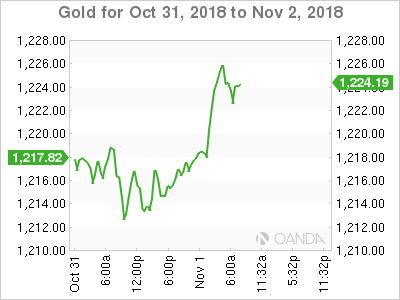
Ahead of the U.S open, gold has recovered overnight from yesterday’s three-week low print as the recent drop in metal prices and an easing of the U.S dollar from multi-month highs encouraged buying. Spot gold is up +0.8% at +$1,222.41 per ounce, after falling for three consecutive sessions – the ‘yellow metal’ touched +$1,211.52 per ounce on Wednesday. U.S gold futures are up +0.9% at +$1,225.4 an ounce.
3. Yields looking for guidance
Government bond markets in the eurozone have been relatively calm given that month-end flows have now been completed and it is a holiday in parts of Europe (France & Italy) and one day before U.S payrolls. Nevertheless, some upbeat noises on Brexit are trying to dim the appeal of fixed income assets.
The 10-year Bund yield is trading at +0.39%, up +1.5 bps. Expect the market to take its cues from the BoE’s rate meeting (08:00 am EDT) that includes a quarterly inflation report and a press conference.
Elsewhere, the yield on 10-year Treasuries has backed up +1 bps to +3.15%. Down-under, the Aussie 10-year yield has rallied +2 bps to +2.65% on stronger trade balance numbers overnight. In Japan, the 10-year JGB yield has declined -1 bps to +0.12%.
Finally, the BoE announces its interest rate decision in a few hours, although it is not expected to raise the +0.75% rate, policy makers may strike a “hawkish” tone relative to current market pricing – many see U.K government Gilt yields as too “dovish” relative to the BoE’s policy plans for further gradual tightening of around one hike per year.
4. The pound breakouts on Brexit
The ‘mighty’ USD has retraced some of its recent strength against G7 and a host of EM currency pairs overnight.
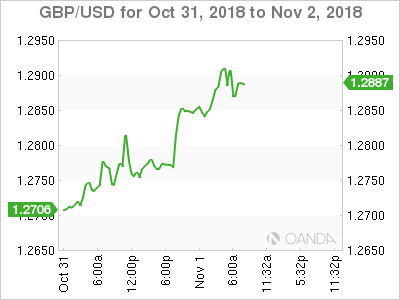
The pound (£1.2910, +1%) is higher on two apparent Brexit breakthroughs. A letter from U.K Brexit negotiator Dominic Raab to Parliament was published today that stated Nov. 21 as the possible date for an agreement with the E.U and overnight, the Times has reported that the U.K. has reached a post-Brexit deal for the financial services sector.
Note: Raab has since backtracked and admitted that there was no set date for the negotiations to conclude.
EUR/USD is higher by +0.5% to trade at €1.1385, while the Japanese yen has gained +0.1% to ¥112.85 outright. The offshore yuan has climbed +0.3% to ¥6.9532 per dollar.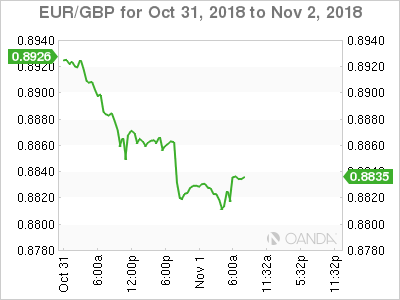
5. U.K manufacturing PMI falls
Data this morning showed that conditions in the U.K manufacturing sector slowed sharply last month – output growth weakened, while new order inflows and employment both declined for the first-time in over two-years.
The seasonally adjusted IHS Markit PMI fell to a 27-month low of 51.1; down from September’s revised reading of 53.6 vs. 53.8.
Digging deeper, the weakness in total new orders was mainly centred on the consumer goods sector, as the intermediate and investment goods categories both posted mild expansions.
Foreign demand decreased for the second-time in the past three-months as Brexit uncertainties and global trade tensions had negatively impacted inflows of new work from within the E.U.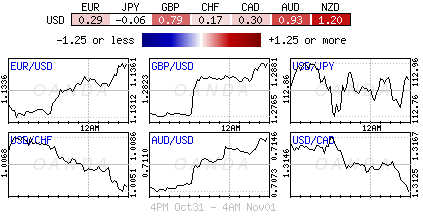
EUR/USD – Euro Gains Ground As Risk Appetite Improves
EUR/USD has posted considerable gains on Thursday, erasing most of this week’s losses. Currently, the pair is trading at 1.1373, up 0.55% on the day. On the release front, there are no German or eurozone events, but stronger risk appetite on Thursday has boosted European stock markets as well as the euro. In the U.S, unemployment claims are expected to edge lower to 213 thousand. The ISM Manufacturing PMI is forecast to drop for a second straight month, with an estimate of 59.0 points. On Friday, Germany and the eurozone release Manufacturing PMI reports. In the U.S, the focus will shift to employment data, with the release of wage growth and nonfarm payrolls.
Eurozone inflation is expected to rise in October. CPI Flash Estimate ticked higher from 2.1% to 2.2% and Core CPI Flash Estimate rose to 1.1%, up from 0.9%. Both of these readings matched the forecasts. The stronger inflation numbers back up ECB President Mario Draghi’s stance that inflation in showing a “relatively vigorous pick-up”. Higher oil prices are one reason behind stronger inflation numbers. Germany, the bellwether for the rest of the eurozone, is also experiencing higher inflation, which climbed 2.4% in October. Although inflation is on the move, growth in the eurozone has softened in the third quarter. Eurozone GDP posted a weak gain of 0.2% in the third quarter, down from the 0.4% gain in the second quarter. On an annualized basis, eurozone growth slipped to 1.7% in Q3, down from 2.1% in Q2. The situation in Germany is even worse, with the German central bank forecasting zero growth in the third quarter. Confidence levels have also headed lower across the eurozone. Lower growth and weaker confidence have translated into sharp losses for the euro, which declined 2.5% in October. This marked the currency’s worst monthly performance since May.
US Jobs Data Expected To Show Wage Growth At Near Decade High: FX And Equity Market Action Eyed
The current week will wrap up with the most important monthly release out of the US, namely the country’s jobs report due at 1230 GMT. Wage growth is anticipated to again attract the lion’s share of attention out of October’s report. A beat on this front will theoretically more conclusively put on the table a December hike by the Federal Reserve. There are some equity market subtleties at play this time around though that may complicate things for the US central bank and which are worth considering.
According to forecasts, the US economy added 190k positions in October, above September’s 134k which was the lowest in a year, being impacted by Hurricane Florence. The unemployment rate is projected to remain at the near five-decade low of 3.7%. In terms of the much-anticipated wage growth figures, average earnings are predicted to have grown by 3.1% on an annual basis, reaching a fresh cycle peak, specifically their highest since April 2009. Overall, the prints are expected to come in at relatively robust levels, building on positive momentum generated by upbeat US data hitting the markets recently.
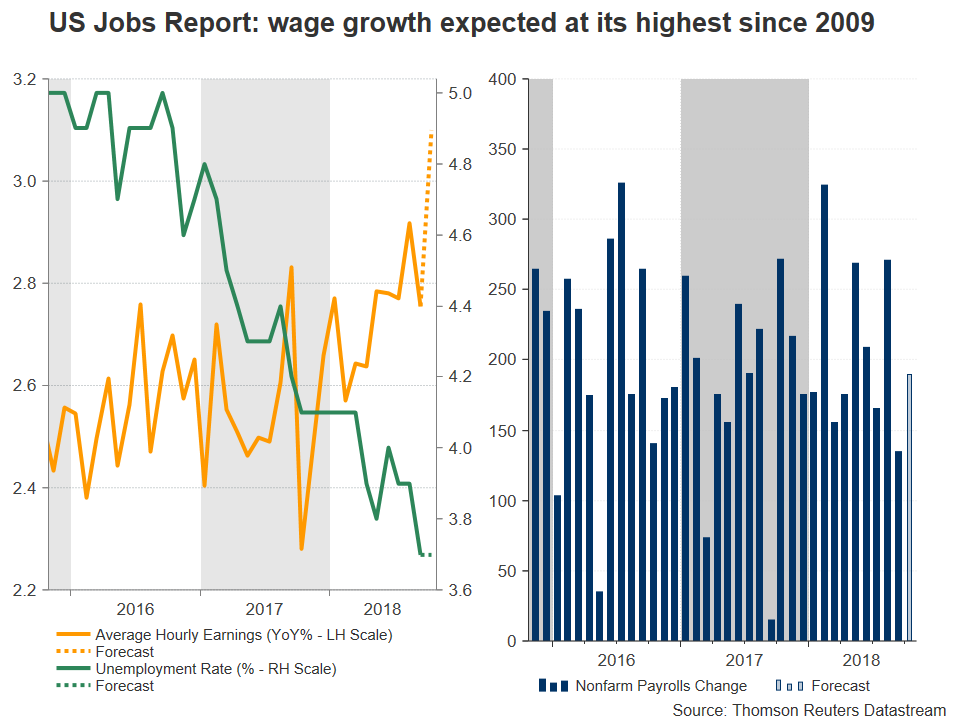
Fed funds futures currently put the odds for a December quarter percentage point rate increase by the US central bank at around 80%. Better-than-forecasted data, especially on the wage front which can act as an inflation driver, can push that probability closer to a done deal, consequently supporting the greenback. Conversely, disappointing numbers could make a fourth hike this year less likely, thus weighing on the dollar. However, there are some complications at play that may lead markets participants to behave differently than just expressed.
The Fed seems to be in the convenient position of being more or less in line with its dual mandate of full employment and price stability; September’s core PCE price index – this being the Fed’s preferred inflation measure – released on Monday, remained at the central bank’s 2.0% annual target for the fifth straight month. Hence the central bank should unequivocally proceed with its rate normalization plans, right? A caveat is in store: the Fed’s unofficial mandate of financial market stability.
Strong wage numbers are supportive of higher Treasury yields. Yield angst was one of the catalysts behind the recent stock market selloff; the S&P 500 is down by around 8% from its record high hit in late September. Should robust readings be associated with a fresh leg lower on Wall Street, then investors may start to believe the Fed will take a more gradual stance on rate normalization, something which is dollar negative. More hints on the weight the central bank currently places on stock market volatility are likely to come during next week’s policy meeting.
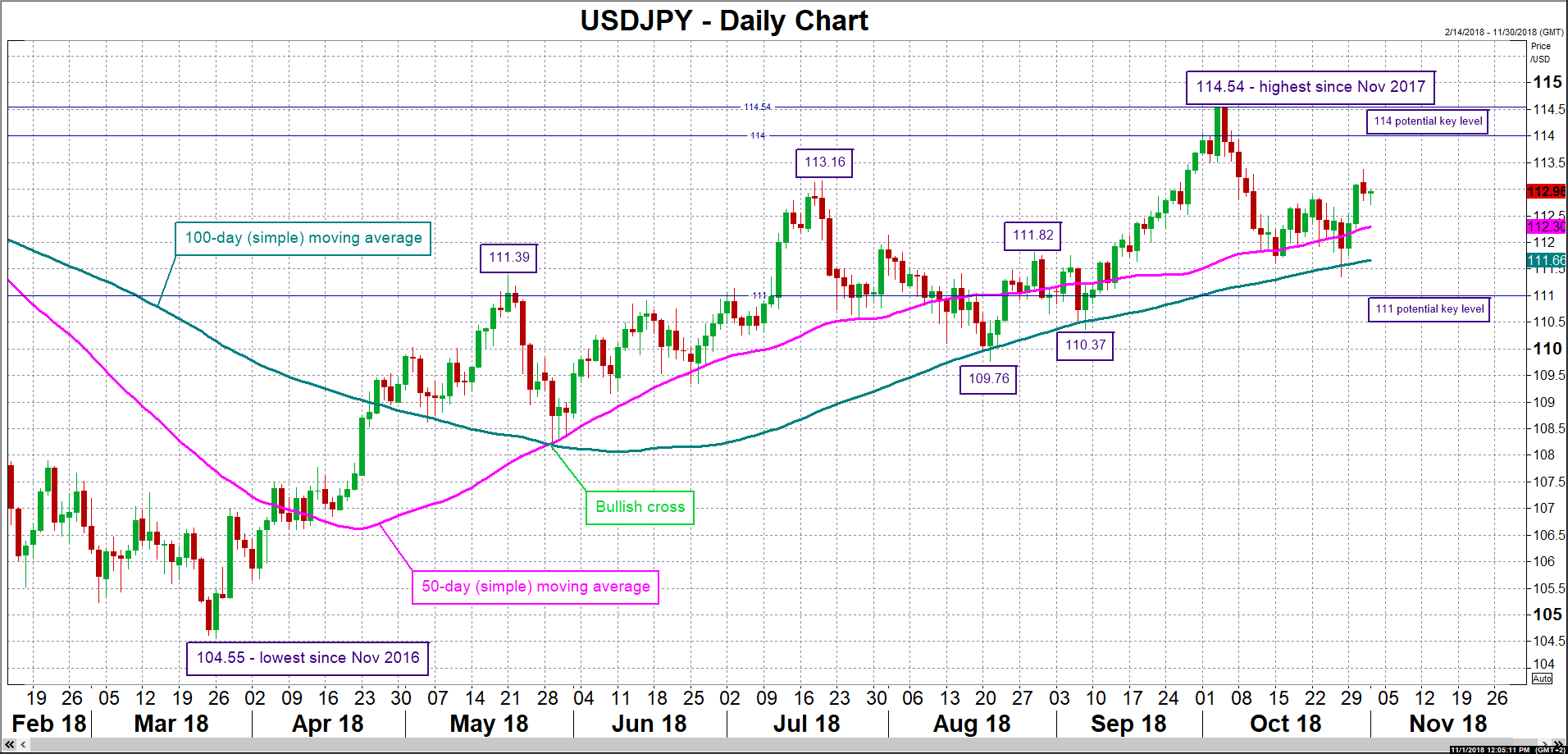
In FX markets, an encouraging report that does not spur a stock market selloff is likely to boost USDJPY. If a decisive move above a previous top at 113.16 materializes, resistance to gains may take place around the 114 round figure. Further above, the region around 114.54, the pair’s highest since November last year would be eyed, with the 115 handle coming into scope in the event of an upside break. On the downside and in case of disappointing prints or sharp equity declines that bring to the fore the yen’s safe-haven allure, support could occur around the current level of the 50-day moving average at 112.30. Not far below lies the 100-day MA at 111.66, with the area around it capturing a couple of tops from previous months. Lower still, the zone around the 111 handle which was congested in the recent past would come in focus.
Lastly, the reading on September’s US trade balance will be made public at the same time as the employment report. The relevant deficit is expected to come in at $53.6 billion, its widest since February. Additional attention will be falling on the politically sensitive trade gap with China that touched an all-time high of $38.6bn in August.
The Analytical Overview Of The Main Currency Pairs
The EUR/USD currency pair
Technical indicators of the currency pair:
Prev Open: 1.13433
Open: 1.13146
% chg. over the last day: -0.26
Day's range: 1.13530 – 1.13689
52 wk range: 1.1299 – 1.2557
Yesterday, the EUR/USD currency pair fell slightly. At the moment, quotes have updated local highs and started to grow. Key support and resistance levels are: 1.13500 and 1.13800, respectively. Positions should be opened from these marks. Trading instrument has the potential for further growth.
The news feed on 01.11.2018:
ISM manufacturing PMI in the US at 16:00 (GMT+2:00).
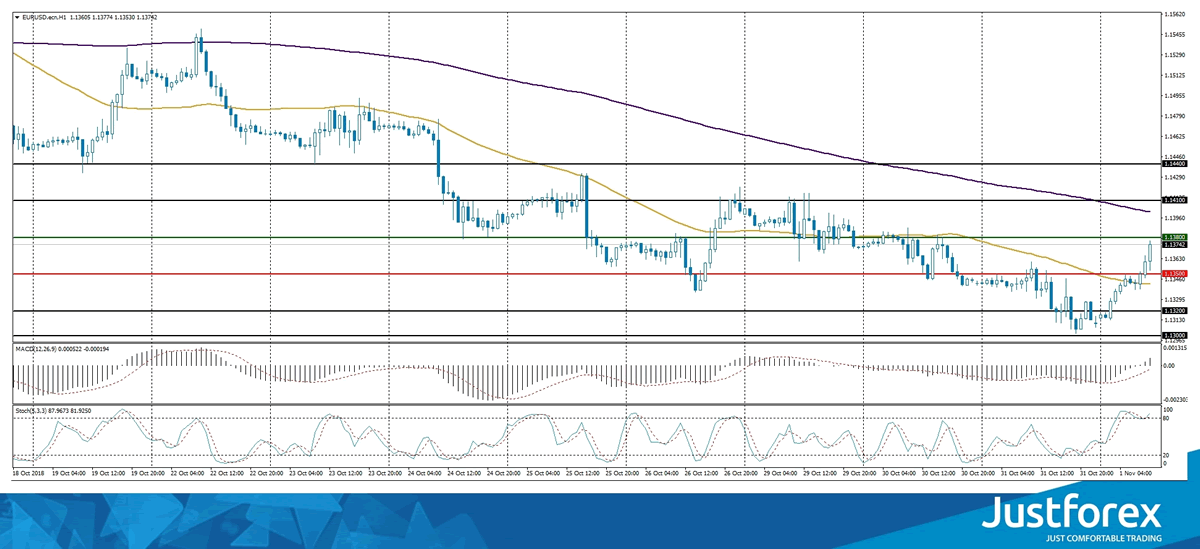
The price has fixed between 50 MA and 200 MA, which are dynamic support and resistance levels.
The MACD histogram has moved to the positive zone, which gives a signal to buy EUR/USD.
Stochastic Oscillator is in the overbought zone, the %K line has crossed the %D line. There are no signals.
Trading recommendations
Support levels: 1.13500, 1.13200, 1.30000
Resistance levels: 1.13800, 1.14100, 1.14400
If the price fixes below the local support level of 1.13500, the EUR/USD quotes are expected to decline. The movement is tending to 1.13200-1.13000.
Alternative option. If the price fixes above the resistance of 1.13800, it is necessary to look for entry points to the market to open long positions. The movement is tending to 1.14100-1.14400.
The GBP/USD currency pair
Technical indicators of the currency pair:
Prev Open: 1.27076
Open: 1.27669
% chg. over the last day: +0.47
Day's range: 1.28720 – 1.29203
52 wk range: 1.2662 – 1.4378
There are aggressive purchases on the GBP/USD currency pair. During yesterday's and today's trading, the growth of quotes exceeded 200 points. Demand for the pound has grown significantly. According to The Times, London and Brussels reached a preliminary agreement in the field of financial services. At the moment, the key support and resistance levels are: 1.28700 and 1.29300, respectively. The trading instrument has the potential for further correction. We recommend opening positions from the key levels. Investors expect the Bank of England interest rate decision.
The news feed on 01.11.2018:
The index of economic activity in the UK manufacturing sector at 11:30 (GMT+2:00);
The Bank of England interest rate decision at 14:00 (GMT+2:00).
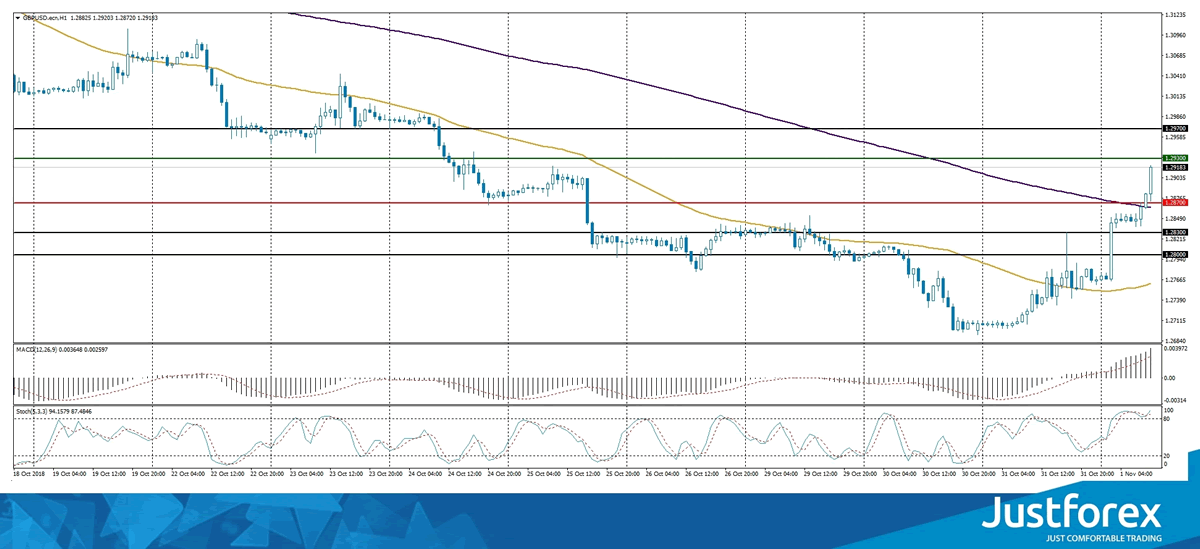
Indicators point to the power of buyers: the price has fixed above 50 MA and 200 MA.
The MACD histogram is in the positive zone, above the signal line, which gives a strong signal to buy GBP/USD.
Stochastic Oscillator is in the overbought zone, the %K line is crossing the %D line. There are no signals.
Trading recommendations
Support levels: 1.28700, 1.28300, 1.28000
Resistance levels: 1.29300, 1.29700
If the price fixes above the resistance level of 1.29300, further growth of the GBP/USD currency pair is expected. The movement is tending to 1.29700-1.30000.
An alternative may be a drop in the GBP/USD quotes to 1.28300-1.28000.
The USD/CAD currency pair
Technical indicators of the currency pair:
Prev Open: 1.31112
Open: 1.31565
% chg. over the last day: +0.40
Day's range: 1.31090 – 1.31256
52 wk range: 1.2248 – 1.3387
Yesterday, Statistics Canada published a fairly optimistic report on the country's GDP. Today, the USD/CAD currency pair has moved away from local highs and started to decline. At the moment, the local support and resistance levels are: 1.31000 and 1.31400, respectively. Positions should be opened from these marks. Trading instrument has the potential for further decline.
The news feed on the economy of Canada is calm.
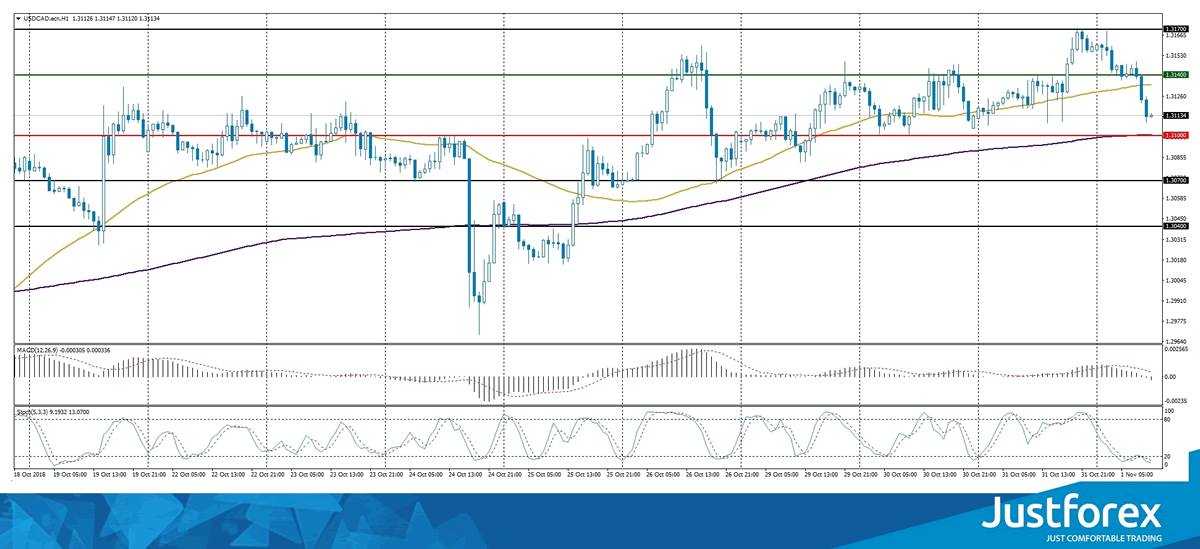
Indicators do not give accurate signals: the price is being traded between 50 MA and 200 MA.
The MACD histogram has moved into the negative zone, which signals the bearish sentiment.
Stochastic Oscillator is in the oversold zone, the %K line has crossed the %D line. There are no accurate signals.
Trading recommendations
Support levels: 1.31000, 1.30700, 1.30400
Resistance levels: 1.31400, 1.31700
If the price fixes below the round level of 1.31000, a further drop in the USD/CAD quotes is expected. The movement is tending to 1.30700-1.30500.
An alternative may be the USD/CAD currency pair growth to the level of 1.31600-1.31800.
The USD/JPY currency pair
Technical indicators of the currency pair:
Prev Open: 113.076
Open: 112.855
% chg. over the last day: -0.20
Day's range: 112.860 – 112.920
52 wk range: 104.56 – 114.74
The technical pattern on the USD/JPY currency pair is ambiguous. The trading instrument is in a sideways trend. Investors expect additional drivers. At the moment, local support and resistance levels are 112.750 and 113.100, respectively. Positions should be opened from these marks.
Today, the publication of important news from Japan is not expected.
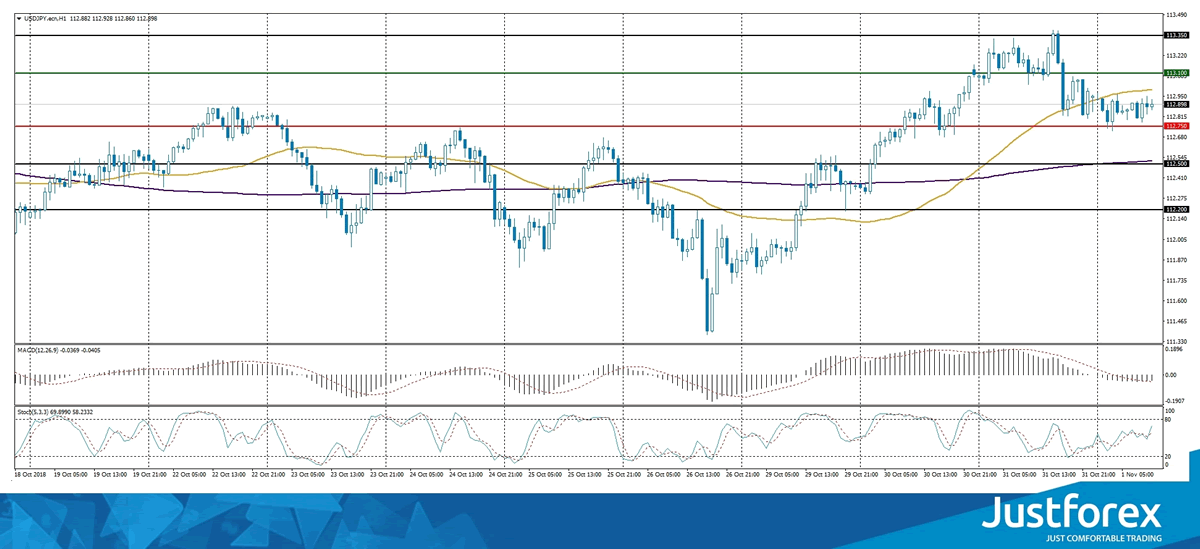
Indicators do not send accurate signals: the price has fixed between 50 MA and 200 MA.
The MACD histogram is in the negative zone, but above the signal line, which gives a weak signal to sell USD/JPY.
Stochastic Oscillator is in the neutral zone, the %K line crossed the %D line. There are no signals.
Trading recommendations
Support levels: 112.750, 112.500, 112.200
Resistance levels: 113.100, 113.350
If the price fixes below the already mirror support of 112.750, the USD/JPY quotes are expected to decline. The movement is tending to 112.500-112.200.
An alternative may be the USD/JPY currency pair growth to 113.350-113.500.