

Sample Category Title
Dollar Stumbles Awaiting US Jobs Report
The US dollar fell against all major pairs on Thursday. The greenback had touched 16 month highs on Wednesday but could not hold on to those gains as positive Brexit news and solid trade data in Australia combined with investors taking profit in their long dollar positions. The release of the U.S. non farm payrolls (NFP) report on Friday, November 2 at 8:30 am EDT could turn the tide for the dollar, but investors looking beyond this week will take into consideration political risk as the US midterms take place on Tuesday, November 6.
The US dollar lost its appeal as a safe haven as President Donald Trump tweeted about having a good talk with Chinese leader Xi Jinping. The two will meet in Buenos Aires ahead of the G20 summit, with trade a big topic under discussion.
- US forecasted to have added 200,000 jobs in October
- US earning to remain upward trend at 0.2 percent gain
- Canadian jobs to show 12,000 gains in October
Dollar on Back Foot Ahead of Jobs Report
The EUR/USD rose 0.90 percent on Thursday. The single currency is trading at 1.1412 after the US dollar hit a brick wall after on its way to a 17 month high. The scenario of a US economy over performing in trade war risk aversion gave strength to the dollar, but the script has changed with the US dollar on the back foot as the major upcoming risk event are the US midterms with investors limiting their dollar exposure while positive indicators have appeared abroad.
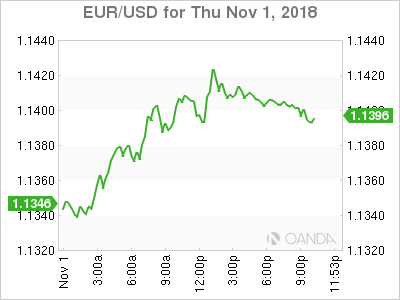
The euro rebounded against the greenback with an eye on the US jobs report on Friday. Employment has been a strong pillar of growth and supported the view of the Fed to keep tightening monetary policy. The upcoming October data will not change that, but it will have to be exceptional to change the view of the market on perceived political risk out of Washington.
Europe is no stranger to political risk as it battles on two fronts. The Italian budget dilemma continues after the European Union rejected the proposal of a member for the first time and gave Italy three weeks to make a list of changes. Italian politicians are digging their heels as Brussels and Rome head for tough negotiations.
Sterling Surges on Brexit Hope and Dollar Softness
The GBP/USD gained 1.96 percent . The currency pair is trading at 1.30 after reports of a financial services agreement between the EU and the UK made the rounds. Officials from both sides denied there being an actual agreement, although the matter as anything Brexit related, has been discussed for months. While it was deemed as speculation, the fact remains that it was also not denied which was good enough for the market pricing in further pound strength.
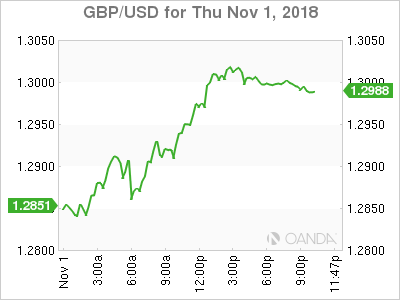
The various comments, both official and unofficial, point to a deal being close. As always with Brexit rhetoric there have been few details disclosed. There is optimism on both sides, although the team in Brussels is more cautious.
As part of its “Super Thursday” the Bank of England (BoE) Governor Mark Carney had a neutral rhetoric about the Brexit outcome saying the central bank is ready to do what it must in either outcome. He did comment that the hard exit is an unlikely scenario and is confident about the levels of preparations done by the financial services industry ahead of the imminent divorce.
Gold Retakes Safe Haven Crown from Dollar
Gold rose 1.64 percent on Thursday after Trade fears eased sapping the attraction of the US dollar as a safe haven. The upcoming US midterms are the next major risk event and investors are limiting their exposures to the US currency.
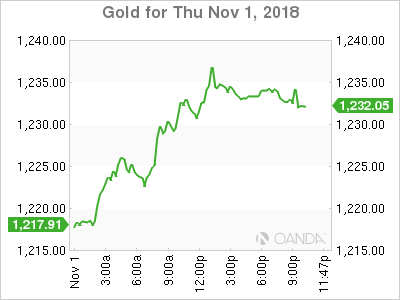
The US economy has been a solid performer this year and the U.S. Federal Reserve has moved towards rate normalization with three rate hikes in 2018. Another rate hike is expected at the December Federal Open Market Committee (FOMC) meeting, if economic indicators remain strong.
Gold has reclaimed a seat at the safe haven table after a difficult start of the year. Demand for the metal has risen from retail investors and central banks keeping prices above $1,230.
'Oil Free falls on Oversupply Fears'
Oil prices tumbled on Thursday as the market is anxious about oversupply ahead of the start of Iran sanctions. Organization of the Petroleum Exporting Countries (OPEC) and other major producers appear to have gotten the message from US President Donald Trump and increased production, but there are still questions on how much will the sanctions actually impact Iranian exports.
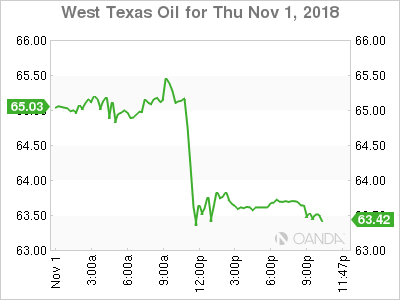
Iran’s biggest customers have bowed down to US pressure and might still work out exemptions or try to exploit loopholes to keep purchasing crude from its longtime supplier.
There are reports that India was able to get US sanctions waivers in exchange from reducing its Iranian imports to by 35 percent.
Market events to watch this week:
Friday, November 2
8:30am CAD Employment Change
8:30am CAD Trade Balance
8:30am CAD Unemployment Rate
8:30am USD Average Hourly Earnings m/m
8:30am USD Non-Farm Employment Change
8:30am USD Unemployment Rate
Eco Data 11/2/18
[php_everywhere instance="1"]
Gold Jumps as US Dollar Shows Broad Losses
Gold has posted sharp gains in the Thursday session, after sustaining strong losses this week. In the North American trade, the spot price for one ounce of gold is $1232.51, up 1.47% on the day. On the release front, unemployment claims ticked lower to 214 thousand, a shade above the forecast of 213 thousand. On the manufacturing front, ISM Manufacturing PMI also disappointed, as it fell to 57.7 points, shy of the estimate of 59.0 points. This marked a 6-month low. On Friday, the focus will be on U.S employment numbers, with the release of wage growth and nonfarm payrolls.
October may have been dismal for the stock markets, but gold prices were sharply higher, posting a gain of 1.75%. This marked the strongest monthly gain since July 2017. With global stock markets rebounding on Thursday, investors have regained confidence and risk appetite. This has weighed on the U.S dollar, which has taken advantage of the recent turmoil in the equity markets and posted impressive gains. A lower dollar on Thursday has pushed gold prices sharply higher. Traders should be prepared for volatility from gold on Friday, with the release of key employment indicators. Nonfarm payrolls are expected to improve sharply to 193 thousand, but wage growth is forecast to tick lower to 0.2%.
EURAUD Bearish as it Touches 2-month Low
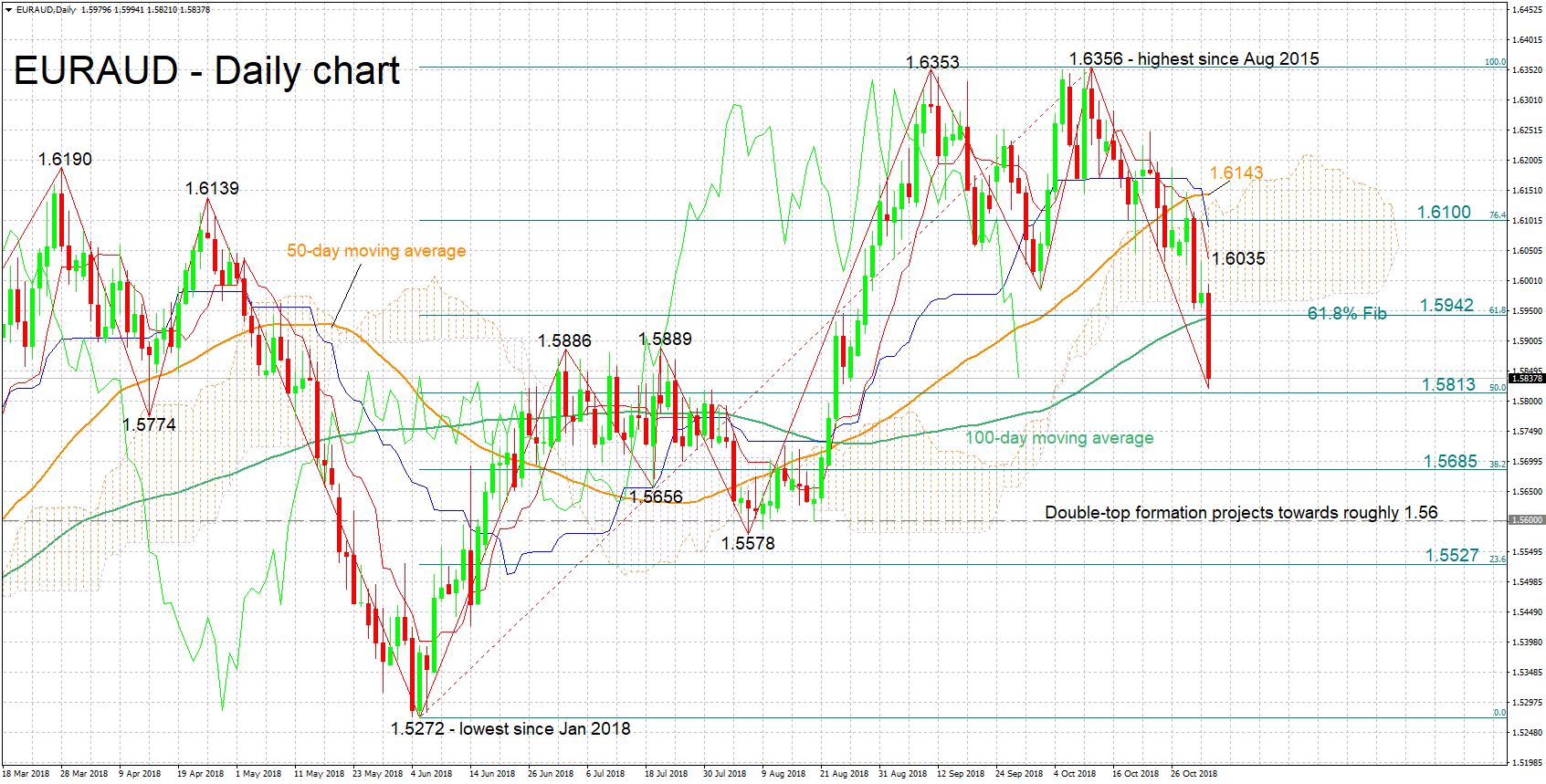
EURAUD lost more than 500 pips after touching a more than three-year high on October 11. Earlier on Thursday, it hit a two-month low of 1.5821.
The Tenkan- and Kijun-sen lines are negatively aligned in support of a bearish short-term bias; it should be kept in mind though that the Chikou Span may be signaling a market that is close to oversold.
Steeper losses may meet immediate support around 1.5813, the 50% Fibonacci retracement level of the upleg from 1.5272 to 1.6356. Further below, the 38.2% Fibonacci mark at 1.5685 would increasingly come in focus, while it bears mention that the recent double top formation is projecting potential losses towards roughly the 1.56 handle.
Should the pair reverse course, resistance could occur around the 61.8% Fibonacci level at 1.5942, which is where the 100-day moving average line and the Ichimoku cloud bottom approximately lie as well. This, given that the area around 1.59, which captures a couple of tops from previous months, is broken first. More bullish movement would bring the zone around the Tenkan-sen at 1.6035 increasingly into scope.
The medium-term outlook is looking predominantly bearish, with trading activity taking place below the 50- and 100-day moving average lines, as well as below the Ichimoku cloud.
Overall, both the short- and medium-term pictures are currently looking mostly negative.
British Pound Climbs as Brexit Talks Show Progress
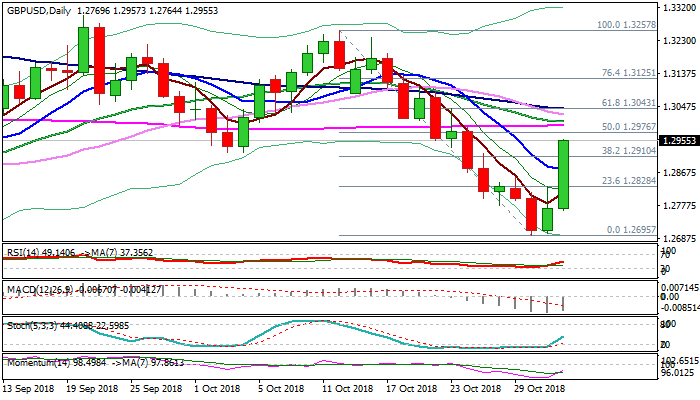
GBP/USD has surged in the Thursday session. In the North American session, the pair is trading at 1.2959, up 1.52% on the day. On the release front, the Bank of England held steady and kept the benchmark rate pegged at 0.75%. The BoE also released its inflation report. In the U.S, unemployment claims ticked lower to 214 thousand, a shade above the forecast of 213 thousand. On the manufacturing front, British Manufacturing PMI slipped to 51.1, missing the estimate of 53.0 points. ISM Manufacturing PMI also disappointed, as it fell to 57.7 points, shy of the estimate of 59.0 points. This marked a 6-month low. On Friday, the UK releases construction PMI, while in the U.S the focus will be on U.S employment numbers, with the release of wage growth and nonfarm payrolls.
The pound has jumped on Thursday, after reports that the UK and the EU had reached a milestone agreement, with the EU allowing access to Europe for British financial services companies after Brexit. However, officials in both London and Brussels denied that any deal had been reached. The fact that the pound screamed higher after the report underscores the tremendous tension over the lack of progress between the sides, with less than five months until Britain leaves the EU. Cross-border trade in financial services after Brexit is a key issue, with London eager to maintain its position as the financial capital of Europe. Thus the report that a deal had been reached would represent a significant breakthrough in the Brexit negotiations. The parties remain far apart on a range of issues, notably the Irish border. There is even disagreement on whether the sides are close to inking a Brexit deal. Prime Minister May recently told Parliament that a deal was “95% done”, while EU leaders are far more pessimistic and have expressed surprise at the optimism on the British side.
Sterling Up 1.4% on Super Thursday Trading; Scope for Further Advance on Strong Bullish Sentiment
Cable continues to benefit from positive Brexit news and extends strong advance, being so far up 1.4% in super Thursday trading. The pair kept strong bullish sentiment after BoE stayed pat in expected action on today’s meeting but connected their future decisions with progress of Brexit talks. The central bank signaled slightly faster pace in future rate hikes if Brexit deal will be reached before the end of talks in March next year, while any scenario without deal would keep the BoE aside. Today’s strong advance took out pivotal Fibo barrier at 1.2910 (38.2% of 1.3257/1.2695) and pressures strong resistances at 1.2980 (base of thick daily cloud) and 1.30 (psychological / converged 55/20SMA’s). Improved daily techs are supportive, with close above 1.30 zone to generate bullish signal for further advance towards 1.3043 (Fibo 61.8% / 100SMA).
Res: 1.2980; 1.3000; 1.3043; 1.3090
Sup: 1.2910; 1.2882; 1.2838; 1.2828
USDJPY Outlook: Weak ISM Data Keep Dollar at the Back Foot ahead of US Jobs Data
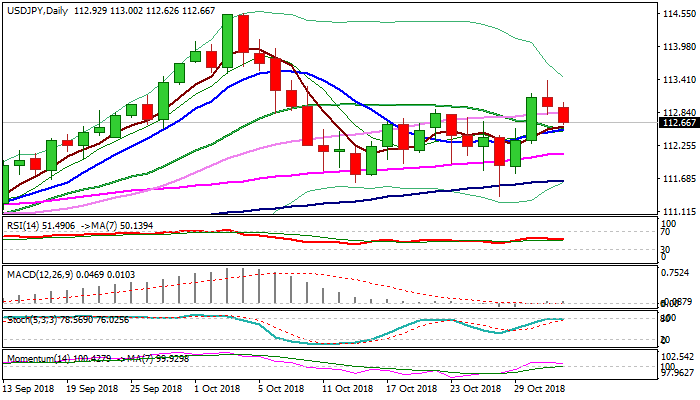
The pair lost traction and dipped further, extending pullback from Wednesday's rejection at 113.33. Broader dollar's weakness on Thursday was boosted by weaker than expected US Oct ISM Manufacturing PMI (57.7 vs 59.0 f/c) and increase of jobless claims above forecast. Fresh bears pressure key supports at 112.62/53 (Fibo 38.2% of 111.37/113.38/converged 10/20SMA's) with firm break here to further weaken near-term structure. US NFP data are in focus as dollar's fresh negative sentiment could be soured further if jobs data fall below expectations. Markets are concerned about average earnings figure (0.2% f/c vs 0.3% prev) which could offset positive impact on strong NFP data and would risk extension towards Fibo 50% support at 112.38. Scenario of both releases coming below expectations would open way for extension through key supports at 111.65 (100SMA) and 111.37 (26 Oct low). Conversely, upbeat NFP and earnings would boost the greenback for advance above 113.38.
Res: 112.82; 113.00; 113.33; 113.80
Sup: 112.53; 112.38; 112.13; 111.65
US ISM: Manufacturing Activity Eases Up in October
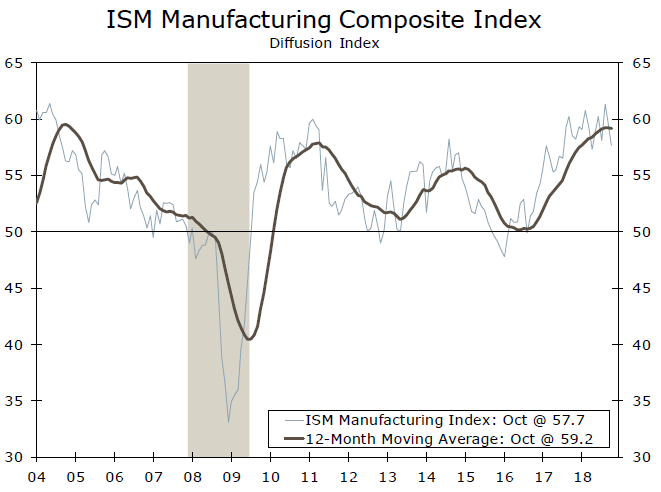
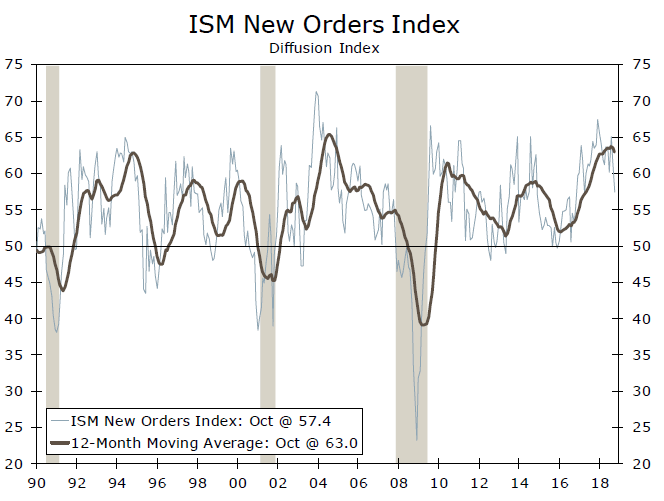
The ISM manufacturing index slipped in October to a still-strong reading of 57.7. A sharp drop in new orders suggests a further slowdown may be in store, however. Input costs remain an issue.
Manufacturing Remains Strong, but Cracks Beginning to Show
Activity in the manufacturing sector eased in October with the ISM index shedding 2.1 points. While at 57.7 the index signals output remains solid, the index has slipped below both its six- and 12-month averages.
We highlighted in September that the euphoric, 60-ish readings of the summer were likely not sustainable, especially in a strong-dollar environment. Today's report flashed additional signals that activity in the manufacturing sector is beginning to moderate from the impressive pace registered over the past year. Specifically, the new orders index posted the largest pullback over the month, falling 4.4 points to 57.4. That marks the first time in a year and a half that new orders have come in below 60.
The stronger dollar and slowdown in global trade may finally be coming to bear. The export orders index slipped to 52.2, which was the lowest reading since 2016. Production moderated in October, but the slowdown in new orders suggests current output growth may slip further. The backlogs index was little changed in October at 55.8, but is also below its six-month average.
With orders and production growth slowing, manufacturers eased up on the pace of hiring. The employment component slipped two points in October to 56.8. Manufacturing has been one of the strongest areas for job growth over the past year, growing half a percent more than total employment since last September. Hiring has come off the boil slightly over the past few months (averaging 15,000 jobs per month in Q3 versus 24,000 per month in the first half of the year), but today's read on hiring suggests the nation's factories are still hiring at a decent, albeit slower rate.
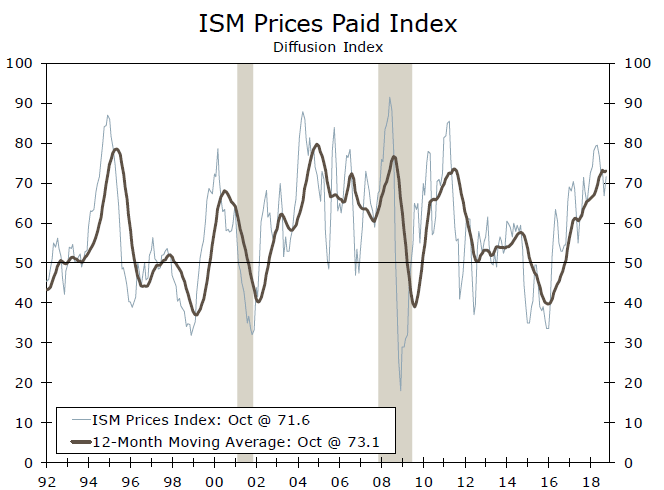
Despite having slowed a bit since the spring, input costs continue to rise at a rapid rate. The prices paid component moved back above 70 in October. Tariffs remain a concern among respondents, with multiple comments about tariffs leading to higher costs, and in some cases starting to be passed on to the costs of goods sold. In the case of a food manufacturer, however, protein prices were "under pressure from heavy U.S. supplies and export concerns related to trade tariffs."
Rebound Unlikely
We see scope for the ISM manufacturing index to moderate further in the coming months. The dollar continued to climb through October and the lagged effect of currency fluctuations suggest it will remain a headwind in the months to come. At the same time, trade tensions show no sign of easing up. Uncertainty about the environment will likely be a deterrent for capital spending. While not tracked by the ISM, regional Federal Reserve purchasing managers indices report a noticeable slowdown in manufacturers' capital spending plans since the start of the year, which suggests the industry itself is bracing for a slowdown.
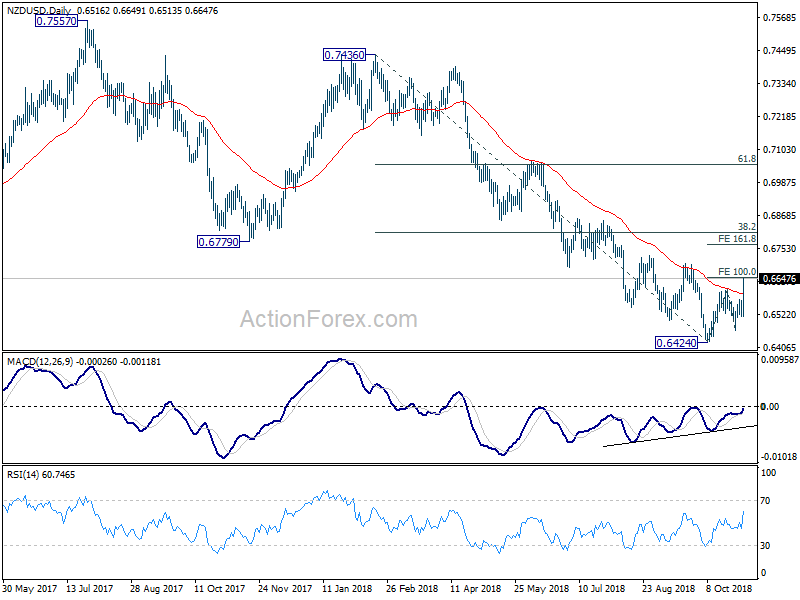
Today’s top mover NZD: Building up case of trend reversal
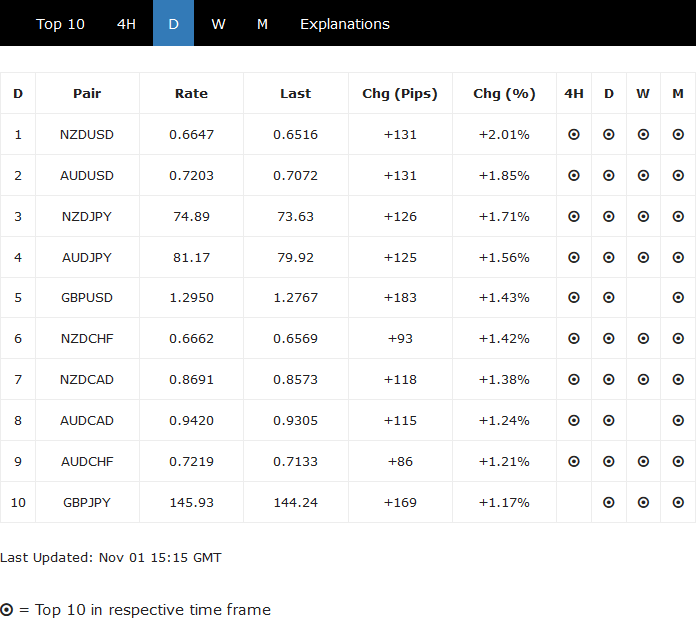
Australian Dollar and New Zealand Dollar surge broadly today. Meanwhile Dollar is under heavy selling pressure as it's possibly staging a broad based near term bearish reversal. As a result NZD/USD is the top mover for today up to now.
In the background, bullish convergence is seen in both 4 hour and Daily MACD. Adding to that, 55 day EMA is firmly taken out with today's rally. The case of medium term reversal is building up. Immediate focus is now on 100% projection of 0.6424 to 0.6610 from 0.6464 at 0.6650. Firm break of this projection level will suggests that rise from 0.6424 is an impulsive wave, which further affirm the reversal case.
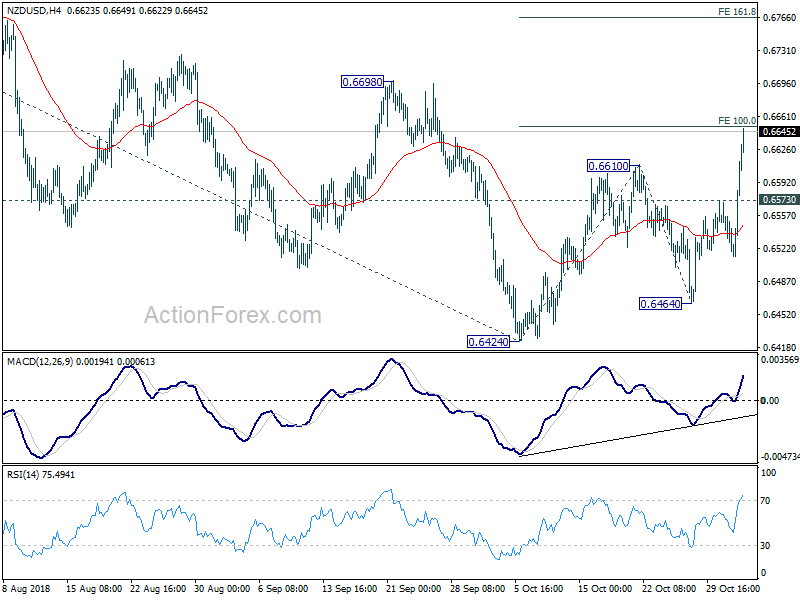
In that case, NZD/USD would target 38.2% retracement of 0.7436 to 0.6424 at 0.6811. Reactions from there will determine whether price actions from 0.6424 is the start of an up trend or just forming a corrective pattern. However, rejection from 0.6650, followed by break of 0.6573 minor support, will retain medium term bearishness and turn focus back to 0.6424 low.
Japanese Yen Edges Higher as Greenback Broadly Lower
The Japanese yen is slightly higher in the Thursday session. In North American trade, USD/JPY is trading at 112.74, down 0.23% on the day. On the release front, Japanese Final Manufacturing PMI improved to 52.9, but missed the forecast of 53.1 points. Japanese 10-year bonds were unchanged, with a yield 0f 0.14%. In the U.S, unemployment claims ticked lower to 214 thousand, a shade above the forecast of 213 thousand. On the manufacturing front, ISM Manufacturing PMI disappointed, as it fell to 57.7 points, shy of the estimate of 59.0 points. This marked a 6-month low. On Friday, the focus will be on U.S employment data, with the release of wage growth and nonfarm payrolls.
As expected, there were no surprises from the Bank of Japan, which wrapped up a policy meeting on Wednesday. Policymakers voted 7-2 to maintain interest rates at -0.10% and 10-year bond yields around zero. The BoJ said that it would maintain ultra-low rates for an “extended period” and that it would allow more flexibility in the movement of 10-year bonds. The bank downgraded its forecasts for inflation and growth through fiscal 2020, in essence acknowledging that its inflation target of 2 percent will not be achieved in the near future. BoJ Governor Haruhiko Kuroda said that the trade war between the U.S and China had not had a significant effect on the Japanese economy, but admitted that protectionist trade policies could hurt the economy. Aside from darkening clouds on the global front, Japan plans to introduce a sales tax shortly, one more reason that the BoJ is unlikely to wean to economy off stimulus anytime soon.