Sample Category Title
Sterling Strong as Supported by More Confident BoE, Ignores Brexit Deal Dismissal and Weak Data
Sterling remains strong in general today, next to Australian and New Zealand Dollar. UK and EU officials came out dismissing the news regarding a Brexit financial services deal. But that didn't harm the Pound a bit. Instead, Sterling ignore weak manufacturing data and is supported by slightly more confidence BoE economic projections. On the other hand, Dollar and Yen are the weakest ones. In particular, Dollar suffers deep and steep pull back with EUR/USD's rebound from 1.1300 spilling over to other pairs. The greenback will need to look into tomorrow's non-farm payroll report for savior.
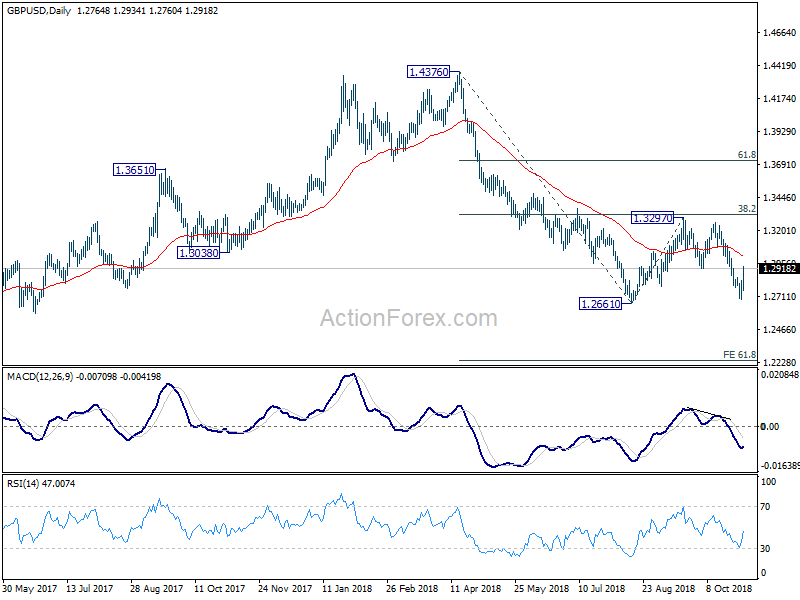
Technically, GBP/USD's breach of 1.2921 resistance now serves as a sign of near term reversal. More upside could be seen back towards 1.3297 resistance. AUD/USD's break of 0.7159 resistance is an early sign of medium term reversal, followed EUR/AUD's break of 1.5984 support yesterday. Now it's time for EUR/USD to break 1.1421 resistance to provide more evidence for a broad based Dollar reversal.
In other markets, European indices are mixed. At the time of writing, FTSE is up 0.06%, DAX up 0.26% but CAC is down -0.17%. German 10 year yield rises 0.0253 to 0.414, back above 0.4 handle. Italian 10 year yield drops -0.0691 to 3.363. That is, German-Italian spread is now back below 300. In Asia, Nikkei dropped sharply by -1.06% to close at 21687.65. But Hong Kong HSI, China Shanghai SSE and Singapore Strait Times recorded 1.75%, 0.13% and 1.39% gains respectively.
US initial jobless claims dropped to 214k, 4-week average at lowest since 1973
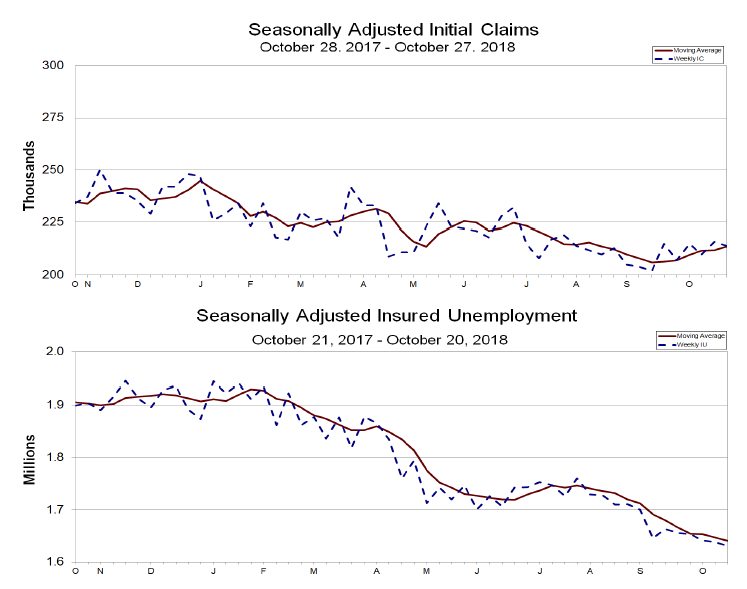
US initial jobless claims dropped -2k to 214k in the week ended October 27, slightly above expectation of 213k. Four-week moving average of initial claims rose 1.75k to 213.75k. Continuing claims dropped -7k to 1.631m in the week ended October 20, lowest since July 28, 1973. Four-week moving average of continuing claims dropped -6.25k to 1.62725m, lowest since August 11, 1973.
Also from the US, non-farm productivity rose 2.2% in Q3, unit labor costs rose 1.2%.
UK and EU officials dismiss misleading news on Brexit financial services deal
Earlier today, Sterling was boosted as the Times reported that a tentative deal is agreed between UK and the EU on all aspects of a future partnership on services. Most importantly, that would grant access of EU markets to for British financial services companies. However, the news was dismissed by both EU and UK officials.
EU chief Brexit negotiator Michel Barnier said in a tweet that EU is "ready" to have "close regulatory dialogue" with the UK. However, the report regarding UK banks' access to the single market was "Misleading press articles today on #Brexit & financial services." The UK government also said in an email statement that "While we continue to make good progress agreeing new arrangements for financial services, negotiations are ongoing and nothing is agreed until everything is agreed."
BoE Bank Rate projections show more confidence on 2019 rate hike, but outlook depends significantly on Brexit
BoE left Bank Rate unchanged at 0.75% as widely expected. The asset purchase target was also held unchanged at GBP 435B. Both decisions were made by 9-0 unanimous vote. In the accompanying statement, BoE warned that the economic outlook will "depend significantly on the nature of EU withdrawal, in particular the form of new trading arrangements, the smoothness of the transition to them and the responses of households, businesses and financial markets." And more importantly, "monetary policy response to Brexit, whatever form it takes, will not be automatic and could be in either direction."
For now, though, the MPC judged that current monetary policy stance "remained appropriate". And, "an ongoing tightening of monetary policy over the forecast period would be appropriate to return inflation sustainably to the 2% target at a conventional horizon. Though, "future increases in Bank Rate are likely to be at a gradual pace and to a limited extent."
In the updated economic projections in the Inflation Report, BoE lowered 2019 Q4 four-quarter GDP forecasts from 1.8% to 1.7%. For 2020, four-quarter GDP forecast was kept unchanged at 1.7%. On CPI inflation, BoE lowered CPI forecast for 2019 Q4 to 2.1% from 2.2%. However, for 2020 Q4, inflation forecast was raised to 2.1% from 2.0%. Bank Rate forecasts for 2019 Q4 was raised from 0.9% to 1.0%. For 2020, Bank Rate forecasts was also raised from 1.1% to 1.2%.
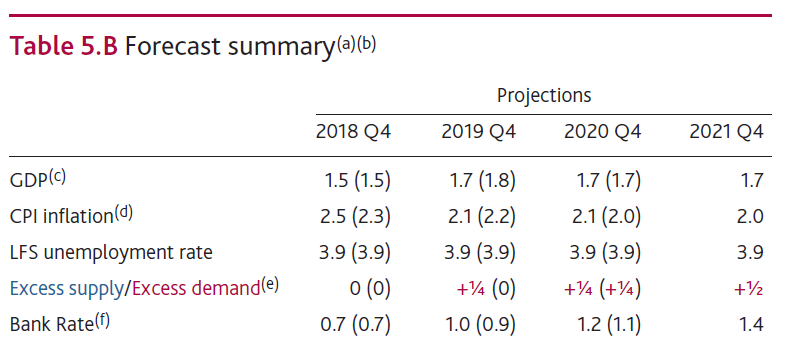
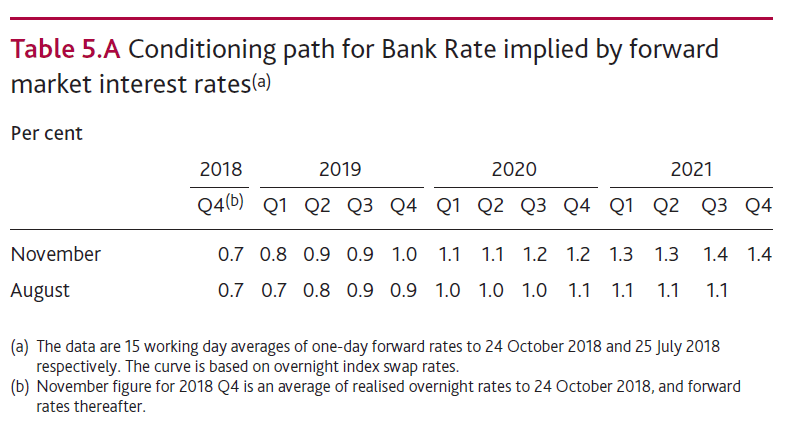
In short, the economic outlook was actually largely unchanged. Nonetheless, BoE is now more certain on a rate hike in 2019, and probably another one in 2020. Indeed, from the conditioning path that BoE used, the next rate hike is pulled ahead from Q1 2020 to Q4 2019. And, another rate could even but seen in between Q3 2020 and Q1 2021.
UK PMI manufacturing dropped to 51.1, worrying turnaround
UK PMI manufacturing dropped to 51.1. in October, down from 53.8, missed expectation of 53.0. Market noted that "new orders and employment decline for first time in 27 months" Also, "input cost and output price inflation both ease".
Rob Dobson, Director at IHS Markit noted that ""October saw a worrying turnaround in the performance of the UK manufacturing sector. At current levels, the survey indicates that factory output could contract in the fourth quarter, dropping by 0.2%." Also, confidence remained low in H2 of the year, "with views on prospects darkening again in October amid rising Brexit-related uncertainties and escalating global trade tensions."
Also released in European session, Swiss PMI manufacturing dropped to 57.4 in October, down fro 59.7 and missed expectation of 58.5. Swiss CPI accelerated to 1.1% yoy in October, up from 1.0% yoy and matched expectations. Swiss SECO consumer confidence improved to -6 in October.
Italian PM Conte: No exchange of concession with EU on budget talks
Italian Prime Minister Giuseppe Conte warned in a newspaper interview that it's "unreasonable and profoundly unfair" to blame the current government for weak economic data. He referred to GDP data released on Tuesday which showed 0% growth in Q3. Also, Conte emphasized that budget talk with EU will not be an "exchange of concession". He insist on sticking to the deficit target of 2.4% of GDP in 2019 despite EU rejection.
Indeed, Conte also said earlier this week that the weak economic performance is the reason for the "expansionary budget". This was echoed by Deputy Prime Minister Matto Salvini who said "the slowing GDP is another reason to go full steam ahead with the budget."
China Caixin PMI manufacturing: Economy has not seen obvious improvement
China Caixin PMI manufacturing rose 0.1 to 50.1 in October, matched expectations. Markit noted there was only "marginal increase in total new work amid further drop in export sales". Dr. Zhengsheng Zhong, Director of Macroeconomic Analysis at CEBM Group said, "Overall, expansion across the manufacturing sector was still weak. Production and business confidence continued to cool despite stable demand. The pressure on production costs didn't ease. China's economy has not seen obvious improvement."
Also released in Asian session, Australia AiG Performance of Manufacturing index dropped to 58.3, seasonally adjusted, in October, down from 59.0. Australia trade surplus widened to AUD 3.02B in September. Japan PMI manufacturing was finalized at 52.9 in October
GBP/USD Daily Outlook
Daily Pivots: (S1) 1.2698; (P) 1.2765; (R1) 1.2833; More...
GBP/USD's rebound from 1.2692 extends higher today but it's limited below 1.2921 support turned resistance. Intraday bias stays neutral first. As long as 1.2921 holds, near term outlook stays cautiously bearish and another decline is in favor. On the downside, break of 1.2692 will target 1.2661 low first. Decisive break there will resume larger down trend from 1.4376. Next target is 61.8% projection of 1.4376 to 1.2661 from 1.3297 at 1.2237. However, break of 1.2921 should extend the consolidation pattern from 1.2661 with another rise towards 1.3297 resistance before completion.
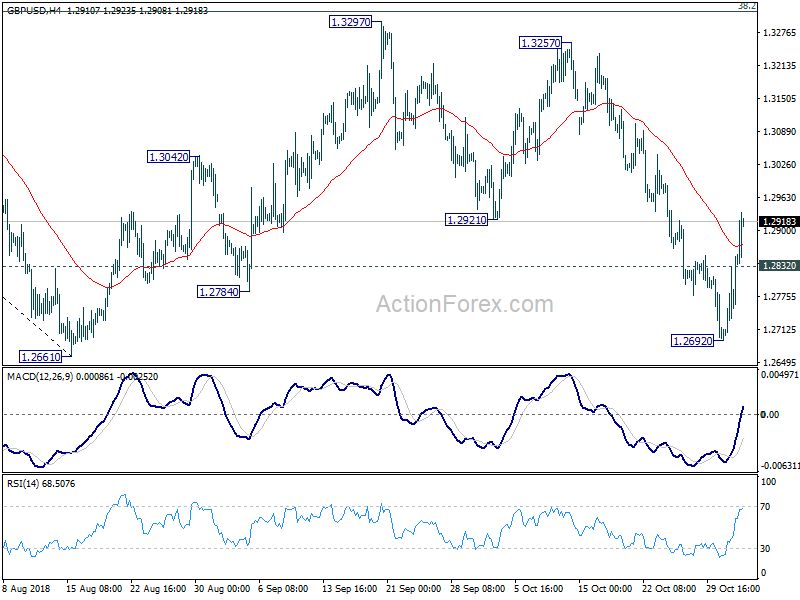
In the bigger picture, whole medium term rebound from 1.1946 (2016 low) should have completed at 1.4376 already, after rejection from 55 month EMA. The structure and momentum of the fall from 1.4376 argues that it's resuming long term down trend. And this will be the preferred case as long as 38.2% retracement of 1.4376 to 1.2661 at 1.3316 holds. However, firm break of 1.3316 would bring stronger rebound to 61.8% retracement at 1.3721. And, the eventual depth of the fall from 1.4376, and the chance of hitting 1.1946 low, will depend on the strength of the interim corrective rebound from 1.2661.
Economic Indicators Update
| GMT | Ccy | Events | Actual | Forecast | Previous | Revised |
|---|---|---|---|---|---|---|
| 21:30 | AUD | AiG Performance of Manufacturing Index Oct | 58.3 | 59 | ||
| 00:30 | JPY | PMI Manufacturing Oct F | 52.9 | 53.1 | ||
| 00:30 | AUD | Trade Balance (AUD) Sep | 3.02B | 1.71B | 1.60B | 2.34B |
| 01:45 | CNY | Caixin PMI Mfg Oct | 50.1 | 50.1 | 50 | |
| 06:45 | CHF | SECO Consumer Confidence Oct | -6 | -8 | -7 | |
| 08:15 | CHF | CPI M/M Oct | 0.20% | 0.20% | 0.10% | |
| 08:15 | CHF | CPI Y/Y Oct | 1.10% | 1.10% | 1.00% | |
| 08:30 | CHF | PMI Manufacturing Oct | 57.4 | 58.5 | 59.7 | |
| 09:30 | GBP | PMI Manufacturing Oct | 51 | 53 | 53.8 | 53.6 |
| 11:30 | USD | Challenger Job Cuts Y/Y Oct | 153.60% | 70.90% | ||
| 12:00 | GBP | BoE Bank Rate | 0.75% | 0.75% | 0.75% | |
| 12:00 | GBP | BoE Asset Purchase Target | 435B | 435B | 435B | |
| 12:00 | GBP | MPC Official Bank Rate Votes | 0--0--9 | 0--0--9 | 0--0--9 | |
| 12:00 | GBP | MPC Asset Purchase Facility Votes | 0--0--9 | 0--0--9 | 0--0--9 | |
| 12:00 | GBP | BoE Inflation Report | ||||
| 12:30 | USD | Nonfarm Productivity Q3 P | 2.20% | 2.00% | 2.90% | |
| 12:30 | USD | Unit Labor Costs Q3 P | 1.20% | 1.10% | -1.00% | |
| 12:30 | USD | Initial Jobless Claims (OCT 27) | 214K | 213K | 215K | 216K |
| 13:30 | CAD | Manufacturing PMI Oct | 54.8 | |||
| 13:45 | USD | Manufacturing PMI Oct F | 55.9 | 55.9 | ||
| 14:00 | USD | Construction Spending M/M Sep | 0.20% | 0.10% | ||
| 14:00 | USD | ISM Manufacturing Oct | 59 | 59.8 | ||
| 14:00 | USD | ISM Prices Paid Oct | 67.5 | 66.9 | ||
| 14:00 | USD | ISM Employment Oct | 58.8 | |||
| 14:30 | USD | Natural Gas Storage | 53B | 58B |
BoE Bank Rate projections show more confidence on 2019 rate hike
In the updated economic projections in the Inflation Report, BoE lowered 2019 Q4 four-quarter GDP forecasts from 1.8% to 1.7%. For 2020, four-quarter GDP forecast was kept unchanged at 1.7%. On CPI inflation, BoE lowered CPI forecast for 2019 Q4 to 2.1% from 2.2%. However, for 2020 Q4, inflation forecast was raised to 2.1% from 2.0%. Bank Rate forecasts for 2019 Q4 was raised from 0.9% to 1.0%. For 2020, Bank Rate forecasts was also raised from 1.1% to 1.2%.
In short, the economic outlook was actually largely unchanged. Nonetheless, BoE is now more certain on a rate hike in 2019, and probably another one in 2020. Indeed, from the conditioning path that BoE used, the next rate hike is pulled ahead from Q1 2020 to Q4 2019. And, another rate could even but seen in between Q3 2020 and Q1 2021.
BoE Carney press confedence live stream
https://www.youtube.com/watch?v=4JFPeUUmLQw
US initial jobless claims dropped to 214k, 4-week average at lowest since 1973
US initial jobless claims dropped -2k to 214k in the week ended October 27, slightly above expectation of 213k. Four-week moving average of initial claims rose 1.75k to 213.75k. Continuing claims dropped -7k to 1.631m in the week ended October 20, lowest since July 28, 1973. Four-week moving average of continuing claims dropped -6.25k to 1.62725m, lowest since August 11, 1973.
Also from the US, non-farm productivity rose 2.2% in Q3, unit labor costs rose 1.2%.
USDCHF Takes the Back Seat after Hitting 20-Month Highs
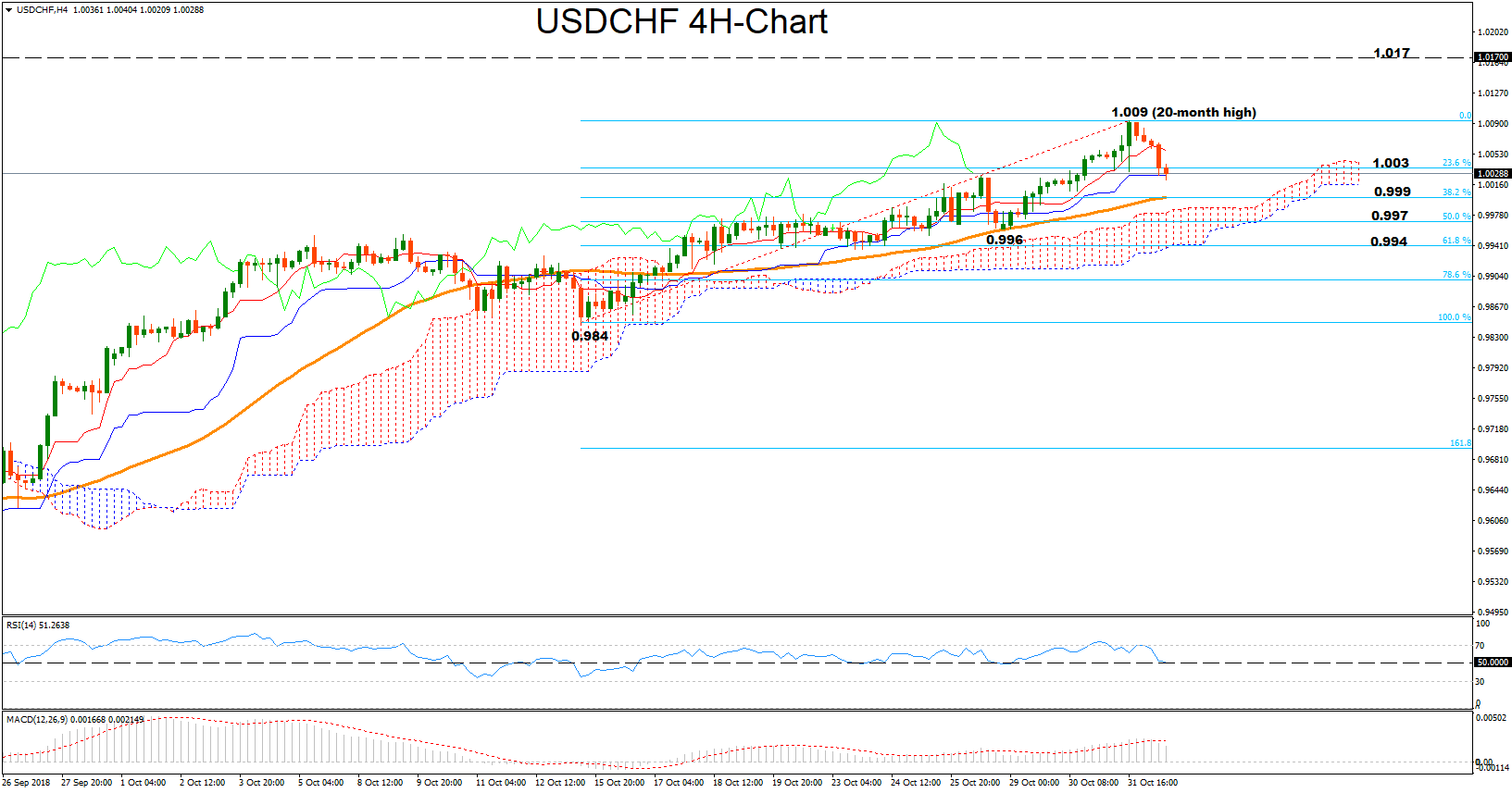
USDCHF topped at 1.009 on Wednesday, at the highest since March 2017, but with the RSI in the four-hour chart fluctuating near its 70 overbought threshold in the past couple of days, chances for a downside reversal were high and thus the price pulled back today. The indicator is currently a shy above its 50-neutral mark, signalling that the market might consolidate in the coming sessions. Yet the MACD continues to weaken below its red signal line, suggesting that weakness might persist.
Should the price head lower, immediate support could come in the crossroads of the 50-period moving average and the 38.2% Fibonacci of the upleg from 0.984 to 1.009, around 0.999. Note that the 50-period MA provided a significant support to downside movements on October 28, near 0.996 and slightly below the 50% Fibonacci. Beneath the 50% fibo, a stronger wall could be found around 0.994, which strictly restricted bearish and bullish corrections during October. A decisive close below that level would brush away any buying interest, turning the market into neutral again.
On the flip side, a rebound above the 23.6% Fibonacci of 1.003, could stretch until the 1.009 top. If this proves an easy obstacle, bullish actions may continue up to 1.017 the peak on March 2017. Even higher the door may open for the 1.024 resistance.
Canadian Dollar Moves Higher as Investor Confidence Improves
The Canadian dollar has gained ground in the Thursday session. Currently, USD/CAD is trading at 1.3092, down 0.49% on the day. On the release front, U.S, unemployment claims are expected to edge lower to 213 thousand. The ISM Manufacturing PMI is forecast to drop for a second straight month, with an estimate of 59.0 points. On Friday, traders should be prepared for volatility from USD/CAD, with key employment releases on both sides of the border.
The Canadian economy grew 0.1% in August, marking a seventh straight month of expansion. Higher oil production in Alberta and higher oil prices fueled the modest gain. The economy has been performing well and remains on track for annualized growth of 2% in 2018. Unemployment is at low levels and is expected to remain pegged at 5.9% for October. The Bank of Canada raised rates last week to 1.75%, and the hawkish message from the bank was a broad hint to the markets that further rate hikes are in store. With the economy operating close to full capacity, rate hikes are an effective method of ensuring that the economy does not overheat. The BoC is also mindful that the Federal Reserve is expected to raise rates again in December, which would mark a fourth rate hike in 2018. Policymakers do not want to see divergence widen between U.S and Canadian rates, and another rate hike from the BoC would be bullish for the Canadian dollar.
BoE maintains bank rate unchanged at 0.75%, full statement
Bank Rate maintained at 0.75%
The Bank of England's Monetary Policy Committee (MPC) sets monetary policy to meet the 2% inflation target, and in a way that helps to sustain growth and employment. At its meeting ending on 31 October 2018, the MPC voted unanimously to maintain Bank Rate at 0.75%.
The Committee voted unanimously to maintain the stock of sterling non-financial investment-grade corporate bond purchases, financed by the issuance of central bank reserves, at £10 billion. The Committee also voted unanimously to maintain the stock of UK government bond purchases, financed by the issuance of central bank reserves, at £435 billion.
The MPC's updated projections for inflation and activity are set out in the November Inflation Report. In the Committee's central projection, conditioned on the gently rising path of Bank Rate implied by market yields and on a smooth adjustment to the average of a range of possible outcomes for the United Kingdom's eventual trading relationship with the European Union, GDP is expected to grow by around 1¾% per year on average over the forecast period. Momentum in household consumption appears greater than previously expected, supported by the strong labour market and resilient household confidence. Over the forecast period, household consumption is expected to grow modestly relative to historical rates, broadly in line with real incomes. In contrast, business investment has been more subdued than previously anticipated, as the effect of Brexit uncertainty has intensified. Under the smooth transition assumption on which the forecast is conditioned, greater clarity is expected to emerge over the coming months, boosting investment growth. The MPC's projections were finalised before the Budget measures had been announced and the Committee will assess the implications at its next meeting.
The global economy continues to grow at above potential rates, supporting UK net trade. Growth has softened, however, and become more uneven across countries, and downside risks have risen. Global financial conditions have tightened, particularly in emerging market economies, and activity has slowed in the euro area. Trade restrictions have increased and there is a risk of further escalation.
The MPC judges that aggregate supply and demand are now broadly in balance. The labour market remains tight, with the employment rate and vacancies around record highs, and the unemployment rate at its lowest since the mid-1970s. Regular pay growth has been stronger than expected, rising to over 3%. Although modest by historical standards, the projected pace of UK GDP growth is slightly faster than the diminished rate of supply growth, which averages around 1½% per year. A margin of excess demand is therefore expected to build, feeding through into higher growth in domestic costs. The contribution of external cost pressures, which has accounted for above-target inflation since the beginning of 2017, is projected to ease over the forecast period. Taking these influences together, CPI inflation is projected to remain above the target for most of the forecast period, before reaching 2% by the end of the third year.
The economic outlook will depend significantly on the nature of EU withdrawal, in particular the form of new trading arrangements, the smoothness of the transition to them and the responses of households, businesses and financial markets. The implications for the appropriate path of monetary policy will depend on the balance of the effects on demand, supply and the exchange rate. The MPC judges that the monetary policy response to Brexit, whatever form it takes, will not be automatic and could be in either direction.
At this meeting the MPC judged that the current stance of monetary policy remained appropriate. The Committee also judges that, were the economy to continue to develop broadly in line with the November Inflation Report projections, an ongoing tightening of monetary policy over the forecast period would be appropriate to return inflation sustainably to the 2% target at a conventional horizon. Any future increases in Bank Rate are likely to be at a gradual pace and to a limited extent.
(BOE) Bank Rate maintained at 0.75%
The Bank of England's Monetary Policy Committee (MPC) sets monetary policy to meet the 2% inflation target, and in a way that helps to sustain growth and employment. At its meeting ending on 31 October 2018, the MPC voted unanimously to maintain Bank Rate at 0.75%.
The Committee voted unanimously to maintain the stock of sterling non-financial investment-grade corporate bond purchases, financed by the issuance of central bank reserves, at £10 billion. The Committee also voted unanimously to maintain the stock of UK government bond purchases, financed by the issuance of central bank reserves, at £435 billion.
The MPC's updated projections for inflation and activity are set out in the November Inflation Report. In the Committee's central projection, conditioned on the gently rising path of Bank Rate implied by market yields and on a smooth adjustment to the average of a range of possible outcomes for the United Kingdom's eventual trading relationship with the European Union, GDP is expected to grow by around 1¾% per year on average over the forecast period. Momentum in household consumption appears greater than previously expected, supported by the strong labour market and resilient household confidence. Over the forecast period, household consumption is expected to grow modestly relative to historical rates, broadly in line with real incomes. In contrast, business investment has been more subdued than previously anticipated, as the effect of Brexit uncertainty has intensified. Under the smooth transition assumption on which the forecast is conditioned, greater clarity is expected to emerge over the coming months, boosting investment growth. The MPC's projections were finalised before the Budget measures had been announced and the Committee will assess the implications at its next meeting.
The global economy continues to grow at above potential rates, supporting UK net trade. Growth has softened, however, and become more uneven across countries, and downside risks have risen. Global financial conditions have tightened, particularly in emerging market economies, and activity has slowed in the euro area. Trade restrictions have increased and there is a risk of further escalation.
The MPC judges that aggregate supply and demand are now broadly in balance. The labour market remains tight, with the employment rate and vacancies around record highs, and the unemployment rate at its lowest since the mid-1970s. Regular pay growth has been stronger than expected, rising to over 3%. Although modest by historical standards, the projected pace of UK GDP growth is slightly faster than the diminished rate of supply growth, which averages around 1½% per year. A margin of excess demand is therefore expected to build, feeding through into higher growth in domestic costs. The contribution of external cost pressures, which has accounted for above-target inflation since the beginning of 2017, is projected to ease over the forecast period. Taking these influences together, CPI inflation is projected to remain above the target for most of the forecast period, before reaching 2% by the end of the third year.
The economic outlook will depend significantly on the nature of EU withdrawal, in particular the form of new trading arrangements, the smoothness of the transition to them and the responses of households, businesses and financial markets. The implications for the appropriate path of monetary policy will depend on the balance of the effects on demand, supply and the exchange rate. The MPC judges that the monetary policy response to Brexit, whatever form it takes, will not be automatic and could be in either direction.
At this meeting the MPC judged that the current stance of monetary policy remained appropriate. The Committee also judges that, were the economy to continue to develop broadly in line with the November Inflation Report projections, an ongoing tightening of monetary policy over the forecast period would be appropriate to return inflation sustainably to the 2% target at a conventional horizon. Any future increases in Bank Rate are likely to be at a gradual pace and to a limited extent.
DAX Surges As Airline And Bank Stocks Jump
The DAX index has climbed sharply in the Thursday session, after posting small gains on Wednesday. Currently, the DAX is trading at 11,519, up 0.88% on the day. There are no German or eurozone events on the schedule. On Friday, Germany and the eurozone release Manufacturing PMI reports.
Higher risk appetite has boosted the DAX on Thursday, which is currently at its highest level since October 22. Deutsche Bank has jumped 3.46%, and Lufthansa has recovered from a recent downturn, surging 6.76%. The DAX has started November with gains, after a dismal October, which was marked by weak growth and confidence indicators. The DAX plunged some 6.7% in October, skidding to its lowest levels since December 2016.
There was positive news on Wednesday, as eurozone inflation is expected to head higher in October. CPI Flash Estimate ticked higher from 2.1% to 2.2% and Core CPI Flash Estimate rose to 1.1%, up from 0.9%. Both of these readings matched the forecasts. The stronger inflation numbers back up ECB President Mario Draghi’s stance that inflation in showing a “relatively vigorous pick-up”. Higher oil prices are one reason behind stronger inflation numbers. Germany, the bellwether for the rest of the eurozone, is also experiencing higher inflation, which climbed 2.4% in October. Although inflation is on the move, growth in the eurozone has softened in the third quarter. Eurozone GDP posted a weak gain of 0.2% in the third quarter, down from the 0.4% gain in the second quarter. On an annualized basis, eurozone growth slipped to 1.7% in Q3, down from 2.1% in Q2. The situation in Germany is even worse, with the German central bank forecasting zero growth in the third quarter.
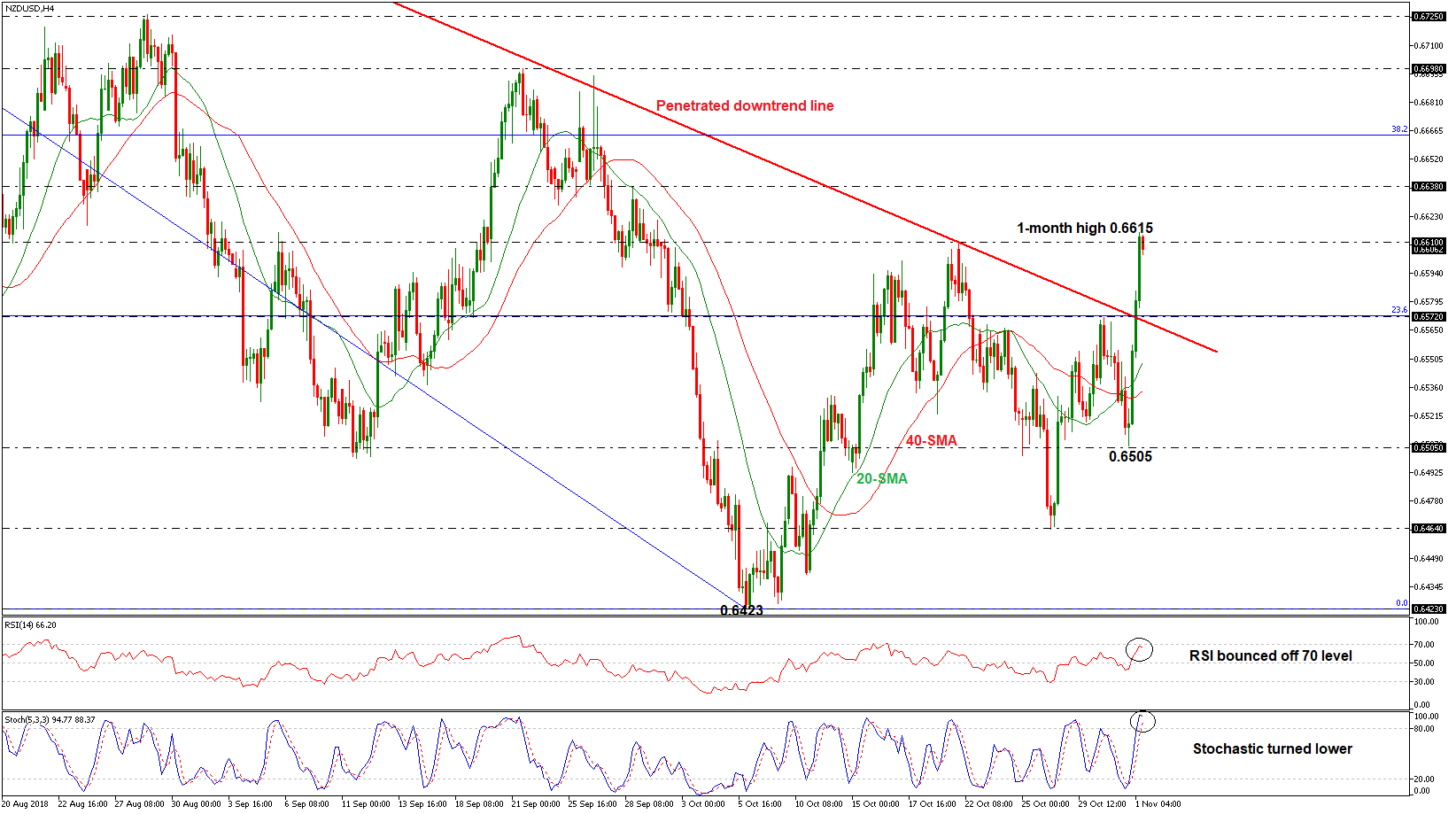
NZDUSD Eases A Bit Following Sharp Upside Rally
NZDUSD recorded a stunning rally over the last three sessions in the 4-hour chart, creating a new one-month high of 0.6615. Currently, though, the pair is on the backfoot and the technical indicators suggest that the market could ease a little bit in the short-term.
The RSI is moving marginally south after the bounce off the overbought levels, while the stochastic oscillator is showing signs for a potential retracement in price action. The Stochastics indicate that a pullback is not far off since the oscillators are in overbought levels. Still, this is more likely to happen if the blue % K line finally forms a bearish cross with the red %D line.
Should the market lose some ground after the sharp buying interest, support could be met at the 23.6% Fibonacci retracement level of the downleg from 0.7050 to 0.6423, around the 0.6572 barrier. A significant leg below this area could send prices towards the 20-simple moving average (SMA), which is currently fluctuating around 0.6550 before the market retests the 40-SMA of 0.6533. Then, if the market fails to hold above this level, the next stop could at the 0.6505 hurdle.
On the flip side, if the pair surpasses the intraday high, immediate resistance could be met at the 0.6638 barrier, taken from the high on September 28. Steeper increases could drive the price north towards the 38.2% Fibonacci region of 0.6665.
Looking at the bigger picture, NZDUSD penetrated to the upside of the medium-term descending trend line, which has been holding since June 6, changing the bearish outlook to neutral. More advances above 0.6700 could give signals for a steeper upside correction.