

Sample Category Title
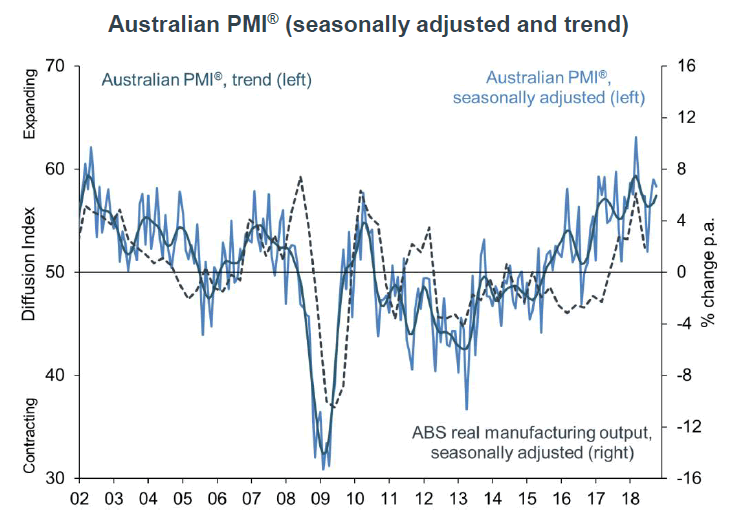
Australian manufacturing PMI dropped to 58.3, expansion to continue into 2019
Australia AiG Performance of Manufacturing index dropped to 58.3, seasonally adjusted, in October, down from 59.0. The Australian Industry Group noted in the release that the PMI now indicated twenty-five months of uninterrupted recovery and expansion, "longest run of recovery or expansion in this data series since 2005". The broad based expansion was led by the wood and paper and the food & beverages sectors. And, the details suggested that manufacturing will "continue to expand for the rest of 2018 and into 2019."
Also from Australia, trade surplus widened to AUD 3.02B in September.
SNB Jordan: Swiss among hardest hit in full-scale trade war
SNB Chair Thomas Jordan warned yesterday that Switzerland could be heavily hit if full-scale trade war broke out. He said "All countries would feel the detrimental effect of a global trade war, but small, open economies such as Switzerland would be among those hardest hit."
Additionally, the current trade tensions have already made it more difficult to conduct monetary policy. He noted, "a wave of protectionism would create a lot of uncertainty, be it with regard to the short-term development of the real economy and prices, or with regard to the longer-term macroeconomic context." And, "the risk of monetary policy mistakes would increase, at least while the economy is in the process of adapting to the changed market conditions."
Jordan also asked the question that the Swiss Franc could be "sought as a safe haven in the event of a trade war", and Swiss could "face particularly strong exposure to a severe contraction in world trade".
White House Kudlow: Additional tariffs on China not set in stone
White House economic adviser Larry Kudlow said the additonal tarrifs on China are not "set in stone right now". He added, "if some kind of amicable deal with China were to happen, then a lot of tariffs might be pulled back." Also, "The policy talks determine this, not an arbitrary timetable. If the policy talks go well, then we'll have a much better situation. If the policy talks don't, it may deteriorate."
Kudlow also said Trump mentioned in a recent interview that if there are "promising policy discussions, I don't know about a full fledged deal, but if things go well, maybe some tariffs get withdrawn and maybe not." However, Kudlow didn't specify which interview he referred to. Instead, the only know one is with Fox News Channel's "The Ingraham Angle" which Trump said he expects a "great deal" with China, without mentioning withdrawing tariffs.
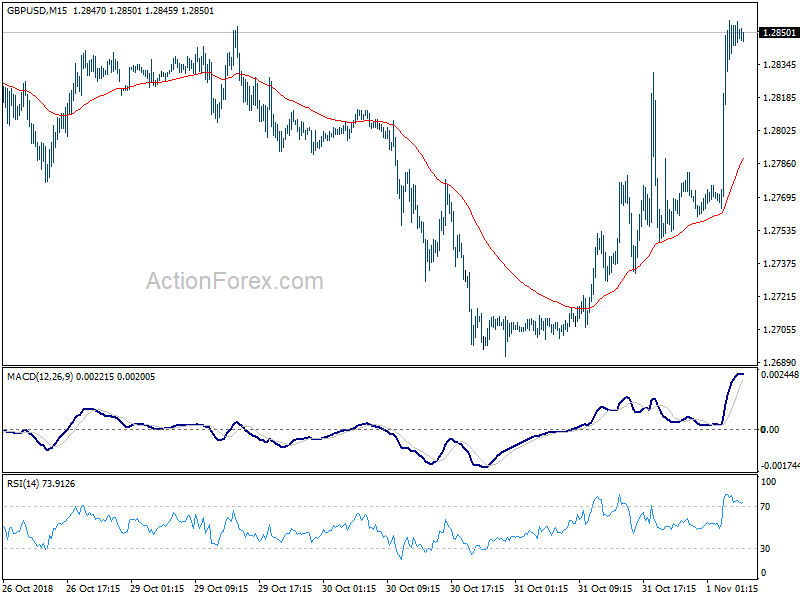
Pound rally extends as UK seals Brexit deal on financial services with EU
Pound rallies further today on more positive Brexit news. The Times reported that a tentative deal is agreed between UK and the EU on all aspects of a future partnership on services. Most importantly, that would grant access of EU markets to for British financial services companies. Prime Minister Theresa May's senior advisor Oliver Robbins is handling the negotiations in Brussels and is expected to complete it within three weeks.
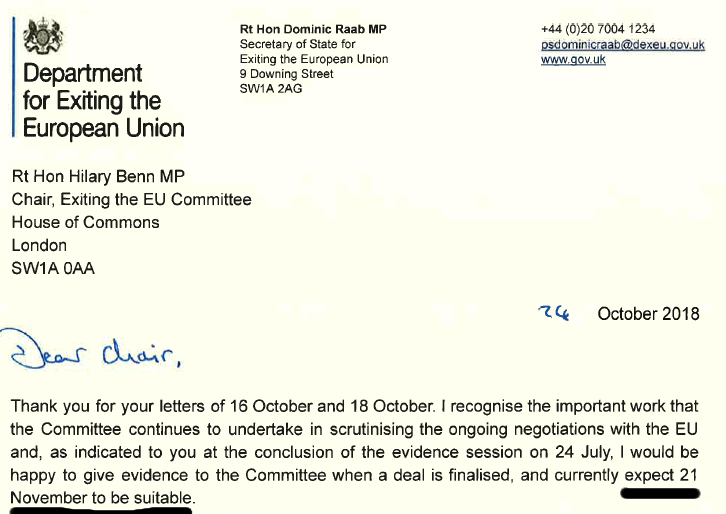
The news came on top of reports that Brexit Minister Dominic Raab told MPs in a letter dated October 24 that November 21 is the date to conclude the Brexit negotiation. The letter was published on the Commons Brexit committee yesterday. But three hours after that, Raab's office, Department for Exiting the European Union, backtracked and said there was "There is no set date for the negotiations to conclude. The 21st November was the date offered by the Chair of the Select Committee for the Secretary of State to give evidence."
Eco Data 11/1/18
[php_everywhere instance="1"]
Yen Edges Higher, BoJ Holds Course
The Japanese yen has posted slight gains in the Wednesday session, after recording losses in the past two sessions. In North American trade, USD/JPY is trading at 113.15, up 0.06% on the day. On the release front, the Bank of Japan maintained its monetary policy. Japanese Preliminary Industrial Production dropped 1.1%, its fourth decline in five months. This was a much steeper decline than the estimate of -0.3%. Housing Starts slipped 1.5%, while consumer confidence came in at 43.0 points. Both indicators fell short of their estimates. In the U.S, ADP nonfarm payrolls came in at 227 thousand, much stronger than the estimate of 188 thousand. This is the first of a host of employment releases, highlighted by wage growth and nonfarm payrolls on Friday. On Thursday, the U.S releases unemployment claims and ISM Manufacturing PMI.
As expected, there were no surprises from the Bank of Japan, which wrapped up a policy meeting on Wednesday. Policymakers voted 7-2 to maintain interest rates at -0.10% and 10-year bond yields around zero. The BoJ said that it would maintain ultra-low rates for an “extended period” and the would allow more flexibility in the movement of 10-year bonds. On the inflation front, the BoJ reiterated that inflation levels would not reach the BoJ’s target of 2$ before March 2021. The policy statement added that there were currently more downside risks to the economy than upside, due to the impact of the tariff war between the U.S and China as well as the impasse over Brexit negotiations.
Japanese retail sales in September posted a solid gain of 2.1%, matching the estimate. This was the 11th straight gain in retail sales, pointing to strong consumer spending, a key driver of economic growth. The Japanese Ministry of Economy, Trade and Industry (METI) noted that high costs for food and energy boosted retail sales. METI upgraded its assessment, saying that retail sales were improving “gradually”. At the same time, the export-reliant Japanese economy is very vulnerable to the fall-out from the global trade war, and the threat by President Trump to impose tariffs on all Chinese goods could spell more headwinds for the Japanese yen.
Mid-US update: Sterling jumps on Brexit optimism, but Dollar strength more convincing
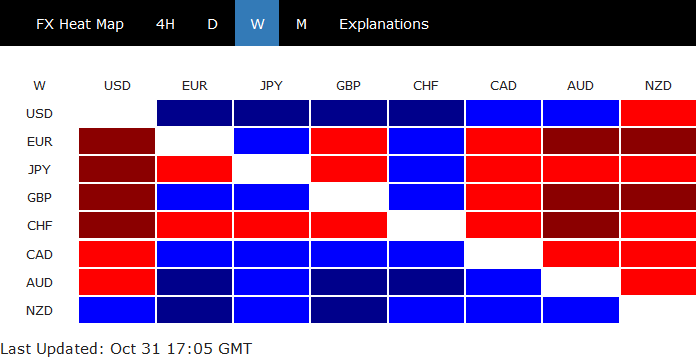
Sterling is trading as the strongest major currency for today as boosted by Brexit optimism. It's revealed that Brexit Minister Dominic Raab has told MPs November 21 is the date to close the deal with EU. It's unsure how certain Raab was but the Pound is lifted anyway. Though, we'd like to emphasize that firstly, Pound's strength is most apparent against Euro and Swiss Franc only. And it's actually staying mixed for the week. Sterling's rebound could also be due to repositioning ahead of BoE Super Thursday tomorrow.
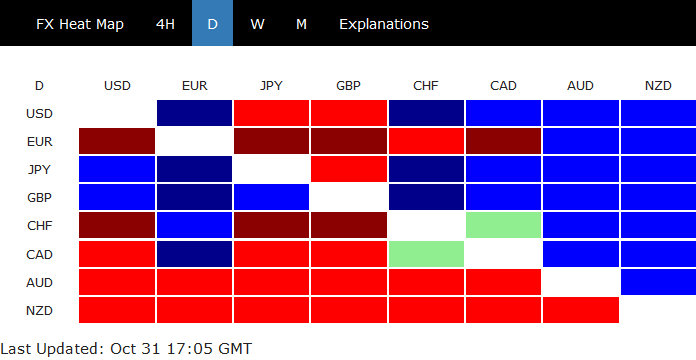
On the other hand, Dollar appears to be doing rather well after stronger than expected ADP employment report. USD/CHF's break of 1.0067 key resistance is a solid sign of strength. EUR/USD is going to test 1.1300 key support. USD/CAD could also be extending recent rally. Yen also jumps broadly today despite strong stock markets rebound. That could at least be partly attributed to the rebound in JGB yields. On the other hand, commodity currencies are generally pressured.
In European markets:
- FTSE closed up 1.31% at 7128.10
- DAX closed up 1.42% at 11447.51
- CAC closed up 2.31% at 5093.44, reclaimed 5000 handle.
- German 10 year yield rose 0.0185 to 0.388, staying below 0.40.
- Italian 10 year yield dropped -0.0398 to 3.432. German Italian spread remains above 300. It's a reason for Euro's sluggishness
In the US, at the time of writing:
- DOW is up 1.43%
- S&P 500 up 1.58%
- NASDAQ up 2.38%
- 10 year yield up 0.034 at 3.144
Sterling surges further as Raab told MPs Nov 21 is the date for Brexit deal
Sterling's rally extends in further in US session. And it's appears to be boosted by news that Brexit deal is less than a month away. Brexit Minister Dominic Raab told MPs in a letter dated October 24 that November 21 is the date to conclude the deal. It's published on the Commons Brexit committee this morning.
The key sentence in the letter is: "I would be happy to give evidence to the committee when a deal is finalized, and currently expect 21 November to be suitable." Also, "The end is now firmly in sight and, while obstacles remain, it cannot be beyond us to navigate them. We have resolved most of the issues and we are building up together what the future relationship should look like and making real progress."
The Natural Unemployment Rate and Fed Policy
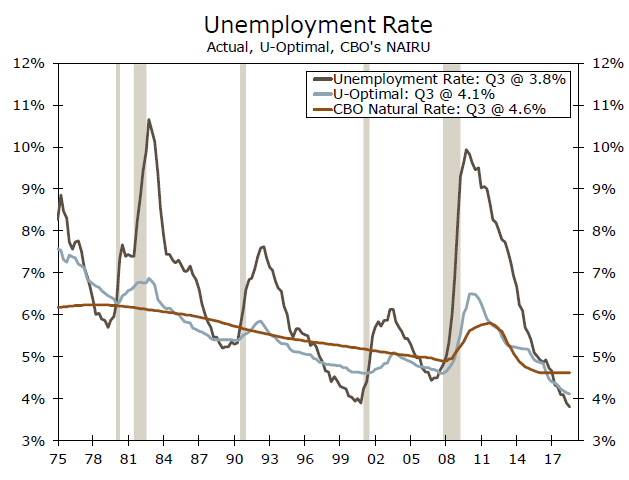
We estimate that the actual unemployment rate is still within our estimated range of the natural unemployment rate. The Fed will probably continue to tighten, although it can do so at a gradual pace.
The Natural Unemployment Rate Continues to Move Lower
In a recent report that is intended for technically inclined readers, we presented a methodology to estimate the natural rate of unemployment, which analysts refer to as the non-accelerating inflation rate of unemployment (NAIRU) or u* (u-star). This non-technical report discusses some implications of that previous report.
Our estimate of the natural unemployment rate, which we call "u-optimal," is shown in the top chart. We find that u-optimal has generally trended lower over the past forty years, although it does tend to edge higher when the economy enters recession. We estimate that u-optimal currently stands at 4.1%, which is a bit above the 3.8% unemployment rate averaged during Q3-2018. But our estimate of the natural unemployment rate is below the 4.6% estimate of the Congressional Budget Office (CBO).
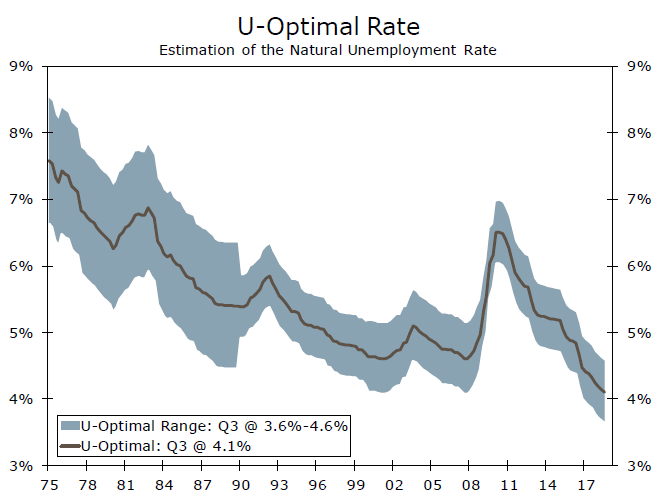
We would caution readers against putting undue weight on a precise estimate of the natural rate of unemployment because it is not directly observable and must be estimated from other economic variables. Rather, one should think about the natural rate in terms of a range. In that regard, we estimate that the natural rate of unemployment is currently in a range of 3.6% to 4.6% (middle chart).
Although a discussion of an unobservable natural rate of unemployment may seem a bit academic, there are some implications that stem from the estimated range of this rate. First, because the actual unemployment rate (3.7%) is still within our estimated range, the Fed likely can continue to raise rates at a gradual pace (i.e., 25 bps at every other FOMC meeting). If the actual unemployment rate were below the bottom end of our range, then the Fed may find it necessary to undertake a more aggressive pace of rate hikes. But because the actual unemployment rate is near the bottom of our estimated range, the Fed probably has a few more rate hikes to go. Why?
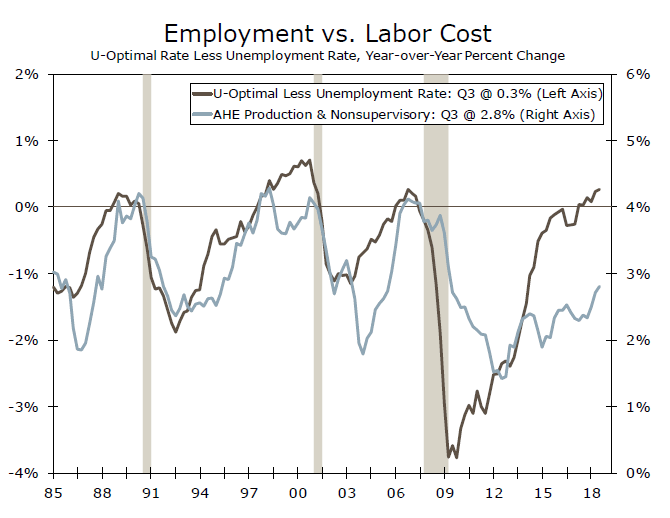
In the bottom chart we plot the year-over-year change in average hourly earnings (AHE), which is a measure of wage inflation, versus the difference between u-optimal and the actual unemployment rate, which measures slack in the labor market. A rise in the actual unemployment rate relative to u-optimal (i.e., an increase in labor market slack) has historically been associated with a drop in wage inflation. Conversely, a reduction in labor market slack (a narrowing in the gap between u-optimal and the actual unemployment rate) has historically been associated with rising wage inflation.
The gap between u-optimal and the actual unemployment rate has narrowed significantly in recent years. Although wage growth has trended higher in recent years, it is still well short of rates that prevailed at this point in previous cycles. Therefore, there is the risk that limited slack in the labor market could lead to further wage acceleration going forward, which could cause inflation rates to move markedly above the Fed's target of 2%.
Sunset Market Commentary
Markets:
Global core bond lost ground today with US Treasuries underperforming German Bunds. A classic risk-on sentiment ruled trading, with Chinese equity gains spilling over to European equity markets. At time of writing, major EU indices gains range from 1% to 2.5% with the CAC40 outperforming. German Bunds are able to limit the loss despite the obvious improvement in risk sentiment. End of month extension buying might be at play. EMU inflation data was spot on and had little to no influence on trading. German Bunds are currently hovering slightly below yesterday’s closing levels. US equities opened with gains exceeding 1%. US Treasuries are, in contrast to Bunds, not capable of holding ground and edge substantially lower throughout the day. A stronger than expected ADP employment report might have helped. The private sector hired 227k new employees, while an increase of only 187k is expected. Investors are already eyeing Friday’s US payrolls. The US yield curve edged higher today with the belly of the curve underperforming the wings. Changes range from +2.4 bps (2-yr) to +3.5 bps (10-yr). The German yield curve behaves in a similar manner with changes from +0.8 bps (2-yr) to +1.9 bps (10-yr). Peripheral bond spreads over Germany narrow with Italy (-9 bps), Greece (-4 bps) and Spain (-3 bps) outperforming.
King dollar extends its reign over FX markets despite a >1.5% surge on US stock markets. The trade-weighted dollar bumped into 97-resistance and eventually cleared the hurdle after a strong US ADP employment report added evidence to US labour market strength. US employment costs also rose more than forecasted in Q3 (0.8% Q/Q from 0.6% Q/Q). More and more anecdotic evidence suggests that US (wage) inflation is set to rise further, forcing the Fed into a more aggressive rate hike cycle than markets currently anticipate. The US/German 2-yr yield spread tests the 350 bps cycle high. EUR/USD dropped from the 1.1350 area towards the low 1.13 region. A test of EUR/USD 1.1301 (2018 low) is in the cards. Key support kicks in at 1.1187 (62% retracement from 2017-2018 rally). Tomorrow’s US manufacturing ISM and Friday’s payrolls could play a determining role. Headline (2.2% Y/Y from 2.1% Y/Y) and core EMU inflation (1.1% Y/Y from 0.9% Y/Y) increased as expected, but didn’t bring reprieve for the single currency. Is this the start of ECB President Draghi’s predicted vigorous pick-up in underlying inflation? USD/JPY changes hands above 113. Sterling reverses yesterday’s remarkable decline, shrugging off S&P warning that chances of a no-deal brexit have increased and could spark a long recession and rating downgrade. EUR/GBP currently trades around 0.8870, from a 0.8929 opening. The queen’s money even has the upper hand over the dollar today, with GBP/USD ending the recent losing strike and rising from 1.2706 to 1.2770. Sterling investors’ next appointment is tomorrow’s Bank of England meeting, including a new inflation report and a press conference by governor Carney.
News Headlines:
According to the ADP employment report of October, 227k new employees were added to an already hot US labour market. It beats market expectations of 187k and is little shy of September’s 230k. The increase in hiring was led by large-sized companies, adding 102k jobs. The Chicago PMI dropped more than forecast in October, from 60.4 to 58.4, while consensus expected a 60.0 outcome.
ECB governors Hansson and Nowotny said that recent disappointing EMU eco data don’t fundamentally alter the ECB’s growth/inflation forecasts yet. This message is in line ECB Draghi at last week’s press conference. The chairman indicated that the EMU economy lost momentum, but that it didn’t enter a downturn. ECB governors therefore argue to move ahead with the ECB’s normalization process as plotted out in June.