

Sample Category Title
EUR/USD Mid-Day Outlook
Daily Pivots: (S1) 1.1328; (P) 1.1358; (R1) 1.1375; More....
EUR/USD's break of 1.1335 suggests resumption of fall from 1.1814. Intraday bias is back on the downside for 1.1300 key support level. Decisive break there will resume whole down trend from 1.2555 and target 1.1186 fibonacci level next. On the upside, however, break of 1.1421 resistance will indicate short term bottoming, with bullish convergence condition in 4 hour MACD. Intraday bias will be turned back to the upside for 1.1621 resistance instead.
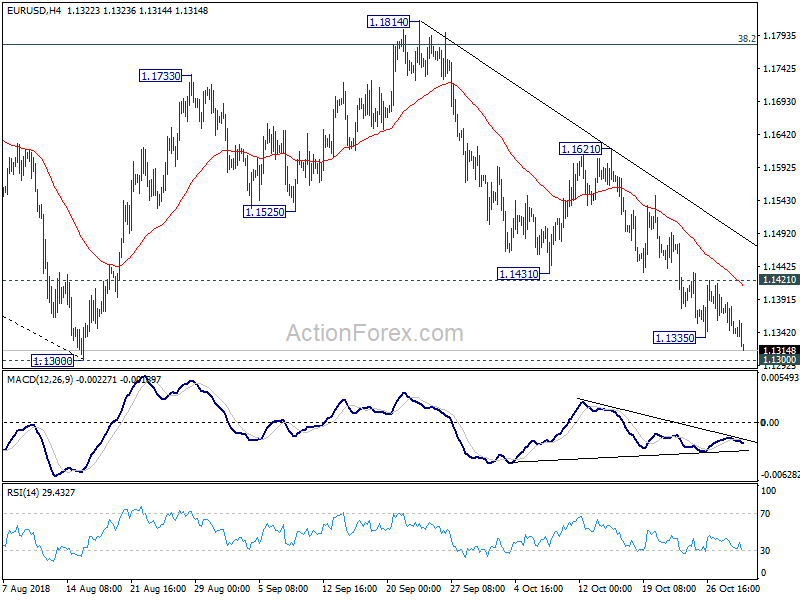
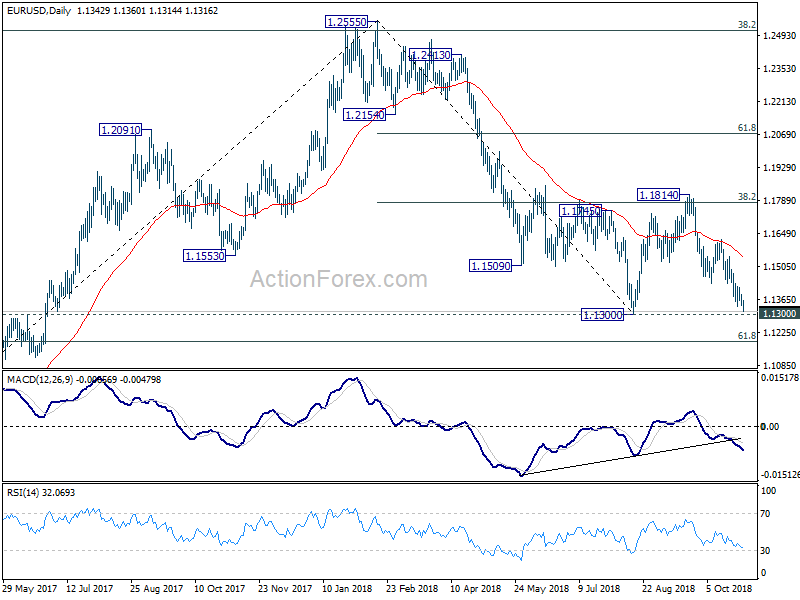
In the bigger picture, corrective pattern from 1.1300 could have completed at 1.1814 after hitting 38.2% retracement of 1.2555 to 1.1300 at 1.1779. Decisive break of 1.1300 will resume the down trend from 1.2555 to 61.8% retracement of 1.0339 (2017 low) to 1.2555 at 1.1186 next. Sustained break there will pave the way to retest 1.0339. On the upside, break of 1.1814 will delay the bearish case and extend the correction from 1.1300 with another rise before completion.
Dollar Lifted by Strong ADP Employment, EUR/USD to Take on 1.13 Key Support
Dollar is trading broadly higher today. In particular, new buying emerges after stronger than expected ADP employment report. USD/CHF breaches 1.0067 key resistance. Meanwhile, EUR/USD is also closing in on 1.1300 key support. Nonetheless, Dollar is overwhelmed by Sterling, which is the strongest one today. There is practically no special news regarding the Pound. However, as it's rather oversold, traders could be lightening up their position ahead of tomorrow's BoE Super Thursday. Euro receives little support from inflation data, which showed acceleration in October. Meanwhile, commodity currencies are the weakest ones.
Technically, first focus will be on whether USD/CHF can sustain above 1.0067. If that happens, next target will be key resistance level at 1.0342. Similar, EUR/USD will be watched on whether it could break through 1.1300 key support decisively to resume the medium term down trend from 1.2555. GBP/USD's recovery is just a recovery for now. Near term outlook stays bearish as long as 1.2921 resistance holds, and 1.2661 low should at least be tested.
In other markets, major European stock indices are trading in black at the time of writing. FTSE is up 1.7%, DAX up 1.32% and CAC is up 2.21%. German 10 year yield is up 0.0164 at 0.386. Italian 10 year yield is down -0.063 at 3.408. German-Italian spread is still larger than 300. Major Asian indices also closed higher. Nikkei rose 2.16%, Hong Kong HSI rose 1.60%, China SSE rose 1.35%, Singapore Strait Times rose 1.76%. Japan 10 year JGB yield closed up 0.0081 at 0.13. Gold dips notably today and is now pressing 1215. Overall, there are signs of improvements in sentiments.
US ADP employment grew 227k, significant gains across all industries
US ADP report showed private sector employment grew 227k in October, higher than expectation of 190k. ADP vice president Ahu Yildirmaz noted in the release that there were "significant gains across all industries with trade and leisure and hospitality leading the way". Also, "larger employers benefit in this environment as they are more apt to provide the competitive wages and strong benefits employees desire."
Moody's Analytics chief economist Mark Zandi said "The job market bounced back strongly last month despite being hit by back-to-back hurricanes. Testimonial to the robust employment picture is the broad-based gains in jobs across industries. The only blemish is the struggles small businesses are having filling open job positions."
Also from US, employment cost index rose 0.8% in Q3.
Canada GDP grew 0.1%, oil and gas extraction, finance, insurance led
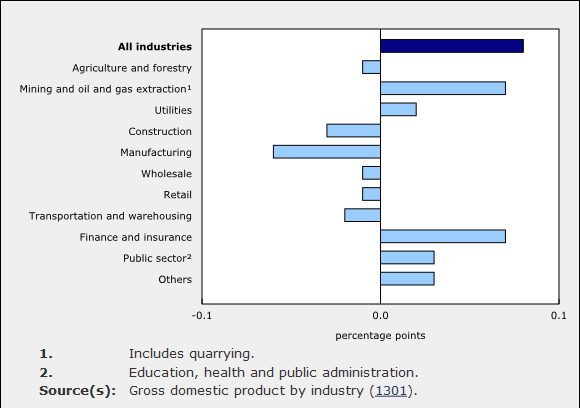
Canada GDP grew 0.1% mom in August, above expectation of 0.0% mom. 12 of 20 industrial sectors declined. But the con centred growth in oil and gas extraction and finance and insurance, was more than enough to offset. In the main industries, mining and oil and gas extraction grew 0.07%, utilities grew 0.02%, finance and concentrated grew 0.07%, public sector grew 0.03%. Manufacturing suffered most by dropped -0.06%.
Also from Canada, IPPI rose 0.1% mom, RMPI dropped -0.9% mom in September.
Eurozone CPI accelerated to 2.2%, core up to 1.1%, unemployment rate unchanged at 8.1%
Eurozone CPI accelerated to 2.2% yoy in October, up from 2.1% yoy and matched expectations. Core CPI accelerated to 1.1% yoy, up from 0.9% yoy and beat expectation of 1.0% yoy. Among the components, energy jumped 10.6% yoy (accelerated from 9.5%). Food, alcohol & tobacco rose 2.2% yoy (slowed from 2.6%). Services rose 1.5% yoy (accelerated from 1.3%). Non-energy industrial goods rose 0.3% yoy (up from 0.3%).
Eurozone (EA19) unemployment rate was unchanged at 8.1% in September, matched expectations, staying as the lowest since November 2008. EU28 unemployment rate was unchanged at 6.7%, lowest since January 2000. Among EU member states, lowest unemployment rate is found in Czechia at 2.3%, then Germany and Poland at 3.4%. Highest unemployment rate is observed in Greece at 19.0%, then Spain at 14.9% and then Italy at 10.1%.
ECB official talk down Q3 GDP slowdown
ECB Governing Council member Ardo Hansson urged not to read too much in to the weaker than expected Q3 GDP figure (0.2% qoq released yesterday). He said, "these were preliminary numbers, maybe they were a bit slower than some expected." And, "we have to wait and see what was behind this." Also, he said "as there have been no significant, material change in one way or the other I would not make major conclusions" regarding monetary policy or economic outlook. He also emphasized the need to look at ECB's own staff projections to be updated in December instead.
Another Governing Council member Olli Rehn said "after a decade of exceptional measures, prospects for returning to a more conventional interest rate environment and a more normal Eurosystem balance sheet have slowly strengthened." Ewald Nowotny also said the slow down was due to temporary factors like German auto industry only.
BoJ stands pat, lowers inflation forecasts once again
BoJ left monetary policy unchanged today as widely expected, by 7-2 vote again. Short term policy interest rate is held at -0.1%. On long term interest rate, BoJ will continue with asset purchases to keep 10 year JGB yield at around 0%. G. Kataoka dissented again, pushing for more monetary easing due to "heightening uncertainties regarding development in economic activity and prices". Y. Harada dissented because "allowing the long-term yields to move upward and downward to some extent was too ambiguous".
In the Outlook for Economic Activity and Prices report, BoJ noted that the economy is likely to continue to grow above potential in fiscal 2018. For fiscal 2019 and 2020, the economy is expected to continue on an "expanding trend", partly supported by "external demand". But growth is projected to decelerate due to a "cyclical slowdown" in business fixed investments and the scheduled sales tax hike.
CPI continued to show "relatively weak developments" comparing to growth and labor market. Though, BoJ maintained that "further price rises are likely to be observed widely and then medium- to long-term inflation expectations are projected to rise gradually". Thus, CPI will gradually increase towards 2% target. On risks, BoJ said both economic and prices risks are "skewed to the downside".
In the updated economic projects, fiscal 2018 growth forecast was downgraded from 1.5% to 1.4%. Growth forecasts for 2018 and 2019 were kept unchanged at 0.8%. Fiscal 2018 core CPI projection was lowered notably to 0.9%, down from 1.1%. For fiscal 2019 and 2020, ex-sales-tax-hike core CPI projections were also lowered, to 1.4% and 1.5%, down from 1.5% and 1.6% respectively. Also, note that the ex-sales-tax-hike core CPI projections are notably lower than April's forecasts, at 1.8% in fiscal 2019 and fiscal 2020 respectively.
Also from Japan, consumer confidence dropped to 43 in October. Housing starts dropped -1.5% yoy in September. Industrial production dropped -1.1% mom.
Australia CPI slowed to 1.9% yoy in Q3
Australia CPI rose 0.4% qoq, 1.9% yoy in Q3, versus expectation of 0.5% qoq, 1.9% yoy. The annual rate slowed quite notably from 2.1% yoy. Trimmed mean CPI was unchanged at 1.8% yoy. Weighted median CPI was also unchanged at 1.7% yoy.
Chief Economist for the ABS, Bruce Hockman said: "Annual growth in the CPI fell back below 2 per cent in the September quarter 2018. Modest rises in housing costs, including rents, utilities and property rates, and a fall in child care out-of-pocket expenses, saw a subdued rise in the CPI this quarter."
New Zealand ANZ business confidence rose to -37.1, next RBNZ move more likely a cut
New Zealand ANZ Business Confidence improved to -37.1 in October, up from -38.3. Confidence is weakest in agriculture (-62.8) and best in construction (-14.8). Activity Outlook index dropped -0.4 to 7.4. Manufacturing (16.2) is the strongest, possibly due to lower New Zealand Dollar exchange rate. Services ranks second (12.6). Retail (-7.8) and agriculture (-2.3) are weakest.
On monetary policy, ANZ noted that "The Reserve Bank argued in the August Monetary Policy Statement that ticking along wasn't going to do the job, in terms of getting CPI inflation sustainably back to target. We therefore continue to believe that while the impacts of higher wage growth, higher oil prices, and the weaker currency certainly mean there's no hurry, it remains the case that an eventual OCR cut is more likely than a hike.
Also from New Zealand, building permits dropped -1.5% mom in September.
EUR/USD Mid-Day Outlook
Daily Pivots: (S1) 1.1328; (P) 1.1358; (R1) 1.1375; More....
EUR/USD's break of 1.1335 suggests resumption of fall from 1.1814. Intraday bias is back on the downside for 1.1300 key support level. Decisive break there will resume whole down trend from 1.2555 and target 1.1186 fibonacci level next. On the upside, however, break of 1.1421 resistance will indicate short term bottoming, with bullish convergence condition in 4 hour MACD. Intraday bias will be turned back to the upside for 1.1621 resistance instead.
In the bigger picture, corrective pattern from 1.1300 could have completed at 1.1814 after hitting 38.2% retracement of 1.2555 to 1.1300 at 1.1779. Decisive break of 1.1300 will resume the down trend from 1.2555 to 61.8% retracement of 1.0339 (2017 low) to 1.2555 at 1.1186 next. Sustained break there will pave the way to retest 1.0339. On the upside, break of 1.1814 will delay the bearish case and extend the correction from 1.1300 with another rise before completion.
Economic Indicators Update
| GMT | Ccy | Events | Actual | Forecast | Previous | Revised |
|---|---|---|---|---|---|---|
| 21:45 | NZD | Building Permits M/M Sep | -1.50% | 7.80% | 6.80% | |
| 23:50 | JPY | Industrial Production M/M Sep P | -1.10% | -0.20% | 0.20% | |
| 00:00 | NZD | ANZ Business Confidence Oct | -37.1 | -38.3 | ||
| 00:01 | GBP | GfK Consumer Confidence Oct | -10 | -10 | -9 | |
| 00:01 | GBP | BRC Shop Price Index Y/Y Oct | -0.20% | 0.20% | ||
| 00:30 | AUD | CPI Q/Q Q3 | 0.40% | 0.50% | 0.40% | |
| 00:30 | AUD | CPI Y/Y Q3 | 1.90% | 1.90% | 2.10% | |
| 00:30 | AUD | CPI RBA Trimmed Mean Q/Q Q3 | 0.40% | 0.40% | 0.50% | 0.40% |
| 00:30 | AUD | CPI RBA Trimmed Mean Y/Y Q3 | 1.80% | 1.90% | 1.90% | 1.80% |
| 00:30 | AUD | CPI RBA Weighted Median Q/Q Q3 | 0.30% | 0.40% | 0.50% | 0.40% |
| 00:30 | AUD | CPI RBA Weighted Median Y/Y Q3 | 1.70% | 1.90% | 1.90% | 1.70% |
| 01:00 | CNY | Manufacturing PMI Oct | 50.2 | 50.6 | 50.8 | |
| 01:00 | CNY | Non-manufacturing PMI Oct | 53.9 | 54.9 | 54.9 | |
| 03:08 | JPY | BOJ Rate Decision | -0.10% | -0.10% | -0.10% | |
| 05:00 | JPY | Consumer Confidence Index Oct | 43 | 43.5 | 43.4 | |
| 05:00 | JPY | Housing Starts Y/Y Sep | -1.50% | -0.50% | 1.60% | |
| 10:00 | EUR | Eurozone Unemployment Rate Sep | 8.10% | 8.10% | 8.10% | |
| 10:00 | EUR | Eurozone CPI Core Y/Y Oct A | 1.10% | 1.00% | 0.90% | |
| 10:00 | EUR | Eurozone CPI Estimate Y/Y Oct | 2.20% | 2.20% | 2.10% | |
| 12:15 | USD | ADP Employment Change Oct | 227K | 190K | 230K | 218K |
| 12:30 | CAD | Industrial Product Price M/M Sep | 0.10% | 0.00% | -0.50% | |
| 12:30 | CAD | Raw Materials Price Index M/M Sep | -0.90% | -0.50% | -4.60% | |
| 12:30 | CAD | GDP M/M Aug | 0.10% | 0.00% | 0.20% | |
| 12:30 | CAD | GDP Y/Y Aug | 2.50% | 2.40% | 2.40% | |
| 12:30 | USD | Employment Cost Index Q3 | 0.80% | 0.80% | 0.60% | |
| 13:45 | USD | Chicago PMI Oct | 60.5 | 60.4 | ||
| 14:30 | USD | Crude Oil Inventories | 6.3M |
Canada GDP grew 0.1%, oil and gas extraction, finance, insurance led
Canada GDP grew 0.1% mom in August, above expectation of 0.0% mom. 12 of 20 industrial sectors declined. But the concentred growth in oil and gas extraction and finance and insurance, was more than enough to offset. In the main industries, mining and oil and gas extraction grew 0.07%, utilities grew 0.02%, finance and concentrated grew 0.07%, public sector grew 0.03%. Manufacturing suffered most by dropped -0.06%.
US ADP employment grew 227k, significant gains across all industries
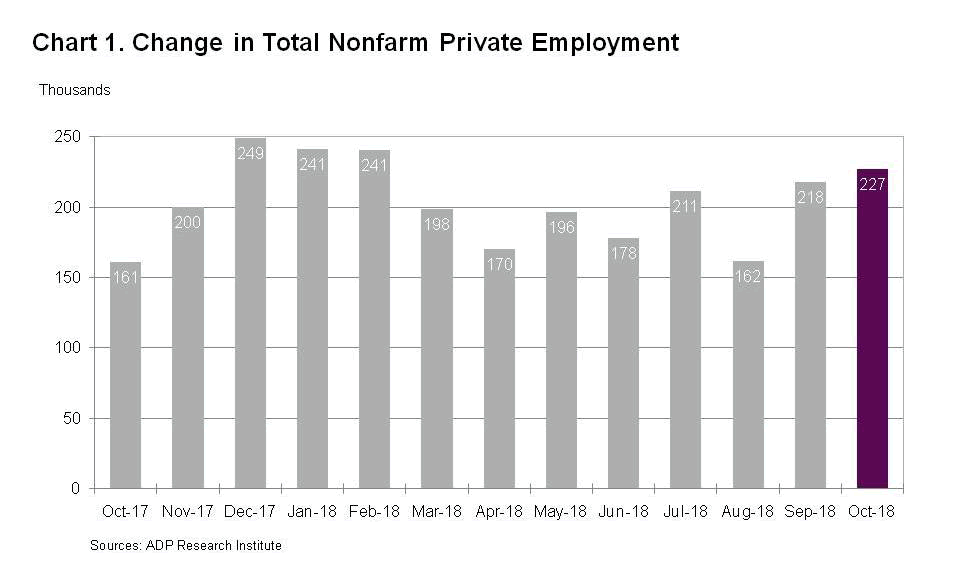
US ADP report showed private sector employment grew 227k in October, higher than expectation of 190k. ADP vice president Ahu Yildirmaz noted in the release that there were "significant gains across all industries with trade and leisure and hospitality leading the way". Also, "larger employers benefit in this environment as they are more apt to provide the competitive wages and strong benefits employees desire."
Moody's Analytics chief economist Mark Zandi said "The job market bounced back strongly last month despite being hit by back-to-back hurricanes. Testimonial to the robust employment picture is the broad-based gains in jobs across industries. The only blemish is the struggles small businesses are having filling open job positions."
Canadian Dollar Ticks Lower ahead of GDP
The Canadian dollar has posted small losses in the Wednesday session. Currently, USD/CAD is trading at 1.3126, up 0.12% on the day. On the release front, Canada’s GDP is expected to slip to a flat 0.0% and Bank of Canada Governor Stephen Poloz continues his testimony on Parliament Hill. In the U.S, ADP nonfarm payrolls is expected to drop sharply to 188 thousand. The indicator kicks off a host of employment releases, highlighted by wage growth and nonfarm payrolls on Friday.
A black October for the stock markets has badly shaken investor confidence, which has translated into softer demand for minor currencies like the Canadian dollar. The currency has slipped 1.73% in October, despite a Bank of Canada rate hike last week. At the forefront of geopolitical tensions is the trade war between the U.S and its major partners, particularly with China. Tensions between the world’s two largest economies show no signs of easing, and the Trump administration continues to threaten further severe tariffs on China. The U.S has also imposed steel tariffs on its two neighbors, Canada and Mexico. On Monday, Mexico’s deputy commerce minister said that Mexico would not sign the new USMCA pact, which replaces NAFTA, unless the U.S agreed to remove the tariffs against Mexico and Canada. We’ll get a look at Canadian GDP for August on Wednesday, which could be a market-mover. The economy expanded 0.2% in July, and the markets will be hoping for a stronger gain on Wednesday.
Copper Outlook: Bears Hit Six-Week Low on Negative Fundamentals
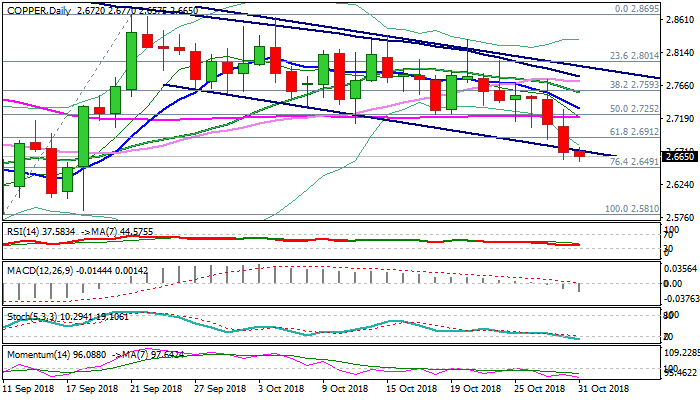
Copper fell to new six-week low at $2.6575 on Wednesday in extension of strong fall in past two days. The metal price was down nearly 3% on Mon/Tue's bearish acceleration, sparked by fresh fears of escalation of US/China trade war as China is the biggest consumer. Weaker than expected China's PMI data, released earlier today (Oct Manufacturing PMI 50.2 vs 50.6 f/c and Non-Manufacturing Oct 53.9 vs 54.9 f/c), showed that manufacturing sector grew at the slowest pace since mid-2016, signaling further slowing in the China's economy and diminishing the outlook for metal's demand. Tuesday's break and close below pivotal supports at $2.6912 (Fibo 61.8% of $2.5810/$2.8695) and $2.6745 (bear-channel support line) generated bearish signals for extension of bear-trend from $2.8695 (21 Sep high). Daily tech in strong bearish setup add to negative outlook, as bears pressure Fibo support at $2.6491 (76.4%) break of which would open way towards $2.6051 (200WMA) and higher base at $2.58 zone. Broken channel support line and Fibo level ($2.6724/$2.6912) mark initial resistances, with broken sideways-moving 55SMA ($2.7227) expected to cap stronger corrective upticks.
Res: 2.6724; 2.6912; 2.7227; 2.7338
Sup: 2.6575; 2.6491; 2.6051; 2.5875
Into US session: Sterling strikes back, Dollar firm after ADP
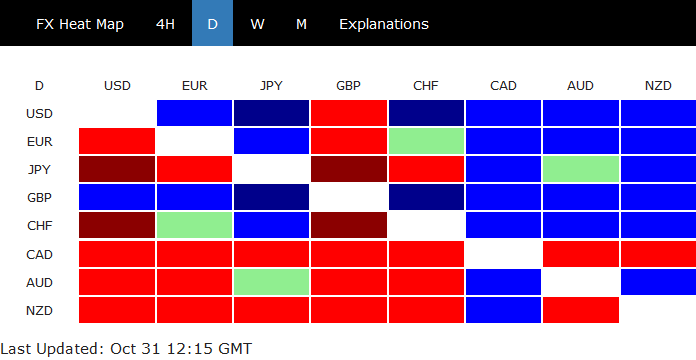
Entering into US session, Sterling is the strongest one for today, striking a come back. Dollar is also firm even though there is no new buying after stronger than expected ADP employment yet. Swiss Franc is the third strongest one. Commodity currencies' fortune reversed with Canadian Dollar leading the way down. Though, the Loonie might try to draw some support from GDP data.
In other markets, major European indices are all trading in black:
- FTSE is up 1.35%
- DAX is up 1.18%
- CAC is up 2.02%
- German 10 year yield is up 0.019 at 0.389
- Italian 10 year yield is down -0.043 at 3.429. That is, spread is still above 300
Earlier in Asia:
-
- Nikkei closed up 2.16% at 21920.46
- Hong Kong HSI rose 1.6% to 24979.69
- China Shanghai SSE rose 1.35% to 2602.78, back above 2600
- Singapore Strati Times rose 1.76% to 3018.8, back above 3000
Euro Slips To 2 ½-Month Lows Despite Encouraging Inflation Signs, Stocks Bounce Higher
Here are the latest developments in global markets:
FOREX: Euro/dollar printed a 2 ½-month low at 1.1330 on Wednesday despite eurozone’s flash core inflation inching up to 1.3% y/y in October from 1.2% expected and 1.1% seen in September. The headline inflation remained unchanged at 2.2% y/y, at the strongest since 2012 but buying interest was subdued as concerns over the budget battle between Italy and the eurozone as well as uncertainty about how political conditions will evolve in Germany after Chancellor Merkel leaves the office in 2021 shifted funds out of the market. Meanwhile, the ECB member Ewald Nowotny said that the central bank could revise economic forecasts slightly to the downside at the December meeting, adding some pressure to the common currency. In the UK, pound/dollar was slowly recovering Tuesday’s losses triggered after the ratings agency S&P said that a no-deal Brexit could dip the country into recession for more than a year. The pair was last seen at 1.2741 (+0.30%), not far above the 2 ½ -month low of 1.2692 tracked yesterday. Dollar/yen flattened around 113.14 after hitting a 3-week high at 113.32 early today, while the dollar index also moved sideways around 97. US 10-year government bond yields climbed as high as 3.15%, the highest in a week. In antipodean currencies, aussie/dollar weakened to 0.7094 (-0.15%) as Australian Q3 inflation figures eased in line with forecasts but Chinese NBS manufacturing PMIs slowed more than forecasts suggested. Kiwi/dollar was on the back foot as well, losing 0.20%. In emerging markets, People’s Bank of China set its official yuan midpoint at a a new decade low, while informing that it will issue a 20 billion yuan of bills out of Hong Kong, the bisggest offshore yuan centre.
STOCKS: Upbeat earnings releases drove European stocks overwhelmingly higher at 0830 GMT. The pan-European STOXX 600 and the blue-chip Euro STOXX 50 were up by 1.49% and 1.59% respectively, though they both poised for a strong monthly loss. The German DAX 30 rose by 1.40%, the British FTSE 100 and the Spanish IBEX 35 were gaining 1.52%, while the Italian FTSE MIB was increasing by 0.79%. The French CAC 40 overperformed its peers, jumping by 2.0% after the cosmetics Loreal French company and the French pharmaceutical firm Sanofi unveiled upbeat profit results. The banking sector was also a positive spot. In Asia, stocks closed in the green, with Japanese equities performing the best. In the US, futures tracking S&P 500, Dow Jones and Nasdaq 100 were holding moderate gains.
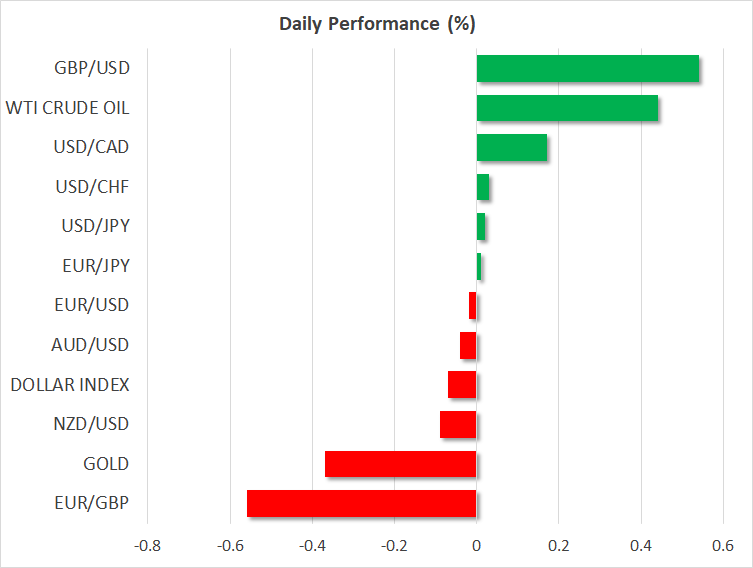
COMMODITIES: Crude prices managed to recoup yesterday’s losses as the focus turned to Iran which is set to face a second round of US sanctions on November 4. Although the API weekly oil report showed a stronger build-up in US inventories and data indicated early this month that production in Russia, Saudi Arabia and the US are near record highs, WTI crude found the opportunity to climb by 0.54% to $66.54/barrel today. The London-based Brent also advanced, crawling up by 0.71% to $76.45/barrel. The recovery in stock markets provided support to the market as well. In precious metals, gold extended losses towards $1216/ounce (-0.48%) increasing speculation that a peak at $1243 has been reached.
Day Ahead: All eyes on US ADP employment report and Canadian GDP
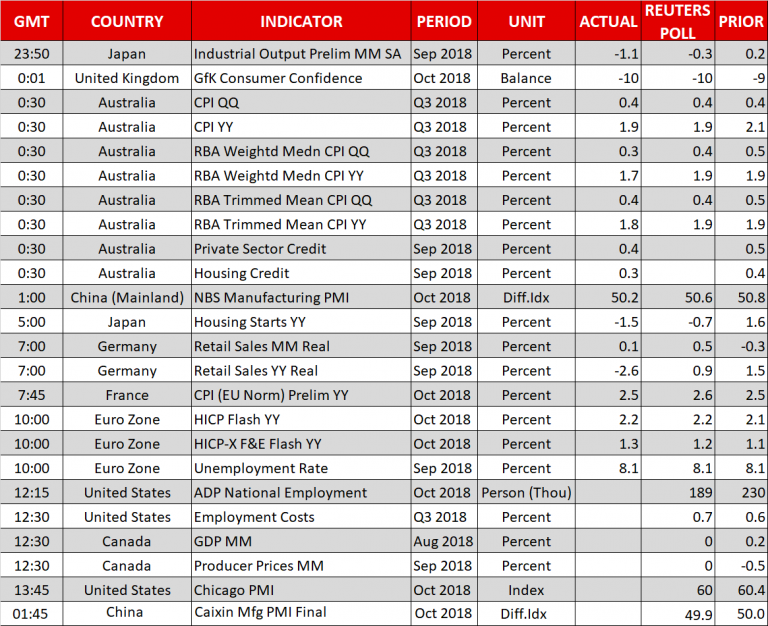
The release of the ADP nonfarm employment report out of the US and monthly Canadian GDP growth figures are expected to be the main highlights later on Wednesday.
In the US, the ADP employment report for October is predicted to be released at 1215 GMT. Forecasts are for the private sector to have gained 189K jobs, less than 230K in the preceding month, which could raise speculation that the NFP report on Friday, could be near its expectation of 189K. The US dollar has edged sharply higher over the last few days against a basket of major currencies, jumping to 1 ½-year highs, while the US stock indices regained some ground. Today’s data could drive the greenback slightly higher if the data come in better than expected.
At 1230 GMT the focus will turn to Canada and monthly GDP growth data. The Canadian economy is expected to show no expansion in August after improving by 0.2% m/m in July. Any upside surprise could be loonie-positive and vice versa. Producer prices for the month of September will be also eyed at the same time.
Meanwhile any potential developments in US-Sino trade relations and updates in Italian and German politics will be valuable to markets. Brexit headlines will be closely watched as well, as the British Prime Minister Theresa May and Finance Minister Philip Hammond will meet around 120 chief executives and international investors to discuss the exit from eurozone and the budget.
In terms of other public appearances, Bank of Canada Governor Stephen Poloz and the Senior Deputy Governor Carolyn Wilkins will appear before a Senate Committee at 2015 GMT.
In energy markets, investors will look through the EIA report on US crude oil inventories. According to forecasts, crude inventories have dropped by 4.110 million barrels in the week ending October 26 compared to 6.346 million in the preceding week. On the other hand, gasoline inventories and distillate stocks are anticipated to increase though not by much.
Overnight, China will see the release of the October Caixin Manufacturing PMI at 0145 GMT. Manufacturing PMI is expected to inch marginally down by 49.9 versus 50.0 in the previous month. Should the numbers show a bigger deterioration in manufacturing activities the aussie which is sensitive to Chinese economic conditions could move south.
Stocks – Facebook And Standard Charted
Facebook Stock Jumped 2.9%; Trading Volume Doubled
Facebook reported its earning last night, on the outset the headline number missed the forecast but the silver lining is that the difference wasn’t much. Overall, the earning’s report was mixed, EPS surged thanks to the one off tax cuts but the revenue growth was disappointing. You could clearly see that there was a pressure on the margin in this earnings report and this is due to the improvement in security and support the growth initiatives. The encouraging sign in the earning’s report was that the profit was still solid as the major concerns were that higher cost and slowing growth may create more obstacles. Facebook showed that it still has tools in its bag which can help the firm to pump up the numbers for active user-
In terms of technical analysis, the price has bounced off from its support zone but still trading below all the important moving averages 50,100 & 200 as shown on the chart. This confirms that the overall trend is to the downside.

Standard Charted Bank Delivers On Its Cost Cutting
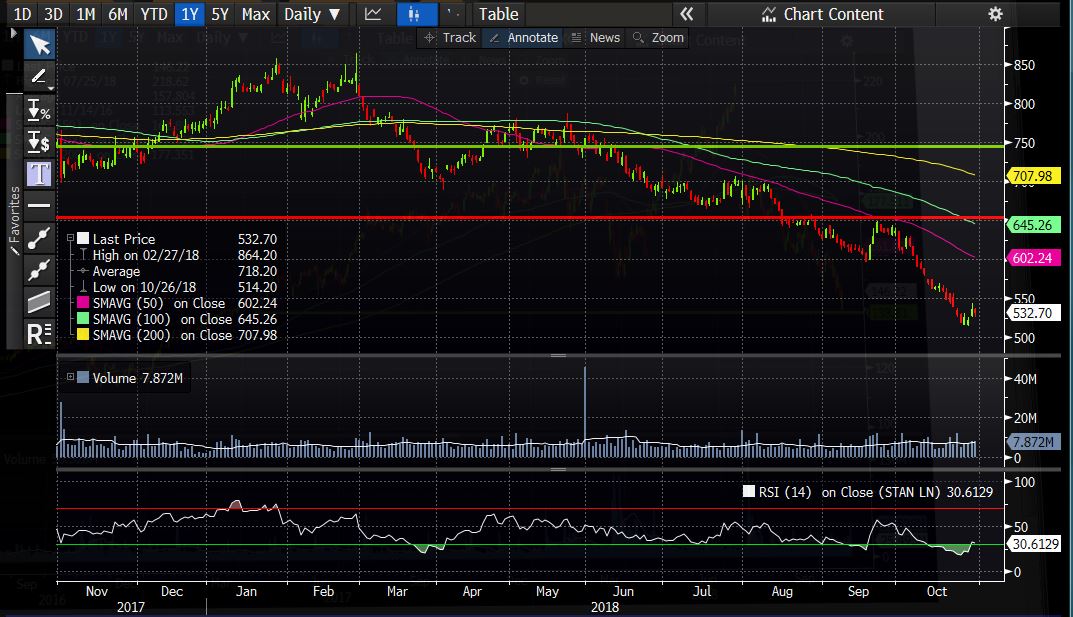
Standard Charted Bank kept its focus straight, getting more out of Asia. The bank’s competitive edge only comes when it is able to squeeze more growth from China, Hong Kong and Singapore. Operating cost is mostly the key concern for investors and the bank showed that it has tightened its belt on this aspect. Standard Charted bank hold a precvious position when it comes to trade finance, and if the trade war continues at its current pace, we do think that the bank would see more adverse results. Most importantly, we do not think that the bank has enough safety net to protect against this given that the it is one of the world’s biggest trade finance bank. The bank continues to deliver more by improving return on equity and controlling cost and this would help to dispel any investor concerns. As long as the bank the retrun on equity remains elevated, the bank may not need to think about deep cost cuts. So far, it is anticipated that the bank’s operating cost would be in line with the first half.
The daily time frame chart for Standard Charted shows that the price is trading in a downtrend. We may see some sort of retracement becuase the 50-day moving average is trading well away from the price. The RSI also confirms this arguement as it is trading near a over sold zone.
Smart Money Spooked During October
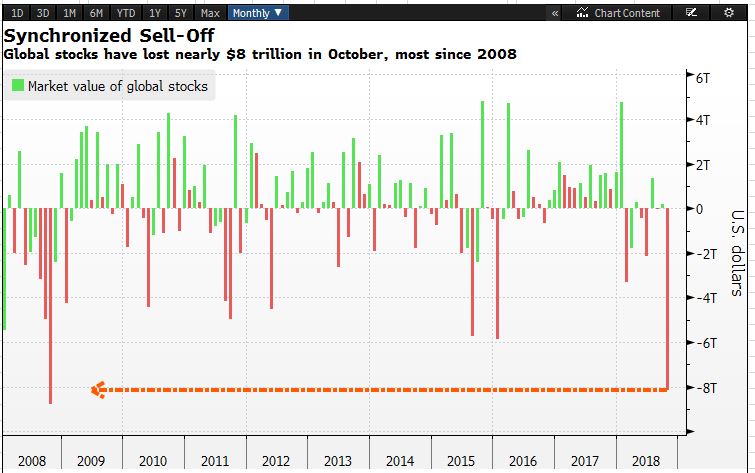
Global stocks lost over $8 trillion in October, a headline which suits the best on the Halloween day.
Smart money is running for the hill and this was the message which October brought for the global equity market. Global stocks lost over $8 trillion in October, a headline which suits the best on the Halloween day.
Looking at the Chinese economy, one thing becomes clear that the trade tensions are taking the toll on the country’s economy. Perhaps, it is time that Beijing may start to admit facts and start to see the consequences of their action. The economic data has started to nosedive, the manufacturing gauge has shown sluggish sign in the economy and the new export orders have touched the level lowest not seen since 2016. The PMI number has printed a reading of 50.2 and if it drops below 50, it will confirm contraction in the economy. Looking at the current trade war and the situation around it, it is likely that the situation would only become worse.
Over in Italy, the populist government has taken matters to the next level by saying that the current dire economic conditions over in Italy are only due to the reason that the previous governments have bowed to the EU. The populist government has one agenda, stick to their promises which they made to their voters at any cost. This is the last thing that one would like to hear especially what happened in Germany. The leader of the free world, Angela Merkel is no longer going to be the leader of her party and she will not be running for another term. She is the one who kept the Eurozone together and most importantly helped the Eurozone to move out of its misery.
In terms of economic data, we have the Eurozone’s inflation number due later today. It is expected that the inflation number may have accelerated by 0.1% to 2.2% from its previous reading of 2.1%. Inflation moving in the right direction would comfort the ECB because of GDP isn’t strong enough at least the inflation is moving closer or its target.