

Sample Category Title
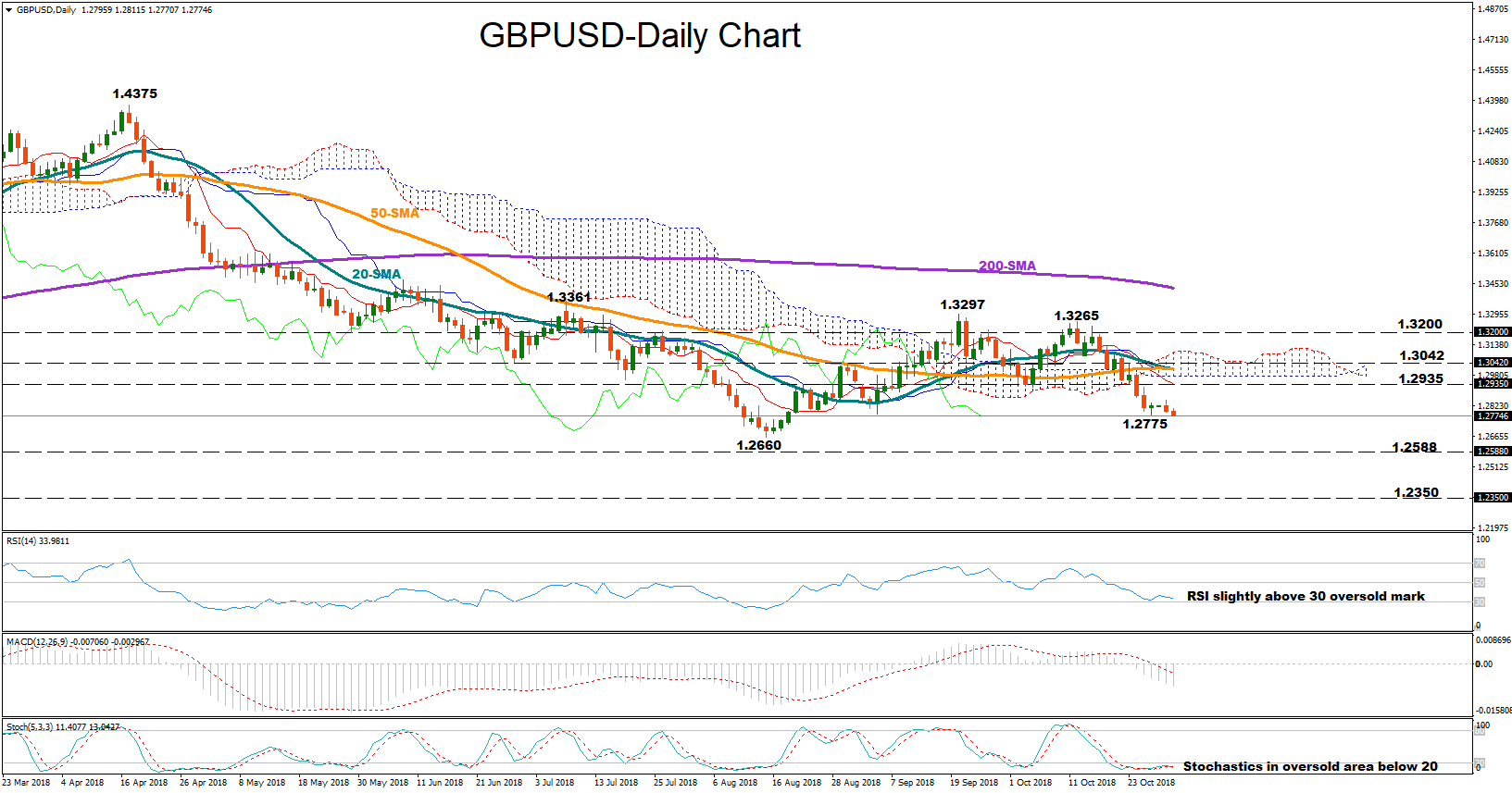
GBPUSD Stalls Around 2-Month Lows, Bearish But Oversold
GBPUSD has stabilized around the two-month low of 1.2775 reached on Friday and according to Stochastics the downfall is already overstretched and hence a rebound might be around the corner. The RSI though has not violated its 30 oversold limit yet and the MACD continues to strengthen to the downside below its red signal line, a sign that things could deteriorate further before becoming better.
A leg lower and below Friday’s trough of 1.2775, would probably meet support at the 1.2660 bottom, the lowest level reached since June 2017. Even lower, bears would activate the long-term downtrend off 1.4375, resuming the bearish outlook. In this case the area around 1.2588, which provided some support to downside movements in June 2017, may come into focus before eyes turn to 1.2350, another frequently tested region in 2017.
Alternatively if the market proves oversold, a rebound could find immediate resistance around 1.2935, where the price stalled several times in previous months. Beating that mark, bullish actions may gain momentum towards 1.3042, taken from the high on August 30, while steeper increases may also challenge the 1.3200 barrier.
In the medium-term picture, GBPUSD holds neutral, ranging between 1.2660 and 1.3361.
To sum-up, the short-term bias looks negative, while in the medium-term the neutral outlook is still in place.
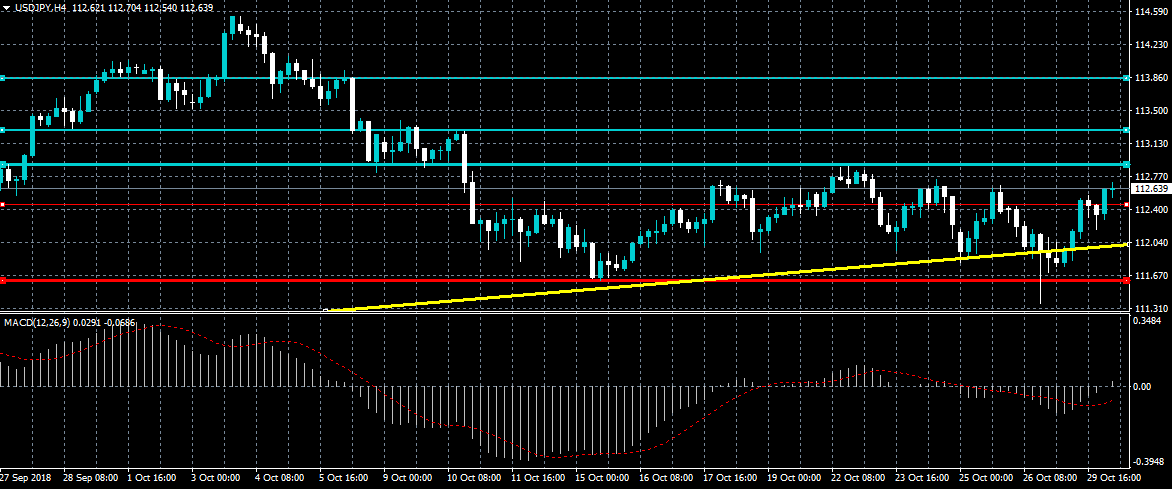
USDJPY Watching 112.87 Resistance Level
The US dollar has soared higher against the Japanese yen currency, following bullish comments from US President Donald Trump over a potential trade deal with China. The USDJPY pair is bullish while trading above the 112.45 level and may accelerate intraday gains if the 112.87 resistance level is breached. The Moving Average Convergence Divergence indicator on the four-hour time frame has also started to trend higher.
The USDJPY pair is bullish while trading above the 112.45 level, key resistance is now found at the 112.87 and 113.30 levels.
If the USDJPY pair trades below the 112.45 level, sellers will likely test key trendline support, at the 112.04 level.
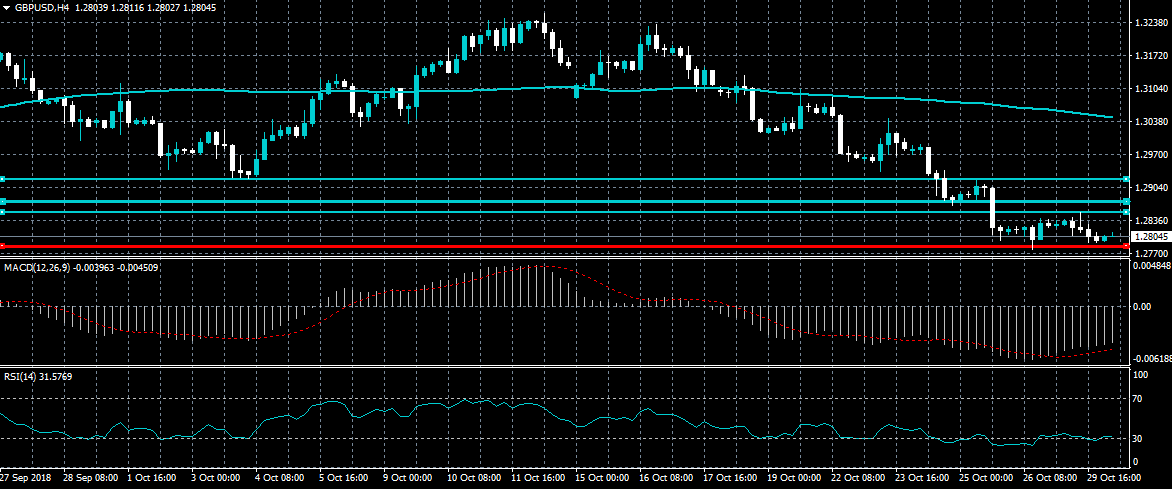
GBPUSD Probing Key Technical Support
The British pound is once again testing the 1.2800 support level against the US dollar after buyers failed around the 1.2840 level on Monday. Sellers are likely to test towards the former weekly low, at 1.2785, while buyers need to move price above the 1.2866 resistance level. The RSI and MACD indicator shows that the GBPUSD pair remains extremely oversold on the four-hour time frame.
The GBPUSD pair is strongly bearish while trading below the 1.2800 level, key support is found at the 1.2785 and 1.2730 levels.
If the GBPUSD pair moves above the 1.2840 level, buyers will likely test towards the 1.2866 and 1.2921 resistance levels.
US Threatens To Put Tariffs On All Chinese Imports In December
The Japanese yen declined against the USD in the Asian session despite better-than-expected jobs numbers. The unemployment rate declined to 2.3% in September which was better than the consensus estimate and August’s unemployment rate of 2.4%. This figure was the lowest it has been since May which was the lowest level since 1992. Additionally, the jobs-to-applicants ratio of 1.64 was better than the 1.63 that traders were expecting. While the unemployment rate has been good in Japan, the country has struggled to generate inflation, which remains at 1%. This is below the BOJ’s target of 2%. The BOJ is expected to leave interest rates unchanged when it meets tomorrow.
Market risks continued yesterday in the United States. The markets opened on a positive note with the Dow gaining by more than 200 points. Within the day, things changed and the Dow ended the day lower by 245 points. This was slightly higher than the bear territory. The declines came after it emerged that the Trump administration was planning to place tariffs on remaining Chinese imports in December. These tariffs will go into effect if the conversation between Trump and Xi Jinping fail to reach a deal.
The euro was little changed against the USD after Angela Merkel announced that she will not stand for re-election in 2021. She also stepped down from her leadership role of the party. To many people, Merkel is the current leader of the free world after Trump’s preference for nationalism and his America First policies. Later today, traders will receive the German employment numbers, Spanish inflation numbers, and the EU GDP numbers.
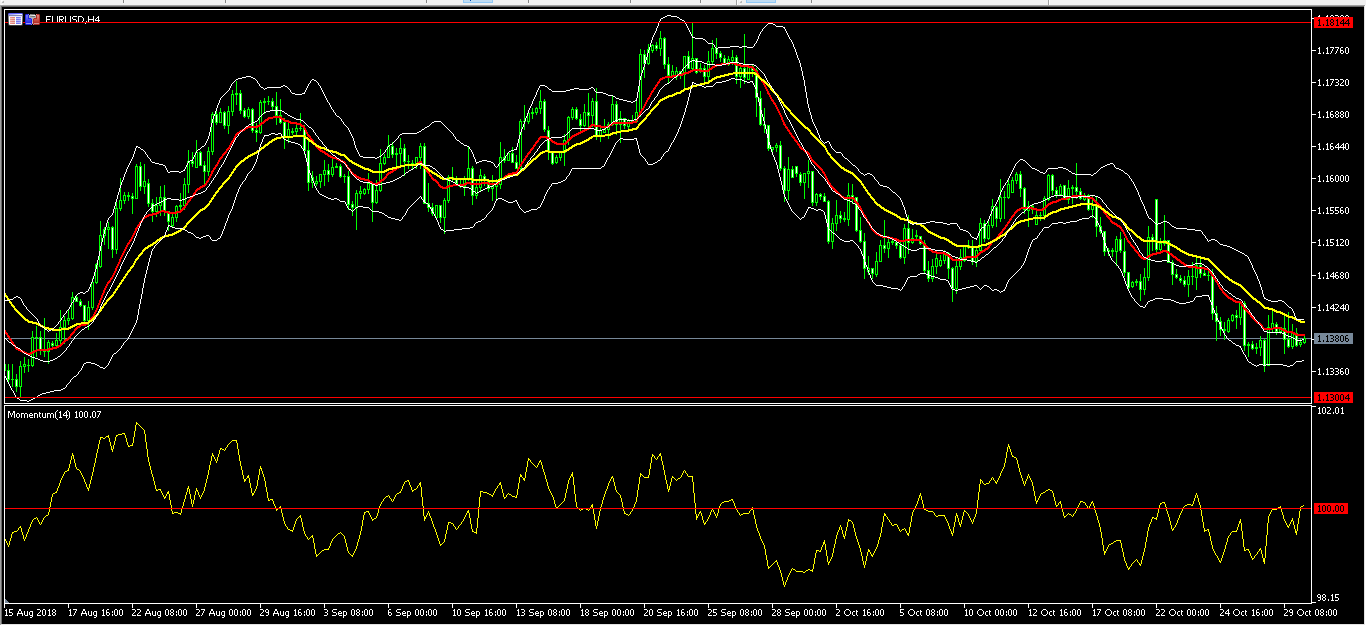
EUR/USD
The EUR/USD pair is trading at 1.1380, which is unchanged from where it ended the day yesterday. The price is along the middle band of the Bollinger Bands while the double EMA shows no signs of a reversal. The momentum indicator is at the neutral 100 level. There is a likelihood that the pair will continue to drop until it tests the 1.1300 level.
USD/JPY
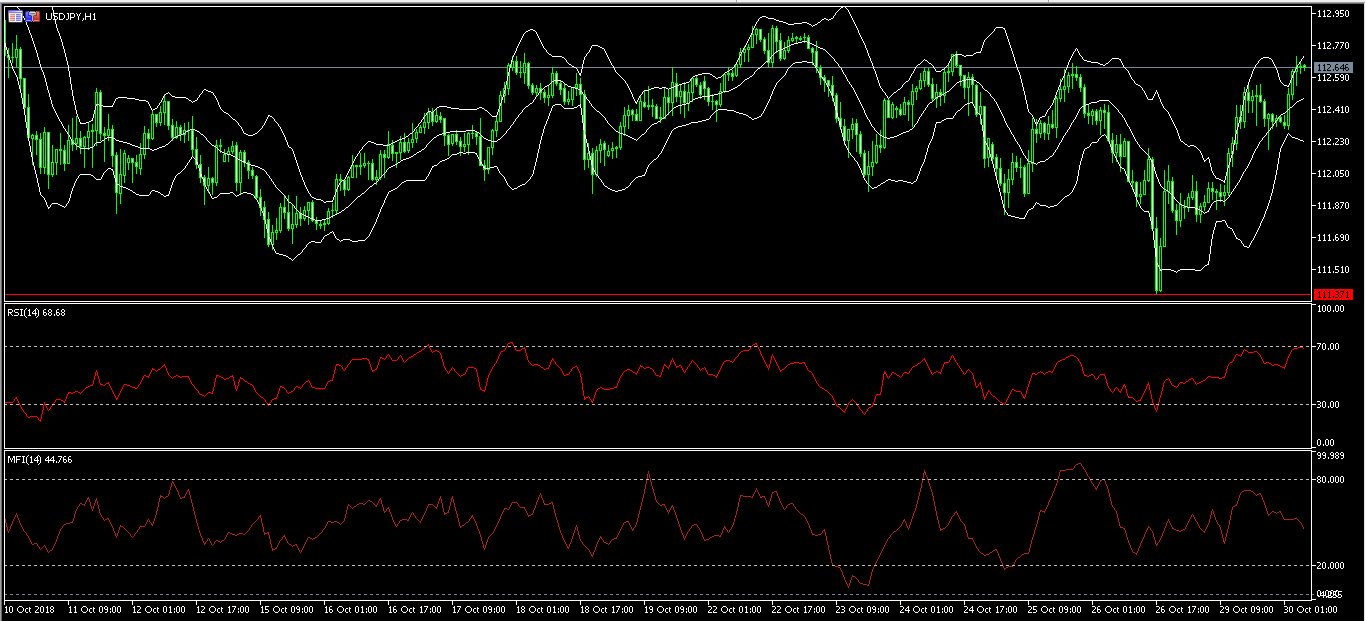
The USD/JPY pair continued the upward momentum started on October 26 and reached a high of 112.700. This is the highest it has been since Wednesday last week. The price is along the upper Bollinger Band while the RSI is currently at 68. The Money Flow Index, which is a volume-based RSI is at 44 and headed lower. While the upward momentum could continue, the pair is likely to see some downward movement that will see it test the 112.50 level.
GBP/USD
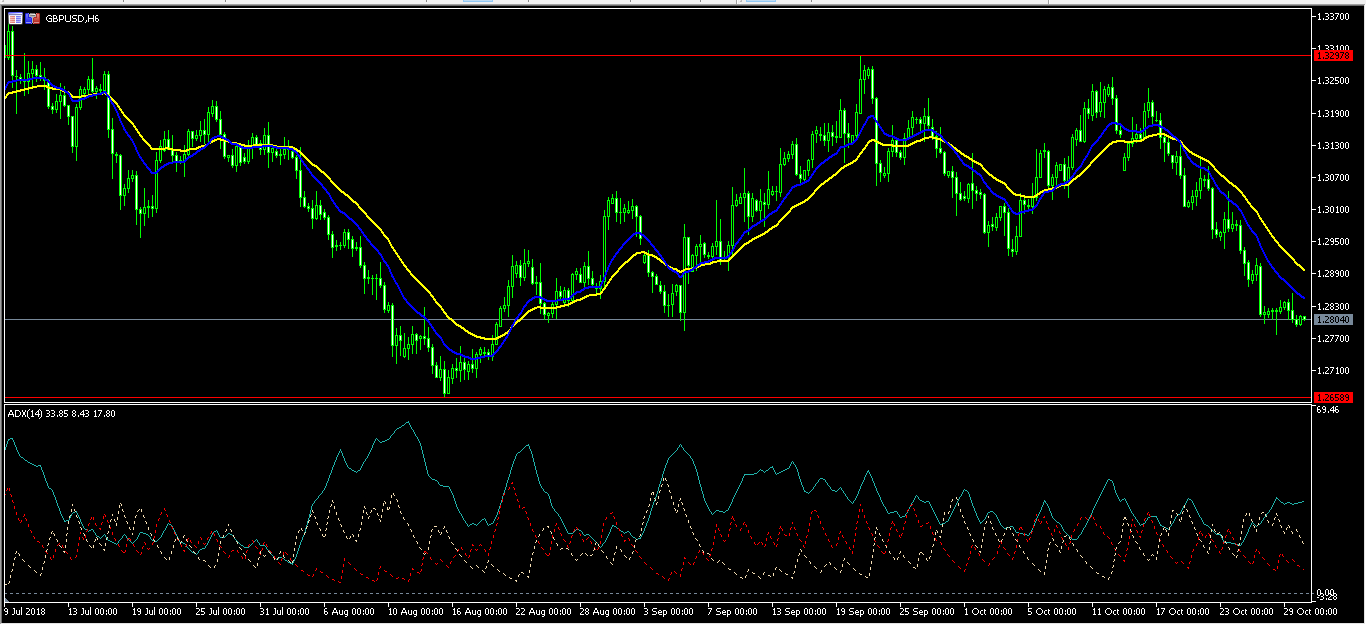
The GBP/USD pair was slightly lower in the Asian session. The focus among traders is on the BOE, which is expected to release its interest rate decision on Thursday. The pair is now trading at 1.2804. The double EMA show that the pair will likely continue the downward trend. This is confirmed by the Average Directional Index (ADX), which is currently at 33. If it does, it will possibly test the 1.2700 support level.
EUR/USD Hovered Volatile In The High 1.13 Region
Markets
Risk assets thrived during yesterday's European trading session following last week's sell-off. The weekend didn't bring unexpected bad news, while Italy survived S&P's downgrade threat, at least for now. Italian assets outperformed with the 10-yr yield spread vs Germany narrowing by 13 bps. European stock markets flourished while US indices faced more difficulties to cling to opening gains. Those gains even turned into new heavy losses after US President Trump reiterated his plan again to impose duties on all remaining Chinese goods if his talks with Xi Jinping fail next month. US stock markets closed 0.66% (S&P) to 1.63% (Nasdaq) lower. German Bunds underperformed US Treasuries. The German yield curve bear steepened with yields increasing by 0.8 bps (2-yr) to 3.9 bps (30-yr). US yields added 0.9 bps (10-yr) to 2 bps (30-yr). USD/JPY clung to most intraday gains, closing the session at 112.37 from 111.89. EUR/USD hovered volatile in the high 1.13 region, but dollar strength eventually prevailed (1.1373 close from 1.1407). EUR/GBP treaded water in the high 0.88 area. Brazilian assets fell prey to buy-the-rumour, sell-the-fact following Bolsonaro's presidential election victory.
Risk sentiment improved again overnight with Asian bourses up to 1.5% higher. Korea, Japan and China outperform (+1.5%). US President Trump eased yesterday's rhetoric by speaking about a great deal with China on trade. Chinese markets received an additional push in the back as the regulator revealed plans to guide more long term capital into the stock market. The trade-weighted dollar (96.7) remains upwardly oriented, closing in on the 2018 high (97). USD/CNY reaches a decade high, just below 7. EUR/USD changes hands around 1.1375. The US Note future slides lower, suggesting a weaker opening for the Bund as well.
The eco calendar is interesting with EC confidence data, EMU Q3 GDP, German inflation numbers, US S&P housing data and US consumer confidence. The bar for Q3 GDP (0.4% Q/Q) might be too high. EMU data will be put against Draghi's last week's comments that the economy is currently losing some momentum, but that it isn't a downturn yet. German inflation is expected flat on a monthly basis following last week's 0.4% M/M leap. US housing data could show more signs of cooling off and might start worrying some investors. Consumer confidence is estimated to come off the cycle high reached last month, which shouldn't surprise given recent market volatility. It's hard to estimate the impact of this complex of eco data. On top, they'll probably be in the shadow of general risk sentiment on stock markets. We expect Europe to extend yesterday's positive spell, pulling bonds lower as well. Dollar strength remains name of the game on FX markets. Q3 earnings by several companies including Facebook (after market) are a wildcard. Sterling remains slightly in the defensive going into Thursday's BoE meeting. There's no market-moving update on Brexit. Yesterday's budget release by Chancellor of the Exchequer Hammond went unnoticed.
News Headlines
Valdis Dombrovskis, EC VP and responsible for financial regulation, pledges access for EU companies to UK clearing houses in case of a no-deal Brexit. The vow comes after EU banks warned that EU companies would otherwise face hefty rises in trading costs and would be unable to hedge certain market exposures.
The Chinese securities regulator said in a statement that it would encourage share buybacks and M&A's by listed companies. In addition, it will reduce trade resistance and increase market liquidity. The measures are the latest bid by officials to shore up the market after a steep sell-off in equities as well as a slowing economy.
US President Trump has said he will make a great deal with China. He added that it must be great since China has "drained our country". Earlier in the day, it was said that US officials are working on a tariff list with all remaining $257bn of Chinese imports to target if talks next month between Trump and Xi Jinping would fail.
Stock Markets Going Nuts
Wall Street experienced one of itswildest trading sessions on Monday. What seemed to be buying the dips, turned into selling the rallies. The session began with sharp gains in all major indices driven by Financial and Tech stocks, sending the S&P 500 1.8% higher in the first two trading hours. Similarly, the Dow Jones rallies 350 points until a Bloomberg report broke out stating that the U.S. is preparing a new round of tariffs on the remaining $257 billion of Chinese imports that haven’t been hit yet. This led the blue-chip index to fall more than 900 points from its high ending the day 1% lower, while the S&P 500 declined 0.7%, in one of the most volatile days since February.
The S&P 500 and the Dow are down 9.4% and 7.6% respectively for the month of October. Meanwhile, the Nasdaq composite has already entered correction territory by falling 12.4%. When investors are already worried about several factors, including raising interest rates, slowing global economic growth, and peaks in corporate earnings, the last thing they need is another layer of uncertainty.
Things turned around in Asia after President Trump said the U.S. could get a great deal on trade with China which seems to contradict the Bloomberg report. Also helping Chinese stocks to rally was a statement from China’s securities regulator stating that it will improve market liquidity and encourage share buybacks and mergers and acquisitions activity. The CSI 300 index climbed as much as 2.2% following the announcement while the Nikkei 225, ASX 200 and the Kospi all gained more than 1.3%.
However, the Chinese Yuan remained under pressure, weakening to a fresh decade low of 6.97 per dollar. The rally in Chinese equities today may reverse if the currency breaksabove the key psychological level of 7, so a close eye should be kept on the currency’s next move. The Yuan’s weakness also reflects lack of confidence as more stimulus means more fiscal deficit, a negative factor in the longer run.
The dollar traded in a tight range against a basket of currencies, but the improvement in risk sentiment helped drive the Aussie and Kiwi 0.5% higher in the Asian trading session. It is a busy day on the Eurozone macroeconomic data front. Eurozone Q3 preliminary GDP, consumer confidence, and industrial production data are likely to show that growth continues to abate. Euro traders will also be closely monitoring CPI data from Germany.
Market Sentiment Perhaps Not As Fragile As It Has Been
China could face another $257 billion of tariffs in December
We’re expecting a mixed start to trading in Europe on Tuesday, as investors shrug off the threat of new Chinese tariffs by the US in a sign that sentiment may be improving.
A tariff on the remaining $257 billion of Chinese imports has been threatened for some time, so the latest revelation comes as little surprise to investors. It did shed some light on when they could be implemented though, with the report claiming they could be imposed as early as December if talks between the two President’s fail next month. Given that neither side has shown much of a willingness to compromise until now, this seems rather likely.
That said, the last couple of months has seen the Chinese economy in particular experience something of a slowdown, with growth in the previous quarter slipping to 6.5% and other economic indicators suggesting that tariffs are already biting. The US economy is very strong right now but growth did slow a little in the third quarter and with momentum slipping ahead of next week’s midterms and some forecasting slower growth next year, I wonder whether this has played into the decision to accelerate these tariffs.
Market sentiment perhaps not as fragile as it has been
Seeing markets take the new tariff threats in their stride is certainly encouraging though, given just how fragile sentiment has been in recent weeks. The information may not be particularly new but the confirmation of such a move threatens to escalate the trade conflict between the world’s two largest economies and had the report come a week or two ago, I wonder whether the reaction would have been more negative.
It’s not been a straightforward start to the week but we have seen reasons for optimism, with Europe and Asia posting gains and the late rally in the US potentially providing a lift heading into Tuesday. If we can get through the week without too many setbacks, then investors may begin to see the light at the end of the tunnel and sense opportunities in the markets, rather than view it with anxiety and fear which has certainly been the case in recent weeks.
Gold pares gains and oil loses its spark
Gold continues to pare recent gains this morning, down around 0.25% early in the day, as risk appetite gradually improves. This is being aided by the gradual increase in the dollar, which typically weighs on the yellow metal. Ultimately though, as we’ve seen recently, Gold has become increasingly correlated with the performance of US markets which have been the key risk barometer, so if we see markets stabilise and recover then Gold could come under a little pressure.
Oil has lost its spark over the last week, entering into a period of consolidation after falling almost 15% over the course of the month. Supply concerns linked to Iranian sanctions appear to have been a little overblown, especially in light of Saudi Arabia’s commitment to fill the shortfall, along with other major oil producers. The gloomier global economic outlook has also taken its toll on oil as traders weigh up the impact on demand in the coming years.
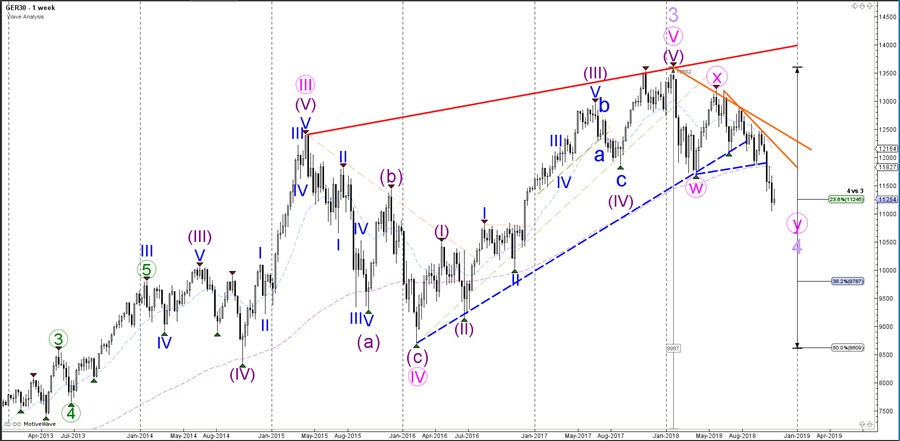
DAX 30 Bearish Momentum Reaches 23.6% Fibonacci At 11,000
The German stock index DAX 30 is showing strong bearish momentum, which seems unfinished. Price is expected to move lower either immediately if breaking below the support trend line (blue) for an extended wave 5 (orange) or after completing the wave B (green) correction.
The DAX 30 is expected to turn at theFibonacciretracement levels if price is indeed building a bearish ABC (green) zigzag pattern within the larger waves Y correction. For the moment the trend lines however play a more important role. Price needs to break below support (blue) or above resistance (red) before the immediate direction becomes more likely.
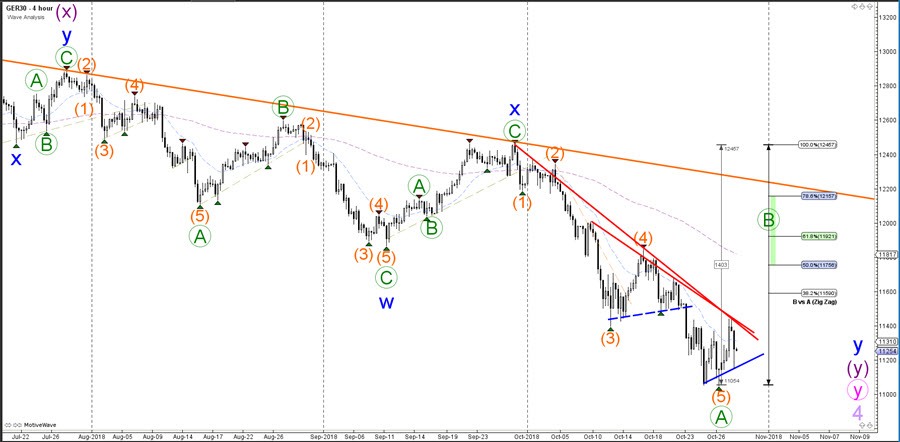
The DAX 30 seems to be building a larger WXY (pink) correction within a wave 4 (purple).
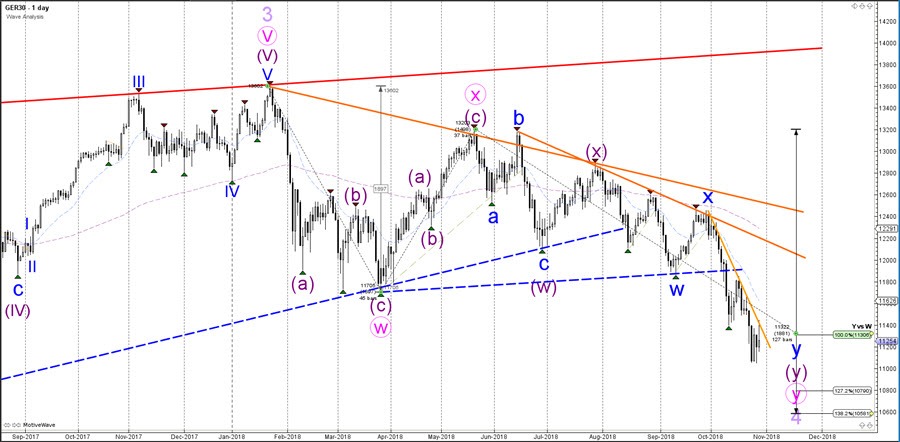
The DAX 30 has reached a 23.6% Fibonacci retracement level of wave 4 vs 3, which is a bounce or break spot. A bearish break could see price extend down to the 38.2% Fibonacci retracement level.
Asian Equity Markets Trade Generally Higher
General Trend:
- China Securities regulator issues response to market concerns
- South Korea regulator said equity market decline is ‘excessive’ (local press)
- Chipmakers in South Korea rise, US Commerce Dept. block sales to Chinese chip firm Fujian Jinhua
- Chinese automakers trade generally higher, China speculated to cut the car purchase tax
- Chinese liquor maker Kweichow Moutai extends post earnings declines
- Japan’s Daiwa Securities drops over 3%, reported profit decline
- PBOC fixes the yuan at weakest level since May 2008
- Yuan is not likely to fall below 7 to the US dollar (Chinese Press)
- Japan auto earnings in focus: Honda and Hino Motors expected to report
- Japan electric appliances firms seen reporting later today include Nintendo, Sony and Sharp
- Steelmakers Kobe and JFE also seen reporting
- Chinese firms expected to report earnings include ICBC and Baosteel
- Bank of Japan decision expected on Wed
- US companies expected to report earnings (including afterhours) are 3D Systems, Aetna, Allergan, Amgen, Anadarko Petroleum, Autonation, Baidu, Coca-Cola, Cummins, Eaton, Electronic Arts, Facebook, FireEye, GE, Lumber Liquidators, Mastercard, Pfizer, Under Armour, eBay
Headlines/Economic Data
Japan
- Nikkei 225 opened -0.5%
- Sony, 6758.JP To invest ¥600B over 3-yrs in chip making - Nikkei
- (JP) Japan Finance Ministry (MOF) said to consider dealing with the issue of tax avoidance in cryptocurrency trading - Japanese Press
- (JP) JAPAN SEPT JOBLESS RATE: 2.3% V 2.4%E; Job to applicant ratio 1.64 v 1.63e (highest since Jan 1974)
- (JP) Japan Fin Min Aso: PM Abe talked to China president Xi and was agreed for yen/yuan swap agreement
- (JP) Japan Economy Min Motegi: TPP-11 trade agreement to take effect by as early as the end of 2018 or early 2019 at the latest
- (JP) Former BOJ Exec Dir Miyanoya: reporting losses may become widespread for Japanese banks in the near future as their bottom lines suffer from a shrinking population and interest rates kept at ultra low levels
- 8698.JP Coincheck unit to resume new account opening; resumes deposit, purchases of Bitcoin and Bitcoin cash
Korea
- Kospi opened -0.5%
- (KR) South Korea Nov Business Survey: Manufacturing: 72 v 78 prior; Non-Manufacturing: 75 v 77 prior
- (KR) South Korea Financial Regulator Chief has told staff to prepare steps to stabilize markets
- (KR) Bank of Korea (BOK) held meeting to discuss financial markets, will take measures to stabilize markets if needed
- (KR) South Korea Sept Department Store Sales y/y: 4.7% v 2.4% prior; Discount Store Sales y/y: +8.1% v -1.2% prior
- (KR) South Korea sells KRW1.25T v KRW1.25T indicated in 30-yr bonds; Avg yield 2.11% v 2.565% prior; bid to cover 2.79x
China/Hong Kong
- Hang Seng opened -0.2%, Shanghai Composite -0.1%
- (CN) US said to implement next round of China tariffs if Trump talks with Xi fail (expected to meet at G20 on Nov 30th) – press
- (CN) China yuan not likely to fall below 7 to the USD - Chinese press
- (CN) Multiple companies in China said to consider conducting IPOs in London - Chinese Press
- (CN) China PBoC Open Market Operation (OMO): skips v skips prior in 7-day reverse repos prior: Net: CNY120B drain v CNY120B injection prior
- (CN) China PBOC sets Yuan midpoint rate at 6.9574 v 6.9377 prior (lowest level since May 2008)
- (HK) Hong Kong Monetary Authority (HKMA): Did bank stress tests based on economy and trade war
- (CN) China Foreign Exchange Trade System (CFETS) planning to develop swaps involving overseas currencies, also looking to build reference rates in onshore markets for dollar borrowing across the maturity spectrum - financial press
- (CN) China Securities Regulator (CSRC) issues statement in response to market concerns: will encourage value investment in stock market; encourage buybacks by listed companies
Australia/New Zealand
- ASX 200 opened -0.2%
- VOC.AU Affirms FY19 Underlying EBITDA A$350-370M; do not expect Net to grow
- RIO.AU CEO Jacques: mining sector faces risk of disruption; Chinese Govt putting more money into the system, Order books from China are full
- (AU) AUSTRALIA SEPT BUILDING APPROVALS M/M: 3.3% V 3.8%E; Y/Y: -14.1% V -9.0%E
- (AU) Reserve Bank of Australia (RBA) Assist Gov Bullock: Direct financial impact on major banks from Royal Commission probe has been relatively modest so far
Other Asia
- (TH) Thailand Sept Manufacturing Index y/y: -2.6% v +0.7% prior (weakest since 2016)
North America
- (US) US President Trump: Predicts 'great deal' with China on trade; could see a trade deal with Brazil happening
- AKAM Guides Q4 $0.97-1.03 v $0.91e, Rev $692-709M v $704Me - earnings call
Europe
- (UK) Chancellor of the Exchequer Hammond (Fin Min): Era of austerity coming to an end; Increasing Brexit provision o £2.0B in 2019; Launches 2% digital tax - Budget Speech
- (UK) UK has rolled over only 14 of 236 EU international treaties - financial press
Levels as of 01:30ET
- Hang Seng +0.4%; Shanghai Composite +1.7%; Kospi +1.5%; Nikkei225 +1.6%; ASX 200 +1.3%
- Equity Futures: S&P500 +0.7%; Nasdaq100 +0.7%, Dax +0.1%; FTSE100 -0.0%
- EUR 1.1361-1.1416; JPY 112.31-112.74 ; AUD 0.7054-0.7096;NZD 0.6521-0.6555
- Dec Gold +0.1% at $1,229/oz; Dec Crude Oil +0.2% at $67.18/brl; Dec Copper -0.4% at $2.73/lb
Trump Expects A ‘Great Deal’ With China
Market movers today
Today's highlight is the advance euro area GDP figure. Quarterly growth rates slowed to 0.4% q/q in H1 18 and we expect to see a similar pace of expansion in Q3 18. We will not yet get a component breakdown, but we estimate growth in Q3 was driven mainly by domestic demand. Some country GDP figures, such as France, are due out.
Spain and Germany will release their CPI figures ahead of the euro area HICP tomorrow, which will give an indication of whether we are in for a negative surprise, which has been the case recently.
In Scandi, we get Danish business confidence as well as Norwegian retail sales, which have been very volatile, especially with the abnormal weather this summer and autumn.
In the overnight session, the Bank of Japan will meet and Chinese PMIs are due. We do not expect any new policy signals from the BoJ. We look for how close the Chinese PMI will be on the 50 threshold.
Selected market news
US equity market futures and Asian equity markets are trading in the green following US President Trump saying he expects a 'great deal' with China. The mood was distinctly dissimilar to yesterday, as major equity markets whipsawed following a Bloomberg story that Trump will announce tariffs on the remaining USD257bn worth of Chinese imports if his talks next month with China's premier Xi Jinping fail.
Flirting with correction territory. The flagship S&P 500 equity index rallied at open, tumbled on renewed trade war fears and closed at a moderate loss. The blue-chip index closed just shy of a technical correction, defined as a 10% drawdown, from its September peak high. We think we are indeed witnessing a correction rather than the end of the longest equity bull market since World War 2. Before the next leg up, brace for more volatility. For more on our view on equity markets, listen to our weekly podcast .
Yesterday marked the end of an era, as Angela Merkel announced she will step down as head of her political party, the CDU. The dismal election results in the state of Hesse were the last straw for the G7's longest serving head of state. Although Merkel will not seek re-election as the head of her party CDU in December, she will remain Chancellor until the end of her term in 2021. Mirroring pan-European political developments, large German mainstream political parties have witnessed eroding popular support. On the right, the CDU and CSU have been under pressure from the right-wing populist party AfD. At the other end of the political spectrum, SPD has been hurt by the rise in popularity of the Green party. German government bonds underperformed on worries concerning the sustainability of Germany's government. We do not think Merkel's decision will undo Germany's solid fiscal stance.