

Sample Category Title
GBP/USD Facing Uphill Task Near 1.2900
Key Highlights
- The British Pound declined sharply and traded below 1.2800 recently against the US Dollar.
- There is a crucial bearish trend line in place with resistance at 1.2880 on the 4-hours chart of GBP/USD.
- UK’s Mortgage Approvals in Sep 2018 were 65.269K, more than the 65.000K forecast.
- Today, the Euro Zone Gross Domestic Product for Q3 2018 (Preliminary) will be released, which is forecasted to grow 0.4% (QoQ).
GBPUSD Technical Analysis
The British Pound started a major downside move from the 1.3240 resistance against the US Dollar. The GBP/USD pair declined heavily and broke the 1.3000, 1.2950 and 1.2920 support levels.
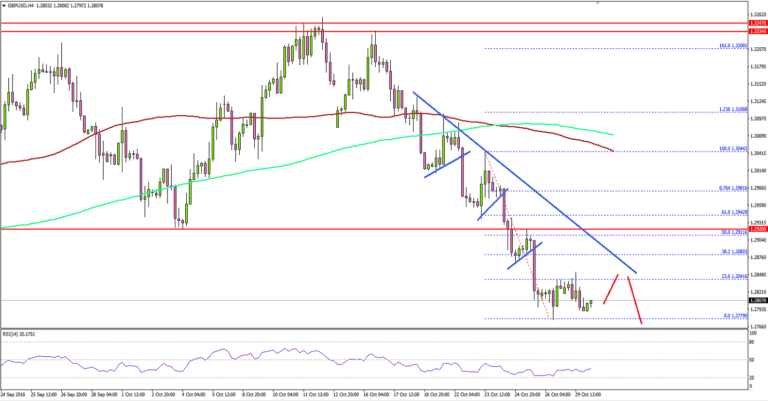
Looking at the 4-hours chart, the pair was under a lot of bearish pressure below the 1.3000 support. It followed a bearish structure and declined below the 1.2800 level. A new monthly low was formed at 1.2779.
The pair is currently consolidating losses above the recent low and it is facing a lot of hurdles on the upside near 1.2880 and 1.2900. There is also a crucial bearish trend line in place with resistance at 1.2880 on the same chart.
Moreover, the 50% Fib retracement level of the recent decline from the 1.3044 high to 1.2779 low is around 1.2900 to act as a solid resistance. Therefore, it won’t be easy for buyers to push GBP/USD above the 1.2880 and 1.2900 resistance levels in the near term.
On the downside, if there is a break below the 1.2770-1.2775 area, the pair is likely to decline towards the 1.2720 support area.
Fundamentally, the UK Mortgage Approvals report for Sep 2018 was released by the Bank of England. The market was looking for a decline from the last reading of 66.440K to 65.000K.
However, the result was better than the forecast as the actual figure was 65.269K and the last reading was revised from 66.440K to 66.101K. The report added that:
Consumer credit increased by £0.8bn in September. This was less than in August, as new borrowing for car finance fell sharply. The flow of mortgage lending increased to £3.9 billion in September, following two relatively weak months.
Overall, the US Dollar remains in control and it seems like recoveries in EUR/USD and GBP/USD are likely to a lot of challenges this week.
Economic Releases to Watch Today
- Euro Zone Gross Domestic Product Q3 2018 (Preliminary) (QoQ) – Forecast 0.4%, versus 0.4% previous.
- Germany’s Unemployment Change for Oct 2018 – Forecast -12K, versus 23K previous.
- Germany’s Unemployment Rate for Oct 2018 – Forecast 5.1%, versus 5.1% previous.
- German Consumer Price Index for Oct 2018 (YoY) (Preliminary) – Forecast +2.4%, versus +2.3% previous.
- German Consumer Price Index for Oct 2018 (MoM) (Preliminary) – Forecast +0.1%, versus +0.4% previous.
Dollar Reclaims Safe Haven Crown With Equity Sell Off And US-China Trade War Concerns
The US dollar was higher across the board against major pairs. The greenback was able to maintain its momentum even as a brief stock market rally crashed and burned on Monday. The stock sell off from last week appeared to have receded, only for the market to do a U-turn in mid session with tech stocks taking heavy hits.
The possibility of more US tariffs aimed at China was one of the factors for the stock market decline, and it also sent investors looking for the safety of the US dollar taking flows away from other safe havens such as the JPY and gold.
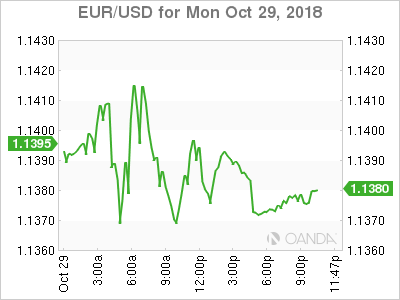
The Bavarian and Hesse elections dealt a heavy blow to the CDU, with German Chancellor stepping down from party leadership and would not seek reelection when her terms end in 2021.
The euro depreciated after the announcement as the EU is facing political headwinds as it negotiates on two fronts. Italian budget talks and Brexit have not progressed as the European Commission would like and sides are too far apart despite rhetoric from leaders.
The dollar was boosted by economic data as the September PCE kept up with August and the core reading is a stronger signal of inflation for the Fed to take into consideration.
GOLD
Gold lost 0.32 percent on Monday as the US and other riskier assets advanced. US stocks had a volatile session that once again is stoking fears of a correction. A report on an escalation of the US-China trade war and the tech sector underperforming put all three major indices in the red.
Personal consumption expenditures in the US, specially the influential core PCE reading, lifted the US dollar against gold as the rate hike path of the Fed is expected to continue. The Fed has hiked 3 times in 2018 and heavily anticipated to add another interest rate bump in December.
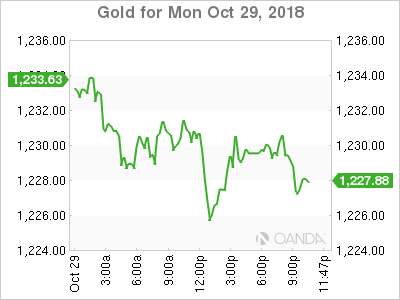
The prospect of higher rates diminished the appeal of the yellow metal, even though gold has reclaimed some of its status as a safe haven asset.
Investors will keep gold in mind as the rest of the week unfolds with central bank announcements, economic data and geopolitics in the background.
OIL
Oil prices fell on Monday. West Texas Intermediate lost 1.33 percent and Brent 0.98 percent as the US dollar came off the blocks to start the week. Russian Energy Minister Alexander Novak signalled over the weekend that production would be higher, despite OPEC concerns about oversupply.
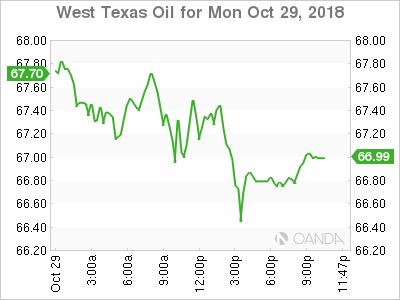
The difference of opinion between Russia and the OPEC put further downward pressure for crude that was already on the back foot as the US dollar appreciated on Monday. Economic data in the US boosted the currency as it continues to validate the monetary tightening policy of the Fed.
There is plenty of chatter around how big of an impact the US sanctions on Iranian exports will have as the market for loopholes to avoid them has been on the rise. If the actual gap caused by lost Iranian exports is not as big as expected it could cause prices to fall even lower.
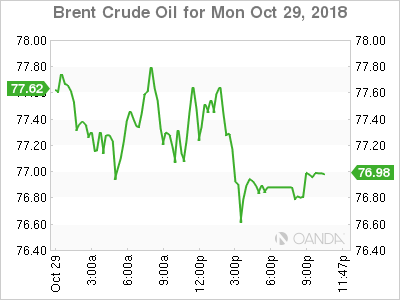
US weekly inventories are forecasted to show a buildup in stocks, with a potential rise of 3.3 million barrels.
US tariffs against China could also go higher, putting in jeopardy global growth with energy demand falling, if the pre-G20 meeting between Trump and Xi does not bear any meaningful fruit.
MEXICAN PESO
The Mexican peso started the week under pressure from strong US fundamentals. The currency fell after the results of a public consultation on an airport construction project that is 30 percent underway by the incoming movement resulted in the elected President saying his administration would cancel the project.
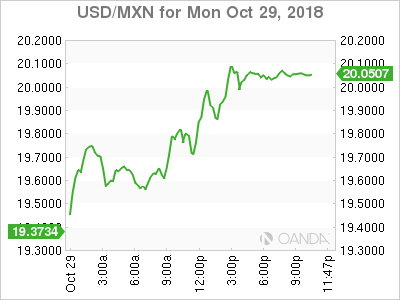
The cancelation filled investors with uncertainty given that the project has been ongoing since 2015 and has more than 70 percent of its funding secured. The currency pair broke through the 20 peso price level even as investors were seeking higher yields and bought emerging market currencies.
GBP Holds At Lower Levels Post-Budget
GBP holds above last week's lows
The pound is marginally in the black versus the US dollar after UK Chancellor of the Exchequer Hammond delivered a budget outlining increased spending yesterday, declaring that the era of austerity is “finally coming to an end”. Notably, an extra GBP500 million has been allocated for preparations for leaving the EU.
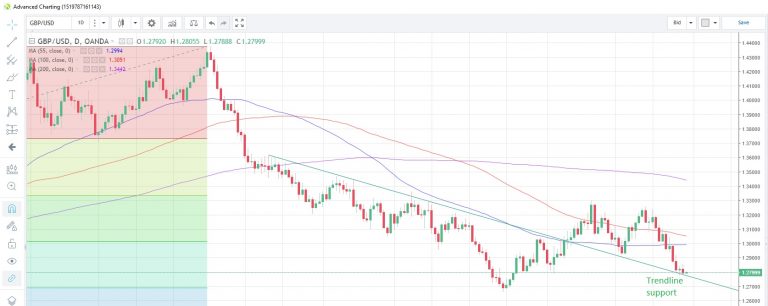
The pound weakened 0.23% versus the dollar yesterday, though failed to take out last week's low of 1.2775, which will act as interim support this week. Trendline support, which was previously resistance, is also around the 1.2775 level.
USD/CNH marks time below 7.0
USD/CNH looks poised for a seventh monthly gain in a row and is hovering close to 21-month highs. Chinese press suggested earlier today that the yuan is “not likely” to fall below 7.0 to the US dollar. Earlier this month, US commentaries suggested 7.0 was a key level for China and that they might use FX reserves to prevent a breach. In recent days, a number of Chinese officials have stated that the yuan will remain “stable” while last week Premier Xi reiterated that China would not engage in competitive devaluation.
Europe growth may be revised lower
The second reading for Euro-zone GDP growth is the highlight of an otherwise dull data slate. Forecasts suggest growth will be revised lower to 1.8% from 2.1% on an annualized basis, but remain unchanged at 0.4% quarter-on-quarter. Consumer confidence and other Euro-zone sentiment indices are expected to be marked lower in October amid softer data, Italy budget issues, Brexit and tumbling equity markets.
The Real China Question
When the chips are down, threaten China and hope for the best next week. Is that what's left for Trump's mid-term election strategy? The wild ride in markets continues as the focus increasingly turns away from the economy and towards the brewing trade trouble. The New Zealand dollar bucked the risk aversion trade to lead the way Monday while the Australian dollar lagged. A new index short was issued 1 hour before the close of the US stocks session. The Premium video is ready to lay out the rationale.
It continues to be all about stock markets as the S&P 500 rose 2% in early trading Monday then fell more than 2% into negative territory before bouncing late to finish down 0.66%. Through it all, the FX market continued to have far less responsive volatility than the historical norm. USD/JPY traded in a 30 pip range with the S&P 500 trading in a 100 point range.
That continued divergence in volatility argues against economic worries or rates as the primary catalyst for the worries. Surely they're part of the story but the price action Monday highlighted other concerns.
The first round of selling came after UK Chancellor of the Exchequer Hammond announced a digital sales tax aimed a very large internet commerce companies. That led to some selling in technology companies. The heavier selling came after a Bloomberg report saying Trump is considering announcing tariffs on all remaining Chinese goods in early December if talks with Xin on Nov 30-Dec 1 don't produce any results.
Within the same theme, we seem to harken back to the speech Pence made on October 4 where the shockingly aggressive tone continues to reverberate in China with op-eds deconstructing it daily in China.
Former Australian PM Kevin Rudd recently gave a speech on the US-China question and it helps frame the debate. The market is trying to understand if the US is simply trying to discipline China into following international norms more closely, or if this is the start of a strategy of full-blooded containment and a comprehensive economic de-coupling.
The market was initially comfortable with the idea this was typical Trump grandstanding and tough talk that would end in concessions and a deal but after Pence's speech and the 10% tariffs that escalate to 25% at year-end, a switch has flipped. This may be the start of an aggressive US effort to undermine China's expansion, influence and growth.
That will be the frame in which the story unfolds.
Eco Data 10/30/18
[php_everywhere instance="1"]
Mid-US update: Dollar rebound may not sustain as stocks strength fades
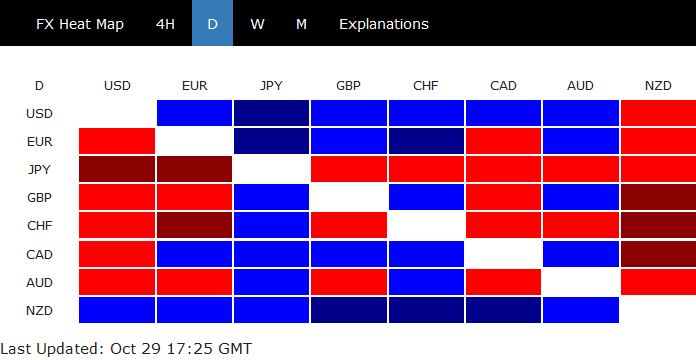
It's a relatively slow day in the forex markets today, in terms of both news and movements. At this point, Yen and Swiss Franc remain the weakest ones for today on stocks rebound. But at the same time, Dollar is having a rebound, has risk aversion eased and US yields strengthen too. However, as the rally in US stocks seem to be fading, it remains to be seen whether treasury yields and US Dollar could maintain the gains before daily close.
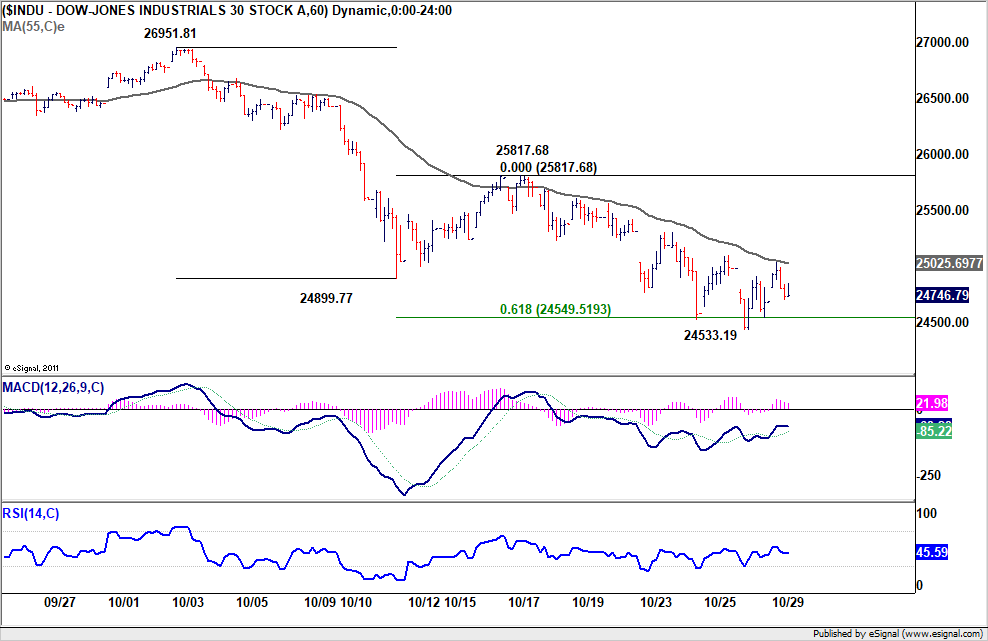
In the US, DOW reached as high as 25040.58 earlier today but it's now at 24745, up only 0.23%. S&P 500 is up 0.78% and NASDAQ is now flat. 10 year yield is up 0.023 at 3.340, after hitting 3.355 earlier today.
In Europe:
- FTSE closed up 1.25% at 7026.32
- DAX closed up 1.20% at 11335.48
- CAC closed up 0.44% at 4989.35
- German 10 year yield rose 0.0221 to 0.38, capped well below 0.4
- Italian 10 year yield dropped -0.0901 to 3.34. It's a good sign that, at least, spread with German is below 300 for now.
USDJPY Price Reversal Leaves Risk Towards 112.88 Zone
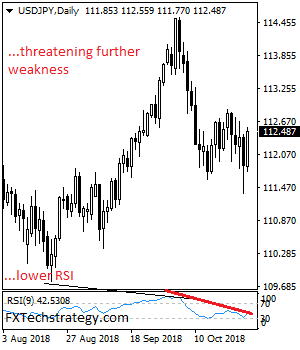
USDJPY price reversal leaves risk towards the 112.88 resistance. On the downside, support comes at the 112.00 level where a break will target the 111.50 level. A break through here will turn focus to the 111.00 level and then lower towards the 110.50 level. On the upside, resistance comes in at 112.50 level. Above here will open the door for more strength towards the 113.00 level. Further out, we expect a possible move towards the 113.50 level on a break of the former level. Further out, resistance resides at the 114.00 level with a turn above here targeting the 114.50 level. On the whole, USDJPY faces further upside pressure following its price reversal.
Gold Slips as U.S. Inflation, Personal Spending Reports Beat Forecasts
Gold prices have started the week with losses. In Monday’s North American trade, the spot price for one ounce of gold is $1230.07, down 0.34% on the day. In the U.S, there are no major releases, but the focus was on consumer numbers. Core PCE Price Index gained 0.2%, edging above the estimate of 0.1%. Personal spending edged up to 0.4%, matching the forecast. However, personal income dipped to 0.2%, its lowest level since August 2017. On Tuesday, the U.S releases CB consumer confidence.
Gold has posted four straight weekly gains, and the metal has posted strong gains of 3.2% in October. A black October for the stock markets has badly shaken investor confidence, and safe-haven gold has acted as a magnet for jittery investors. At the forefront of geopolitical tensions is the trade war between the U.S and its major partners, particularly with China. Tensions between the two largest economies show no signs of easing, and the Trump administration continues to threaten further severe tariffs on China.
Last week ended on a high note, as Advance GDP posted an impressive gain of 3.5%, above the estimate of 3.3%. Although the gain of 3.5% certainly represents a brisk pace of expansion, it was well below the sizzling Final GDP for Q2, which came in at 4.2%. The downward trend could continue as we move into the fourth quarter. On Monday, the Atlanta Fed released its well-respected GDP forecast, which predicted growth of just 2.6% in the fourth quarter. If Q4 growth does fall below the 3-percent threshold, the Federal Reserve would have to rethink its plans for three rate hikes in 2019 and that could put pressure on the U.S dollar.
Japanese Yen Slips Despite Strong Retail Sales, BOJ Decision Next
The Japanese yen has posted considerable losses in the Monday session, erasing Friday’s gains. In North American trade, USD/JPY is trading at 112.40, up 0.45% on the day. On the release front, Japanese retail sales posted a strong gain of 2.1%, matching the forecast. In the U.S, the Core PCE Price Index gained 0.2%, edging above the estimate of 0.1%. Personal spending edged up to 0.4%, matching the forecast. However, personal income dipped to 0.2%, its lowest level since August 2017. On Tuesday, the U.S releases CB consumer confidence. In Japan, the BoJ winds up its policy meeting and will release a policy statement.
Japanese retail sales posted gains for a 11th straight month, on an annualized basis. The Japanese Ministry of Economy, Trade and Industry (METI) noted that high costs for food and energy boosted retail sales. METI upgraded its assessment, saying that retail sales were improving “gradually”. However, stronger consumer spending failed to boost the yen, which has started the week with losses. The markets are keeping a close eye on the Bank of Japan, with policymakers expected to maintain the current monetary policy.
Last week ended on a high note, as Advance GDP posted an impressive gain of 3.5%, above the estimate of 3.3%. This was down from the sizzling Final GDP for Q2, which came in at 4.2%. Still, analysts were not expecting a repeat of the Q2 performance, and the U.S dollar moved higher on Friday. With global stock markets spiraling lower, risk appetite has dampened as investors flock to the U.S dollar at the expense of the Canadian dollar and other currencies. A rash of geopolitical hotspots has weighed on investor sentiment, including the spike in Italian debt, the Brexit impasse and the U.S-China trade war.
Eurozone GDP Growth Not Expected to Pick Up in Q3; Poses Downside Risk to Euro
There’s been little good news for the beleaguered Eurozone economy lately and GDP numbers due on Tuesday are not likely to change that trend. Eurostat will publish the euro area’s preliminary flash GDP estimates for the three months to September at 10:00 GMT, where another quarter of lacklustre growth is being predicted. The euro, which has been on a losing streak for the past month, is looking highly vulnerable to any disappointing readings.
Eurozone growth has been stuck in slow gear since the start of the year and a much-anticipated pick up in the second half doesn’t appear to have materialized. After notching up growth of 0.7% quarter-on-quarter throughout 2017, there’s been a significant loss of steam in 2018, with growth averaging 0.4% in the first half. While a strong euro and a cold winter held back growth in the first quarter, global trade tensions have dampened business confidence since the second quarter, with fears of an Italian crisis over the budget dispute with the European Union further undermining investor sentiment more recently.
The deteriorating outlook, which has coincided with slowing growth in most other parts of the world as well, has set the single currency on a downtrend even as the European Central Bank moves towards winding to a close its asset purchase program by year-end. Amid the weaker economic backdrop and uncertainty over Italy and Brexit, the euro is unlikely to find much respite from Tuesday’s GDP report.
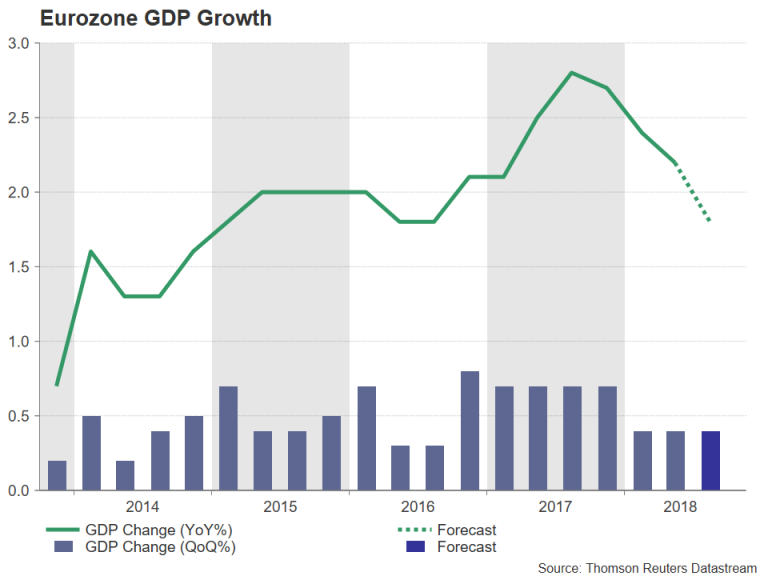
The Eurozone economy is expected to have expanded by 0.4% q/q during the third quarter, unchanged from the prior period’s rate. On an annual basis, growth is projected to have slowed from 2.1% in the second quarter to 1.8% in the last quarter. Also due at the same time on Tuesday is the European Commission’s economic sentiment indicator (ESI). The index is forecast to moderate further in October, falling from 110.9 to 110.0 and down from its peak of 115.2 in December 2017.
While all eyes will be on the GDP figures, if the ESI points to a poor start to the fourth quarter, this could potentially exasperate any sell-off in the euro should the GDP data miss expectations. Euro/dollar would likely fall towards the August low of 1.1297, with a breach of this support clearing the path for the 1.1175 level – the 123.6% Fibonacci extension of the August-September upleg from 1.1297 to 1.1815. Further declines would bring into focus the 138.2% Fibonacci extension at the psychological 1.11 mark.
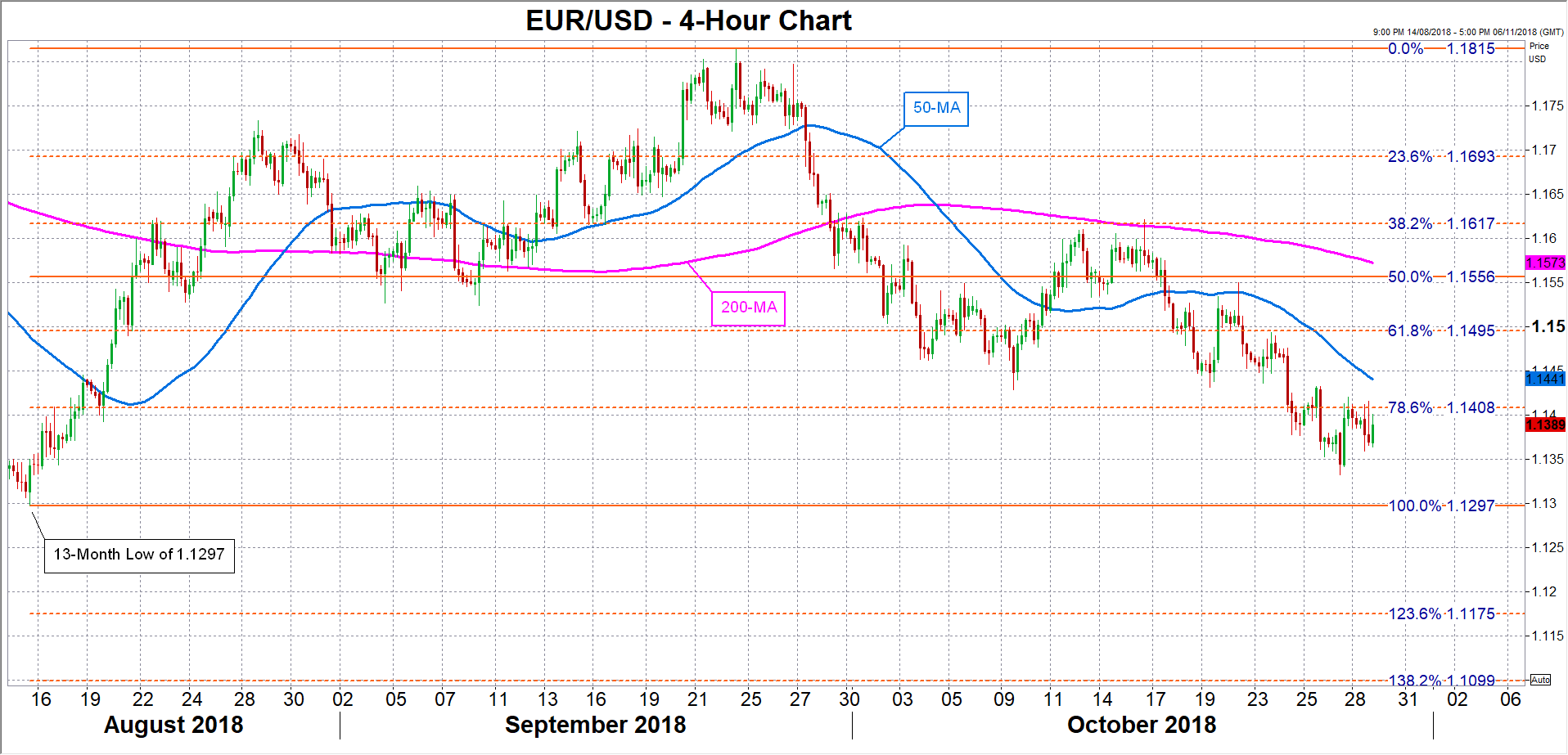
In the event of an upside surprise to the numbers, or in a more probable scenario that there is some positive aspect to the components of the data, traders could seek an excuse for a rebound. Any attempt for an upward push could see euro bulls stumbling near immediate resistance at just above the 1.14 handle, which is the 78.6% Fibonacci retracement. A successful break above this region would open the way for the 61.8% Fibonacci retracement at 1.1495. Higher up, an even bigger challenge could come from the 50% Fibonacci at 1.1556.